oil level NISSAN 370Z ROADSTER 2010 Owners Manual
[x] Cancel search | Manufacturer: NISSAN, Model Year: 2010, Model line: 370Z ROADSTER, Model: NISSAN 370Z ROADSTER 2010Pages: 409, PDF Size: 3.56 MB
Page 72 of 409
Black plate (70,1)
Model "Z34-D" EDITED: 2009/ 9/ 10
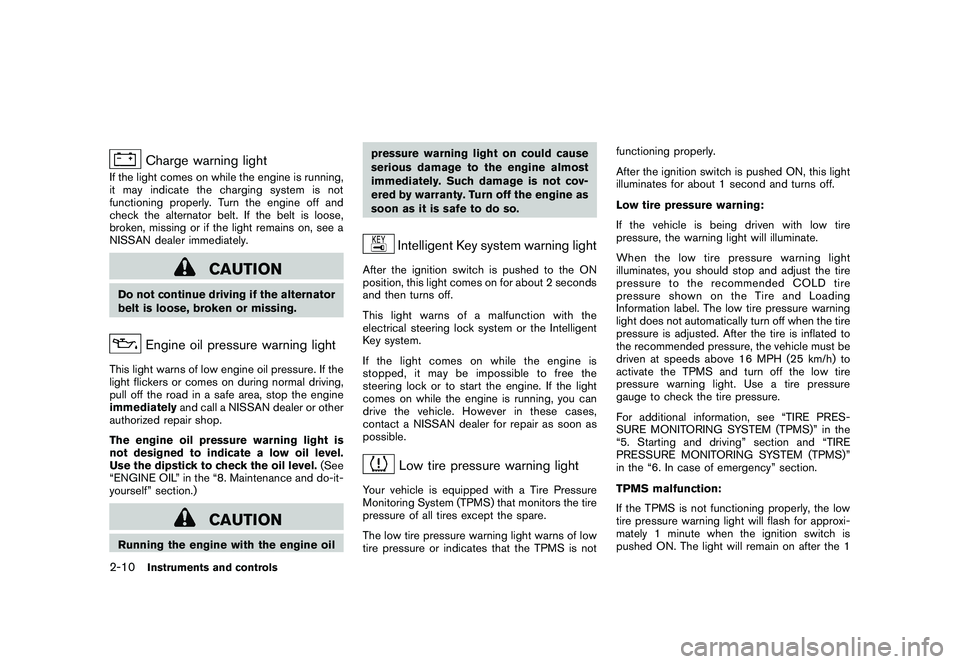
Charge warning light
If the light comes on while the engine is running,
it may indicate the charging system is not
functioning properly. Turn the engine off and
check the alternator belt. If the belt is loose,
broken, missing or if the light remains on, see a
NISSAN dealer immediately.
CAUTION
Do not continue driving if the alternator
belt is loose, broken or missing.
Engine oil pressure warning light
This light warns of low engine oil pressure. If the
light flickers or comes on during normal driving,
pull off the road in a safe area, stop the engine
immediatelyand call a NISSAN dealer or other
authorized repair shop.
The engine oil pressure warning light is
not designed to indicate a low oil level.
Use the dipstick to check the oil level. (See
“ENGINE OIL” in the “8. Maintenance and do-it-
yourself” section.)
CAUTION
Running the engine with the engine oil pressure warning light on could cause
serious damage to the engine almost
immediately. Such damage is not cov-
ered by warranty. Turn off the engine as
soon as it is safe to do so.
Intelligent Key system warning light
After the ignition switch is pushed to the ON
position, this light comes on for about 2 seconds
and then turns off.
This light warns of a malfunction with the
electrical steering lock system or the Intelligent
Key system.
If the light comes on while the engine is
stopped, it may be impossible to free the
steering lock or to start the engine. If the light
comes on while the engine is running, you can
drive the vehicle. However in these cases,
contact a NISSAN dealer for repair as soon as
possible.
Low tire pressure warning light
Your vehicle is equipped with a Tire Pressure
Monitoring System (TPMS) that monitors the tire
pressure of all tires except the spare.
The low tire pressure warning light warns of low
tire pressure or indicates that the TPMS is notfunctioning properly.
After the ignition switch is pushed ON, this light
illuminates for about 1 second and turns off.
Low tire pressure warning:
If the vehicle is being driven with low tire
pressure, the warning light will illuminate.
When the low tire pressure warning light
illuminates, you should stop and adjust the tire
pressure to the recommended COLD tire
pressure shown on the Tire and Loading
Information label. The low tire pressure warning
light does not automatically turn off when the tire
pressure is adjusted. After the tire is inflated to
the recommended pressure, the vehicle must be
driven at speeds above 16 MPH (25 km/h) to
activate the TPMS and turn off the low tire
pressure warning light. Use a tire pressure
gauge to check the tire pressure.
For additional information, see “TIRE PRES-
SURE MONITORING SYSTEM (TPMS)” in the
“5. Starting and driving” section and “TIRE
PRESSURE MONITORING SYSTEM (TPMS)”
in the “6. In case of emergency” section.
TPMS malfunction:
If the TPMS is not functioning properly, the low
tire pressure warning light will flash for approxi-
mately 1 minute when the ignition switch is
pushed ON. The light will remain on after the 1
2-10
Instruments and controls
Page 284 of 409
Black plate (284,1)
Model "Z34-D" EDITED: 2009/ 9/ 10
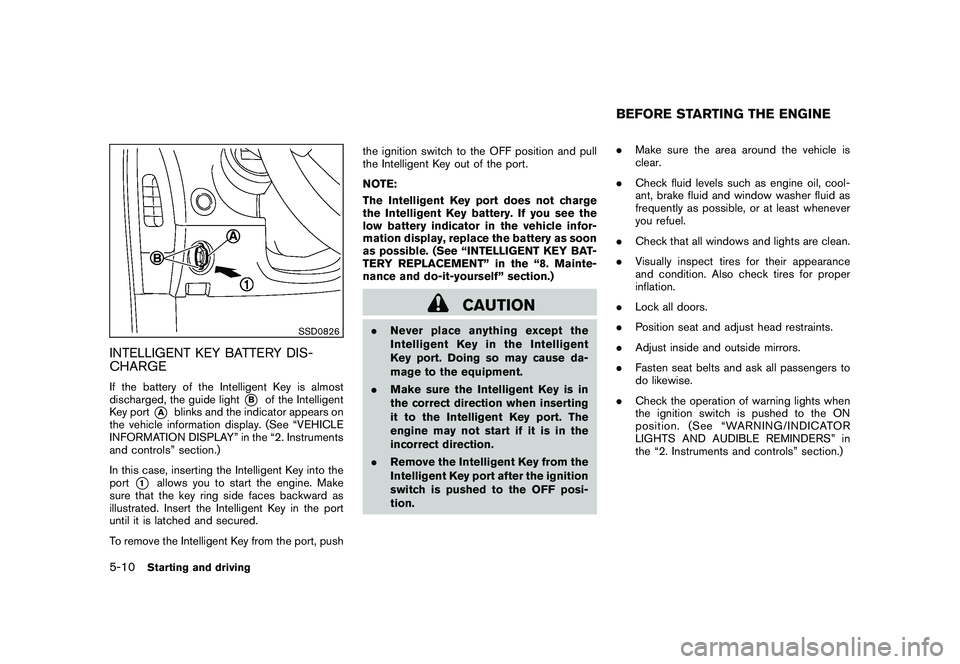
SSD0826
INTELLIGENT KEY BATTERY DIS-
CHARGEIf the battery of the Intelligent Key is almost
discharged, the guide light
*B
of the Intelligent
Key port
*A
blinks and the indicator appears on
the vehicle information display. (See “VEHICLE
INFORMATION DISPLAY” in the “2. Instruments
and controls” section.)
In this case, inserting the Intelligent Key into the
port
*1
allows you to start the engine. Make
sure that the key ring side faces backward as
illustrated. Insert the Intelligent Key in the port
until it is latched and secured.
To remove the Intelligent Key from the port, push the ignition switch to the OFF position and pull
the Intelligent Key out of the port.
NOTE:
The Intelligent Key port does not charge
the Intelligent Key battery. If you see the
low battery indicator in the vehicle infor-
mation display, replace the battery as soon
as possible. (See “INTELLIGENT KEY BAT-
TERY REPLACEMENT” in the “8. Mainte-
nance and do-it-yourself” section.)
CAUTION
.
Never place anything except the
Intelligent Key in the Intelligent
Key port. Doing so may cause da-
mage to the equipment.
. Make sure the Intelligent Key is in
the correct direction when inserting
it to the Intelligent Key port. The
engine may not start if it is in the
incorrect direction.
. Remove the Intelligent Key from the
Intelligent Key port after the ignition
switch is pushed to the OFF posi-
tion. .
Make sure the area around the vehicle is
clear.
. Check fluid levels such as engine oil, cool-
ant, brake fluid and window washer fluid as
frequently as possible, or at least whenever
you refuel.
. Check that all windows and lights are clean.
. Visually inspect tires for their appearance
and condition. Also check tires for proper
inflation.
. Lock all doors.
. Position seat and adjust head restraints.
. Adjust inside and outside mirrors.
. Fasten seat belts and ask all passengers to
do likewise.
. Check the operation of warning lights when
the ignition switch is pushed to the ON
position. (See “WARNING/INDICATOR
LIGHTS AND AUDIBLE REMINDERS” in
the “2. Instruments and controls” section.)
BEFORE STARTING THE ENGINE
5-10
Starting and driving
Page 339 of 409
Black plate (25,1)
8 Maintenance and do-it-yourself
Model "Z34-D" EDITED: 2009/ 9/ 10
Maintenance requirement..................................... 8-2
Scheduled maintenance ................................... 8-2
General maintenance ...................................... 8-2
Where to go for service ................................... 8-2
General maintenance .......................................... 8-2
Explanation of maintenance items ....................... 8-2
Maintenance precautions ..................................... 8-5
Engine compartment check locations ...................... 8-7
VQ37VHR engine model. ................................. 8-7
Engine cooling system ......................................... 8-8
Checking engine coolant level ........................... 8-8
Changing engine coolant ................................. 8-9
Engine oil ......................................................... 8-9
Checking engine oil level ................................. 8-9
Changing engine oil and filter ............................ 8-9
Automatic transmission fluid ................................ 8-11
Power steering fluid .......................................... 8-12
Brake and clutch fluid ....................................... 8-12
Brake fluid .................................................. 8-13
Clutch fluid ................................................. 8-13
Window washer fluid ........................................ 8-13
Battery .......................................................... 8-14
Jump starting .............................................. 8-16
Variable voltage control system ............................ 8-16
Drive belts ...................................................... 8-16 Spark plugs
.................................................... 8-17
Replacing spark plugs ................................... 8-17
Air cleaner ...................................................... 8-18
Windshield wiper blades .................................... 8-18
Cleaning .................................................... 8-18
Replacing ................................................... 8-19
Brakes ........................................................... 8-20
Self-adjusting brakes .................................... 8-20
Brake pad wear warning ................................ 8-20
Fuses ............................................................ 8-20
Engine compartment ..................................... 8-20
Passenger compartment ................................ 8-22
Intelligent Key battery replacement ....................... 8-22
Lights ............................................................ 8-24
Coupe ....................................................... 8-24
Roadster .................................................... 8-25
Headlights .................................................. 8-26
Exterior and interior lights ............................... 8-26
Wheels and tires .............................................. 8-28
Tire pressure ............................................... 8-28
Tire labeling ................................................ 8-31
Types of tires .............................................. 8-33
Tire chains .................................................. 8-34
Changing wheels and tires ............................. 8-35
Emergency tire puncture repair kit
(if so equipped) ........................................... 8-37
Page 342 of 409
Black plate (344,1)
Model "Z34-D" EDITED: 2009/ 9/ 10
Warning lights and chimes:Make sure that
all warning lights and chimes are operating
properly.
Windshield defroster: Check that the air
comes out of the defroster outlets properly and
in sufficient quantity when operating the heater
or air conditioner.
Windshield wiper and washer*: Check that
the wipers and washer operate properly and that
the wipers do not streak.Under the hood and vehicleThe maintenance items listed here should be
checked periodically (for example, each time you
check the engine oil or refuel) .
Battery*: Check the fluid level in each cell. It
should be between the MAX and MIN lines.
Vehicles operated in high temperatures or under
severe condition require frequent checks of the
battery fluid level.
Brake and clutch fluid levels*: Make sure
that the brake and clutch fluid levels are
between the MAX and MIN lines on the
reservoirs.
Engine coolant level*: Check the coolant level
when the engine is cold.
Engine drive belts*: Make sure that no belt is
frayed, worn, cracked or oily. Engine oil level*:
Check the level after parking
the vehicle on a level spot and turning off the
engine. Wait more than 15 minutes for the oil to
drain back into the oil pan.
Exhaust system: Make sure there are no loose
supports, cracks or holes. If the sound of the
exhaust seems unusual or there is a smell of
exhaust fumes, immediately have the exhaust
system inspected by a NISSAN dealer. (See
“PRECAUTIONS WHEN STARTING AND
DRIVING” in the “5. St arting and driving”
section for exhaust gas (carbon monoxide) .)
Fluid leaks: Check under the vehicle for fuel,
oil, water or other fluid leaks after the vehicle has
been parked for a while. Water dripping from the
air conditioner after use is normal. If you should
notice any leaks or if gasoline fumes are evident,
check for the cause and have it corrected
immediately.
Power steering fluid level* and lines: Check
the level with the engine off. Check the lines for
proper attachment, leaks, cracks, etc.
Radiator and hoses: Check the front of the
radiator and clean off any dirt, insects, leaves,
etc., that may have accumulated. Make sure the
hoses have no cracks, deformation, rot or loose
connections. Underbody:
The underbody is frequently ex-
posed to corrosive substances such as those
used on icy roads or to control dust. It is very
important to remove these substances, other-
wise rust will form on the floor pan, frame, fuel
lines and around the exhaust system. At the end
of winter, the underbody should be thoroughly
flushed with plain water, being careful to clean
those areas where mud and dirt may accumu-
late. For additional information, see “CLEANING
EXTERIOR” in the “7. Appearance and care”
section.
Windshield washer fluid*: Check that there is
adequate fluid in the reservoir.8-4
Maintenance and do-it-yourself
Page 343 of 409
Black plate (345,1)
Model "Z34-D" EDITED: 2009/ 9/ 10
When performing any inspection or mainte-
nance work on your vehicle, always take care
to prevent serious accidental injury to yourself or
damage to the vehicle. The following are general
precautions which should be closely observed.
WARNING
.Park the vehicle on a level surface,
apply the parking brake securely
and block the wheels to prevent
the vehicle from moving. For man-
ual transmission models, move the
shift lever to N (Neutral) . For auto-
matic transmission models, move
the selector lever to P (Park) .
. Be sure the ignition switch is in the
OFF or LOCK position when per-
forming any parts replacement or
repairs.
. Never connect or disconnect the
battery or any transistorized com-
ponent while the ignition switch is
in the ON position.
. Never leave the engine or automatic
transmission related component
harnesses disconnected while the
ignition switch is in the ON position.
. If you must work with the engine running, keep your hands, clothing,
hair and tools away from moving
fans, belts and any other moving
parts.
. It is advisable to secure or remove
any loose clothing and remove any
jewelry, such as rings, watches, etc.
before working on your vehicle.
. Always wear eye protection when-
ever you work on your vehicle.
. If you must run the engine in an
enclosed space such as a garage, be
sure there is proper ventilation for
exhaust gases to escape.
. Never get under the vehicle while it
is supported only by a jack. If it is
necessary to work under the vehicle,
support it with safety stands.
. Keep smoking materials, flame and
sparks away from fuel tank and the
battery.
. Your vehicle is equipped with an
automatic engine cooling fan. It may
come on at any time without warn-
ing, even if the ignition key is in the
OFF position and the engine is not
running. To avoid injury, always
disconnect the negative battery cable before working near the fan.
. The fuel filter or fuel lines should be
serviced by a NISSAN dealer be-
cause the fuel lines are under high
pressure even when the engine is
off.
CAUTION
.Do not work under the hood while
the engine is hot. Turn the engine
off and wait until it cools down.
. Avoid direct contact with used en-
gine oil and coolant. Improperly
disposed engine oil, coolant, and/
or other vehicle fluids can damage
the environment. Always conform to
local regulations for disposal of
vehicle fluid.
This “8. Maintenance and do-it-yourself” section
gives instructions regarding only those items
which are relatively easy for an owner to perform.
A genuine NISSAN Service Manual is also
available. (See “OWNER’S MANUAL/SERVICE
MANUAL ORDER INFORMATION” in the “9.
Technical and consumer information” section.)
Youshouldbeawarethatincompleteor
MAINTENANCE PRECAUTIONS
Maintenance and do-it-yourself
8-5
Page 347 of 409
Black plate (349,1)
Model "Z34-D" EDITED: 2009/ 9/ 10
CHANGING ENGINE COOLANTMajor cooling system repairs should be per-
formed by a NISSAN dealer. The service
procedures can be found in the appropriate
NISSAN Service Manual.
Improper servicing can result in reduced
heater performance and engine overheat-
ing.
WARNING
.To avoid the danger of being
scalded, never change the coolant
when the engine is hot.
. Never remove the radiator cap when
the engine is hot. Serious burns
could be caused by high pressure
fluid escaping from the radiator.
. Avoid direct skin contact with used
coolant. If skin contact is made,
wash thoroughly with soap or hand
cleaner as soon as possible.
. Keep coolant out of reach of chil-
dren and pets.
Engine coolant must be disposed of properly.
Check your local regulations.
SDI2348
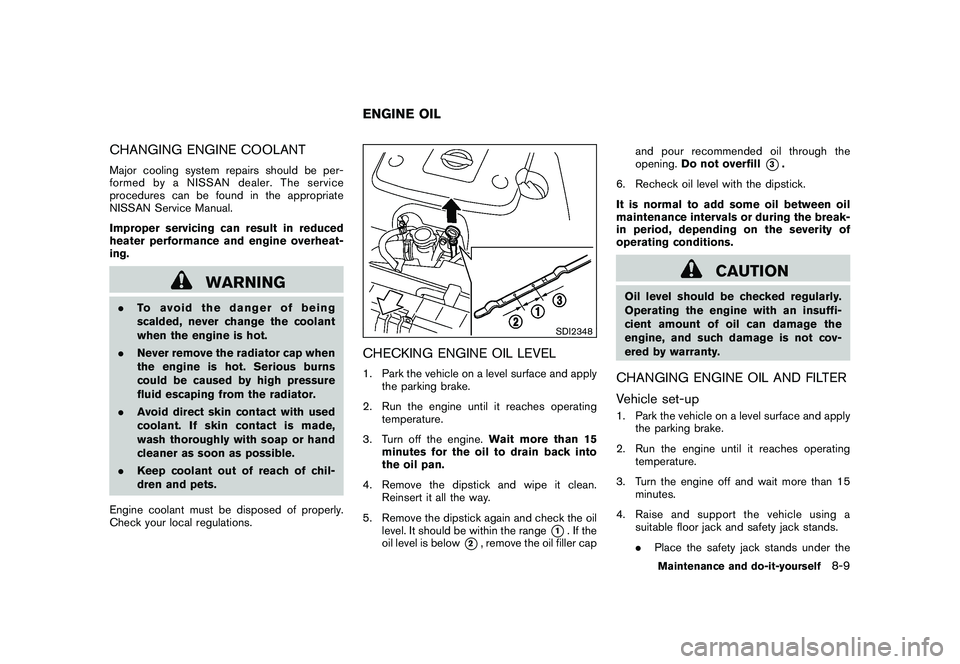
CHECKING ENGINE OIL LEVEL1. Park the vehicle on a level surface and apply the parking brake.
2. Run the engine until it reaches operating temperature.
3. Turn off the engine. Wait more than 15
minutes for the oil to drain back into
the oil pan.
4. Remove the dipstick and wipe it clean. Reinsert it all the way.
5. Remove the dipstick again and check the oil level. It should be within the range
*1. If the
oil level is below
*2, remove the oil filler cap and pour recommended oil through the
opening.
Do not overfill
*3.
6. Recheck oil level with the dipstick.
It is normal to add some oil between oil
maintenance intervals or during the break-
in period, depending on the severity of
operating conditions.
CAUTION
Oil level should be checked regularly.
Operating the engine with an insuffi-
cient amount of oil can damage the
engine, and such damage is not cov-
ered by warranty.CHANGING ENGINE OIL AND FILTER
Vehicle set-up1. Park the vehicle on a level surface and apply the parking brake.
2. Run the engine until it reaches operating temperature.
3. Turn the engine off and wait more than 15 minutes.
4. Raise and support the vehicle using a suitable floor jack and safety jack stands.
.Place the safety jack stands under the
ENGINE OIL
Maintenance and do-it-yourself
8-9
Page 349 of 409
Black plate (351,1)
Model "Z34-D" EDITED: 2009/ 9/ 10
Do not use excessive force.
9. Refill engine with recommended oil through the oil filler opening, and install the oil filler
cap securely.
See “CAPACITIES AND RECOMMENDED
FUEL/LUBRICANTS” in the “9. Technical
and consumer information” section for drain
and refill capacity. The drain and refill
capacity depends on the oil temperature
and drain time. Use these specifications for
reference only. Always use the dipstick to
determine the proper amount of oil in the
engine.
10. Start the engine and check for leakage around the drain plug and the oil filter.
Correct as required.
11. Turn the engine off and wait more than 15 minutes. Check the oil level with the dipstick.
Add engine oil if necessary.
After the operation1. Install the engine undercover into position as
the following steps.
a. Pull the center of the small plastic clipout.
b. Hold the engine undercover into posi- tion. c. Insert the clip through the undercover
into the hole in the frame, then push the
center of the clip in to lock the clip in
place.
d. Install the bolts that hold the undercover in place. Be careful not to strip the bolts
or over-tighten them.
2. Lower the vehicle carefully to the ground.
3. Dispose of waste oil and filter properly.
WARNING
. Prolonged and repeated contact
with used engine oil may cause skin
cancer.
. Try to avoid direct skin contact with
used oil. If skin contact is made,
wash thoroughly with soap or hand
cleaner as soon as possible.
. Keep used engine oil out of reach of
children. When checking or replacement is required, we
recommend a NISSAN dealer for servicing.
CAUTION
.
Use only Genuine NISSAN Matic S
ATF. Do not mix with other fluids.
. Using automatic transmission fluid
other than Genuine NISSAN Matic S
ATF will cause deterioration in dri-
veability and automatic transmis-
sion durability, and may damage
the automatic transmission, which
is not covered by the NISSAN new
vehicle limited warranty.AUTOMATIC TRANSMISSION FLUID
Maintenance and do-it-yourself
8-11
Page 378 of 409
Black plate (380,1)
Model "Z34-D" EDITED: 2009/ 9/ 10
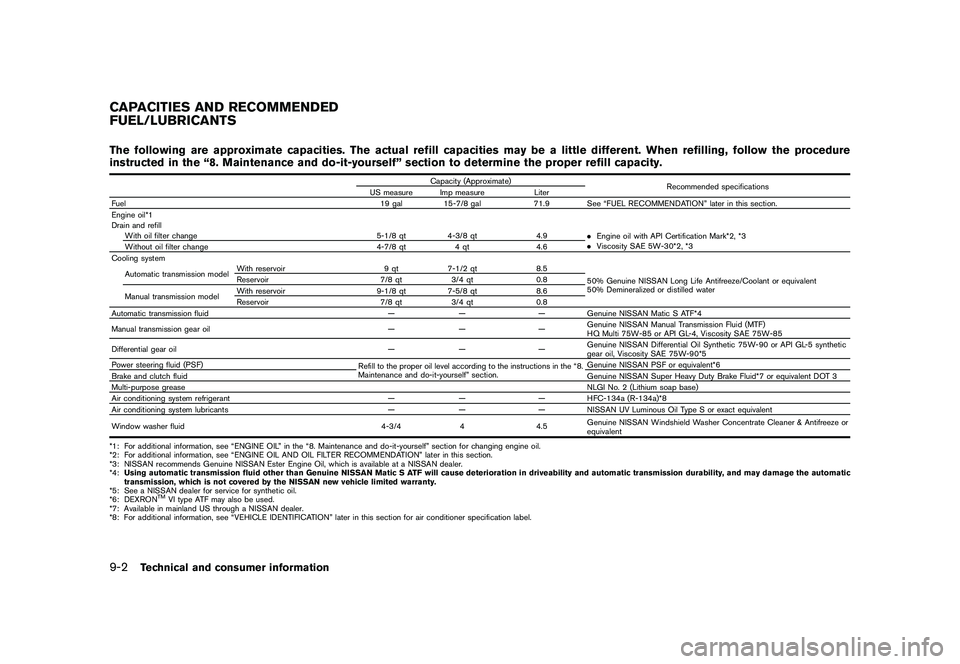
The following are approximate capacities. The actual refill capacities may be a little different. When refilling, follow the procedure
instructed in the “8. Maintenance and do-it-yourself” section to determine the proper refill capacity.
Capacity (Approximate)Recommended specifications
US measure Imp measure Liter
Fuel 19 gal 15-7/8 gal 71.9 See “FUEL RECOMMENDATION” later in this section.
Engine oil*1
Drain and refill With oil filter change 5-1/8 qt 4-3/8 qt 4.9 .Engine oil with API Certification Mark*2, *3
. Viscosity SAE 5W-30*2, *3
Without oil filter change 4-7/8 qt 4 qt 4.6
Cooling system
Automatic transmission model With reservoir 9 qt 7-1/2 qt 8.5
50% Genuine NISSAN Long Life Antifreeze/Coolant or equivalent
50% Demineralized or distilled water
Reservoir 7/8 qt 3/4 qt 0.8
Manual transmission model With reservoir 9-1/8 qt 7-5/8 qt 8.6
Reservoir 7/8 qt 3/4 qt 0.8
Automatic transmission fluid —— —Genuine NISSAN Matic S ATF*4
Manual transmission gear oil —— —Genuine NISSAN Manual Transmission Fluid (MTF)
HQ Multi 75W-85 or API GL-4, Viscosity SAE 75W-85
Differential gear oil —— —Genuine NISSAN Differential Oil Synthetic 75W-90 or API GL-5 synthetic
gear oil, Viscosity SAE 75W-90*5
Power steering fluid (PSF) Refill to the proper oil level according to the instructions in the “8.
Maintenance and do-it-yourself” section.Genuine NISSAN PSF or equivalent*6
Brake and clutch fluid Genuine NISSAN Super Heavy Duty Brake Fluid*7 or equivalent DOT 3
Multi-purpose grease NLGI No. 2 (Lithium soap base)
Air conditioning system refrigerant —— —HFC-134a (R-134a)*8
Air conditioning system lubricants —— —NISSAN UV Luminous Oil Type S or exact equivalent
Window washer fluid 4-3/444.5Genuine NISSAN Windshield Washer Concentrate Cleaner & Antifreeze or
equivalent
*1: For additional information, see “ENGINE OIL” in the “8. Maintenance and do-it-yourself” section for changing engine oil.
*2: For additional information, see “ENGINE OIL AND OIL FILTER RECOMMENDATION” later in this section.
*3: NISSAN recommends Genuine NISSAN Ester Engine Oil, which is available at a NISSAN dealer.
*4: Using automatic transmission fluid other than Genuine NISSAN Matic S ATF will cause deterioration in driveability and automatic transmission durability, and may damage the automatic
transmission, which is not covered by the NISSAN new vehicle limited warranty.
*5: See a NISSAN dealer for service for synthetic oil.
*6: DEXRON
TMVI type ATF may also be used.
*7: Available in mainland US through a NISSAN dealer.
*8: For additional information, see “VEHICLE IDENTIFICATION” later in this section for air conditioner specification label.
CAPACITIES AND RECOMMENDED
FUEL/LUBRICANTS9-2
Technical and consumer information
Page 402 of 409
Black plate (2,1)
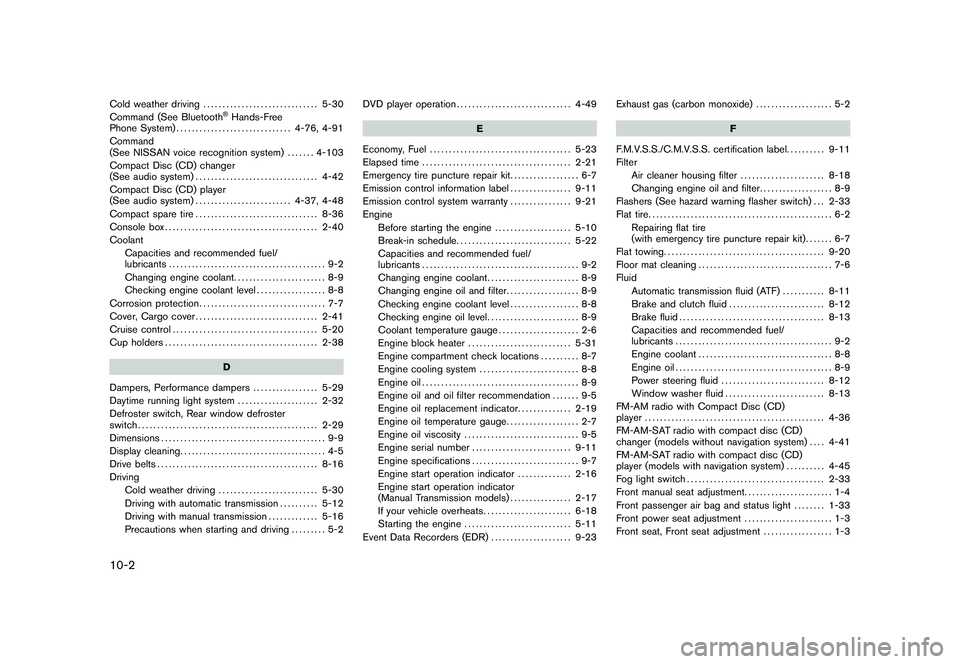
10-2Cold weather driving.............................. 5-30
Command (See Bluetooth
®Hands-Free
Phone System) .............................. 4-76, 4-91
Command
(See NISSAN voice recognition system) ....... 4-103
Compact Disc (CD) changer
(See audio system) ................................ 4-42
Compact Disc (CD) player
(See audio system) ......................... 4-37, 4-48
Compact spare tire ................................ 8-36
Console box ........................................ 2-40
Coolant Capacities and recommended fuel/
lubricants ......................................... 9-2
Changing engine coolant ........................ 8-9
Checking engine coolant level .................. 8-8
Corrosion protection ................................. 7-7
Cover, Cargo cover ................................ 2-41
Cruise control ...................................... 5-20
Cup holders ........................................ 2-38
D
Dampers, Performance dampers ................. 5-29
Daytime running light system ..................... 2-32
Defroster switch, Rear window defroster
switch ............................................... 2-29
Dimensions ........................................... 9-9
Display cleaning ...................................... 4-5
Drive belts .......................................... 8-16
Driving Cold weather driving .......................... 5-30
Driving with automatic transmission .......... 5-12
Driving with manual transmission ............. 5-16
Precautions when starting and driving ......... 5-2DVD player operation
.............................. 4-49
E
Economy, Fuel ..................................... 5-23
Elapsed time ....................................... 2-21
Emergency tire puncture repair kit .................. 6-7
Emission control information label ................ 9-11
Emission control system warranty ................ 9-21
Engine Before starting the engine .................... 5-10
Break-in schedule .............................. 5-22
Capacities and recommended fuel/
lubricants ......................................... 9-2
Changing engine coolant ........................ 8-9
Changing engine oil and filter ................... 8-9
Checking engine coolant level .................. 8-8
Checking engine oil level ........................ 8-9
Coolant temperature gauge ..................... 2-6
Engine block heater ........................... 5-31
Engine compartment check locations .......... 8-7
Engine cooling system .......................... 8-8
Engine oil ......................................... 8-9
Engine oil and oil filter recommendation ....... 9-5
Engine oil replacement indicator .............. 2-19
Engine oil temperature gauge ................... 2-7
Engine oil viscosity .............................. 9-5
Engine serial number .......................... 9-11
Engine specifications ............................ 9-7
Engine start operation indicator .............. 2-16
Engine start operation indicator
(Manual Transmission models) ................ 2-17
If your vehicle overheats ....................... 6-18
Starting the engine ............................ 5-11
Event Data Recorders (EDR) ..................... 9-23Exhaust gas (carbon monoxide)
.................... 5-2
F
F.M.V.S.S./C.M.V.S.S. certification label. ......... 9-11
Filter Air cleaner housing filter ...................... 8-18
Changing engine oil and filter ................... 8-9
Flashers (See hazard warning flasher switch) . . . 2-33
Flat tire ................................................ 6-2
Repairing flat tire
(with emergency tire puncture repair kit) ....... 6-7
Flat towing .......................................... 9-20
Floor mat cleaning ................................... 7-6
Fluid Automatic transmission fluid (ATF) ........... 8-11
Brake and clutch fluid ......................... 8-12
Brake fluid ...................................... 8-13
Capacities and recommended fuel/
lubricants ......................................... 9-2
Engine coolant ................................... 8-8
Engine oil ......................................... 8-9
Power steering fluid ........................... 8-12
Window washer fluid .......................... 8-13
FM-AM radio with Compact Disc (CD)
player ............................................... 4-36
FM-AM-SAT radio with compact disc (CD)
changer (models without navigation system) .... 4-41
FM-AM-SAT radio with compact disc (CD)
player (models with navigation system) .......... 4-45
Fog light switch .................................... 2-33
Front manual seat adjustment. ...................... 1-4
Front passenger air bag and status light ........ 1-33
Front power seat adjustment ....................... 1-3
Front seat, Front seat adjustment .................. 1-3
Model "Z34-D" EDITED: 2009/ 9/ 10
Page 404 of 409
Black plate (4,1)
10-4
Headlight switch............................... 2-30
Headlights bulb replacement ................. 8-26
Indicator lights ................................. 2-12
Interior light control switch .................... 2-44
Interior lights ................................... 2-44
Map lights ...................................... 2-44
Replacement ................................... 8-24
Trunk light ...................................... 2-46
Vanity mirror lights ............................. 2-45
Warning/indicator lights and audible
reminders ......................................... 2-9
Xenon headlights .............................. 2-29
Lights, Exterior and interior light replacement . . . 8-26
Loading information (See vehicle loading
information) ......................................... 9-17
Lock Automatic door locks ............................ 3-5
Door locks ........................................ 3-4
Power door lock ................................. 3-4
Rear hatch lock ................................ 3-17
Trunk lid ........................................ 3-19
Locking with mechanical key ........................ 3-4
Low tire pressure warning light ................... 2-10
Low tire pressure warning system (See tire
pressure monitoring system (TPMS)) .............. 5-3
M
Maintenance Battery .......................................... 8-14
General maintenance ............................ 8-2
Indicators for maintenance (dot matrix) ...... 2-19
Inside the vehicle ................................ 8-3
Maintenance information (display) .............. 4-8
Maintenance precautions ........................ 8-5 Maintenance requirements
...................... 8-2
Outside the vehicle .............................. 8-2
Seat belt maintenance ......................... 1-16
Malfunction indicator light (MIL) .................. 2-13
Manual front seat adjustment ....................... 1-4
Map lights .......................................... 2-44
Master warning light ............................... 2-11
Mechanical key (Intelligent Key system) ............ 3-3
Meter, Trip computer .............................. 2-20
Meters and gauges .................................. 2-4
Instrument brightness control ................. 2-32
Mirror Inside mirror .................................... 3-36
Outside mirrors ................................ 3-38
Vanity mirror .................................... 3-39
Multi-function controller ............................. 4-3
Music box hard-disk drive ......................... 4-63
N
New vehicle break-in .............................. 5-22
NISSAN Vehicle Immobilizer System ............. 2-26
NISSAN voice recognition system ................ 4-98
No key warning .................................... 2-17
O
Odometer ............................................. 2-5
Off-road recovery .................................... 5-6
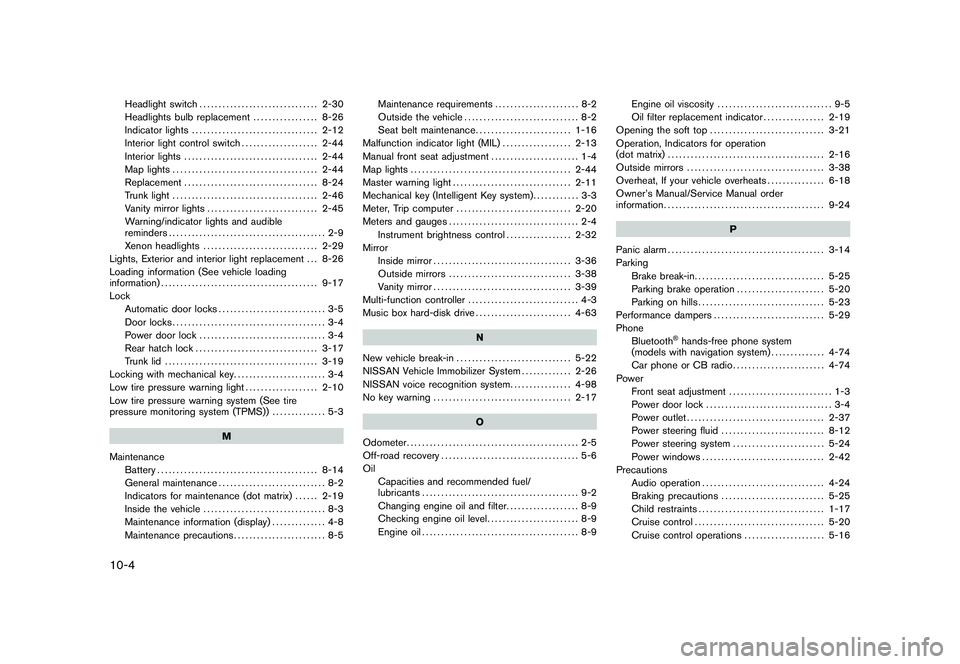
Oil Capacities and recommended fuel/
lubricants ......................................... 9-2
Changing engine oil and filter ................... 8-9
Checking engine oil level ........................ 8-9
Engine oil ......................................... 8-9 Engine oil viscosity
.............................. 9-5
Oil filter replacement indicator ................ 2-19
Opening the soft top .............................. 3-21
Operation, Indicators for operation
(dot matrix) ......................................... 2-16
Outside mirrors .................................... 3-38
Overheat, If your vehicle overheats ............... 6-18
Owner’s Manual/Service Manual order
information .......................................... 9-24
P
Panic alarm ......................................... 3-14
Parking Brake break-in .................................. 5-25
Parking brake operation ....................... 5-20
Parking on hills ................................. 5-23
Performance dampers ............................. 5-29
Phone Bluetooth
®hands-free phone system
(models with navigation system) .............. 4-74
Car phone or CB radio ........................ 4-74
Power Front seat adjustment ........................... 1-3
Power door lock ................................. 3-4
Power outlet .................................... 2-37
Power steering fluid ........................... 8-12
Power steering system ........................ 5-24
Power windows ................................ 2-42
Precautions Audio operation ................................ 4-24
Braking precautions ........................... 5-25
Child restraints ................................. 1-17
Cruise control .................................. 5-20
Cruise control operations ..................... 5-16
Model "Z34-D" EDITED: 2009/ 9/ 10