towing NISSAN ALTIMA 2001 L30 / 2.G Owners Manual
[x] Cancel search | Manufacturer: NISSAN, Model Year: 2001, Model line: ALTIMA, Model: NISSAN ALTIMA 2001 L30 / 2.GPages: 258, PDF Size: 2.09 MB
Page 156 of 258

6 In case of emergency
Flat tire ...................................................................6-2
Changing a flat tire ............................................6-2
Jump starting ..........................................................6-8
Push starting ........................................................6-10
If your vehicle overheats ......................................6-10Towing your vehicle .............................................6-11
Towing recommended by Nissan ....................6-12
Vehicle recovery (freeing a stuck
vehicle) ............................................................6-13
ZX
Page 166 of 258
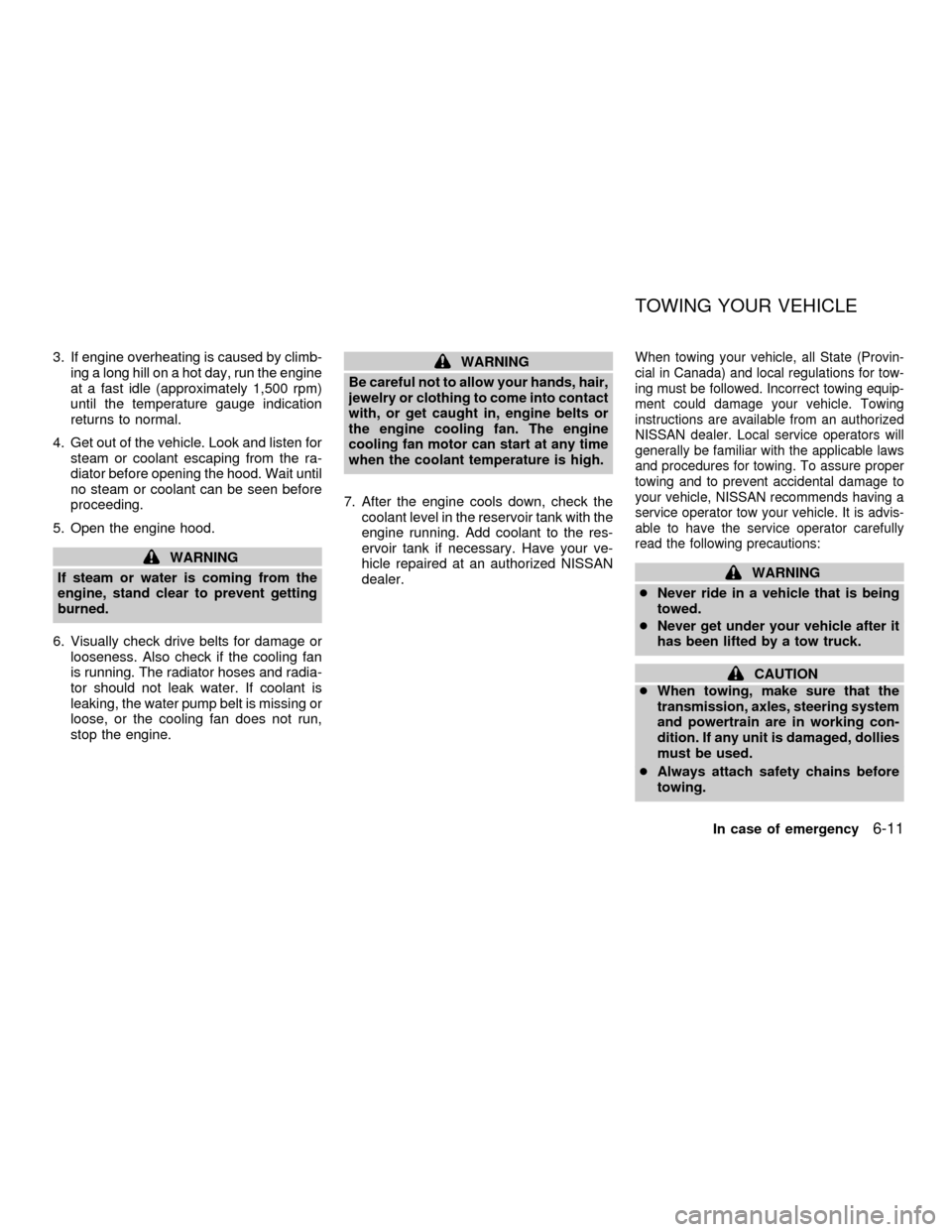
3. If engine overheating is caused by climb-
ing a long hill on a hot day, run the engine
at a fast idle (approximately 1,500 rpm)
until the temperature gauge indication
returns to normal.
4. Get out of the vehicle. Look and listen for
steam or coolant escaping from the ra-
diator before opening the hood. Wait until
no steam or coolant can be seen before
proceeding.
5. Open the engine hood.
WARNING
If steam or water is coming from the
engine, stand clear to prevent getting
burned.
6. Visually check drive belts for damage or
looseness. Also check if the cooling fan
is running. The radiator hoses and radia-
tor should not leak water. If coolant is
leaking, the water pump belt is missing or
loose, or the cooling fan does not run,
stop the engine.
WARNING
Be careful not to allow your hands, hair,
jewelry or clothing to come into contact
with, or get caught in, engine belts or
the engine cooling fan. The engine
cooling fan motor can start at any time
when the coolant temperature is high.
7. After the engine cools down, check the
coolant level in the reservoir tank with the
engine running. Add coolant to the res-
ervoir tank if necessary. Have your ve-
hicle repaired at an authorized NISSAN
dealer.When towing your vehicle, all State (Provin-
cial in Canada) and local regulations for tow-
ing must be followed. Incorrect towing equip-
ment could damage your vehicle. Towing
instructions are available from an authorized
NISSAN dealer. Local service operators will
generally be familiar with the applicable laws
and procedures for towing. To assure proper
towing and to prevent accidental damage to
your vehicle, NISSAN recommends having a
service operator tow your vehicle. It is advis-
able to have the service operator carefully
read the following precautions:
WARNING
cNever ride in a vehicle that is being
towed.
cNever get under your vehicle after it
has been lifted by a tow truck.
CAUTION
cWhen towing, make sure that the
transmission, axles, steering system
and powertrain are in working con-
dition. If any unit is damaged, dollies
must be used.
cAlways attach safety chains before
towing.
TOWING YOUR VEHICLE
In case of emergency6-11
ZX
Page 167 of 258

TOWING RECOMMENDED BY
NISSAN
NISSAN recommends that your vehicle be
towed with the driving (front) wheels off the
ground or place the vehicle on a flat bed
truck as illustrated.
CAUTION
cNever tow automatic transmission
models with the front wheels on the
ground or four wheels on the ground
(forward or backward), as this may
cause serious and expensive dam-
age to the transmission. If it is nec-
essary to tow the vehicle with the
rear wheels raised, always use tow-
ing dollies under the front wheels.
cWhen towing automatic transmis-
sion models with the front wheels on
ACE0511
ACE1001
6-12In case of emergency
ZX
Page 168 of 258

towing dollies, or when towing
manual transmission models with
the front wheels on the ground:
cTurn the ignition key to the OFF
position, and secure the steering
wheel in a straight-ahead position
with a rope or similar device.
Never place the ignition key in the
LOCK position. This will result in
damage to the steering lock
mechanism.
cMove the gearshift lever to the N
(Neutral) position.
c
When towing automatic or manual
transmission models with the rear
wheels on the ground (if you do not
use towing dollies): Always release
the parking brake.
VEHICLE RECOVERY (Freeing a
stuck vehicle)
cTow chains or cables must be attached
only to the main structual members of the
vehicle.
cPulling devices should be routed so they
do not touch any part of the suspension,steering, brake or cooling systems.
cAlways pull the cable straight out from
the front or rear of the vehicle. Never pull
on the vehicle at an angle.
cPulling devices such as ropes or canvas
straps are not recommended for use in
vehicle towing or recovery.
cStand clear of a stuck vehicle.
WARNING
Do not spin your tires at high speed.
This could cause them to explode and
result in serious injury. Parts of your
vehicle could also overheat and be
damaged.
In case of emergency
6-13
ZX
Page 222 of 258
To ensure smooth, trouble-free, safe and
economical driving, NISSAN provides two
periodic maintenance schedules that may
be used, depending upon the conditions in
which you usually drive. These schedules
contain both distance and time intervals, up
to 60,000 miles (96,000 km)/48 months. For
most people, the odometer reading indi-
cates when service is needed. However, if
you drive very little, your vehicle should be
serviced at the regular time intervals shown
in the schedules.After 60,000 miles
(96,000 km)/48 months, continue peri-
odic maintenance at the same
mileage/time intervals.
SCHEDULE 1
Follow Periodic Maintenance Schedule 1 if
your driving habits frequently include one or
more of the following driving conditions:
cRepeated short trips of less than 5
miles (8 km).
cRepeated short trips of less than 10
miles (16 km) with outside tempera-
tures below freezing.
cOperating the vehicle in hot weather
during in stop-and-go ``rush hour''
traffic.cExtensive idling and/or low speed
driving for long distances, such as
police, taxi or door-to-door delivery
use.
cDriving in dusty conditions.
cDriving on rough, muddy, or salt
spread roads.
cTowing a trailer, using a camper or a
car-top carrier.
SCHEDULE 2
Follow Periodic Maintenance Schedule 2 if
none of the driving conditions shown in
Schedule 1 apply to your driving habits.
PERIODIC MAINTENANCE
SCHEDULES
Maintenance9-5
ZX
Page 224 of 258
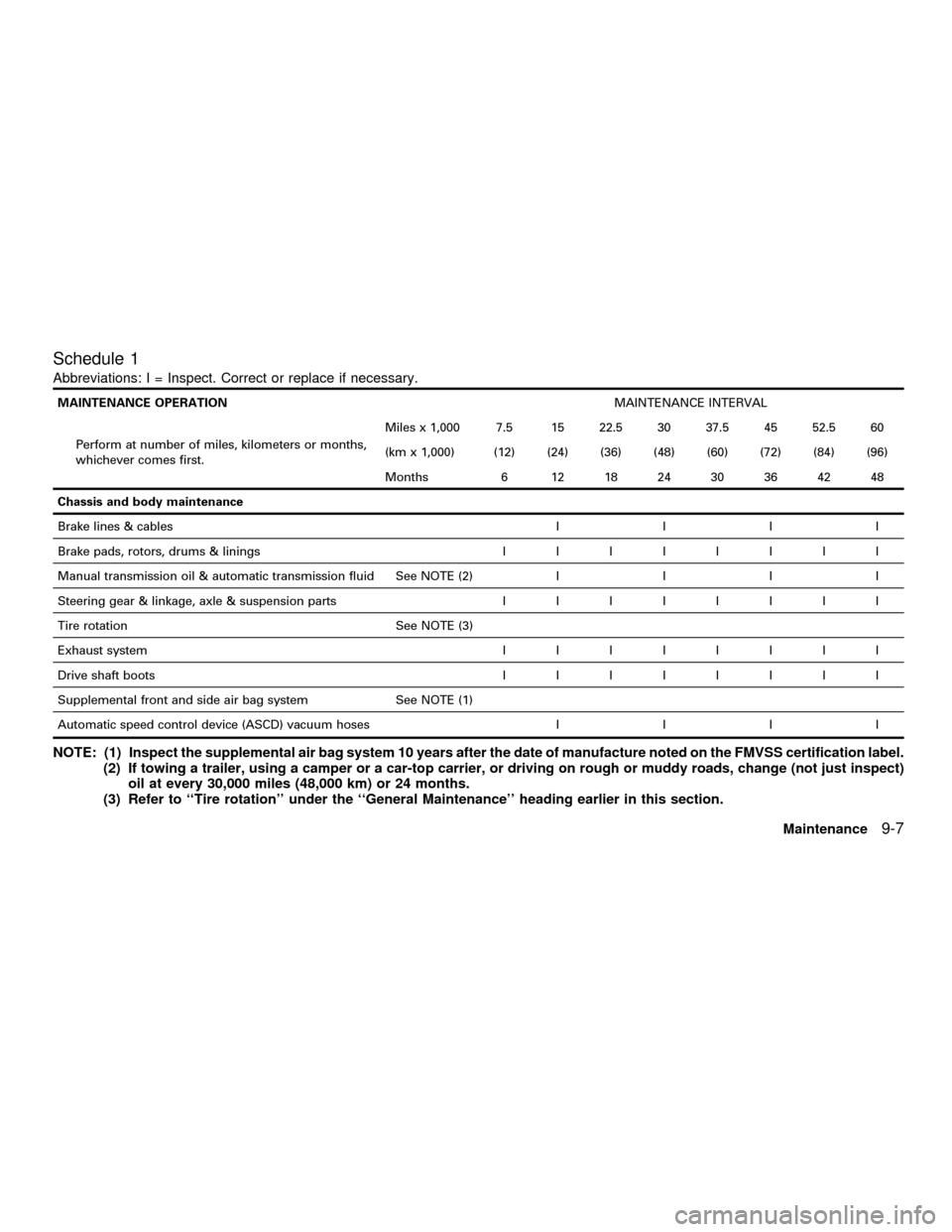
Schedule 1
Abbreviations: I = Inspect. Correct or replace if necessary.
MAINTENANCE OPERATIONMAINTENANCE INTERVAL
Perform at number of miles, kilometers or months,
whichever comes first.Miles x 1,000 7.5 15 22.5 30 37.5 45 52.5 60
(km x 1,000) (12) (24) (36) (48) (60) (72) (84) (96)
Months 6 12 18 24 30 36 42 48
Chassis and body maintenance
Brake lines & cablesIIII
Brake pads, rotors, drums & liningsIIIIIIII
Manual transmission oil & automatic transmission fluid See NOTE (2)IIII
Steering gear & linkage, axle & suspension partsIIIIIIII
Tire rotation See NOTE (3)
Exhaust systemIIIIIIII
Drive shaft bootsIIIIIIII
Supplemental front and side air bag system See NOTE (1)
Automatic speed control device (ASCD) vacuum hosesIIII
NOTE: (1) Inspect the supplemental air bag system 10 years after the date of manufacture noted on the FMVSS certification label.
(2) If towing a trailer, using a camper or a car-top carrier, or driving on rough or muddy roads, change (not just inspect)
oil at every 30,000 miles (48,000 km) or 24 months.
(3) Refer to ``Tire rotation'' under the ``General Maintenance'' heading earlier in this section.
Maintenance
9-7
ZX
Page 230 of 258
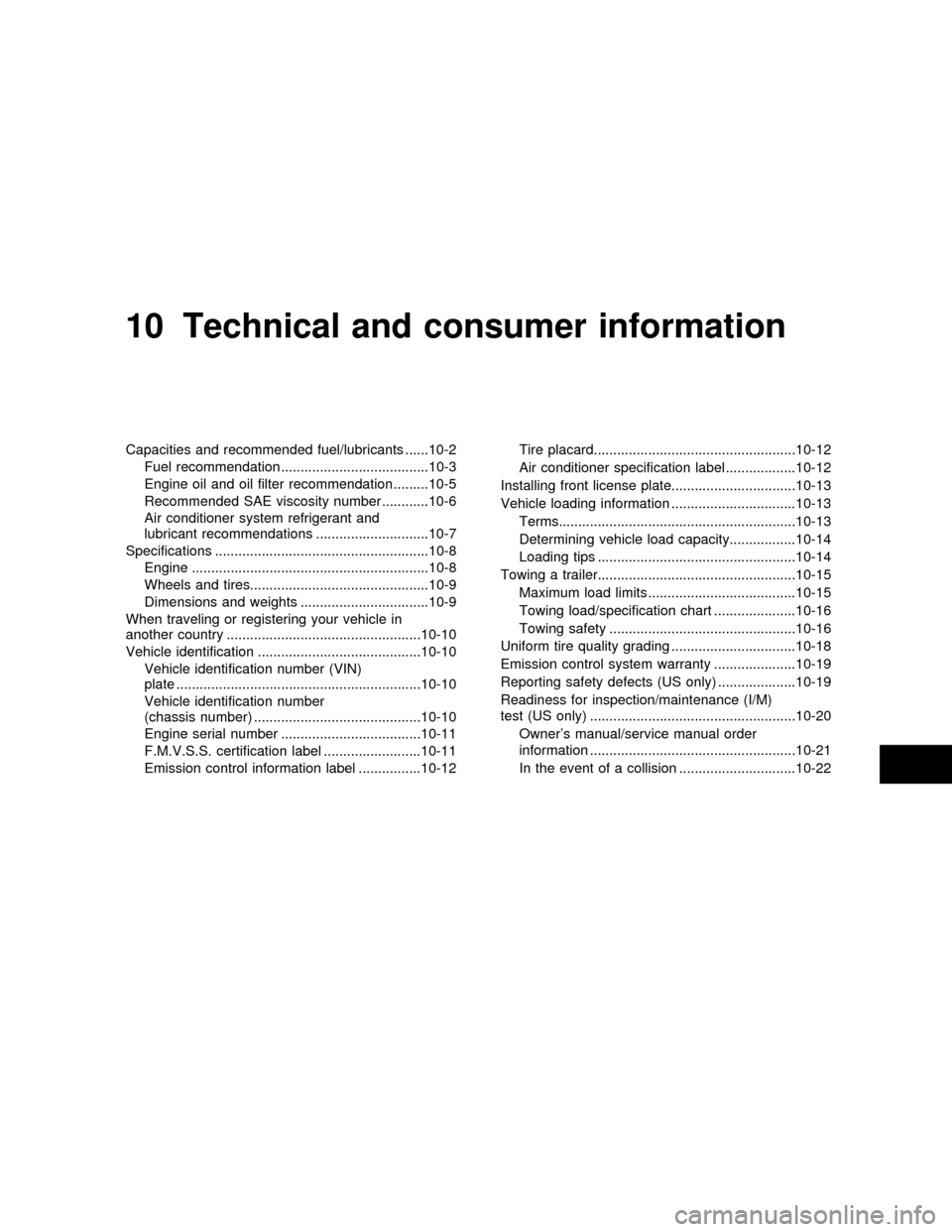
10 Technical and consumer information
Capacities and recommended fuel/lubricants ......10-2
Fuel recommendation ......................................10-3
Engine oil and oil filter recommendation .........10-5
Recommended SAE viscosity number ............10-6
Air conditioner system refrigerant and
lubricant recommendations .............................10-7
Specifications .......................................................10-8
Engine .............................................................10-8
Wheels and tires..............................................10-9
Dimensions and weights .................................10-9
When traveling or registering your vehicle in
another country ..................................................10-10
Vehicle identification ..........................................10-10
Vehicle identification number (VIN)
plate ...............................................................10-10
Vehicle identification number
(chassis number) ...........................................10-10
Engine serial number ....................................10-11
F.M.V.S.S. certification label .........................10-11
Emission control information label ................10-12Tire placard....................................................10-12
Air conditioner specification label ..................10-12
Installing front license plate................................10-13
Vehicle loading information ................................10-13
Terms.............................................................10-13
Determining vehicle load capacity.................10-14
Loading tips ...................................................10-14
Towing a trailer...................................................10-15
Maximum load limits ......................................10-15
Towing load/specification chart .....................10-16
Towing safety ................................................10-16
Uniform tire quality grading ................................10-18
Emission control system warranty .....................10-19
Reporting safety defects (US only) ....................10-19
Readiness for inspection/maintenance (I/M)
test (US only) .....................................................10-20
Owner's manual/service manual order
information .....................................................10-21
In the event of a collision ..............................10-22
ZX
Page 235 of 258
Selecting the correct oil filter
Your new NISSAN vehicle is equipped with
a high- quality genuine NISSAN oil filter.
When replacing, use a genuine NISSAN oil
filter or its equivalent for the reason de-
scribed in ``Change intervals''.
Change intervals
The oil and oil filter change intervals for your
engine are based on the use of the specified
quality oils and filters. Oil and filter other
than the specified quality, or oil and filter
change intervals longer than recommended
could reduce engine life. Damage to the
engine caused by improper maintenance or
use of incorrect oil and filter quality and/or
viscosity is not covered by the new NISSAN
vehicle warranties.
Your engine was filled with a high quality
engine oil when it was built. You do not have
to change the oil before the first recom-
mended change interval. Oil and filter
change intervals depend upon how you use
your vehicle. Operation under the following
conditions may require more frequent oil
and filter changes:
Ð repeated short distance driving at cold
outside temperatures,Ð driving in dusty conditions,
Ð extensive idling,
Ð towing a trailer.
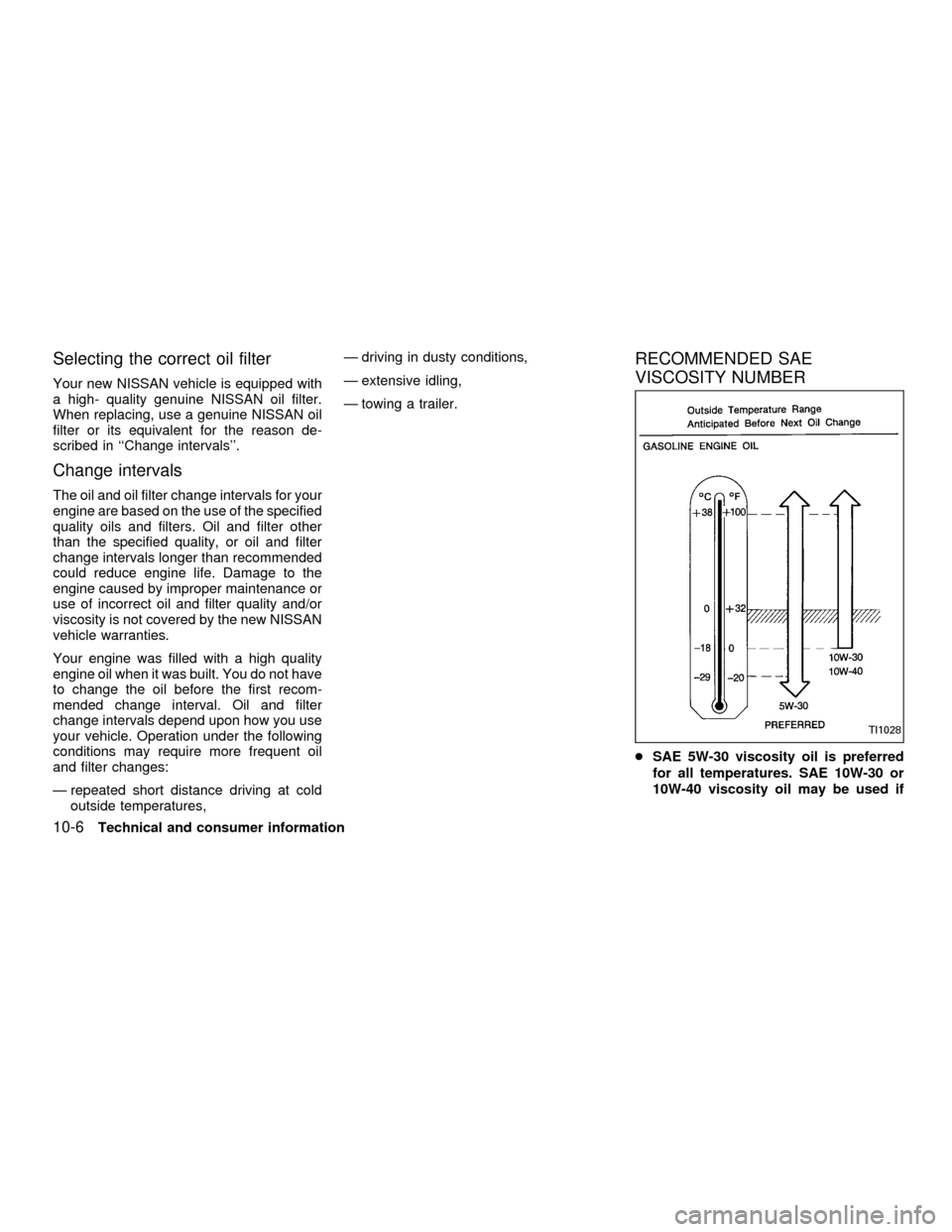
RECOMMENDED SAE
VISCOSITY NUMBER
cSAE 5W-30 viscosity oil is preferred
for all temperatures. SAE 10W-30 or
10W-40 viscosity oil may be used if
TI1028
10-6Technical and consumer information
ZX
Page 244 of 258
Your new vehicle was designed to be used
primarily to carry passengers and cargo. Re-
member that towing a trailer will place addi-
tional loads on your vehicle's engine, drive
train, steering, braking and other systems.
A Nissan Trailer Towing Guide (U.S. only)
containing information on trailer towing ability
and the special equipment required may be
obtained from an authorized NISSAN dealer.
MAXIMUM LOAD LIMITS
Maximum trailer loads:
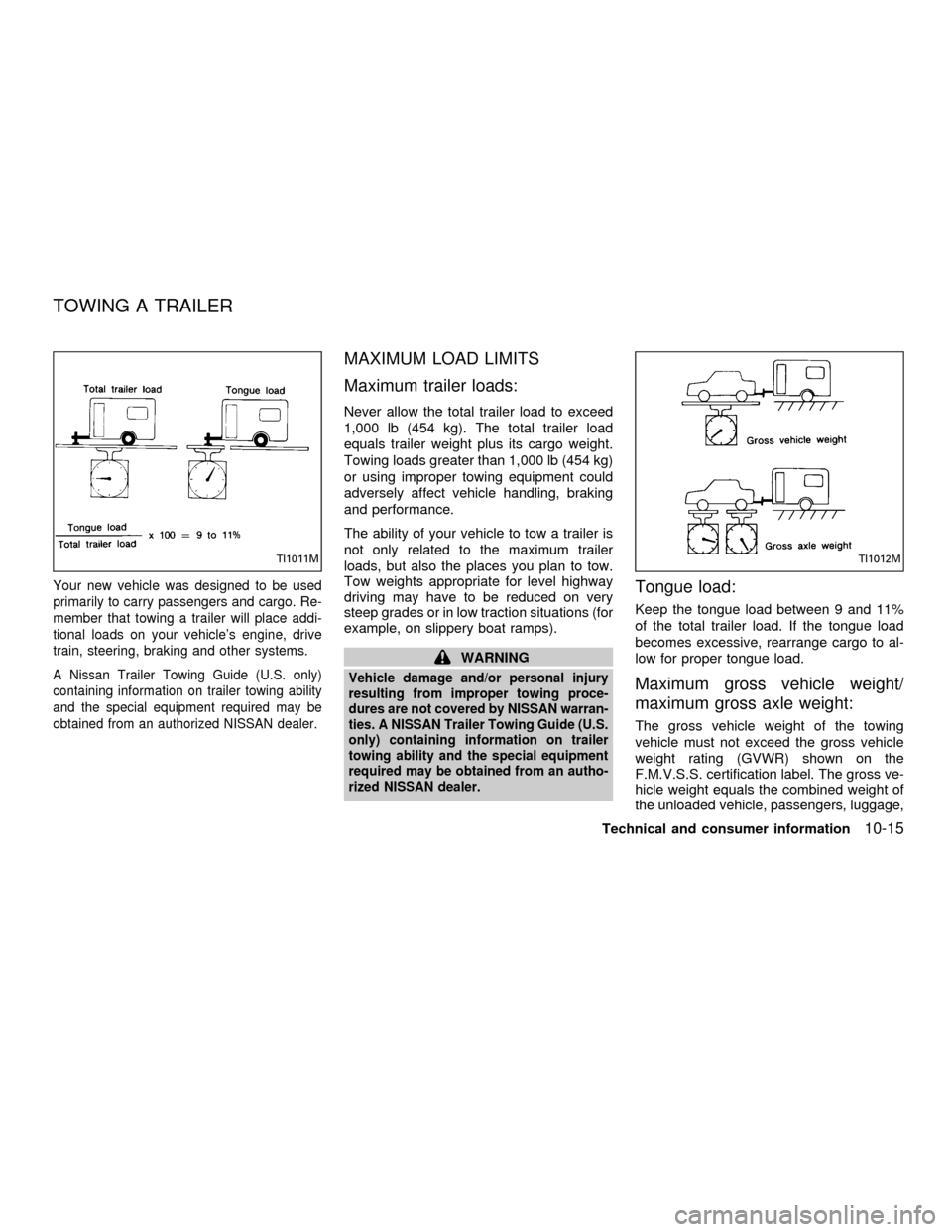
Never allow the total trailer load to exceed
1,000 lb (454 kg). The total trailer load
equals trailer weight plus its cargo weight.
Towing loads greater than 1,000 lb (454 kg)
or using improper towing equipment could
adversely affect vehicle handling, braking
and performance.
The ability of your vehicle to tow a trailer is
not only related to the maximum trailer
loads, but also the places you plan to tow.
Tow weights appropriate for level highway
driving may have to be reduced on very
steep grades or in low traction situations (for
example, on slippery boat ramps).
WARNING
Vehicle damage and/or personal injury
resulting from improper towing proce-
dures are not covered by NISSAN warran-
ties. A NISSAN Trailer Towing Guide (U.S.
only) containing information on trailer
towing ability and the special equipment
required may be obtained from an autho-
rized NISSAN dealer.
Tongue load:
Keep the tongue load between 9 and 11%
of the total trailer load. If the tongue load
becomes excessive, rearrange cargo to al-
low for proper tongue load.
Maximum gross vehicle weight/
maximum gross axle weight:
The gross vehicle weight of the towing
vehicle must not exceed the gross vehicle
weight rating (GVWR) shown on the
F.M.V.S.S. certification label. The gross ve-
hicle weight equals the combined weight of
the unloaded vehicle, passengers, luggage,
TI1011MTI1012M
TOWING A TRAILER
Technical and consumer information10-15
ZX
Page 245 of 258
hitch, trailer tongue load and any other
optional equipment. In addition, front or rear
gross axle weight must not exceed the
gross axle weight rating (GAWR) shown on
the F.M.V.S.S. certification label.
TOWING LOAD/SPECIFICATION
CHART
UNIT: lb (kg)
MAXIMUM
TOWING LOAD1,000 (454)
MAXIMUM
TONGUE LOAD110 (49)
TOWING SAFETY
Trailer hitch
Choose a proper hitch for your vehicle and
trailer. A genuine NISSAN trailer hitch is
available from your NISSAN dealer
(Canada only). Make sure the trailer hitch is
securely attached to the vehicle, to help
avoid personal injury or property damage
due to sway caused by crosswinds, rough
road surfaces or passing trucks.
CAUTION
cDo not use axle-mounted hitches.
cThe hitch should not be attached to
or affect the operation of the impact-
absorbing bumper.
cDo not modify the vehicle exhaust
system, brake system, etc. to install
a trailer hitch.
cTo reduce the possibility of addi-
tional damage if your vehicle is
struck from the rear, where practical,
remove the hitch and/or receiver
when not in use.
cAfter the hitch is removed, seal the
bolt holes to prevent exhaust fumes,
water or dust from entering the pas-
senger compartment.
cRegularly check that all hitch mount-
ing bolts are securely mounted.
Tire pressures
cWhen towing a trailer, inflate the vehicle
tires to the recommended cold tire pres-
sure indicated on the tire placard (affixed
to the driver's door, center pillar).cTrailer tire condition, size, load rating and
proper inflation pressure should be in
accordance with the trailer and tire
manufacturer's specifications.
Safety chains
Always use suitable chains between your
vehicle and the trailer. Safety chains should
be crossed and should be attached to the
hitch, not to the vehicle bumper or axle. Be
sure to leave enough slack in the chains to
permit turning corners.
Trailer lights
Trailer lights should comply with federal
and/ or local regulations. When wiring the
vehicle for towing, connect the stop and tail
light pickup into the vehicle electrical circuit.
Trailer brakes
If your trailer is equipped with a braking
system, make sure it conforms to Federal
and/or local regulations and that it is prop-
erly installed.
10-16Technical and consumer information
ZX