flat NISSAN ALTIMA 2002 L31 / 3.G Owners Manual
[x] Cancel search | Manufacturer: NISSAN, Model Year: 2002, Model line: ALTIMA, Model: NISSAN ALTIMA 2002 L31 / 3.GPages: 249, PDF Size: 2.02 MB
Page 15 of 249

PRECAUTIONS ON SUPPLE-
MENTAL RESTRAINT SYSTEM
This Supplemental Restraint System (SRS)
section contains important information con-
cerning the driver and passenger front im-
pact supplemental air bags, front seat side-
impact supplemental air bags, curtain air
bags and front seat pre-tensioner seat belts.
Front impact supplemental air bag sys-
tem:This system can help cushion the
impact force to the face and chest of the
driver and front passenger in certain frontal
collisions.
Side-impact supplemental air bag sys-
tem:This system can help cushion the
impact force to the chest area of the driver
and front passenger in certain side impact
collisions. The front seat side-impact
supplemental air bags are designed to in-
flate on the side where the vehicle is im-
pacted.
Side impact supplemental curtain air bag
system:This system can help cushion the
impact force to the head of occupants in
front and rear outboard seating positions in
certain side impact collisions. The curtain
air bags are designed to inflate on the sidewhere the vehicle is impacted.
These supplemental restraint systems are
designed tosupplementthe crash protec-
tion provided by the driver and front passen-
ger seat belts and arenot a substitutefor
them. Seat belts should always be correctly
worn and the occupant seated a suitable
distance away from the steering wheel, in-
strument panel and door finishers. (See
``Seat belts'' later in this section for instruc-
tions and precautions on seat belt usage.)
After turning the ignition key to the ON
position, the supplemental air bag warn-
ing light illuminates. The supplemental
air bag warning light will turn off after
about 7 seconds if the systems are op-
erational.
SUPPLEMENTAL RESTRAINT
SYSTEM
1-8Seats, restraints and supplemental air bag systems
ZX
Page 16 of 249
WARNING
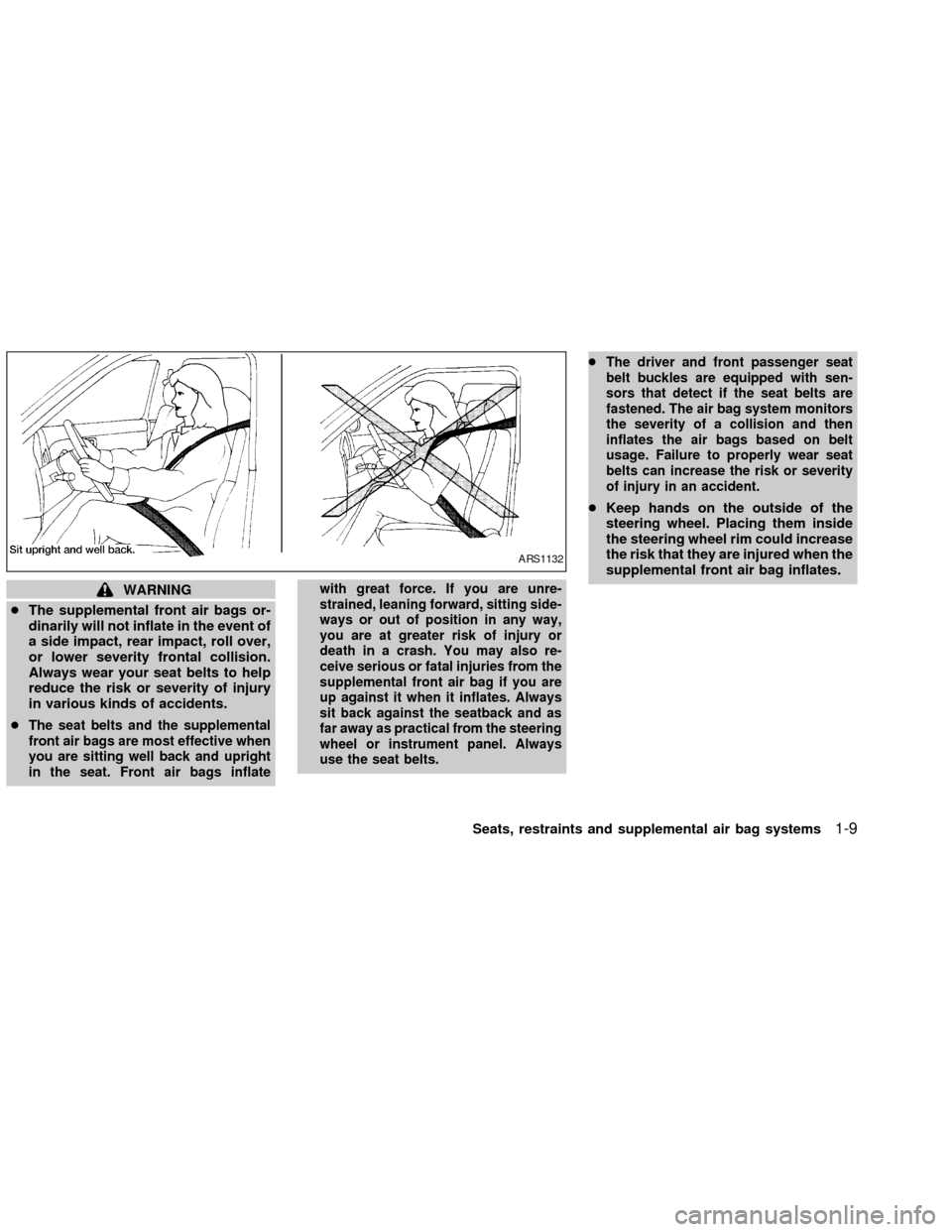
cThe supplemental front air bags or-
dinarily will not inflate in the event of
a side impact, rear impact, roll over,
or lower severity frontal collision.
Always wear your seat belts to help
reduce the risk or severity of injury
in various kinds of accidents.
c
The seat belts and the supplemental
front air bags are most effective when
you are sitting well back and upright
in the seat. Front air bags inflatewith great force. If you are unre-
strained, leaning forward, sitting side-
ways or out of position in any way,
you are at greater risk of injury or
death in a crash. You may also re-
ceive serious or fatal injuries from the
supplemental front air bag if you are
up against it when it inflates. Always
sit back against the seatback and as
far away as practical from the steering
wheel or instrument panel. Always
use the seat belts.cThe driver and front passenger seat
belt buckles are equipped with sen-
sors that detect if the seat belts are
fastened. The air bag system monitors
the severity of a collision and then
inflates the air bags based on belt
usage. Failure to properly wear seat
belts can increase the risk or severity
of injury in an accident.
cKeep hands on the outside of the
steering wheel. Placing them inside
the steering wheel rim could increase
the risk that they are injured when the
supplemental front air bag inflates.
ARS1132
Seats, restraints and supplemental air bag systems1-9
ZX
Page 18 of 249

WARNING
cNever let children ride unrestrained
or extend their hands or face out of
the window. Do not attempt to hold
them in your lap or arms. Some ex-
amples of dangerous riding posi-
tions are shown in the previous illus-
trations.
cChildren may be severely injured or
killed when the supplemental front
air bag or supplemental side air bag
inflates if they are not properly re-
strained.
cAlso, never install a rear facing child
restraint in the front seat. An inflat-
ing supplemental front air bag could
seriously injure or kill your child.
See ``Child restraints'' later in this
section for details.
ARS1043
ARS1044
ARS1045
ARS1046
Seats, restraints and supplemental air bag systems1-11
ZX
Page 19 of 249

WARNING
Supplemental side air bag and curtain
air bag:
cThe supplemental side air bag and
curtain air bag ordinarily will not
inflate in the event of a frontal im-
pact, rear impact, rollover or lower
severity side collision. Always wear
your seat belts to help reduce the
risk or severity of injury in various
kinds of accidents.cThe seat belts and the supplemental
side air bags and curtain air bags are
most effective when you are sitting
well back and upright in the seat.
The side air bag and curtain air bag
inflate with great force. Do not allow
anyone to place their hand, leg or
face near the side air bag on the side
of the seatback of the front seat or
near the side roof rails. Do not allow
anyone sitting in the front seats or
rear outboard seats to extend their
hand out of the window or lean
against the door. Some examples ofdangerous riding positions are
shown in the previous illustrations.
When sitting in the rear seat, do not
hold onto the seatback of the front
seat. If the supplemental side air bag
inflates, you may be seriously in-
jured. Be especially careful with chil-
dren, who should always be properly
restrained.
cDo not use seat covers on the front
seatbacks. They may interfere with
supplemental side air bag inflation.
SSS0101SSS0140
1-12Seats, restraints and supplemental air bag systems
ZX
Page 21 of 249

Supplemental front air bag system
The driver supplemental air bag is located in
the center of the steering wheel; the front
passenger supplemental air bag is mounted in
the dashboard above the glove box. Thesesystems are designed to meet optional certi-
fication requirements under U.S. regulations.
They are also permitted in Canada. The op-
tional certification allows front air bags to be
designed to inflate somewhat less forcefully
than previously.However, all of the informa-tion, cautions and warnings in this manual
still apply and must be followed.The front
air bags are designed to inflate in higher
severity frontal collisions, although they may
inflate if the forces in another type of collision
are similar to those of a higher severity frontal
impact. They may not inflate in certain frontal
collisions. Vehicle damage (or lack of it) is not
always an indication of proper supplemental
air bag operation.
The supplemental air bag system has dual
stage inflators for both the driver and pas-
senger air bags. The system monitors infor-
mation from the crash zone sensor, the
diagnosis sensor unit and seat belt buckle
sensors that detect if the seat belts are
fastened. Inflator operation is based on the
severity of a collision and whether the seat
belts are being used.
When the supplemental front air bag in-
flates, a fairly loud noise may be heard,
followed by release of smoke. This smoke is
not harmful and does not indicate a fire.
Care should be taken not to inhale it, as it
may cause irritation and choking. Those
with a history of a breathing condition
should get fresh air promptly.
Supplemental front air bags, along with the
LRS0104
1-14Seats, restraints and supplemental air bag systems
ZX
Page 22 of 249
use of seat belts, help to cushion the impact
force on the face and chest of the front
occupants. They can help save lives and
reduce serious injuries. However, an inflat-
ing front air bag may cause facial abrasions
or other injuries. Front air bags do not
provide restraint to the lower body.
The seat belts should be correctly worn and
the driver and passenger seated upright as
far as practical away from the steering
wheel or dash board. The supplemental
front air bags inflate quickly in order to help
protect the front occupants. Because of this,
the force of the front air bag inflating can
increase the risk of injury if the occupant is
too close to or is against the air bag module
during inflation.The air bag will deflate
quickly after the collision is over.
After turning the ignition key to the ON
position, the supplemental air bag warn-
ing light illuminates. The air bag warning
light will turn off after about 7 seconds if
the system is operational.
WARNING
c
Do not place any objects on the steer-
ing wheel pad or on the instrument
panel. Also, do not place any objectsbetween any occupant and the steer-
ing wheel or instrument panel. Such
objects may become dangerous pro-
jectiles and cause injury if the supple-
mental front air bag inflates.
cRight after inflation, several air bag
system components will be hot. Do
not touch them; you may severely
burn yourself.
c
No unauthorized changes should be
made to any components or wiring of
the supplemental front air bag sys-
tem. This is to prevent accidental in-
flation of the air bag or damage to the
air bag system.
cDo not make unauthorized changes
to your vehicle's electrical system,
suspension system or front end
structure. This could affect proper
operation of the supplemental front
air bag system.
c
Tampering with the supplemental front
air bag system may result in serious
personal injury. For example, do not
change the steering wheel and the in-
strument panel assembly by placing
material over the steering wheel padand above the instrument panel, or by
installing additional trim material
around the air bag system.
cWork around and on the supplemental
front air bag system should be done
by an authorized NISSAN retailer. In-
stallation of electrical equipment
should also be done by an authorized
NISSAN retailer. The yellow and or-
ange Supplemental Restrain System
(SRS) wiring and connectors should
not be modified or disconnected. Un-
authorized electrical test equipment
and probing devices should not be
used on the air bag system.
cA cracked windshield should be re-
placed immediately by a qualified
repair facility. A cracked windshield
could affect inflation of the supple-
mental air bag system.
c
The SRS wiring harness connectors are
yellow and orange for easy identification.
When selling your vehicle, we request that
you inform the buyer about the supple-
mental front air bag system and guide the
buyer to the appropriate sections in this
Owner's Manual.
Seats, restraints and supplemental air bag systems
1-15
ZX
Page 23 of 249

Supplemental side air bag and cur-
tain air bag system (if so equipped)
The supplemental side air bags are located
in the outside of the seatback of the front
seats. The supplemental curtain air bags
are located in the roof side rails. These
systems are designed to meet voluntary
guidelines to help reduce the risk of injury to
out-of-position occupants.However, all of
the information, cautions and warnings
in this manual still apply and must be
followed.The supplemental side air bags
and curtain air bags are designed to inflate
in higher severity side collisions, althoughthey may inflate if the forces in another type
of collision are similar to those of a higher
severity side impact. They are designed to
inflate on the side where the vehicle is
impacted. They may not inflate in certain
side collisions. Vehicle damage (or lack of
it) is not always an indication of proper
supplemental side air bag operation.
When the supplemental side air bag and
curtain air bag inflate, a fairly loud noise
may be heard, followed by release of
smoke. This smoke is not harmful and does
not indicate a fire. Care should be taken not
to inhale it, as it may cause irritation and
choking. Those with a history of a breathing
condition should get fresh air promptly.
Supplemental side air bags, along with the
use of seat belts, help to cushion the impact
force on the chest of the front occupants.
Curtain air bags help to cushion the impact
force to the head of occupants in the front
and rear outboard seating positions. They
can help save lives and reduce serious
injuries. However, an inflating side air bag
and curtain air bag may cause abrasions or
other injuries. Supplemental side air bags
and curtain air bags do not provide restraint
to the lower body.The seat belts should be correctly worn and
the driver and passenger seated upright as
far as practical away from the side air bag.
Rear seat passengers should be seated as
far away as practical from the door finishers
and side roof rails. The side air bags and
curtain air bag inflate quickly in order to help
protect the front occupants. Because of this,
the force of the side air bag and curtain air
bag inflating can increase the risk of injury if
the occupant is too close to, or is against,
these air bag modules during inflation. The
side air bag and curtain air bag will deflate
quickly after the collision is over.
After turning the ignition key to the ON
position, the supplemental air bag warn-
ing light illuminates. The air bag warning
light will turn off after about 7 seconds if
the system is operational.
WARNING
cDo not place any objects near the
seatback of the front seats. Also, do
not place any objects (an umbrella,
bag, etc.) between the front door
finisher and the front seat. Such ob-
jects may become dangerous pro-
jectiles and cause injury if the side
air bag inflates.
LRS0105
1-16Seats, restraints and supplemental air bag systems
ZX
Page 24 of 249

cRight after inflation, several side air
bag and curtain air bag system com-
ponents will be hot. Do not touch
them; you may severely burn your-
self.
cNo unauthorized changes should be
made to any components or wiring
of this side air bag and curtain air
bag system. This is to prevent acci-
dental inflation of the side air bag
and curtain air bag or damage to the
side air bag and curtain air bag sys-
tem.
cDo not make unauthorized changes
to your vehicle's electrical system,
suspension system or side panel.
This could affect proper operation of
the supplemental side air bag and
curtain air bag system.
cTampering with the supplemental
system may result in serious per-
sonal injury. For example, do not
change the front seat by placing ma-
terial near the seatback or by install-
ing additional trim material, such as
seat covers, around the side air bag.cWork around and on the side air bag
and curtain air bag system should be
done by an authorized NISSAN re-
tailer. Installation of electrical equip-
ment should also be done by an
authorized NISSAN retailer. The SRS
wiring harnesses* should not be
modified or disconnected. Unautho-
rized electrical test equipment and
probing devices should not be used
on the side air bag system.
* The SRS wiring harness connectors
are yellow and orange for easy identi-
fication.
When selling your vehicle, we request that
you inform the buyer about the side air bag
and curtain air bag system and guide the
buyer to the appropriate sections in this
Owner's Manual.
Pre-tensioner seat belt system (For
front seats)
WARNING
cThe pre-tensioner seat belt cannot
be reused after activation. It must bereplaced together with the retractor
as a unit.
cIf the vehicle becomes involved in a
frontal collision but the pre-
tensioner is not activated, be sure to
have the pre-tensioner system
checked and, if necessary, replaced
by your NISSAN retailer.
cNo unauthorized changes should be
made to any components or wiring
of the pre-tensioner seat belt sys-
tem. This is to prevent accidental
activation of the pre-tensioner seat
belt or damage to the pre-tensioner
seat belt operation. Tampering with
the pre-tensioner seat belt system
may result in serious personal in-
jury.
cWork around and on the pre-
tensioner system should be done by
an authorized NISSAN retailer. In-
stallation of electrical equipment
should also be done by an autho-
rized NISSAN retailer. Unauthorized
electrical test equipment and prob-
ing devices should not be used on
Seats, restraints and supplemental air bag systems
1-17
ZX
Page 27 of 249

When the ignition key is in the ON or START
position, the supplemental air bag warning
light illuminates for about 7 seconds and
then turns off. This means the system is
operational.
If any of the following conditions occur, the
supplemental front air bag, supplemental
side air bag and curtain air bag (if so
equipped) and pre-tensioner seat belt sys-
tems need servicing:
cThe supplemental air bag warning light
remains on after approximately 7 sec-
onds.
cThe supplemental air bag warning light
flashes intermittently.
cThe supplemental air bag warning light
does not come on at all.
Under these conditions, the supplemental
front air bag, supplemental side air bags
and curtain air bag (if so equipped) or
pre-tensioner seat belt systems may not
operate properly. It must be checked and
repaired. Take your vehicle to the nearest
authorized NISSAN dealer.WARNING
If the supplemental air bag warning
light is on, it could mean that the
supplemental front air bag, supplemen-
tal side air bag, curtain air bag systems
(if so equipped) and/or pre-tensioner
seat belt systems will not operate in an
accident.
Repair and replacement procedure
The supplemental front air bags, supple-
mental side air bags, curtain air bags and
pretensioner seat belts are designed to in-
flate on a one-time-only basis. As a re-
minder, unless it is damaged, the supple-
mental air bag light remains illuminated
after inflation has occurred. Repair and re-
placement of these supplemental air bag
systems should be done only by an autho-
rized NISSAN dealer.
When maintenance work is required on the
vehicle, the supplemental front air bags,
supplemental side air bags, pre-tensioner
seat belts and related parts should be
pointed out to the person conducting the
maintenance. The ignition key should al-
ways be in the LOCK position when working
under the hood or inside the vehicle.
WARNING
cOnce the supplemental front air bag,
supplemental side air bag or curtain
air bag has inflated, the air bag mod-
ule will not function again and must
be replaced. Additionally, if any of
the supplemental air bags inflate, the
pre-tensioner seat belts must also
be replaced. The air bag module and
pre-tensioner seat belt system
should be replaced by an authorized
NISSAN dealer. The air bag module
and pre-tensioner seat belt system
cannot be repaired.
cThe supplemental front air bag,
supplemental side air bag and cur-
tain air bag systems should be in-
spected by an authorized NISSAN
dealer if there is any damage to the
front end or side portion of the ve-
hicle.
cIf you need to dispose of a supple-
mental air bag, pre-tensioner seat
belt system or scrap the vehicle,
contact an authorized NISSAN
dealer. Correct supplemental air bag
and pre-tensioner seat belt system
1-20Seats, restraints and supplemental air bag systems
ZX
Page 36 of 249

accident. The child could be crushed
between the adult and parts of the
vehicle. Also, do not put the same
seat belt around both your child and
yourself.
cNever install a rear-facing child re-
straint in the front seat. An inflating
supplemental front air bag could se-
riously injure or kill your child. A
rear-facing child restraint must only
be used in the rear seat.
cNISSAN recommends that the child
restraint be installed in the rear seat.
According to accident statistics,
children are safer when properly re-
strained in the rear seat than in the
front seat.
cAn improperly installed child re-
straint could lead to serious injury or
death in an accident.
In general, child restraints are designed to
be installed with a lap belt or the lap portion
of a three-point type seat belt. In addition,
this vehicle is equipped with a universal
child restraint lower anchor system, referred
to as the LATCH (Lower Anchors andTether for Children) system. Some child
restraints include two rigid or webbing-
mounted attachments that can be con-
nected to these lower anchors. For details,
see the ``LATCH (Lower Anchors and
Tether for Children) system'' later in this
section.
Child restraints for infants and children of
various sizes are offered by several manu-
facturers. When selecting any child re-
straint, keep the following points in mind:
1) Choose only a restraint with a label cer-
tifying that it complies with Federal Motor
Vehicle Safety Standard 213 or Cana-
dian Motor Vehicle Safety Standard 213.
2) Check the child restraint in your vehicle
to be sure it is compatible with the vehi-
cle's seat and seat belt system.
3) If the child restraint is compatible with
your vehicle, place your child in the child
restraint and check the various adjust-
ments to be sure the child restraint is
compatible with your child. Always follow
all recommended procedures.
All U.S. states and provinces of Canada
require that infants and small children be
restrained in approved child restraints atall times while the vehicle is being
operated.
WARNING
cImproper use of a child restraint can
result in increased injuries for both
the infant or child and other occu-
pants in the vehicle.
cFollow all of the child restraint manu-
facturer's instructions for installa-
tion and use. When purchasing a
child restraint, be sure to select one
which will fit your child and vehicle.
It may not be possible to properly
install some types of child restraints
in your vehicle.
cIf the child restraint is not anchored
properly, the risk of a child being
injured in a collision or a sudden
stop greatly increases.
cAdjustable seatbacks should be po-
sitioned to fit the child restraint, but
as upright as possible.
cAfter attaching the child restraint,
test it before you place the child in it.
Tilt it from side to side. Try to tug it
Seats, restraints and supplemental air bag systems
1-29
ZX