Engine control NISSAN ALTIMA 2016 L33 / 5.G Repair Manual
[x] Cancel search | Manufacturer: NISSAN, Model Year: 2016, Model line: ALTIMA, Model: NISSAN ALTIMA 2016 L33 / 5.GPages: 491, PDF Size: 5.33 MB
Page 400 of 491
8 Maintenance and do-it-yourself
Maintenance requirements..........................8-2
General maintenance ..............................8-2
Explanation of general maintenance items .........8-2
Maintenance precautions ...........................8-5
Engine compartment check locations ................8-7
Engine cooling system .............................8-9
Checking engine coolant level ..................8-10
Changing engine coolant .......................8-10
Engine oil ........................................ 8-11
Checking engine oil level .......................8-11
Changing engine oil ........................... 8-12
Changing engine oil filter .......................8-14
Continuously Variable Transmission (CVT) fluid ......8-15
Power steering fluid ............................... 8-15
Brake fluid ....................................... 8-16
Windshield-washer fluid ........................... 8-16
Windshield-washer fluid reservoir ...............8-16
Battery .......................................... 8-17
Jump starting ................................. 8-19
Variable voltage control system .....................8-19
Drive belt ........................................ 8-20
Spark plugs ...................................... 8-21Replacing spark plugs
......................... 8-21
Air cleaner ....................................... 8-22
In-cabin microfilter (if so equipped) ..............8-22
Windshield wiper blades .......................... 8-23
Cleaning ..................................... 8-23
Replacing .................................... 8-23
Brakes .......................................... 8-24
Fuses ........................................... 8-25
Engine compartment ........................... 8-25
Passenger compartment .......................8-26
Battery replacement .............................. 8-27
NISSAN Intelligent Key® .......................8-28
Lights ........................................... 8-29
Headlights .................................... 8-29
Fog
lights (if so equipped) ...................... 8-29
Exterior and interior lights .......................8-31
Wheels and tires ................................. 8-34
Tire pressure .................................. 8-34
Tire labeling ................................... 8-38
Types of tires .................................. 8-41
Tire chains .................................... 8-42
Changing wheels and tires .....................8-43
Page 404 of 491
UnderbodyThe underbody is frequently ex-
posed to corrosive substances such as those
used on icy roads or to control dust. It is very
important to remove these substances from the
underbody, otherwise rust may form on the floor
pan, frame, fuel lines and exhaust system. At the
end of winter, the underbody should be thor-
oughly flushed with plain water, in those areas
where mud and dirt may have accumulated. For
additional information, refer to “Appearance and
care” section of this manual.
Windshield-washer fluid* Check that there is
adequate fluid in the reservoir. When performing any inspection or maintenance
work on your vehicle, always take care to prevent
serious accidental injury to yourself or damage to
the vehicle. The following are general precau-
tions which should be closely observed.
WARNING
●
Park the vehicle on a level surface, ap-
ply the parking brake securely and
block the wheels to prevent the vehicle
from moving. Move the shift lever to P
(Park) .
● Be sure the ignition key is in the OFF or
LOCK position when performing any
parts replacement or repairs.
● If you must work with the engine run-
ning, keep your hands, clothing, hair
and tools away from moving fans, belts
and any other moving parts.
● It is advisable to secure or remove any
loose clothing and remove any jewelry,
such as rings, watches, etc. before
working on your vehicle.
● Always wear eye protection whenever
you work on your vehicle. ●
Your vehicle is equipped with an auto-
matic engine cooling fan. It may come
on at any time without warning, even if
the ignition key is in the OFF position
and the engine is not running. To avoid
injury, always disconnect the negative
battery cable before working near the
fan.
● If you must run the engine in an en-
closed space such as a garage, be sure
there is proper ventilation for exhaust
gases to escape.
● Never get under the vehicle while it is
supported only by a jack. If it is neces-
sary to work under the vehicle, support
it with safety stands.
● Keep smoking materials, flame and
sparks away from the fuel tank and
battery.
● On gasoline engine models, the fuel
filter or fuel lines should be serviced by
a NISSAN dealer because the fuel lines
are under high pressure even when the
engine is off.
MAINTENANCE PRECAUTIONS
Maintenance and do-it-yourself8-5
Page 418 of 491
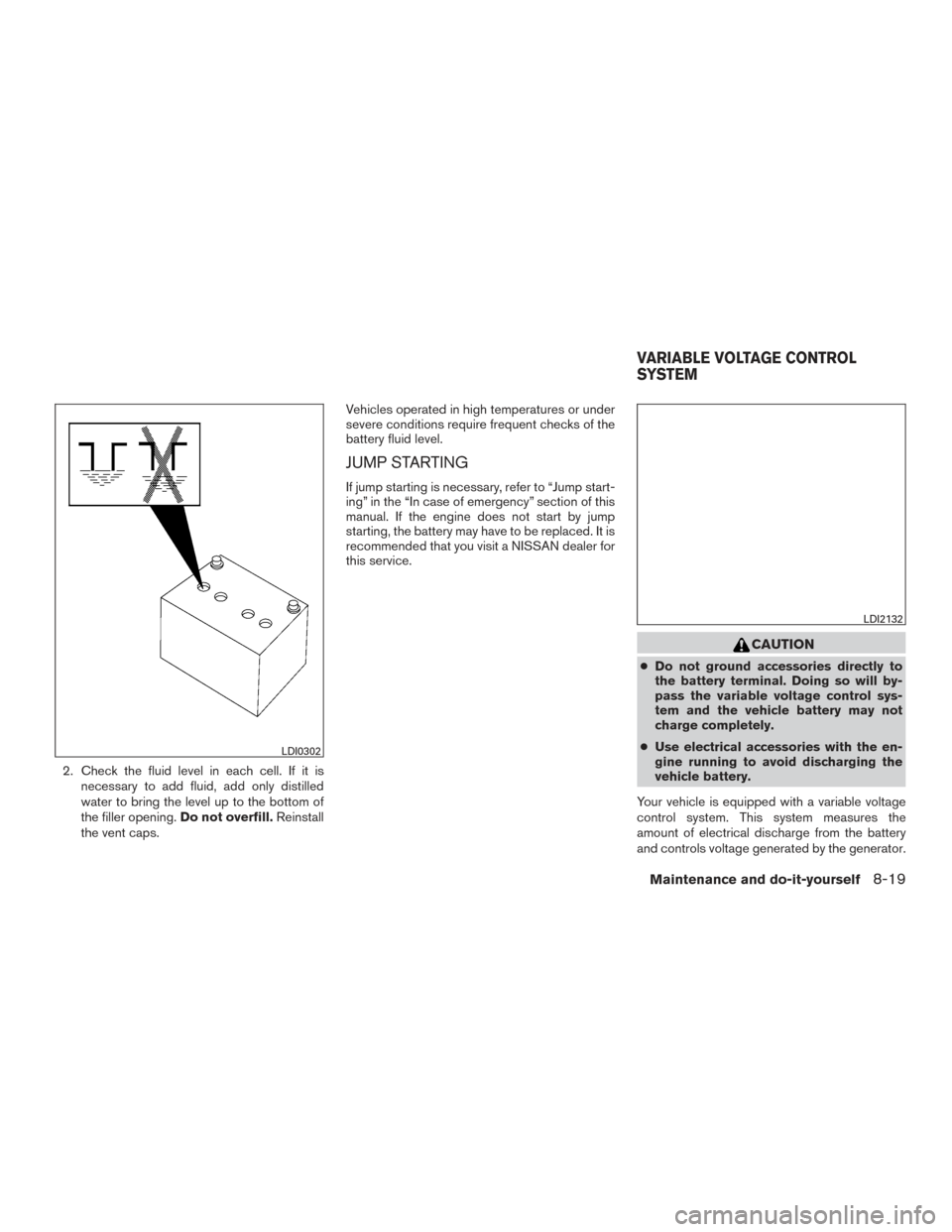
2. Check the fluid level in each cell. If it isnecessary to add fluid, add only distilled
water to bring the level up to the bottom of
the filler opening. Do not overfill.Reinstall
the vent caps. Vehicles operated in high temperatures or under
severe conditions require frequent checks of the
battery fluid level.
JUMP STARTING
If jump starting is necessary, refer to “Jump start-
ing” in the “In case of emergency” section of this
manual. If the engine does not start by jump
starting, the battery may have to be replaced. It is
recommended that you visit a NISSAN dealer for
this service.
CAUTION
●
Do not ground accessories directly to
the battery terminal. Doing so will by-
pass the variable voltage control sys-
tem and the vehicle battery may not
charge completely.
● Use electrical accessories with the en-
gine running to avoid discharging the
vehicle battery.
Your vehicle is equipped with a variable voltage
control system. This system measures the
amount of electrical discharge from the battery
and controls voltage generated by the generator.
LDI0302
LDI2132
VARIABLE VOLTAGE CONTROL
SYSTEM
Maintenance and do-it-yourself8-19
Page 446 of 491
9 Technical and consumer information
Recommended fluids/lubricants and capacities.......9-2
Fuel recommendation ...........................9-4
Engine oil and oil filter recommendations ..........9-6
Air conditioner system refrigerant and oil
recommendations ..............................9-7
Specifications .....................................9-8
Engine ........................................9-8
Wheels and tires ...............................9-9
Dimensions and weights ........................9-9
When traveling or registering in another country ......9-10
Vehicle identification .............................. 9-10
Vehicle identification number (VIN) plate .........9-10
Vehicle identification number
(chassis number) .............................. 9-10
Engine serial number ........................... 9-11
F.M.V.S.S./C.M.V.S.S. certification label ..........9-11
Emission control information label ...............9-12Tire and loading information label
................9-12
Air conditioner specification label ................9-12
Installing front license plate ........................9-13
Vehicle loading information ........................9-13
Terms ........................................ 9-13
Vehicle load capacity .......................... 9-14
Loading tips .................................. 9-16
Measurement of weights .......................9-16
Towing a trailer ................................... 9-17
Flat towing .................................... 9-17
Uniform tire quality grading ........................9-17
Emission control system warranty ..................9-18
Reporting safety defects .......................... 9-19
Readiness for inspection/maintenance (I/M) test .....9-20
Event Data Recorders (EDR) .......................9-20
Owner’s Manual/Service Manual order information . . . 9-21
Page 450 of 491
●E-15 fuel contains more than 10% oxy-
genate. E-15 fuel will adversely affect
the emission control devices and sys-
tems of the vehicle and should not be
used. Damage caused by such fuel is
not covered by the NISSAN New Ve-
hicle Limited Warranty.
● If a methanol blend is used, it should
contain no more than 5% methanol
(methyl alcohol, wood alcohol) . It
should also contain a suitable amount
of appropriate cosolvents and corro-
sion inhibitors. If not properly formu-
lated with appropriate cosolvents and
corrosion inhibitors, such methanol
blends may cause fuel system damage
and/or vehicle performance problems.
At this time, sufficient data is not avail-
able to ensure that all methanol blends
are suitable for use in NISSAN ve-
hicles.
If any driveability problems such as engine stall-
ing and difficult hot-starting are experienced after
using oxygenate-blend fuels, immediately
change to a non-oxygenate fuel or a fuel with a
low blend of MTBE.
Take care not to spill gasoline during refu-
eling. Gasoline containing oxygenates can
cause paint damage.E–15 fuel
E-15 fuel is a mixture of approximately 15% fuel
ethanol and 85% unleaded gasoline. E-15 can
only be used in vehicles designed to run on E-15
fuel. Do not use E-15 in your vehicle. U.S. gov-
ernment regulations require fuel ethanol dispens-
ing pumps to be identified with small, square,
orange and black label with the common abbre-
viation or the appropriate percentage for that
region.
E–85 fuel
E-85 fuel is a mixture of approximately 85% fuel
ethanol and 15% unleaded gasoline. E-85 can
only be used in a Flexible Fuel Vehicle (FFV) . Do
not use E-85 in your vehicle. U.S. government
regulations require fuel ethanol dispensing
pumps to be identified by a small, square, orange
and black label with the common abbreviation or
the appropriate percentage for that region.
Fuel containing MMT
MMT, or methylcyclopentadienyl manganese tri-
carbonyl, is an octane boosting additive. NISSAN
does not recommend the use of fuel containing
MMT. Such fuel may adversely affect vehicle per-
formance, including the emissions control sys-
tem. Note that while some fuel pumps label MMT
content, not all do, so you may have to consult
your gasoline retailer for more details.
Aftermarket fuel additives
NISSAN does not recommend the use of any
aftermarket fuel additives (for example, fuel injec-
tor cleaner, octane booster, intake valve deposit
removers, etc.) which are sold commercially.
Many of these additives intended for gum, varnish
or deposit removal may contain active solvents or
similar ingredients that can be harmful to the fuel
system and engine.
Octane rating tips
Using unleaded gasoline with an octane
rating lower than recommended can cause
persistent, heavy “spark knock.” (“Spark
knock” is a metallic rapping noise.) If se-
vere, this can lead to engine damage. If you
detect a persistent heavy spark knock even
when using gasoline of the stated octane
rating, or if you hear steady spark knock
while holding a steady speed on level
roads, have a NISSAN dealer correct the
condition. Failure to correct the condition
is misuse of the vehicle, for which NISSAN
is not responsible.
Technical and consumer information9-5
Page 455 of 491
When planning to drive your NISSAN ve-
hicle in another country,you should first find
out if the fuel available is suitable for your vehi-
cle’s engine.
Using fuel with an octane rating that is too low
may cause engine damage. All gasoline vehicles
must be operated with unleaded gasoline. There-
fore, avoid taking your vehicle to areas where
appropriate fuel is not available.
When transferring the registration of your
vehicle to another country, state, province
or district, it may be necessary to modify the
vehicle to meet local laws and regulations.
The laws and regulations for motor vehicle emis-
sion control and safety standards vary according
to the country, state, province or district; there-
fore, vehicle specifications may differ.
When any vehicle is to be taken into an-
other country, state, province or district and
registered, its modifications, transporta-
tion and registration are the responsibility
of the user. NISSAN is not responsible for
any inconvenience that may result.
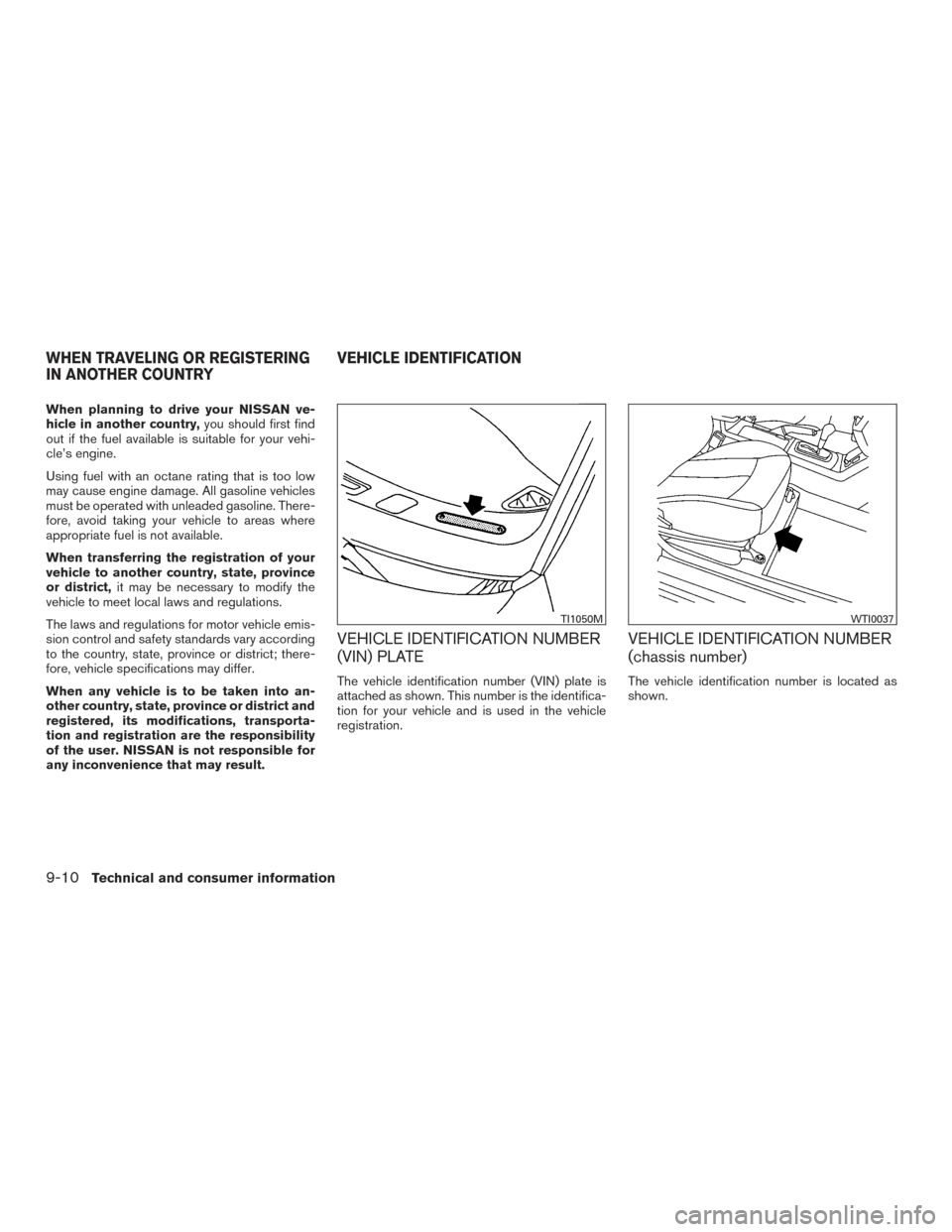
VEHICLE IDENTIFICATION NUMBER
(VIN) PLATE
The vehicle identification number (VIN) plate is
attached as shown. This number is the identifica-
tion for your vehicle and is used in the vehicle
registration.
VEHICLE IDENTIFICATION NUMBER
(chassis number)
The vehicle identification number is located as
shown.
TI1050MWTI0037
WHEN TRAVELING OR REGISTERING
IN ANOTHER COUNTRY VEHICLE IDENTIFICATION
9-10Technical and consumer information
Page 465 of 491
Due to legal requirements in some states and
Canadian Provinces, your vehicle may be re-
quired to be in what is called the “ready condi-
tion” for an Inspection/Maintenance (I/M) test of
the emission control system.
The vehicle is set to the “ready condition” when it
is driven through certain driving patterns. Usually,
the ready condition can be obtained by ordinary
usage of the vehicle.
If a powertrain system component is repaired or
the battery is disconnected, the vehicle may be
reset to a “not ready” condition. Before taking the
I/M test, check the vehicle’s
inspection/maintenance test readiness condi-
tion. Place the ignition switch in the ON position
without starting the engine. If the Malfunction
Indicator Light (MIL) comes on steady for 20 sec-
onds and then blinks for 10 seconds , the I/M test
condition is “not ready”. If the MIL does not blink
after 20 seconds, the I/M test condition is
“ready”. Contact a NISSAN dealer to set the
“ready condition” or to prepare the vehicle for
testing.This vehicle is equipped with an EDR. The main
purpose of an EDR is to record, in certain colli-
sion or near collision-like situations, such as an
air bag deployment or hitting a road obstacle,
data that will assist in understanding how a vehi-
cle’s systems performed. The EDR is designed to
record data related to vehicle dynamics and
safety systems for a short period of time, typically
30 seconds or less. The EDR in this vehicle is
designed to record such data as:
● How various systems in your vehicle were
operating;
● Whether or not the driver and passenger
safety belts were buckled/fastened;
● How far (if at all) the driver was depressing
the accelerator and/or brake pedal; and,
● How fast the vehicle was traveling.
● Sounds are not recorded. These data can help provide a better understand-
ing of the circumstances in which collisions and
injuries occur. NOTE: EDR data are recorded by
your vehicle only if a nontrivial collision situation
occurs; no data are recorded by the EDR under
normal driving conditions and no personal data
(e.g. name, gender, age and collision location)
are recorded. However, other parties, such as
law enforcement, could combine the EDR data
with the type of personally identifying data rou-
tinely acquired during a collision investigation.
To read data recorded by an EDR, special equip-
ment is required and access to the vehicle or the
EDR is needed. In addition to the vehicle manu-
facturer and NISSAN dealer, other parties, such
as law enforcement, that have the special equip-
ment, can read the information if they have ac-
cess to the vehicle or the EDR. EDR data will only
be accessed with the consent of the vehicle
owner or lessee or as otherwise required or per-
mitted by law.
READINESS FOR INSPECTION/
MAINTENANCE (I/M) TEST
EVENT DATA RECORDERS (EDR)
9-20Technical and consumer information
Page 468 of 491
10 Index
A
ABS (Anti-lock Braking System) ........5-74
Air bag (See supplemental restraint
system) .....................1-42
Air bag system Front (See supplemental front impact air bag
system) ...................1-49
Airbagwarninglight...........1-59,2-14
Air bag warning light, supplemental . .1-59, 2-14
Air cleaner housing filter ............8-22
Air conditioner Air conditioner operation ..........4-19
Air conditioner specification label .....9-12
Air conditioner system refrigerant and
oil recommendations .............9-7
Air conditioner system refrigerant
recommendations ..............9-7
Heater and air conditioner
controls................4-17,4-25
Servicing air conditioner ..........4-27
Airflowcharts..................4-20
Alarm system
(See vehicle security system) .........2-29
Anchor point locations .............1-26
Antenna .....................4-69
Antifreeze ....................5-83
Anti-lock brake warning light ..........2-11
Anti-lock Braking System (ABS) ........5-74
Apps .......................4-69
Armrests .....................1-7
Audible reminders ...............2-17 Audio system
..................4-27
AMradioreception.............4-28
Bluetooth®audio..........4-65,4-66
Bluetooth® streaming audio ........4-66
Compact disc (CD)
player..........4-37,4-41,4-47,4-54
FM-AM radio with compact disc (CD)
player ....................4-35
FM/AM/SAT radio with compact disc (CD)
player .............4-39,4-43,4-49
FMradioreception.............4-27
iPod® Player .............4-60,4-62
iPod® player operation .......4-60,4-62
Radio ....................4-27
USB interface ............4-55,4-57
USB (Universal Serial Bus) Connection
Port..................4-55,4-57
Autolight switch .................2-34
Automatic Automatic power window switch .....2-48
Automatic anti-glare inside mirror .......3-37
Automatic door locks ..............3-6
AUXjack.................4-38,4-55
B
Battery ..................5-83,8-17
Chargewarninglight............2-11
Battery replacement ..............8-27
Keyfob ...................8-27
NISSAN Intelligent Key® ..........8-28
Before starting the engine ...........5-12 Belt (See drive belt)
..............8-20
Blind Spot Warning (BSW) warning
system......................5-19
Block heater Engine ....................5-85
Bluetooth® audio ............4-65,4-66
Bluetooth® hands-free phone
system..............4-74,4-89,4-100
Bluetooth® streaming audio with Navigation
System .....................4-66
Boosterseats..................1-38
Brake Anti-lock Braking System (ABS) ......5-74
Brake fluid ..................8-16
Brakelight(Seestoplight).........8-31
Brake system ................5-74
Brakewarninglight.............2-11
Brakewearindicators........2-17,8-24
Parking brake operation ..........5-19
Self-adjusting brakes ............8-24
Brake fluid ....................8-16
Brakes ......................8-24
Brake system ..................5-74
Break-inschedule ...............5-70
Brightness/contrast button ...........4-9
Brightness control Instrument panel ..............2-36
Bulb check/instrument panel ..........2-10
Bulbreplacement................8-31
Page 469 of 491
C
Capacities and recommended fuel/lubricants . .9-2
Cargonet.....................2-45
Cargo(Seevehicleloadinginformation)....9-13
Car phone or CB radio .............4-74
CD care and cleaning ..............4-67
CD player
(See audio system) .....4-37,4-41,4-47,4-54
Check tire pressure ...............2-27
Child restraints .......1-19,1-20,1-22,1-24
LATCH (Lower Anchors and Tethers for
CHildren) System ..............1-24
Precautions on child
restraints.........1-22,1-28,1-34,1-39
Top tether strap anchor point locations . .1-26
Child safety rear door lock ............3-7
Chimes, audible reminders ...........2-17
Cleaningexteriorandinterior........7-2,7-4
Clock (models without navigation system) ....4-36
Clockset.....................4-36
Clock setting
(models with Navigation System) ........4-7
Clock setting (models without Navigation
System) ...............4-36,4-40,4-44
C.M.V.S.S. certification label ..........9-11
Cold weather driving ...............5-83
Compact disc (CD)
player ............4-37,4-41,4-47,4-54
Compass ......................2-7
Connect phone .................4-70
Consolebox...................2-43
Consolelight...................2-51
Continuously Variable Transmission (CVT) . . .5-13 Continuously Variable Transmission (CVT)
fluid......................8-15
Driving with Continuously Variable
Transmission (CVT)
.............5-13
Control panel buttons ...............4-4
Brightness/contrast button ..........4-9
Enterbutton..................4-4
Controls Heater and air conditioner
controls................4-17,4-25
Coolant Capacities and recommended
fuel/lubricants .................9-2
Changingenginecoolant..........8-10
Checking engine coolant level .......8-10
Engine coolant temperature gauge .....2-5
Corrosion protection ...............7-6
Cruisecontrol..................5-37
Cupholders................2-44,2-45
D
Daytime Running Light System .........2-35
Defroster switch Rear window and outside mirror defroster
switch.....................2-32
Dimensionsandweights.............9-9
Dimmer switch for instrument panel ......2-36
Display controls (see control panel buttons) . .4-4
Door locks .....................3-5
Doors ........................3-4
Drive belt .....................8-20
Driving Cold weather driving .............5-83 Driving with Continuously Variable
Transmission (CVT)
.............5-13
Precautions when starting and driving ....5-2
Driving the vehicle ................5-13
E
Economy-fuel..................5-72
Emergency engine shutoff .........5-10,6-2
Emission control information label .......9-12
Emission control system warranty .......9-18
Engine Before starting the engine ..........5-12
Blockheater.................5-85
Capacities and recommended
fuel/lubricants.................9-2
Changing engine coolant ..........8-10
Changingengineoil.............8-12
Changing engine oil filter ..........8-14
Checking engine coolant level .......8-10
Checking engine oil level ..........8-11
Engine
compartment check locations ....8-7
Engine coolant temperature gauge .....2-5
Engine cooling system ............8-9
Engineoil...................8-11
Engine oil and oil filter recommendation . . .9-6
Engine oil viscosity ..............9-7
Engine serial number ............9-11
Engine specifications .............9-8
Starting the engine .............5-12
Engine coolant temperature gauge .......2-5
Enter button ....................4-4
Event Data recorders ..............9-20
Exhaust gas (Carbon monoxide) .........5-2
Explanation of maintenance items ........8-2
10-2
Page 470 of 491
Extendedstorageswitch ............2-41
Eyeglass case..................2-44
F
First aid kit .....................6-3
Flashers (See hazard warning flasher switch) . .6-2
Flat tire ....................6-3,6-4
Floor mat positioning aid .............7-6
Fluid Brake fluid ..................8-16
Capacities and recommended
fuel/lubricants .................9-2
Continuously Variable Transmission (CVT)
fluid......................8-15
Engine coolant .................8-9
Engine oil ...................8-11
Power steering fluid .............8-15
Windshield-washerfluid...........8-16
F.M.V.S.S. certification label ...........9-11
Foglightswitch .................2-37
Forward Emergency Braking (FEB) .......2-12
Front air bag system
(See supplemental restraint system) ......1-49
Front power seat adjustment ...........1-4
Frontseats.....................1-2
Fuel Capacities and recommended
fuel/lubricants .................9-2
Fuel economy ................5-72
Fuel-filler door and cap ...........3-33
Fuel-filler door lock opener lever ......3-32
Fuel gauge ...................2-6
Fuel octane rating ...............9-5
Fuel recommendation .............9-4 Loose fuel cap warning
...........2-28
Fuel Cell Vehicle (FCV) System Tirepressure.................8-34
Fuel-filler door ..................3-32
Fuelgauge.....................2-6
Fuses.......................8-25
Fusiblelinks ...................8-26
G
Garage door opener, HomeLink® Universal
Transceiver . .2-52, 2-53, 2-54, 2-55, 2-55, 2-56
Gascap .....................3-33
Gauge Engine coolant temperature gauge .....2-5
Fuel gauge ...................2-6
Odometer ...................2-4
Speedometer .................2-4
Tachometer ..................2-5
Trip odometer .................2-4
General maintenance ...............8-2
Glovebox.....................2-43
Gloveboxlock..................2-43
H
Hands-free phone system,
Bluetooth®............4-74,4-89,4-100
Hazard warning flasher switch ..........6-2
Headlight and turn signal switch ........2-33
Headlight control switch ............2-33
Headlights ....................8-29
Head restraints ..................1-7
Heated seats ...................2-37 Heated steering wheel
.............2-38
Heater Heater and air conditioner
controls ................4-17,4-25
Heater operation ...........4-18,4-26
HomeLink® Universal
Transceiver . .2-52, 2-53, 2-54, 2-55, 2-55, 2-56
Hood.......................3-29
Horn .......................2-37
I
Ignition Switch Push-Button Ignition Switch .........5-8
Immobilizer system ............2-30,5-11
Important vehicle information label .......9-11
In-cabin microfilter ................8-22
Increasing
fuel economy .............5-72
Indicator lights and audible reminders
(See warning/indicator lights and audible
reminders).................2-10,2-15
Inside automatic anti-glare mirror ........3-37
Instrument brightness control ..........2-36
Instrumentpanel...............0-6,2-2
Instrument panel dimmer switch ........2-36
Intelligent cruise control (ICC) system Brake assist .................5-39
Intelligent Key system Key operating range ..........3-9,3-21
Key operation ................3-10
Mechanical key ................3-3
Remote keyless entry operation . . .3-13, 3-21
Troubleshooting guide ........3-18,3-25
Warning signals ............3-18,3-25
Interior light ....................2-50
10-3