roof NISSAN ALTIMA 2018 Owner´s Manual
[x] Cancel search | Manufacturer: NISSAN, Model Year: 2018, Model line: ALTIMA, Model: NISSAN ALTIMA 2018Pages: 467, PDF Size: 5.42 MB
Page 209 of 467
To turn system off
Press the ON-OFF button.
Rear window and outside mirror
(if so equipped) defroster switch
For additional information, refer to “Rear
window and outside mirror (if so equipped)
defroster switch” in the “Instruments and
controls” section of this manual.
OPERATING TIPS
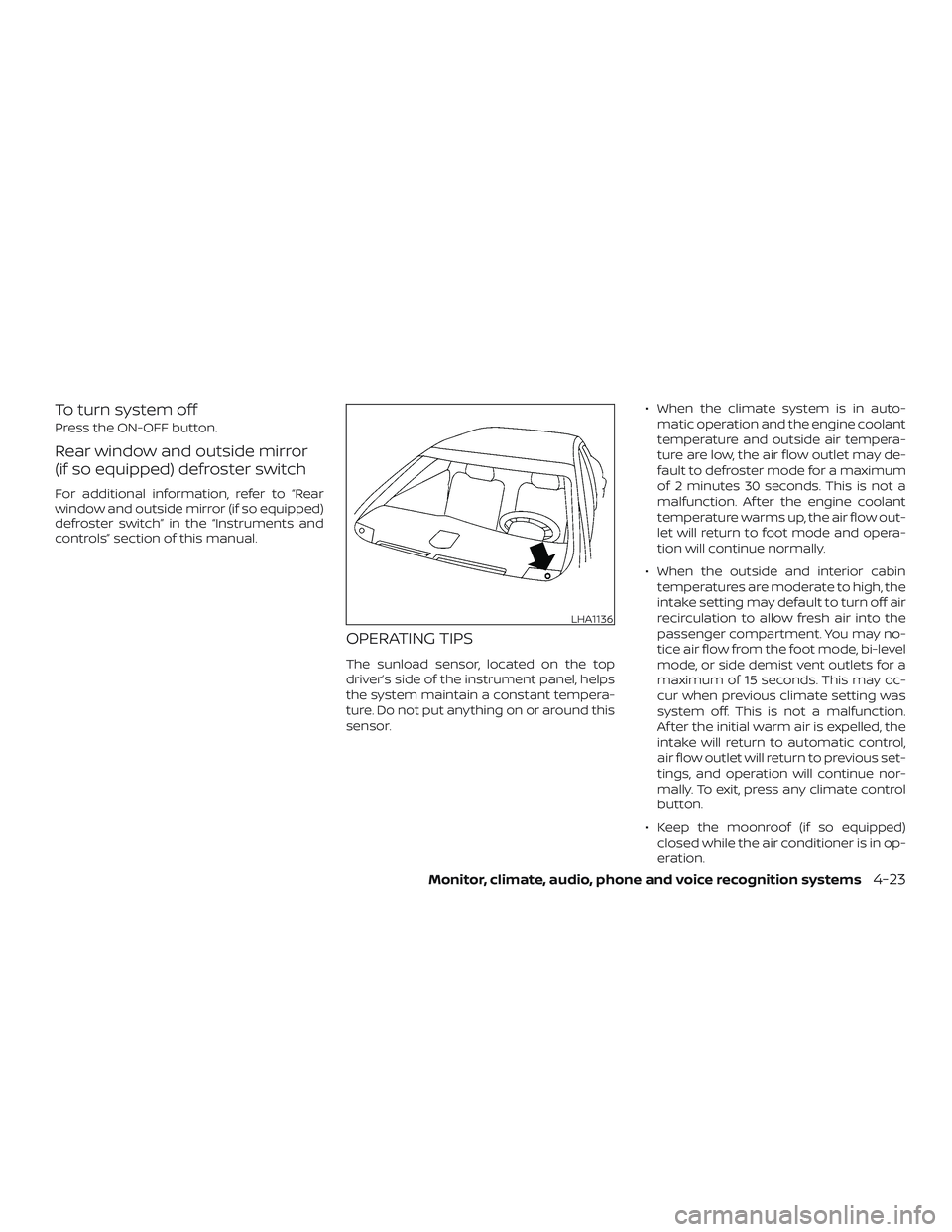
The sunload sensor, located on the top
driver’s side of the instrument panel, helps
the system maintain a constant tempera-
ture. Do not put anything on or around this
sensor.∙ When the climate system is in auto-
matic operation and the engine coolant
temperature and outside air tempera-
ture are low, the air flow outlet may de-
fault to defroster mode for a maximum
of 2 minutes 30 seconds. This is not a
malfunction. Af ter the engine coolant
temperature warms up, the air flow out-
let will return to foot mode and opera-
tion will continue normally.
∙ When the outside and interior cabin temperatures are moderate to high, the
intake setting may default to turn off air
recirculation to allow fresh air into the
passenger compartment. You may no-
tice air flow from the foot mode, bi-level
mode, or side demist vent outlets for a
maximum of 15 seconds. This may oc-
cur when previous climate setting was
system off. This is not a malfunction.
Af ter the initial warm air is expelled, the
intake will return to automatic control,
air flow outlet will return to previous set-
tings, and operation will continue nor-
mally. To exit, press any climate control
button.
∙ Keep the moonroof (if so equipped) closed while the air conditioner is in op-
eration.
LHA1136
Monitor, climate, audio, phone and voice recognition systems4-23
Page 211 of 467
area and do not indicate any malfunction
in your NISSAN radio system.
Reception conditions will constantly
change because of vehicle movement.
Buildings, terrain, signal distance and inter-
ference from other vehicles can work
against ideal reception. Described below
are some of the factors that can affect your
radio reception.
Some cellular phones or other devices may
cause interference or a buzzing noise to
come from the audio system speakers.
Storing the device in a different location
may reduce or eliminate the noise.
FM RADIO RECEPTION
Range: FM range is normally limited to 25 –
30 mi (40 – 48 km), with monaural (single
channel) FM having slightly more range
than stereo FM. External influences may
sometimes interfere with FM station re-
ception even if the FM station is within 25
mi (40 km). The strength of the FM signal is
directly related to the distance between
the transmitter and receiver. FM signals fol-
low a line-of-sight path, exhibiting many of
the same characteristics as light. For ex-
ample, they will reflect off objects.Fade and drif t: As your vehicle moves away
from a station transmitter, the signals will
tend to fade and/or drif t.
Static and flutter: During signal interfer-
ence from buildings, large hills or due to
antenna position (usually in conjunction
with increased distance from the station
transmitter), static or flutter can be heard.
This can be reduced by adjusting the treble
control to reduce treble response.
Multipath reception: Because of the reflec-
tive characteristics of FM signals, direct and
reflected signals reach the receiver at the
same time. The signals may cancel each
other, resulting in momentary flutter or loss
of sound.AM RADIO RECEPTION
AM signals, because of their low frequency,
can bend around objects and skip along
the ground. In addition, the signals can be
bounced off the ionosphere and bent back
to earth. Because of these characteristics,
AM signals are also subject to interference
as they travel from transmitter to receiver.
Fading: Occurs while the vehicle is passing
through freeway underpasses or in areas
with many tall buildings. It can also occurfor several seconds during ionospheric tur-
bulence even in areas where no obstacles
exist.
Static: Caused by thunderstorms, electrical
power lines, electric signs and even traffic
lights.
SATELLITE RADIO RECEPTION (if so
equipped)
When the satellite radio is used for the first
time or the battery has been replaced, the
satellite radio may not work properly. This
is not a malfunction. Wait more than
10 minutes with satellite radio ON and the
vehicle outside of any metal or large build-
ing for satellite radio to receive all of the
necessary data.
No satellite radio reception is available and
“NO SAT” is displayed when the SAT band
option is selected unless optional satellite
receiver and antenna are installed and a
SiriusXM® Satellite Radio service subscrip-
tion is active. Satellite radio is not available
in Alaska, Hawaii and Guam.
Satellite radio performance may be af-
fected if cargo carried on the roof blocks
the satellite radio signal.
Monitor, climate, audio, phone and voice recognition systems4-25
Page 458 of 467
Key fob battery replacement........8-24
Keyless entry With Intelligent Key system
(See Intelligent Key system) .......3-13
Keys NISSAN Intelligent Key® ..........3-2
NISSAN Vehicle Immobilizer System
keys......................3-4
L
Label Tire and Loading Information label . .10-12
Labels Air conditioner specification label . . .10-12
C.M.V.S.S. certification label .......10-11
Emission control information label . .10-12
Engine serial number ...........10-11
F.M.V.S.S. certification label ........10-11
Tire and Loading Information label . .10-12
Vehicle identification number (VIN) . .10-10
Vehicle identification number (VIN)
plate.....................10-10
Warning labels (for SRS) ..........1-61
LATCH (Lower Anchors and Tethers for
CHildren)System................1-25
License plate Installing the license plate .......10-13
Light Airbagwarninglight........1-62, 2-15
Brakelight(Seestoplight)........8-28
Bulb check/instrument panel ......2-10
Bulb replacement .............8-28
Charge warning light ...........2-12
Console light ................2-54 ExteriorandInteriorlights........8-28
Foglights..................8-26
Foglightswitch..............2-40
Headlight and turn signal switch
....2-35
Headlightcontrolswitch.........2-35
Headlights .................8-26
Interiorlight.................2-54
Lightbulbs.................8-26
Low tire pressure warning light .....2-12
Low windshield-washer fluid warning
light......................2-29
Passenger air bag and status light . . .1-53
Personal lights ...............2-55
Security indicator light ..........2-17
Spotlights(Seemaplight)........2-55
Trunklight..................2-55
Warning/indicator lights and audible
reminders ...............2-15,3-17
Lights......................8-26 Maplights..................2-55
Lock Child safety rear door lock ........3-6
Door locks ................3-4,3-5
Fuel-filler door lock opener lever . . . .3-26
Gloveboxlock...............2-46
Power door locks ...........3-5, 3-6
Trunk lid lock opener lever ........3-24
Loose fuel cap warning ...........2-28
Lowfuelwarninglight.........2-14,2-28
Low tire pressure warning light .......2-12
Low windshield-washer fluid warning
light........................2-29
Luggage
(See vehicle loading information) .....10-13 M
Maintenance General maintenance ...........9-2
Insidethevehicle..............9-3
Maintenance precautions .........8-2
Outsidethevehicle.............9-2
Seat belt maintenance ..........1-19
Under the hood and vehicle .......9-4
Maintenance log ................9-13
Maintenance requirements ..........9-2
Maintenance schedules ............9-7
Maintenance under severe operation
conditions....................9-12
Malfunctionindicatorlight..........2-16
Manual front seat adjustment ........1-3
Maplights................... .2-55
Meters and gauges ...............2-3
Instrument brightness control .....2-39
Mirror Automatic anti-glare inside mirror. . .3-30
Outsidemirrors..............3-32
Rearview ..................3-30
Vanitymirror................3-30
Mirrors......................3-30
Moonroof ....................2-52
N
NissanConnect® Owner's Manual ......4-2
NISS
AN Intelligent Key® ............3-2
NISSAN Intelligent Key® battery discharge
indicator.....................5-11
NISSAN Vehicle Immobilizer
System ..................2-32, 5-12
11-4
Page 460 of 467
Armrests ...................1-7
Frontseats..................1-2
Manual front seat adjustment ......1-3
Rearseat.................. .1-6
Security indicator light ............2-17
Security system (NISSAN Vehicle Immobilizer
System), engine start ..........2-32,5-12
Security systems Vehicle security system ..........2-31
Self-adjustingbrakes.............8-21
Service manual order form .........10-21
Servicing air conditioner ...........4-24
Shif ting Continuously Variable Transmission
(CVT) .....................5-16
Shiftleverlockrelease............5-19
Shoulder belt height adjustment ......1-19
Siri® Eyes-Free .................4-50
Spark plug replacement ...........8-17
Spark plugs ...................8-17
Specifications .................10-8
Speedometer ..................2-4
Speedometer and odometer ........2-4
Spotlights(Seemaplight)..........2-55
SRS warning label ...............1-61
Stability control ................5-83
Standard maintenance ............9-7
Starting Before starting the engine ........5-12
Jumpstarting............6-10,8-15
Precautions when starting and
driving .....................5-2
Push starting ................6-12
Starting the engine ............5-13
Starting the engine ..............5-13 Steering
Powersteeringfluid............8-11
Powersteeringsystem .........5-80
Steering wheel .................3-28
Stoplight....................8-28
Storage.....................2-45
Sunglasses case ................2-47
Sunglasses holder ...............2-47
Sunroof (see Moonroof ) ...........2-52
Sunvisors....................3-29
Supplemental air bag warning
light.................... .1-62, 2-15
Supplemental front impact air bag
system ..................... .1-51
Supplemental restraint system Information and warning labels .....1-61
Precautions on supplemental restraint
system ................... .1-44
Supplemental restraint system
(Supplemental air bag system) .......1-44
Switch Autolightswitch..............2-36
Automatic power window switch . . .2-51
Foglightswitch..............2-40
Hazard warning flasher switch ......6-2
Headlight and turn signal switch ....2-35
Headlightcontrolswitch.........2-35
Instrument brightness control .....2-39
Power door lock switch ........3-5,3-6
Rear window and outside mirror
defrosterswitch..............2-35
Turn signal switch .............2-39 T
Tachometer ...................2-5
Temperature gauge Engine coolant temperature gauge . .2-5
Thef t (NISSAN Vehicle Immobilizer System),
engine start ...............2-32,5-12
Three-waycatalyst...............5-2
Tilt Telescopicsteering............3-29
Tire F
lattire..................6-3,6-4
Spare tire ................6-5,8-43
Tire and Loading Information label . .10-12
Tire chains .................8-39
Tire pressure ................8-31
Tirerotation ................8-40
Types of tires ................8-38
Uniform tire quality grading .......10-17
Wheels and tires ..............8-31
Wheel/tire size ...............10-9
Tire pressure Low tire pressure warning light .....2-12
Tire Pressure Monitoring System
(TPMS)....................5-3,6-3
Towing 4-wheel drive models ...........6-14
Flattowing.................10-17
Trailertowing ...............10-17
Towingatrailer................10-17
Towingyourvehicle..............6-13
Transceiver HomeLink® Universal
Transceiver ..........2-56,2-58,2-59
11-6