towing NISSAN ALTIMA 2020 Owner´s Manual
[x] Cancel search | Manufacturer: NISSAN, Model Year: 2020, Model line: ALTIMA, Model: NISSAN ALTIMA 2020Pages: 559, PDF Size: 6.3 MB
Page 432 of 559
6 In case of emergency
Hazard warning flasher switch..................6-2
Emergency engine shut off ......................6-2
Flat tire ..........................................6-3
Tire Pressure Monitoring System
(TPMS)........................................6-3
Changing a flat tire ...........................6-4
Jump starting ...................................6-9 Push starting
.................................... 6-11
If your vehicle overheats .........................6-11
Towing your vehicle ............................ 6-12
Towing recommended by NISSAN ...........6-12
Vehicle recovery
(freeing a stuck vehicle) ......................6-14
Page 443 of 559
6. Af ter the engine cools down, check thecoolant level in the engine coolant res-
ervoir tank with the engine running.
Add coolant to the engine coolant res-
ervoir tank if necessary. It is recom-
mended that you visit a NISSAN dealer
for this service. When towing your vehicle, all State (Provin-
cial in Canada) and local regulations for
towing must be followed. Incorrect towing
equipment could damage your vehicle.
Towing instructions are available from a
NISSAN dealer. Local service operators are
generally familiar with the applicable laws
and procedures for towing. To assure
proper towing and to prevent accidental
damage to your vehicle, NISSAN recom-
mends having a service operator tow your
vehicle. It is advisable to have the service
operator carefully read the following pre-
cautions:
WARNING
∙ Never ride in a vehicle that is being
towed.
∙ Never get under your vehicle af ter it has been lif ted by a tow truck.
CAUTION
∙ When towing, make sure that thetransmission, axles, steering system
and powertrain are in working condi-
tion. If any of these conditions apply,
dollies or a flatbed tow truck must be
used.
∙ Always attach safety chains before towing.
For additional information, refer to “Flat
towing” in the “Technical and consumer in-
formation” section of this manual.
TOWING RECOMMENDED BY
NISSAN
NISSAN recommends towing your vehicle
based upon the type of drivetrain. For addi-
tional information, refer to the diagrams in
this section to ensure that your vehicle is
properly towed.
TOWING YOUR VEHICLE
6-12In case of emergency
Page 444 of 559
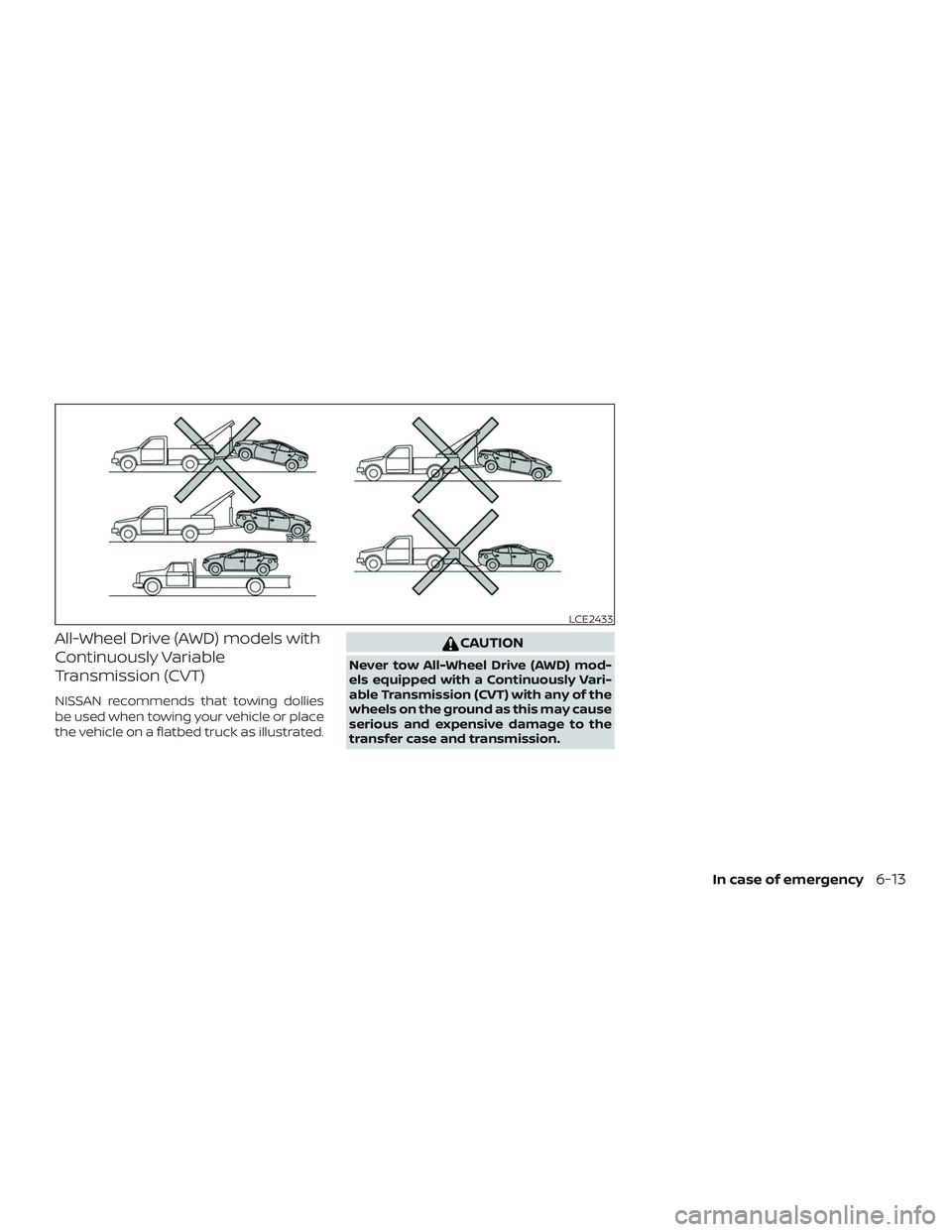
All-Wheel Drive (AWD) models with
Continuously Variable
Transmission (CVT)
NISSAN recommends that towing dollies
be used when towing your vehicle or place
the vehicle on a flatbed truck as illustrated.
CAUTION
Never tow All-Wheel Drive (AWD) mod-
els equipped with a Continuously Vari-
able Transmission (CVT) with any of the
wheels on the ground as this may cause
serious and expensive damage to the
transfer case and transmission.
LCE2433
In case of emergency6-13
Page 445 of 559
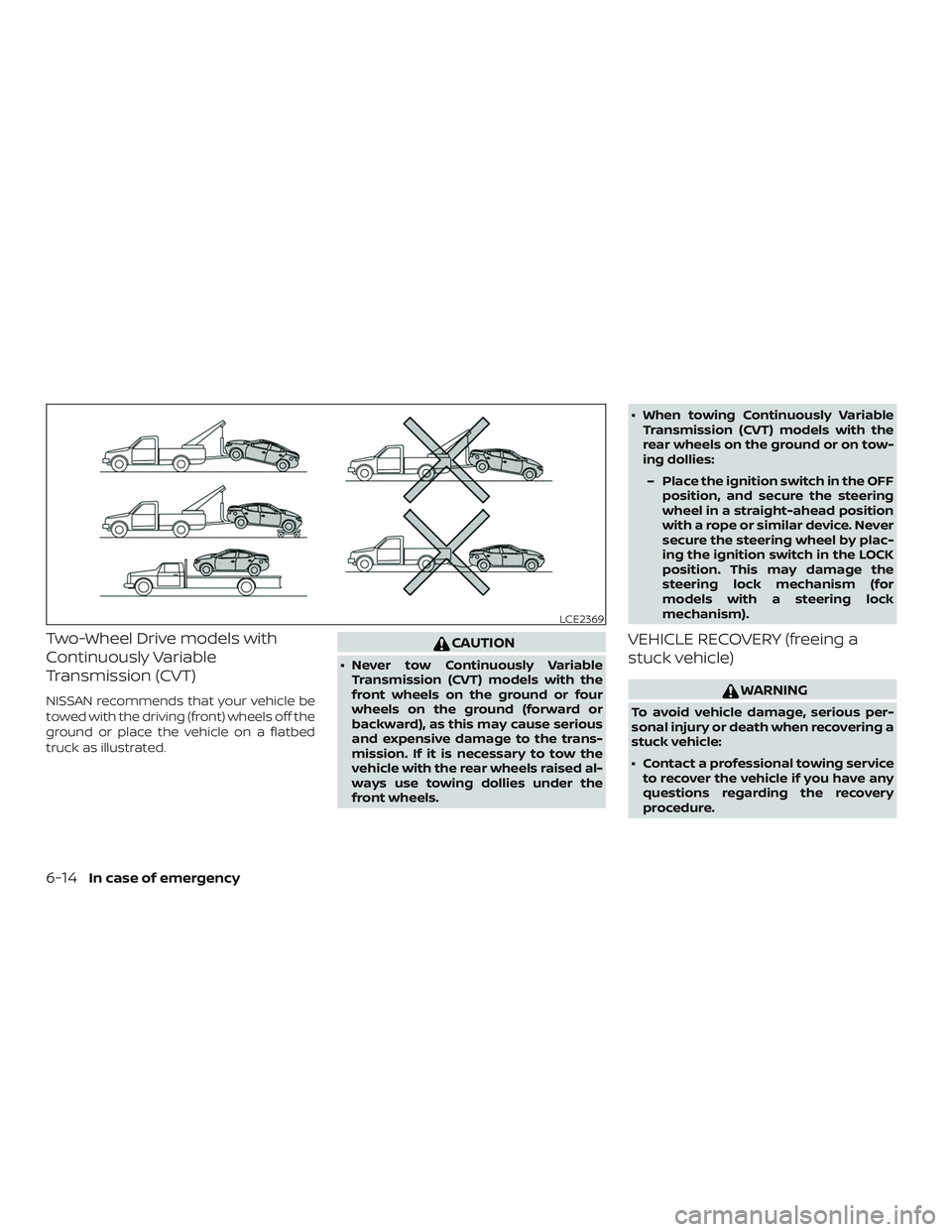
Two-Wheel Drive models with
Continuously Variable
Transmission (CVT)
NISSAN recommends that your vehicle be
towed with the driving (front) wheels off the
ground or place the vehicle on a flatbed
truck as illustrated.
CAUTION
∙ Never tow Continuously VariableTransmission (CVT) models with the
front wheels on the ground or four
wheels on the ground (forward or
backward), as this may cause serious
and expensive damage to the trans-
mission. If it is necessary to tow the
vehicle with the rear wheels raised al-
ways use towing dollies under the
front wheels. ∙ When towing Continuously Variable
Transmission (CVT) models with the
rear wheels on the ground or on tow-
ing dollies:
– Place the ignition switch in the OFF position, and secure the steering
wheel in a straight-ahead position
with a rope or similar device. Never
secure the steering wheel by plac-
ing the ignition switch in the LOCK
position. This may damage the
steering lock mechanism (for
models with a steering lock
mechanism).
VEHICLE RECOVERY (freeing a
stuck vehicle)
WARNING
To avoid vehicle damage, serious per-
sonal injury or death when recovering a
stuck vehicle:
∙ Contact a professional towing serviceto recover the vehicle if you have any
questions regarding the recovery
procedure.
LCE2369
6-14In case of emergency
Page 446 of 559
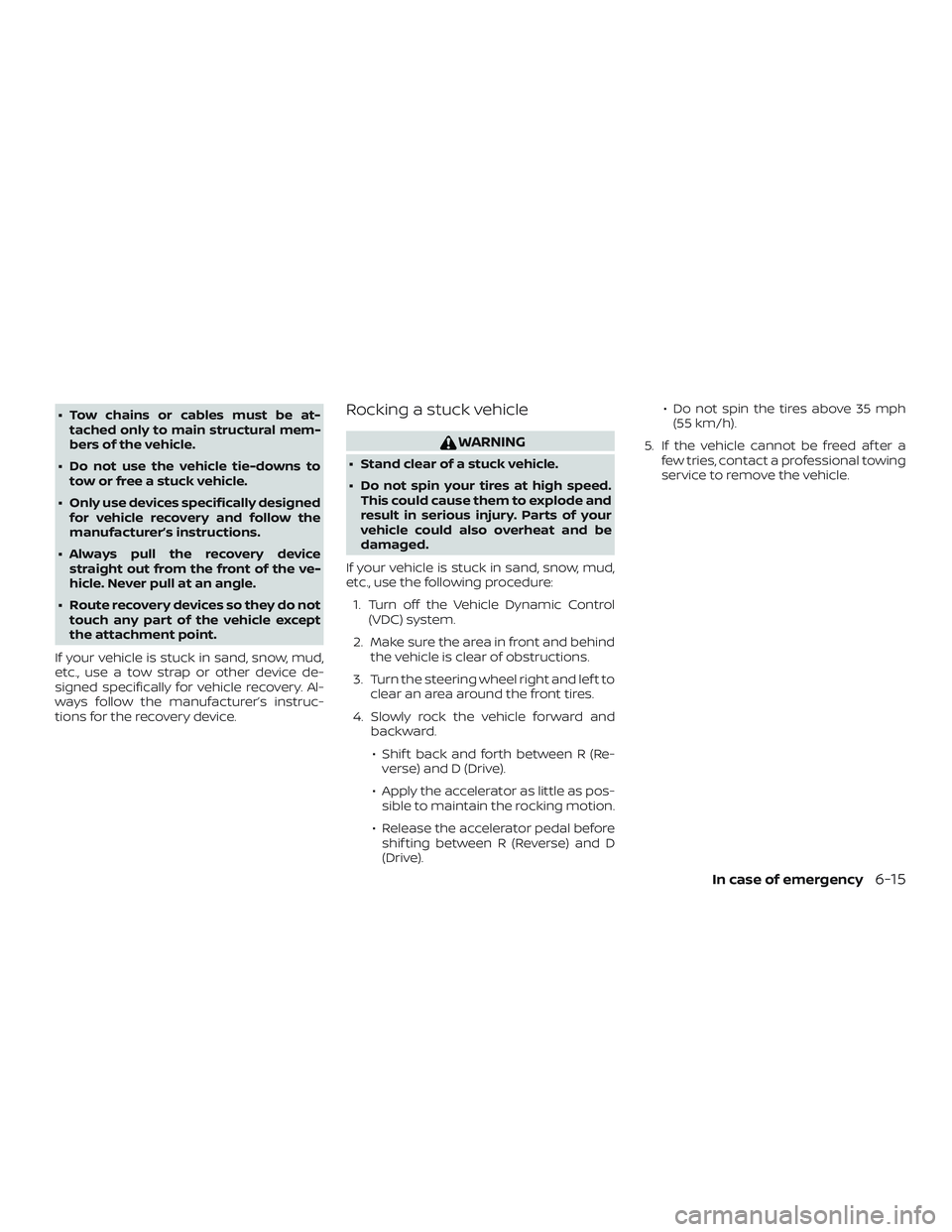
∙ Tow chains or cables must be at-tached only to main structural mem-
bers of the vehicle.
∙ Do not use the vehicle tie-downs to tow or free a stuck vehicle.
∙ Only use devices specifically designed for vehicle recovery and follow the
manufacturer’s instructions.
∙ Always pull the recovery device straight out from the front of the ve-
hicle. Never pull at an angle.
∙ Route recovery devices so they do not touch any part of the vehicle except
the attachment point.
If your vehicle is stuck in sand, snow, mud,
etc., use a tow strap or other device de-
signed specifically for vehicle recovery. Al-
ways follow the manufacturer’s instruc-
tions for the recovery device.Rocking a stuck vehicle
WARNING
∙ Stand clear of a stuck vehicle.
∙ Do not spin your tires at high speed. This could cause them to explode and
result in serious injury. Parts of your
vehicle could also overheat and be
damaged.
If your vehicle is stuck in sand, snow, mud,
etc., use the following procedure: 1. Turn off the Vehicle Dynamic Control (VDC) system.
2. Make sure the area in front and behind the vehicle is clear of obstructions.
3. Turn the steering wheel right and lef t to clear an area around the front tires.
4. Slowly rock the vehicle forward and backward.
∙ Shif t back and forth between R (Re- verse) and D (Drive).
∙ Apply the accelerator as little as pos- sible to maintain the rocking motion.
∙ Release the accelerator pedal before shif ting between R (Reverse) and D
(Drive). ∙ Do not spin the tires above 35 mph
(55 km/h).
5. If the vehicle cannot be freed af ter a few tries, contact a professional towing
service to remove the vehicle.
In case of emergency6-15
Page 505 of 559
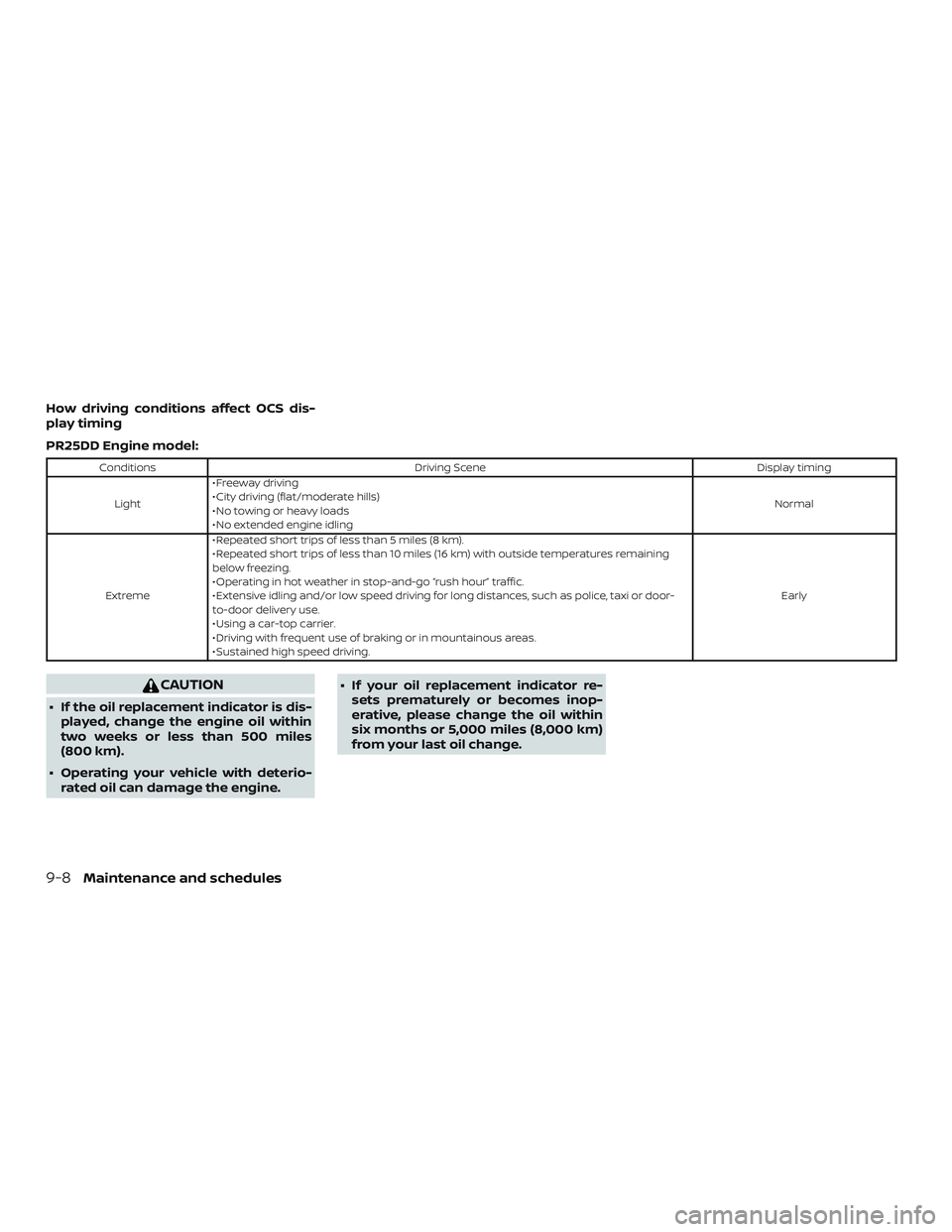
How driving conditions affect OCS dis-
play timing
PR25DD Engine model:
ConditionsDriving Scene Display timing
Light ∙ Freeway driving
∙ City driving (flat/moderate hills)
∙ No towing or heavy loads
∙ No extended engine idling Normal
Extreme ∙ Repeated short trips of less than 5 miles (8 km).
∙ Repeated short trips of less than 10 miles (16 km) with outside temperatures remaining
below freezing.
∙ Operating in hot weather in stop-and-go “rush hour” traffic.
∙ Extensive idling and/or low speed driving for long distances, such as police, taxi or door-
to-door delivery use.
∙ Using a car-top carrier.
∙ Driving with frequent use of braking or in mountainous areas.
∙ Sustained high speed driving. Early
CAUTION
∙ If the oil replacement indicator is dis-
played, change the engine oil within
two weeks or less than 500 miles
(800 km).
∙ Operating your vehicle with deterio- rated oil can damage the engine. ∙ If your oil replacement indicator re-
sets prematurely or becomes inop-
erative, please change the oil within
six months or 5,000 miles (8,000 km)
from your last oil change.
9-8Maintenance and schedules
Page 506 of 559
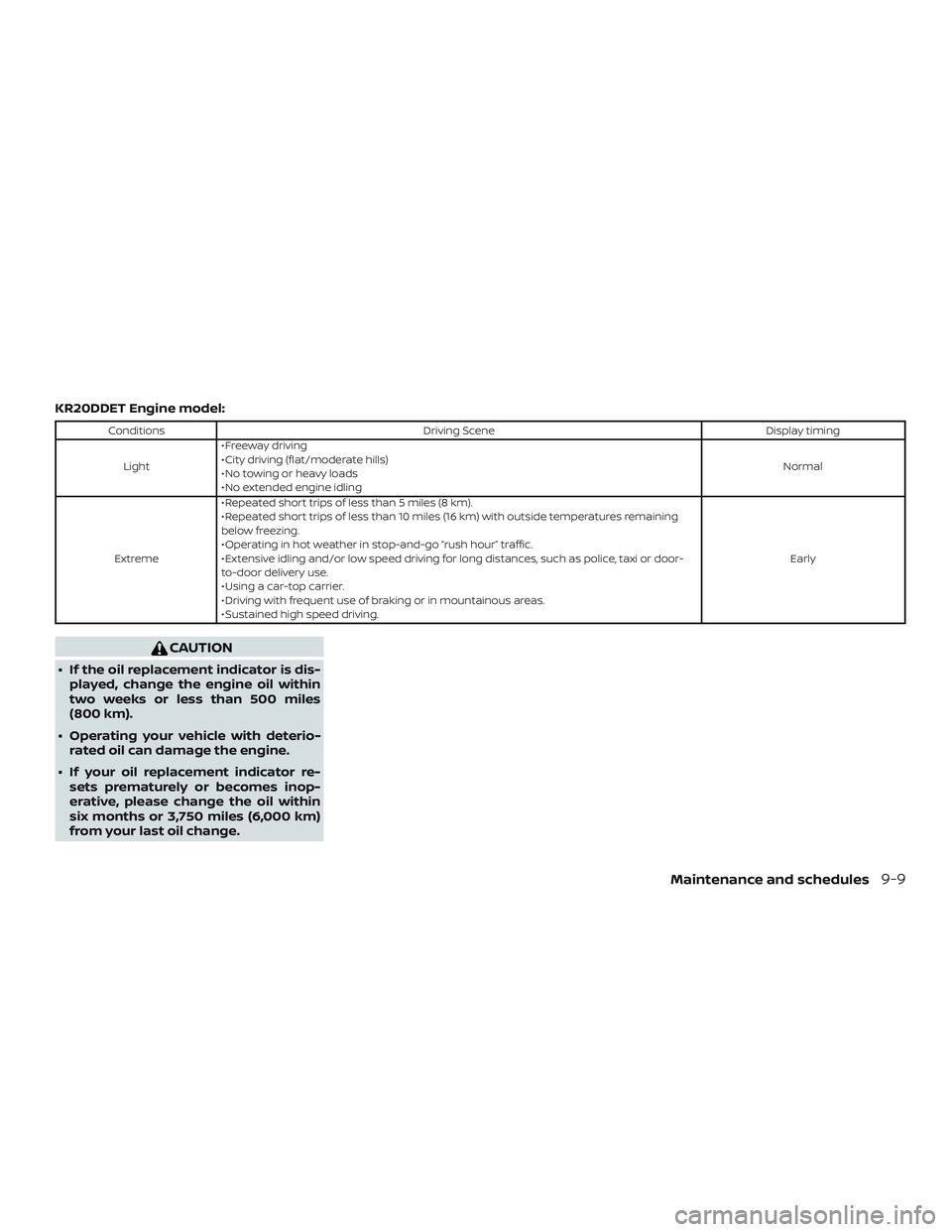
KR20DDET Engine model:
ConditionsDriving Scene Display timing
Light ∙ Freeway driving
∙ City driving (flat/moderate hills)
∙ No towing or heavy loads
∙ No extended engine idling Normal
Extreme ∙ Repeated short trips of less than 5 miles (8 km).
∙ Repeated short trips of less than 10 miles (16 km) with outside temperatures remaining
below freezing.
∙ Operating in hot weather in stop-and-go “rush hour” traffic.
∙ Extensive idling and/or low speed driving for long distances, such as police, taxi or door-
to-door delivery use.
∙ Using a car-top carrier.
∙ Driving with frequent use of braking or in mountainous areas.
∙ Sustained high speed driving. Early
CAUTION
∙ If the oil replacement indicator is dis-
played, change the engine oil within
two weeks or less than 500 miles
(800 km).
∙ Operating your vehicle with deterio- rated oil can damage the engine.
∙ If your oil replacement indicator re- sets prematurely or becomes inop-
erative, please change the oil within
six months or 3,750 miles (6,000 km)
from your last oil change.
Maintenance and schedules9-9
Page 522 of 559
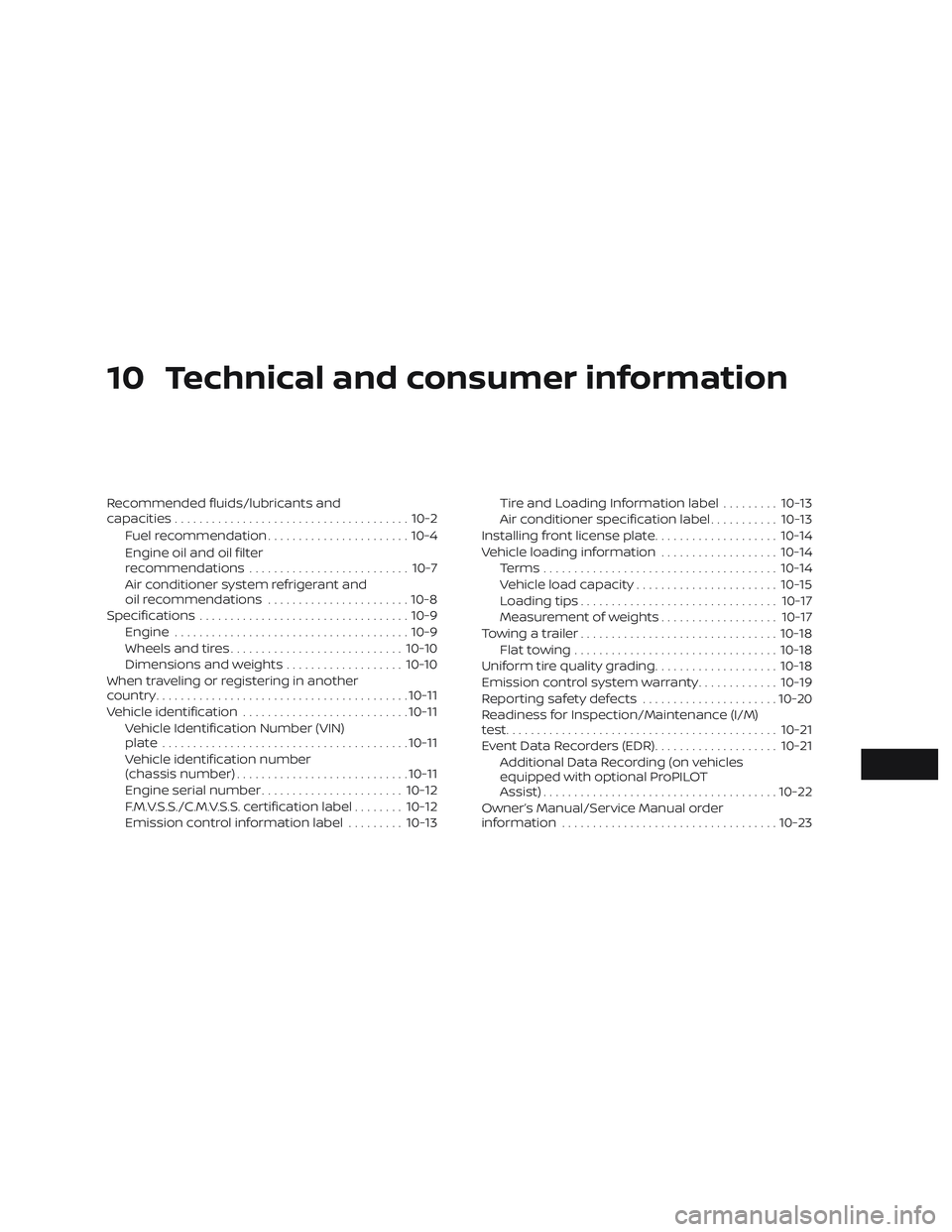
10 Technical and consumer information
Recommended fluids/lubricants and
capacities...................................... 10-2
Fuel recommendation ....................... 10-4
Engine oil and oil filter
recommendations .......................... 10-7
Air conditioner system refrigerant and
oil recommendations .......................10-8
Specifications .................................. 10-9
Engine ...................................... 10-9
Wheels and tires ............................ 10-10
Dimensions and weights ...................10-10
When traveling or registering in another
country ......................................... 10-11
Vehicle identification ........................... 10-11
Vehicle Identification Number (VIN)
plate ........................................ 10-11
Vehicle identification number
(chassis number) ............................ 10-11
Engine serial number ....................... 10-12
F.M.V.S.S./C.M.V.S.S. certification label ........10-12
Emission control information label .........10-13 Tire and Loading Information label
.........10-13
Air conditioner specification label ...........10-13
Installing front license plate ....................10-14
Vehicle loading information ...................10-14
Terms ...................................... 10-14
Vehicle load capacity ....................... 10-15
Loading tips ................................ 10-17
Measurement of weights ...................10-17
Towing a trailer ................................ 10-18
Flat towing ................................. 10-18
Uniform tire quality grading ....................10-18
Emission control system warranty .............10-19
Reporting safety defects ......................10-20
Readiness for Inspection/Maintenance (I/M)
test ............................................ 10-21
Event Data Recorders (EDR) ....................10-21
Additional Data Recording (on vehicles
equipped with optional ProPILOT
Assist) ...................................... 10-22
Owner’s Manual/Service Manual order
inf
ormation ................................... 10-23
Page 539 of 559
Do not tow a trailer with your vehicle.
FLAT TOWING
Towing your vehicle with all four wheels on
the ground is sometimes called flat towing.
This method is sometimes used when
towing a vehicle behind a recreational ve-
hicle, such as a motor home.
CAUTION
∙ Failure to follow these guidelines canresult in severe transmission damage.
∙ Whenever flat towing your vehicle, al- ways tow forward, never backward.
∙ Never tow your front wheel drive ve- hicle with the front tires on the
ground. Doing so may cause serious
and expensive damage to the
powertrain.
∙ DO NOT tow any continuously variable transmission vehicle with all four
wheels on the ground (flat towing).
Doing so WILL DAMAGE internal trans-
mission parts due to lack of transmis-
sion lubrication. ∙ For emergency towing procedures re-
fer to “Towing recommended by
NISSAN” in the “In case of emergency ”
section of this manual.
Continuously Variable
Transmission (CVT)
To tow a vehicle equipped with a CVT, an
appropriate vehicle dolly MUSTbe placed
under the towed vehicle’s drive wheels.
Always follow the dolly manufacturer’s
recommendations when using their prod-
uct. DOT (Department of Transportation) Qual-
ity Grades: All passenger car tires must
conform to federal safety requirements in
addition to these grades.
Quality grades can be found where appli-
cable on the tire sidewall between tread
shoulder and maximum section width. For
example:
Treadwear 200 Traction AA Temperature A
Treadwear
The treadwear grade is a comparative rat-
ing based on the wear rate of the tire when
tested under controlled conditions on a
specified government test course. For ex-
ample, a tire graded 150 would wear one
and one-half (1 1/2) times as well on the
government course as a tire graded 100.
The relative performance of tires depends
upon the actual conditions of their use,
however, and may depart significantly from
the norm due to variations in driving habits,
service practices and differences in road
characteristics and climate.
TOWING A TRAILER
UNIFORM TIRE QUALITY GRADING
10-18Technical and consumer information
Page 551 of 559
Armrests ...................1-7Automatic drive positioner. .3-32, 3-33, 3-34
Frontseats..................1-2
Manual front seat adjustment ......1-3
Rearseat...................1-5
Security indicator light ............2-17
Security system (NISSAN Vehicle Immobilizer
System), engine start ..........2-42,5-16
Security systems Vehicle security system .........2-40
Self-adjustingbrakes.............8-20
Service manual order form .........10-23
Servicing air conditioner ...........4-41
Shif ting Continuously Variable Transmission
(CVT) .....................5-21
Shiftleverlockrelease............5-23
Shoulder belt height adjustment ......1-19
Sonar Rear system ................5-175
Spark plug replacement ...........8-17
Spark plugs ...................8-17
Specifications ..................10-9
Speedometer ................2-4,2-5
Speedometer and odometer ........2-4
Spotlights(Seemaplight)..........2-66
SRS warning label ...............1-67
Stability control ................5-171
Standard maintenance . .9-10, 9-11, 9-14, 9-15
Starting Before starting the engine ........5-17
Jumpstarting.............6-9,8-15
Precautions when starting and
driving ..................5-4,5-11
Push starting ................6-11
Starting the engine ............5-17 Starting the engine
..............5-17
Steering Heated steering wheel ..........2-53
Powersteeringsystem.........5-168
Steering Assist switch
(forvehicleswithProPILOTAssist).....2-54
Steering wheel .................3-28
Stoplight....................8-26
Storage.....................2-58
Sunglasses case ................2-59
Sunglasses holder ..............2-59
Sunroof ......................7-5
Sunroof (see Moonroof ) ...........2-64
Sunvisors....................3-29
Supplemental air bag warning
light.................... .1-67, 2-15
Supplemental front impact air bag
system ..................... .1-54
Supplemental restraint system Information and warning labels . . . .1-67
Precautions on supplemental restraint
system ................... .1-46
Supplemental restraint system
(Supplemental air bag system) .......1-46
Switch Autolightswitch..............2-47
Automatic power window switch . . .2-63
Foglightswitch ..............2-51
Hazard warning flasher switch ......6-2
Headlight and turn signal switch ....2-45
Headlightcontrolswitch.........2-45
Instrument brightness control .....2-50
Power door lock switch ..........3-6
Rear window and outside mirror
defrosterswitch..............2-44
Turn signal switch .............2-50 T
Tachometer ...................2-6
Temperature gauge Engine coolant temperature gauge . .2-6
Thef t (NISSAN Vehicle Immobilizer System),
engine start ...............2-42,5-16
Three-waycatalyst...............5-4
Tilt T
elescopicsteering............3-28
Tire Flattire..................6-3,6-4
Spare tire ...............6-5,8-40
Tire and Loading Information label . .10-13
Tire chains .................8-36
Tire pressure ................8-29
Tirerotation.................8-37
Types of tires ................8-35
Uniform tire quality grading ......10-18
Wheels and tires ..............8-29
Wheel/tire size ...............10-10
Tire pressure Low tire pressure warning light .....2-12
Tire Pressure Monitoring System
(TPMS)....................5-5,6-3
Towing 4-wheel drive models ...........6-14
Flattowing.................10-18
Trailertowing...............10-18
Towingatrailer................10-18
Towingyourvehicle..............6-12
Traffic Sign Recognition (TSR) ........5-31
Transceiver HomeLink® Universal Transceiver . . .2-67, 2-68, 2-69, 2-70, 2-70, 2-71
11-6