tire type NISSAN ALTIMA 2023 User Guide
[x] Cancel search | Manufacturer: NISSAN, Model Year: 2023, Model line: ALTIMA, Model: NISSAN ALTIMA 2023Pages: 644, PDF Size: 4.12 MB
Page 491 of 644
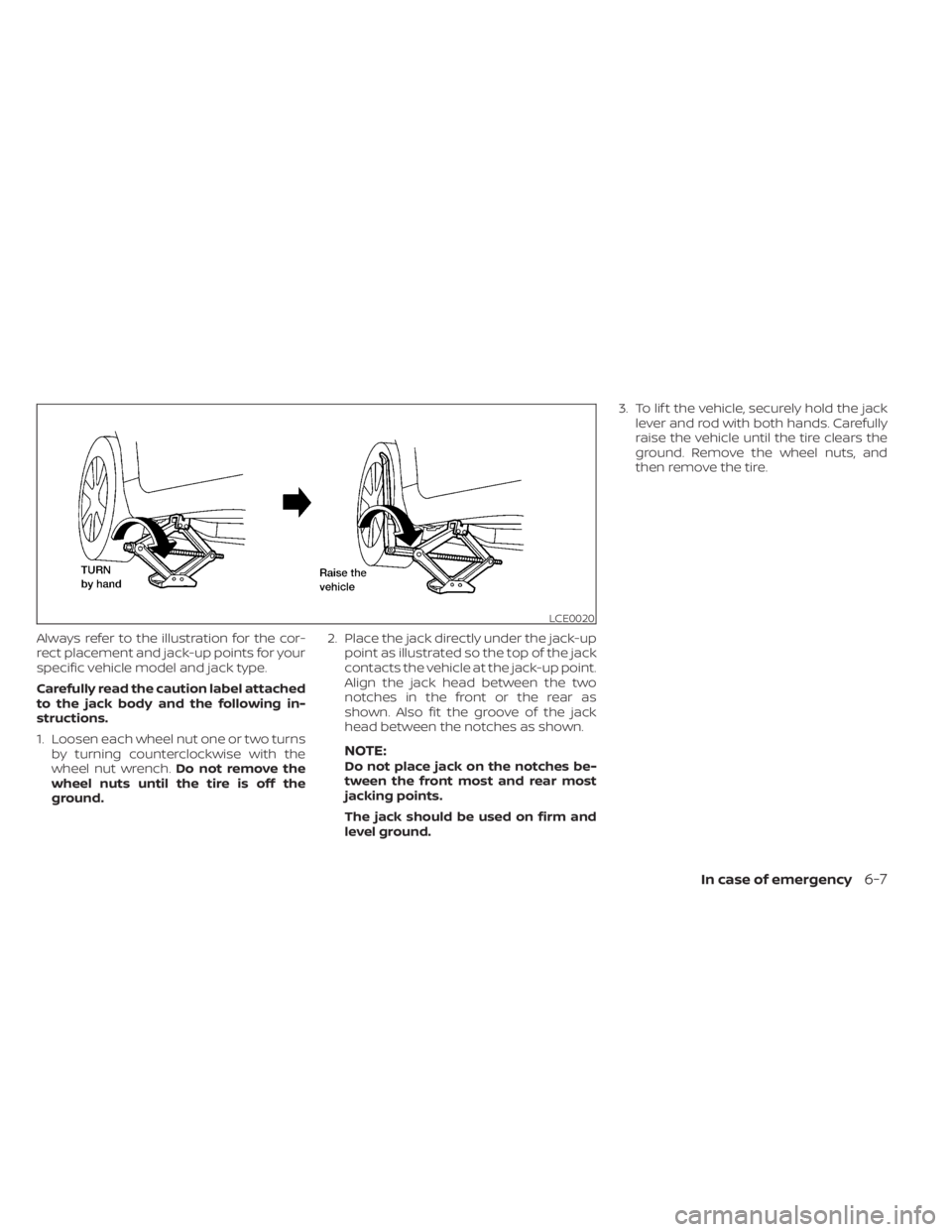
Always refer to the illustration for the cor-
rect placement and jack-up points for your
specific vehicle model and jack type.
Carefully read the caution label attached
to the jack body and the following in-
structions.
1. Loosen each wheel nut one or two turnsby turning counterclockwise with the
wheel nut wrench. Do not remove the
wheel nuts until the tire is off the
ground. 2. Place the jack directly under the jack-up
point as illustrated so the top of the jack
contacts the vehicle at the jack-up point.
Align the jack head between the two
notches in the front or the rear as
shown. Also fit the groove of the jack
head between the notches as shown.
NOTE:Do not place jack on the notches be-
tween the front most and rear most
jacking points.
The jack should be used on firm and
level ground. 3. To lif t the vehicle, securely hold the jack
lever and rod with both hands. Carefully
raise the vehicle until the tire clears the
ground. Remove the wheel nuts, and
then remove the tire.
LCE0020
In case of emergency6-7
Page 493 of 644
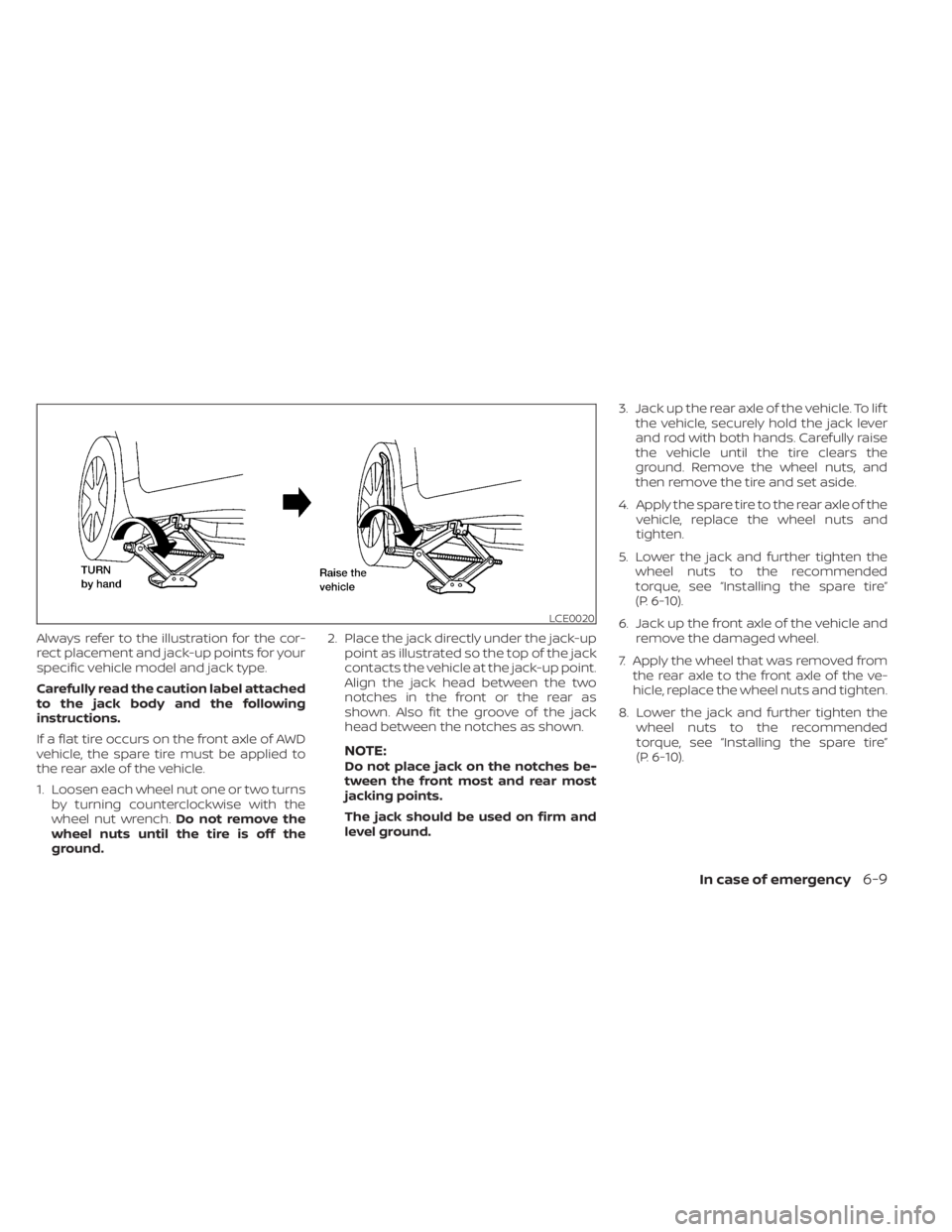
Always refer to the illustration for the cor-
rect placement and jack-up points for your
specific vehicle model and jack type.
Carefully read the caution label attached
to the jack body and the following
instructions.
If a flat tire occurs on the front axle of AWD
vehicle, the spare tire must be applied to
the rear axle of the vehicle.
1. Loosen each wheel nut one or two turnsby turning counterclockwise with the
wheel nut wrench. Do not remove the
wheel nuts until the tire is off the
ground. 2. Place the jack directly under the jack-up
point as illustrated so the top of the jack
contacts the vehicle at the jack-up point.
Align the jack head between the two
notches in the front or the rear as
shown. Also fit the groove of the jack
head between the notches as shown.
NOTE:Do not place jack on the notches be-
tween the front most and rear most
jacking points.
The jack should be used on firm and
level ground. 3. Jack up the rear axle of the vehicle. To lif t
the vehicle, securely hold the jack lever
and rod with both hands. Carefully raise
the vehicle until the tire clears the
ground. Remove the wheel nuts, and
then remove the tire and set aside.
4. Apply the spare tire to the rear axle of the vehicle, replace the wheel nuts and
tighten.
5. Lower the jack and further tighten the wheel nuts to the recommended
torque, see “Installing the spare tire”
(P. 6-10).
6. Jack up the front axle of the vehicle and remove the damaged wheel.
7. Apply the wheel that was removed from the rear axle to the front axle of the ve-
hicle, replace the wheel nuts and tighten.
8. Lower the jack and further tighten the wheel nuts to the recommended
torque, see “Installing the spare tire”
(P. 6-10).
LCE0020
In case of emergency6-9
Page 517 of 644
8 Do-it-yourself
Maintenance precautions.......................8-2
Engine compartment check locations ...........8-3
Engine cooling system ..........................8-5
Checking engine coolant level ................8-6
Changing engine coolant ....................8-6
Engine oil .......................................8-7
Checking engine oil level .....................8-7
Changing engine oil and oil filter ..............8-8
Continuously Variable Transmission (CVT)
fluid ............................................ 8-12
Brake fluid ...................................... 8-12
Windshield-washer fluid ........................8-13
Windshield-washer fluid reservoir ...........8-13
Battery......................................... 8-14
Jump starting ............................... 8-15
Variable voltage control system ................8-16
Drive belt ....................................... 8-16
Spark plugs .................................... 8-17
Replacing spark plugs ....................... 8-17
Air cleaner ..................................... 8-18In-cabin microfilter
.......................... 8-18
Windshield wiper blades ........................8-19
Cleaning .................................... 8-19
Replacing ................................... 8-19
Brakes ......................................... 8-20
Fuses .......................................... 8-21
Engine compartment ....................... 8-21
Passenger compartment ...................8-22
Battery replacement ........................... 8-23
NISSAN Intelligent Key® ......................8-24
Lights .......................................... 8-25
Headlights .................................. 8-25
Fog lights (if so equipped) ...................8-26
Exterior and interior lights ...................8-26
Wheels and tires ............................... 8-29
Tire pressure ................................ 8-29
Tire labeling ................................. 8-33
Types of tires ................................
8-36
Tir
e chains .................................. 8-37
Changing wheels and tires ..................8-39
Page 550 of 644
6. Two- or three-digit number (95):This number is the tire's load in-
dex. It is a measurement of how
much weight each tire can
support.
7. H: Tire speed rating. You should not drive the vehicle faster than
the tire speed rating.
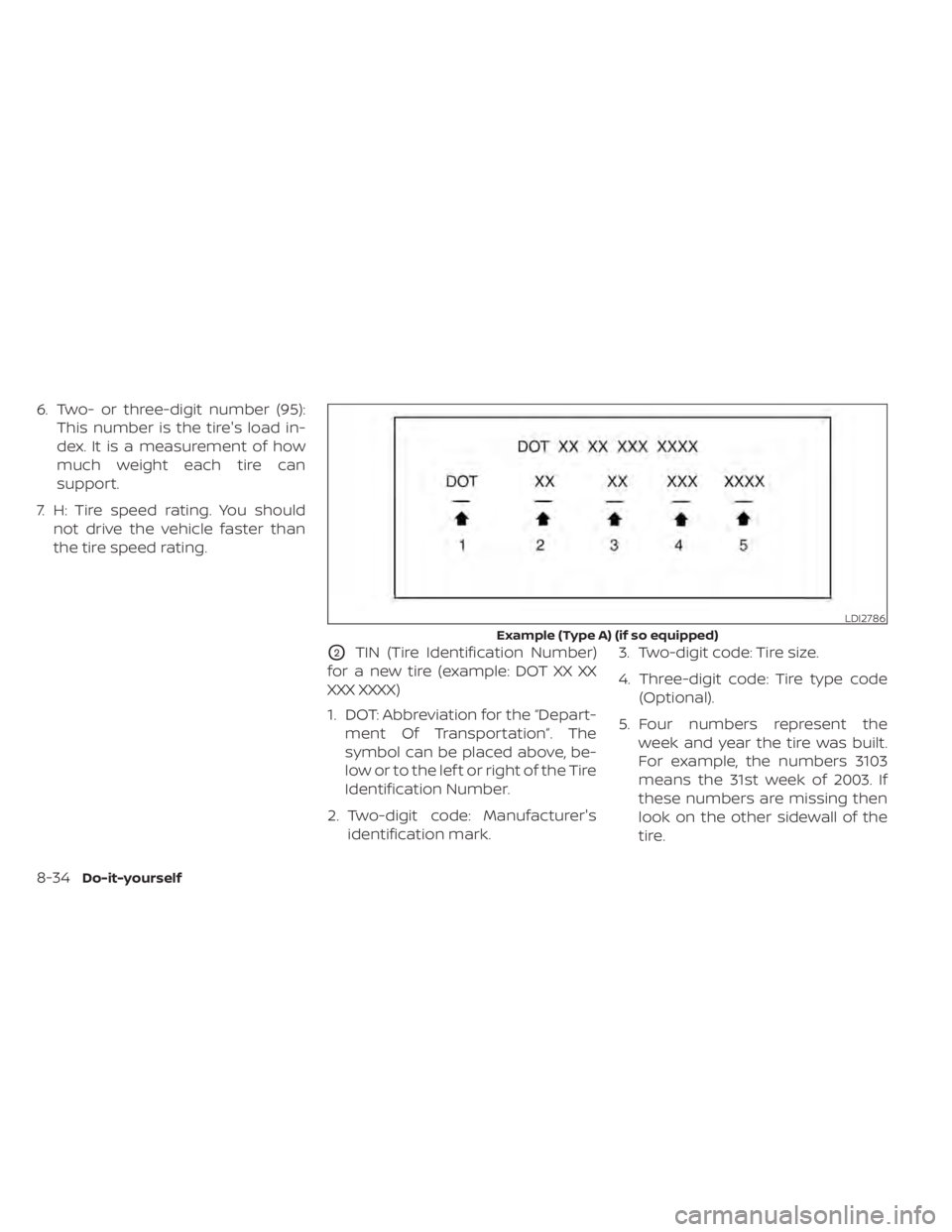
O2TIN (Tire Identification Number)
for a new tire (example: DOT XX XX
XXX XXXX)
1. DOT: Abbreviation for the “Depart- ment Of Transportation”. The
symbol can be placed above, be-
low or to the lef t or right of the Tire
Identification Number.
2. Two-digit code: Manufacturer's identification mark. 3. Two-digit code: Tire size.
4. Three-digit code: Tire type code
(Optional).
5. Four numbers represent the week and year the tire was built.
For example, the numbers 3103
means the 31st week of 2003. If
these numbers are missing then
look on the other sidewall of the
tire.
LDI2786
Example (Type A) (if so equipped)
8-34Do-it-yourself
Page 551 of 644
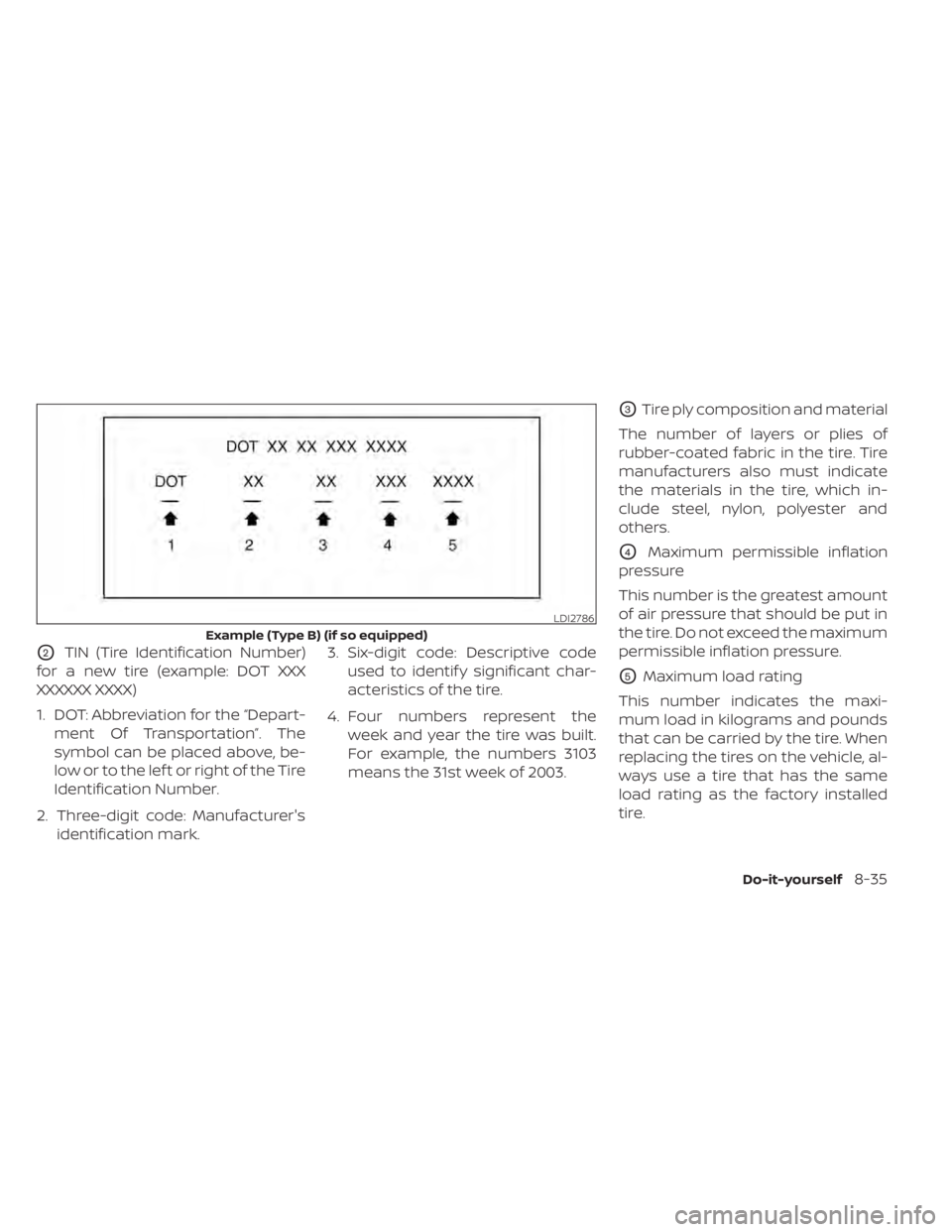
O2TIN (Tire Identification Number)
for a new tire (example: DOT XXX
XXXXXX XXXX)
1. DOT: Abbreviation for the “Depart- ment Of Transportation”. The
symbol can be placed above, be-
low or to the lef t or right of the Tire
Identification Number.
2. Three-digit code: Manufacturer's identification mark. 3. Six-digit code: Descriptive code
used to identif y significant char-
acteristics of the tire.
4. Four numbers represent the week and year the tire was built.
For example, the numbers 3103
means the 31st week of 2003.
O3Tire ply composition and material
The number of layers or plies of
rubber-coated fabric in the tire. Tire
manufacturers also must indicate
the materials in the tire, which in-
clude steel, nylon, polyester and
others.
O4Maximum permissible inflation
pressure
This number is the greatest amount
of air pressure that should be put in
the tire. Do not exceed the maximum
permissible inflation pressure.
O5Maximum load rating
This number indicates the maxi-
mum load in kilograms and pounds
that can be carried by the tire. When
replacing the tires on the vehicle, al-
ways use a tire that has the same
load rating as the factory installed
tire.
LDI2786
Example (Type B) (if so equipped)
Do-it-yourself8-35
Page 552 of 644
O6Term of “tubeless” or “tube type”
Indicates whether the tire requires
an inner tube (“tube type”) or not
(“tubeless”).
O7The word “radial”
The word “radial” is shown if the tire
has radial structure.
O8Manufacturer or brand name
Manufacturer or brand name is
shown.
Other Tire-related Terminology
In addition to the many terms that
are defined throughout this section,
Intended Outboard Sidewall is (1) the
sidewall that contains a whitewall,
bears white lettering or bears
manufacturer, brand, and/or model
name molding that is higher or
deeper than the same molding on
the other sidewall of the tire, or (2)
the outward facing sidewall of an
asymmetrical tire that has a particu- lar side that must always face out-
ward when mounted on a vehicle.
TYPES OF TIRES
WARNING
• When changing or replacing tires, be
sure all four tires are of the same type
(i.e., Summer, All Season or Snow)
and construction. A NISSAN dealer
may be able to help you with infor-
mation about tire type, size, speed
rating and availability.
• Replacement tires may have a lower
speed rating than the factory
equipped tires, and may not match
the potential maximum vehicle
speed. Never exceed the maximum
speed rating of the tire.
• Replacing tires with those not origi-
nally specified by NISSAN could af-
fect the proper operation of the low
tire pressure warning system. •
Always use tires of the same type,
size, brand, construction and tread
pattern on all four wheels. Failure to
do so may result in a circumference
difference between tires on the front
and rear axles which can cause the
Vehicle Dynamic Control (VDC) sys-
tem to malfunction resulting in per-
sonal injury or death, excessive tire
wear and may damage the transmis-
sion and differential gears.
• For additional information regarding
tires, refer to “Important Tire Safety
Information” (US) or “Tire Safety In-
formation” (Canada) in the Warranty
Information Booklet.
All-Wheel Drive (AWD) models
WARNING
For AWD vehicles - the TEMPORARY USE
ONLY spare tire must be installed to the
rear wheels only. If a front tire is punc-
tured, install the original rear tire onto
the front wheel, then install the TEMPO-
RARY USE ONLY spare tire on the rear.
Failure to do so could cause overheat-
ing to the AWD system
8-36Do-it-yourself
Page 554 of 644
Use of tire chains may be prohibited ac-
cording to location. Check the local laws
before installing tire chains. When installing
tire chains, make sure they are the proper
size for the tires on your vehicle and are
installed according to the chain manufac-
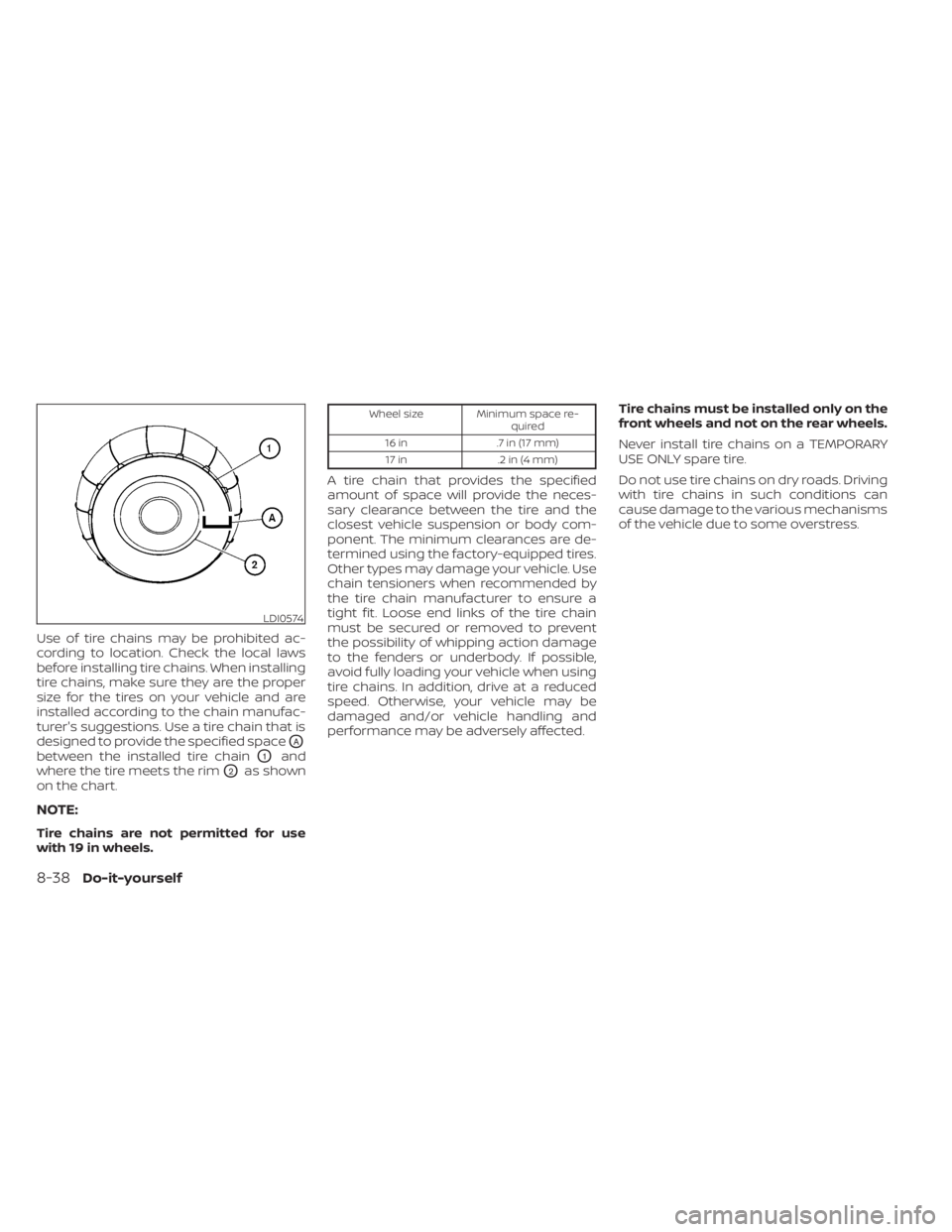
turer's suggestions. Use a tire chain that is
designed to provide the specified space
OA
between the installed tire chainO1and
where the tire meets the rim
O2as shown
on the chart.
NOTE:
Tire chains are not permitted for use
with 19 in wheels.
Wheel size Minimum space re-
quired
16 in .7 in (17 mm)
17 in .2 in (4 mm)
A tire chain that provides the specified
amount of space will provide the neces-
sary clearance between the tire and the
closest vehicle suspension or body com-
ponent. The minimum clearances are de-
termined using the factory-equipped tires.
Other types may damage your vehicle. Use
chain tensioners when recommended by
the tire chain manufacturer to ensure a
tight fit. Loose end links of the tire chain
must be secured or removed to prevent
the possibility of whipping action damage
to the fenders or underbody. If possible,
avoid fully loading your vehicle when using
tire chains. In addition, drive at a reduced
speed. Otherwise, your vehicle may be
damaged and/or vehicle handling and
performance may be adversely affected. Tire chains must be installed only on the
front wheels and not on the rear wheels.
Never install tire chains on a TEMPORARY
USE ONLY spare tire.
Do not use tire chains on dry roads. Driving
with tire chains in such conditions can
cause damage to the various mechanisms
of the vehicle due to some overstress.
LDI0574
8-38Do-it-yourself
Page 610 of 644
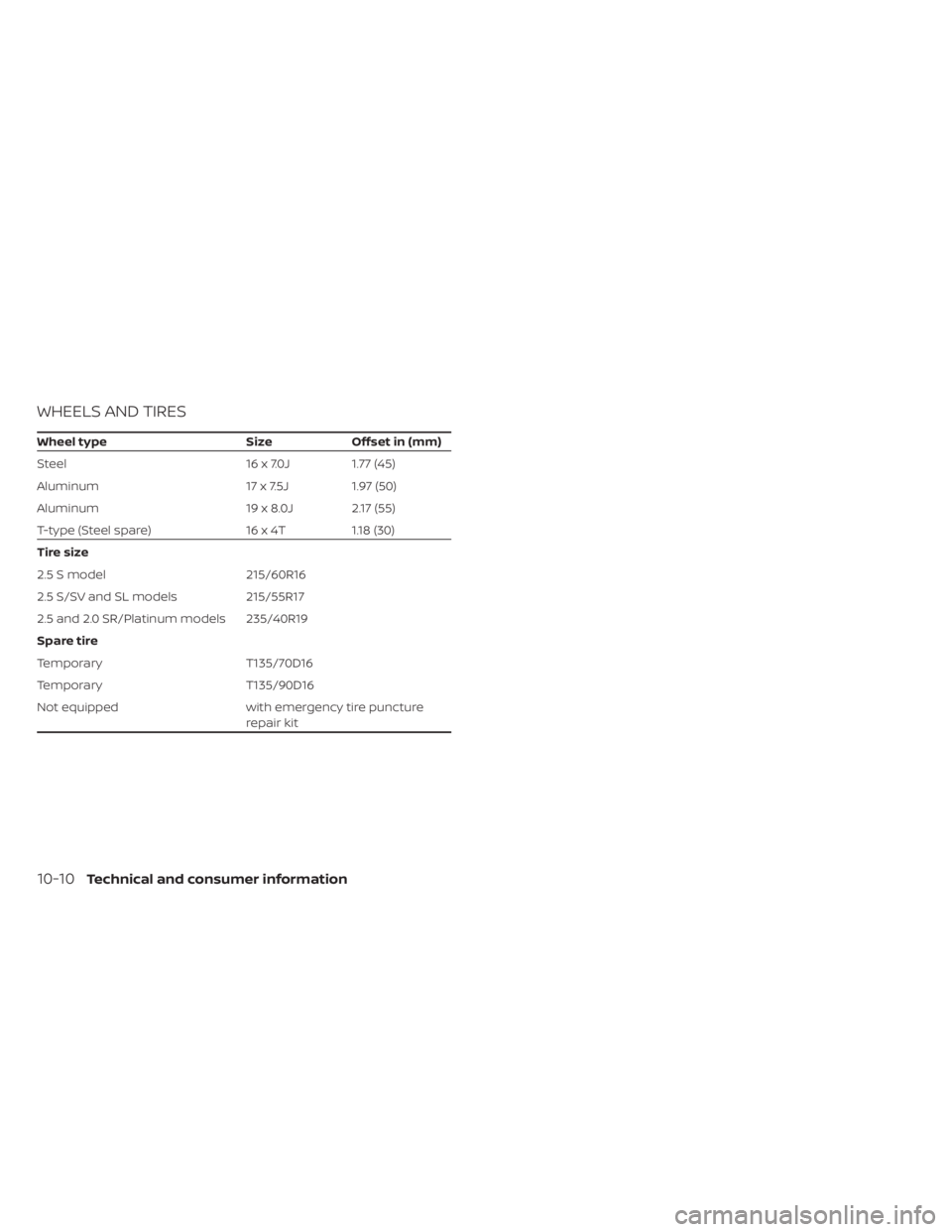
WHEELS AND TIRES
Wheel typeSizeOffset in (mm)
Steel 16 x 7.0J 1.77 (45)
Aluminum 17 x 7.5J1.97 (50)
Aluminum 19 x 8.0J 2.17 (55)
T-type (Steel spare) 16 x 4T1.18 (30)
Tire size
2.5 S model 215/60R16
2.5 S/SV and SL models 215/55R17
2.5 and 2.0 SR/Platinum models 235/40R19
Spare tire
Temporary T135/70D16
Temporary T135/90D16
Not equipped with emergency tire puncture
repair kit
10-10Technical and consumer information
Page 632 of 644
Rear power windows.............2-76Rear seat.....................1-6Rear Sonar System (RSS)..........5-179Rear window and outside mirror defroster
switch..................... .2-56Rearview mirror................3-29RearView Monitor................4-8Recommended Fluids............10-2Recorders
Event Data.............10-24, 10-25Refrigerant recommendation.......10-8Registering a vehicle in another
country.................... .10-12Remote Engine Start..........3-19,5-17Repairing flat tire................6-11Repairing tire..................6-13Reporting safety defects (US only). . . .10-22
S
Safety
Child safety rear door lock.........3-7Child seat belts.....1-23, 1-31, 1-38, 1-43Reporting safety defects (US only). .10-22Seat
Memory seat.........3-31, 3-32, 3-33Seat adjustmentFront manual seat adjustment......1-3Front power seat adjustment.......1-4Rear seat adjustment............1-6Seat beltChild safety..................1-21Infants and small children.....1-21,1-22
Injured person................1-15Larger children...............1-22Precautions on seat belt usage.....1-12Pregnant women..............1-15Seat belt extenders............1-20Seat belt maintenance..........1-20Seat belts................1-12,7-7Shoulder belt height adjustment. . . .1-19Three-point type with retractor.....1-15Seat belt extenders..............1-20Seat belt warning light.........1-14,2-12Seatback pockets...............2-71SeatsAdjustment..................1-2Armrests....................1-7Front seats..................1-2Manual front seat adjustment......1-3Rear seat.................. .1-6Security indicator light............2-12Security system (NISSAN Vehicle Immobilizer
System), engine start.........2-54, 5-16Security systems
Vehicle security system.........2-52Self-adjusting brakes.............8-20Service manual order form........10-26Servicing air conditioner...........4-44Shif t lever lock release............5-22Shif tingContinuously Variable Transmission
(CVT)
.....................5-20Shoulder belt height adjustment......1-19Siri® Eyes-Free................ .4-64Sonar
Rear system................5-179
Spark plug replacement...........8-17Spark plugs...................8-17Specifications................ .10-9Speedometer................. .2-4Spotlights (See map light)..........2-80SRS warning label...............1-67Stability control................5-175Standard maintenance........9-10,9-28Starting
Before starting the engine........5-16Jump starting............6-17,8-15Precautions when starting and
driving................. .5-4, 5-10Push starting................6-19Starting the engine............5-16Starting the engine..............5-16Steering
Heated steering wheel..........2-65Power steering system.........5-172Steering Assist switch
(for vehicles with ProPILOT Assist).....2-66Steering wheel.................3-27Stop light....................8-26Storage.....................2-71Sun visors....................3-28Sunglasses case................2-73Sunglasses holder...............2-73Sunroof...................2-77,7-6Supplemental air bag warning
light................... .1-67, 2-12Supplemental front impact air bag
system..................... .1-54Supplemental restraint system
Information and warning labels.....1-67
11-6
Page 633 of 644
Precautions on supplemental restraint
system....................1-47Supplemental restraint system
(Supplemental air bag system).......1-47Switch
Autolight switch..............2-58Automatic power window switch. . .2-76Fog light switch..............2-63Hazard warning flasher switch......6-2Headlight and turn signal switch. . . .2-57Headlight control switch.........2-57Instrument brightness control.....2-62Power door lock switch..........3-6Rear window and outside mirror defroster
switch................... .2-56Turn signal switch.............2-63
T
Tachometer...................2-6Temperature gauge
Engine coolant temperature gauge. . .2-6Thef t (NISSAN Vehicle Immobilizer System),
engine start...............2-54, 5-16Three-way catalyst...............5-4TiltTelescopic steering............3-27TireFlat tire................. .6-3, 6-4Spare tire...............6-5, 8-42Tire and Loading Information label. .10-14Tire chains..................8-37Tire pressure................8-29
Tire rotation.................8-39Types of tires................8-36Uniform tire quality grading.......10-21Wheel/tire size...............10-10Wheels and tires..............8-29Tire pressure
Low tire pressure warning light.....2-13Tire Pressure Monitoring System
(TPMS)................... .5-5, 6-3Towing
2-wheel drive models...........6-22All-wheel drive models..........6-21Flat towing................ .10-20Trailer towing...............10-20Towing a trailer................10-20Towing your vehicle..............6-20Traffic Sign Recognition (TSR)........5-30Transceiver
HomeLink® Universal
Transceiver
..........2-81, 2-83, 2-84TransmissionContinuously Variable Transmission (CVT)
fluid
......................8-12Driving with Continuously Variable
Transmission (CVT)............5-18Transmission shif t lever lock release. . .5-22Travel (See registering a vehicle in another
country)................... .10-12Trip odometer..................2-5Trunk access through the rear
seat.................... .1-6, 3-24Trunk lid.....................3-22Trunk lid lock opener lever..........3-22Trunk light...................2-80
Turn signal switch...............2-63
U
Uniform tire quality grading........10-21USB interface.................4-54USB/iPod® Charging Ports.........2-70
V
Vanity mirror..................3-29Variable voltage control system......8-16Vehicle dimensions and weights.....10-11Vehicle Dynamic Control (VDC)
system.....................5-175Vehicle identification.............10-12Vehicle identification number (VIN)
(Chassis number)...............10-12Vehicle identification number (VIN)
plate...................... .10-12Vehicle immobilizer system.....2-54, 5-16Vehicle information display.....2-18,2-34Vehicle loading information........10-16Vehicle recovery............6-22,6-23Vehicle security system...........2-52Vehicle security system
(NISSAN Vehicle Immobilizer System),
engine start
...............2-54, 5-16Ventilators.................. .4-31Visors......................3-28Voice Prompt Interrupt............4-70
11-7