steering NISSAN ALTIMA SL 2018 User Guide
[x] Cancel search | Manufacturer: NISSAN, Model Year: 2018, Model line: ALTIMA SL, Model: NISSAN ALTIMA SL 2018Pages: 592, PDF Size: 6.95 MB
Page 376 of 592
WARNING
Steering Assist is not a system for
hands-free driving. Always keep your
hands on the steering wheel and drive
your vehicle safely. Failure to do so
could cause a collision resulting in seri-
ous personal injury or death.
NOTE:
If the driver lightly touches (instead of
firmly grips) the steering wheel, the
steering torque sensor may not detect
the driver’s hand(s) on the wheel and a
sequence of warnings may occur. When
the driver holds and operates the steer-
ing wheel again, the warnings turn off.
Steering Assist limitations
Page 377 of 592
– When driving on roads where thetraveling lane merges or separates
or where there are temporary lane
markers because of road
construction
– When there is a lane closure due to road repairs
– When driving on a bumpy road sur- face, such as an uneven dirt road
– When driving on sharp curves or winding roads
– When driving on repeated uphill and downhill roads
∙ Do not use the Steering Assist under the following conditions because the
system will not operate properly:
– When driving with a tire that is not within normal tire conditions (for
example, tire wear, abnormal tire
pressure, installation of a spare
tire, tire chains, nonstandard
wheels)
– When the vehicle is equipped with non-original brake or suspension
parts – When an object such as a sticker or
cargo obstructs the camera
– When excessively heavy baggage is loaded in the rear seat or lug-
gage area of your vehicle
– When the vehicle load capacity is exceeded
– When towing a trailer or other vehicle
∙ Excessive noise will interfere with the warning chime sound, and the beep
may not be heard.
∙ For the ProPILOT Assist system to op- erate properly, the windshield in front
of the camera must be clean. Replace
worn wiper blades. The correct size
wiper blades must be used to help
make sure the windshield is kept
clean. Only use Genuine NISSAN wiper
blades, or equivalent wiper blades,
that are specifically designed for use
on your vehicle model and model
year. It is recommended that you visit
a NISSAN dealer for the correct parts
for your vehicle.Steering Assist temporary
standby
Automatic standby due to driving opera-
tion:
When the driver activates the turn signal,
the Steering Assist is temporarily placed in
a standby mode. (The Steering Assist re-
starts automatically when the operating
conditions are met again.)
Automatic standby:
In the following cases, a warning message
is displayed along with the chime, and the
Steering Assist is placed in a temporary
standby mode. (The Steering Assist re-
starts automatically when the operating
conditions are met again.)
∙ When lane markers on both sides are no longer detected
∙ When a vehicle ahead is no longer de- tected under approximately 37 mph
(60 km/h)
Starting and driving5-119
Page 379 of 592
For Canada
Model: ARS4–B
IC: 4135A-ARS4B
FCC ID: OAYARS4B
This device complies with Part 15 of the FCC
Rules and with Industry Canada licence-
exempt RSS standard(s). Operation is sub-
ject to the following two conditions:1. This device may not cause harmful in- terference, and
2. This device must accept any interfer- ence received, including interference
that may cause undesired operation.
Le present appareil est conforme aux CNR
d’Industrie Canada applicables aux appar-
eils radio exempts de licence. L’exploitation
est autorisee aux deux conditions suiv-
antes: 1. L’appareil ne doit pas produire de brouillage, et
2. L’utilisateur de l’appareil doit accepter tout brouillage radioelectrique subi,
meme si le brouillage est susceptible
d’en compromettre le fonctionnement. Radio Frequency Radiation Exposure Infor-
mation:
This equipment complies with FCC radia-
tion exposure limits set forth for an uncon-
trolled environment.
This equipment should be installed and
operated with minimum distance of 30 cm
between the radiator and your body.
The transmitter must not be co-located or
operating in conjunction with any other an-
tenna or transmitter.
Cet equipement est conforme aux limites
d’exposition aux rayonnements IC etablies
pour un environnement non controle. Cet
equipement doit etre installe et utilise avec
un minimum de 30 cm de distance entre la
source de rayonnement et votre corps.
FCC Notice
Changes or modifications not expressly
approved by the party responsible for
compliance could void the user’s authority
to operate the equipment.CONVENTIONAL (fixed speed)
CRUISE CONTROL MODE
NOTE:
ProPILOT Assist provides no approach
warnings, automatic braking, or steering
assist in the conventional (fixed speed)
cruise control mode.
This mode allows driving at a speed be-
tween 25 to 90 mph (40 to 144 km/h) with-
out keeping your foot on the accelerator
pedal.
Page 387 of 592
∙ Once the automatic brake controloperates, it does not operate again if
the vehicle approaches the same
obstacle.
∙ The automatic brake control can only operate for a short period of time.
Therefore, the driver must depress
the brake pedal.
∙ In the following situations, the RAB system may not operate properly or
may not function sufficiently:
– The vehicle is driven in bad weather (rain, fog, snow, etc.).
– The vehicle is driven on a steep hill.
– The vehicle’s posture is changed (e.g., when driving over a bump).
– The vehicle is driven on a slippery road.
– The vehicle is turned sharply by turning the steering wheel fully.
– Snow chains are used.
– Wheels or tires other than NISSAN recommended are used. – The brakes are cold at low ambient
temperatures or immediately af ter
driving has started.
– The braking force becomes poor due to wet brakes af ter driving
through a puddle or washing the
vehicle.
∙ Turn the RAB system off in the follow- ing conditions to prevent the occur-
rence of an unexpected accident
resulting from sudden system
operation:
– The vehicle is towed.
– The vehicle is carried on a flatbed truck.
– The vehicle is on the chassis dynamometer.
– The vehicle drives on an uneven road surface.
– Suspension parts other than those designated as Genuine NISSAN
parts are used. (If the vehicle
height or the vehicle body inclina-
tion is changed, the system may
not detect an obstacle correctly.) ∙ Excessive noise (e.g., audio system
volume, an open vehicle window) will
interfere with the chime sound, and it
may not be heard.
SYSTEM MALFUNCTION
If the RAB system malfunctions, it will be
turned off automatically, the RAB system
warning light will illuminate, and the “Sys-
tem fault” warning message will appear in
the vehicle information display.
Action to take
If the warning light illuminates, park the ve-
hicle in a safe location, turn the engine off,
and restart the engine. If the warning light
continues to illuminate, have the RAB sys-
tem checked. It is recommended that you
visit a NISSAN dealer for this service.
NOTE:
If the RAB system cannot be operated
temporarily, the RAB system warning
light blinks.
Starting and driving5-129
Page 428 of 592
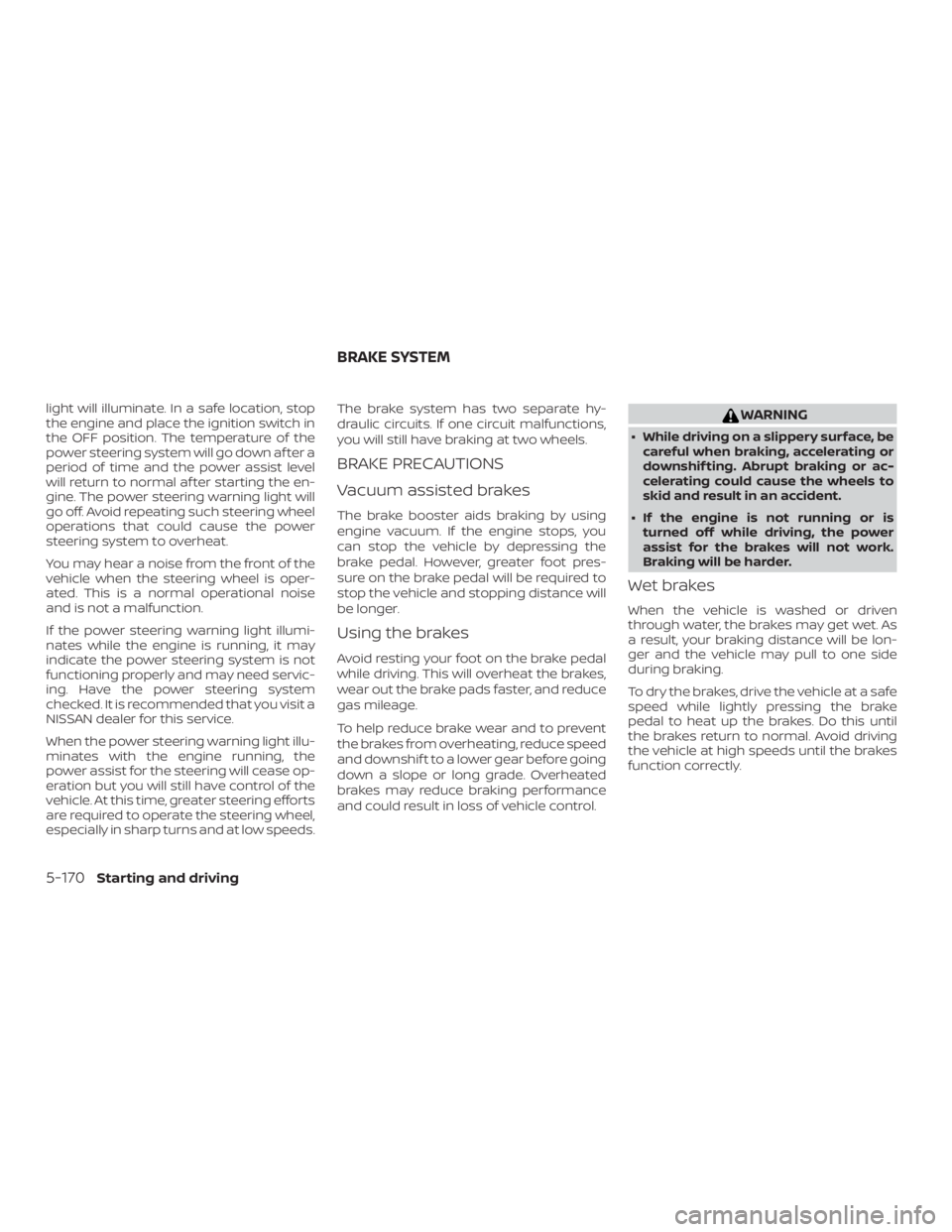
light will illuminate. In a safe location, stop
the engine and place the ignition switch in
the OFF position. The temperature of the
power steering system will go down af ter a
period of time and the power assist level
will return to normal af ter starting the en-
gine. The power steering warning light will
go off. Avoid repeating such steering wheel
operations that could cause the power
steering system to overheat.
You may hear a noise from the front of the
vehicle when the steering wheel is oper-
ated. This is a normal operational noise
and is not a malfunction.
If the power steering warning light illumi-
nates while the engine is running, it may
indicate the power steering system is not
functioning properly and may need servic-
ing. Have the power steering system
checked. It is recommended that you visit a
NISSAN dealer for this service.
When the power steering warning light illu-
minates with the engine running, the
power assist for the steering will cease op-
eration but you will still have control of the
vehicle. At this time, greater steering efforts
are required to operate the steering wheel,
especially in sharp turns and at low speeds.The brake system has two separate hy-
draulic circuits. If one circuit malfunctions,
you will still have braking at two wheels.
BRAKE PRECAUTIONS
Vacuum assisted brakes
The brake booster aids braking by using
engine vacuum. If the engine stops, you
can stop the vehicle by depressing the
brake pedal. However, greater foot pres-
sure on the brake pedal will be required to
stop the vehicle and stopping distance will
be longer.
Using the brakes
Avoid resting your foot on the brake pedal
while driving. This will overheat the brakes,
wear out the brake pads faster, and reduce
gas mileage.
To help reduce brake wear and to prevent
the brakes from overheating, reduce speed
and downshif t to a lower gear before going
down a slope or long grade. Overheated
brakes may reduce braking performance
and could result in loss of vehicle control.
Page 559 of 592
Frontseats....................1-2
Fuel Capacities and recommended
fuel/lubricants...............10-2
Fuel economy ...............5-165
Fuel-filler door and cap ..........3-27
Fuel-filler door lock opener lever ....3-27
Fuel gauge ..................2-7
Fueloctanerating.............10-6
Fuel recommendation ..........10-4
Loose fuel cap warning .........2-34
Fuelefficientdrivingtips..........5-164
Fuel-filler door .................3-27
Fuel gauge ....................2-7
Fuses .......................8-22
Fusiblelinks...................8-23
G
Garage door opener, HomeLink® Universal
Transceiver ......2-66,2-68,2-69,2-69,2-70
Gascap.....................3-27
Gauge Engine coolant temperature gauge . .2-6
Fuel gauge ..................2-7
Odometer ..................2-5
Speedometer ..............2-4,2-5
Tachometer .................2-6
Trip odometer .............2-4,2-5
General maintenance .............9-3
Glovebox....................2-57
Gloveboxlock.................2-57 H
Hazard warning flasher switch ........6-2
Headlight and turn signal switch ......2-43
Headlightcontrolswitch...........2-43
Headlights ...................8-26
Headrestraints................. .1-7
Heated seat switches .............2-51
Heated steering wheel ............2-52
Heater Heater and air conditioner
controls................4-29,4-38
Heater operation ..........4-30,4-39
Hill start assist system ...........5-176
HomeLink® Universal
Transceiver ......2-66,2-68,2-69,2-69,2-70
Hood ...................... .3-24
Horn.......................2-50
I
Ignition switch Push-button ignition switch .......5-13
Immobilizer system ..........2-40,5-16
Important vehicle information label . . . .10-11
In-cabinmicrofilter ..............8-19
Increasing fuel economy ..........5-165
Indicator NISSAN Intelligent Key® battery discharge
indicator...................5-15
Indicator lights and audible reminders
(See warning/indicator lights and audible
reminders) ....................2-15
Inside automatic anti-glare mirror .....3-32
Instrument brightness control .......2-49Instrument panel
.............0-6,2-2
Instrument panel dimmer switch .....2-49
Intelligent Around View Monitor .......4-11
Intelligent Cruise Control (ICC)
(for vehicles without ProPILOT Assist) . . .5-67
Intelligent Cruise Control (ICC)
(for vehicles with ProPILOT Assist) ....5-103
Intelligent Driver Alertness (I-DA) .....5-160
Intelligent Forward Collision Warning
(I-FCW).....................5-148
Intelligent Key system Key operating range ............3-9
Key operation ................3-10
Mechanical key ...............3-3
Remote keyless entry operation ....3-14
Troubleshooting guide ..........3-18
W
arning signals ..............3-18
Intelligent Lane Intervention (I-LI) .....5-39
Intelligent Trace Control (I-TC) .......5-175
Interiorlight...................2-64
Interiortrunklidrelease...........3-26
ISOFIX child restraints .............1-26
J
Jumpstarting...............6-9,8-16
K
Key........................ .3-2
Key fob battery replacement ........8-24
Keyless entry With Intelligent Key system
(See Intelligent Key system) .......3-14
11-3
Page 561 of 592
O
Octane rating (See fuel octane rating) . .10-6
Odometer ....................2-5
Oil Capacities and recommended
fuel/lubricants...............10-2
Changing engine oil ............8-9
Changing engine oil filter .........8-9
Checking engine oil level .........8-8
Engine oil ...................8-8
Engine oil and oil filter
recommendation .............10-6
Engine oil viscosity .............10-7
Outsidemirrors................3-32
Overhead sunglasses holder ........2-58
Overheat Ifyourvehicleoverheats.........6-11
Owner's manual order form ........10-22
Owner's manual/service manual order
information..................10-22
P
Parking Parking brake operation .........5-25
Parking/parkingonhills.........5-169
Parkingbrake...........2-12,2-15,5-25
Personal lights .................2-65
Power Power door locks ..............3-6
Poweroutlet................2-54
Powerrearwindows ...........2-61
Power steering system .........5-169
Powerwindows..............2-60 Rearpowerwindows...........2-61
Poweroutlet..................2-54
Powersteering................5-169
Precautions Maintenance precautions .........8-2
Precautions on booster
seats............1-23, 1-31, 1-38, 1-43
Precautions on child
restraints .........1-23, 1-31, 1-38, 1-43
Precautions on seat belt usage .....1-12
Precautions on supplemental restraint
system ................... .1-46
Precautions when starting and
driving..................5-4,5-11
ProPILOT Assist .................5-91
Push starting ..................6-11
R
Radio Car phone or CB radio ..........4-42
Readiness for inspection maintenance
(I/M) test ....................10-20
Rear Automatic Braking (RAB) .......5-125
RearCrossTrafficAlert(RCTA) .......5-55
Rear Door Alert ..........2-36,2-37,2-53
Rearpowerwindows.............2-61
Rearseat.................... .1-5
Rear Sonar System (RSS) ..........5-176
Rearviewmirror ................3-31
RearViewMonitor................4-3
Rear window and outside mirror defroster
switch......................2-43
Recommended Fluids ............10-2 Recorders
EventData.............10-20,10-21
Refrigerant recommendation ........10-7
Registering a vehicle in another
country .....................10-10
Remote Engine Start ..........3-21,5-18
Reporting safety defects (US only) . . . .10-19
S
Safety Child safety rear door lock ........3-7
Childseatbelts......1-23, 1-31, 1-38, 1-43
Reporting safety defects (US only) . .10-19
Seat adjustment Front manual seat adjustment ......1-3
Front power seat adjustment ......1-4
Rear seat adjustment ...........1-5
Seatback pockets ...............
2-56
Seat belt Childsafety ................ .1-21
Infants and small children ........1-22
InjuredPerson............... .1-15
Largerchildren.............. .1-22
Precautionsonseatbeltusage.....1-12
Pregnant women ..............1-15
Seat belt extenders ............1-20
Seat belt maintenance ..........1-20
Seatbelts................1-12, 7-7
Shoulder belt height adjustment . . . .1-19
Three-pointtypewithretractor.....1-15
Seat belt extenders ..............1-20
Seatbeltwarninglight.........1-14, 2-14
Seats Adjustment ..................1-2
11-5
Page 562 of 592
Armrests ...................1-7
Automatic drive
positioner ...........3-33,3-34,3-35
Frontseats..................1-2
Manual front seat adjustment ......1-3
Rearseat...................1-5
Security indicator light ............2-17
Security system (NISSAN Vehicle Immobilizer
System), engine start ..........2-40,5-16
Security systems Vehicle security system .........2-39
Self-adjustingbrakes.............8-21
Service manual order form .........10-22
Servicing air conditioner ...........4-41
Shif ting Continuously Variable Transmission
(CVT) .....................5-20
Shiftleverlockrelease............5-23
Shoulder belt height adjustment ......1-19
Sonar Rear system ................5-176
Spark plug replacement ...........8-18
Spark plugs ...................8-18
Specifications .................10-8
Speedometer ................2-4,2-5
Speedometer and odometer ........2-4
Spotlights(Seemaplight)..........2-65
SRS warning label ...............1-66
Stability control ................5-172
Standard maintenance ........9-10,9-15
Starting Before starting the engine ........5-16
Jumpstarting.............6-9,8-16
Precautions when starting and
driving ..................5-4,5-11
Push starting ................6-11 Starting the engine
............5-17
Starting the engine ..............5-17
Steering Heated steering wheel ..........2-52
Powersteeringsystem.........5-169
Steering Assist switch
(forvehicleswithProPILOTAssist).....2-52
Steering wheel .................3-29
Stoplight....................8-27
Storage.....................2-56
Sunglasses case ................2-58
Sunglasses holder ..............2-58
Sunroof ......................7-5
Sunroof (see Moonroof ) ...........2-62
Sunvisors....................3-30
Supplemental air bag warning
light.................... .1-66, 2-15
Supplemental front impact air bag
system ..................... .1-53
Supplemental restraint system Information and warning labels . . . .1-66
Precautions on supplemental restraint
system ................... .1-46
Supplemental restraint system
(Supplemental air bag system) .......1-46
Switch Autolightswitch..............2-44
Automatic power window switch . . .2-61
Foglightswitch..............2-50
Hazard warning flasher switch ......6-2
Headlight and turn signal switch ....2-43
Headlightcontrolswitch.........2-43
Instrument brightness control .....2-49
Power door lock switch ..........3-6
Rear window and outside mirror
defrosterswitch..............2-43 Turn signal switch
.............2-49
T
Tachometer ...................
2-6
Temperature gauge Engine coolant temperature gauge . .2-6
Thef t (NISSAN Vehicle Immobilizer System),
engine start ...............2-40,5-16
Three-waycatalyst...............5-4
Tilt Telescopicsteering............3-30
Tire Flattire..................6-3,6-4
Spare tire ...............6-5,8-42
Tire and Loading Information label . .10-12
Tire chains .................8-37
Tire pressure ................8-30
Tirerotation ................8-39
Types of tires ................8-36
Uniform tire quality grading .......10-17
Wheels and tires ..............8-30
Wheel/tire size ...............10-9
Tire pressure Low tire pressure warning light .....2-12
Tire Pressure Monitoring System
(TPMS)....................5-5,6-3
Towing 4-wheel drive models ...........6-13
Flattowing.................10-17
Trailertowing ...............10-17
Towingatrailer................10-17
Towingyourvehicle..............6-12
Traffic Sign Recognition (TSR) ........5-31
11-6
Page 586 of 592
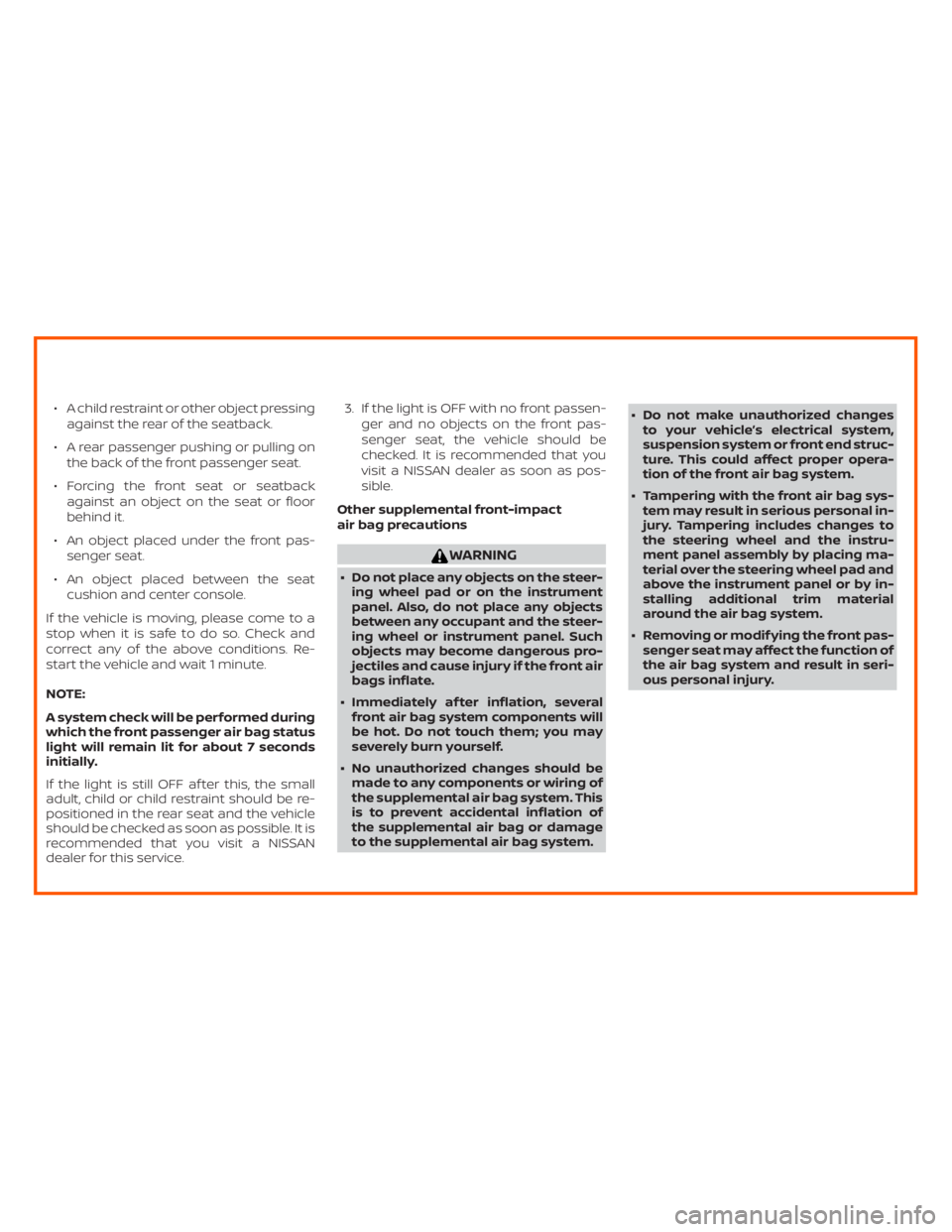
WARNING
∙ Do not place any objects on the steer-
ing wheel pad or on the instrument
panel. Also, do not place any objects
between any occupant and the steer-
ing wheel or instrument panel. Such
objects may become dangerous pro-
jectiles and cause injury if the front air
bags inflate.
∙ Immediately af ter inflation, several
front air bag system components will
be hot. Do not touch them; you may
severely burn yourself.
∙ No unauthorized changes should be
made to any components or wiring of
the supplemental air bag system. This
is to prevent accidental inflation of
the supplemental air bag or damage
to the supplemental air bag system.∙ Do not make unauthorized changes
to your vehicle’s electrical system,
suspension system or front end struc-
ture. This could affect proper opera-
tion of the front air bag system.
∙ Tampering with the front air bag sys-
tem may result in serious personal in-
jury. Tampering includes changes to
the steering wheel and the instru-
ment panel assembly by placing ma-
terial over the steering wheel pad and
above the instrument panel or by in-
stalling additional trim material
around the air bag system.
∙ Removing or modif ying the front pas-
senger seat may affect the function of
the air bag system and result in seri-
ous personal injury.