phone NISSAN ALTIMA SV 2018 Owners Manual
[x] Cancel search | Manufacturer: NISSAN, Model Year: 2018, Model line: ALTIMA SV, Model: NISSAN ALTIMA SV 2018Pages: 467, PDF Size: 5.06 MB
Page 139 of 467
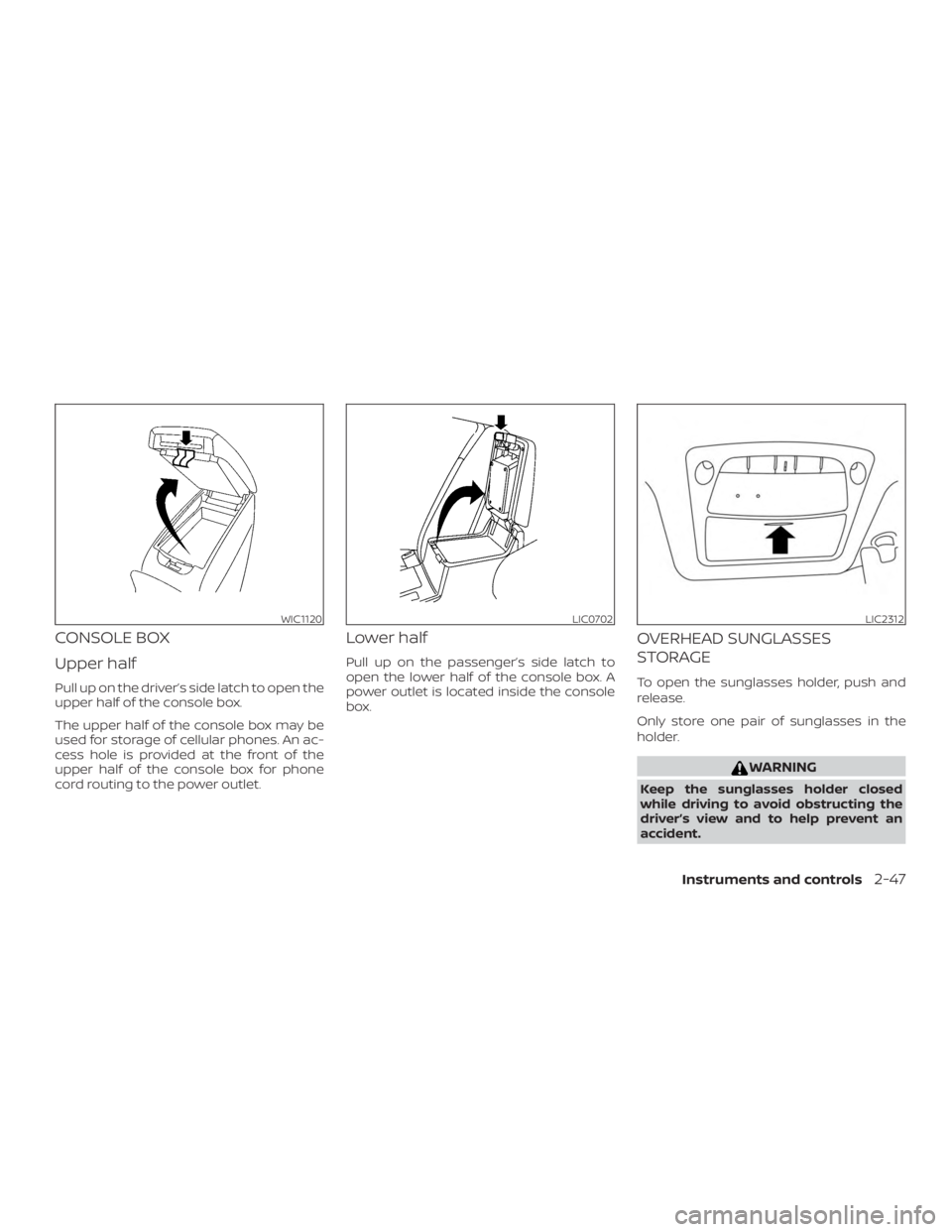
CONSOLE BOX
Upper half
Pull up on the driver’s side latch to open the
upper half of the console box.
The upper half of the console box may be
used for storage of cellular phones. An ac-
cess hole is provided at the front of the
upper half of the console box for phone
cord routing to the power outlet.
Lower half
Pull up on the passenger’s side latch to
open the lower half of the console box. A
power outlet is located inside the console
box.
OVERHEAD SUNGLASSES
STORAGE
To open the sunglasses holder, push and
release.
Only store one pair of sunglasses in the
holder.
Page 231 of 467
CAUTION
∙ Do not force the USB device into theUSB port. Inserting the USB device
tilted or up-side-down into the port
may damage the port. Make sure that
the USB device is connected correctly
into the USB connection port.
∙ Do not grab the USB port cover (if so equipped) when pulling the USB de-
vice out of the port. This could dam-
age the port and the cover.
∙ Do not leave the USB cable in a place where it can be pulled unintentionally.
Pulling the cable may damage the
port.
For additional information, refer to your de-
vice manufacturer’s owner information re-
garding the proper use and care of the
device.
To connect an iPod® to the vehicle so that
the iPod® can be controlled with the audio
system controls and display screen, use
the USB connection port located in the
center console. Connect the iPod®-specific
end of the cable to the iPod® and the USB
end of the cable to the USB connection
port. on the vehicle. If your iPod® supports
charging via a USB connection, its battery will be charged while connected to the ve-
hicle with the ignition switch in the ACC or
ON position.
While connected to the vehicle, the iPod®
can only be operated by the vehicle audio
controls.
To disconnect the iPod® from the vehicle,
remove the USB end of the cable from the
USB connection port. on the vehicle, then
remove the cable from the iPod®.
* iPod® is a trademark of Apple Inc., regis-
tered in the U.S. and other countries.
Compatibility
The following models are compatible:
∙ iPod® Classic - 5th Generation (firmware version 1.3.0 or later)
∙ iPod® Classic - 6th Generation (firm- ware version 2.0.1 or later)
∙ iPod® Classic - 7th Generation (firmware version 2.0.4 or later)
∙ iPod® nano - 1st generation (firmware version 1.3.1 or later)
∙ iPod® nano - 2nd generation (firmware version 1.1.3 or later) ∙ iPod® nano - 3rd generation (firmware
version 1.1.3 or later)
∙ iPod® nano - 4th generation (firmware version 1.0.4 or later)
∙ iPod® nano - 5th generation (firmware version 1.0.2 or later)
∙ iPod® nano - 6th generation (firmware version 1.1 or later)
∙ iPod® Touch - 2nd generation (firmware version 4.2.1 or later)
∙ iPod® Touch - 3rd generation (firmware version 5.1 or later) (minimum iOS 5.0
required for smartphone integration)
∙ iPod® Touch - 4th generation (firmware version 5.1 or later) (minimum iOS 5.0
required for smartphone integration)
∙ iPhone® 3G (firmware version 4.2.1 or later)
∙ iPhone® 3GS (firmware version 5.1 or later) (minimum iOS 5.0 required for
smartphone integration)
∙ iPhone® 4 (firmware version 5.1 or later) (minimum iOS 5.0 required for smart-
phone integration)
Monitor, climate, audio, phone and voice recognition systems4-45
Page 240 of 467
When installing a CB, ham radio or car
phone in your vehicle, be sure to observe
the following precautions; otherwise, the
new equipment may adversely affect the
engine control system and other electronic
parts.
Page 386 of 467
∙ Keep the battery surface clean and dry.Any corrosion should be washed off
with a solution of baking soda and wa-
ter.
∙ Make certain the terminal connections are clean and securely tightened.
∙ If the vehicle is not to be used for 30 days or longer, disconnect the nega-
tive (-) battery terminal cable to prevent
discharge.
NOTE:
Care should be taken to avoid situations
that can lead to potential battery dis-
charge and potential no-start conditions
such as: 1. Installation or extended use of elec-
tronic accessories that consume bat-
tery power when the engine is not
running (Phone chargers, GPS, DVD
players, etc.)
2. Vehicle is not driven regularly and/or
only driven short distances.
In these cases, the battery may need to
be charged to maintain battery health.
Page 457 of 467
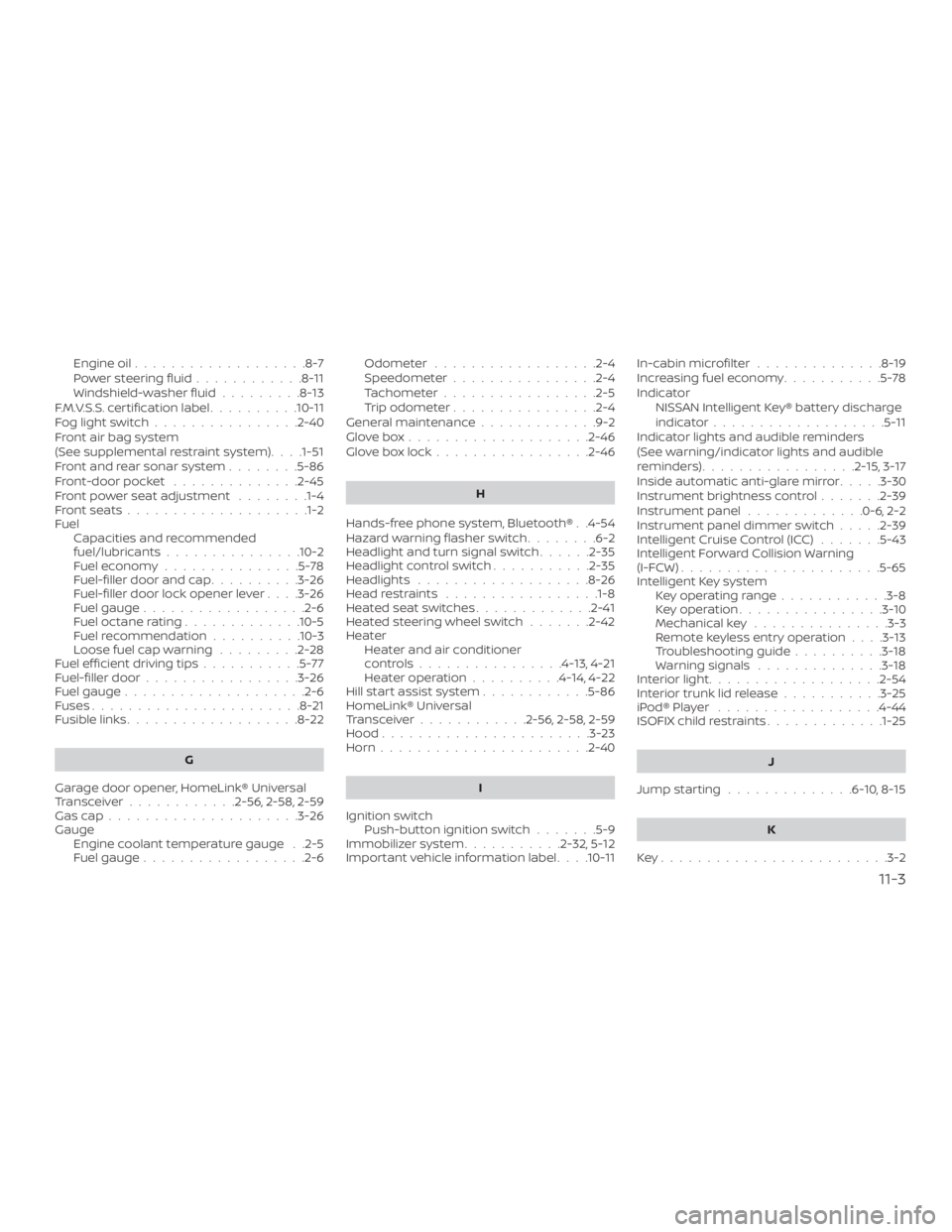
Engine oil...................8-7
Powersteeringfluid............8-11
Windshield-washer fluid .........8-13
F.M.V.S.S. certification label ..........10-11
Foglightswitch................2-40
Front air bag system
(See supplemental restraint system) . . . .1-51
Front and rear sonar system ........5-86
Front-door pocket ..............2-45
Front power seat adjustment ........1-4
Frontseats................... .1-2
Fuel Capacities and recommended
fuel/lubricants...............10-2
Fuel economy ...............5-78
Fuel-filler door and cap ..........3-26
Fuel-filler door lock opener lever ....3-26
Fuel gauge ..................2-6
Fueloctanerating.............10-5
Fuel recommendation ..........10-3
Loose fuel cap warning .........2-28
Fuelefficientdrivingtips...........5-77
Fuel-filler door .................3-26
Fuel gauge ....................2-6
Fuses .......................8-21
Fusiblelinks...................8-22
G
Garage door opener, HomeLink® Universal
Transceiver ............2-56,2-58,2-59
Gascap.....................3-26
Gauge Engine coolant temperature gauge . .2-5
Fuel gauge ..................2-6 Odometer
..................2-4
Speedometer ................2-4
Tachometer .................2-5
Trip odometer ................2-4
General maintenance .............9-2
Glovebox....................2-46
Gloveboxlock.................2-46
H
Hands-free phone system, Bluetooth® . .4-54
Hazard warning flasher switch ........6-2
Headlight and turn signal switch ......2-35
Headlightcontrolswitch...........2-35
Headlights ...................8-26
Headrestraints .................1-8
Heated seat switches .............2-41
Heated steering wheel switch .......2-42
Heater Heater and air conditioner
controls................4-13,4-21
Heater operation ..........4-14,4-22
Hill start assist system ............5-86
HomeLink® Universal
Transceiver ............2-56,2-58,2-59
Hood .......................3-23
Horn.......................2-40
I
Ignition switch Push-button ignition switch .......5-9
Immobilizer system ...........2-32,5-12
Important vehicle information label . . . .10-11In-cabinmicrofilter ..............8-19
Increasing fuel economy
...........5-78
Indicator NISSAN Intelligent Key® battery discharge
indicator...................5-11
Indicator lights and audible reminders
(See warning/indicator lights and audible
reminders) .................2-15,3-17
Inside automatic anti-glare mirror .....3-30
Instrument brightness control .......2-39
Instrument panel .............0-6,2-2
Instrument panel dimmer switch .....2-39
Intelligent
Cruise Control (ICC) .......5-43
Intelligent Forward Collision Warning
(I-FCW)......................5-65
Intelligent Key system Key operating range ............3-8
Key operation ................3-10
Mechanical key ...............3-3
Remote keyless entry operation ....3-13
Troubleshooting guide ..........3-18
Warning signals ..............3-18
Interiorlight...................2-54
Interiortrunklidrelease...........3-25
iPod®Player ..................4-44
ISOFIX child restraints .............1-25
J
Jumpstarting..............6-10,8-15
K
Key........................ .3-2
11-3
Page 459 of 467
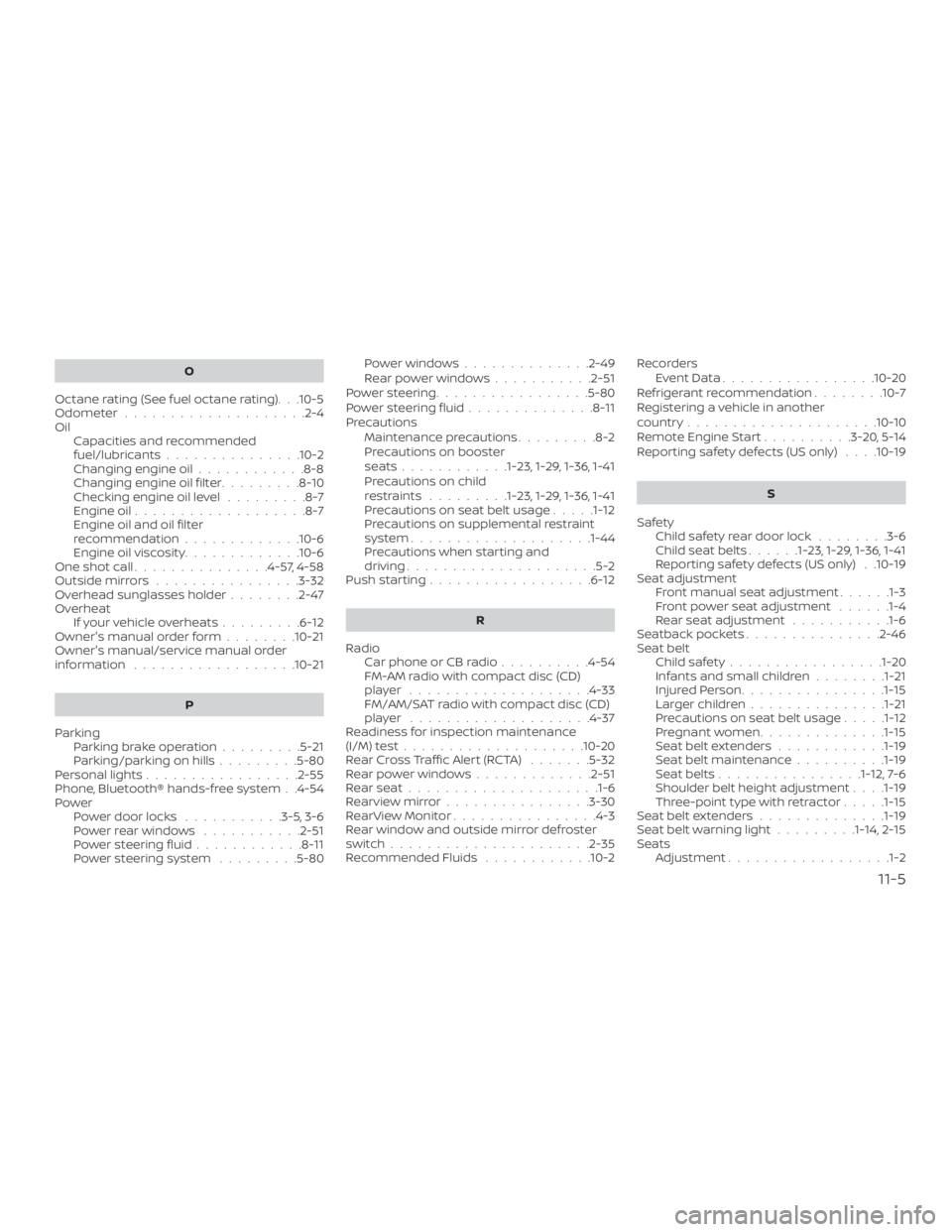
O
Octane rating (See fuel octane rating). . .10-5
Odometer ....................2-4
Oil Capacities and recommended
fuel/lubricants...............10-2
Changing engine oil ............8-8
Changing engine oil filter .........8-10
Checking engine oil level .........8-7
Engine oil ...................8-7
Engine oil and oil filter
recommendation .............10-6
Engine oil viscosity .............10-6
One shot call ...............4-57,4-58
Outsidemirrors................3-32
Overhead sunglasses holder ........2-47
Overheat Ifyourvehicleoverheats.........6-12
Owner's manual order form ........10-21
Owner's manual/service manual order
information ..................10-21
P
Parking Parking brake operation .........5-21
Parking/parkingonhills.........5-80
Personal lights .................2-55
Phone, Bluetooth® hands-free system . .4-54
Power Power door locks ...........3-5,3-6
Powerrearwindows ...........2-51
Powersteeringfluid............8-11
Power steering system .........5-80Powerwindows..............2-49
Rearpowerwindows...........2-51
Powersteering.................5-80
Powersteeringfluid..............8-11
Precautions Maintenance precautions .........8-2
Precautions on booster
seats............1-23, 1-29, 1-36, 1-41
Precautions on child
restraints .........1-23, 1-29, 1-36, 1-41
Precautions on seat belt usage .....1-12
Precautions on supplemental restraint
system ................... .1-44
Precautions when starting and
driving.....................5-2
Push starting ..................6-12
R
Radio Car phone or CB radio ..........4-54
FM-AM radio with compact disc (CD)
player ....................4-33
FM/AM/SAT radio with compact disc (CD)
player ....................4-37
Readiness for inspection maintenance
(I/M) test ....................10-20
RearCrossTrafficAlert(RCTA) .......5-32
Rearpowerwindows.............2-51
Rearseat.................... .1-6
Rearviewmirror................3-30
RearViewMonitor................4-3
Rear window and outside mirror defroster
switch......................2-35
Recommended Fluids ............10-2 Recorders
EventData................ .10-20
Refrigerant recommendation ........10-7
Registering a vehicle in another
country .....................10-10
Remote Engine Start ..........3-20,5-14
Reporting safety defects (US only) . . . .10-19
S
Safety Child safety rear door lock ........3-6
Childseatbelts......1-23, 1-29, 1-36, 1-41
Reporting safety defects (US only) . .10-19
Seat adjustment Front manual seat adjustment ......1-3
Front power seat adjustment ......1-4
Rear seat adjustment ...........1-6
Seatback pockets ...............2-46
Seat belt Childsafety................ .1-20
Infants
and small children ........1-21
InjuredPerson............... .1-15
Largerchildren.............. .1-21
Precautionsonseatbeltusage.....1-12
Pregnant women ..............1-15
Seat belt extenders ............1-19
Seat belt maintenance ..........1-19
Seatbelts................1-12, 7-6
Shoulder belt height adjustment . . . .1-19
Three-pointtypewithretractor.....1-15
Seat belt extenders ..............1-19
Seatbeltwarninglight.........1-14, 2-15
Seats Adjustment ..................1-2
11-5