towing NISSAN ALTIMA SV 2018 Owners Manual
[x] Cancel search | Manufacturer: NISSAN, Model Year: 2018, Model line: ALTIMA SV, Model: NISSAN ALTIMA SV 2018Pages: 467, PDF Size: 5.06 MB
Page 273 of 467
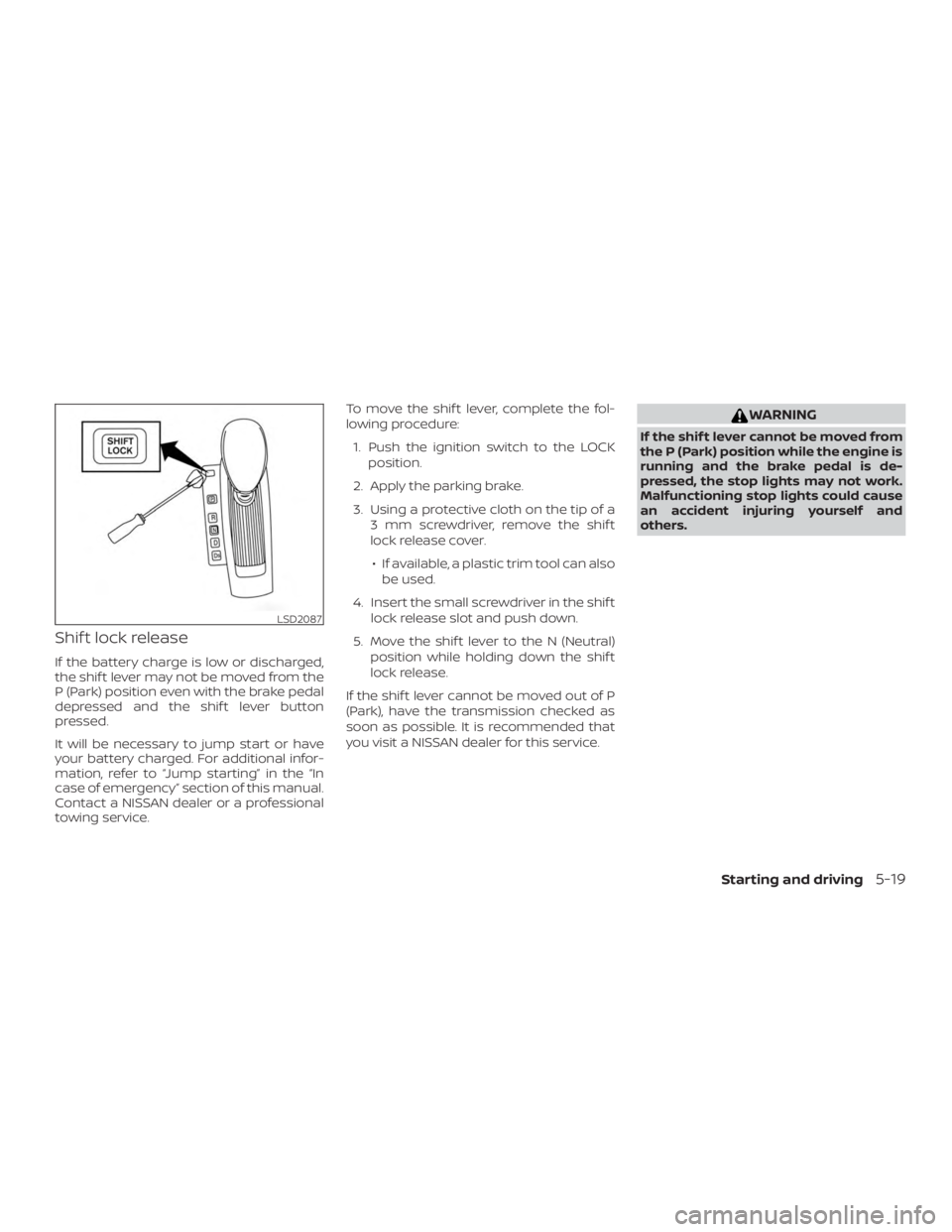
Shif t lock release
If the battery charge is low or discharged,
the shif t lever may not be moved from the
P (Park) position even with the brake pedal
depressed and the shif t lever button
pressed.
It will be necessary to jump start or have
your battery charged. For additional infor-
mation, refer to “Jump starting” in the “In
case of emergency” section of this manual.
Contact a NISSAN dealer or a professional
towing service.To move the shif t lever, complete the fol-
lowing procedure:
1. Push the ignition switch to the LOCK position.
2. Apply the parking brake.
3. Using a protective cloth on the tip of a 3 mm screwdriver, remove the shif t
lock release cover.
∙ If available, a plastic trim tool can also be used.
4. Insert the small screwdriver in the shif t lock release slot and push down.
5. Move the shif t lever to the N (Neutral) position while holding down the shif t
lock release.
If the shif t lever cannot be moved out of P
(Park), have the transmission checked as
soon as possible. It is recommended that
you visit a NISSAN dealer for this service.
Page 307 of 467
∙ The system may not detect the ve-hicle in front of you in certain road or
weather conditions. To avoid acci-
dents, never use the ICC system under
the following conditions:
– On roads where the traffic is heavy or there are sharp curves
– On slippery road surfaces such as on ice or snow, etc.
– During bad weather (rain, fog, snow, etc.)
– When rain, snow or dirt adhere to the bumper around the distance
sensor
– On steep downhill roads (the ve- hicle may go beyond the set ve-
hicle speed and frequent braking
may result in overheating the
brakes)
– On repeated uphill and downhill roads
– When traffic conditions make it dif- ficult to keep a proper distance be-
tween vehicles because of fre-
quent acceleration or deceleration – Interference by other radar
sources.
∙ Do not use the ICC system if you are towing a trailer. The system may not
detect a vehicle ahead.
∙ In some road or traffic conditions, a vehicle or object can unexpectedly
come into the sensor detection zone
and cause automatic braking. Always
stay alert and avoid using the ICC sys-
tem where not recommended in this
warning section.
The radar sensor will not detect the follow-
ing objects: ∙ Stationary and slow moving vehicles
∙ Pedestrians or objects in the roadway
∙ Oncoming vehicles in the same lane
∙ Motorcycles traveling offset in the travel lane
The following are some conditions in which
the sensor cannot properly detect a ve-
hicle ahead and the system may not oper-
ate properly: ∙ When snow or road spray from traveling vehicles reduces the sensor’s detection. ∙ When excessively heavy baggage is
loaded in the rear seat or the trunk of
your vehicle.
The ICC system is designed to automati-
cally check the sensor’s operation within
the limitations of the system.
The detection zone of the ICC sensor is
limited. A vehicle ahead must be in the de-
tection zone for the vehicle-to-vehicle dis-
tance detection mode to maintain the se-
lected distance from the vehicle ahead.
A vehicle ahead may move outside of the
detection zone due to its position within
the same lane of travel. Motorcycles may
not be detected in the same lane ahead if
they are traveling offset from the centerline
of the lane. A vehicle that is entering the
lane ahead may not be detected until the
vehicle has completely moved into the
lane.
If this occurs, the ICC system may warn
you by blinking the system indicator and
sounding the chime. The driver may
have to manually control the proper dis-
tance away from the vehicle traveling
ahead.
Starting and driving5-53
Page 361 of 467
6. Af ter the engine cools down, check thecoolant level in the engine coolant res-
ervoir tank with the engine running.
Add coolant to the engine coolant res-
ervoir tank if necessary. It is recom-
mended that you visit a NISSAN dealer
for this service. When towing your vehicle, all State (Provin-
cial in Canada) and local regulations for
towing must be followed. Incorrect towing
equipment could damage your vehicle.
Towing instructions are available from a
NISSAN dealer. Local service operators are
generally familiar with the applicable laws
and procedures for towing. To assure
proper towing and to prevent accidental
damage to your vehicle, NISSAN recom-
mends having a service operator tow your
vehicle. It is advisable to have the service
operator carefully read the following pre-
cautions:
Page 449 of 467
Do not tow a trailer with your vehicle.
FLAT TOWING
Towing your vehicle with all four wheels on
the ground is sometimes called flat towing.
This method is sometimes used when
towing a vehicle behind a recreational ve-
hicle, such as a motor home.
Page 460 of 467
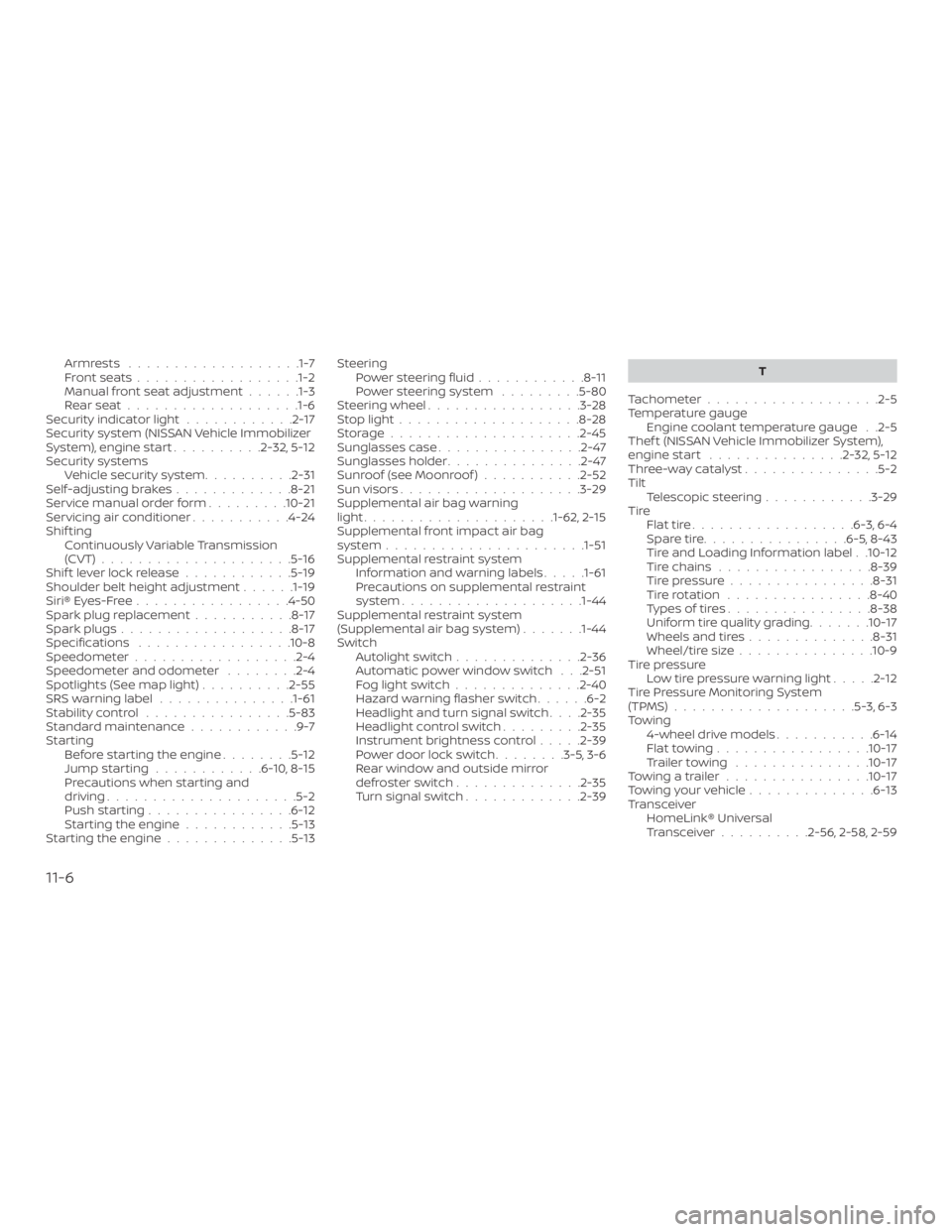
Armrests ...................1-7
Frontseats..................1-2
Manual front seat adjustment ......1-3
Rearseat.................. .1-6
Security indicator light ............2-17
Security system (NISSAN Vehicle Immobilizer
System), engine start ..........2-32,5-12
Security systems Vehicle security system ..........2-31
Self-adjustingbrakes.............8-21
Service manual order form .........10-21
Servicing air conditioner ...........4-24
Shif ting Continuously Variable Transmission
(CVT) .....................5-16
Shiftleverlockrelease............5-19
Shoulder belt height adjustment ......1-19
Siri® Eyes-Free .................4-50
Spark plug replacement ...........8-17
Spark plugs ...................8-17
Specifications .................10-8
Speedometer ..................2-4
Speedometer and odometer ........2-4
Spotlights(Seemaplight)..........2-55
SRS warning label ...............1-61
Stability control ................5-83
Standard maintenance ............9-7
Starting Before starting the engine ........5-12
Jumpstarting............6-10,8-15
Precautions when starting and
driving .....................5-2
Push starting ................6-12
Starting the engine ............5-13
Starting the engine ..............5-13 Steering
Powersteeringfluid............8-11
Powersteeringsystem .........5-80
Steering wheel .................3-28
Stoplight....................8-28
Storage.....................2-45
Sunglasses case ................2-47
Sunglasses holder ...............2-47
Sunroof (see Moonroof ) ...........2-52
Sunvisors....................3-29
Supplemental air bag warning
light.................... .1-62, 2-15
Supplemental front impact air bag
system ..................... .1-51
Supplemental restraint system Information and warning labels .....1-61
Precautions on supplemental restraint
system ................... .1-44
Supplemental restraint system
(Supplemental air bag system) .......1-44
Switch Autolightswitch..............2-36
Automatic power window switch . . .2-51
Foglightswitch..............2-40
Hazard warning flasher switch ......6-2
Headlight and turn signal switch ....2-35
Headlightcontrolswitch.........2-35
Instrument brightness control .....2-39
Power door lock switch ........3-5,3-6
Rear window and outside mirror
defrosterswitch..............2-35
Turn signal switch .............2-39 T
Tachometer ...................2-5
Temperature gauge Engine coolant temperature gauge . .2-5
Thef t (NISSAN Vehicle Immobilizer System),
engine start ...............2-32,5-12
Three-waycatalyst...............5-2
Tilt Telescopicsteering............3-29
Tire F
lattire..................6-3,6-4
Spare tire ................6-5,8-43
Tire and Loading Information label . .10-12
Tire chains .................8-39
Tire pressure ................8-31
Tirerotation ................8-40
Types of tires ................8-38
Uniform tire quality grading .......10-17
Wheels and tires ..............8-31
Wheel/tire size ...............10-9
Tire pressure Low tire pressure warning light .....2-12
Tire Pressure Monitoring System
(TPMS)....................5-3,6-3
Towing 4-wheel drive models ...........6-14
Flattowing.................10-17
Trailertowing ...............10-17
Towingatrailer................10-17
Towingyourvehicle..............6-13
Transceiver HomeLink® Universal
Transceiver ..........2-56,2-58,2-59
11-6