fuel cap NISSAN ARMADA 2015 1.G User Guide
[x] Cancel search | Manufacturer: NISSAN, Model Year: 2015, Model line: ARMADA, Model: NISSAN ARMADA 2015 1.GPages: 510, PDF Size: 4.18 MB
Page 464 of 510
![NISSAN ARMADA 2015 1.G User Guide 9 Technical and consumer information
Recommended fluids/lubricants and capacities.......9-2
Recommended fuel (without Flexible Fuel
Vehicle [FFV] option): ...........................9-4
Flexible fuel](/img/5/419/w960_419-463.png "NISSAN ARMADA 2015 1.G User Guide 9 Technical and consumer information
Recommended fluids/lubricants and capacities.......9-2
Recommended fuel (without Flexible Fuel
Vehicle [FFV] option): ...........................9-4
Flexible fuel")
9 Technical and consumer information
Recommended fluids/lubricants and capacities.......9-2
Recommended fuel (without Flexible Fuel
Vehicle [FFV] option): ...........................9-4
Flexible fuel vehicle (FFV) fuel
recommendation (if so equipped) .................9-6
Engine oil and oil filter recommendations ..........9-7
Air conditioner system refrigerant and oil
recommendations ..............................9-8
Specifications .....................................9-9
Engine ........................................9-9
Wheels and tires .............................. 9-10
Dimensions and weights .......................9-10
When traveling or registering your vehicle in
another country .................................. 9-11
Vehicle identification .............................. 9-11
Vehicle identification number (VIN) plate .........9-11
Vehicle identification number
(chassis number) .............................. 9-11
Engine serial number ........................... 9-12
F.M.V.S.S./C.M.V.S.S. certification label ..........9-12
Emission control information label ...............9-12Tire and loading information label
................9-13
Air conditioner specification label ................9-13
Installing front license plate ........................9-13
Vehicle loading information ........................9-14
Terms ........................................ 9-14
Vehicle load capacity .......................... 9-15
Securing the load .............................. 9-17
Loading tips .................................. 9-18
Measurement of weights .......................9-18
Towing a trailer ................................... 9-19
Maximum load limits ........................... 9-19
Towing load/specification .......................9-22
Towing safety ................................. 9-23
Flat towing .................................... 9-31
Snow plow ...................................... 9-31
Uniform tire quality grading ........................9-31
Emission control system warranty ..................9-32
Reporting safety defects .......................... 9-33
Readiness for inspection/maintenance (I/M) test .....9-34
Event
Data Recorders (EDR) ....................... 9-34
Owner’s Manual/Service Manual order information . . . 9-35
Page 465 of 510
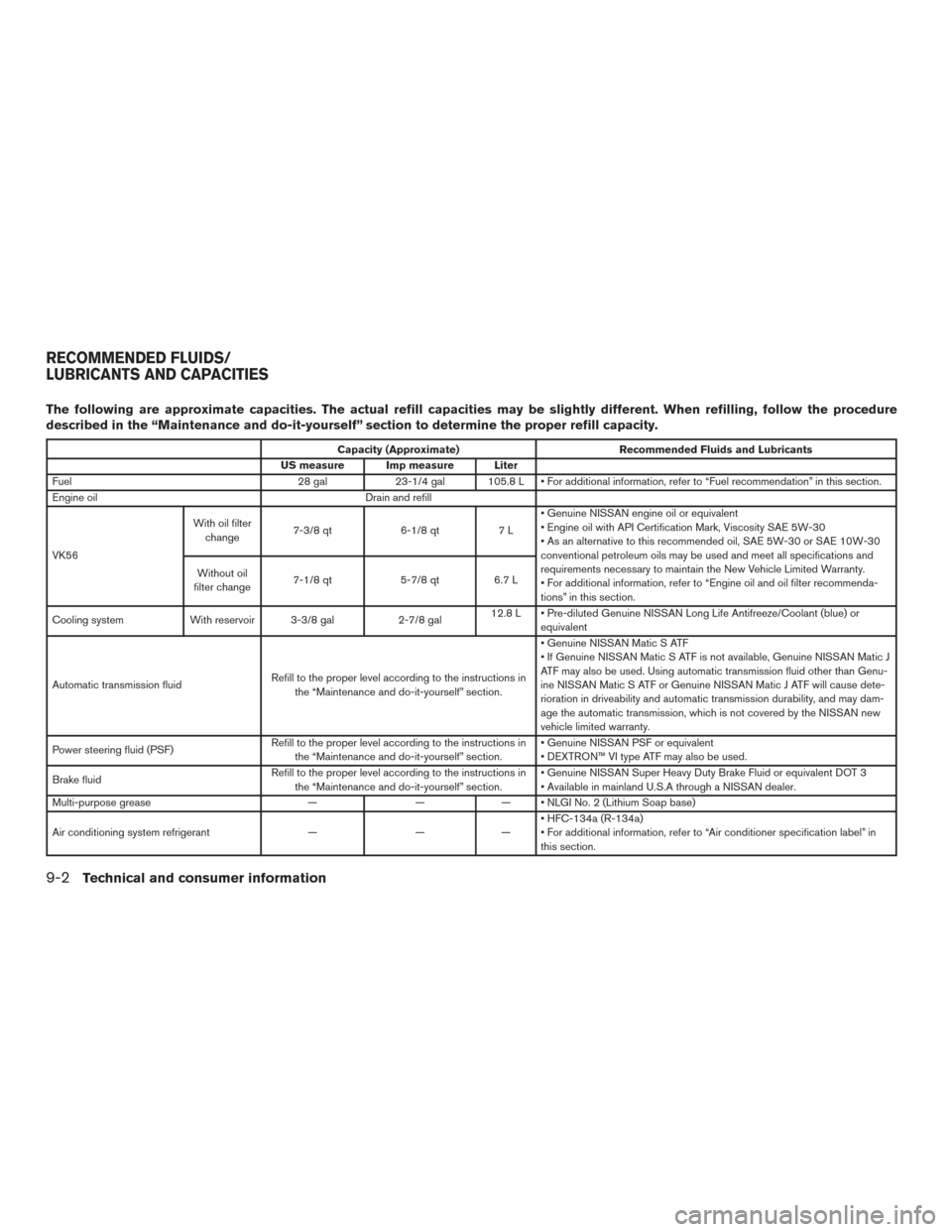
The following are approximate capacities. The actual refill capacities may be slightly different. When refilling, follow the procedure
described in the “Maintenance and do-it-yourself” section to determine the proper refill capacity.
Capacity (Approximate)Recommended Fluids and Lubricants
US measure Imp measure Liter
Fuel 28 gal23-1/4 gal 105.8 L • For additional information, refer to “Fuel recommendation” in this section.
Engine oil Drain and refill
VK56 With oil filter
change 7-3/8 qt
6-1/8 qt7 L• Genuine NISSAN engine oil or equivalent
• Engine oil with API Certification Mark, Viscosity SAE 5W-30
• As an alternative to this recommended oil, SAE 5W-30 or SAE 10W-30
conventional petroleum oils may be used and meet all specifications and
requirements necessary to maintain the New Vehicle Limited Warranty.
• For additional information, refer to “Engine oil and oil filter recommenda-
tions” in this section.
Without oil
filter change 7-1/8 qt
5-7/8 qt6.7 L
Cooling system With reservoir 3-3/8 gal 2-7/8 gal12.8 L • Pre-diluted Genuine NISSAN Long Life Antifreeze/Coolant (blue) or
equivalent
Automatic transmission fluid Refill to the proper level according to the instructions in
the “Maintenance and do-it-yourself” section. • Genuine NISSAN Matic S ATF
• If Genuine NISSAN Matic S ATF is not available, Genuine NISSAN Matic J
ATF may also be used. Using automatic transmission fluid other than Genu-
ine NISSAN Matic S ATF or Genuine NISSAN Matic J ATF will cause dete-
rioration in driveability and automatic transmission durability, and may dam-
age the automatic transmission, which is not covered by the NISSAN new
vehicle limited warranty.
Power steering fluid (PSF) Refill to the proper level according to the instructions in
the “Maintenance and do-it-yourself” section. • Genuine NISSAN PSF or equivalent
• DEXTRON™ VI type ATF may also be used.
Brake fluid Refill to the proper level according to the instructions in
the “Maintenance and do-it-yourself” section. • Genuine NISSAN Super Heavy Duty Brake Fluid or equivalent DOT 3
• Available in mainland U.S.A through a NISSAN dealer.
Multi-purpose grease ——— • NLGI No. 2 (Lithium Soap base)
Air conditioning system refrigerant ———• HFC-134a (R-134a)
• For additional information, refer to “Air conditioner specification label” in
this section.
RECOMMENDED FLUIDS/
LUBRICANTS AND CAPACITIES
9-2Technical and consumer information
Page 467 of 510
![NISSAN ARMADA 2015 1.G User Guide RECOMMENDED FUEL (without
Flexible Fuel Vehicle [FFV] option):
Use UNLEADED REGULAR gasoline with an
octane rating of at least 91 (RON) .
CAUTION
●Only vehicles with the E-85 filler door
label can o](/img/5/419/w960_419-466.png "NISSAN ARMADA 2015 1.G User Guide RECOMMENDED FUEL (without
Flexible Fuel Vehicle [FFV] option):
Use UNLEADED REGULAR gasoline with an
octane rating of at least 91 (RON) .
CAUTION
●Only vehicles with the E-85 filler door
label can o")
RECOMMENDED FUEL (without
Flexible Fuel Vehicle [FFV] option):
Use UNLEADED REGULAR gasoline with an
octane rating of at least 91 (RON) .
CAUTION
●Only vehicles with the E-85 filler door
label can operate on E-85. Fuel system
or other damage can occur if E-85 is
used in vehicles that are not designed
to run on E-85.
● Using a fuel other than that specified
could adversely affect the emission
control system, and may also affect the
warranty coverage.
● Under no circumstances should a
leaded gasoline be used, because this
will damage the three-way catalyst.
● Do not use E-15 or E-85 fuel in your
vehicle. Your vehicle is not designed to
run on E-15 or E-85 fuel. Using E-15 or
E-85 fuel in a vehicle not specifically
designed for E-15 or E-85 fuel can ad-
versely affect the emission control de-
vices and systems of the vehicle. Dam-
age caused by such fuel is not covered
by the NISSAN new vehicle limited
warranty. ●
U.S. government regulations require
ethanol dispensing pumps to be identi-
fied by a small, square, orange and
black label with the common abbrevia-
tion or the appropriate percentage for
that region.
For additional information, refer to “Recom-
mended fluids/lubricants and capacities” in the
“Technical and consumer information” section.
Gasoline specifications
NISSAN recommends using gasoline that meets
the World-Wide Fuel Charter (WWFC) specifi-
cations where it is available. Many of the automo-
bile manufacturers developed this specification
to improve emission control system and vehicle
performance. Ask your service station manager if
the gasoline meets the WWFC specifications.
Reformulated gasoline
Some fuel suppliers are now producing reformu-
lated gasolines. These gasolines are specially
designed to reduce vehicle emissions. NISSAN
supports efforts towards cleaner air and sug-
gests that you use reformulated gasoline when
available.
Gasoline containing oxygenates
Some fuel suppliers sell gasoline containing oxy-
genates such as ethanol, Methyl Tert-butyl Ether
(MTBE) and methanol with or without advertising
their presence. NISSAN does not recommend
the use of fuels of which the oxygenate content
and the fuel compatibility for your NISSAN can-
not be readily determined. If in doubt, ask your
service station manager.
If you use oxygenate-blend gasoline, please take
the following precautions as the usage of such
fuels may cause vehicle performance problems
and/or fuel system damage. ● The fuel should be unleaded and have
an octane rating no lower than that
recommended for unleaded gasoline.
● If an oxygenate-blend other than
methanol blend is used, it should con-
tain no more than 10% oxygenate.
(MTBE may, however, be added up to
15%.)
● E-15 fuel contains more than 10% oxy-
genate. E-15 fuel will adversely affect
the emission control devices and sys-
tems of the vehicle and should not be
used. Damage caused by such fuel is
not covered by the NISSAN New Ve-
hicle Limited Warranty.
9-4Technical and consumer information
Page 469 of 510
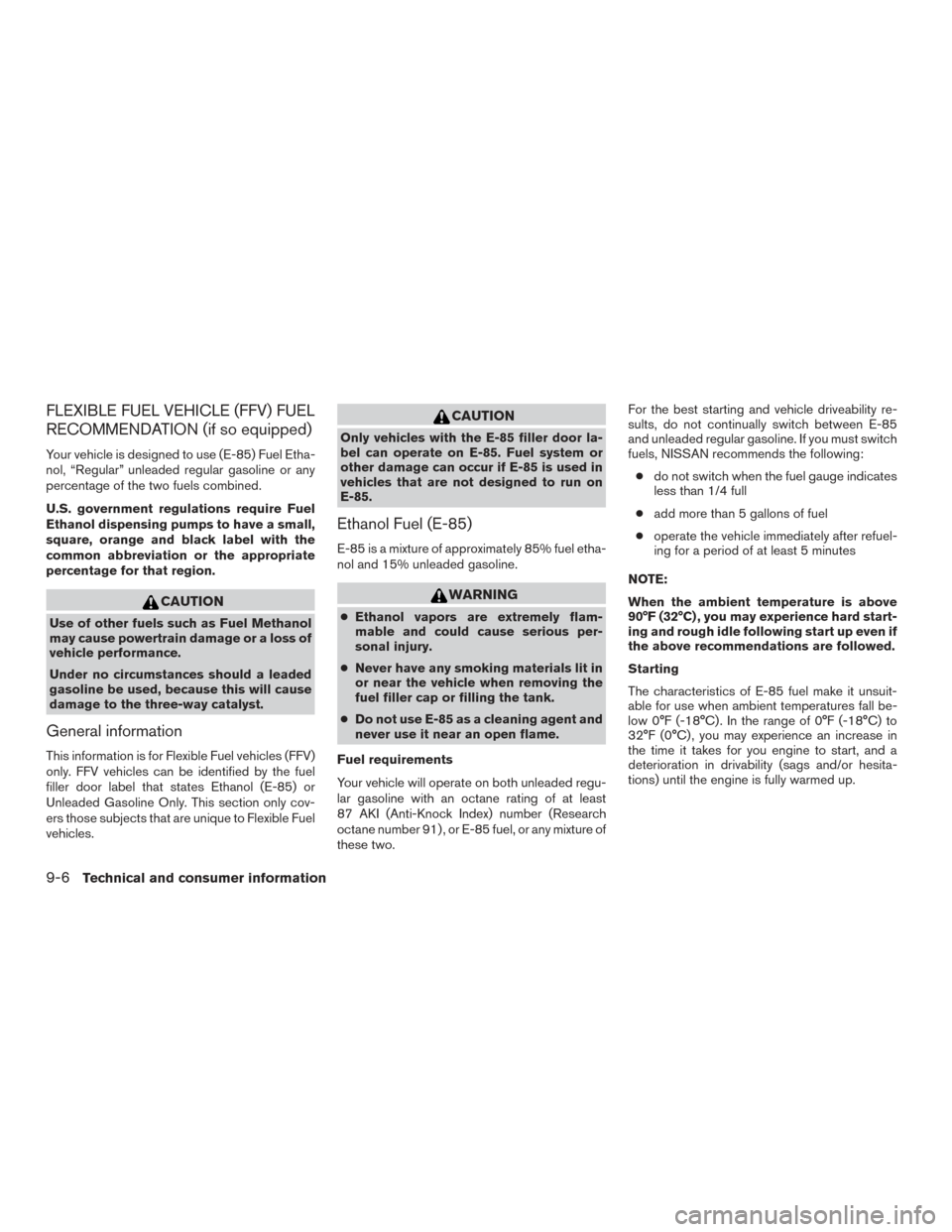
FLEXIBLE FUEL VEHICLE (FFV) FUEL
RECOMMENDATION (if so equipped)
Your vehicle is designed to use (E-85) Fuel Etha-
nol, “Regular” unleaded regular gasoline or any
percentage of the two fuels combined.
U.S. government regulations require Fuel
Ethanol dispensing pumps to have a small,
square, orange and black label with the
common abbreviation or the appropriate
percentage for that region.
CAUTION
Use of other fuels such as Fuel Methanol
may cause powertrain damage or a loss of
vehicle performance.
Under no circumstances should a leaded
gasoline be used, because this will cause
damage to the three-way catalyst.
General information
This information is for Flexible Fuel vehicles (FFV)
only. FFV vehicles can be identified by the fuel
filler door label that states Ethanol (E-85) or
Unleaded Gasoline Only. This section only cov-
ers those subjects that are unique to Flexible Fuel
vehicles.
CAUTION
Only vehicles with the E-85 filler door la-
bel can operate on E-85. Fuel system or
other damage can occur if E-85 is used in
vehicles that are not designed to run on
E-85.
Ethanol Fuel (E-85)
E-85 is a mixture of approximately 85% fuel etha-
nol and 15% unleaded gasoline.
WARNING
●Ethanol vapors are extremely flam-
mable and could cause serious per-
sonal injury.
● Never have any smoking materials lit in
or near the vehicle when removing the
fuel filler cap or filling the tank.
● Do not use E-85 as a cleaning agent and
never use it near an open flame.
Fuel requirements
Your vehicle will operate on both unleaded regu-
lar gasoline with an octane rating of at least
87 AKI (Anti-Knock Index) number (Research
octane number 91) , or E-85 fuel, or any mixture of
these two. For the best starting and vehicle driveability re-
sults, do not continually switch between E-85
and unleaded regular gasoline. If you must switch
fuels, NISSAN recommends the following:
● do not switch when the fuel gauge indicates
less than 1/4 full
● add more than 5 gallons of fuel
● operate the vehicle immediately after refuel-
ing for a period of at least 5 minutes
NOTE:
When the ambient temperature is above
90°F (32°C) , you may experience hard start-
ing and rough idle following start up even if
the above recommendations are followed.
Starting
The characteristics of E-85 fuel make it unsuit-
able for use when ambient temperatures fall be-
low 0°F (-18°C) . In the range of 0°F (-18°C) to
32°F (0°C) , you may experience an increase in
the time it takes for you engine to start, and a
deterioration in drivability (sags and/or hesita-
tions) until the engine is fully warmed up.
9-6Technical and consumer information
Page 470 of 510
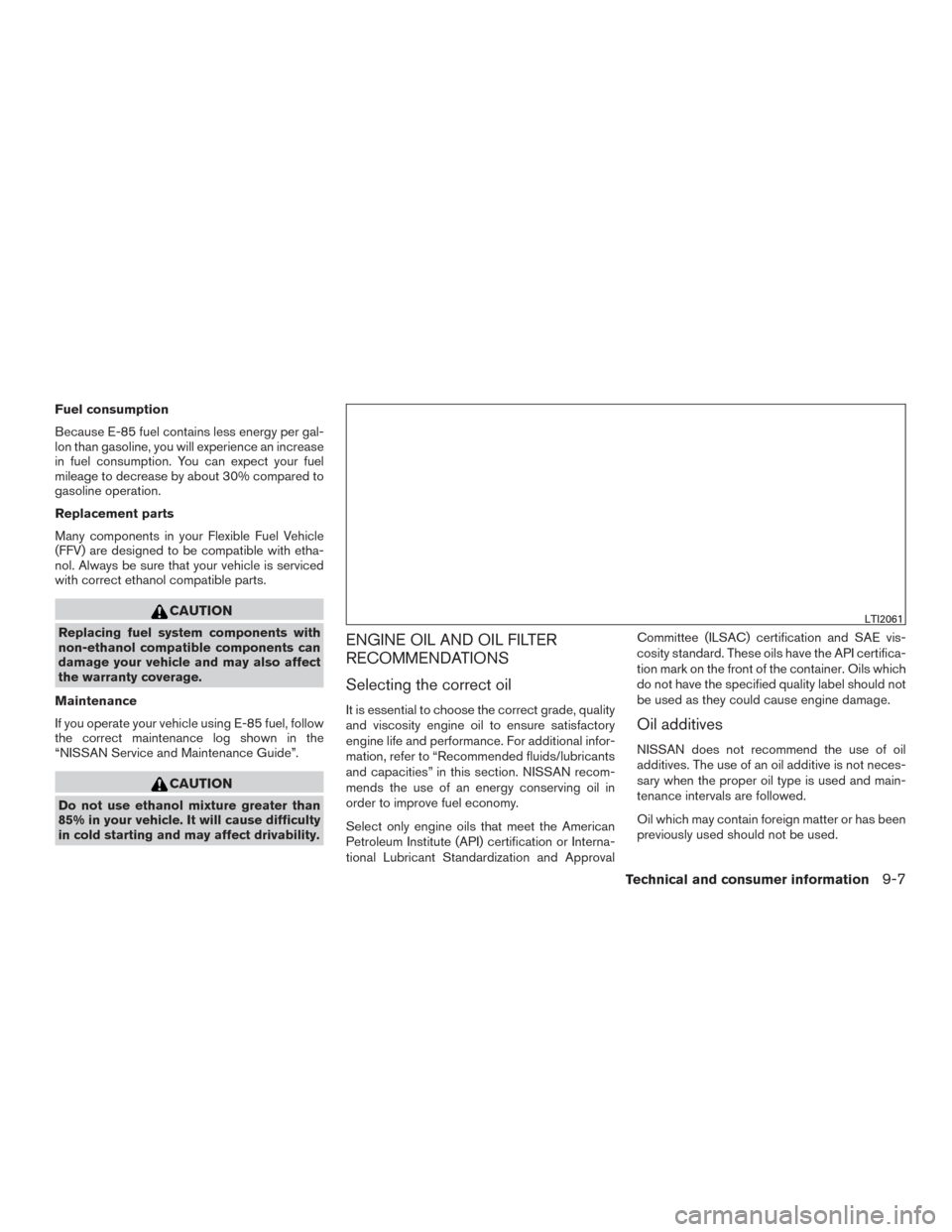
Fuel consumption
Because E-85 fuel contains less energy per gal-
lon than gasoline, you will experience an increase
in fuel consumption. You can expect your fuel
mileage to decrease by about 30% compared to
gasoline operation.
Replacement parts
Many components in your Flexible Fuel Vehicle
(FFV) are designed to be compatible with etha-
nol. Always be sure that your vehicle is serviced
with correct ethanol compatible parts.
CAUTION
Replacing fuel system components with
non-ethanol compatible components can
damage your vehicle and may also affect
the warranty coverage.
Maintenance
If you operate your vehicle using E-85 fuel, follow
the correct maintenance log shown in the
“NISSAN Service and Maintenance Guide”.
CAUTION
Do not use ethanol mixture greater than
85% in your vehicle. It will cause difficulty
in cold starting and may affect drivability.
ENGINE OIL AND OIL FILTER
RECOMMENDATIONS
Selecting the correct oil
It is essential to choose the correct grade, quality
and viscosity engine oil to ensure satisfactory
engine life and performance. For additional infor-
mation, refer to “Recommended fluids/lubricants
and capacities” in this section. NISSAN recom-
mends the use of an energy conserving oil in
order to improve fuel economy.
Select only engine oils that meet the American
Petroleum Institute (API) certification or Interna-
tional Lubricant Standardization and Approval Committee (ILSAC) certification and SAE vis-
cosity standard. These oils have the API certifica-
tion mark on the front of the container. Oils which
do not have the specified quality label should not
be used as they could cause engine damage.Oil additives
NISSAN does not recommend the use of oil
additives. The use of an oil additive is not neces-
sary when the proper oil type is used and main-
tenance intervals are followed.
Oil which may contain foreign matter or has been
previously used should not be used.
LTI2061
Technical and consumer information9-7
Page 501 of 510
Bulb replacement................8-33
C
Capacities and recommended fuel/lubricants . .9-2
Captain’s chair adjustment (2nd row) . . .1-6, 1-7
Cargolight....................2-64
Cargo(Seevehicleloadinginformation)....9-14
Car phone or CB radio .............4-108
CD care and cleaning ..............4-80
CD player (See audio system) ......4-53,4-59
Check tire pressure ...............2-28
Child restraints .......1-30,1-31,1-32,1-34
LATCH (Lower Anchors and Tethers for
CHildren) System ..............1-34
Precautions on child
restraints.........1-32,1-40,1-46,1-52
Top tether strap anchor point locations . .1-38
Child restraint with top tether strap .......1-37
Child safety rear door lock ............3-7
Chimes, audible reminders ...........2-20
Cleaningexteriorandinterior........7-2,7-4
Clock.......................4-50
Clock setting
(models with Navigation System) ........4-16
Clock setting
(models without Navigation System) .......4-8
C.M.V.S.S. certification label ..........9-12
Cold weather driving ...............5-37
Compact disc (CD) player ........4-53,4-59
Consolebox................2-46,2-51
Control panel buttons ..............4-10
Brightness/contrast button ......4-10,4-19
Enterbutton...............4-4,4-10
Without navigation system ..........4-4Controls
Audio controls (steering wheel) .......4-81
Heater and air conditioner controls .....4-29
Rear seat air conditioner ..........4-31
Coolant Capacities and recommended
fuel/lubricants .................9-2
Changingenginecoolant...........8-8
Checking engine coolant level ........8-8
Engine coolant temperature gauge .....2-5
Corrosion protection ...............7-5
Cruisecontrol ...........5-20,5-20,5-20
Cupholders...................2-49
Curtainside-impactandrolloverairbag....1-69
D
Daytime running light system (Canada only) . .2-36
Defroster switch Rear window and outside mirror defroster
switch.....................2-34
Digital Versatile Disc (DVD) player .......4-63
Digital video disc DVD ..............4-83
Dimensionsandweights ............9-10
Dimmer switch for instrument panel ......2-37
Display......................2-21
Display controls
(seecontrolpanelbuttons) ........4-4,4-10
Door locks .....................3-5
Drive belt .....................8-17
Drive positioner, Automatic ........3-36,3-36
Driving Cold weather driving .............5-37
Driving with automatic transmission ....5-15
Precautions when starting and driving ....5-2Driving the vehicle
................5-14
E
Economy-fuel..................5-23
Emission control information label .......9-12
Emission control system warranty .......9-32
Engine Before starting the engine ..........5-13
Blockheater.................5-39
Capacities and recommended
fuel/lubricants.................9-2
Changing engine coolant ...........8-8
Changingengineoil.............8-10
Changing engine oil filter ..........8-11
Checking engine coolant level ........8-8
Checking engine oil level ...........8-9
Engine compartment check locations ....
8-6
Engine coolant temperature gauge .....2-5
Engine cooling system ............8-7
Engineoil ...................8-9
Engine oil and oil filter recommendation . . .9-7
Engineoilpressuregauge..........2-7
Engine oil viscosity ..............9-8
Engine serial number ............9-12
Engine specifications .............9-9
Starting the engine .............5-13
Engine coolant temperature gauge .......2-5
Engine oil pressure gauge ............2-7
Engine oil pressure low/engine coolant
temperature high warning light .........2-15
Enter button .................4-4,4-10
Event Data recorders ..............9-34
Exhaust gas (Carbon monoxide) .........5-2
Explanation of maintenance items ........8-2
10-2
Page 502 of 510
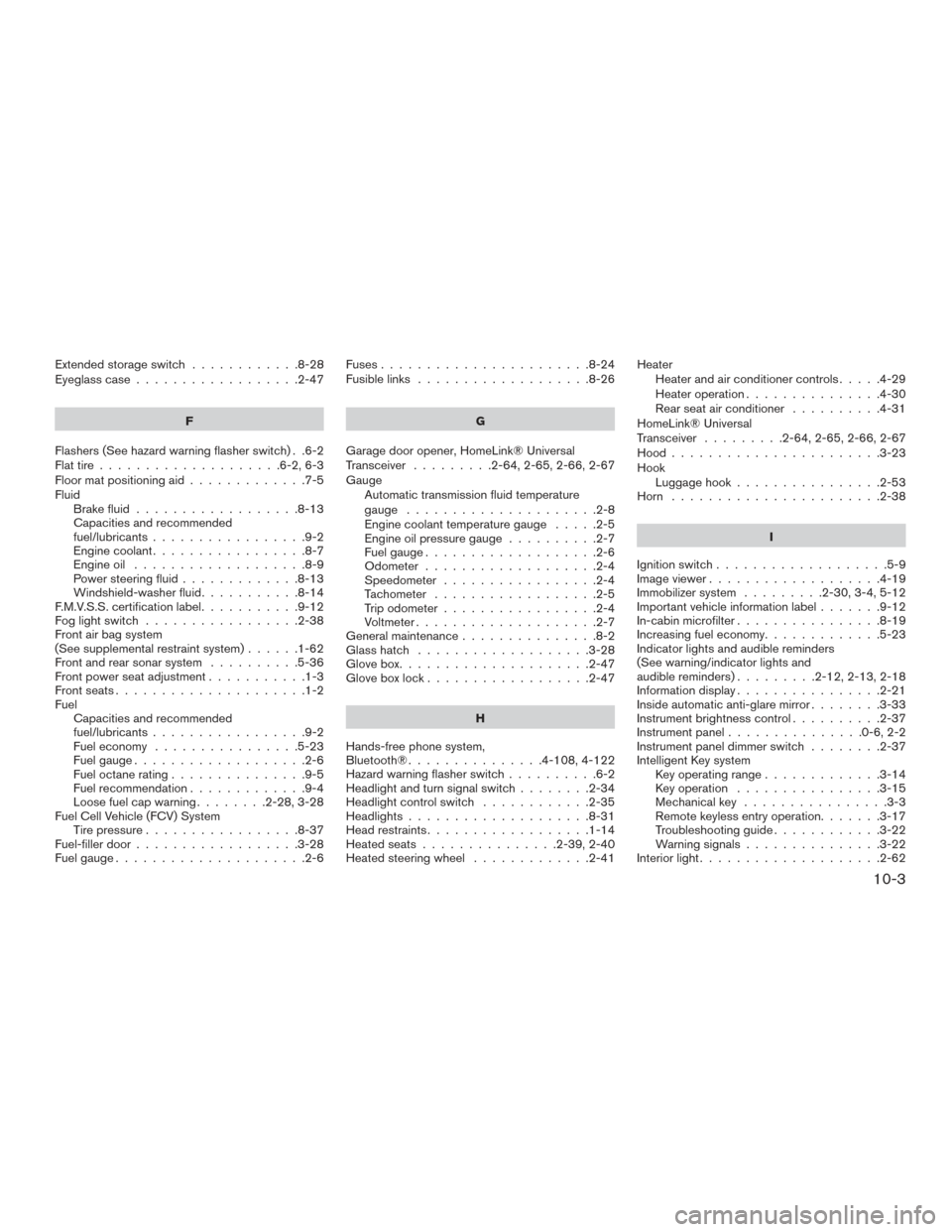
Extendedstorageswitch ............8-28
Eyeglass case..................2-47
F
Flashers (See hazard warning flasher switch) . .6-2
Flat tire ....................6-2,6-3
Floor mat positioning aid .............7-5
Fluid Brake fluid ..................8-13
Capacities and recommended
fuel/lubricants .................9-2
Engine coolant .................8-7
Engine oil ...................8-9
Power steering fluid .............8-13
Windshield-washerfluid...........8-14
F.M.V.S.S. certification label ...........9-12
Foglightswitch .................2-38
Front air bag system
(See supplemental restraint system) ......1-62
Front and rear sonar system ..........5-36
Front power seat adjustment ...........1-3
Frontseats.....................1-2
Fuel Capacities and recommended
fuel/lubricants .................9-2
Fuel economy ................5-23
Fuel gauge ...................2-6
Fuel octane rating ...............9-5
Fuel recommendation .............9-4
Loose fuel cap warning ........2-28,3-28
Fuel Cell Vehicle (FCV) System Tirepressure.................8-37
Fuel-filler door ..................3-28
Fuel gauge .....................2-6 Fuses.......................8-24
Fusiblelinks ...................8-26
G
Garage door opener, HomeLink® Universal
Transceiver .........2-64,2-65,2-66,2-67
Gauge Automatic transmission fluid temperature
gauge .....................2-8
Engine coolant temperature gauge .....2-5
Engine oil pressure gauge ..........2-7
Fuel gauge ...................2-6
Odometer ...................2-4
Speedometer .................2-4
Tachometer ..................2-5
Trip odometer .................2-4
Voltmeter....................2-7
General maintenance ...............8-2
Glass hatch ...................3-28
Glovebox.....................2-47
Gloveboxlock..................2-47
H
Hands-free phone system,
Bluetooth®...............4- 108, 4-122
Hazard warning flasher switch ..........6-2
Headlight and turn signal switch ........2-34
Headlight control switch ............2-35
Headlights ....................8-31
Head restraints ..................1-14
Heated seats ...............2-39,2-40
Heated steering wheel .............2-41 Heater
Heater and air conditioner controls .....4-29
Heater operation ...............4-30
Rear seat air conditioner ..........4-31
HomeLink® Universal
Transceiver .........2-64,2-65,2-66,2-67
H
ood.......................3-23
Hook Luggage hook ................2-53
Horn .......................2-38
I
Ignition switch ...................5-9
Imageviewer...................4-19
Immobilizer system .........2-30,3-4,5-12
Important vehicle information label .......9-12
In-cabin microfilter ................8-19
Increasing fuel economy .............5-23
Indicator lights and audible reminders
(See warning/indicator lights and
audible reminders) .........2-12,2-13,2-18
Information display ................2-21
Inside automatic anti-glare mirror ........3-33
Instrument brightness control ..........2-37
Instrumentpanel...............0-6,2-2
Instrument panel dimmer switch ........2-37
Intelligent Key system Key operating range .............3-14
Key operation ................3-15
Mechanical key ................3-3
Remote keyless entry operation.......3-17
Troubleshooting guide ............3-22
Warning signals ...............3-22
Interior light ....................2-62
10-3
Page 503 of 510
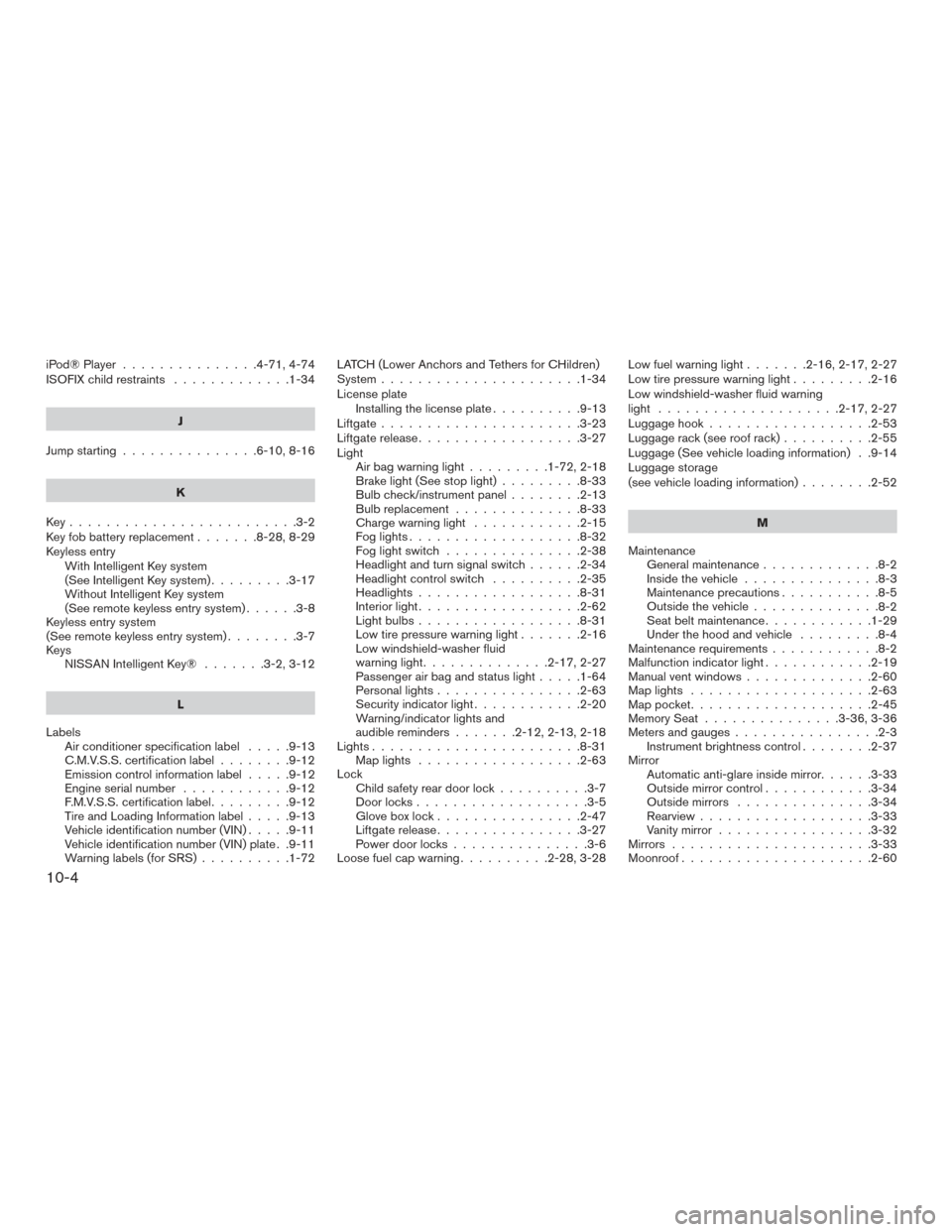
iPod®Player ...............4-71,4-74
ISOFIX child restraints.............1-34
J
Jump starting ...............6-10,8-16
K
Key.........................3-2
Key fob battery replacement .......8-28,8-29
Keyless entry With Intelligent Key system
(See Intelligent Key system) .........3-17
Without Intelligent Key system
(See remote keyless entry system) ......3-8
Keyless entry system
(See remote keyless entry system) ........3-7
Keys NISSAN Intelligent Key® .......3-2,3-12
L
Labels Air conditioner specification label .....9-13
C.M.V.S.S. certification label ........9-12
Emissioncontrolinformationlabel.....9-12
Engine serial number ............9-12
F.M.V.S.S. certification label .........9-12
Tire and Loading Information label .....9-13
Vehicle identification number (VIN) .....9-11
Vehicle identification number (VIN) plate . .9-11
Warning labels (for SRS) ..........1-72LATCH (Lower Anchors and Tethers for CHildren)
System
......................1-34
License plate Installing the license plate ..........9-13
Liftgate ......................3-23
Liftgate release ..................3-27
Light Air bag warning light .........1-72,2-18
Brake light (See stop light) .........8-33
Bulb check/instrument panel ........2-13
Bulbreplacement..............8-33
Charge warning light ............2-15
Foglights...................8-32
Foglightswitch ...............2-38
Headlight and turn signal switch ......2-34
Headlight control switch ..........2-35
Headlights..................8-31
Interiorlight..................2-62
Lightbulbs..................8-31
Low tire pressure warning light .......2-16
Low windshield-washer fluid
warning light ..............2-17,2-27
Passenger air bag and status light .....1-64
Personal lights ................2-63
Security indicator light ............2-20
Warning/indicator lights and
audiblereminders.......2-12,2-13,2-18
Lights.......................8-31 Maplights ..................2-63
Lock Child safety rear door lock ..........3-7
Door locks ...................3-5
Gloveboxlock................2-47
Liftgate release ................3-27
Power door locks ...............3-6
Loose fuel cap warning ..........2-28,3-28 Low fuel warning light
.......2-16,2-17,2-27
Low tire pressure warning light .........2-16
Low windshield-washer fluid warning
light ....................2-17,2-27
Luggage hook ..................2-53
Luggage rack (see roof rack) ..........2-55
Luggage (See vehicle loading information) . .9-14
Luggage storage
(see vehicle loading information) ........2-52
M
Maintenance General maintenance .............8-2
Insidethevehicle...............8-3
Maintenance precautions ...........8-5
Outside the vehicle ..............
8-2
Seat belt maintenance ............1-29
Under the hood and vehicle .........8-4
Maintenance requirements ............8-2
Malfunction indicator light ............2-19
Manual vent windows ..............2-60
Maplights ....................2-63
Mappocket....................2-45
Memory Seat ...............3-36,3-36
Meters and gauges ................2-3
Instrument brightness control ........2-37
Mirror Automatic anti-glare inside mirror ......3-33
Outside mirror control ............3-34
Outside mirrors ...............3-34
Rearview ...................3-33
Vanity mirror .................3-32
Mirrors ......................3-33
Moonroof .....................2-60
10-4
Page 504 of 510
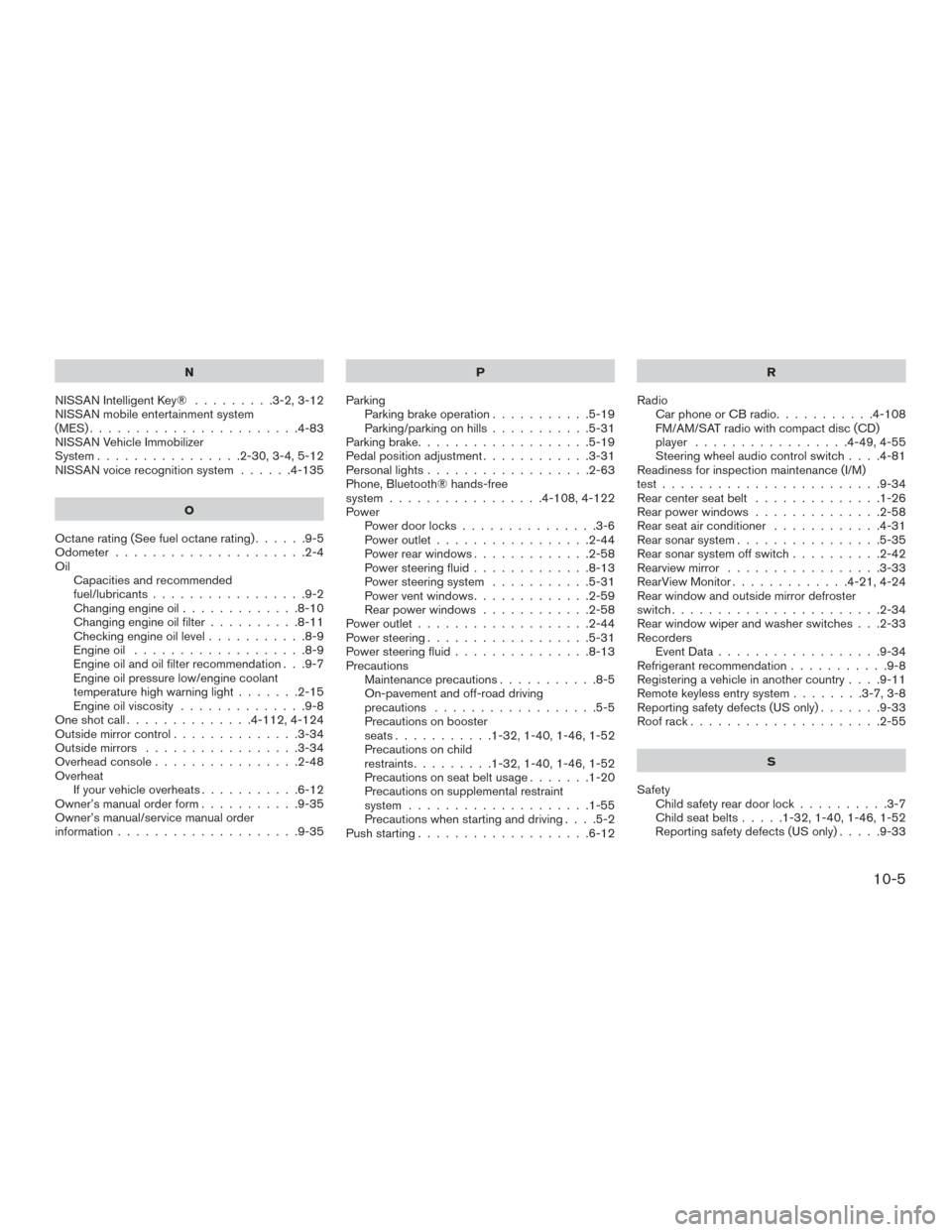
N
NISSAN Intelligent Key® .........3-2,3-12
NISSAN mobile entertainment system
(MES) .......................4-83
NISSAN Vehicle Immobilizer
System ................2-30,3-4,5-12
NISSAN voice recognition system ......4-135
O
Octanerating(Seefueloctanerating)......9-5
Odometer .....................2-4
Oil Capacities and recommended
fuel/lubricants .................9-2
Changing engine oil .............8-10
Changing engine oil filter ..........8-11
Checking engine oil level ...........8-9
Engine oil ...................8-9
Engine oil and oil filter recommendation . . .9-7
Engine oil pressure low/engine coolant
temperature high warning light .......2-15
Engine oil viscosity ..............9-8
Oneshotcall..............4- 112, 4-124
Outside mirror control ..............3-34
Outside mirrors .................3-34
Overhead console ................2-48
Overheat Ifyourvehicleoverheats...........6-12
Owner’s manual order form ...........9-35
Owner’s manual/service manual order
information ....................9-35 P
Parking Parking brake operation ...........5-19
Parking/parking on hills ...........5-31
Parking brake ...................5-19
Pedal position adjustment ............3-31
Personallights..................2-63
Phone, Bluetooth® hands-free
system .................4- 108, 4-122
Power Power door locks ...............3-6
Power outlet .................2-44
Power rear windows .............2-58
Power steering fluid .............8-13
Power steering system ...........5-31
Power vent windows .............2-59
Rear power windows ............2-58
Power outlet ...................2-44
Power steering ..................5-31
Power steering fluid ...............8-13
Precautions Maintenance precautions ...........8-5
On-pavement and off-road driving
precautions ..................5-5
Precautions on booster
seats...........1-32,1-40,1-46,1-52
Precautions on child
restraints .........1-32,1-40,1-46,1-52
Precautions on seat belt usage .......1-20
Precautions on supplemental restraint
system ....................1-55
Precautions when starting and driving ....5-2
Push starting ...................6-12 R
Radio CarphoneorCBradio...........4-108
FM/AM/SAT radio with compact disc (CD)
player .................4-49,4-55
Steering wheel audio control switch . . . .4-81
Readiness for inspection maintenance (I/M)
test ........................9-34
Rear center seat belt ..............1-26
Rear power windows ..............
2-58
Rear seat air conditioner ............4-31
Rear sonar system ................5-35
Rear sonar system off switch ..........2-42
Rearview mirror .................3-33
RearView Monitor .............4-21,4-24
Rear window and outside mirror defroster
switch.......................2-34
Rear window wiper and washer switches . . .2-33
Recorders EventData..................9-34
Refrigerant recommendation ...........9-8
Registering a vehicle in another country ....9-11
Remote keyless entry system ........3-7,3-8
Reporting safety defects (US only) .......9-33
Roof rack .....................2-55
S
Safety Child safety rear door lock ..........3-7
Child seat belts .....1-32,1-40,1-46,1-52
Reporting safety defects (US only) .....9-33
10-5
Page 506 of 510
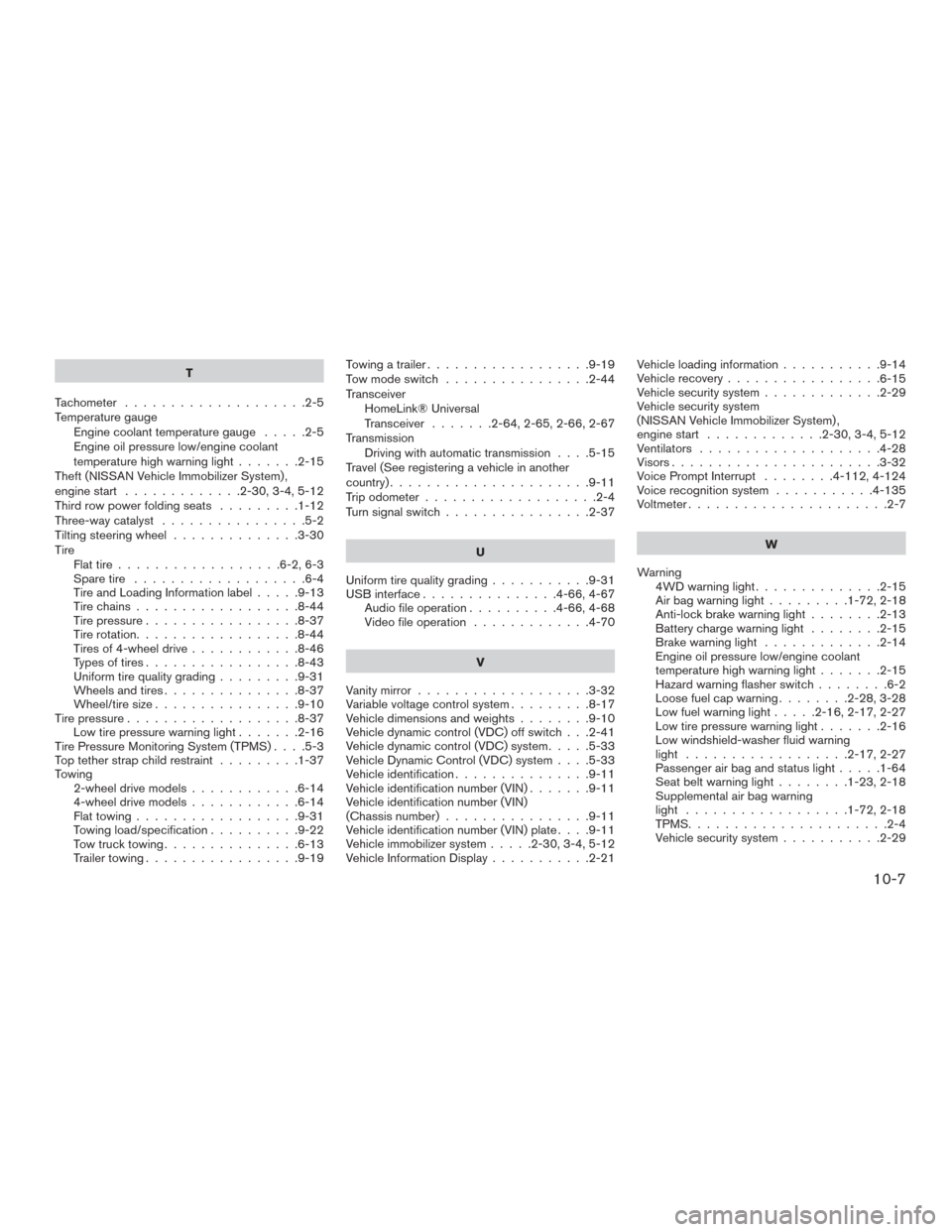
T
Tachometer ....................2-5
Temperature gauge Engine coolant temperature gauge .....2-5
Engine oil pressure low/engine coolant
temperature high warning light .......2-15
Theft (NISSAN Vehicle Immobilizer System) ,
engine start .............2-30,3-4,5-12
Third row power folding seats .........1-12
Three-way catalyst ................5-2
Tilting steering wheel ..............3-30
Tire Flat tire ..................6-2,6-3
Spare tire ...................6-4
TireandLoadingInformationlabel.....9-13
Tire chains ..................8-44
Tirepressure.................8-37
Tire rotation..................8-44
Tires of 4-wheel drive ............8-46
Types of tires .................8-43
Uniform tire quality grading .........9-31
Wheels and tires ...............8-37
Wheel/tire size ................9-10
Tirepressure...................8-37 Low tire pressure warning light .......2-16
Tire Pressure Monitoring System (TPMS) ....5-3
Top tether strap child restraint .........1-37
Towing 2-wheel drive models ............6-14
4-wheel drive models ............6-14
Flattowing..................9-31
Towing load/specification ..........9-22
Towtrucktowing...............6-13
Trailer towing .................9-19 Towing a trailer
..................9-19
Tow mode switch ................2-44
Transceiver HomeLink® Universal
Transceiver .......2-64,2-65,2-66,2-67
Transmission Driving with automatic transmission ....5-15
Travel (See registering a vehicle in another
country) ......................9-11
Trip odometer ...................2-4
Turn signal switch ................2-37
U
Uniform tire quality grading ...........9-31
USB interface ...............4-66,4-67
Audio file operation ..........4-66,4-68
Video file operation .............4-70
V
Vanity mirror ...................3-32
Variable voltage control system .........8-17
Vehicle dimensions and weights ........9-10
Vehicle dynamic control (VDC) off switch . . .2-41
Vehicle dynamic control (VDC) system .....5-33
Vehicle Dynamic Control (VDC) system ....5-33
Vehicle identification ...............9-11
Vehicle identification number (VIN) .......9-11
Vehicle identification number (VIN)
(Chassis number) ................9-11
Vehicle identification number (VIN) plate ....9-11
Vehicle immobilizer system .....2-30,3-4,5-12
Vehicle Information Display ...........2-21Vehicle loading information
...........9-14
Vehicle recovery ................. 6-15
Vehicle security system .............2-29
Vehicle security system
(NISSAN Vehicle Immobilizer System) ,
enginestart .............2-30,3-4,5-12
Ventilators ....................4-28
Visors.......................3-32
Voice Prompt Interrupt ........4-112, 4-124
Voice recognition system ...........4-135
Voltmeter......................2-7
W
Warning 4WD warning light ..............2-15
Airbagwarninglight.........1-72,2-18
Anti-lock brake warning light ........2-13
Battery charge warning light ........2-15
Brake warning light .............2-14
Engine oil pressure low/engine coolant
temperature high warning light .......2-15
Hazard warning flasher switch ........6-2
Loose fuel cap warning ........2-28,3-28
Low fuel warning light .....2-16,2-17,2-27
Low tire pressure warning light .......2-16
Low windshield-washer fluid warning
light ..................2-17,2-27
Passenger air bag and status light .....1-64
Seat belt warning light ........1-23,2-18
Supplemental air bag warning
light ..................1-72,2-18
TPMS ......................2-4
Vehicle security system ...........2-29
10-7