Wiper NISSAN ARMADA 2017 2.G User Guide
[x] Cancel search | Manufacturer: NISSAN, Model Year: 2017, Model line: ARMADA, Model: NISSAN ARMADA 2017 2.GPages: 614, PDF Size: 2.87 MB
Page 127 of 614
2-38Instruments and controls
headlights when it is light.
The headlights will also be turned on automa-
tically at twilight or in rainy weather (when the
windshield wiper is operated continuously) .
If the ignition switch is placed in the OFF
position and one of the doors is opened and this
condition is continued, the headlights remain on
for 5 minutes.
Automatic headlights off delay:
You can keep the headlights on for up to 180
seconds after you place the ignition switch in the
OFF position and open any door then close all
the doors.
You can adjust the period of the automatic
headlights off delay from 0 seconds (OFF) to
180 seconds. The factory default setting is 45
seconds.
For automatic headlights off delay setting, see
“How to use SETTING button” (P.4-13) .
SIC3784A
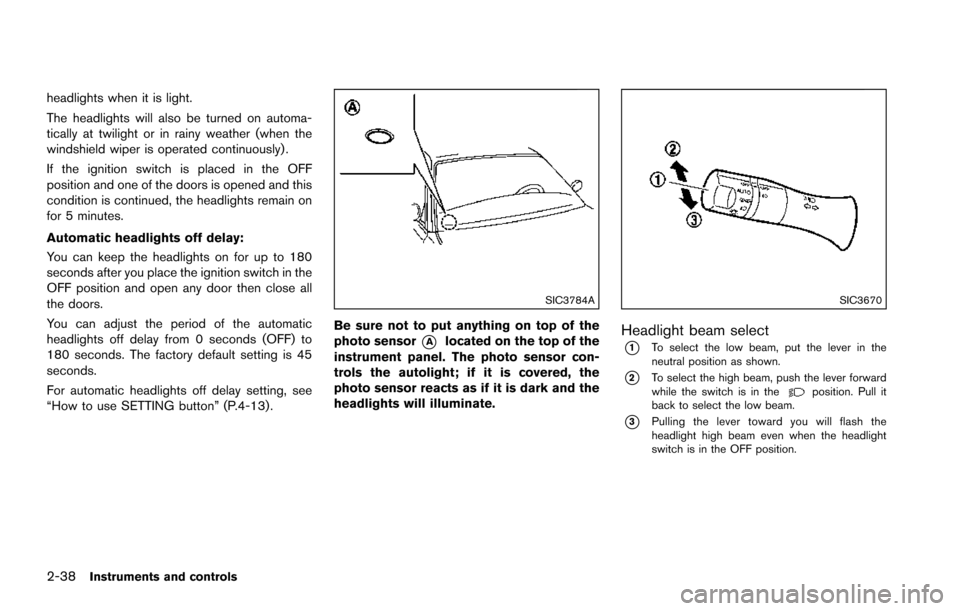
Be sure not to put anything on top of the
photo sensor
*Alocated on the top of the
instrument panel. The photo sensor con-
trols the autolight; if it is covered, the
photo sensor reacts as if it is dark and the
headlights will illuminate.
SIC3670
Headlight beam select
*1To select the low beam, put the lever in the
neutral position as shown.
*2To select the high beam, push the lever forward
while the switch is in theposition. Pull it
back to select the low beam.
*3Pulling the lever toward you will flash the
headlight high beam even when the headlight
switch is in the OFF position.
Page 214 of 614
When any mode button is pushed with the
screen off, the screen turns on for further
operation. The screen will turn off automatically
5 seconds after the operation is finished.
To turn on the screen, set this item to the ON
position, or push the
OFF button.
. Brightness/Contrast/Background Color
To adjust the brightness and contrast of the
screen, select the “Brightness” or “Contrast”
key.
Then, you can adjust the brightness and the
contrast using the multi-function controller.
For information on the “Background Color” key,
refer to the separate Navigation System Own-
er’s Manual.
Color Theme:
Choose the theme color of the menu screen.
SAA3151
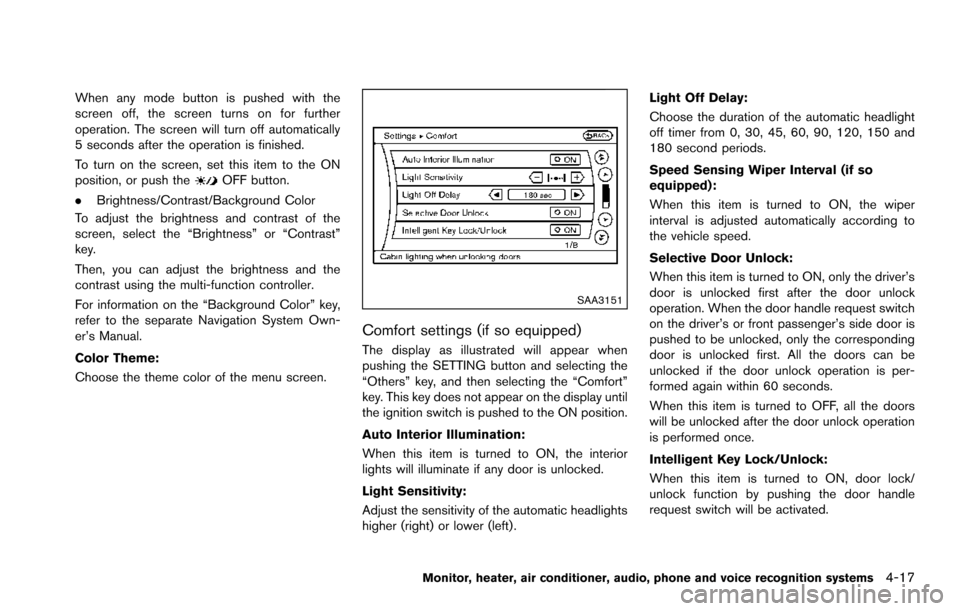
Comfort settings (if so equipped)
The display as illustrated will appear when
pushing the SETTING button and selecting the
“Others” key, and then selecting the “Comfort”
key. This key does not appear on the display until
the ignition switch is pushed to the ON position.
Auto Interior Illumination:
When this item is turned to ON, the interior
lights will illuminate if any door is unlocked.
Light Sensitivity:
Adjust the sensitivity of the automatic headlights
higher (right) or lower (left) . Light Off Delay:
Choose the duration of the automatic headlight
off timer from 0, 30, 45, 60, 90, 120, 150 and
180 second periods.
Speed Sensing Wiper Interval (if so
equipped):
When this item is turned to ON, the wiper
interval is adjusted automatically according to
the vehicle speed.
Selective Door Unlock:
When this item is turned to ON, only the driver’s
door is unlocked first after the door unlock
operation. When the door handle request switch
on the driver’s or front passenger’s side door is
pushed to be unlocked, only the corresponding
door is unlocked first. All the doors can be
unlocked if the door unlock operation is per-
formed again within 60 seconds.
When this item is turned to OFF, all the doors
will be unlocked after the door unlock operation
is performed once.
Intelligent Key Lock/Unlock:
When this item is turned to ON, door lock/
unlock function by pushing the door handle
request switch will be activated.
Monitor, heater, air conditioner, audio, phone and voice recognition systems4-17
Page 482 of 614
TIRE EQUIPMENT
SUMMER tires have a tread designed to provide
superior performance on dry pavement. How-
ever, the performance of these tires will be
substantially reduced in snowy and icy condi-
tions. If you operate your vehicle on snowy or icy
roads, NISSAN recommends the use of MUD &
SNOW or ALL SEASON tires on all four wheels.
It is recommended you consult a NISSAN dealer
for the tire type, size, speed rating and
availability information.
For additional traction on icy roads, studded
tires may be used. However, some U.S. states
and Canadian provinces prohibit their use.
Check local, state and provincial laws before
installing studded tires.
Skid and traction capabilities of studded
snow tires, on wet or dry surfaces, may be
poorer than that of non-studded snow
tires.
Tire chains may be used. For details, see “Tire
chains” (P.8-36) .
For four-wheel drive
If you install snow tires, they must also be the
same size, brand, construction and tread pattern
on all four wheels.
SPECIAL WINTER EQUIPMENT
It is recommended that the following items be
carried in the vehicle during winter:
.A scraper and stiff-bristled brush to remove
ice and snow from the windows and wiper
blades.
. A sturdy, flat board to be placed under the
jack to give it firm support.
. A shovel to dig the vehicle out of snowdrifts.
. Extra window washer fluid to refill the
reservoir tank.
DRIVING ON SNOW OR ICE
WARNING
.Wet ice (328F, 0 8C and freezing rain) ,
very cold snow or ice can be slick
and very hard to drive on. The
vehicle will have much less traction
or “grip” under these conditions. Try
to avoid driving on wet ice until the
road is salted or sanded.
. Whatever the condition, drive with
caution. Accelerate and slow down
with care. If accelerating or down-
shifting too fast, the drive wheels
will lose even more traction. .
Allow more stopping distance under
these conditions. Braking should be
started sooner than on dry pave-
ment.
. Allow greater following distances
on slippery roads.
. Watch for slippery spots (glare ice) .
These may appear on an otherwise
clear road in shaded areas. If a
patch of ice is seen ahead, brake
before reaching it. Try not to brake
while on the ice, and avoid any
sudden steering maneuvers.
. Do not use the cruise control on
slippery roads.
. Snow can trap dangerous exhaust
gases under your vehicle. Keep
snow clear of the exhaust pipe and
from around your vehicle.
ENGINE BLOCK HEATER (if so
equipped)
Engine block heaters are used to assist in cold
temperature starting.
The engine block heater should be used when
the outside temperature is 208F( í78C) or lower.
Starting and driving5-141
Page 516 of 614
8 Do-it-yourself
Maintenance precautions ........................................................ 8-2
Engine compartment check locations .................................. 8-3VK56VD engine ................................................................... 8-3
Engine cooling system ............................................................. 8-4 Checking engine coolant level ......................................... 8-5
Changing engine coolant .................................................. 8-5
Engine oil ........................................................................\
............ 8-6 Checking engine oil level .................................................. 8-6
Changing engine oil and filter .......................................... 8-6
Automatic Transmission Fluid (ATF) ..................................... 8-8
Power steering fluid .................................................................. 8-8
Brake fluid ........................................................................\
........... 8-9
Window washer fluid ............................................................ 8-10
Battery ........................................................................\
............... 8-11 Jump starting ..................................................................... 8-13
Variable voltage control system .......................................... 8-13
Drive belts ........................................................................\
........ 8-13
Spark plugs ........................................................................\
..... 8-14 Replacing spark plugs .................................................... 8-14
Air cleaner ........................................................................\
........ 8-15 Windshield wiper blades ..................................................... 8-16
Cleaning ........................................................................\
... 8-16
Replacing ........................................................................\
. 8-16
Rear window wiper blades ................................................. 8-17
Brakes ........................................................................\
.............. 8-17 Self-adjusting brakes .................................................... 8-17
Brake pad wear warning .............................................. 8-17
Brake booster ................................................................. 8-18
Fuses ........................................................................\
................ 8-18 Engine compartment ..................................................... 8-19
Passenger compartment .............................................. 8-20
Intelligent Key battery replacement ................................... 8-21
Lights ........................................................................\
................ 8-24
Headlights ........................................................................\
8-25
Exterior and interior lights ............................................ 8-26
Wheels and tires ................................................................... 8-30
Tire pressure ................................................................... 8-30
Tire labeling ..................................................................... 8-34
Types of tires ................................................................... 8-36
Tire chains ....................................................................... 8-36
Changing wheels and tires .......................................... 8-37
Page 531 of 614
8-16Do-it-yourself
CLEANING
If your windshield is not clear after using the
windshield washer or if a wiper blade chatters
when running, wax or other material may be on
the blade or windshield.
Clean the outside of the windshield with a
washer solution or a mild detergent. Your
windshield is clean if beads do not form when
rinsing with clear water.
Clean each blade by wiping it with a cloth
soaked in a washer solution or a mild detergent.
Then rinse the blade with clear water. If your
windshield is still not clear after cleaning the
blades and using the wiper, replace the blades.
Worn windshield wiper blades can damage the
windshield and impair driver vision.
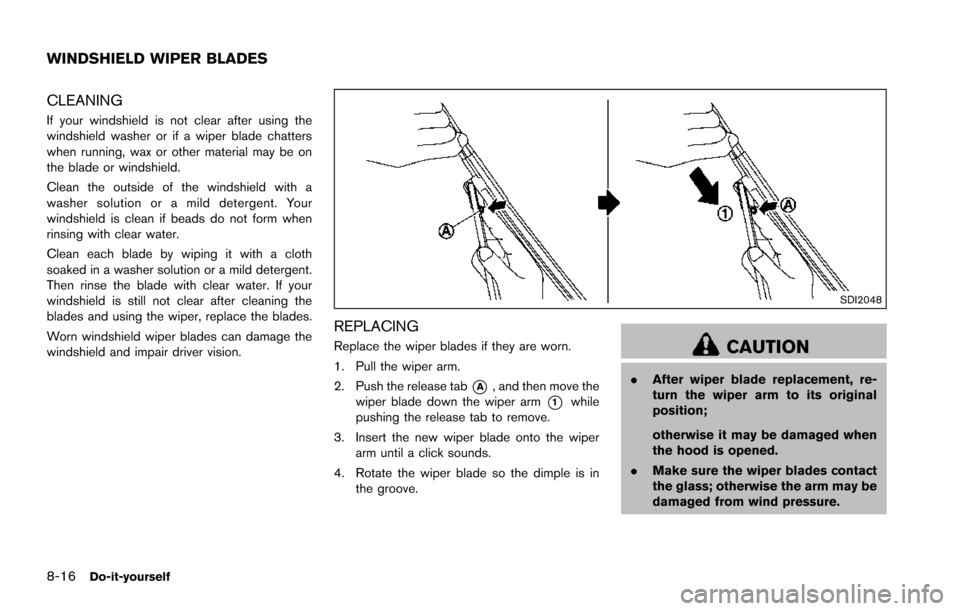
SDI2048
REPLACING
Replace the wiper blades if they are worn.
1. Pull the wiper arm.
2. Push the release tab
*A, and then move the
wiper blade down the wiper arm
*1while
pushing the release tab to remove.
3. Insert the new wiper blade onto the wiper arm until a click sounds.
4. Rotate the wiper blade so the dimple is in the groove.
CAUTION
.After wiper blade replacement, re-
turn the wiper arm to its original
position;
otherwise it may be damaged when
the hood is opened.
. Make sure the wiper blades contact
the glass; otherwise the arm may be
damaged from wind pressure.
WINDSHIELD WIPER BLADES
Page 532 of 614
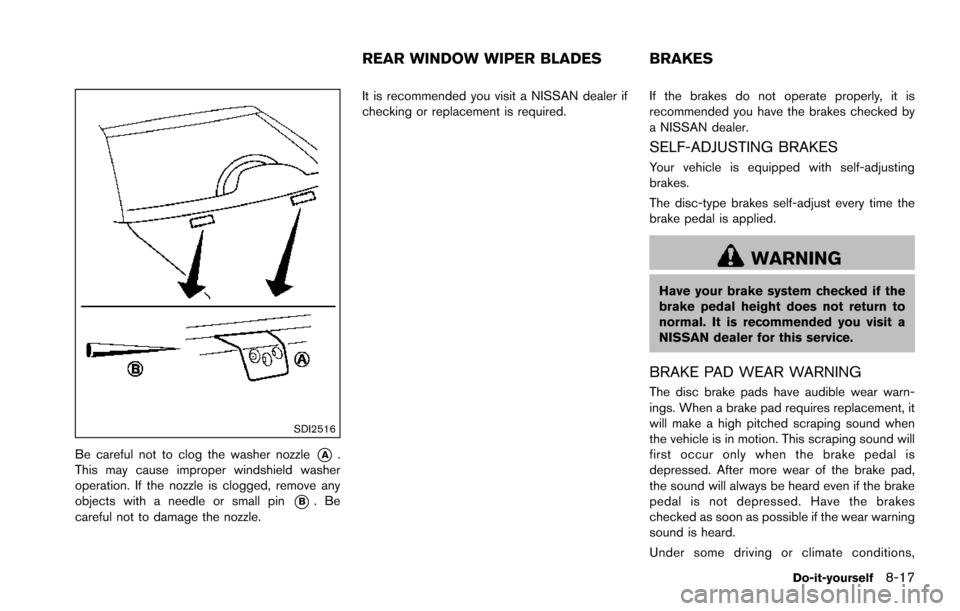
SDI2516
Be careful not to clog the washer nozzle*A.
This may cause improper windshield washer
operation. If the nozzle is clogged, remove any
objects with a needle or small pin
*B.Be
careful not to damage the nozzle. It is recommended you visit a NISSAN dealer if
checking or replacement is required.
If the brakes do not operate properly, it is
recommended you have the brakes checked by
a NISSAN dealer.
SELF-ADJUSTING BRAKES
Your vehicle is equipped with self-adjusting
brakes.
The disc-type brakes self-adjust every time the
brake pedal is applied.
WARNING
Have your brake system checked if the
brake pedal height does not return to
normal. It is recommended you visit a
NISSAN dealer for this service.
BRAKE PAD WEAR WARNING
The disc brake pads have audible wear warn-
ings. When a brake pad requires replacement, it
will make a high pitched scraping sound when
the vehicle is in motion. This scraping sound will
first occur only when the brake pedal is
depressed. After more wear of the brake pad,
the sound will always be heard even if the brake
pedal is not depressed. Have the brakes
checked as soon as possible if the wear warning
sound is heard.
Under some driving or climate conditions,
Do-it-yourself8-17
REAR WINDOW WIPER BLADES BRAKES
Page 558 of 614
When driving in areas using road salt or other
corrosive materials, check lubrication frequently.
Lights*:Clean the headlights on a regular basis.
Make sure that the headlights, stop lights, tail
lights, turn signal lights, and other lights are all
operating properly and installed securely. Also
check headlight aim.
Road wheel nuts (lug nuts)*: When checking
the tires, make sure no wheel nuts are missing,
and check for any loose wheel nuts. Tighten if
necessary.
Tire rotation*: Tires should be rotated every
5,000 miles (8,000 km) .
Tires*: Check the pressure with a gauge often
and always prior to long distance trips. If
necessary, adjust the pressure in all tires,
including the spare, to the pressure specified.
Check carefully for damage, cuts or excessive
wear.
Tire Pressure Monitoring System (TPMS)
transmitter components: Replace the TPMS
transmitter grommet seal, valve core and cap
when the tires are replaced due to wear or age.
Wheel alignment and balance: If the vehicle
should pull to either side while driving on a
straight and level road, or if you detect uneven or
abnormal tire wear, there may be a need for
wheel alignment. If the steering wheel or seat vibrates at normal
highway speeds, wheel balancing may be
needed.
For additional information regarding tires, refer
to “Important Tire Safety Information” (US) or
“Tire Safety Information” (Canada) in the
NISSAN Warranty Information Booklet.
Windshield:
Clean the windshield on a regular
basis. Check the windshield at least every six
months for cracks or other damage. Have a
damaged windshield repaired by a qualified
repair facility.
Windshield wiper blades*: Check for cracks
or wear if they do not wipe properly.
Inside the vehicle
The maintenance items listed here should be
checked on a regular basis, such as when
performing scheduled maintenance, cleaning
the vehicle, etc.
Accelerator pedal: Check the pedal for
smooth operation and make sure the pedal
does not catch or require uneven effort. Keep
the floor mat away from the pedal.
Automatic transmission P (Park) mechan-
ism: On a fairly steep hill, check that your
vehicle is held securely with the shift lever in the
P (Park) position without applying any brakes. Brake pedal:
Check the pedal for smooth
operation. If the brake pedal suddenly goes
down further than normal, the pedal feels
spongy or the vehicle seems to take longer to
stop, have your vehicle checked immediately. It
is recommended you visit a NISSAN dealer for
this service. Keep the floor mat away from the
pedal.
Brakes: Check that the brakes do not pull the
vehicle to one side when applied.
Parking brake: Check the parking brake
operation regularly. The vehicle should be
securely held on a fairly steep hill with only the
parking brake applied. If the parking brake needs
adjusted, it is recommended you visit a NISSAN
dealer for this service.
Seats: Check seat position controls such as
seat adjusters, seatback recliner, etc. to ensure
they operate smoothly and that all latches lock
securely in every position. Check that the head
restraints move up and down smoothly and that
the locks (if so equipped) hold securely in all
latched positions.
Seat belts: Check that all parts of the seat belt
system (for example, buckles, anchors, adjuster
and retractors) operate properly and smoothly,
and are installed securely. Check the belt
webbing for cuts, fraying, wear or damage.
Maintenance and schedules9-3
Page 559 of 614
9-4Maintenance and schedules
Steering wheel:Check for changes in the
steering conditions, such as excessive free play,
hard steering or strange noises.
Warning lights and chimes: Make sure that
all warning lights and chimes are operating
properly.
Windshield defroster: Check that the air
comes out of the defroster outlets properly and
in sufficient quantity when operating the heater
or air conditioner.
Windshield wiper and washer*: Check that
the wipers and washer operate properly and that
the wipers do not streak.
Under the hood and vehicle
The maintenance items listed here should be
checked periodically (for example, each time you
check the engine oil or refuel) .
Battery*: Check the fluid level in each cell. It
should be between the MAX and MIN lines.
Vehicles operated in high temperatures or under
severe condition require frequent checks of the
battery fluid level.
NOTE:
Care should be taken to avoid situations
that can lead to potential battery discharge
and potential no-start conditions such as: 1.
Installation or extended use of electro-
nic accessories that consume battery
power when the engine is not running
(Phone chargers, GPS, DVD players,
etc.)
2. Vehicle is not driven regularly and/or
only driven short distances.
In these cases, the battery may need to be
charged to maintain battery health.
Brake fluid level*: Make sure that the brake
fluid level is between the MAX and MIN lines on
the reservoir.
Engine coolant level*: Check the coolant level
when the engine is cold.
Engine drive belts*: Make sure that no belt is
frayed, worn, cracked or oily.
Engine oil level*: Check the level after parking
the vehicle on a level spot and turning off the
engine. Wait more than 15 minutes for the oil to
drain back into the oil pan.
Exhaust system: Make sure there are no loose
supports, cracks or holes. If the sound of the
exhaust seems unusual or there is a smell of
exhaust fumes, immediately have the exhaust
system inspected. It is recommended you visit a
NISSAN dealer for this service. (See “Precau-
tions when starting and driving” (P.5-4) for
exhaust gas (carbon monoxide) .) Fluid leaks:
Check under the vehicle for fuel,
oil, water or other fluid leaks after the vehicle has
been parked for a while. Water dripping from the
air conditioner after use is normal. If you should
notice any leaks or if gasoline fumes are evident,
check for the cause and have it corrected
immediately.
Power steering fluid level* and lines: Check
the level when the fluid is cold, with the engine
off. Check the lines for proper attachment, leaks,
cracks, etc.
Radiator and hoses: Check the front of the
radiator and clean off any dirt, insects, leaves,
etc., that may have accumulated. Make sure the
hoses have no cracks, deformation, rot or loose
connections.
Underbody: The underbody is frequently ex-
posed to corrosive substances such as those
used on icy roads or to control dust. It is very
important to remove these substances, other-
wise rust will form on the floor pan, frame, fuel
lines and around the exhaust system. At the end
of winter, the underbody should be thoroughly
flushed with plain water, being careful to clean
those areas where mud and dirt may accumu-
late. For additional information, see “Cleaning
exterior” (P.7-2).
Windshield washer fluid*: Check that there is
adequate fluid in the reservoir.
Page 610 of 614
Parking brake operation ..................................... 5-22
Parking on hills ................................................... 5-131
Phone Bluetooth
ŠHands-Free Phone System ....... 4-106
Car phone or CB radio .................................... 4-106
Pocket ........................................................................... 2-55
Power Front seat adjustment ............................................ 1-3
Moonroof ............................................................... 2-62
Power door lock ..................................................... 3-4
Power outlet .......................................................... 2-48
Power steering ................................................... 5-135
Power steering fluid ............................................... 8-8
Power windows .................................................... 2-59
Precautions Audio operation .................................................... 4-59
Braking precautions .......................................... 5-136
Child restraints ..................................................... 1-31
Cruise control ....................................................... 5-67
Driving safety ........................................................ 5-10
Maintenance ............................................................. 8-2
On-pavement and off-road driving ..................... 5-9
Seat belt usage .................................................... 1-18
Supplemental restraint system ......................... 1-52
When starting and driving .................................... 5-4
Predictive Forward Collision
Warning (PFCW) .................................................... 5-112
Push starting ................................................................ 6-14
Push-button ignition switch ..................................... 5-12
R
Radio ............................................................................. 4-59 Car phone or CB radio .................................... 4-106
FM-AM-SAT radio with Compact Disc
(CD) player ............................................................ 4-70
Rain-sensing auto wiper system ............................ 2-34 Rapid air pressure loss ............................................... 5-9
Readiness for Inspection/Maintenance
(I/M) test .................................................................... 10-32
Rear bumper cover .................................................... 2-58
Rear door lock, Child safety rear door lock .......... 3-6
Rear personal lights ................................................... 2-65
Rear window wiper and washer switch ............... 2-35
Rear window wiper blades ...................................... 8-17
RearView Monitor ....................................................... 4-21
RearView Monitor system operation ...................... 4-22
Recorders, Event data ............................................ 10-33
Registering your vehicle in another country ..... 10-10
Remote controller (DVD) ....................................... 4-103
Remote engine start .................................................. 3-19
Remote keyless entry system .................................. 3-15
Reporting safety defects ....................................... 10-31
Roadside assistance program ................................... 6-2
Rollover ........................................................................... 5-8
Roof
Moonroof ............................................................... 2-63
Roof rack ............................................................... 2-57
S
SafetyChild seat belts .................................................... 1-28
Towing safety ...................................................... 10-21
Satellite radio operation ............................................ 4-71
Seat adjustment Front power seat adjustment .............................. 1-3
Front seats ................................................... 1-3, 1-10
Seat belt(s) Child safety ........................................................... 1-28
Infants ..................................................................... 1-29
Injured persons .................................................... 1-21
Larger children ..................................................... 1-29
Precautions on seat belt usage ....................... 1-18 Pregnant women .................................................. 1-21
Seat belt cleaning .................................................. 7-6
Seat belt extenders ............................................. 1-27
Seat belt maintenance ....................................... 1-27
Seat belt warning light and chime .................. 2-16
Seat belts .............................................................. 1-18
Seat belts with pretensioners .......................... 1-67
Small children ....................................................... 1-29
Three-point type .................................................. 1-21
Seat(s) Climate controlled seats .................................... 2-45
Driver-side memory ............................................. 3-33
Heated seats ........................................................ 2-43
Seats .......................................................................... 1-2
Security system (NISSAN Vehicle Immobilizer
System) , Engine start ................................................ 2-31
Security system, Vehicle security system ............. 2-30
Servicing air conditioner ........................................... 4-58
SETTING button ......................................................... 4-13
Setting memory function, Automatic
drive positioner ............................................................ 3-35
Shift lever, Shift lock release ................................... 5-21
Shift lock release Transmission ......................................................... 5-21
Shifting, Automatic transmission ............................ 5-18
SNOW mode ........................................................... 5-132
SNOW mode switch ................................................. 2-47
Sonar system ............................................................ 5-133
Spare tire .......................................................... 8-40, 10-9
Spark plugs .................................................................. 8-14
Speedometer ................................................................. 2-6
Standard maintenance ................................................ 9-7
Starting Before starting the engine ................................ 5-15
Jump starting ........................................................ 6-12
Precautions when starting and driving ............. 5-4
Push starting ......................................................... 6-14
11-5
Page 612 of 614
Voice command (NISSAN voice
recognition system) .................................. 4-122, 4-133
Voice recognition system ...................................... 4-117
Voice recognition, Alternate command mode .... 4-130
Voltmeter ......................................................................... 2-9
W
WarningCheck tire pressure warning ............................ 2-24
Hazard warning flasher switch ............................ 6-2
Lights ...................................................................... 2-11
Loose fuel cap warning ..................................... 2-24
Predictive Forward Collision
Warning (PFCW) .............................................. 5-112
Tire Pressure Monitoring
System (TPMS) ............................................. 5-5, 6-3
Vehicle information display ................................ 2-20
Warning lights, indicator lights and
audible reminders ................................................ 2-10
Warning labels, Air bag warning labels ................ 1-68
Warning light
4WD warning light ............................................ 5-128
Air bag warning light ............................... 1-68, 2-16
Anti-lock Braking System (ABS)
warning light ......................................................... 2-11
Brake warning light ............................................. 2-12
Forward Emergency Braking system
warning light ......................................................... 2-14
Intelligent Key warning light .............................. 2-14
Lane Departure Warning (LDW) indicator
light (orange) ........................................................ 2-14
Low tire pressure warning light ....................... 2-15
Seat belt warning light and chime .................. 2-16
Warranty, Emission control system warranty .... 10-30
Washer switch Rear window wiper and washer switch ........ 2-35 Windshield wiper and washer switch ............ 2-32
Washing .......................................................................... 7-2
Waxing ............................................................................ 7-2
Welcome light ............................................................. 2-64
Wheel/tire size ............................................................ 10-9
Wheels and tires ........................................................ 8-30 Care of wheels ........................................................ 7-3
Cleaning aluminum alloy wheels ......................... 7-3
Cleaning bright wheels ......................................... 7-3
Window washer fluid ................................................. 8-10
Window(s) Cleaning .................................................................... 7-3
Power windows .................................................... 2-59
Windshield wiper and washer switch ................... 2-32
Wiper Rain-sensing auto wiper system ..................... 2-34
Rear window wiper and washer switch ........ 2-35
Windshield wiper and washer switch ............ 2-32
Wiper blades ........................................................ 8-16
11-7