seats NISSAN ARMADA 2017 2.G User Guide
[x] Cancel search | Manufacturer: NISSAN, Model Year: 2017, Model line: ARMADA, Model: NISSAN ARMADA 2017 2.GPages: 614, PDF Size: 2.87 MB
Page 27 of 614
1-8Safety — seats, seat belts and supplemental restraint system
SSS1116
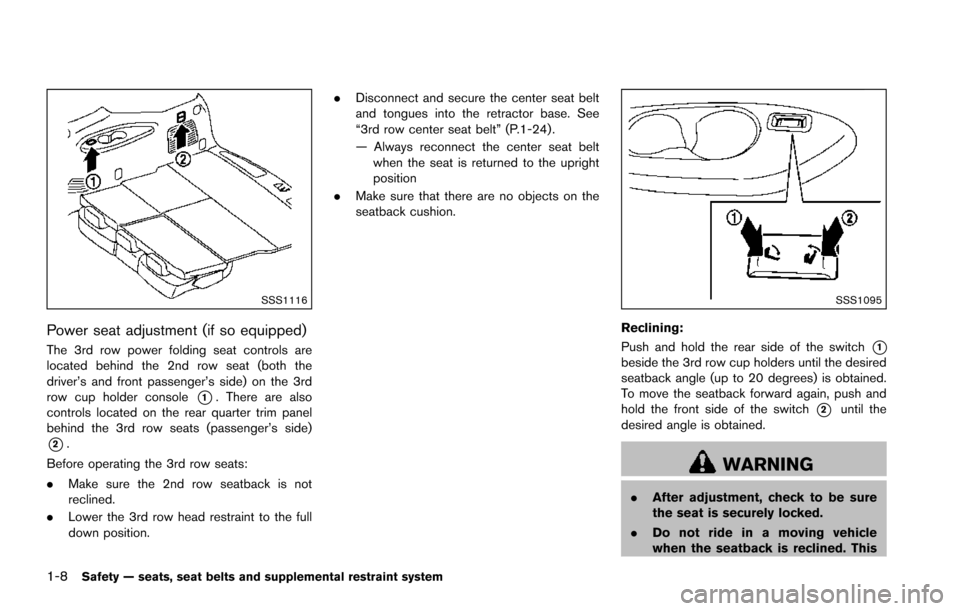
Power seat adjustment (if so equipped)
The 3rd row power folding seat controls are
located behind the 2nd row seat (both the
driver’s and front passenger’s side) on the 3rd
row cup holder console
*1. There are also
controls located on the rear quarter trim panel
behind the 3rd row seats (passenger’s side)
*2.
Before operating the 3rd row seats:
. Make sure the 2nd row seatback is not
reclined.
. Lower the 3rd row head restraint to the full
down position. .
Disconnect and secure the center seat belt
and tongues into the retractor base. See
“3rd row center seat belt” (P.1-24) .
— Always reconnect the center seat belt
when the seat is returned to the upright
position
. Make sure that there are no objects on the
seatback cushion.
SSS1095
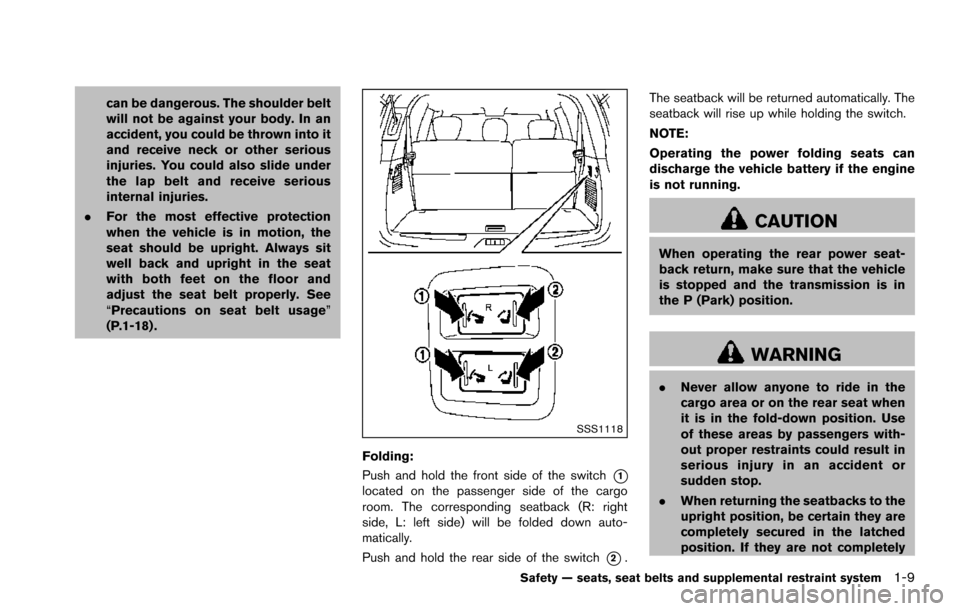
Reclining:
Push and hold the rear side of the switch
*1beside the 3rd row cup holders until the desired
seatback angle (up to 20 degrees) is obtained.
To move the seatback forward again, push and
hold the front side of the switch
*2until the
desired angle is obtained.
WARNING
. After adjustment, check to be sure
the seat is securely locked.
. Do not ride in a moving vehicle
when the seatback is reclined. This
Page 28 of 614
can be dangerous. The shoulder belt
will not be against your body. In an
accident, you could be thrown into it
and receive neck or other serious
injuries. You could also slide under
the lap belt and receive serious
internal injuries.
. For the most effective protection
when the vehicle is in motion, the
seat should be upright. Always sit
well back and upright in the seat
with both feet on the floor and
adjust the seat belt properly. See
“Precautions on seat belt usage”
(P.1-18) .
SSS1118
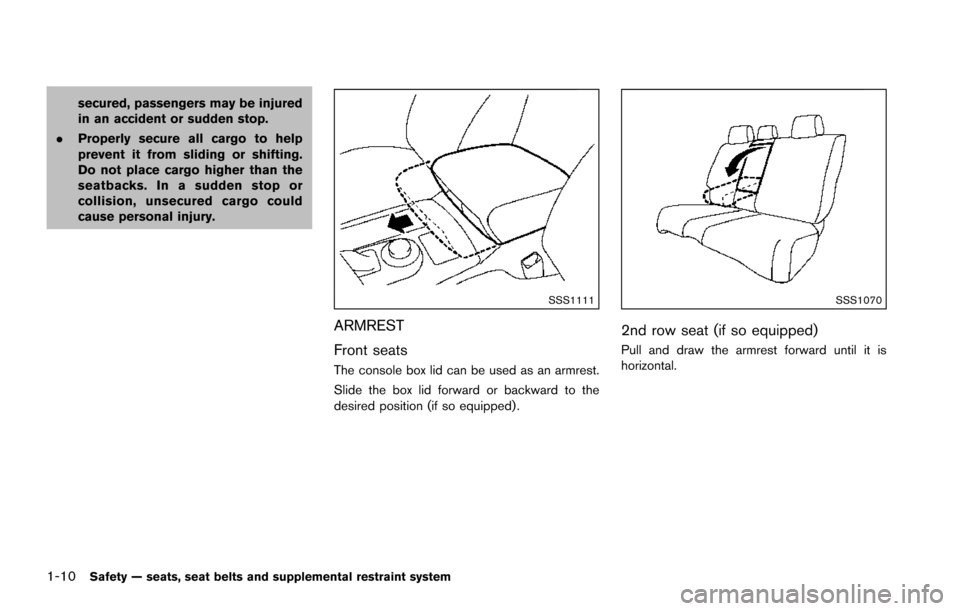
Folding:
Push and hold the front side of the switch
*1located on the passenger side of the cargo
room. The corresponding seatback (R: right
side, L: left side) will be folded down auto-
matically.
Push and hold the rear side of the switch
*2. The seatback will be returned automatically. The
seatback will rise up while holding the switch.
NOTE:
Operating the power folding seats can
discharge the vehicle battery if the engine
is not running.
CAUTION
When operating the rear power seat-
back return, make sure that the vehicle
is stopped and the transmission is in
the P (Park) position.
WARNING
.
Never allow anyone to ride in the
cargo area or on the rear seat when
it is in the fold-down position. Use
of these areas by passengers with-
out proper restraints could result in
serious injury in an accident or
sudden stop.
. When returning the seatbacks to the
upright position, be certain they are
completely secured in the latched
position. If they are not completely
Safety — seats, seat belts and supplemental restraint system1-9
Page 29 of 614
1-10Safety — seats, seat belts and supplemental restraint system
secured, passengers may be injured
in an accident or sudden stop.
. Properly secure all cargo to help
prevent it from sliding or shifting.
Do not place cargo higher than the
seatbacks. In a sudden stop or
collision, unsecured cargo could
cause personal injury.
SSS1111
ARMREST
Front seats
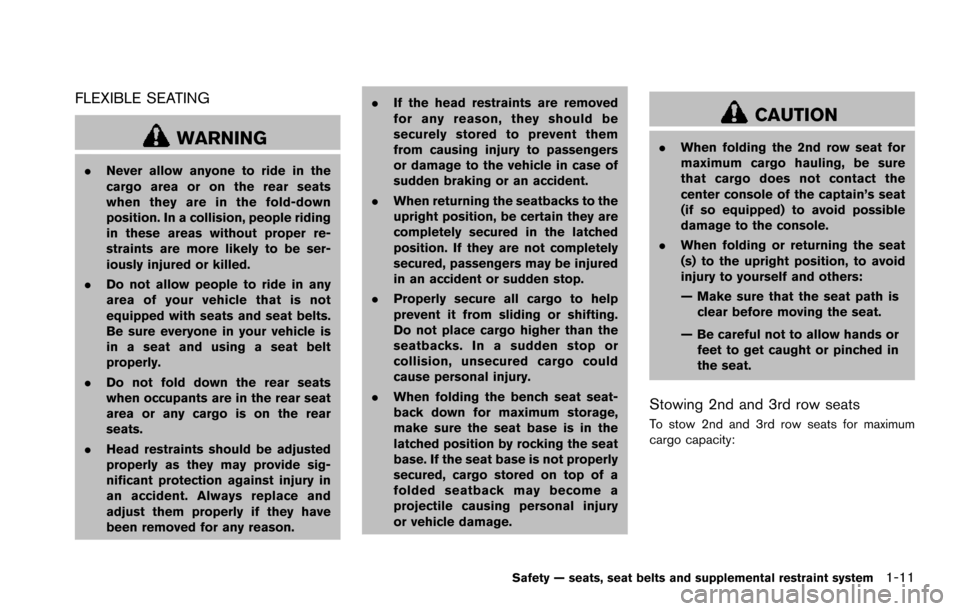
The console box lid can be used as an armrest.
Slide the box lid forward or backward to the
desired position (if so equipped) .
SSS1070
2nd row seat (if so equipped)
Pull and draw the armrest forward until it is
horizontal.
Page 30 of 614
FLEXIBLE SEATING
WARNING
.Never allow anyone to ride in the
cargo area or on the rear seats
when they are in the fold-down
position. In a collision, people riding
in these areas without proper re-
straints are more likely to be ser-
iously injured or killed.
. Do not allow people to ride in any
area of your vehicle that is not
equipped with seats and seat belts.
Be sure everyone in your vehicle is
in a seat and using a seat belt
properly.
. Do not fold down the rear seats
when occupants are in the rear seat
area or any cargo is on the rear
seats.
. Head restraints should be adjusted
properly as they may provide sig-
nificant protection against injury in
an accident. Always replace and
adjust them properly if they have
been removed for any reason. .
If the head restraints are removed
for any reason, they should be
securely stored to prevent them
from causing injury to passengers
or damage to the vehicle in case of
sudden braking or an accident.
. When returning the seatbacks to the
upright position, be certain they are
completely secured in the latched
position. If they are not completely
secured, passengers may be injured
in an accident or sudden stop.
. Properly secure all cargo to help
prevent it from sliding or shifting.
Do not place cargo higher than the
seatbacks. In a sudden stop or
collision, unsecured cargo could
cause personal injury.
. When folding the bench seat seat-
back down for maximum storage,
make sure the seat base is in the
latched position by rocking the seat
base. If the seat base is not properly
secured, cargo stored on top of a
folded seatback may become a
projectile causing personal injury
or vehicle damage.
CAUTION
.When folding the 2nd row seat for
maximum cargo hauling, be sure
that cargo does not contact the
center console of the captain’s seat
(if so equipped) to avoid possible
damage to the console.
. When folding or returning the seat
(s) to the upright position, to avoid
injury to yourself and others:
— Make sure that the seat path is
clear before moving the seat.
— Be careful not to allow hands or feet to get caught or pinched in
the seat.
Stowing 2nd and 3rd row seats
To stow 2nd and 3rd row seats for maximum
cargo capacity:
Safety — seats, seat belts and supplemental restraint system1-11
Page 31 of 614
1-12Safety — seats, seat belts and supplemental restraint system
SSS1119
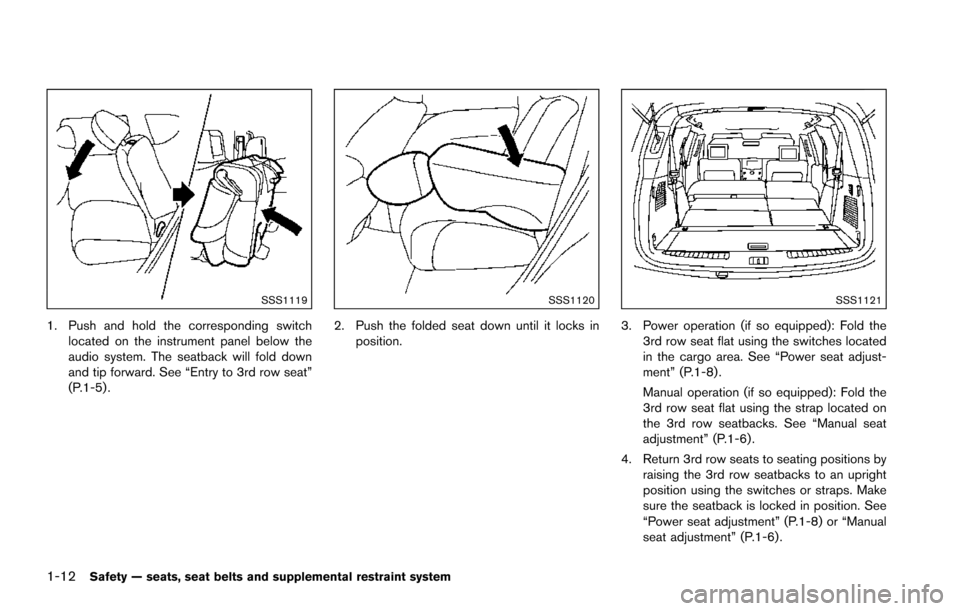
1. Push and hold the corresponding switchlocated on the instrument panel below the
audio system. The seatback will fold down
and tip forward. See “Entry to 3rd row seat”
(P.1-5) .
SSS1120
2. Push the folded seat down until it locks inposition.
SSS1121
3. Power operation (if so equipped): Fold the3rd row seat flat using the switches located
in the cargo area. See “Power seat adjust-
ment” (P.1-8) .
Manual operation (if so equipped): Fold the
3rd row seat flat using the strap located on
the 3rd row seatbacks. See “Manual seat
adjustment” (P.1-6) .
4. Return 3rd row seats to seating positions by raising the 3rd row seatbacks to an upright
position using the switches or straps. Make
sure the seatback is locked in position. See
“Power seat adjustment” (P.1-8) or “Manual
seat adjustment” (P.1-6).
Page 32 of 614
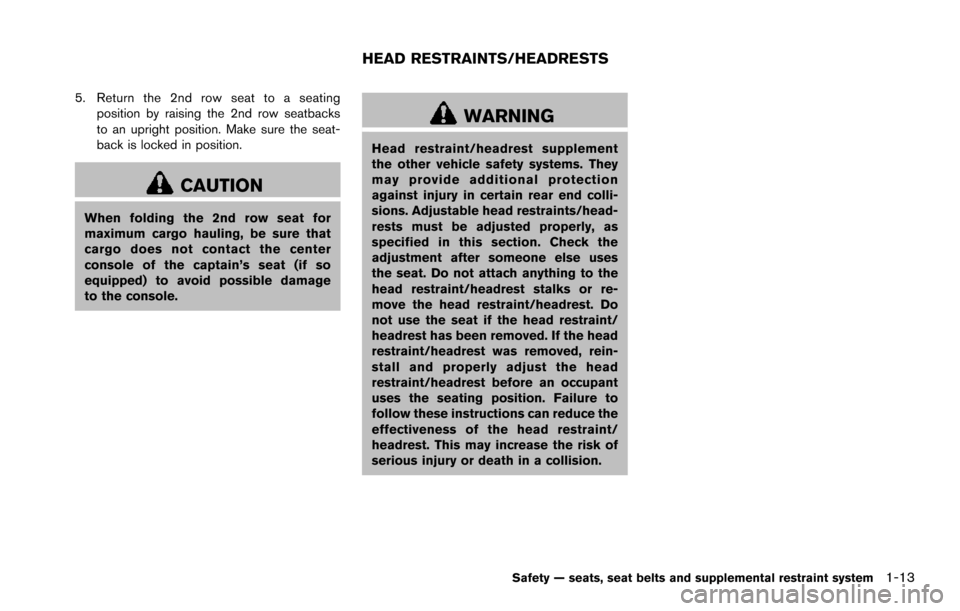
5. Return the 2nd row seat to a seatingposition by raising the 2nd row seatbacks
to an upright position. Make sure the seat-
back is locked in position.
CAUTION
When folding the 2nd row seat for
maximum cargo hauling, be sure that
cargo does not contact the center
console of the captain’s seat (if so
equipped) to avoid possible damage
to the console.
WARNING
Head restraint/headrest supplement
the other vehicle safety systems. They
may provide additional protection
against injury in certain rear end colli-
sions. Adjustable head restraints/head-
rests must be adjusted properly, as
specified in this section. Check the
adjustment after someone else uses
the seat. Do not attach anything to the
head restraint/headrest stalks or re-
move the head restraint/headrest. Do
not use the seat if the head restraint/
headrest has been removed. If the head
restraint/headrest was removed, rein-
stall and properly adjust the head
restraint/headrest before an occupant
uses the seating position. Failure to
follow these instructions can reduce the
effectiveness of the head restraint/
headrest. This may increase the risk of
serious injury or death in a collision.
Safety — seats, seat belts and supplemental restraint system1-13
HEAD RESTRAINTS/HEADRESTS
Page 33 of 614
1-14Safety — seats, seat belts and supplemental restraint system
JVR0403X
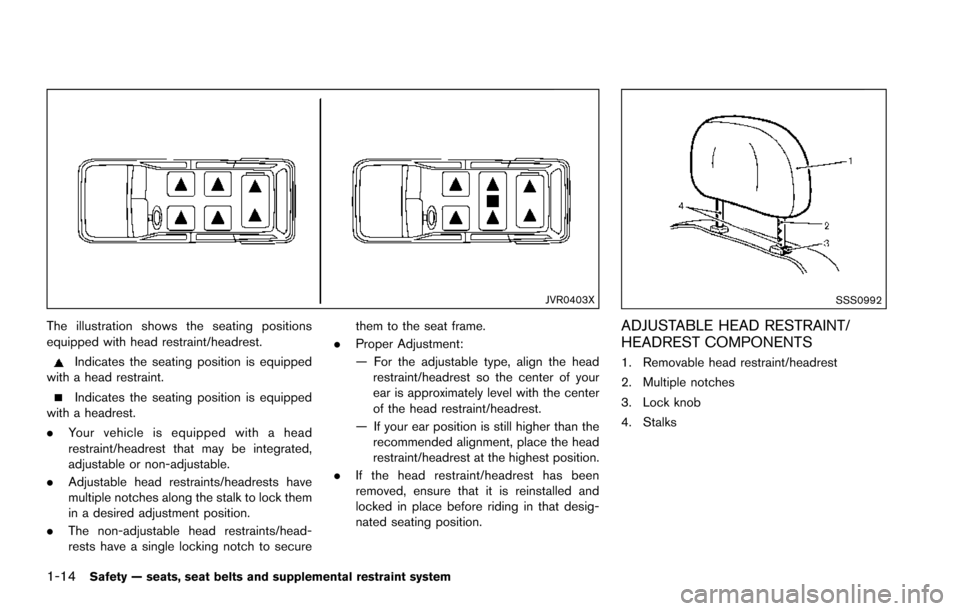
The illustration shows the seating positions
equipped with head restraint/headrest.
Indicates the seating position is equipped
with a head restraint.
Indicates the seating position is equipped
with a headrest.
. Your vehicle is equipped with a head
restraint/headrest that may be integrated,
adjustable or non-adjustable.
. Adjustable head restraints/headrests have
multiple notches along the stalk to lock them
in a desired adjustment position.
. The non-adjustable head restraints/head-
rests have a single locking notch to secure them to the seat frame.
. Proper Adjustment:
— For the adjustable type, align the head
restraint/headrest so the center of your
ear is approximately level with the center
of the head restraint/headrest.
— If your ear position is still higher than the recommended alignment, place the head
restraint/headrest at the highest position.
. If the head restraint/headrest has been
removed, ensure that it is reinstalled and
locked in place before riding in that desig-
nated seating position.
SSS0992
ADJUSTABLE HEAD RESTRAINT/
HEADREST COMPONENTS
1. Removable head restraint/headrest
2. Multiple notches
3. Lock knob
4. Stalks
Page 34 of 614
JVR0203X
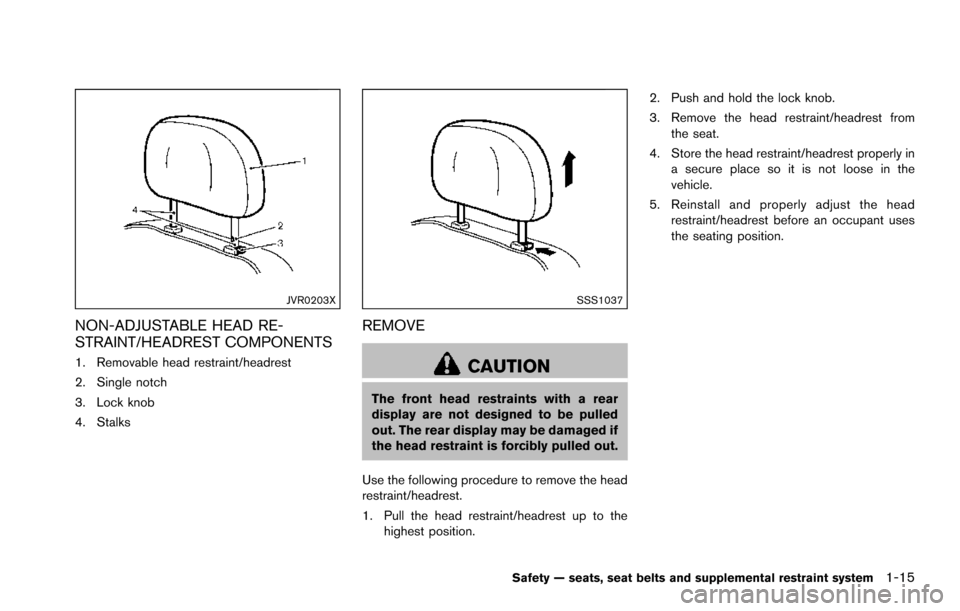
NON-ADJUSTABLE HEAD RE-
STRAINT/HEADREST COMPONENTS
1. Removable head restraint/headrest
2. Single notch
3. Lock knob
4. Stalks
SSS1037
REMOVE
CAUTION
The front head restraints with a rear
display are not designed to be pulled
out. The rear display may be damaged if
the head restraint is forcibly pulled out.
Use the following procedure to remove the head
restraint/headrest.
1. Pull the head restraint/headrest up to the highest position. 2. Push and hold the lock knob.
3. Remove the head restraint/headrest from
the seat.
4. Store the head restraint/headrest properly in a secure place so it is not loose in the
vehicle.
5. Reinstall and properly adjust the head restraint/headrest before an occupant uses
the seating position.
Safety — seats, seat belts and supplemental restraint system1-15
Page 35 of 614
1-16Safety — seats, seat belts and supplemental restraint system
SSS0996
INSTALL
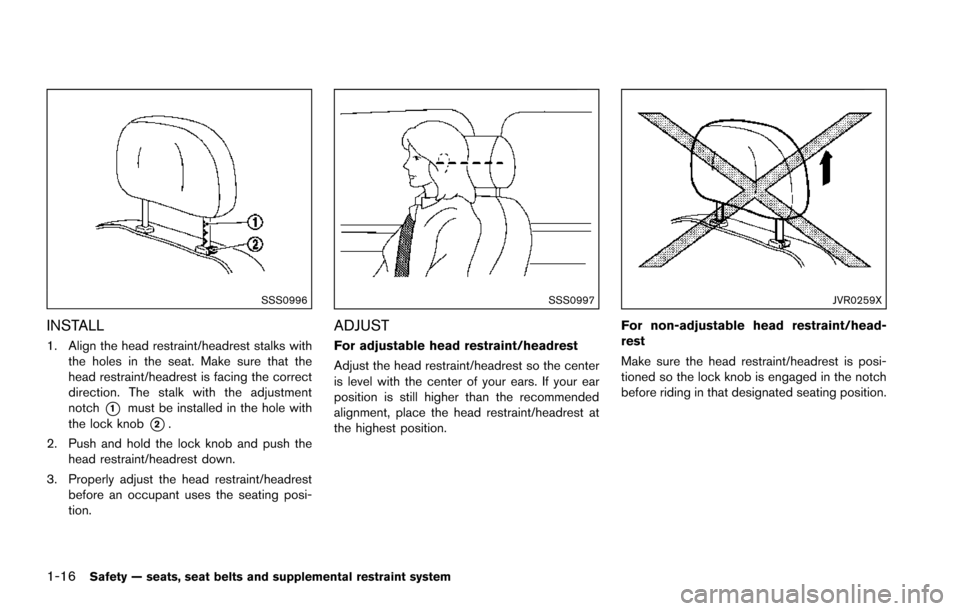
1. Align the head restraint/headrest stalks withthe holes in the seat. Make sure that the
head restraint/headrest is facing the correct
direction. The stalk with the adjustment
notch
*1must be installed in the hole with
the lock knob
*2.
2. Push and hold the lock knob and push the head restraint/headrest down.
3. Properly adjust the head restraint/headrest before an occupant uses the seating posi-
tion.
SSS0997
ADJUST
For adjustable head restraint/headrest
Adjust the head restraint/headrest so the center
is level with the center of your ears. If your ear
position is still higher than the recommended
alignment, place the head restraint/headrest at
the highest position.
JVR0259X
For non-adjustable head restraint/head-
rest
Make sure the head restraint/headrest is posi-
tioned so the lock knob is engaged in the notch
before riding in that designated seating position.
Page 36 of 614
SSS1035
Raise
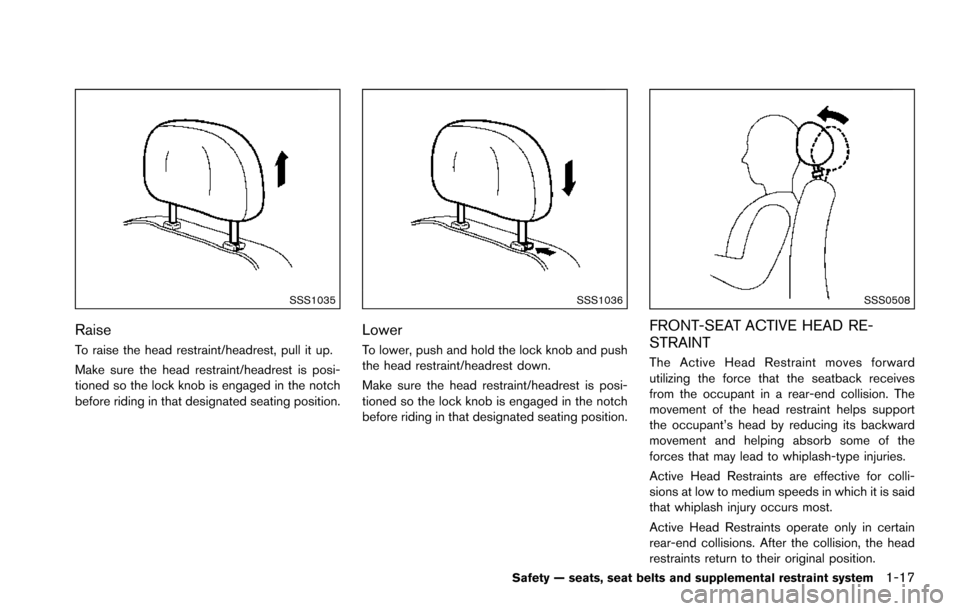
To raise the head restraint/headrest, pull it up.
Make sure the head restraint/headrest is posi-
tioned so the lock knob is engaged in the notch
before riding in that designated seating position.
SSS1036
Lower
To lower, push and hold the lock knob and push
the head restraint/headrest down.
Make sure the head restraint/headrest is posi-
tioned so the lock knob is engaged in the notch
before riding in that designated seating position.
SSS0508
FRONT-SEAT ACTIVE HEAD RE-
STRAINT
The Active Head Restraint moves forward
utilizing the force that the seatback receives
from the occupant in a rear-end collision. The
movement of the head restraint helps support
the occupant’s head by reducing its backward
movement and helping absorb some of the
forces that may lead to whiplash-type injuries.
Active Head Restraints are effective for colli-
sions at low to medium speeds in which it is said
that whiplash injury occurs most.
Active Head Restraints operate only in certain
rear-end collisions. After the collision, the head
restraints return to their original position.
Safety — seats, seat belts and supplemental restraint system1-17