suspension NISSAN ARMADA 2017 2.G User Guide
[x] Cancel search | Manufacturer: NISSAN, Model Year: 2017, Model line: ARMADA, Model: NISSAN ARMADA 2017 2.GPages: 614, PDF Size: 2.87 MB
Page 502 of 614
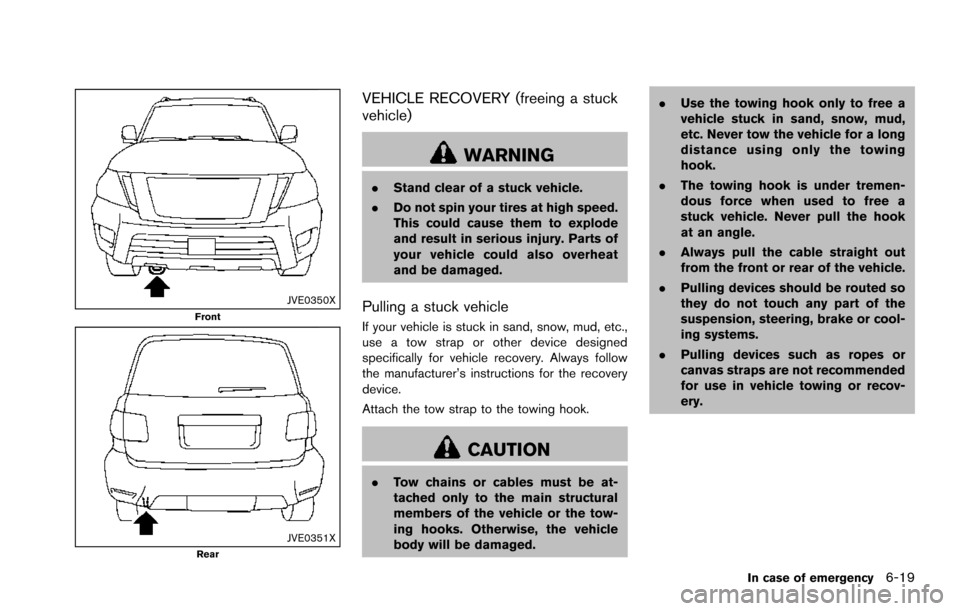
JVE0350XFront
JVE0351XRear
VEHICLE RECOVERY (freeing a stuck
vehicle)
WARNING
.Stand clear of a stuck vehicle.
. Do not spin your tires at high speed.
This could cause them to explode
and result in serious injury. Parts of
your vehicle could also overheat
and be damaged.
Pulling a stuck vehicle
If your vehicle is stuck in sand, snow, mud, etc.,
use a tow strap or other device designed
specifically for vehicle recovery. Always follow
the manufacturer’s instructions for the recovery
device.
Attach the tow strap to the towing hook.
CAUTION
.Tow chains or cables must be at-
tached only to the main structural
members of the vehicle or the tow-
ing hooks. Otherwise, the vehicle
body will be damaged. .
Use the towing hook only to free a
vehicle stuck in sand, snow, mud,
etc. Never tow the vehicle for a long
distance using only the towing
hook.
. The towing hook is under tremen-
dous force when used to free a
stuck vehicle. Never pull the hook
at an angle.
. Always pull the cable straight out
from the front or rear of the vehicle.
. Pulling devices should be routed so
they do not touch any part of the
suspension, steering, brake or cool-
ing systems.
. Pulling devices such as ropes or
canvas straps are not recommended
for use in vehicle towing or recov-
ery.
In case of emergency6-19
Page 510 of 614
damage the vehicle finish.
Machine compound or aggressive polishing on a
base coat/clear coat paint finish may dull the
finish or leave swirl marks.
REMOVING SPOTS
Remove tar and oil spots, industrial dust,
insects, and tree sap as quickly as possible
from the paint surface to avoid lasting damage
or staining. Special cleaning products are
available at a NISSAN dealer or any automotive
accessory stores.
UNDERBODY
In areas where road salt is used in winter, the
underbody must be cleaned regularly. This will
prevent dirt and salt from building up and
causing the acceleration of corrosion on the
underbody and suspension. Before the winter
period and again in the spring, the underseal
must be checked and, if necessary, re-treated.
GLASS
Use glass cleaner to remove smoke and dust
film from the glass surfaces. It is normal for glass
to become coated with a film after the vehicle is
parked in the hot sun. Glass cleaner and a soft
cloth will easily remove this film.
CAUTION
When cleaning the inside of the win-
dows, do not use sharp-edged tools,
abrasive cleaners or chlorine-based
disinfectant cleaners. They could da-
mage the electrical conductors, radio
antenna elements or rear window
defroster elements.
WHEELS
Wash the wheels when washing the vehicle to
maintain their appearance.
. Clean the inner side of the wheels when the
wheel is changed or the underside of the
vehicle is washed.
. Inspect wheel rims regularly for dents or
corrosion. Such damage may cause loss of
pressure or poor seal at the tire bead.
. NISSAN recommends that the road wheels
be waxed to protect against road salt in
areas where it is used during winter.
CAUTION
Do not use abrasive cleaners when
washing the wheels.
Aluminum alloy wheels
Wash regularly with a sponge dampened in a
mild soap solution, especially during winter
months in areas where road salt is used. Salt
could discolor the wheels if not removed.
CAUTION
Follow the directions below to avoid
staining or discoloring the wheels:
.Do not use a cleaner that uses
strong acid or alkali contents to
clean the wheels.
. Do not apply wheel cleaners to the
wheels when they are hot. The
wheel temperature should be the
same as ambient temperature.
. Rinse the wheel to completely re-
move the cleaner within 15 minutes
after the cleaner is applied.
Bright wheels (if so equipped)
The bright wheels use a different coating
process than typical aluminum alloy wheel and
they are not plated wheels. These wheels are
clear-coated and require the following special
cleaning. They should be regularly washed with
a soft sponge soaked in a lot of water. After
Appearance and care7-3
Page 552 of 614
manufacturer’s suggestions.Use only SAE
Class S chains. Class “S” chains are used on
vehicles with restricted tire to vehicle clearance.
Vehicles that can use Class “S” chains are
designed to meet the SAE standard minimum
clearances between the tire and the closest
vehicle suspension or body component required
to accommodate the use of a winter traction
device (tire chains or cables) . The minimum
clearances are determined using the factory
equipped tire size. Other types may damage
your vehicle. Use chain tensioners when re-
commended by the tire chain manufacturer to
ensure a tight fit. Loose end links of the tire
chain must be secured or removed to prevent
the possibility of whipping action damage to the
fenders or underbody. If possible, avoid fully
loading your vehicle when using tire chains. In
addition, drive at a reduced speed. Otherwise,
your vehicle may be damaged and/or vehicle
handling and performance may be adversely
affected.
Tire chains must be installed only on the
rear wheels and not on the front wheels.
Do not use tire chains on dry roads. Driving with
tire chains in such conditions can cause damage
to the various mechanisms of the vehicle due to
some overstress.
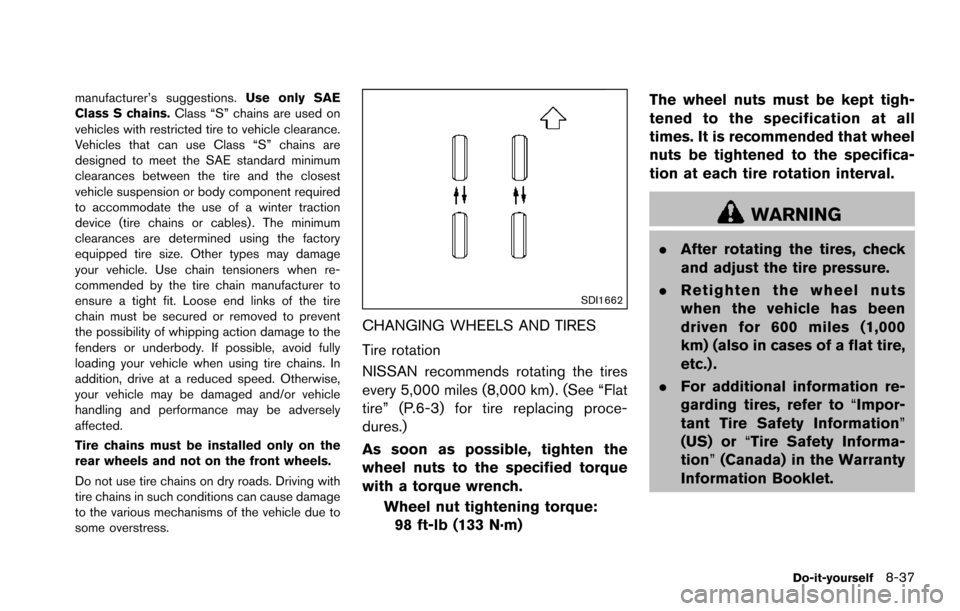
SDI1662
CHANGING WHEELS AND TIRES
Tire rotation
NISSAN recommends rotating the tires
every 5,000 miles (8,000 km) . (See “Flat
tire” (P.6-3) for tire replacing proce-
dures.)
As soon as possible, tighten the
wheel nuts to the specified torque
with a torque wrench.
Wheel nut tightening torque:98 ft-lb (133 N·m) The wheel nuts must be kept tigh-
tened to the specification at all
times. It is recommended that wheel
nuts be tightened to the specifica-
tion at each tire rotation interval.
WARNING
.
After rotating the tires, check
and adjust the tire pressure.
. Retighten the wheel nuts
when the vehicle has been
driven for 600 miles (1,000
km) (also in cases of a flat tire,
etc.) .
. For additional information re-
garding tires, refer to “Impor-
tant Tire Safety Information”
(US) or “Tire Safety Informa-
tion” (Canada) in the Warranty
Information Booklet.
Do-it-yourself8-37
Page 566 of 614
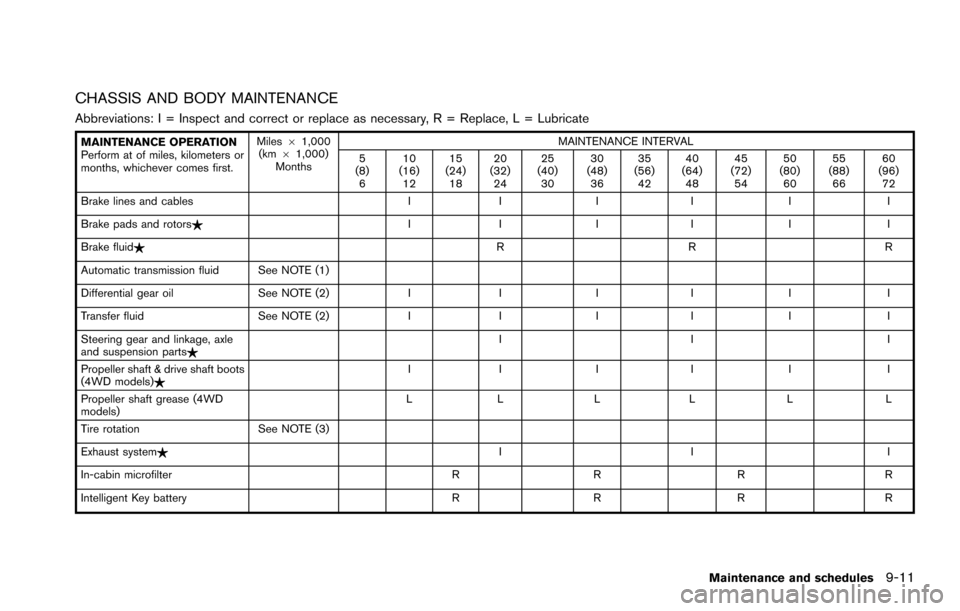
CHASSIS AND BODY MAINTENANCE
Abbreviations: I = Inspect and correct or replace as necessary, R = Replace, L = Lubricate
MAINTENANCE OPERATION
Perform at of miles, kilometers or
months, whichever comes first.Miles
61,000
(km 61,000)
Months MAINTENANCE INTERVAL
5
(8) 6 10
(16) 12 15
(24) 18 20
(32) 24 25
(40) 30 30
(48) 36 35
(56) 42 40
(64) 48 45
(72) 54 50
(80) 60 55
(88) 66 60
(96) 72
Brake lines and cables II II I I
Brake pads and rotors$ II I I I I
Brake fluid$ RR R
Automatic transmission fluid See NOTE (1)
Differential gear oil See NOTE (2)II II I I
Transfer fluid See NOTE (2)II II I I
Steering gear and linkage, axle
and suspension parts$ II I
Propeller shaft & drive shaft boots
(4WD models)$ II I I I I
Propeller shaft grease (4WD
models) LL L L L L
Tire rotation See NOTE (3)
Exhaust system$ II I
In-cabin microfilter RR R R
Intelligent Key battery RR R R
Maintenance and schedules9-11
Page 567 of 614
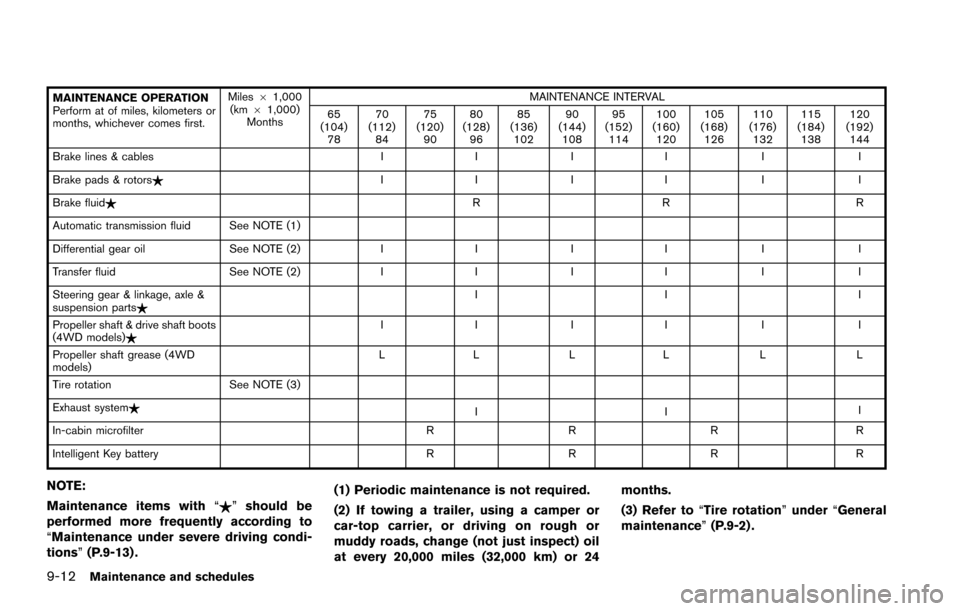
9-12Maintenance and schedules
MAINTENANCE OPERATION
Perform at of miles, kilometers or
months, whichever comes first.Miles
61,000
(km 61,000)
Months MAINTENANCE INTERVAL
65
(104) 78 70
(112) 84 75
(120) 90 80
(128) 96 85
(136) 102 90
(144) 108 95
(152) 114 100
(160) 120 105
(168) 126 110
(176) 132 115
(184) 138 120
(192) 144
Brake lines & cables II II I I
Brake pads & rotors$ II II I I
Brake fluid$ RR R
Automatic transmission fluid See NOTE (1)
Differential gear oil See NOTE (2)II II I I
Transfer fluid See NOTE (2)II II I I
Steering gear & linkage, axle &
suspension parts$ II I
Propeller shaft & drive shaft boots
(4WD models)$ II II I I
Propeller shaft grease (4WD
models) LL LL L L
Tire rotation See NOTE (3)
Exhaust system$ III
In-cabin microfilter RRR R
Intelligent Key battery RRR R
NOTE:
Maintenance items with “$”should be
performed more frequently according to
“Maintenance under severe driving condi-
tions” (P.9-13) . (1) Periodic maintenance is not required.
(2) If towing a trailer, using a camper or
car-top carrier, or driving on rough or
muddy roads, change (not just inspect) oil
at every 20,000 miles (32,000 km) or 24 months.
(3) Refer to
“Tire rotation” under“General
maintenance” (P.9-2) .
Page 568 of 614
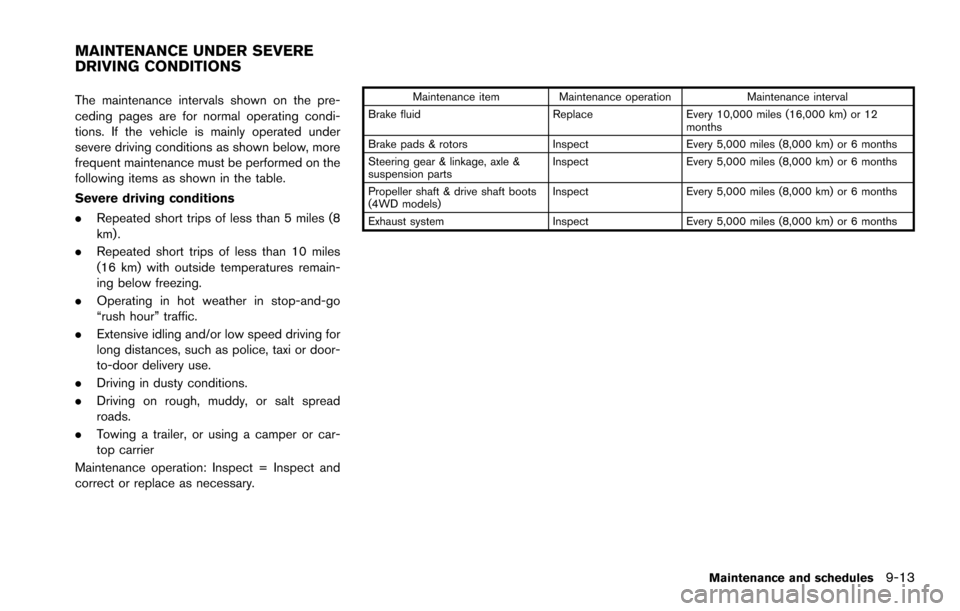
The maintenance intervals shown on the pre-
ceding pages are for normal operating condi-
tions. If the vehicle is mainly operated under
severe driving conditions as shown below, more
frequent maintenance must be performed on the
following items as shown in the table.
Severe driving conditions
.Repeated short trips of less than 5 miles (8
km) .
. Repeated short trips of less than 10 miles
(16 km) with outside temperatures remain-
ing below freezing.
. Operating in hot weather in stop-and-go
“rush hour” traffic.
. Extensive idling and/or low speed driving for
long distances, such as police, taxi or door-
to-door delivery use.
. Driving in dusty conditions.
. Driving on rough, muddy, or salt spread
roads.
. Towing a trailer, or using a camper or car-
top carrier
Maintenance operation: Inspect = Inspect and
correct or replace as necessary.Maintenance item Maintenance operation Maintenance interval
Brake fluid ReplaceEvery 10,000 miles (16,000 km) or 12
months
Brake pads & rotors InspectEvery 5,000 miles (8,000 km) or 6 months
Steering gear & linkage, axle &
suspension parts Inspect
Every 5,000 miles (8,000 km) or 6 months
Propeller shaft & drive shaft boots
(4WD models) Inspect
Every 5,000 miles (8,000 km) or 6 months
Exhaust system InspectEvery 5,000 miles (8,000 km) or 6 months
Maintenance and schedules9-13
MAINTENANCE UNDER SEVERE
DRIVING CONDITIONS
Page 573 of 614
10-2Technical and consumer information
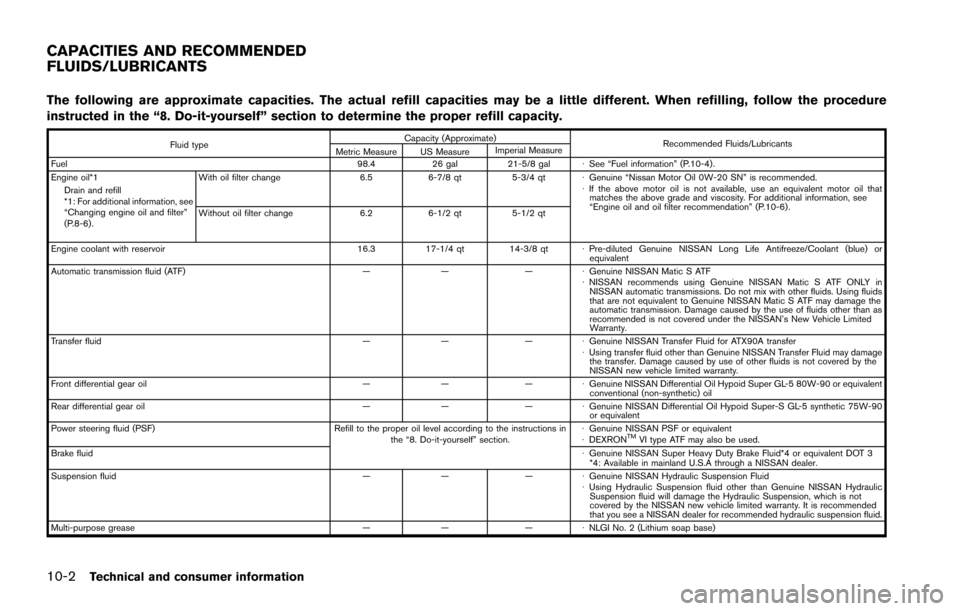
The following are approximate capacities. The actual refill capacities may be a little different. When refilling, follow the procedure
instructed in the “8. Do-it-yourself” section to determine the proper refill capacity.
Fluid typeCapacity (Approximate)
Recommended Fluids/Lubricants
Metric Measure US Measure Imperial Measure
Fuel 98.426 gal 21-5/8 galÂSee “Fuel information” (P.10-4).
Engine oil*1 With oil filter change 6.56-7/8 qt 5-3/4 qtÂGenuine “Nissan Motor Oil 0W-20 SN” is recommended.
 If the above motor oil is not available, use an equivalent motor oil that
matches the above grade and viscosity. For additional information, see
“Engine oil and oil filter recommendation” (P.10-6).
Drain and refill
*1: For additional information, see
“Changing engine oil and filter”
(P.8-6) .
Without oil filter change
6.26-1/2 qt 5-1/2 qt
Engine coolant with reservoir 16.317-1/4 qt 14-3/8 qt ÂPre-diluted Genuine NISSAN Long Life Antifreeze/Coolant (blue) or
equivalent
Automatic transmission fluid (ATF) —— —ÂGenuine NISSAN Matic S ATF
 NISSAN recommends using Genuine NISSAN Matic S ATF ONLY in
NISSAN automatic transmissions. Do not mix with other fluids. Using fluids
that are not equivalent to Genuine NISSAN Matic S ATF may damage the
automatic transmission. Damage caused by the use of fluids other than as
recommended is not covered under the NISSAN’s New Vehicle Limited
Warranty.
Transfer fluid —— —ÂGenuine NISSAN Transfer Fluid for ATX90A transfer
 Using transfer fluid other than Genuine NISSAN Transfer Fluid may damage
the transfer. Damage caused by use of other fluids is not covered by the
NISSAN new vehicle limited warranty.
Front differential gear oil —— —ÂGenuine NISSAN Differential Oil Hypoid Super GL-5 80W-90 or equivalent
conventional (non-synthetic) oil
Rear differential gear oil —— —ÂGenuine NISSAN Differential Oil Hypoid Super-S GL-5 synthetic 75W-90
or equivalent
Power steering fluid (PSF) Refill to the proper oil level according to the instructions in
the “8. Do-it-yourself” section. Â
Genuine NISSAN PSF or equivalent
 DEXRON
TMVI type ATF may also be used.
Brake fluid ÂGenuine NISSAN Super Heavy Duty Brake Fluid*4 or equivalent DOT 3
*4: Available in mainland U.S.A through a NISSAN dealer.
Suspension fluid —— —ÂGenuine NISSAN Hydraulic Suspension Fluid
 Using Hydraulic Suspension fluid other than Genuine NISSAN Hydraulic
Suspension fluid will damage the Hydraulic Suspension, which is not
covered by the NISSAN new vehicle limited warranty. It is recommended
that you see a NISSAN dealer for recommended hydraulic suspension fluid.
Multi-purpose grease —— —ÂNLGI No. 2 (Lithium soap base)
CAPACITIES AND RECOMMENDED
FLUIDS/LUBRICANTS
Page 597 of 614
10-26Technical and consumer information
Several types of braking systems are available.
Surge Brakes -The surge brake actuator is
mounted on the trailer tongue with a hydraulic
line running to each trailer wheel. Surge brakes
are activated by the trailer pushing against the
hitch ball when the tow vehicle is braking.
Hydraulic surge brakes are common on rental
trailers and some boat trailers. In this type of
system, there is no hydraulic or electric connec-
tion for brake operation between the tow vehicle
and the trailer.
Electric Trailer Brakes - Electric braking
systems are activated by an electronic signal
sent from a trailer brake controller (special brake
sensing module) .
Have a professional supplier of towing equip-
ment make sure the trailer brakes are properly
installed and demonstrate proper brake function
testing.
WARNING
Never connect a trailer brake system
directly to the vehicle brake system.
Pre-towing tips
. Be certain your vehicle maintains a level
position when a loaded or unloaded trailer is
hitched. Do not drive the vehicle if it has an
abnormal nose-up or nose-down condition;
check for improper tongue load, overload,
worn suspension or other possible causes
of either condition.
. Always secure items in the trailer to prevent
load shift while driving.
. Keep the cargo load as low as possible in
the trailer to keep the trailer center of gravity
low.
. Load the trailer so approximately 60% of the
trailer load is in the front half and 40% is in
the back half. Also make sure the load is
balanced side to side.
. Check your hitch, trailer tire pressure,
vehicle tire pressure, trailer light operation,
and trailer wheel lug nuts every time you
attach a trailer to the vehicle.
. Be certain your rearview mirrors conform to
all federal, state or local regulations. If not,
install any mirrors required for towing before
driving the vehicle.
. Determine the overall height of the vehicle
and trailer so the required clearance is
known.
Trailer towing tips
In order to gain skill and an understanding of the
vehicle’s behavior, you should practice turning,
stopping and backing up in an area which is free
from traffic. Steering stability, and braking
performance will be somewhat different than
under normal driving conditions.
.Always secure items in the trailer to prevent
load shift while driving.
. Lock the trailer hitch coupler with a pin or
lock to prevent the coupler from inadver-
tently becoming unlatched.
. Avoid abrupt starts, acceleration or stops.
. Avoid sharp turns or lane changes.
. Always drive your vehicle at a moderate
speed. Some states or provinces have
specific speed limits for vehicles that are
towing trailers. Obey the local speed limits.
. When backing up, hold the bottom of the
steering wheel with one hand. Move your
hand in the direction in which you want the
trailer to go. Make small corrections and
back up slowly. If possible, have someone
guide you when you are backing up.
Always block the wheels on both vehicle and
trailer when parking. Parking on a slope is not
recommended; however, if you must do so: