warning NISSAN ARMADA 2017 2.G Owners Manual
[x] Cancel search | Manufacturer: NISSAN, Model Year: 2017, Model line: ARMADA, Model: NISSAN ARMADA 2017 2.GPages: 614, PDF Size: 2.87 MB
Page 559 of 614
9-4Maintenance and schedules
Steering wheel:Check for changes in the
steering conditions, such as excessive free play,
hard steering or strange noises.
Warning lights and chimes: Make sure that
all warning lights and chimes are operating
properly.
Windshield defroster: Check that the air
comes out of the defroster outlets properly and
in sufficient quantity when operating the heater
or air conditioner.
Windshield wiper and washer*: Check that
the wipers and washer operate properly and that
the wipers do not streak.
Under the hood and vehicle
The maintenance items listed here should be
checked periodically (for example, each time you
check the engine oil or refuel) .
Battery*: Check the fluid level in each cell. It
should be between the MAX and MIN lines.
Vehicles operated in high temperatures or under
severe condition require frequent checks of the
battery fluid level.
NOTE:
Care should be taken to avoid situations
that can lead to potential battery discharge
and potential no-start conditions such as: 1.
Installation or extended use of electro-
nic accessories that consume battery
power when the engine is not running
(Phone chargers, GPS, DVD players,
etc.)
2. Vehicle is not driven regularly and/or
only driven short distances.
In these cases, the battery may need to be
charged to maintain battery health.
Brake fluid level*: Make sure that the brake
fluid level is between the MAX and MIN lines on
the reservoir.
Engine coolant level*: Check the coolant level
when the engine is cold.
Engine drive belts*: Make sure that no belt is
frayed, worn, cracked or oily.
Engine oil level*: Check the level after parking
the vehicle on a level spot and turning off the
engine. Wait more than 15 minutes for the oil to
drain back into the oil pan.
Exhaust system: Make sure there are no loose
supports, cracks or holes. If the sound of the
exhaust seems unusual or there is a smell of
exhaust fumes, immediately have the exhaust
system inspected. It is recommended you visit a
NISSAN dealer for this service. (See “Precau-
tions when starting and driving” (P.5-4) for
exhaust gas (carbon monoxide) .) Fluid leaks:
Check under the vehicle for fuel,
oil, water or other fluid leaks after the vehicle has
been parked for a while. Water dripping from the
air conditioner after use is normal. If you should
notice any leaks or if gasoline fumes are evident,
check for the cause and have it corrected
immediately.
Power steering fluid level* and lines: Check
the level when the fluid is cold, with the engine
off. Check the lines for proper attachment, leaks,
cracks, etc.
Radiator and hoses: Check the front of the
radiator and clean off any dirt, insects, leaves,
etc., that may have accumulated. Make sure the
hoses have no cracks, deformation, rot or loose
connections.
Underbody: The underbody is frequently ex-
posed to corrosive substances such as those
used on icy roads or to control dust. It is very
important to remove these substances, other-
wise rust will form on the floor pan, frame, fuel
lines and around the exhaust system. At the end
of winter, the underbody should be thoroughly
flushed with plain water, being careful to clean
those areas where mud and dirt may accumu-
late. For additional information, see “Cleaning
exterior” (P.7-2).
Windshield washer fluid*: Check that there is
adequate fluid in the reservoir.
Page 584 of 614
WARNING
.It is extremely dangerous to
ride in a cargo area inside the
vehicle. In a collision, people
riding in these areas are more
likely to be seriously injured or
killed.
.Do not allow people to ride in
any area of vehicle that is not
equipped with seats and seat
belts.
.Be sure everyone in your ve-
hicle is in a seat and using a
seat belt properly.
TERMS
It is important to familiarize yourself with
the following terms before loading your
vehicle:
. Curb Weight (actual weight of your
vehicle) - vehicle weight including:
standard and optional equipment,
fluids, emergency tools, and spare tire assembly. This weight
does not
include passengers and cargo.
. GVW (Gross Vehicle Weight) - curb
weight plus the combined weight of
passengers and cargo.
. GVWR (Gross Vehicle Weight Rat-
ing) - maximum total combined
weight of the unloaded vehicle, pas-
sengers, luggage, hitch, trailer tongue
load and any other optional equip-
ment. This information is located on
the F.M.V.S.S./C.M.V.S.S. label.
. GAWR (Gross Axle Weight Rating) -
maximum weight (load) limit specified
for the front or rear axle. This informa-
tion is located on the F.M.V.S.S./C.M.
V.S.S. label.
. GCWR (Gross Combined Weight
Rating) - The maximum total weight
rating of the vehicle, passengers,
cargo, and trailer.
. Vehicle Capacity Weight, Load limit,
Total load capacity - maximum total
weight limit specified of the load
(passengers and cargo) for the vehi- cle. This is the maximum combined
weight of occupants and cargo that
can be loaded into the vehicle. If the
vehicle is used to tow a trailer, the
trailer tongue weight must be in-
cluded as part of the cargo load. This
information is located on the Tire and
Loading Information label.
. Cargo capacity - permissible weight
of cargo, the weight of total occu-
pants weight subtracted from the
load limit.
Technical and consumer information10-13
VEHICLE LOADING INFORMATION
Page 586 of 614
4. The resulting figure equals the avail-able amount of cargo and luggage
load capacity. For example, if the XXX
amount equals 1400 lbs. and there
will be five 150 lb. passengers in your
vehicle, the amount of available cargo
and luggage load capacity is 650 lbs.
(1400 í750 (5 x 150) = 650 lbs) or
(640 í340 (5 x 70) = 300 kg.)
5. Determine the combined weight of luggage and cargo being loaded on
the vehicle. That weight may not
safely exceed the available cargo
and luggage load capacity calculated
in Step 4.
6. If your vehicle will be towing a trailer, load from your trailer will be trans-
ferred to your vehicle. Consult this
manual to determine how this re-
duces the available cargo and lug-
gage load capacity of your vehicle.
Before driving a loaded vehicle, confirm
that you do not exceed the Gross Vehicle
Weight Rating (GVWR) or the Gross
Axle Weight Rating (GAWR) for your vehicle. (See “Measurement of weights”
(P.10-16) .)
Also check tires for proper inflation
pressures. See the Tire and Loading
Information label.
SIC4446
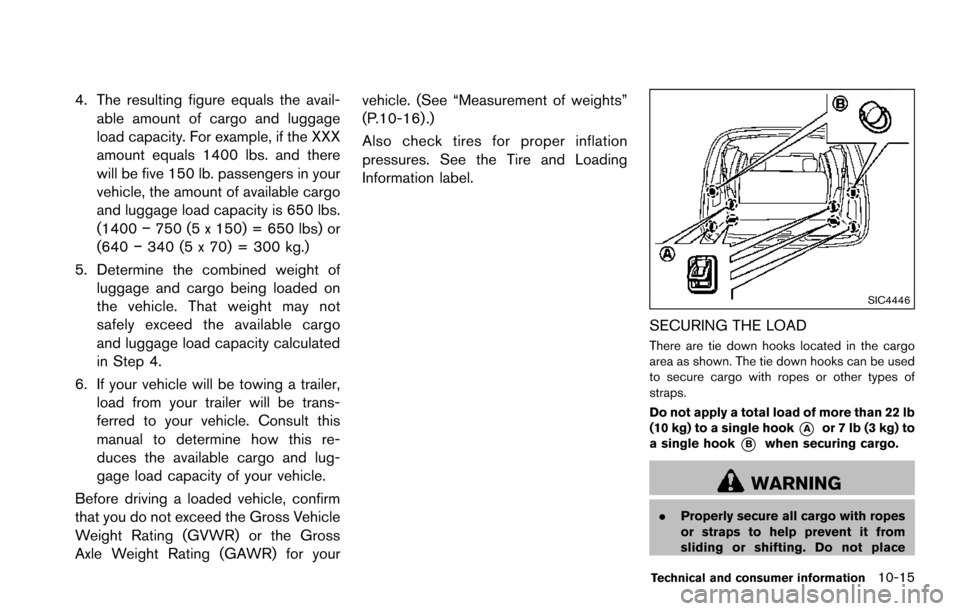
SECURING THE LOAD
There are tie down hooks located in the cargo
area as shown. The tie down hooks can be used
to secure cargo with ropes or other types of
straps.
Do not apply a total load of more than 22 lb
(10 kg) to a single hook
*Aor 7 lb (3 kg) to
a single hook
*Bwhen securing cargo.
WARNING
. Properly secure all cargo with ropes
or straps to help prevent it from
sliding or shifting. Do not place
Technical and consumer information10-15
Page 587 of 614
10-16Technical and consumer information
cargo higher than the seatbacks. In
a sudden stop or collision, unse-
cured cargo could cause personal
injury.
. The child restraint top tether strap
may be damaged by contact with
items in the cargo area. Secure any
items in the cargo area. Your child
could be seriously injured or killed
in a collision if the top tether strap is
damaged.
. Do not load your vehicle any heavier
than the GVWR or the maximum
front and rear GAWRs. If you do,
parts of your vehicle can break, tire
damage could occur, or it can
change the way your vehicle han-
dles. This could result in loss of
control and cause personal injury.
LOADING TIPS
.The GVW must not exceed GVWR or
GAWR as specified on the F.M.V.S.
S./C.M.V.S.S. certification label.
.Do not load the front and rear axle to
the GAWR. Doing so will exceed the
GVWR.
WARNING
.Properly secure all cargo to
help prevent it from sliding or
shifting. Do not place cargo
higher than the seatbacks. In a
sudden stop or collision, un-
secured cargo could cause
personal injury.
. Do not load your vehicle any
heavier than the GVWR or the
maximum front and rear
GAWRs. If you do, parts of
your vehicle can break, tire
damage could occur, or it can
change the way your vehicle
handles. This could result in
loss of control and cause per-
sonal injury.
. Overloading not only can
shorten the life of your vehicle
and the tire, but can cause
unsafe vehicle handling and
long braking distance. This may cause a premature tire
failure, which could result in a
serious accident and personal
injury. Failures caused by
overloading are not covered
by the vehicle’s warranty.
MEASUREMENT OF WEIGHTS
Secure loose items to prevent weight
shifts that could affect the balance of
your vehicle. When the vehicle is loaded,
drive to a scale and weigh the front and
the rear wheels separately to determine
axle loads. Individual axle loads should
not exceed either of the gross axle
weight ratings (GAWR) . The total of the
axle loads should not exceed the gross
vehicle weight rating (GVWR) . These
ratings are given on the vehicle certifica-
tion label. If weight ratings are exceeded,
move or remove items to bring all
weights below the ratings.
Page 588 of 614
WARNING
Overloading or improper loading of a
trailer and its cargo can adversely affect
vehicle handling, braking and perfor-
mance and may lead to accidents.
CAUTION
.Do not tow a trailer or haul a heavy
load for the first 500 miles (800 km) .
Your engine, axle or other parts
could be damaged.
. For the first 500 miles (800 km) that
you tow a trailer, do not drive over
50 MPH (80 km/h) and do not make
starts at full throttle. This helps the
engine and other parts of your
vehicle wear in at the heavier loads.
Your new vehicle was designed to be used
primarily to carry passengers and cargo. Re-
member that towing a trailer places additional
loads on your vehicle’s engine, drivetrain, steer-
ing, braking and other systems.
A NISSAN Towing Guide (U.S. only) is available
on the website at www.nissanusa.com. This guide includes infor-
mation on trailer towing capability and the
special equipment required for proper towing.
MAXIMUM LOAD LIMITS
Maximum trailer loads
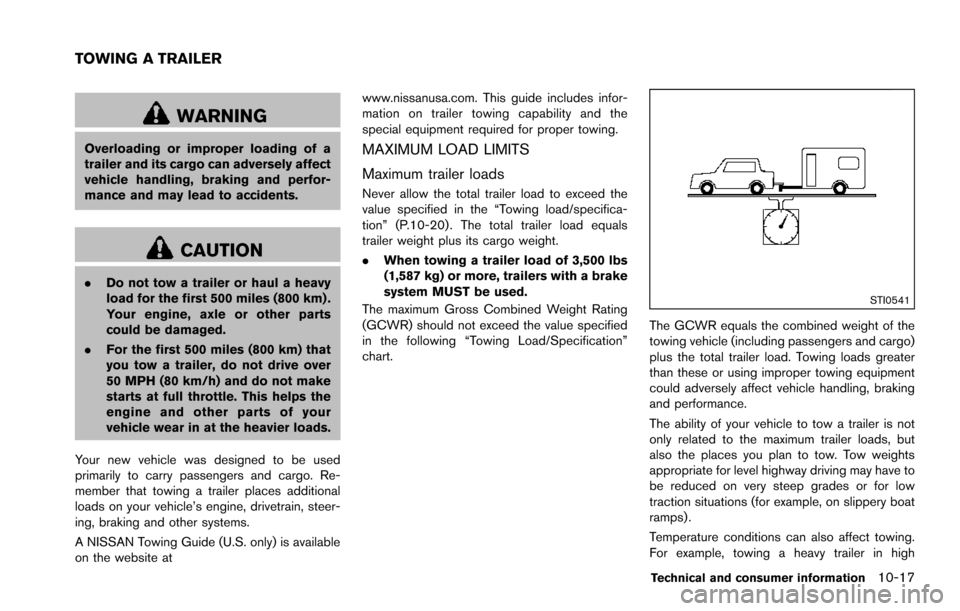
Never allow the total trailer load to exceed the
value specified in the “Towing load/specifica-
tion” (P.10-20) . The total trailer load equals
trailer weight plus its cargo weight.
.
When towing a trailer load of 3,500 lbs
(1,587 kg) or more, trailers with a brake
system MUST be used.
The maximum Gross Combined Weight Rating
(GCWR) should not exceed the value specified
in the following “Towing Load/Specification”
chart.
STI0541
The GCWR equals the combined weight of the
towing vehicle (including passengers and cargo)
plus the total trailer load. Towing loads greater
than these or using improper towing equipment
could adversely affect vehicle handling, braking
and performance.
The ability of your vehicle to tow a trailer is not
only related to the maximum trailer loads, but
also the places you plan to tow. Tow weights
appropriate for level highway driving may have to
be reduced on very steep grades or for low
traction situations (for example, on slippery boat
ramps) .
Temperature conditions can also affect towing.
For example, towing a heavy trailer in high
Technical and consumer information10-17
TOWING A TRAILER
Page 589 of 614
10-18Technical and consumer information
outside temperatures on graded roads can
affect engine performance and cause overheat-
ing. The transmission high fluid temperature and
engine protection mode, which helps reduce the
chance of transmission and engine damage,
could activate and automatically decrease en-
gine power. Vehicle speed may decrease under
high load. Plan your trip carefully to account for
trailer and vehicle load, weather and road
conditions.
WARNING
Overheating can result in reduced en-
gine power and vehicle speed. The
reduced speed may be lower than other
traffic, which could increase the chance
of a collision. Be especially careful
when driving. If the vehicle cannot
maintain a safe driving speed, pull to
the side of the road in a safe area.
Allow the engine to cool and return to
normal operation. See“If your vehicle
overheats” (P.6-14) .
CAUTION
Vehicle damage resulting from impro-
per towing procedures is not covered by
NISSAN warranties.
STI0542
Tongue load
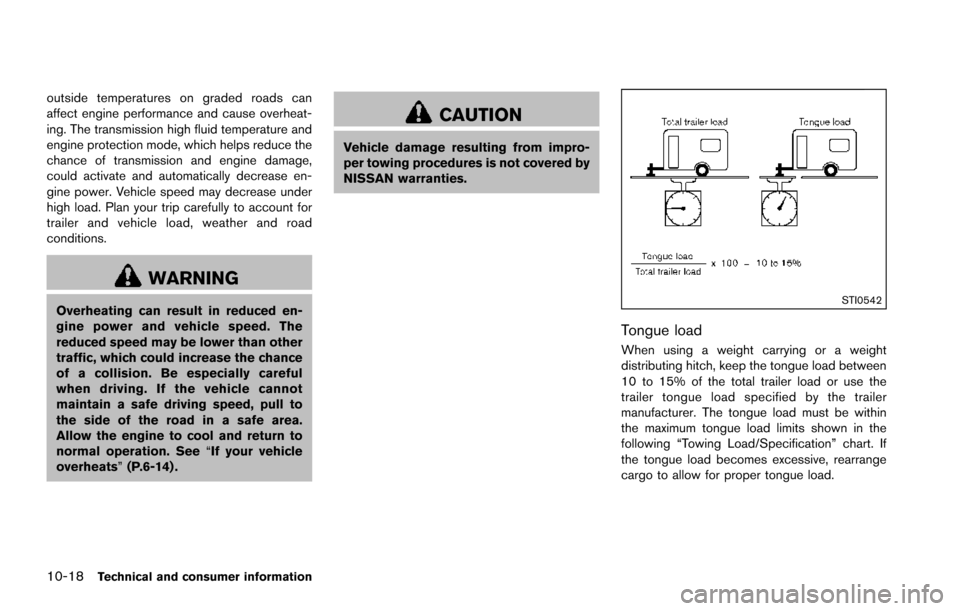
When using a weight carrying or a weight
distributing hitch, keep the tongue load between
10 to 15% of the total trailer load or use the
trailer tongue load specified by the trailer
manufacturer. The tongue load must be within
the maximum tongue load limits shown in the
following “Towing Load/Specification” chart. If
the tongue load becomes excessive, rearrange
cargo to allow for proper tongue load.
Page 591 of 614
10-20Technical and consumer information
.Maximum Trailer towing capacity from “Tow-
ing Load/Specification” chart - 8,500 lb.
(3,856 kg) .
7,300 lb. (3,311 kg) GVWR
í 5,822 lb. (2,641 kg) GVW
= 1,478 lb. (670 kg) Available for tongue
weight
14,700 lb. (6,668 kg) GCWR
í 5,822 lb. (2,641 kg) GVW
= 8,878 lb. (4,027 kg) Capacity available for
towing
1,478 lb. (670 kg) / Available tongue weight
8,878 lb. (4,027 kg) Available capacity
= 11 % tongue weight
The available towing capacity may be less than
the maximum towing capacity due to the
passenger and cargo load in the vehicle.
Remember to keep trailer tongue weight be-
tween 10 - 15% of the trailer weight or within
the trailer tongue load specification recom-
mended by the trailer manufacturer. If the tongue
load becomes excessive, rearrange the cargo to
obtain the proper tongue load. Do not exceed
the maximum tongue weight specification shown
in the “Towing load/specification” chart even if
the calculated available tongue weight is greater
than 15%. If the calculated tongue weight is less than 10%, reduce the total trailer weight to
match the available tongue weight.
Always verify that available capacities are within
the required ratings.
TOWING LOAD/SPECIFICATION
WARNING
The towing capacities provided in this
manual are for general reference only.
The safe towing capacity of your vehicle
is affected by dealer and factory in-
stalled options and passenger and
cargo loads. You must weigh the vehi-
cle and trailer as described in this
manual to determine the actual vehicle
towing capacity. Do not exceed the
published maximum towing capacity,
or the GCWR or the GVWR shown on
the F.M.V.S.S./C.M.V.S.S. certification
label. Doing so can result in an accident
causing serious personal injury or prop-
erty damage.
Page 593 of 614
10-22Technical and consumer information
JVT0457X
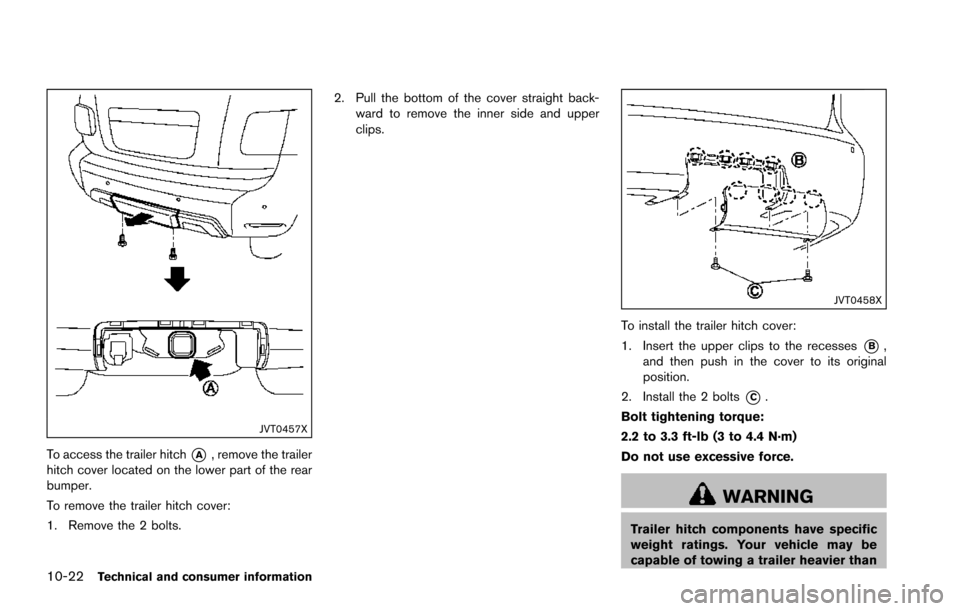
To access the trailer hitch*A, remove the trailer
hitch cover located on the lower part of the rear
bumper.
To remove the trailer hitch cover:
1. Remove the 2 bolts. 2. Pull the bottom of the cover straight back-
ward to remove the inner side and upper
clips.
JVT0458X
To install the trailer hitch cover:
1. Insert the upper clips to the recesses
*B,
and then push in the cover to its original
position.
2. Install the 2 bolts
*C.
Bolt tightening torque:
2.2 to 3.3 ft-lb (3 to 4.4 N·m)
Do not use excessive force.
WARNING
Trailer hitch components have specific
weight ratings. Your vehicle may be
capable of towing a trailer heavier than
Page 595 of 614
10-24Technical and consumer information
WARNING
Properly adjust the weight distributing
hitch so the rear of the bumper is no
higher than the measured reference
height when the trailer is attached. If
the rear bumper is higher than the
measured reference height when
loaded, the vehicle may handle unpre-
dictably which could cause a loss of
vehicle control and cause serious per-
sonal injury or property damage.
Sway control device
Sudden maneuvers, wind gusts and buffeting
caused by other vehicles can affect trailer
handling. Sway control devices may be used to
help control these affects. If you choose to use
one, contact a reputable trailer hitch supplier to
make sure the sway control device will work with
the vehicle, hitch, trailer and the trailer’s brake
system. Follow the instructions provided by the
manufacturer for installing and using the sway
control device.
Class I hitch
Class I trailer hitch equipment (receiver, ball
mount and hitch ball) can be used to tow trailers
of a maximum weight of 2,000 lb (907 kg) .
Class II hitch
Class II trailer hitch equipment (receiver, ball
mount and hitch ball) can be used to tow trailers
of a maximum weight of 3,500 lb (1,588 kg).
Class III hitch
Class III trailer hitch equipment (receiver, ball
mount and hitch ball) can be used to tow trailers
of a maximum weight of 5,000 lb (2,267 kg).
Class IV hitch
Class IV trailer hitch equipment (receiver, ball
mount and hitch ball) can be used to tow trailers
of a maximum weight of 10,000 lb (4,545 kg) . A
weight distributing hitch should be used to tow
trailers that weigh over 5,000 lb (2,267 kg) .
Your vehicle may be equipped with Class IV
trailer hitch equipment that has a 10,000 lb
(4,545 kg) maximum weight rating, but your
vehicle is only capable of towing the maximum
trailer weights shown in the “Towing Load/
Specification” chart earlier in this section.
CAUTION
.Do not use axle-mounted hitches.
. Do not modify the vehicle exhaust
system, brake system, etc.
. Do not attach any additional hitches
to your vehicle because a hitch is
already mounted to your vehicle
frame.
Tire pressures
.When towing a trailer, inflate the
vehicle tires to the recommended
cold tire pressure indicated on the
Tire and Loading Information label.
. Trailer tire condition, size, load rating
and proper inflation pressure should
be in accordance with the trailer and
tire manufacturers’ specifications.
Safety chains
Always use a suitable chain between your
vehicle and the trailer. The safety chains should
be crossed and should be attached to the hitch,
not to the vehicle bumper or axle. Be sure to
leave enough slack in the chains to permit
Page 597 of 614
10-26Technical and consumer information
Several types of braking systems are available.
Surge Brakes -The surge brake actuator is
mounted on the trailer tongue with a hydraulic
line running to each trailer wheel. Surge brakes
are activated by the trailer pushing against the
hitch ball when the tow vehicle is braking.
Hydraulic surge brakes are common on rental
trailers and some boat trailers. In this type of
system, there is no hydraulic or electric connec-
tion for brake operation between the tow vehicle
and the trailer.
Electric Trailer Brakes - Electric braking
systems are activated by an electronic signal
sent from a trailer brake controller (special brake
sensing module) .
Have a professional supplier of towing equip-
ment make sure the trailer brakes are properly
installed and demonstrate proper brake function
testing.
WARNING
Never connect a trailer brake system
directly to the vehicle brake system.
Pre-towing tips
. Be certain your vehicle maintains a level
position when a loaded or unloaded trailer is
hitched. Do not drive the vehicle if it has an
abnormal nose-up or nose-down condition;
check for improper tongue load, overload,
worn suspension or other possible causes
of either condition.
. Always secure items in the trailer to prevent
load shift while driving.
. Keep the cargo load as low as possible in
the trailer to keep the trailer center of gravity
low.
. Load the trailer so approximately 60% of the
trailer load is in the front half and 40% is in
the back half. Also make sure the load is
balanced side to side.
. Check your hitch, trailer tire pressure,
vehicle tire pressure, trailer light operation,
and trailer wheel lug nuts every time you
attach a trailer to the vehicle.
. Be certain your rearview mirrors conform to
all federal, state or local regulations. If not,
install any mirrors required for towing before
driving the vehicle.
. Determine the overall height of the vehicle
and trailer so the required clearance is
known.
Trailer towing tips
In order to gain skill and an understanding of the
vehicle’s behavior, you should practice turning,
stopping and backing up in an area which is free
from traffic. Steering stability, and braking
performance will be somewhat different than
under normal driving conditions.
.Always secure items in the trailer to prevent
load shift while driving.
. Lock the trailer hitch coupler with a pin or
lock to prevent the coupler from inadver-
tently becoming unlatched.
. Avoid abrupt starts, acceleration or stops.
. Avoid sharp turns or lane changes.
. Always drive your vehicle at a moderate
speed. Some states or provinces have
specific speed limits for vehicles that are
towing trailers. Obey the local speed limits.
. When backing up, hold the bottom of the
steering wheel with one hand. Move your
hand in the direction in which you want the
trailer to go. Make small corrections and
back up slowly. If possible, have someone
guide you when you are backing up.
Always block the wheels on both vehicle and
trailer when parking. Parking on a slope is not
recommended; however, if you must do so: