towing NISSAN ARMADA 2017 2.G Owner's Manual
[x] Cancel search | Manufacturer: NISSAN, Model Year: 2017, Model line: ARMADA, Model: NISSAN ARMADA 2017 2.GPages: 614, PDF Size: 2.87 MB
Page 499 of 614
6-16In case of emergency
When towing your vehicle, all State (Provincial in
Canada) and local regulations for towing must
be followed. Incorrect towing equipment could
damage your vehicle. Towing instructions are
available from a NISSAN dealer. Local service
operators are familiar with the applicable laws
and procedures for towing. To assure proper
towing and to prevent accidental damage to
your vehicle, NISSAN recommends that you
have a service operator tow your vehicle. It is
advisable to have the service operator carefully
read the following precautions.
WARNING
.Never ride in a vehicle that is being
towed.
. Never get under your vehicle after it
has been lifted by a tow truck.
CAUTION
.When towing, make sure that the
transmission, axles, steering system
and powertrain are in working con-
dition. If any of these conditions
apply, dollies or a flatbed tow truck
must be used. .
Always attach safety chains before
towing.
For information about towing your vehicle behind
a recreational vehicle (RV) , see “Flat towing”
(P.10-29) .
TOWING YOUR VEHICLE
Page 500 of 614
SCE0925Two-Wheel Drive (2WD) models
TOWING RECOMMENDED BY
NISSAN
Two-Wheel Drive (2WD) models
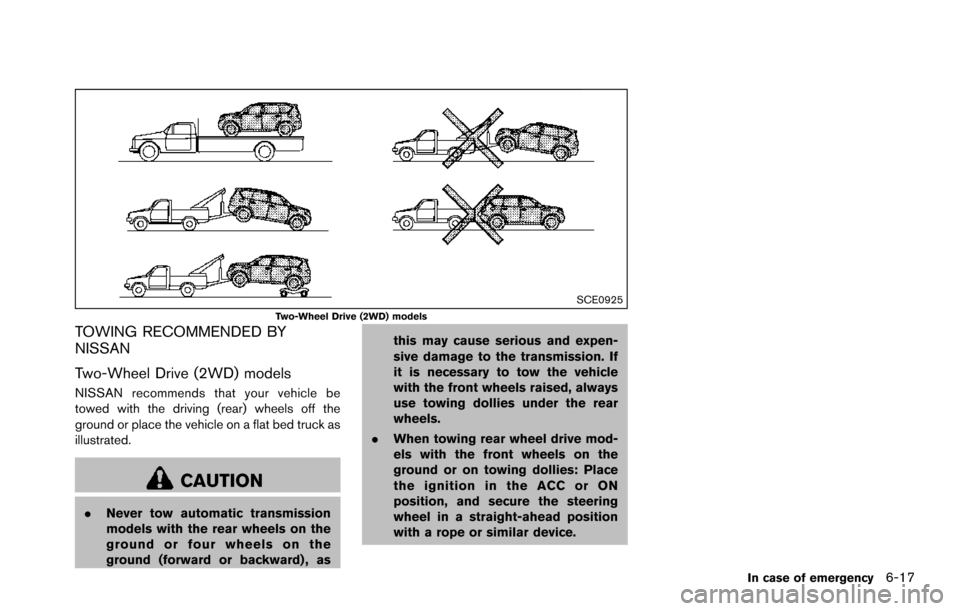
NISSAN recommends that your vehicle be
towed with the driving (rear) wheels off the
ground or place the vehicle on a flat bed truck as
illustrated.
CAUTION
.Never tow automatic transmission
models with the rear wheels on the
ground or four wheels on the
ground (forward or backward) , as this may cause serious and expen-
sive damage to the transmission. If
it is necessary to tow the vehicle
with the front wheels raised, always
use towing dollies under the rear
wheels.
. When towing rear wheel drive mod-
els with the front wheels on the
ground or on towing dollies: Place
the ignition in the ACC or ON
position, and secure the steering
wheel in a straight-ahead position
with a rope or similar device.
In case of emergency6-17
Page 501 of 614
6-18In case of emergency
SCE0907Four-Wheel Drive (4WD) models
Four-Wheel Drive (4WD) models
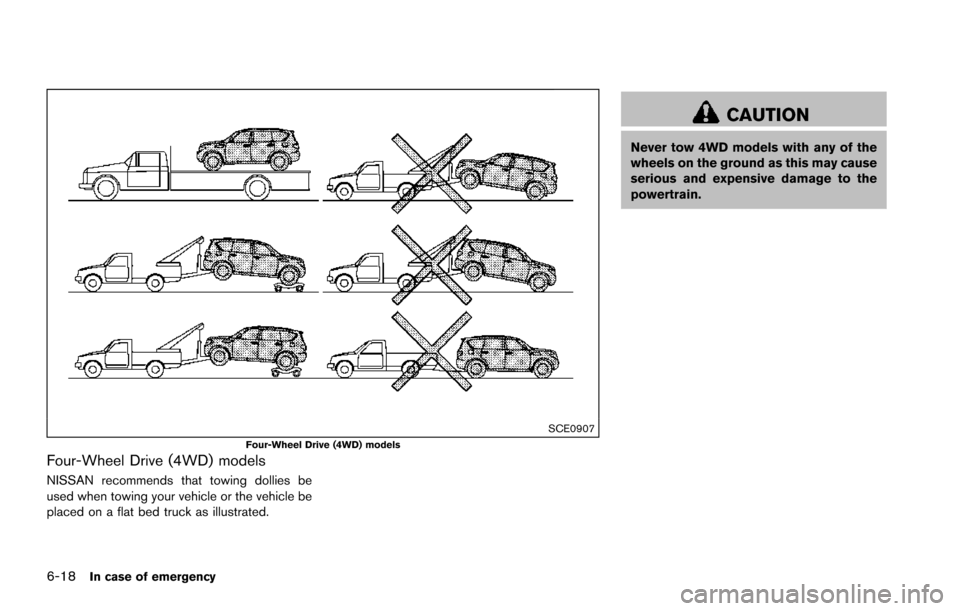
NISSAN recommends that towing dollies be
used when towing your vehicle or the vehicle be
placed on a flat bed truck as illustrated.
CAUTION
Never tow 4WD models with any of the
wheels on the ground as this may cause
serious and expensive damage to the
powertrain.
Page 502 of 614
JVE0350XFront
JVE0351XRear
VEHICLE RECOVERY (freeing a stuck
vehicle)
WARNING
.Stand clear of a stuck vehicle.
. Do not spin your tires at high speed.
This could cause them to explode
and result in serious injury. Parts of
your vehicle could also overheat
and be damaged.
Pulling a stuck vehicle
If your vehicle is stuck in sand, snow, mud, etc.,
use a tow strap or other device designed
specifically for vehicle recovery. Always follow
the manufacturer’s instructions for the recovery
device.
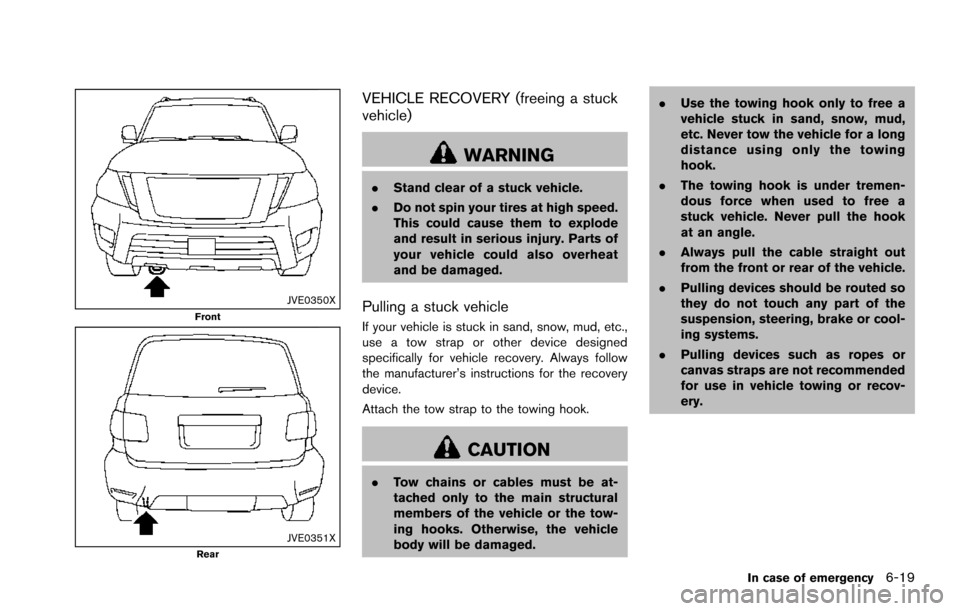
Attach the tow strap to the towing hook.
CAUTION
.Tow chains or cables must be at-
tached only to the main structural
members of the vehicle or the tow-
ing hooks. Otherwise, the vehicle
body will be damaged. .
Use the towing hook only to free a
vehicle stuck in sand, snow, mud,
etc. Never tow the vehicle for a long
distance using only the towing
hook.
. The towing hook is under tremen-
dous force when used to free a
stuck vehicle. Never pull the hook
at an angle.
. Always pull the cable straight out
from the front or rear of the vehicle.
. Pulling devices should be routed so
they do not touch any part of the
suspension, steering, brake or cool-
ing systems.
. Pulling devices such as ropes or
canvas straps are not recommended
for use in vehicle towing or recov-
ery.
In case of emergency6-19
Page 503 of 614
6-20In case of emergency
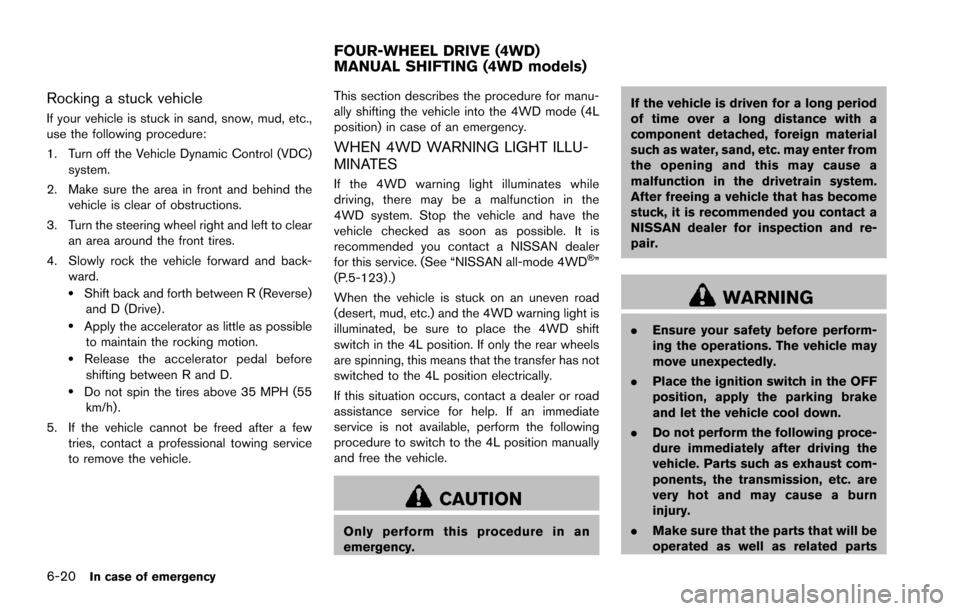
Rocking a stuck vehicle
If your vehicle is stuck in sand, snow, mud, etc.,
use the following procedure:
1. Turn off the Vehicle Dynamic Control (VDC)system.
2. Make sure the area in front and behind the vehicle is clear of obstructions.
3. Turn the steering wheel right and left to clear an area around the front tires.
4. Slowly rock the vehicle forward and back- ward.
.Shift back and forth between R (Reverse)and D (Drive) .
.Apply the accelerator as little as possibleto maintain the rocking motion.
.Release the accelerator pedal before
shifting between R and D.
.Do not spin the tires above 35 MPH (55 km/h) .
5. If the vehicle cannot be freed after a few tries, contact a professional towing service
to remove the vehicle. This section describes the procedure for manu-
ally shifting the vehicle into the 4WD mode (4L
position) in case of an emergency.
WHEN 4WD WARNING LIGHT ILLU-
MINATES
If the 4WD warning light illuminates while
driving, there may be a malfunction in the
4WD system. Stop the vehicle and have the
vehicle checked as soon as possible. It is
recommended you contact a NISSAN dealer
for this service. (See “NISSAN all-mode 4WD
Š”
(P.5-123) .)
When the vehicle is stuck on an uneven road
(desert, mud, etc.) and the 4WD warning light is
illuminated, be sure to place the 4WD shift
switch in the 4L position. If only the rear wheels
are spinning, this means that the transfer has not
switched to the 4L position electrically.
If this situation occurs, contact a dealer or road
assistance service for help. If an immediate
service is not available, perform the following
procedure to switch to the 4L position manually
and free the vehicle.
CAUTION
Only perform this procedure in an
emergency. If the vehicle is driven for a long period
of time over a long distance with a
component detached, foreign material
such as water, sand, etc. may enter from
the opening and this may cause a
malfunction in the drivetrain system.
After freeing a vehicle that has become
stuck, it is recommended you contact a
NISSAN dealer for inspection and re-
pair.
WARNING
.
Ensure your safety before perform-
ing the operations. The vehicle may
move unexpectedly.
. Place the ignition switch in the OFF
position, apply the parking brake
and let the vehicle cool down.
. Do not perform the following proce-
dure immediately after driving the
vehicle. Parts such as exhaust com-
ponents, the transmission, etc. are
very hot and may cause a burn
injury.
. Make sure that the parts that will be
operated as well as related parts
FOUR-WHEEL DRIVE (4WD)
MANUAL SHIFTING (4WD models)
Page 562 of 614
.Operating in hot weather in stop-and-go
“rush hour” traffic.
. Extensive idling and/or low speed driving for
long distances, such as police, taxi or door-
to-door delivery use.
. Driving in dusty conditions.
. Driving on rough, muddy or salt spread
roads.
. Towing a trailer, or using a camper or car-
top carrier.
NOTE:
For vehicles operated in Canada, both
standard and severe maintenance items
should be performed at every interval. The following tables show the standard main-
tenance schedule. Depending upon weather
and atmospheric conditions, varying road sur-
faces, individual driving habits and vehicle
usage, additional or more frequent maintenance
may be required.
After 120,000 miles (192,000 km)/144
months, continue maintenance at the
same mileage/time intervals.
Maintenance and schedules9-7
STANDARD MAINTENANCE
Page 567 of 614
9-12Maintenance and schedules
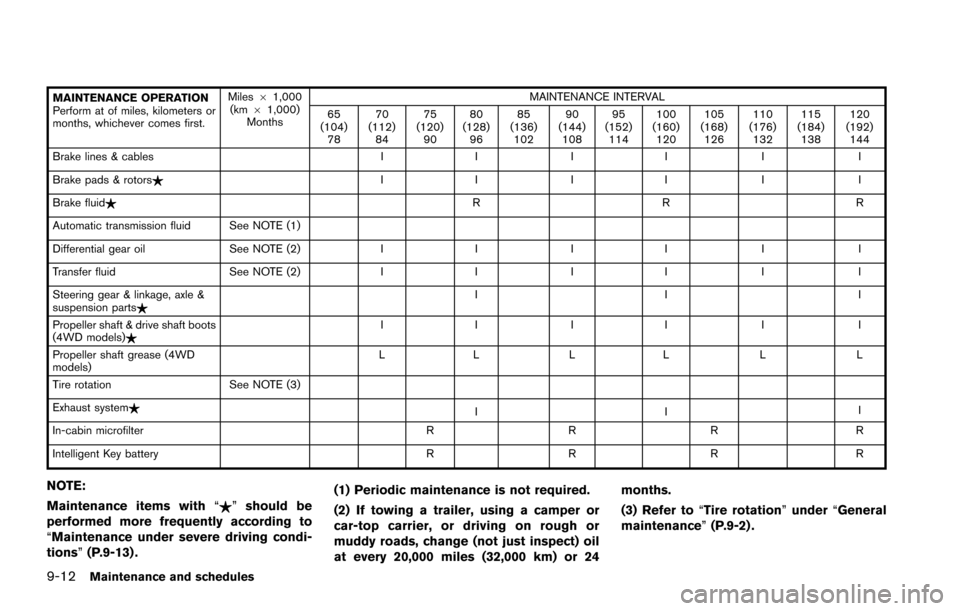
MAINTENANCE OPERATION
Perform at of miles, kilometers or
months, whichever comes first.Miles
61,000
(km 61,000)
Months MAINTENANCE INTERVAL
65
(104) 78 70
(112) 84 75
(120) 90 80
(128) 96 85
(136) 102 90
(144) 108 95
(152) 114 100
(160) 120 105
(168) 126 110
(176) 132 115
(184) 138 120
(192) 144
Brake lines & cables II II I I
Brake pads & rotors$ II II I I
Brake fluid$ RR R
Automatic transmission fluid See NOTE (1)
Differential gear oil See NOTE (2)II II I I
Transfer fluid See NOTE (2)II II I I
Steering gear & linkage, axle &
suspension parts$ II I
Propeller shaft & drive shaft boots
(4WD models)$ II II I I
Propeller shaft grease (4WD
models) LL LL L L
Tire rotation See NOTE (3)
Exhaust system$ III
In-cabin microfilter RRR R
Intelligent Key battery RRR R
NOTE:
Maintenance items with “$”should be
performed more frequently according to
“Maintenance under severe driving condi-
tions” (P.9-13) . (1) Periodic maintenance is not required.
(2) If towing a trailer, using a camper or
car-top carrier, or driving on rough or
muddy roads, change (not just inspect) oil
at every 20,000 miles (32,000 km) or 24 months.
(3) Refer to
“Tire rotation” under“General
maintenance” (P.9-2) .
Page 568 of 614
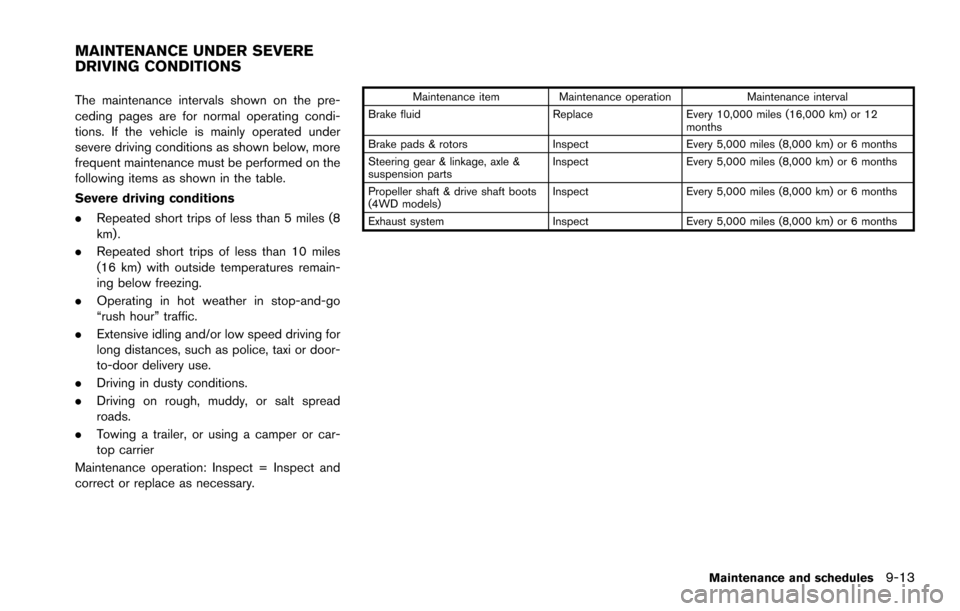
The maintenance intervals shown on the pre-
ceding pages are for normal operating condi-
tions. If the vehicle is mainly operated under
severe driving conditions as shown below, more
frequent maintenance must be performed on the
following items as shown in the table.
Severe driving conditions
.Repeated short trips of less than 5 miles (8
km) .
. Repeated short trips of less than 10 miles
(16 km) with outside temperatures remain-
ing below freezing.
. Operating in hot weather in stop-and-go
“rush hour” traffic.
. Extensive idling and/or low speed driving for
long distances, such as police, taxi or door-
to-door delivery use.
. Driving in dusty conditions.
. Driving on rough, muddy, or salt spread
roads.
. Towing a trailer, or using a camper or car-
top carrier
Maintenance operation: Inspect = Inspect and
correct or replace as necessary.Maintenance item Maintenance operation Maintenance interval
Brake fluid ReplaceEvery 10,000 miles (16,000 km) or 12
months
Brake pads & rotors InspectEvery 5,000 miles (8,000 km) or 6 months
Steering gear & linkage, axle &
suspension parts Inspect
Every 5,000 miles (8,000 km) or 6 months
Propeller shaft & drive shaft boots
(4WD models) Inspect
Every 5,000 miles (8,000 km) or 6 months
Exhaust system InspectEvery 5,000 miles (8,000 km) or 6 months
Maintenance and schedules9-13
MAINTENANCE UNDER SEVERE
DRIVING CONDITIONS
Page 572 of 614
10 Technical and consumer information
Capacities and recommended fluids/lubricants ............. 10-2Fuel information ................................................................ 10-4
Engine oil and oil filter recommendation .................... 10-6
Air conditioning system refrigerant and
lubricant recommendations ............................................ 10-7
Specifications ........................................................................\
.. 10-8
Engine ........................................................................\
......... 10-8
Wheels and tires .............................................................. 10-9
Dimensions ........................................................................\
10-9
When traveling or registering in another country ....... 10-10
Vehicle identification ........................................................... 10-10 Vehicle Identification Number (VIN) plate ............... 10-10
Vehicle identification number (chassis number) .... 10-10
Engine serial number .................................................... 10-11
F.M.V.S.S./C.M.V.S.S. certification label ................. 10-11
Emission control information label ............................ 10-11
Tire and loading information label ............................. 10-12
Air conditioner specification label ............................. 10-12
Installing front license plate .............................................. 10-12
Vehicle loading information ............................................... 10-13
Terms ........................................................................\
........ 10-13 Vehicle load capacity ................................................. 10-14
Securing the load ....................................................... 10-15
Loading tips .................................................................. 10-16
Measurement of weights ........................................... 10-16
Towing a trailer .................................................................... 10-17 Maximum load limits ................................................... 10-17
Maximum Gross Vehicle Weight (GVW)/maximum
Gross Axle Weight (GAW) ...................................... 10-19
Towing load/specification ......................................... 10-20
Towing safety .............................................................. 10-21
Flat towing .................................................................... 10-29
Uniform tire quality grading .............................................. 10-29 Treadwear ..................................................................... 10-29
Traction AA, A, B and C ........................................... 10-29
Temperature A, B and C ........................................... 10-30
Emission control system warranty .................................. 10-30
Reporting safety defects .................................................. 10-31
Readiness for Inspection/Maintenance (I/M) test ...... 10-32
Event Data Recorders (EDR) .......................................... 10-33
Owner’s Manual/Service Manual
order information ................................................................ 10-33
Page 586 of 614
4. The resulting figure equals the avail-able amount of cargo and luggage
load capacity. For example, if the XXX
amount equals 1400 lbs. and there
will be five 150 lb. passengers in your
vehicle, the amount of available cargo
and luggage load capacity is 650 lbs.
(1400 í750 (5 x 150) = 650 lbs) or
(640 í340 (5 x 70) = 300 kg.)
5. Determine the combined weight of luggage and cargo being loaded on
the vehicle. That weight may not
safely exceed the available cargo
and luggage load capacity calculated
in Step 4.
6. If your vehicle will be towing a trailer, load from your trailer will be trans-
ferred to your vehicle. Consult this
manual to determine how this re-
duces the available cargo and lug-
gage load capacity of your vehicle.
Before driving a loaded vehicle, confirm
that you do not exceed the Gross Vehicle
Weight Rating (GVWR) or the Gross
Axle Weight Rating (GAWR) for your vehicle. (See “Measurement of weights”
(P.10-16) .)
Also check tires for proper inflation
pressures. See the Tire and Loading
Information label.
SIC4446
SECURING THE LOAD
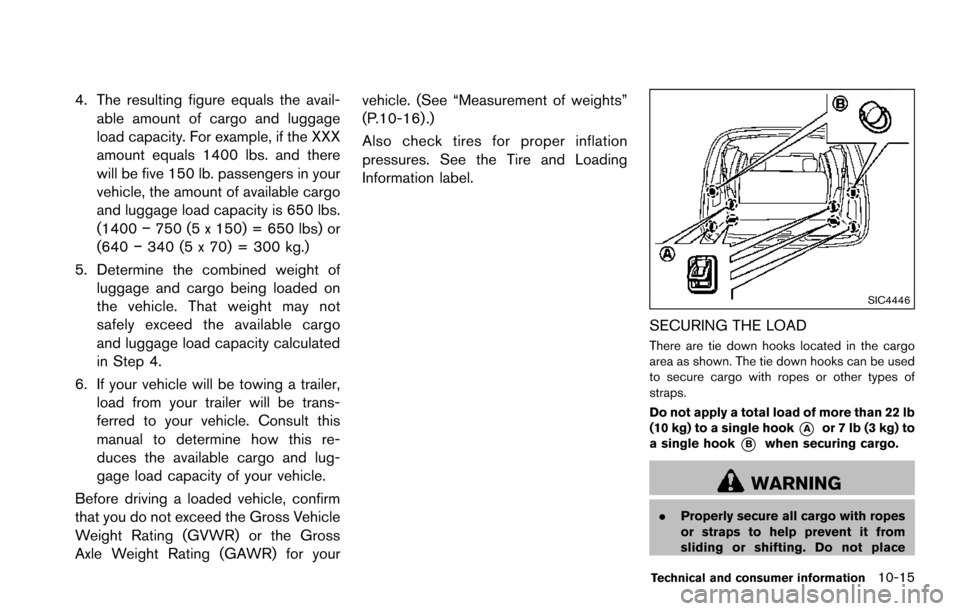
There are tie down hooks located in the cargo
area as shown. The tie down hooks can be used
to secure cargo with ropes or other types of
straps.
Do not apply a total load of more than 22 lb
(10 kg) to a single hook
*Aor 7 lb (3 kg) to
a single hook
*Bwhen securing cargo.
WARNING
. Properly secure all cargo with ropes
or straps to help prevent it from
sliding or shifting. Do not place
Technical and consumer information10-15