maintenance NISSAN ARMADA 2017 2.G Workshop Manual
[x] Cancel search | Manufacturer: NISSAN, Model Year: 2017, Model line: ARMADA, Model: NISSAN ARMADA 2017 2.GPages: 614, PDF Size: 2.87 MB
Page 566 of 614
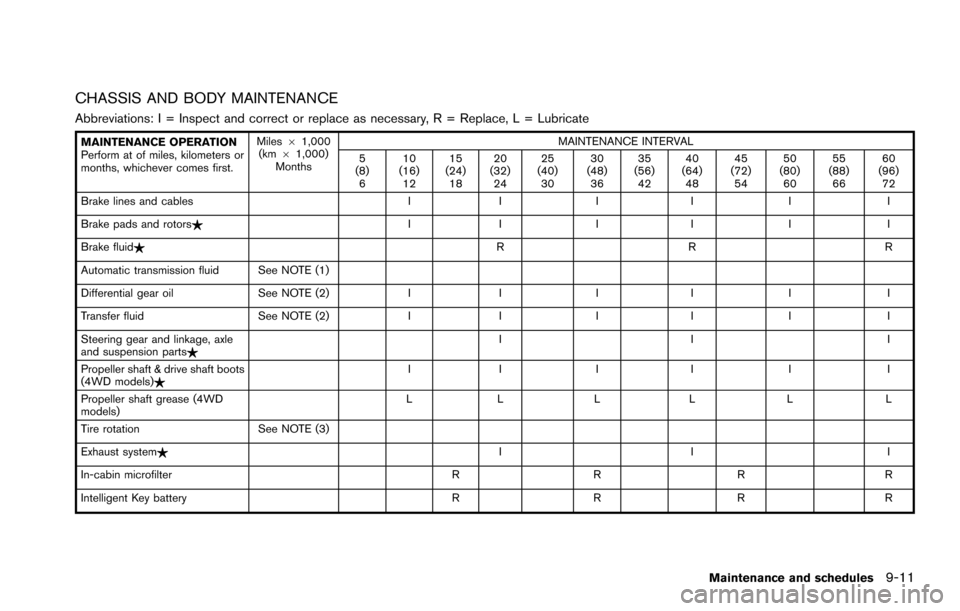
CHASSIS AND BODY MAINTENANCE
Abbreviations: I = Inspect and correct or replace as necessary, R = Replace, L = Lubricate
MAINTENANCE OPERATION
Perform at of miles, kilometers or
months, whichever comes first.Miles
61,000
(km 61,000)
Months MAINTENANCE INTERVAL
5
(8) 6 10
(16) 12 15
(24) 18 20
(32) 24 25
(40) 30 30
(48) 36 35
(56) 42 40
(64) 48 45
(72) 54 50
(80) 60 55
(88) 66 60
(96) 72
Brake lines and cables II II I I
Brake pads and rotors$ II I I I I
Brake fluid$ RR R
Automatic transmission fluid See NOTE (1)
Differential gear oil See NOTE (2)II II I I
Transfer fluid See NOTE (2)II II I I
Steering gear and linkage, axle
and suspension parts$ II I
Propeller shaft & drive shaft boots
(4WD models)$ II I I I I
Propeller shaft grease (4WD
models) LL L L L L
Tire rotation See NOTE (3)
Exhaust system$ II I
In-cabin microfilter RR R R
Intelligent Key battery RR R R
Maintenance and schedules9-11
Page 567 of 614
9-12Maintenance and schedules
MAINTENANCE OPERATION
Perform at of miles, kilometers or
months, whichever comes first.Miles
61,000
(km 61,000)
Months MAINTENANCE INTERVAL
65
(104) 78 70
(112) 84 75
(120) 90 80
(128) 96 85
(136) 102 90
(144) 108 95
(152) 114 100
(160) 120 105
(168) 126 110
(176) 132 115
(184) 138 120
(192) 144
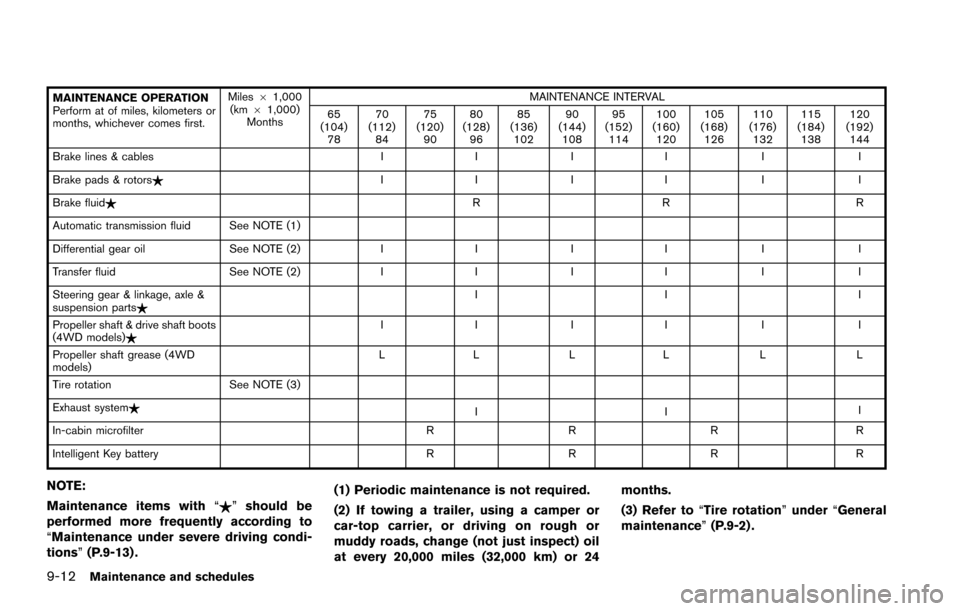
Brake lines & cables II II I I
Brake pads & rotors$ II II I I
Brake fluid$ RR R
Automatic transmission fluid See NOTE (1)
Differential gear oil See NOTE (2)II II I I
Transfer fluid See NOTE (2)II II I I
Steering gear & linkage, axle &
suspension parts$ II I
Propeller shaft & drive shaft boots
(4WD models)$ II II I I
Propeller shaft grease (4WD
models) LL LL L L
Tire rotation See NOTE (3)
Exhaust system$ III
In-cabin microfilter RRR R
Intelligent Key battery RRR R
NOTE:
Maintenance items with “$”should be
performed more frequently according to
“Maintenance under severe driving condi-
tions” (P.9-13) . (1) Periodic maintenance is not required.
(2) If towing a trailer, using a camper or
car-top carrier, or driving on rough or
muddy roads, change (not just inspect) oil
at every 20,000 miles (32,000 km) or 24 months.
(3) Refer to
“Tire rotation” under“General
maintenance” (P.9-2) .
Page 568 of 614
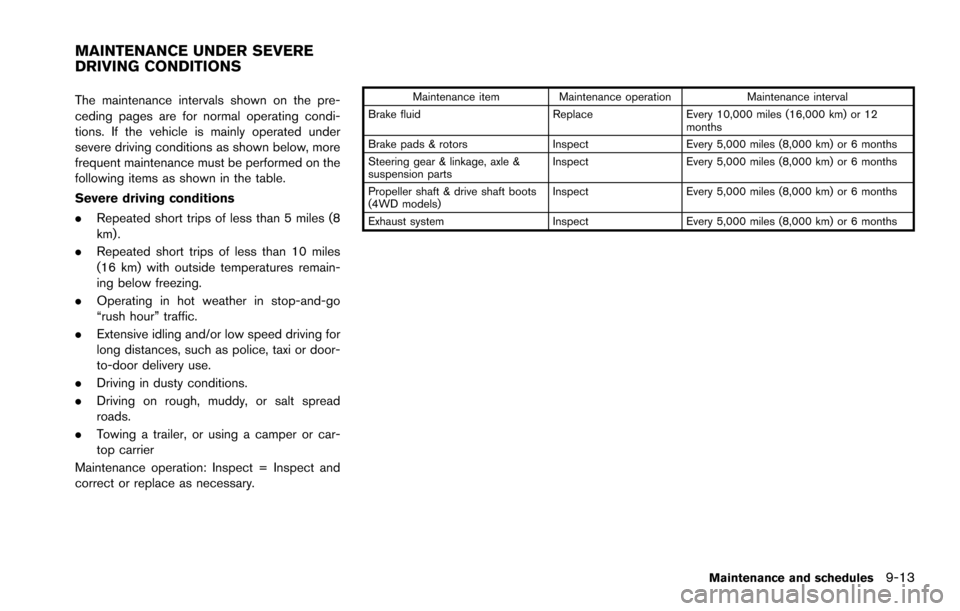
The maintenance intervals shown on the pre-
ceding pages are for normal operating condi-
tions. If the vehicle is mainly operated under
severe driving conditions as shown below, more
frequent maintenance must be performed on the
following items as shown in the table.
Severe driving conditions
.Repeated short trips of less than 5 miles (8
km) .
. Repeated short trips of less than 10 miles
(16 km) with outside temperatures remain-
ing below freezing.
. Operating in hot weather in stop-and-go
“rush hour” traffic.
. Extensive idling and/or low speed driving for
long distances, such as police, taxi or door-
to-door delivery use.
. Driving in dusty conditions.
. Driving on rough, muddy, or salt spread
roads.
. Towing a trailer, or using a camper or car-
top carrier
Maintenance operation: Inspect = Inspect and
correct or replace as necessary.Maintenance item Maintenance operation Maintenance interval
Brake fluid ReplaceEvery 10,000 miles (16,000 km) or 12
months
Brake pads & rotors InspectEvery 5,000 miles (8,000 km) or 6 months
Steering gear & linkage, axle &
suspension parts Inspect
Every 5,000 miles (8,000 km) or 6 months
Propeller shaft & drive shaft boots
(4WD models) Inspect
Every 5,000 miles (8,000 km) or 6 months
Exhaust system InspectEvery 5,000 miles (8,000 km) or 6 months
Maintenance and schedules9-13
MAINTENANCE UNDER SEVERE
DRIVING CONDITIONS
Page 569 of 614
9-14Maintenance and schedules
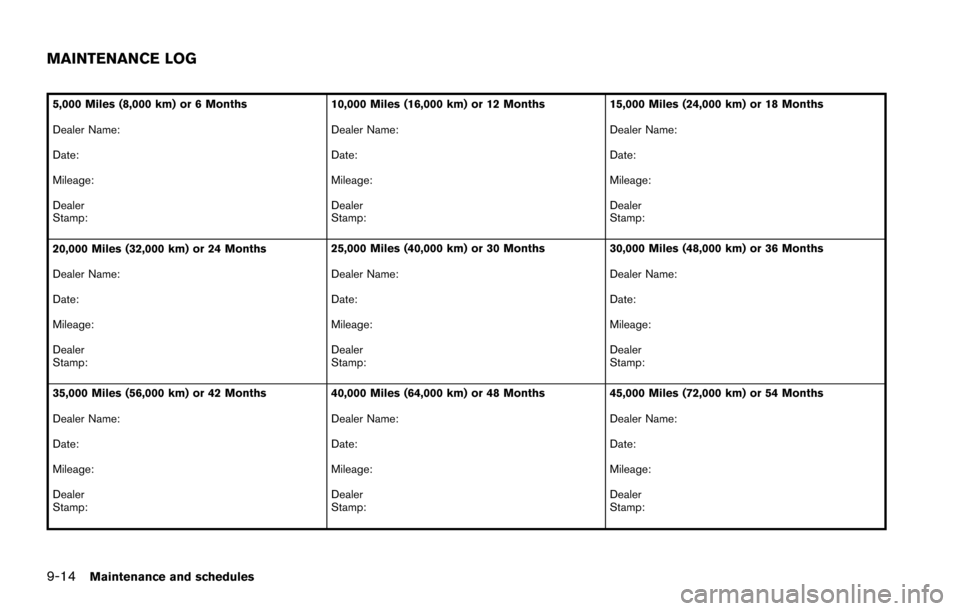
5,000 Miles (8,000 km) or 6 Months
Dealer Name:
Date:
Mileage:
Dealer
Stamp:10,000 Miles (16,000 km) or 12 Months
Dealer Name:
Date:
Mileage:
Dealer
Stamp:15,000 Miles (24,000 km) or 18 Months
Dealer Name:
Date:
Mileage:
Dealer
Stamp:
20,000 Miles (32,000 km) or 24 Months
Dealer Name:
Date:
Mileage:
Dealer
Stamp: 25,000 Miles (40,000 km) or 30 Months
Dealer Name:
Date:
Mileage:
Dealer
Stamp:30,000 Miles (48,000 km) or 36 Months
Dealer Name:
Date:
Mileage:
Dealer
Stamp:
35,000 Miles (56,000 km) or 42 Months
Dealer Name:
Date:
Mileage:
Dealer
Stamp: 40,000 Miles (64,000 km) or 48 Months
Dealer Name:
Date:
Mileage:
Dealer
Stamp:45,000 Miles (72,000 km) or 54 Months
Dealer Name:
Date:
Mileage:
Dealer
Stamp:
MAINTENANCE LOG
Page 570 of 614
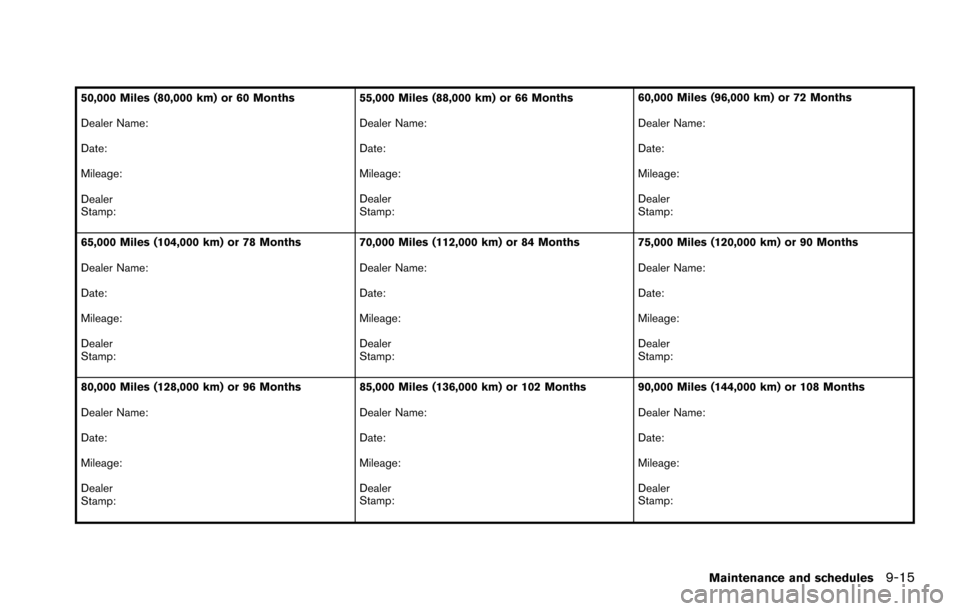
50,000 Miles (80,000 km) or 60 Months
Dealer Name:
Date:
Mileage:
Dealer
Stamp:55,000 Miles (88,000 km) or 66 Months
Dealer Name:
Date:
Mileage:
Dealer
Stamp:60,000 Miles (96,000 km) or 72 Months
Dealer Name:
Date:
Mileage:
Dealer
Stamp:
65,000 Miles (104,000 km) or 78 Months
Dealer Name:
Date:
Mileage:
Dealer
Stamp: 70,000 Miles (112,000 km) or 84 Months
Dealer Name:
Date:
Mileage:
Dealer
Stamp:75,000 Miles (120,000 km) or 90 Months
Dealer Name:
Date:
Mileage:
Dealer
Stamp:
80,000 Miles (128,000 km) or 96 Months
Dealer Name:
Date:
Mileage:
Dealer
Stamp: 85,000 Miles (136,000 km) or 102 Months
Dealer Name:
Date:
Mileage:
Dealer
Stamp:90,000 Miles (144,000 km) or 108 Months
Dealer Name:
Date:
Mileage:
Dealer
Stamp:
Maintenance and schedules9-15
Page 571 of 614
9-16Maintenance and schedules
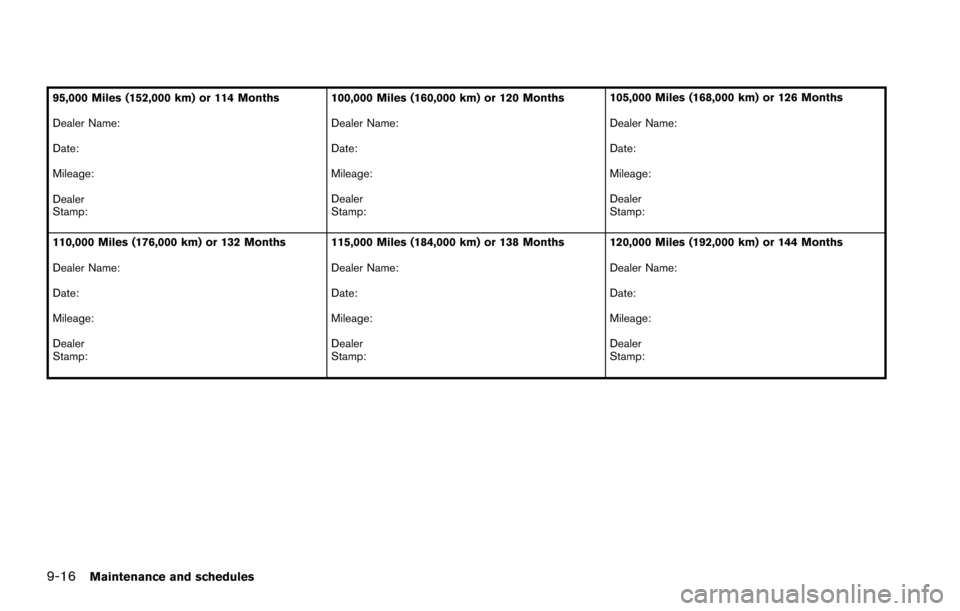
95,000 Miles (152,000 km) or 114 Months
Dealer Name:
Date:
Mileage:
Dealer
Stamp:100,000 Miles (160,000 km) or 120 Months
Dealer Name:
Date:
Mileage:
Dealer
Stamp:105,000 Miles (168,000 km) or 126 Months
Dealer Name:
Date:
Mileage:
Dealer
Stamp:
110,000 Miles (176,000 km) or 132 Months
Dealer Name:
Date:
Mileage:
Dealer
Stamp: 115,000 Miles (184,000 km) or 138 Months
Dealer Name:
Date:
Mileage:
Dealer
Stamp:120,000 Miles (192,000 km) or 144 Months
Dealer Name:
Date:
Mileage:
Dealer
Stamp:
Page 572 of 614
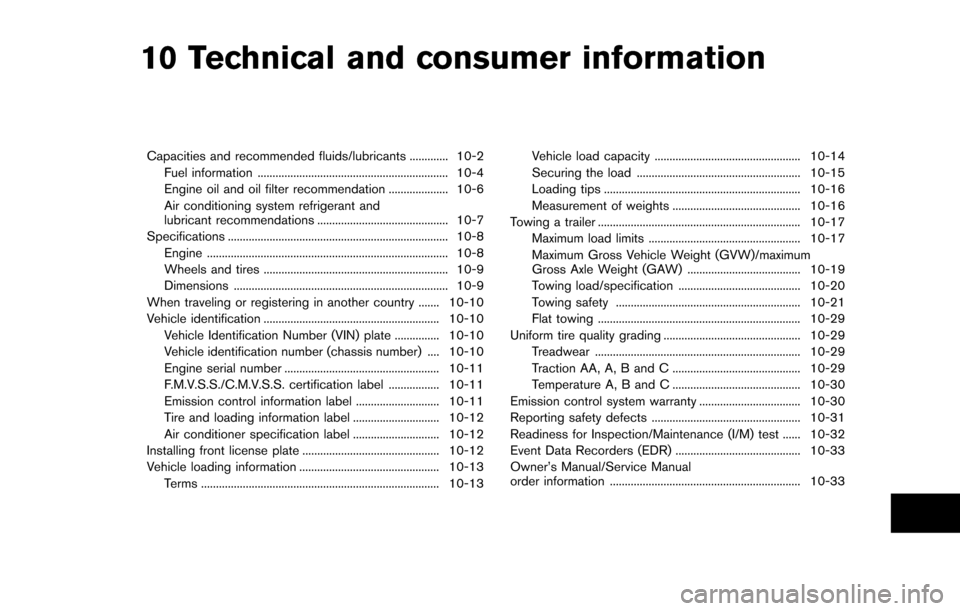
10 Technical and consumer information
Capacities and recommended fluids/lubricants ............. 10-2Fuel information ................................................................ 10-4
Engine oil and oil filter recommendation .................... 10-6
Air conditioning system refrigerant and
lubricant recommendations ............................................ 10-7
Specifications ........................................................................\
.. 10-8
Engine ........................................................................\
......... 10-8
Wheels and tires .............................................................. 10-9
Dimensions ........................................................................\
10-9
When traveling or registering in another country ....... 10-10
Vehicle identification ........................................................... 10-10 Vehicle Identification Number (VIN) plate ............... 10-10
Vehicle identification number (chassis number) .... 10-10
Engine serial number .................................................... 10-11
F.M.V.S.S./C.M.V.S.S. certification label ................. 10-11
Emission control information label ............................ 10-11
Tire and loading information label ............................. 10-12
Air conditioner specification label ............................. 10-12
Installing front license plate .............................................. 10-12
Vehicle loading information ............................................... 10-13
Terms ........................................................................\
........ 10-13 Vehicle load capacity ................................................. 10-14
Securing the load ....................................................... 10-15
Loading tips .................................................................. 10-16
Measurement of weights ........................................... 10-16
Towing a trailer .................................................................... 10-17 Maximum load limits ................................................... 10-17
Maximum Gross Vehicle Weight (GVW)/maximum
Gross Axle Weight (GAW) ...................................... 10-19
Towing load/specification ......................................... 10-20
Towing safety .............................................................. 10-21
Flat towing .................................................................... 10-29
Uniform tire quality grading .............................................. 10-29 Treadwear ..................................................................... 10-29
Traction AA, A, B and C ........................................... 10-29
Temperature A, B and C ........................................... 10-30
Emission control system warranty .................................. 10-30
Reporting safety defects .................................................. 10-31
Readiness for Inspection/Maintenance (I/M) test ...... 10-32
Event Data Recorders (EDR) .......................................... 10-33
Owner’s Manual/Service Manual
order information ................................................................ 10-33
Page 577 of 614
10-6Technical and consumer information
engine. If any of the above symptoms are
encountered, have your vehicle checked. It is
recommended you visit a NISSAN dealer for
servicing.
However, now and then you may notice
light spark knock for a short time while
accelerating or driving up hills. This is no
cause for concern, because you get the
greatest fuel benefit when there is light
spark knock for a short time under heavy
engine load.
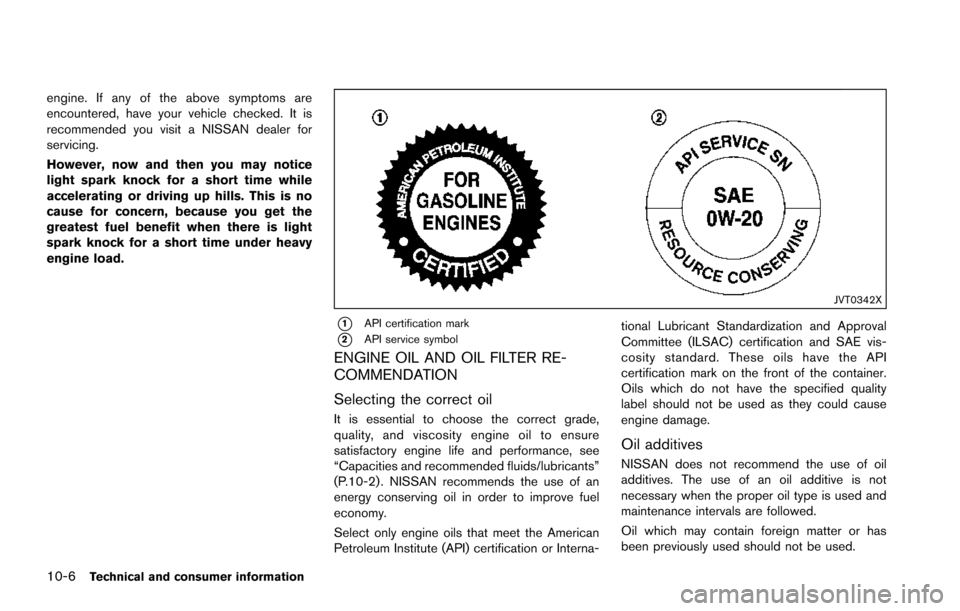
JVT0342X
*1API certification mark
*2API service symbol
ENGINE OIL AND OIL FILTER RE-
COMMENDATION
Selecting the correct oil
It is essential to choose the correct grade,
quality, and viscosity engine oil to ensure
satisfactory engine life and performance, see
“Capacities and recommended fluids/lubricants”
(P.10-2) . NISSAN recommends the use of an
energy conserving oil in order to improve fuel
economy.
Select only engine oils that meet the American
Petroleum Institute (API) certification or Interna-tional Lubricant Standardization and Approval
Committee (ILSAC) certification and SAE vis-
cosity standard. These oils have the API
certification mark on the front of the container.
Oils which do not have the specified quality
label should not be used as they could cause
engine damage.
Oil additives
NISSAN does not recommend the use of oil
additives. The use of an oil additive is not
necessary when the proper oil type is used and
maintenance intervals are followed.
Oil which may contain foreign matter or has
been previously used should not be used.
Page 578 of 614
Oil viscosity
The engine oil viscosity or thickness changes
with temperature. Because of this, it is important
that the engine oil viscosity be selected based
on the temperatures at which the vehicle will be
operated before the next oil change. Choosing
an oil viscosity other than that recommended
could cause serious engine damage.
Selecting the correct oil filter
Your new vehicle is equipped with a high-quality
genuine NISSAN oil filter. When replacing, use
the genuine oil filter or its equivalent for the
reason described in change intervals.
Change intervals
The oil and oil filter change intervals for your
engine are based on the use of the specified
quality oils and filters. Oil and filter other than the
specified quality, or oil and filter change intervals
longer than recommended could reduce engine
life. Damage to engines caused by improper
maintenance or use of incorrect oil and filter
quality and/or viscosity is not covered by the
new NISSAN vehicle limited warranties.
Your engine was filled with a high quality engine
oil when it was built. You do not have to change
the oil before the first recommended change
interval. Oil and filter change intervals depend
upon how you use your vehicle.
AIR CONDITIONING SYSTEM RE-
FRIGERANT AND LUBRICANT RE-
COMMENDATIONS
The air conditioning system in your
NISSAN vehicle must be charged with the
refrigerant HFC-134a (R-134a) and the
lubricant, NISSAN A/C system oil Type S
or the exact equivalents.
CAUTION
The use of any other refrigerant or
lubricant may cause severe damage to
the air conditioning system and may
require the replacement of all air con-
ditioner system components.
The refrigerant HFC-134a (R-134a) in your
NISSAN vehicle will not harm the earth’s ozone
layer. Although this refrigerant does not affect
the earth’s atmosphere, certain governmental
regulations require the recovery and recycling of
any refrigerant during automotive air condition-
ing system service. Your NISSAN dealer has the
trained technicians and equipment needed to
recover and recycle your air conditioning system
refrigerant.
It is recommended you visit a NISSAN dealer
when servicing your air conditioning system.
Technical and consumer information10-7
Page 598 of 614
CAUTION
If you move the shift lever to the P
(Park) position before blocking the
wheels and applying the parking brake,
transmission damage could occur.
1. Apply and hold the brake pedal.
2. Have someone place blocks on the downhill side of the vehicle and trailer wheels.
3. After the wheel blocks are in place, slowly release the brake pedal until the blocks
absorb the vehicle load.
4. Apply the parking brake.
5. Shift the transmission into P (Park) .
6. Four-Wheel Drive (4WD) models:
Make sure that the 4WD shift switch is
engaged in the AUTO, 4HI or 4LO position
and the Automatic Transmission (AT) park
warning light is turned off.
7. Turn off the engine.
To drive away:
1. Apply and hold the brake pedal.
2. Start the engine.
3. Shift the transmission into gear. 4. Release the parking brake.
5. Drive slowly until the vehicle and trailer are
clear from the blocks.
6. Apply and hold the brake pedal.
7. Have someone retrieve and store the blocks.
. While going downhill, the weight of the
trailer pushing on the tow vehicle may
decrease overall stability. Therefore, to
maintain adequate control, reduce your
speed and shift to a lower gear. Avoid long
or repeated use of the brakes when
descending a hill, as this reduces their
effectiveness and could cause overheating.
Shifting to a lower gear instead provides
“engine braking” and reduces the need to
brake as frequently.
. If the engine coolant temperature rises to a
high temperature, see “If your vehicle over-
heats” (P.6-14) .
. Trailer towing requires more fuel than normal
circumstances.
. Avoid towing a trailer for your vehicle’s first
500 miles (800 km).
. Have your vehicle serviced more often than
at intervals specified in the recommended
maintenance schedule shown in the "9.
Maintenance and schedules" section. .
When making a turn, your trailer wheels will
be closer to the inside of the turn than your
vehicle wheels. To compensate for this,
make a larger than normal turning radius
during the turn.
. Crosswinds and rough roads will adversely
affect vehicle/trailer handling, possibly caus-
ing vehicle sway. When being passed by
larger vehicles, be prepared for possible
changes in crosswinds that could affect
vehicle handling.
Do the following if the trailer begins to sway:
1. Take your foot off the accelerator pedal to allow the vehicle to coast and steer as
straight ahead as the road conditions allow.
This combination will help stabilize the
vehicle.
.Do not correct trailer sway by steering orapplying the brakes.
2. When the trailer sway stops, gently apply the brakes and pull to the side of the road in
a safe area.
3. Try to rearrange the trailer load so it is balanced as described earlier in this section.
. Be careful when passing other vehicles.
Passing while towing a trailer requires
considerably more distance than normal
passing. Remember the length of the trailer
must also pass the other vehicle before you
Technical and consumer information10-27