heater NISSAN ARMADA 2019 Owner´s Manual
[x] Cancel search | Manufacturer: NISSAN, Model Year: 2019, Model line: ARMADA, Model: NISSAN ARMADA 2019Pages: 536, PDF Size: 2.56 MB
Page 263 of 536

TOW mode ........................................................................\
.......... 5-131
SNOW mode ........................................................................\
....... 5-132
Sonar system (if so equipped) .................................... 5-132Sonar settings ................................................................... 5-133
Sonar indicator ................................................................. 5-134
Power steering ........................................................................\
5-135
Brake system ........................................................................\
.... 5-135 Braking precautions ..................................................... 5-135
Parking brake break-in ............................................... 5-136
Brake assist ........................................................................\
........ 5-136 Brake assist ........................................................................\
. 5-136
Anti-lock Braking System (ABS) ........................... 5-136 Vehicle Dynamic Control (VDC) system .............. 5-138
Vehicle Dynamic Control (VDC)
OFF switch ........................................................................\
. 5-139
Cold weather driving ......................................................... 5-140
Freeing a frozen door lock ................................... 5-140
Antifreeze ........................................................................\
.... 5-140
Battery ........................................................................\
........... 5-140
Draining of coolant water ..................................... 5-140
Tire equipment ............................................................... 5-140
Special winter equipment ..................................... 5-141
Driving on snow or ice ............................................. 5-141
Engine block heater (if so equipped) ........... 5-141
Page 401 of 536
For four-wheel drive
If you install snow tires, they must also be
the same size, brand, construction and
tread pattern on all four wheels.
SPECIAL WINTER EQUIPMENT
It is recommended that the following
items be carried in the vehicle during
winter:
.A scraper and stiff-bristled brush to
remove ice and snow from the win-
dows and wiper blades.
. A sturdy, flat board to be placed under
the jack to give it firm support.
. A shovel to dig the vehicle out of
snowdrifts.
. Extra window washer fluid to refill the
reservoir tank.
DRIVING ON SNOW OR ICE
WARNING
.Wet ice (32°F, 0°C and freezing
rain), very cold snow or ice can be
slick and very hard to drive on.
The vehicle will have much less
traction or “grip” under these
conditions. Try to avoid driving
on wet ice until the road is salted
or sanded. .
Whatever the condition, drive
with caution. Accelerate and slow
down with care. If accelerating or
downshifting too fast, the drive
wheels will lose even more trac-
tion.
. Allow more stopping distance
under these conditions. Braking
should be started sooner than on
dry pavement.
. Allow greater following distances
on slippery roads.
. Watch for slippery spots (glare
ice). These may appear on an
otherwise clear road in shaded
areas. If a patch of ice is seen
ahead, brake before reaching it.
Try not to brake while on the ice,
and avoid any sudden steering
maneuvers.
. Do not use the cruise control on
slippery roads.
. Snow can trap dangerous ex-
haust gases under your vehicle.
Keep snow clear of the exhaust
pipe and from around your vehi-
cle.
ENGINE BLOCK HEATER (if so
equipped)
Engine block heaters are used to assist in
cold temperature starting.
The engine block heater should be used
when the outside temperature is 20°F
(−7°C) or lower.
To use the engine block heater
1. Turn the engine off.
2. Open the hood and unwrap the en-
gine block heater cord.
3. Plug the engine block heater cord into a grounded 3-wire, 3-pronged exten-
sion cord.
4. Plug the extension cord into a Ground Fault Interrupt (GFI) protected,
grounded 110-volt AC (VAC) outlet.
5. The engine block heater must be plugged in for at least 2 - 4 hours,
depending on outside temperatures,
to properly warm the engine coolant.
Use an appropriate timer to turn the
engine block heater on.
6. Before starting the engine, unplug and properly store the cord to keep it
away from moving parts.
Starting and driving5-141
Page 402 of 536
5-142Starting and driving
WARNING
.Do not use your engine block
heater with an ungrounded elec-
trical system or a 2-pronged
adapter. You can be seriously
injured by an electrical shock if
you use an ungrounded connec-
tion.
. Disconnect and properly store the
engine block heater cord before
starting the engine. Damage to
the cord could result in an elec-
trical shock and can cause ser-
ious injury.
. Use a heavy-duty 3-wire, 3-
pronged extension cord rated
for at least 10A. Plug the exten-
sion cord into a Ground Fault
Interrupt (GFI) protected,
grounded 110-VAC outlet. Failure
to use the proper extension cord
or a grounded outlet can result in
a fire or electrical shock and
cause serious personal injury.
Page 415 of 536
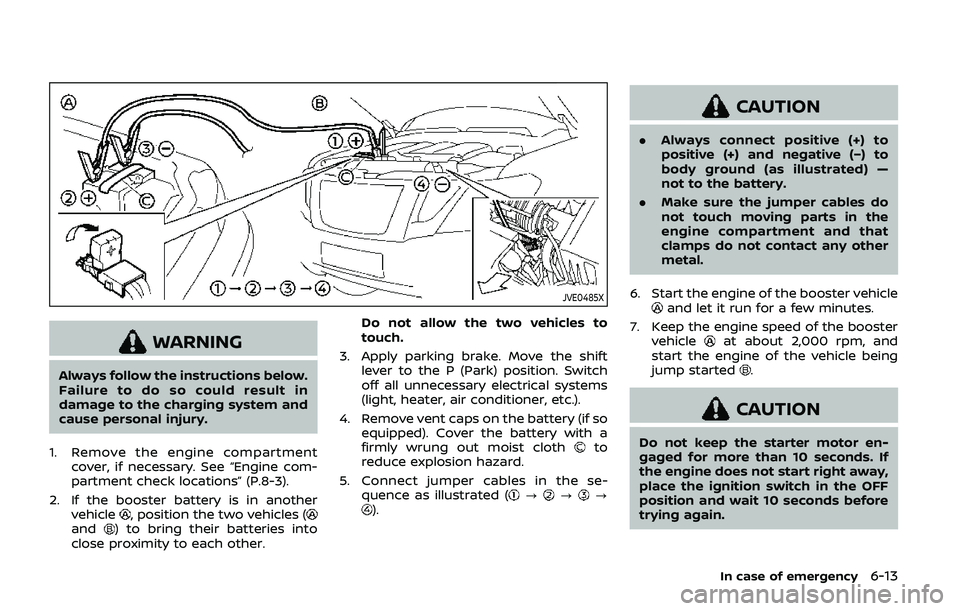
JVE0485X
WARNING
Always follow the instructions below.
Failure to do so could result in
damage to the charging system and
cause personal injury.
1. Remove the engine compartment cover, if necessary. See “Engine com-
partment check locations” (P.8-3).
2. If the booster battery is in another vehicle
, position the two vehicles (and) to bring their batteries into
close proximity to each other. Do not allow the two vehicles to
touch.
3. Apply parking brake. Move the shift lever to the P (Park) position. Switch
off all unnecessary electrical systems
(light, heater, air conditioner, etc.).
4. Remove vent caps on the battery (if so equipped). Cover the battery with a
firmly wrung out moist cloth
to
reduce explosion hazard.
5. Connect jumper cables in the se- quence as illustrated (
???).
CAUTION
.Always connect positive (+) to
positive (+) and negative (−) to
body ground (as illustrated) —
not to the battery.
. Make sure the jumper cables do
not touch moving parts in the
engine compartment and that
clamps do not contact any other
metal.
6. Start the engine of the booster vehicle
and let it run for a few minutes.
7. Keep the engine speed of the booster vehicle
at about 2,000 rpm, and
start the engine of the vehicle being
jump started
.
CAUTION
Do not keep the starter motor en-
gaged for more than 10 seconds. If
the engine does not start right away,
place the ignition switch in the OFF
position and wait 10 seconds before
trying again.
In case of emergency6-13
Page 416 of 536
6-14In case of emergency
8. After starting your engine, carefullydisconnect the negative cable and
then the positive cable (
???).
9. Replace the vent caps (if so equipped). Be sure to dispose of the cloth used to
cover the vent holes as it may be
contaminated with corrosive acid.
10. Put the battery cover on. Do not attempt to start the engine by
pushing.CAUTION
.
Automatic transmission models
cannot be push-started or tow-
started. Attempting to do so may
cause transmission damage.
. Three way catalyst equipped
models should not be started by
pushing since the three way cat-
alyst may be damaged.
. Never try to start the vehicle by
towing it; when the engine starts,
the forward surge could cause
the vehicle to collide with the
tow vehicle.
CAUTION
.Do not continue to drive if your
vehicle overheats. Doing so could
cause engine damage or a vehicle
fire.
. To avoid the danger of being
scalded, never remove the radia-
tor cap or coolant reservoir cap
while the engine is still hot. When
the radiator cap or coolant reser-
voir cap is removed, pressurized
hot water will spurt out, possibly
causing serious injury.
. Do not open the hood if steam is
coming out.
If your vehicle is overheating (indicated by
an extremely high temperature gauge
reading), or if you feel a lack of engine
power, detect abnormal noise, etc., take
the following steps:
1. Move the vehicle safely off the road, apply the parking brake and move the
shift lever to the P (Park) position.
Do not stop the engine.
2. Turn off the heater and air condi- tioner. Open all the windows, move
the heater or air conditioner tempera-
ture control to maximum hot and fan
PUSH STARTING IF YOUR VEHICLE OVERHEATS
Page 439 of 536
JVM0733X
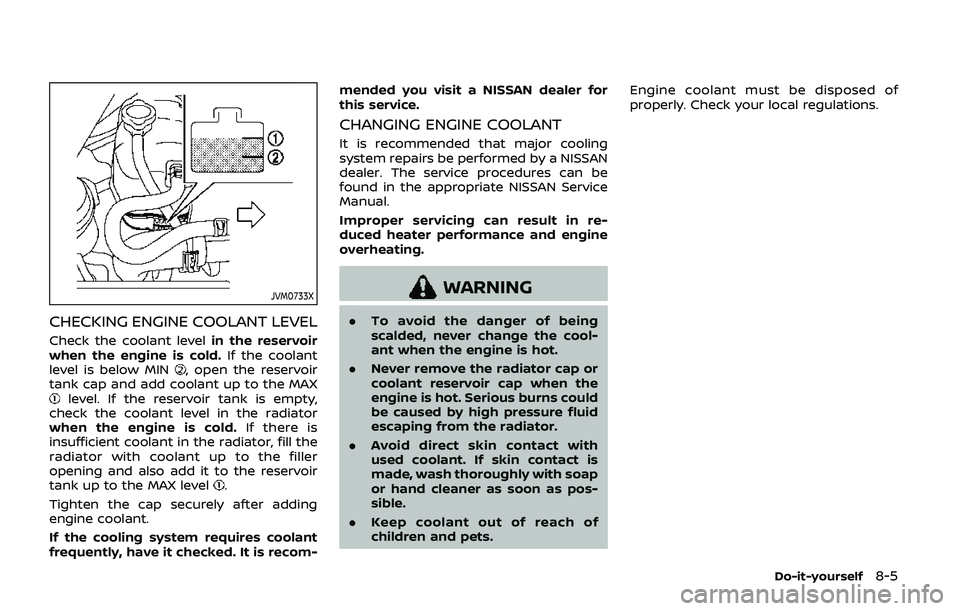
CHECKING ENGINE COOLANT LEVEL
Check the coolant levelin the reservoir
when the engine is cold. If the coolant
level is below MIN
, open the reservoir
tank cap and add coolant up to the MAX
level. If the reservoir tank is empty,
check the coolant level in the radiator
when the engine is cold. If there is
insufficient coolant in the radiator, fill the
radiator with coolant up to the filler
opening and also add it to the reservoir
tank up to the MAX level
.
Tighten the cap securely after adding
engine coolant.
If the cooling system requires coolant
frequently, have it checked. It is recom- mended you visit a NISSAN dealer for
this service.
CHANGING ENGINE COOLANT
It is recommended that major cooling
system repairs be performed by a NISSAN
dealer. The service procedures can be
found in the appropriate NISSAN Service
Manual.
Improper servicing can result in re-
duced heater performance and engine
overheating.
WARNING
.
To avoid the danger of being
scalded, never change the cool-
ant when the engine is hot.
. Never remove the radiator cap or
coolant reservoir cap when the
engine is hot. Serious burns could
be caused by high pressure fluid
escaping from the radiator.
. Avoid direct skin contact with
used coolant. If skin contact is
made, wash thoroughly with soap
or hand cleaner as soon as pos-
sible.
. Keep coolant out of reach of
children and pets. Engine coolant must be disposed of
properly. Check your local regulations.
Do-it-yourself8-5
Page 478 of 536
9-4Maintenance and schedules
Steering wheel:Check for changes in the
steering conditions, such as excessive
free play, hard steering or strange noises.
Warning lights and chimes: Make sure
that all warning lights and chimes are
operating properly.
Windshield defroster: Check that the air
comes out of the defroster outlets prop-
erly and in sufficient quantity when oper-
ating the heater or air conditioner.
Windshield wiper and washer*: Check
that the wipers and washer operate
properly and that the wipers do not
streak.
Under the hood and vehicle
The maintenance items listed here should
be checked periodically (for example,
each time you check the engine oil or
refuel).
Battery*: Check the fluid level in each cell.
It should be between the MAX and MIN
lines. Vehicles operated in high tempera-
tures or under severe condition require
frequent checks of the battery fluid level.
NOTE:
Care should be taken to avoid situations
that can lead to potential battery dis-
charge and potential no-start condi-
tions such as: 1.
Installation or extended use of elec-
tronic accessories that consume
battery power when the engine is
not running (Phone chargers, GPS,
DVD players, etc.)
2. Vehicle is not driven regularly and/
or only driven short distances.
In these cases, the battery may need to
be charged to maintain battery health.
Brake fluid level*: Make sure that the
brake fluid level is between the MAX and
MIN lines on the reservoir.
Engine coolant level*: Check the coolant
level when the engine is cold.
Engine drive belts*: Make sure that no
belt is frayed, worn, cracked or oily.
Engine oil level*: Check the level after
parking the vehicle on a level spot and
turning off the engine. Wait more than 15
minutes for the oil to drain back into the
oil pan.
Exhaust system: Make sure there are no
loose supports, cracks or holes. If the
sound of the exhaust seems unusual or
there is a smell of exhaust fumes, im-
mediately have the exhaust system in-
spected. It is recommended you visit a
NISSAN dealer for this service. (See “Pre-
cautions when starting and driving” (P.5-
4) for exhaust gas (carbon monoxide).) Fluid leaks:
Check under the vehicle for
fuel, oil, water or other fluid leaks after the
vehicle has been parked for a while. Water
dripping from the air conditioner after use
is normal. If you should notice any leaks
or if gasoline fumes are evident, check for
the cause and have it corrected immedi-
ately.
Power steering fluid level* and lines:
Check the level when the fluid is cold, with
the engine off. Check the lines for proper
attachment, leaks, cracks, etc.
Radiator and hoses: Check the front of
the radiator and clean off any dirt, insects,
leaves, etc., that may have accumulated.
Make sure the hoses have no cracks,
deformation, rot or loose connections.
Underbody: The underbody is frequently
exposed to corrosive substances such as
those used on icy roads or to control
dust. It is very important to remove these
substances, otherwise rust will form on
the floor pan, frame, fuel lines and around
the exhaust system. At the end of winter,
the underbody should be thoroughly
flushed with plain water, being careful to
clean those areas where mud and dirt
may accumulate. For additional informa-
tion, see “Cleaning exterior” (P.7-2).
Windshield washer fluid*: Check that
there is adequate fluid in the reservoir.
Page 528 of 536
11-2
Cold weather driving ............................................. 5-140
Console box ..................................................................... 2-57
Console light ................................................................... 2-70
CoolantCapacities and
recommended fluids/lubricants............... 10-2
Changing engine coolant ................................. 8-5
Checking engine coolant level...................... 8-5
Corrosion protection .................................................... 7-7
Cruise control Fixed speed cruise control (on
ICC system)................................................................ 5-85
Intelligent Cruise Control (ICC) ................. 5-67
Cup holders...................................................................... 2-54
D
Daytime running light system........................... 2-40
Dimensions ....................................................................... 10-9
Drive belts...................................................................\
....... 8-13
Drive positioner............................................................. 3-40
Driving Cold weather driving ..................................... 5-140
Driving with
automatic transmission .................................. 5-18
On-pavement and off-road driving .......... 5-9
Precautions when starting
and driving.................................................................... 5-4
Safety precautions .............................................. 5-10
E
Economy, Fuel............................................................. 5-121
Elapsed time.................................................................... 2-28
Emission control information label............ 10-11
Emission control system maintenance ......... 9-8
Emission control system warranty ............ 10-31 Engine
Before starting the engine............................ 5-16
Break-in schedule ............................................ 5-120
Capacities and
recommended fluids/lubricants............... 10-2
Changing engine coolant ................................. 8-5
Changing engine oil and filter ...................... 8-6
Checking engine coolant level...................... 8-5
Checking engine oil level................................... 8-6
Coolant temperature gauge .......................... 2-7
Emergency engine shut off.......................... 5-15
Engine block heater ....................................... 5-141
Engine compartment
check locations ......................................................... 8-3
Engine cooling system ........................................ 8-4
Engine oil.....................................................................\
... 8-6
Engine oil and oil
filter recommendation ..................................... 10-5
Engine oil replacement indicator ............ 2-26
Engine oil viscosity .............................................. 10-6
Engine serial number .................................... 10-11
Engine specifications......................................... 10-7
Engine start operation indicator.............. 2-23
If your vehicle overheats ................................ 6-14
Oil pressure gauge ................................................. 2-8
Protection mode ................................................... 5-17
Remote engine start
operation indicator ............................................. 2-23
Starting the engine............................................. 5-16
Entry/exit function, Automatic
drive positioner ............................................................. 3-40
Event Data Recorders (EDR)............................. 10-33
Exhaust gas (carbon monoxide) ......................... 5-4
Explanation of scheduled
maintenance items ........................................................ 9-5
Extended storage fuse warning ...................... 2-24
Extended storage switch ...................................... 8-21
F
F.M.V.S.S./C.M.V.S.S. certification label ...... 10-11
Filter Air cleaner housing filter ................................ 8-15
Changing engine oil and filter ...................... 8-6
Flashers (See hazard warning
flasher switch).................................................................... 6-2
Flat tire........................................................................\
............. 6-3
Flat towing..................................................................... 10-29
Flexible seating.............................................................. 1-12
Floor mat cleaning ......................................................... 7-5
Fluid Automatic Transmission Fluid (ATF) ........ 8-8
Brake fluid ..................................................................... 8-9
Capacities and
recommended fluids/lubricants............... 10-2
Engine coolant........................................................... 8-4
Engine oil.....................................................................\
... 8-6
Power steering fluid .............................................. 8-8
Window washer fluid ......................................... 8-10
Fog light switch ............................................................ 2-42
Four-Wheel Drive (4WD) NISSAN all-mode 4WD®................................ 5-121
Front passenger air bag and
status light........................................................................\
1-63
Front power seat adjustment ............................... 1-4
Front seat Front seat adjustment ......................... 1-4, 1-11
Front-seat active head restraint..................... 1-19
Fuel Capacities and
recommended fluids/lubricants............... 10-2
Fuel economy...................................................... 5-121
Fuel information.................................................... 10-3
Fuel octane rating ............................................... 10-3
Page 529 of 536
Fuel-filler cap............................................................ 3-26
Fuel-filler door......................................................... 3-26
Gauge........................................................................\
........ 2-8
LOOSE FUEL CAP warning............................. 3-29
Fuel efficient driving tips .................................... 5-120
Fuses........................................................................\
.............. 8-18
Fusible links...................................................................... 8-19
G
Garage door opener HomeLink®
Universal Transceiver ......................... 2-71, 2-75
Gas cap........................................................................\
........ 3-26
Gauge........................................................................\
................ 2-5 Engine coolant temperature gauge......... 2-7
Engine oil pressure gauge ............................... 2-8
Fuel gauge .................................................................... 2-8
Odometer....................................................................... 2-6
Speedometer .............................................................. 2-6
Tachometer.................................................................. 2-7
Trip computer ......................................................... 2-28
General maintenance................................................... 9-2
Glove box ........................................................................\
... 2-57
H
Hazard warning flasher switch ............................ 6-2
Head restraints/headrests................................... 1-14
Headlights Aiming control ........................................................ 2-40
Bulb replacement ................................................. 8-24
Headlight switch ................................................... 2-37
Heated seats ................................................................... 2-43
Heated steering wheel ............................................ 2-42
Heater Automatic air conditioner ............................. 4-35 Engine block heater ....................................... 5-141
Heater and air
conditioner operation....................................... 4-34
Hill start assist system ......................................... 5-129
HomeLink® Universal Transceiver ..... 2-71, 2-75
Hood release ................................................................... 3-21
Hook Coat hooks ................................................................ 2-60
Luggage hook ......................................................... 2-60
Horn........................................................................\
................ 2-43
I
Ignition switch (Push-button)............................ 5-13
Immobilizer system.................................................... 2-32
In-cabin microfilter ..................................................... 4-42
Indicator Lights..................................................................\
............ 2-17
Vehicle information display.......................... 2-20
Inside mirror .................................................................... 3-31
Inspection/Maintenance (I/M) test............. 10-32
Instrument brightness control ......................... 2-41
Instrument panel ............................................................. 2-4
Intelligent Around View Monitor ..................... 4-10
Intelligent Auto Headlight system ................. 2-38
Intelligent Back-up Intervention (I-BI) ......... 5-57
Intelligent Blind Spot
Intervention (I-BSI) ...................................................... 5-43
Intelligent Blind Spot Intervention (I-BSI)
ON indicator light ........................................................ 2-18
Intelligent Cruise Control (ICC) ........................ 5-67
Intelligent Cruise Control (ICC) system main switch indicator ....................................... 2-25
Intelligent Cruise Control (ICC) system
warning light ................................................................... 2-14
Intelligent Distance Control (I-DC) ................. 5-89 Intelligent Distance Control (I-DC) system
warning light ................................................................... 2-13
Intelligent Forward Collision
Warning (I-FCW).......................................................... 5-111
Intelligent Key..................................................................... 3-2
Intelligent Key system ................................................. 3-7
Battery replacement.......................................... 8-21
Key operating range ............................................. 3-9
Key operation .......................................................... 3-10
Warning light............................................................ 2-14
Warning signals...................................................... 3-12
Intelligent Key warning light .............................. 2-14
Intelligent Lane Intervention (I-LI) .................. 5-23
Intelligent Lane Intervention (I-LI) ON
indicator light (green) .............................................. 2-18
Intelligent Rear View Mirror................................. 3-32
Interior light replacement..................................... 8-26
Interior light switch.................................................... 2-69
Interior lights................................................................... 2-69
ISOFIX child restraint ................................................ 1-35
J
Jump starting ................................................................. 6-12
K
Keyless entry (See remote keyless
entry system) .................................................................. 3-15
Keys ........................................................................\
.................... 3-2 For Intelligent Key system................................ 3-7
L
LabelsAir bag warning labels ..................................... 1-71
Air conditioner specification label....... 10-12
11-3