flat tire NISSAN ARMADA 2020 Owner´s Manual
[x] Cancel search | Manufacturer: NISSAN, Model Year: 2020, Model line: ARMADA, Model: NISSAN ARMADA 2020Pages: 528, PDF Size: 2.1 MB
Page 459 of 528

SDI1949
Checking the tire pressure
1. Remove the valve stem cap fromthe tire.
2. Press the pressure gauge squarely onto the valve stem.
Do not press too hard or force
the valve stem sideways, or air
will escape. If the hissing sound
of air escaping from the tire is
heard while checking the pres-
sure, reposition the gauge to
eliminate this leakage. 3. Remove the gauge.
4. Read the tire pressure on the
gauge stem and compare it to
the specification shown on the
Tire and Loading Information
label.
5. Add air to the tire as needed. If too much air is added, press the
core of the valve stem briefly
with the tip of the gauge stem to
release pressure. Recheck the
pressure and add or release air
as needed.
6. Install the valve stem cap.
7. Check the pressure of all other tires, including the spare.
SIZE COLD
TIRE IN-
FLATION
PRES-SURE
FRONT
ORIGI-
NAL
TIRE 265/70R18
116H
240 kPa,
35 PSI
P275/60R20
114H 240 kPa,
35 PSI
P275/50R22
111H 240 kPa,
35 PSI
REAR
ORIGI- NAL
TIRE 265/70R18
116H
240 kPa,
35 PSI
P275/60R20
114H 240 kPa,
35 PSI
P275/50R22
111H 240 kPa,
35 PSI
SPARE TIRE 265/70R18
116H
240 kPa,
35 PSI
265/70R18
116M 350 kPa,
51 PSI
275/60R20
115M 240 kPa,
35 PSI
Do-it-yourself8-33
Page 461 of 528

JVM0694X
Example
TIN (Tire Identification
Number) for a new tire
(example: DOT XX XX XXX
XXXX)
1. DOT: Abbreviation for the “De-partment of Transportation”.
The symbol can be placed
above, below or to the left or
right of the Tire Identification
Number.
2. Two-digit code: Manufacturer’s identification mark 3. Two-digit code: Tire size
4. Three-digit code: Tire type code
(Optional)
5. Four numbers represent the week and year the tire was built.
For example, the numbers 3103
means the 31st week of 2003. If
these numbers are missing, then
look on the other sidewall of the
tire.
Tire ply composition and
material
The number of layers or
plies of rubber-coated fab-
ric in the tire.
Tire manufacturers also
must indicate the materials
in the tire, which include
steel, nylon, polyester, and
others.
Maximum permissible infla-
tion pressure
This number is the greatest
amount of air pressure
that should be put in the
tire. Do not exceed the maximum permissible in-
flation pressure.
Maximum load rating
This number indicates the
maximum load in kilo-
grams and pounds that
can be carried by the tire.
When replacing the tires on
the vehicle, always use a
tire that has the same load
rating as the factory in-
stalled tire.
Term of “tubeless” or “tube
type”
Indicates whether the tire
requires an inner tube
(“tube type”) or not (“tube-
less”).
The word “radial”
The word “radial” is shown,
if the tire has radial struc-
ture.
Manufacturer or brand
name
Manufacturer or brand
name is shown.
Do-it-yourself8-35
Page 463 of 528

tires. Skid and traction capabilities of
studded snow tires, on wet or dry sur-
faces, may be poorer than that of non-
studded snow tires.
TIRE CHAINS
Use of tire chains may be prohibited
according to location. Check the local
laws before installing tire chains. When
installing tire chains, make sure they are
the proper size for the tires on your
vehicle and are installed according to
the chain manufacturer’s suggestions.
Use only SAE Class S chains.Class “S”
chains are used on vehicles with re-
stricted tire to vehicle clearance. Vehicles
that can use Class “S” chains are designed
to meet the SAE standard minimum
clearances between the tire and the
closest vehicle suspension or body com-
ponent required to accommodate the
use of a winter traction device (tire chains
or cables). The minimum clearances are
determined using the factory equipped
tire size. Other types may damage your
vehicle. Use chain tensioners when re-
commended by the tire chain manufac-
turer to ensure a tight fit. Loose end links
of the tire chain must be secured or
removed to prevent the possibility of
whipping action damage to the fenders
or underbody. If possible, avoid fully load-
ing your vehicle when using tire chains. In addition, drive at a reduced speed. Other-
wise, your vehicle may be damaged and/
or vehicle handling and performance may
be adversely affected.
Tire chains must be installed only on
the rear wheels and not on the front
wheels.
Never install tire chains on the full-size
temporary use only spare tire (if so
equipped).
Do not use tire chains on dry roads.
Driving with tire chains in such conditions
can cause damage to the various me-
chanisms of the vehicle due to some
overstress.
SDI1662
CHANGING WHEELS AND TIRES
Tire rotation
NISSAN recommends rotating the
tires every 7,500 miles (12,000 km).
(See “Flat tire” (P.6-3) for tire repla-
cing procedures.)
As soon as possible, tighten the
wheel nuts to the specified torque
with a torque wrench.
Wheel nut tightening torque:98 ft-lb (133 N·m)
The wheel nuts must be kept
tightened to the specification at
Do-it-yourself8-37
Page 464 of 528
8-38Do-it-yourself
all times. It is recommended that
wheel nuts be tightened to the
specification at each tire rotation
interval.
WARNING
.After rotating the tires,
check and adjust the tire
pressure.
. Retighten the wheel nuts
when the vehicle has been
driven for 600 miles (1,000
km) (also in cases of a flat
tire, etc.).
. Do not include the full-size
temporary use only spare
tire (if so equipped) in the
tire rotation.
. For additional information
regarding tires, refer to “Im-
portant Tire Safety Informa-
tion” (US) or “Tire Safety
Information” (Canada) in the
Warranty Information Book-
let.
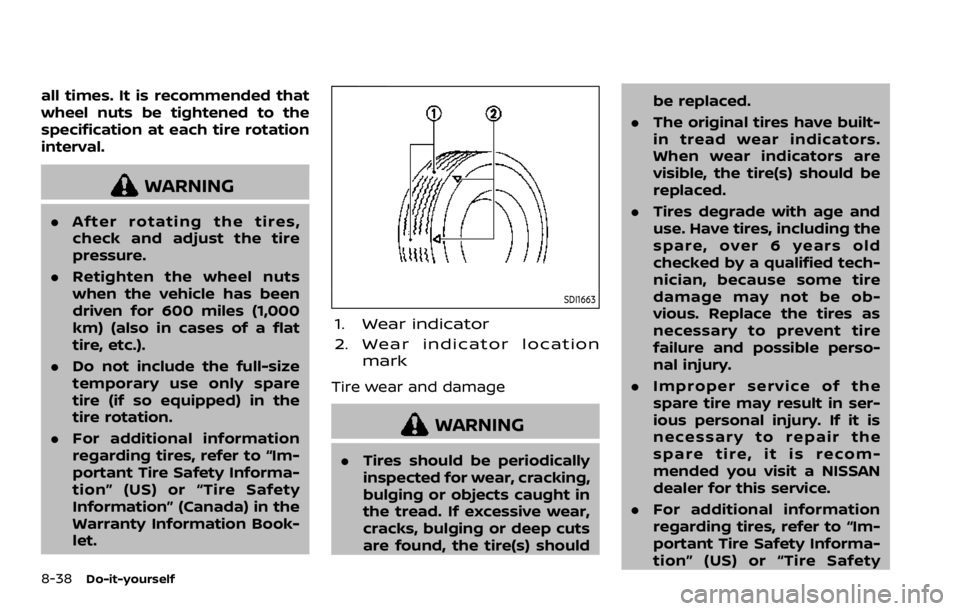
SDI1663
1. Wear indicator
2. Wear indicator location
mark
Tire wear and damage
WARNING
.Tires should be periodically
inspected for wear, cracking,
bulging or objects caught in
the tread. If excessive wear,
cracks, bulging or deep cuts
are found, the tire(s) should be replaced.
. The original tires have built-
in tread wear indicators.
When wear indicators are
visible, the tire(s) should be
replaced.
. Tires degrade with age and
use. Have tires, including the
spare, over 6 years old
checked by a qualified tech-
nician, because some tire
damage may not be ob-
vious. Replace the tires as
necessary to prevent tire
failure and possible perso-
nal injury.
. Improper service of the
spare tire may result in ser-
ious personal injury. If it is
necessary to repair the
spare tire, it is recom-
mended you visit a NISSAN
dealer for this service.
. For additional information
regarding tires, refer to “Im-
portant Tire Safety Informa-
tion” (US) or “Tire Safety
Page 467 of 528
.When the spare tire is installed,
the following systems may not
work correctly.
— Tire Pressure Monitoring Sys-
tem (TPMS)
— Vehicle Dynamic Control (VDC) System
. Periodically check spare tire in-
flation pressure. Always keep the
spare tire inflated to the pressure
specification shown on the Tire
and Loading Information label.
For Tire and Loading Information
label location, see “Tire and Load-
ing Information label” in the index
of this manual.
. With the spare tire installed do
not drive your vehicle at speeds
faster than 70 MPH (112 km/h).
. When driving on roads covered
with snow or ice, the spare tire
should be used on the front
wheels and original tire used on
the rear wheels (drive wheels).
Use tire chains only on the two
rear original tires.
. Do not use the spare tire on other
vehicles.
. Do not use more than one spare
tire at the same time.CAUTION
Do not use tire chains on the spare
tire. Tire chains will not fit properly
and may cause damage to the vehi-
cle.
Do-it-yourself8-41
Page 483 of 528

10 Technical and consumer information
Capacities and
recommended fluids/lubricants .................................... 10-2Fuel information .................................................................. 10-3
Engine oil and oil filter recommendation ........ 10-5
Air conditioning system refrigerant and
lubricant recommendations ...................................... 10-6
Specifications ........................................................................\
........ 10-7 Engine ........................................................................\
.................. 10-7
Wheels and tires .................................................................. 10-8
Dimensions ........................................................................\
...... 10-9
When traveling or registering in
another country ..................................................................... 10-10
Vehicle identification .......................................................... 10-10 Vehicle Identification Number
(VIN) plate ........................................................................\
...... 10-10
Vehicle identification number
(chassis number) ............................................................. 10-10
Engine serial number ................................................... 10-11
F.M.V.S.S./C.M.V.S.S. certification label ............. 10-11
Emission control information label .................. 10-11
Tire and loading information label ................... 10-12
Air conditioner specification label ..................... 10-12
Installing front license plate ......................................... 10-12 Vehicle loading information ......................................... 10-13
Terms ........................................................................\
............. 10-13
Vehicle load capacity ................................................ 10-14
Securing the load ......................................................... 10-15
Loading tips ...................................................................... 10-16
Measurement of weights ....................................... 10-16
Towing a trailer ...................................................................... 10-17 Maximum load limits ................................................. 10-17
Maximum Gross Vehicle Weight (GVW)/
maximum Gross Axle Weight (GAW) .............. 10-19
Towing load/specification ..................................... 10-21
Towing safety ................................................................ 10-22
Flat towing ........................................................................\
. 10-29
Uniform tire quality grading ........................................ 10-30 Treadwear ........................................................................\
.. 10-30
Traction AA, A, B and C ........................................... 10-30
Temperature A, B and C ......................................... 10-30
Emission control system warranty ......................... 10-31
Reporting safety defects ................................................ 10-31
Readiness for Inspection/Maintenance
(I/M) test ........................................................................\
............... 10-32
Event Data Recorders (EDR) ......................................... 10-33
Owner’s Manual/Service Manual
order information ................................................................. 10-34
Page 497 of 528

from XXX kg or XXX lbs.
4. The resulting figure equals the available amount of cargo and
luggage load capacity. For ex-
ample, if the XXX amount equals
1400 lbs. and there will be five
150 lb. passengers in your vehi-
cle, the amount of available
cargo and luggage load capacity
is 650 lbs. (1400 − 750 (5 x 150) =
650 lbs) or (640 − 340 (5 x 70) =
300 kg.)
5. Determine the combined weight of luggage and cargo being
loaded on the vehicle. That
weight may not safely exceed
the available cargo and luggage
load capacity calculated in Step
4.
6. If your vehicle will be towing a trailer, load from your trailer will
be transferred to your vehicle.
Consult this manual to deter-
mine how this reduces the avail-
able cargo and luggage load
capacity of your vehicle.
Before driving a loaded vehicle, confirm that you do not exceed
the Gross Vehicle Weight Rating
(GVWR) or the Gross Axle Weight
Rating (GAWR) for your vehicle. (See
“Measurement of weights” (P.10-16).)
Also check tires for proper inflation
pressures. See the Tire and Loading
Information label.
SIC4446
SECURING THE LOAD
There are tie down hooks located in the
cargo area as shown. The tie down hooks
can be used to secure cargo with ropes or
other types of straps.
Do not apply a total load of more than
22 lb (10 kg) to a single hook
or 7 lb (3
kg) to a single hookwhen securing
cargo.
WARNING
. Properly secure all cargo with
ropes or straps to help prevent it
from sliding or shifting. Do not
Technical and consumer information10-15
Page 507 of 528
CAUTION
.Do not use axle-mounted hitches.
. Do not modify the vehicle ex-
haust system, brake system, etc.
. Do not attach any additional
hitches to your vehicle because
a hitch is already mounted to
your vehicle frame.
Tire pressures
.When towing a trailer, inflate the
vehicle tires to the recom-
mended cold tire pressure indi-
cated on the Tire and Loading
Information label.
. Trailer tire condition, size, load
rating and proper inflation pres-
sure should be in accordance
with the trailer and tire manu-
facturers’ specifications. Safety chains
Always use a suitable chain between your
vehicle and the trailer. The safety chains
should be crossed and should be at-
tached to the hitch, not to the vehicle
bumper or axle. Be sure to leave enough
slack in the chains to permit turning
corners.
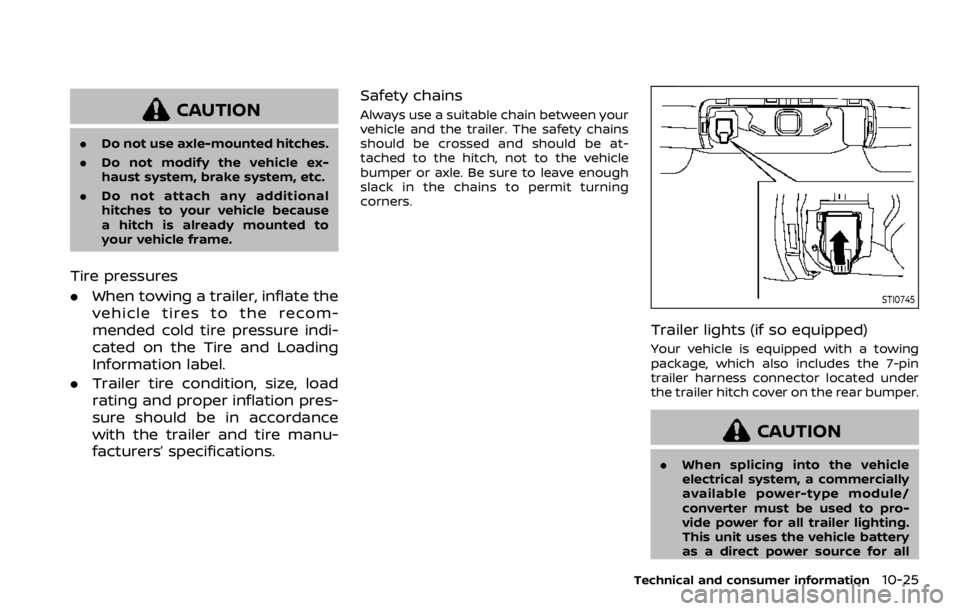
STI0745
Trailer lights (if so equipped)
Your vehicle is equipped with a towing
package, which also includes the 7-pin
trailer harness connector located under
the trailer hitch cover on the rear bumper.
CAUTION
.
When splicing into the vehicle
electrical system, a commercially
available power-type module/
converter must be used to pro-
vide power for all trailer lighting.
This unit uses the vehicle battery
as a direct power source for all
Technical and consumer information10-25
Page 512 of 528
10-30Technical and consumer information
DOT (Department Of Transportation)
Quality Grades: All passenger car tires
must conform to federal safety require-
ments in addition to these grades.
Quality grades can be found where ap-
plicable on the tire sidewall between
tread shoulder and maximum section
width. For example:
Treadwear 200 Traction AA Tempera-
ture A
TREADWEAR
The treadwear grade is a comparative
rating based on the wear rate of the tire
when tested under controlled conditions
on a specified government test course.
For example, a tire graded 150 would
wear one and one-half (1 1/2) times as
well on the government course as a tire
graded 100. The relative performance of
tires depends upon actual conditions of
their use, however, and may depart sig-
nificantly from the norm due to variations
in driving habits, service practices and
differences in road characteristics and
climate.
TRACTION AA, A, B AND C
The traction grades, from highest to low-
est, are AA, A, B and C. Those grades
represent the tire’s ability to stop on wet
pavement as measured under controlled
conditions on specified government test
surfaces of asphalt and concrete. A tire
marked C may have poor traction perfor-
mance.
WARNING
The traction grade assigned to this
tire is based on straight-ahead brak-
ing traction tests, and does not
include acceleration, cornering, hy-
droplaning, or peak traction charac-
teristics.
TEMPERATURE A, B AND C
The temperature grades A (the highest),
B, and C, representing the tire’s resistance
to the generation of heat and its ability to
dissipate heat when tested under con-
trolled conditions on a specified indoor
laboratory test wheel. Sustained high
temperature can cause the material of
the tire to degenerate and reduce tire life,
and excessive temperature can lead to
sudden tire failure. The grade C corre-
sponds to a level of performance whichall passenger car tires must meet under
the Federal Motor Vehicle Safety Stan-
dard No. 109. Grades B and A represent
higher levels of performance on the
laboratory test wheel than the minimum
required by law.
WARNING
The temperature grade for this tire is
established for a tire that is properly
inflated and not overloaded. Exces-
sive speed, under-inflation, or exces-
sive loading, either separately or in
combination, can cause heat build-
up and possible tire failure.
UNIFORM TIRE QUALITY GRADING
Page 520 of 528

11-2
CoolantCapacities and recommended fluids/
lubricants .................................................................... 10-2
Changing engine coolant ................................. 8-5
Checking engine coolant level...................... 8-5
Corrosion protection .................................................... 7-7
Cruise control Fixed speed cruise control
(on ICC system) ...................................................... 5-81
Intelligent Cruise Control (ICC) ................. 5-63
Cup holders...................................................................... 2-53
D
Daytime running light system........................... 2-39
Dimensions ....................................................................... 10-9
Drive belts...................................................................\
....... 8-13
Drive positioner............................................................. 3-40
Driving Cold weather driving ..................................... 5-135
Driving with
automatic transmission .................................. 5-18
On-pavement and off-road driving .......... 5-9
Precautions when starting and
driving........................................................................\
....... 5-4
Safety precautions .............................................. 5-10
E
Economy, Fuel............................................................. 5-116
Elapsed time.................................................................... 2-28
Emission control information label............ 10-11
Emission control system warranty ............ 10-31
EngineBefore starting the engine............................ 5-16
Break-in schedule ............................................ 5-115 Capacities and
recommended fluids/lubricants............... 10-2
Changing engine coolant ................................. 8-5
Changing engine oil and filter ...................... 8-6
Checking engine coolant level...................... 8-5
Checking engine oil level................................... 8-6
Coolant temperature gauge .......................... 2-7
Emergency engine shut off.......................... 5-15
Engine block heater ....................................... 5-136
Engine compartment
check locations ......................................................... 8-3
Engine cooling system ........................................ 8-4
Engine oil.....................................................................\
... 8-6
Engine oil and oil
filter recommendation ..................................... 10-5
Engine oil replacement indicator ............ 2-26
Engine oil viscosity .............................................. 10-6
Engine serial number .................................... 10-11
Engine specifications......................................... 10-7
Engine start operation indicator.............. 2-23
If your vehicle overheats ................................ 6-14
Oil pressure gauge ................................................. 2-8
Protection mode ................................................... 5-17
Remote engine start operation
indicator....................................................................... 2-23
Starting the engine............................................. 5-16
Entry/exit function, Automatic
drive positioner ............................................................. 3-40
Event Data Recorders (EDR)............................. 10-33
Exhaust gas (carbon monoxide) ......................... 5-4
Explanation of scheduled maintenance
items ........................................................................\
.................. 9-5
Extended storage fuse warning ...................... 2-24
Extended storage switch ...................................... 8-21
F
F.M.V.S.S./C.M.V.S.S. certification label ...... 10-11
Filter Air cleaner housing filter ................................ 8-15
Changing engine oil and filter ...................... 8-6
Flashers (See hazard warning
flasher switch).................................................................... 6-2
Flat tire........................................................................\
............. 6-3
Flat towing..................................................................... 10-29
Flexible seating.............................................................. 1-12
Floor mat cleaning ......................................................... 7-5
Fluid Automatic Transmission Fluid (ATF) ........ 8-8
Brake fluid ..................................................................... 8-9
Capacities and recommended fluids/
lubricants .................................................................... 10-2
Engine coolant........................................................... 8-4
Engine oil.....................................................................\
... 8-6
Power steering fluid .............................................. 8-8
Window washer fluid ......................................... 8-10
Fog light switch ............................................................ 2-41
Four-Wheel Drive (4WD) NISSAN all-mode 4WD®................................ 5-116
Front passenger air bag and status
light........................................................................\
................. 1-62
Front power seat adjustment ............................... 1-4
Front seat Front seat adjustment ......................... 1-4, 1-11
Front-seat active head restraint..................... 1-19
Fuel Capacities and recommended fluids/
lubricants .................................................................... 10-2
Fuel economy...................................................... 5-116
Fuel information.................................................... 10-3
Fuel octane rating ............................................... 10-3
Fuel-filler cap............................................................ 3-26