service NISSAN ARMADA 2021 Owner´s Manual
[x] Cancel search | Manufacturer: NISSAN, Model Year: 2021, Model line: ARMADA, Model: NISSAN ARMADA 2021Pages: 603, PDF Size: 3.16 MB
Page 512 of 603
10-4Technical and consumer information
FUEL INFORMATION
VK56VD engine
NISSAN recommends the use of unleaded
premium gasoline with an octane rating
of at least 91 AKI (Anti-Knock Index)
number (Research octane number 96).
If unleaded premium gasoline is not
available, you may use unleaded regular
gasoline with an octane rating of at least
87 AKI number (Research octane number
91), but you may notice a decrease in
performance.
CAUTION
.Using a fuel other than that spe-
cified could adversely affect the
emission control system, and
may also affect warranty cover-
age.
. Under no circumstances should a
leaded gasoline be used, because
this will damage the three-way
catalyst.
. Do not use E-15 or E-85 fuel in
your vehicle. Your vehicle is not
designed to run on E-15 or E-85
fuel. Using E-15 or E-85 fuel in a
vehicle not specifically designed
for E-15 or E-85 fuel can adversely affect the emission control de-
vices and systems of the vehicle.
Damage caused by such fuel is
not covered by the NISSAN new
vehicle limited warranty.
. Do not use fuel that contains the
octane booster methylcyclopen-
tadienyl manganese tricarbonyl
(MMT). Using fuel containing
MMT may adversely affect vehicle
performance and vehicle emis-
sions. Not all fuel dispensers are
labeled to indicate MMT content,
so you may have to consult your
gasoline retailer for more details.
Note that Federal and California
laws prohibit the use of MMT in
reformulated gasoline.
. U.S. government regulations re-
quire ethanol dispensing pumps
to be identified by a small,
square, orange and black label
with the common abbreviation or
the appropriate percentage for
that region.
Gasoline specifications
NISSAN recommends using gasoline that
meets the World-Wide Fuel Charter
(WWFC) specifications where it is avail-
able. Many of the automobile manufac-
turers developed this specification to
improve emission system and vehicle
performance. Ask your service station
manager if the gasoline meets the
World-Wide Fuel Charter (WWFC) specifi-
cations.
Reformulated gasoline
Some fuel suppliers are now producing
reformulated gasolines. These gasolines
are specially designed to reduce vehicle
emissions. NISSAN supports efforts to-
wards cleaner air and suggests that you
use reformulated gasoline when avail-
able.
Gasoline containing oxygenates
Some fuel suppliers sell gasoline contain-
ing oxygenates such as ethanol, MTBE
and methanol with or without advertising
their presence. NISSAN does not recom-
mend the use of fuels of which the
oxygenate content and the fuel compat-
ibility for your NISSAN cannot be readily
determined. If in doubt, ask your service
station manager.
If you use oxygenate-blend gasoline,
Page 514 of 603
10-6Technical and consumer information
Octane rating tips
Using unleaded gasoline with an octane
rating lower than recommended above
can cause persistent, heavy spark
knock. (Spark knock is a metallic rap-
ping noise.) If severe, this can lead to
engine damage. If you detect a persis-
tent heavy spark knock even when
using gasoline of the stated octane
rating, or if you hear steady spark knock
while holding a steady speed on level
roads, it is recommended you have a
NISSAN dealer correct the condition.
Failure to correct the condition is mis-
use of the vehicle, for which NISSAN is
not responsible.
Incorrect ignition timing will result in
knocking, after-run or overheating. This
in turn may cause excessive fuel con-
sumption or damage to the engine. If any
of the above symptoms are encountered,
have your vehicle checked. It is recom-
mended you visit a NISSAN dealer for
servicing.
However, now and then you may notice
light spark knock for a short time while
accelerating or driving up hills. This is
no cause for concern, because you get
the greatest fuel benefit when there is
light spark knock for a short time under
heavy engine load.
JVT0342X
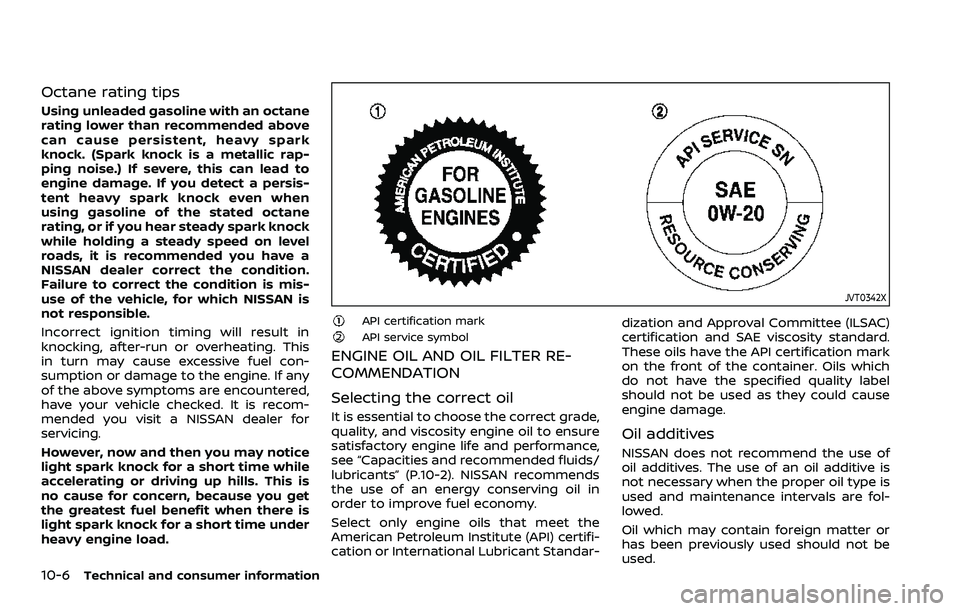
API certification markAPI service symbol
ENGINE OIL AND OIL FILTER RE-
COMMENDATION
Selecting the correct oil
It is essential to choose the correct grade,
quality, and viscosity engine oil to ensure
satisfactory engine life and performance,
see “Capacities and recommended fluids/
lubricants” (P.10-2). NISSAN recommends
the use of an energy conserving oil in
order to improve fuel economy.
Select only engine oils that meet the
American Petroleum Institute (API) certifi-
cation or International Lubricant Standar-dization and Approval Committee (ILSAC)
certification and SAE viscosity standard.
These oils have the API certification mark
on the front of the container. Oils which
do not have the specified quality label
should not be used as they could cause
engine damage.
Oil additives
NISSAN does not recommend the use of
oil additives. The use of an oil additive is
not necessary when the proper oil type is
used and maintenance intervals are fol-
lowed.
Oil which may contain foreign matter or
has been previously used should not be
used.
Page 515 of 603
Oil viscosity
The engine oil viscosity or thickness
changes with temperature. Because of
this, it is important that the engine oil
viscosity be selected based on the tem-
peratures at which the vehicle will be
operated before the next oil change.
Choosing an oil viscosity other than that
recommended could cause serious en-
gine damage.
Selecting the correct oil filter
Your new vehicle is equipped with a high-
quality genuine NISSAN oil filter. When
replacing, use the genuine oil filter or its
equivalent for the reason described in
change intervals.
Change intervals
The oil and oil filter change intervals for
your engine are based on the use of the
specified quality oils and filters. Oil and
filter other than the specified quality, or
oil and filter change intervals longer than
recommended could reduce engine life.
Damage to engines caused by improper
maintenance or use of incorrect oil and
filter quality and/or viscosity is not cov-
ered by the new NISSAN vehicle limited
warranties.
Your engine was filled with a high quality
engine oil when it was built. You do nothave to change the oil before the first
recommended change interval. Oil and
filter change intervals depend upon how
you use your vehicle.
AIR CONDITIONING SYSTEM RE-
FRIGERANT AND OIL RECOMMEN-
DATIONS
The air conditioner system in your
NISSAN vehicle must be charged with
the refrigerant HFO-1234yf (R-1234yf)
and NISSAN A/C System Oil VC100YF
(PAG) or the exact equivalents.
CAUTION
The use of any other refrigerant or oil
will cause severe damage to the air
conditioning system and will require
the replacement of all air conditioner
system components.
The refrigerant HFO-1234yf (R-1234yf) in
your NISSAN vehicle does not harm the
earth’s ozone layer. Although this refrig-
erant does not affect the earth’s atmo-
sphere, certain government regulations
require the recovery and recycling of any
refrigerant during automotive air condi-
tioner system service. Air conditioner
system should only be serviced by trained
and certified technicians to ensure proper and safe operation (SAE J2845). A NISSAN
dealer has the trained technicians and
equipment needed to recover and recycle
your air conditioner system refrigerant.
Only new and SAEJ2842 certified eva-
porator(s) shall be used as replacement
parts.
A damaged or leaking air conditioning
evaporator shall never be repaired or
replaced with one removed from a used
or salvaged vehicle. To replace a da-
maged or leaking evaporator, use only
new and SAE J2842 certified evaporator
(s). It is recommended that you visit a
NISSAN dealer when servicing your air
conditioner system.
Technical and consumer information10-7
Page 522 of 603
10-14Technical and consumer information
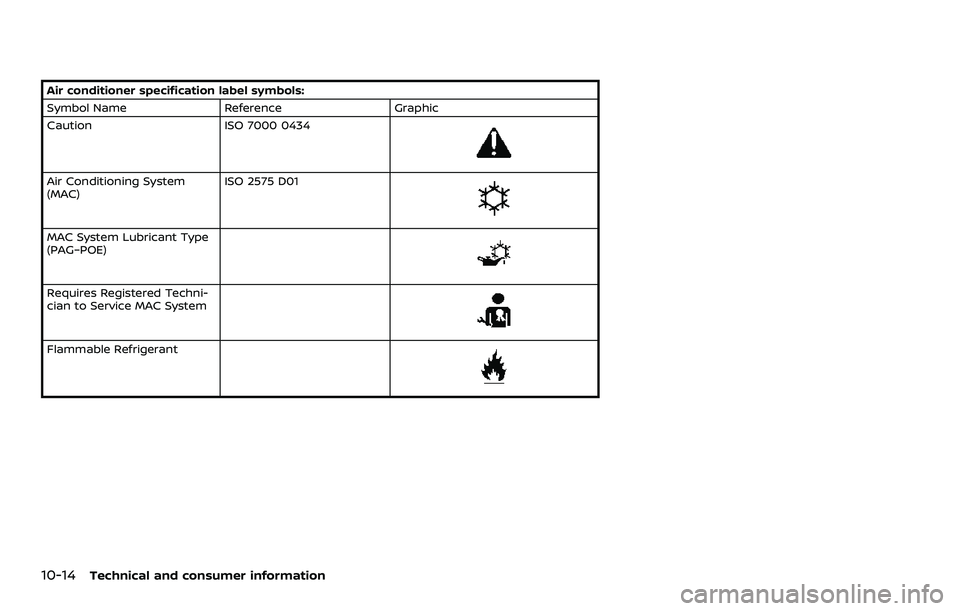
Air conditioner specification label symbols:
Symbol NameReferenceGraphic
Caution ISO 7000 0434
Air Conditioning System
(MAC)ISO 2575 D01
MAC System Lubricant Type
(PAG–POE)
Requires Registered Techni-
cian to Service MAC System
Flammable Refrigerant
Page 538 of 603
10-30Technical and consumer information
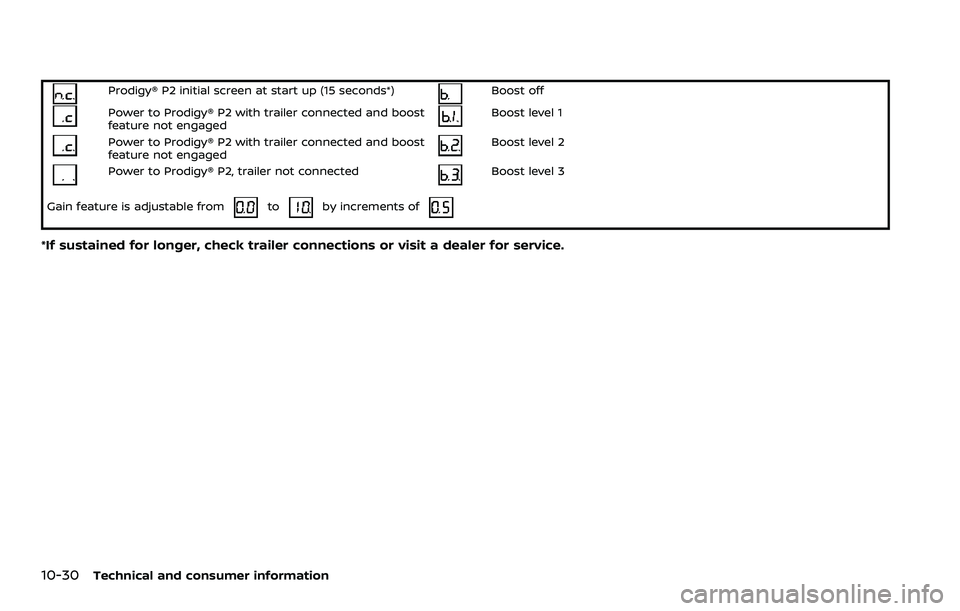
Prodigy® P2 initial screen at start up (15 seconds*)Boost off
Power to Prodigy® P2 with trailer connected and boost
feature not engagedBoost level 1
Power to Prodigy® P2 with trailer connected and boost
feature not engagedBoost level 2
Power to Prodigy® P2, trailer not connectedBoost level 3
Gain feature is adjustable from
toby increments of
*If sustained for longer, check trailer connections or visit a dealer for service.
Page 541 of 603
2. Start the engine.
3. Shift the transmission into gear.
4. Release the parking brake.
5. Drive slowly until the vehicle andtrailer are clear from the blocks.
6. Apply and hold the brake pedal.
7. Have someone retrieve and store the blocks.
. While going downhill, the weight of the
trailer pushing on the tow vehicle may
decrease overall stability. Therefore, to
maintain adequate control, reduce
your speed and shift to a lower gear.
Avoid long or repeated use of the
brakes when descending a hill, as this
reduces their effectiveness and could
cause overheating. Shifting to a lower
gear instead provides “engine braking”
and reduces the need to brake as
frequently.
. If the engine coolant temperature
rises to a high temperature, see “If
your vehicle overheats” (P.6-14).
. Trailer towing requires more fuel than
normal circumstances.
. Avoid towing a trailer for your vehicle’s
first 500 miles (800 km).
. Have your vehicle serviced more often
than at intervals specified in the
recommended maintenance schedule
shown in the "9. Maintenance and schedules" section.
. When making a turn, your trailer
wheels will be closer to the inside of
the turn than your vehicle wheels. To
compensate for this, make a larger
than normal turning radius during the
turn.
. Crosswinds and rough roads will ad-
versely affect vehicle/trailer handling,
possibly causing vehicle sway. When
being passed by larger vehicles, be
prepared for possible changes in
crosswinds that could affect vehicle
handling.
Do the following if the trailer begins to
sway:
1. Take your foot off the accelerator pedal to allow the vehicle to coast
and steer as straight ahead as the
road conditions allow. This combina-
tion will help stabilize the vehicle.
.Do not correct trailer sway bysteering or applying the brakes.
2. When the trailer sway stops, gently apply the brakes and pull to the side
of the road in a safe area.
3. Try to rearrange the trailer load so it is balanced as described earlier in this
section.
. Be careful when passing other vehi-
cles. Passing while towing a trailer requires considerably more distance
than normal passing. Remember the
length of the trailer must also pass the
other vehicle before you can safely
change lanes.
. Use the Tow mode or downshift the
transmission to a lower gear for en-
gine braking when driving down steep
or long hills. This will help slow the
vehicle without applying the brakes.
. Avoid holding the brake pedal down
too long or too frequently. This could
cause the brakes to overheat, result-
ing in reduced braking efficiency.
. Increase your following distance to
allow for greater stopping distances
while towing a trailer. Anticipate stops
and brake gradually.
. NISSAN recommends that the cruise
control not be used while towing a
trailer.
. While towing a trailer, do not use the
following systems (if so equipped):
— the Lane Departure Warning (LDW)
system
(See “How to enable/disable the
LDW system” (P.5-28).)
— the Intelligent Lane Intervention (I- LI) system
(See “How to enable/disable the I-LI
system” (P.5-34).)
Technical and consumer information10-33
Page 544 of 603
10-36Technical and consumer information
DOT (Department Of Transportation)
Quality Grades: All passenger car tires
must conform to federal safety require-
ments in addition to these grades.
Quality grades can be found where ap-
plicable on the tire sidewall between
tread shoulder and maximum section
width. For example:
Treadwear 200 Traction AA Tempera-
ture A
TREADWEAR
The treadwear grade is a comparative
rating based on the wear rate of the tire
when tested under controlled conditions
on a specified government test course.
For example, a tire graded 150 would
wear one and one-half (1 1/2) times as
well on the government course as a tire
graded 100. The relative performance of
tires depends upon actual conditions of
their use, however, and may depart sig-
nificantly from the norm due to variations
in driving habits, service practices and
differences in road characteristics and
climate.
TRACTION AA, A, B AND C
The traction grades, from highest to low-
est, are AA, A, B and C. Those grades
represent the tire’s ability to stop on wet
pavement as measured under controlled
conditions on specified government test
surfaces of asphalt and concrete. A tire
marked C may have poor traction perfor-
mance.
WARNING
The traction grade assigned to this
tire is based on straight-ahead brak-
ing traction tests, and does not
include acceleration, cornering, hy-
droplaning, or peak traction charac-
teristics.
TEMPERATURE A, B AND C
The temperature grades A (the highest),
B, and C, representing the tire’s resistance
to the generation of heat and its ability to
dissipate heat when tested under con-
trolled conditions on a specified indoor
laboratory test wheel. Sustained high
temperature can cause the material of
the tire to degenerate and reduce tire life,
and excessive temperature can lead to
sudden tire failure. The grade C corre-
sponds to a level of performance whichall passenger car tires must meet under
the Federal Motor Vehicle Safety Stan-
dard No. 109. Grades B and A represent
higher levels of performance on the
laboratory test wheel than the minimum
required by law.
WARNING
The temperature grade for this tire is
established for a tire that is properly
inflated and not overloaded. Exces-
sive speed, under-inflation, or exces-
sive loading, either separately or in
combination, can cause heat build-
up and possible tire failure.
UNIFORM TIRE QUALITY GRADING
Page 548 of 603
10-40Technical and consumer information
Genuine NISSAN Service Manual for this
model year and prior can be purchased. A
genuine NISSAN Service Manual is the
best source of service and repair informa-
tion for your vehicle. This manual is the
same one used by the factory-trained
technicians working at NISSAN dealers.
Genuine NISSAN Owner’s Manual can also
be purchased.
For USA:
For current pricing and availability of
genuineNISSAN Service Manuals, con-
tact:
www.nissan-techinfo.com
For current pricing and availability of
genuine NISSAN Owner’s Manuals, con-
tact:
1-800-247-5321
For Canada:
To purchase a copy of a genuine NISSAN
Service Manual or Owner’s Manual for this
model year and prior, contact a NISSAN
dealer. For the phone number and loca-
tion of a NISSAN dealer in your area, call
the NISSAN Satisfaction Center at 1-800-
387-0122 and a bilingual NISSAN repre-
sentative will assist you.
OWNER’S MANUAL/SERVICE
MANUAL ORDER INFORMATION
Page 551 of 603
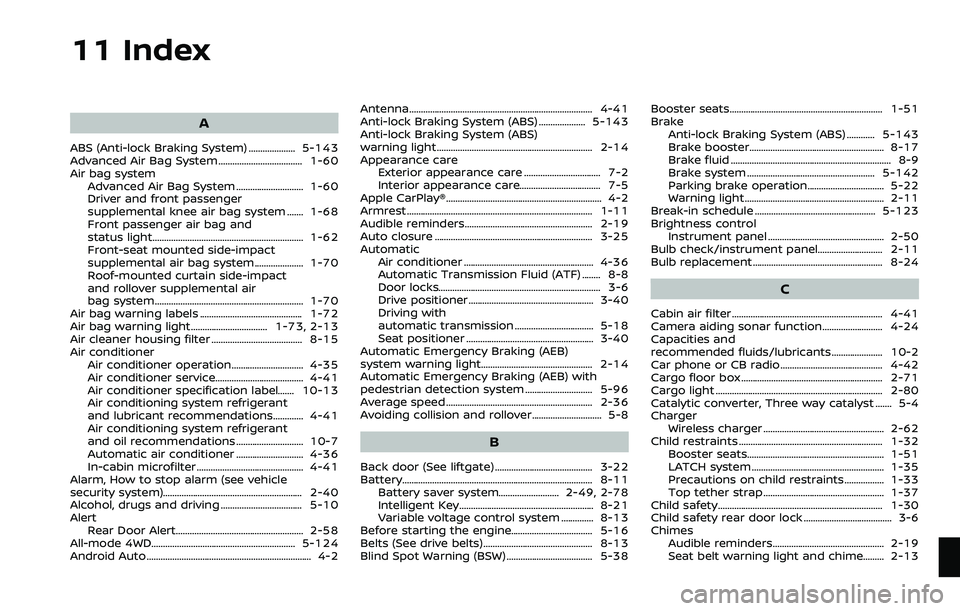
11 Index
A
ABS (Anti-lock Braking System) .................... 5-143
Advanced Air Bag System .................................... 1-60
Air bag systemAdvanced Air Bag System ............................. 1-60
Driver and front passenger
supplemental knee air bag system ....... 1-68
Front passenger air bag and
status light................................................................. 1-62
Front-seat mounted side-impact
supplemental air bag system..................... 1-70
Roof-mounted curtain side-impact
and rollover supplemental air
bag system................................................................ 1-70
Air bag warning labels ............................................ 1-72
Air bag warning light................................. 1-73, 2-13
Air cleaner housing filter ....................................... 8-15
Air conditioner Air conditioner operation............................... 4-35
Air conditioner service...................................... 4-41
Air conditioner specification label....... 10-13
Air conditioning system refrigerant
and lubricant recommendations............. 4-41
Air conditioning system refrigerant
and oil recommendations ............................. 10-7
Automatic air conditioner ............................. 4-36
In-cabin microfilter .............................................. 4-41
Alarm, How to stop alarm (see vehicle
security system)............................................................ 2-40
Alcohol, drugs and driving ................................... 5-10
Alert Rear Door Alert....................................................... 2-58
All-mode 4WD.............................................................. 5-124
Android Auto ....................................................................... 4-2 Antenna........................................................................\
....... 4-41
Anti-lock Braking System (ABS) .................... 5-143
Anti-lock Braking System (ABS)
warning light ................................................................... 2-14
Appearance care
Exterior appearance care ................................. 7-2
Interior appearance care................................... 7-5
Apple CarPlay®................................................................... 4-2
Armrest ........................................................................\
........ 1-11
Audible reminders....................................................... 2-19
Auto closure .................................................................... 3-25
Automatic Air conditioner ........................................................ 4-36
Automatic Transmission Fluid (ATF) ........ 8-8
Door locks...................................................................... 3-6
Drive positioner...................................................... 3-40
Driving with
automatic transmission .................................. 5-18
Seat positioner ....................................................... 3-40
Automatic Emergency Braking (AEB)
system warning light................................................ 2-14
Automatic Emergency Braking (AEB) with
pedestrian detection system ............................. 5-96
Average speed ............................................................... 2-36
Avoiding collision and rollover.............................. 5-8
B
Back door (See liftgate) .......................................... 3-22
Battery........................................................................\
.......... 8-11 Battery saver system.......................... 2-49, 2-78
Intelligent Key.......................................................... 8-21
Variable voltage control system .............. 8-13
Before starting the engine................................... 5-16
Belts (See drive belts)............................................... 8-13
Blind Spot Warning (BSW) ..................................... 5-38 Booster seats.................................................................. 1-51
Brake
Anti-lock Braking System (ABS) ............ 5-143
Brake booster.......................................................... 8-17
Brake fluid ..................................................................... 8-9
Brake system ....................................................... 5-142
Parking brake operation................................. 5-22
Warning light............................................................ 2-11
Break-in schedule .................................................... 5-123
Brightness control Instrument panel .................................................. 2-50
Bulb check/instrument panel............................ 2-11
Bulb replacement ........................................................ 8-24
C
Cabin air filter ................................................................. 4-41
Camera aiding sonar function.......................... 4-24
Capacities and
recommended fluids/lubricants...................... 10-2
Car phone or CB radio ............................................ 4-42
Cargo floor box ............................................................. 2-71
Cargo light ........................................................................\
2-80
Catalytic converter, Three way catalyst ....... 5-4
Charger Wireless charger .................................................... 2-62
Child restraints .............................................................. 1-32 Booster seats........................................................... 1-51
LATCH system ......................................................... 1-35
Precautions on child restraints................. 1-33
Top tether strap .................................................... 1-37
Child safety....................................................................... 1-30
Child safety rear door lock ...................................... 3-6
Chimes Audible reminders................................................ 2-19
Seat belt warning light and chime......... 2-13
Page 554 of 603
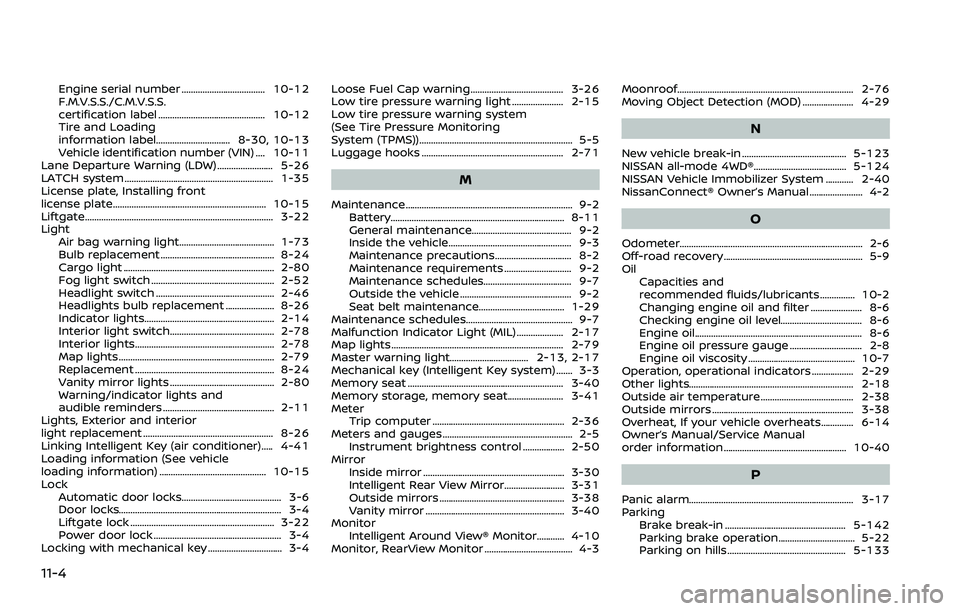
11-4
Engine serial number .................................... 10-12
F.M.V.S.S./C.M.V.S.S.
certification label .............................................. 10-12
Tire and Loading
information label................................ 8-30, 10-13
Vehicle identification number (VIN) .... 10-11
Lane Departure Warning (LDW) ........................ 5-26
LATCH system ................................................................ 1-35
License plate, Installing front
license plate.................................................................. 10-15
Liftgate........................................................................\
......... 3-22
Light Air bag warning light......................................... 1-73
Bulb replacement ................................................. 8-24
Cargo light ................................................................. 2-80
Fog light switch ..................................................... 2-52
Headlight switch ................................................... 2-46
Headlights bulb replacement ..................... 8-26
Indicator lights........................................................ 2-14
Interior light switch............................................. 2-78
Interior lights............................................................ 2-78
Map lights ................................................................... 2-79
Replacement ............................................................ 8-24
Vanity mirror lights ............................................. 2-80
Warning/indicator lights and
audible reminders ................................................ 2-11
Lights, Exterior and interior
light replacement ........................................................ 8-26
Linking Intelligent Key (air conditioner)..... 4-41
Loading information (See vehicle
loading information) .............................................. 10-15
Lock Automatic door locks........................................... 3-6
Door locks...................................................................... 3-4
Liftgate lock .............................................................. 3-22
Power door lock ....................................................... 3-4
Locking with mechanical key ................................ 3-4 Loose Fuel Cap warning........................................ 3-26
Low tire pressure warning light ...................... 2-15
Low tire pressure warning system
(See Tire Pressure Monitoring
System (TPMS)).................................................................. 5-5
Luggage hooks ............................................................. 2-71
M
Maintenance........................................................................\
9-2
Battery........................................................................\
... 8-11
General maintenance........................................... 9-2
Inside the vehicle..................................................... 9-3
Maintenance precautions................................. 8-2
Maintenance requirements ............................. 9-2
Maintenance schedules...................................... 9-7
Outside the vehicle ................................................ 9-2
Seat belt maintenance..................................... 1-29
Maintenance schedules.............................................. 9-7
Malfunction Indicator Light (MIL) .................... 2-17
Map lights ........................................................................\
.. 2-79
Master warning light.................................. 2-13, 2-17
Mechanical key (Intelligent Key system) ....... 3-3
Memory seat ................................................................... 3-40
Memory storage, memory seat........................ 3-41
Meter Trip computer ......................................................... 2-36
Meters and gauges ........................................................ 2-5 Instrument brightness control .................. 2-50
Mirror Inside mirror ............................................................. 3-30
Intelligent Rear View Mirror.......................... 3-31
Outside mirrors ...................................................... 3-38
Vanity mirror ............................................................ 3-40
Monitor Intelligent Around View® Monitor............ 4-10
Monitor, RearView Monitor ...................................... 4-3 Moonroof........................................................................\
.... 2-76
Moving Object Detection (MOD) ...................... 4-29
N
New vehicle break-in ............................................. 5-123
NISSAN all-mode 4WD®........................................ 5-124
NISSAN Vehicle Immobilizer System ............ 2-40
NissanConnect® Owner’s Manual....................... 4-2
O
Odometer........................................................................\
....... 2-6
Off-road recovery ............................................................ 5-9
Oil
Capacities and
recommended fluids/lubricants............... 10-2
Changing engine oil and filter ...................... 8-6
Checking engine oil level................................... 8-6
Engine oil.....................................................................\
... 8-6
Engine oil pressure gauge ............................... 2-8
Engine oil viscosity .............................................. 10-7
Operation, operational indicators .................. 2-29
Other lights....................................................................... 2-18
Outside air temperature ........................................ 2-38
Outside mirrors ............................................................. 3-38
Overheat, If your vehicle overheats.............. 6-14
Owner’s Manual/Service Manual
order information..................................................... 10-40
P
Panic alarm....................................................................... 3-17
Parking Brake break-in .................................................... 5-142
Parking brake operation................................. 5-22
Parking on hills................................................... 5-133