flat tire NISSAN ARMADA 2021 Owner´s Manual
[x] Cancel search | Manufacturer: NISSAN, Model Year: 2021, Model line: ARMADA, Model: NISSAN ARMADA 2021Pages: 603, PDF Size: 3.16 MB
Page 475 of 603
outside the vehicle for inflating the
tires to the recommended COLD
tire pressure. (See “TPMS with Easy
Fill Tire Alert” (P.5-8).)
Incorrect tire pressure, including
under inflation, may adversely
affect tire life and vehicle hand-
ling.
WARNING
.Improperly inflated tires can
fail suddenly and cause an
accident.
. The Gross Vehicle Weight
rating (GVWR) is located on
the F.M.V.S.S./C.M.V.S.S. cer-
tification label. The vehicle
weight capacity is indicated
on the Tire and Loading In-
formation label. Do not load
your vehicle beyond this ca-
pacity. Overloading your ve-
hicle may result in reduced
tire life, unsafe operating
conditions due to premature
tire failure, or unfavorable handling characteristics
and could also lead to a
serious accident. Loading
beyond the specified capa-
city may also result in failure
of other vehicle compo-
nents.
. Before taking a long trip, or
whenever you heavily load
your vehicle, use a tire pres-
sure gauge to ensure that
the tire pressures are at the
specified level.
. For additional information
regarding tires, refer to “Im-
portant Tire Safety Informa-
tion” (US) or “Tire Safety
Information” (Canada) in the
Warranty Information Book-
let.
Do-it-yourself8-29
Page 476 of 603
8-30Do-it-yourself
SDI2496
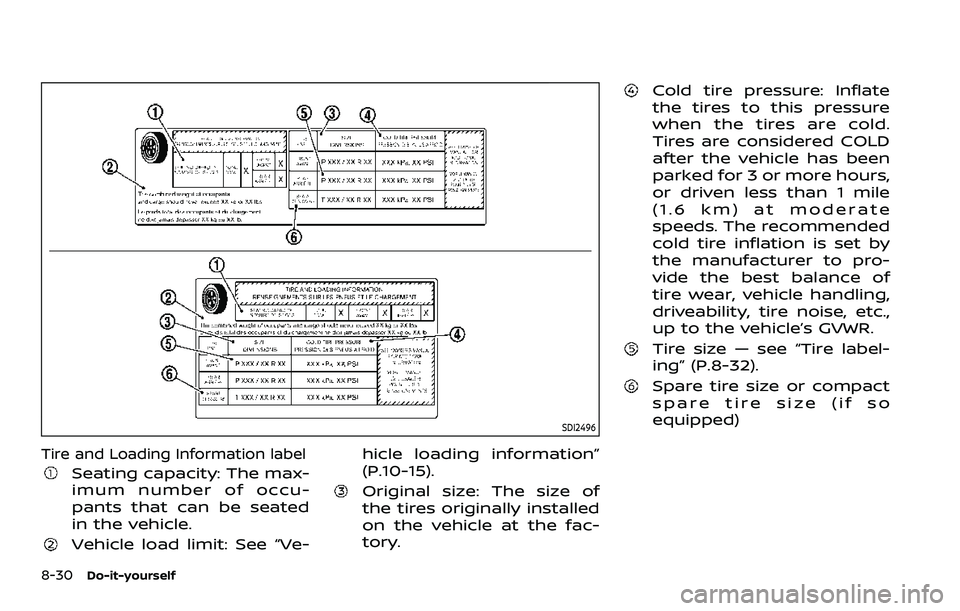
Tire and Loading Information label
Seating capacity: The max-
imum number of occu-
pants that can be seated
in the vehicle.
Vehicle load limit: See “Ve-hicle loading information”
(P.10-15).
Original size: The size of
the tires originally installed
on the vehicle at the fac-
tory.
Cold tire pressure: Inflate
the tires to this pressure
when the tires are cold.
Tires are considered COLD
after the vehicle has been
parked for 3 or more hours,
or driven less than 1 mile
(1.6 km) at moderate
speeds. The recommended
cold tire inflation is set by
the manufacturer to pro-
vide the best balance of
tire wear, vehicle handling,
driveability, tire noise, etc.,
up to the vehicle’s GVWR.
Tire size — see “Tire label-
ing” (P.8-32).
Spare tire size or compact
spare tire size (if so
equipped)
Page 477 of 603
SDI1949
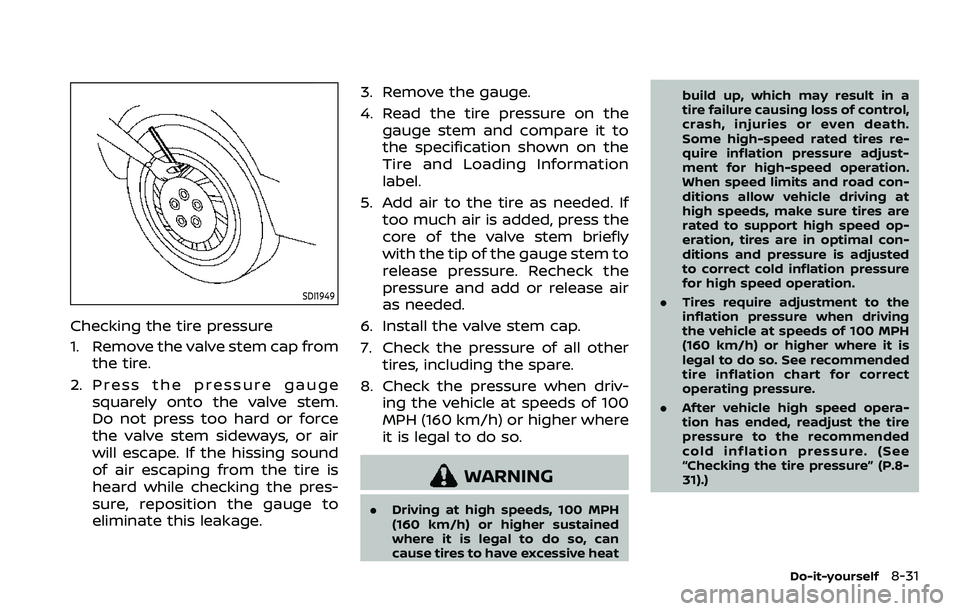
Checking the tire pressure
1. Remove the valve stem cap fromthe tire.
2. Press the pressure gauge squarely onto the valve stem.
Do not press too hard or force
the valve stem sideways, or air
will escape. If the hissing sound
of air escaping from the tire is
heard while checking the pres-
sure, reposition the gauge to
eliminate this leakage. 3. Remove the gauge.
4. Read the tire pressure on the
gauge stem and compare it to
the specification shown on the
Tire and Loading Information
label.
5. Add air to the tire as needed. If too much air is added, press the
core of the valve stem briefly
with the tip of the gauge stem to
release pressure. Recheck the
pressure and add or release air
as needed.
6. Install the valve stem cap.
7. Check the pressure of all other tires, including the spare.
8. Check the pressure when driv- ing the vehicle at speeds of 100
MPH (160 km/h) or higher where
it is legal to do so.
WARNING
. Driving at high speeds, 100 MPH
(160 km/h) or higher sustained
where it is legal to do so, can
cause tires to have excessive heat build up, which may result in a
tire failure causing loss of control,
crash, injuries or even death.
Some high-speed rated tires re-
quire inflation pressure adjust-
ment for high-speed operation.
When speed limits and road con-
ditions allow vehicle driving at
high speeds, make sure tires are
rated to support high speed op-
eration, tires are in optimal con-
ditions and pressure is adjusted
to correct cold inflation pressure
for high speed operation.
. Tires require adjustment to the
inflation pressure when driving
the vehicle at speeds of 100 MPH
(160 km/h) or higher where it is
legal to do so. See recommended
tire inflation chart for correct
operating pressure.
. After vehicle high speed opera-
tion has ended, readjust the tire
pressure to the recommended
cold inflation pressure. (See
“Checking the tire pressure” (P.8-
31).)
Do-it-yourself8-31
Page 478 of 603
8-32Do-it-yourself
SizeCold Tire In-
flation Pres- sure
Front Original Tire:
265/70R18 116H 35 psi, 240
kPa
Front Original Tire:
P275/60R20 114H 35 psi, 240
kPa
Front Original Tire:
P275/50R22 111H 35 psi, 240
kPa
Rear Original Tire:
265/70R18 116H 35 psi, 240
kPa
Rear Original Tire:
P275/60R20 114H 35 psi, 240
kPa
Rear Original Tire:
P275/50R22 111H 35 psi, 240
kPa
Spare Tire:
265/70R18 116H 35 psi, 240
kPa
Spare Tire:
265/70R18 116M 51 psi, 350
kPa
Spare Tire:
275/60R20 115M 35 psi, 240
kPa
Recommended tire inflation pressures at
speeds of 100 MPH (160 km/h) or higher where
it is legal to do so.
SizeCold Tire In-
flation Pres- sure
Front Original Tire:
P275/60R20 114H 36 psi, 250
kPa
Front Original Tire:
P275/50R22 111H 41 psi, 280
kPa
Rear Original Tire:
P275/60R20 114H 36 psi, 250
kPa
Rear Original Tire:
P275/50R22 111H 41 psi, 280
kPa
SDI1575
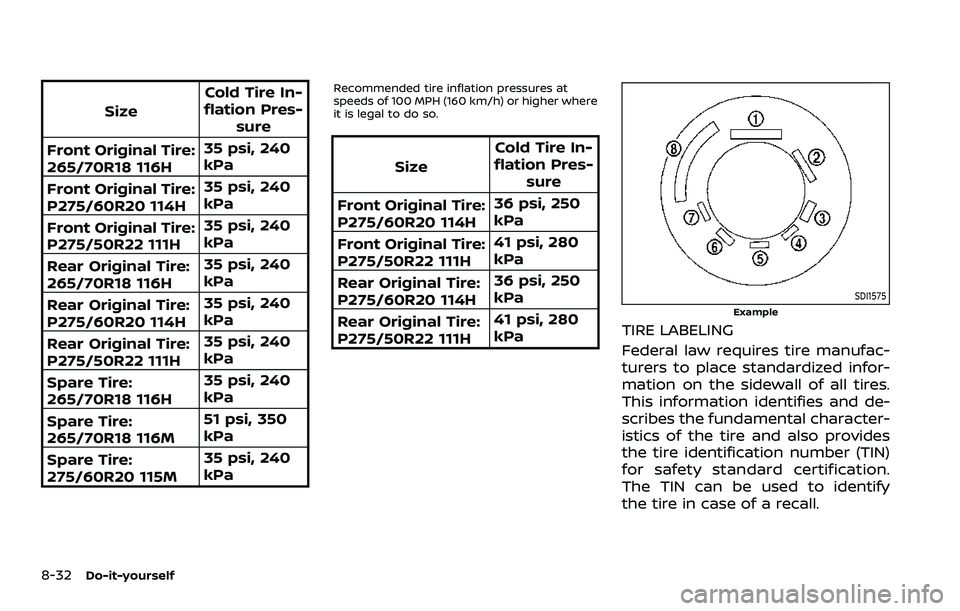
Example
TIRE LABELING
Federal law requires tire manufac-
turers to place standardized infor-
mation on the sidewall of all tires.
This information identifies and de-
scribes the fundamental character-
istics of the tire and also provides
the tire identification number (TIN)
for safety standard certification.
The TIN can be used to identify
the tire in case of a recall.
Page 480 of 603
8-34Do-it-yourself
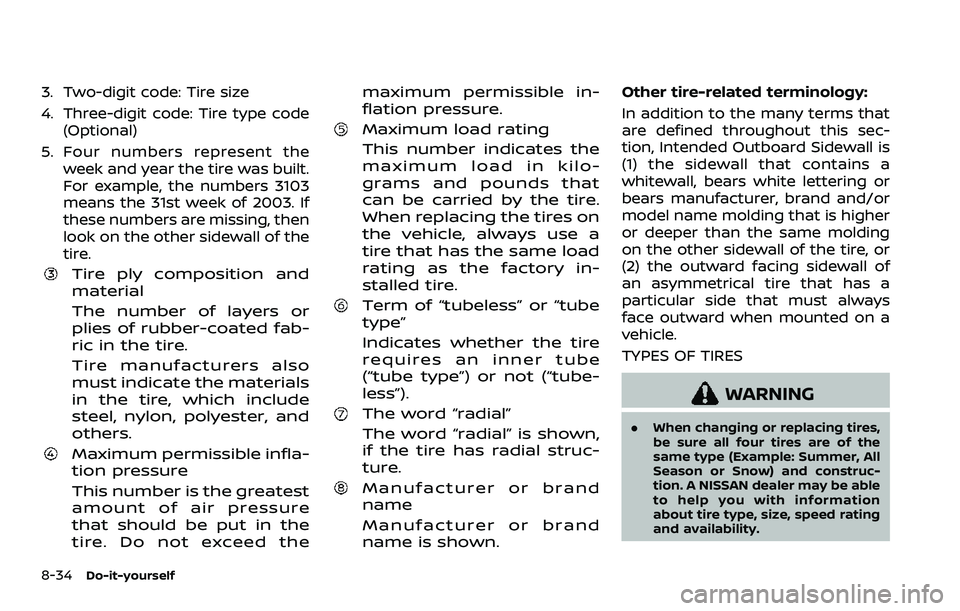
3. Two-digit code: Tire size
4. Three-digit code: Tire type code(Optional)
5. Four numbers represent the week and year the tire was built.
For example, the numbers 3103
means the 31st week of 2003. If
these numbers are missing, then
look on the other sidewall of the
tire.
Tire ply composition and
material
The number of layers or
plies of rubber-coated fab-
ric in the tire.
Tire manufacturers also
must indicate the materials
in the tire, which include
steel, nylon, polyester, and
others.
Maximum permissible infla-
tion pressure
This number is the greatest
amount of air pressure
that should be put in the
tire. Do not exceed the maximum permissible in-
flation pressure.
Maximum load rating
This number indicates the
maximum load in kilo-
grams and pounds that
can be carried by the tire.
When replacing the tires on
the vehicle, always use a
tire that has the same load
rating as the factory in-
stalled tire.
Term of “tubeless” or “tube
type”
Indicates whether the tire
requires an inner tube
(“tube type”) or not (“tube-
less”).
The word “radial”
The word “radial” is shown,
if the tire has radial struc-
ture.
Manufacturer or brand
name
Manufacturer or brand
name is shown.
Other tire-related terminology:
In addition to the many terms that
are defined throughout this sec-
tion, Intended Outboard Sidewall is
(1) the sidewall that contains a
whitewall, bears white lettering or
bears manufacturer, brand and/or
model name molding that is higher
or deeper than the same molding
on the other sidewall of the tire, or
(2) the outward facing sidewall of
an asymmetrical tire that has a
particular side that must always
face outward when mounted on a
vehicle.
TYPES OF TIRES
WARNING
.
When changing or replacing tires,
be sure all four tires are of the
same type (Example: Summer, All
Season or Snow) and construc-
tion. A NISSAN dealer may be able
to help you with information
about tire type, size, speed rating
and availability.
Page 482 of 603
8-36Do-it-yourself
addition, drive at a reduced speed. Other-
wise, your vehicle may be damaged and/
or vehicle handling and performance may
be adversely affected.
Tire chains must be installed only on
the rear wheels and not on the front
wheels.
Never install tire chains on the full-size
temporary use only spare tire (if so
equipped).
Do not use tire chains on dry roads.
Driving with tire chains in such conditions
can cause damage to the various me-
chanisms of the vehicle due to some
overstress.
SDI1662
CHANGING WHEELS AND TIRES
Tire rotation
NISSAN recommends rotating the
tires every 7,500 miles (12,000 km).
(See “Flat tire” (P.6-3) for tire repla-
cing procedures.)
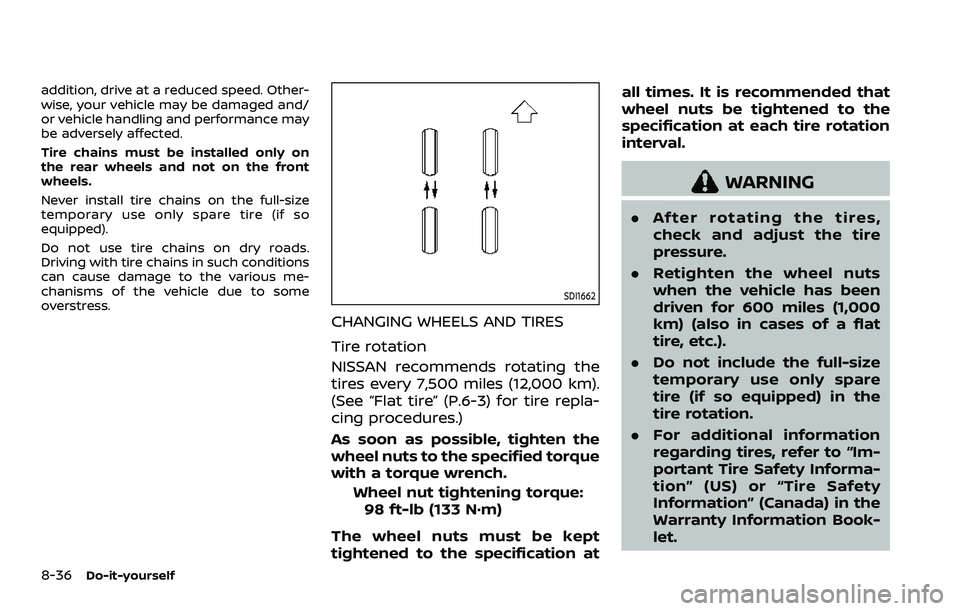
As soon as possible, tighten the
wheel nuts to the specified torque
with a torque wrench.Wheel nut tightening torque:98 ft-lb (133 N·m)
The wheel nuts must be kept
tightened to the specification at all times. It is recommended that
wheel nuts be tightened to the
specification at each tire rotation
interval.
WARNING
.
After rotating the tires,
check and adjust the tire
pressure.
. Retighten the wheel nuts
when the vehicle has been
driven for 600 miles (1,000
km) (also in cases of a flat
tire, etc.).
. Do not include the full-size
temporary use only spare
tire (if so equipped) in the
tire rotation.
. For additional information
regarding tires, refer to “Im-
portant Tire Safety Informa-
tion” (US) or “Tire Safety
Information” (Canada) in the
Warranty Information Book-
let.
Page 485 of 603
construction and tread pattern. The tire
pressure and wheel alignment should
also be checked and corrected as neces-
sary. It is recommended you visit a
NISSAN dealer for this service.
Wheel balance
Unbalanced wheels may affect vehicle
handling and tire life. Even with regular
use, wheels can get out of balance.
Therefore, they should be balanced as
required.
Wheel balance service should be per-
formed with the wheels off the vehicle.
Spin balancing the wheels on the vehi-
cle could lead to mechanical damage.
For additional information regarding tires,
refer to “Important Tire Safety Informa-
tion” (US) or “Tire Safety Information”
(Canada) in the NISSAN Warranty Infor-
mation Booklet.
Care of wheels
See “Cleaning exterior” (P.7-2) for details
about care of the wheels.
Spare tire
Since the spare tire is not equipped with
the TPMS, when a spare tire is mounted
(TEMPORARY USE ONLY or conventional),
the TPMS will not function.
Spare tire (FULL-SIZE TEMPORARY USE
ONLY spare tire) (Applies ONLY to vehi-
cles equipped with P275/50R22 or
P275/60R20 tires):
Observe the following precautions if the
full-size temporary use only spare tire
must be used, otherwise your vehicle
could be damaged or involved in an
accident.
WARNING
.The full-size temporary use only
spare tire should be used for
emergency use. It should be re-
placed with the standard tire at
the first opportunity to avoid
possible tire or differential da-
mage.
. Drive carefully while the spare tire
is installed. Avoid sharp turns and
abrupt braking while driving. The
vehicle driving performance may
be affected when driving on wet
or snow covered roads. .
When the spare tire is installed,
the following systems may not
work correctly.
— Tire Pressure Monitoring Sys-
tem (TPMS)
— Vehicle Dynamic Control (VDC) System
. Periodically check spare tire in-
flation pressure. Always keep the
spare tire inflated to the pressure
specification shown on the Tire
and Loading Information label.
For Tire and Loading Information
label location, see “Tire and Load-
ing Information label” in the index
of this manual.
. With the spare tire installed do
not drive your vehicle at speeds
faster than 70 MPH (112 km/h).
. When driving on roads covered
with snow or ice, the spare tire
should be used on the front
wheels and original tire used on
the rear wheels (drive wheels).
Use tire chains only on the two
rear original tires.
. Do not use the spare tire on other
vehicles.
. Do not use more than one spare
tire at the same time.
Do-it-yourself8-39
Page 509 of 603
10 Technical and consumer information
Capacities and
recommended fluids/lubricants .................................... 10-2Fuel information .................................................................. 10-4
Engine oil and oil filter recommendation ........ 10-6
Air conditioning system refrigerant and
oil recommendations ....................................................... 10-7
Specifications ........................................................................\
........ 10-8 Engine ........................................................................\
.................. 10-8
Wheels and tires .................................................................. 10-9
Dimensions ........................................................................\
.. 10-10
When traveling or registering in
another country ..................................................................... 10-11
Vehicle identification .......................................................... 10-11 Vehicle Identification Number
(VIN) plate ........................................................................\
...... 10-11
Vehicle identification number
(chassis number) ............................................................. 10-11
Engine serial number ................................................... 10-12
F.M.V.S.S./C.M.V.S.S. certification label ............. 10-12
Emission control information label .................. 10-12
Tire and loading information label ................... 10-13
Air conditioner specification label ..................... 10-13
Installing front license plate ......................................... 10-15 Vehicle loading information ......................................... 10-15
Terms ........................................................................\
............. 10-15
Vehicle load capacity ................................................ 10-17
Securing the load ......................................................... 10-18
Loading tips ...................................................................... 10-18
Measurement of weights ....................................... 10-19
Towing a trailer ...................................................................... 10-19 Maximum load limits ................................................. 10-19
Maximum Gross Vehicle Weight (GVW)/
maximum Gross Axle Weight (GAW) .............. 10-21
Towing load/specification ..................................... 10-23
Towing safety ................................................................ 10-24
Flat towing ........................................................................\
. 10-35
Uniform tire quality grading ........................................ 10-36 Treadwear ........................................................................\
.. 10-36
Traction AA, A, B and C ........................................... 10-36
Temperature A, B and C ......................................... 10-36
Emission control system warranty ......................... 10-37
Reporting safety defects ................................................ 10-37
Readiness for Inspection/Maintenance
(I/M) test ........................................................................\
............... 10-38
Event Data Recorders (EDR) ......................................... 10-39
Owner’s Manual/Service Manual
order information ................................................................. 10-40
Page 525 of 603
VEHICLE LOAD CAPACITY
Do not exceed the load limit of your
vehicle shown as “The combined
weight of occupants and cargo” on
the Tire and Loading Information
label. Do not exceed the number of
occupants shown as “Seating Ca-
pacity” on the Tire and Loading
Information label.
To get “the combined weight of
occupants and cargo”, add the
weight of all occupants, then add
the total luggage weight. Examples
are shown in the illustration.
Steps for determining correct load
limit
1. Locate the statement “The com-bined weight of occupants and
cargo should never exceed XXX
kg or XXX lbs” on your vehicle’s
placard.
2. Determine the combined weight of the driver and passengers
that will be riding in your vehicle.
3. Subtract the combined weight of the driver and passengers from XXX kg or XXX lbs.
4. The resulting figure equals the available amount of cargo and
luggage load capacity. For ex-
ample, if the XXX amount equals
1400 lbs. and there will be five
150 lb. passengers in your vehi-
cle, the amount of available
cargo and luggage load capacity
is 650 lbs. (1400 − 750 (5 x 150) =
650 lbs) or (640 − 340 (5 x 70) =
300 kg.)
5. Determine the combined weight of luggage and cargo being
loaded on the vehicle. That
weight may not safely exceed
the available cargo and luggage
load capacity calculated in Step
4.
6. If your vehicle will be towing a trailer, load from your trailer will
be transferred to your vehicle.
Consult this manual to deter-
mine how this reduces the avail-
able cargo and luggage load
capacity of your vehicle.
Before driving a loaded vehicle, confirm that you do not exceed
the Gross Vehicle Weight Rating
(GVWR) or the Gross Axle Weight
Rating (GAWR) for your vehicle. (See
“Measurement of weights” (P.10-19).)
Also check tires for proper inflation
pressures. See the Tire and Loading
Information label.
Technical and consumer information10-17
Page 535 of 603
.Do not modify the vehicle ex-
haust system, brake system, etc.
. Do not attach any additional
hitches to your vehicle because
a hitch is already mounted to
your vehicle frame.
Tire pressures
.When towing a trailer, inflate the
vehicle tires to the recom-
mended cold tire pressure indi-
cated on the Tire and Loading
Information label.
. Trailer tire condition, size, load
rating and proper inflation pres-
sure should be in accordance
with the trailer and tire manu-
facturers’ specifications.
Safety chains
Always use a suitable chain between your
vehicle and the trailer. The safety chains
should be crossed and should be at-
tached to the hitch, not to the vehicle
bumper or axle. Be sure to leave enough
slack in the chains to permit turning
corners.
STI0745
Trailer lights (if so equipped)
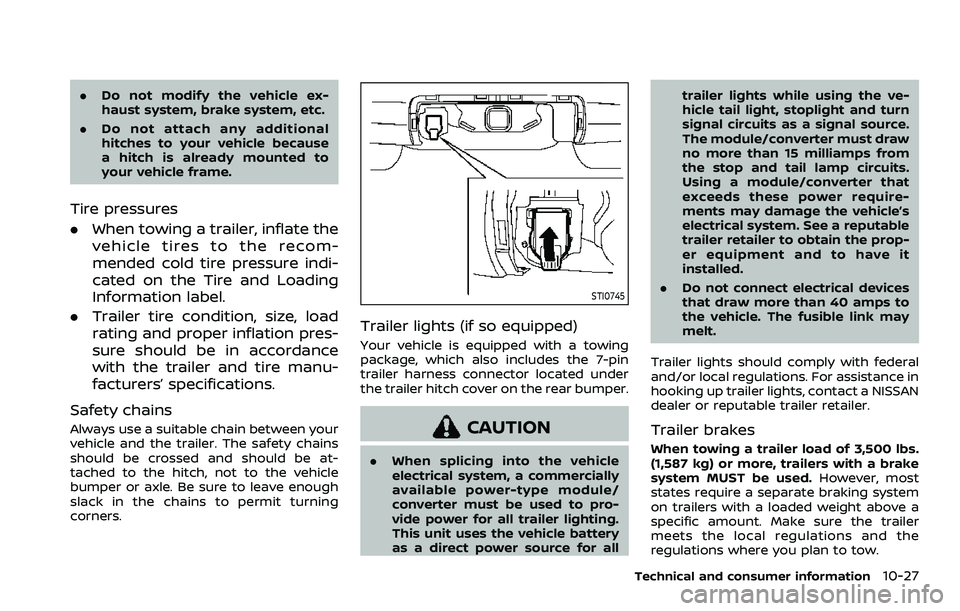
Your vehicle is equipped with a towing
package, which also includes the 7-pin
trailer harness connector located under
the trailer hitch cover on the rear bumper.
CAUTION
. When splicing into the vehicle
electrical system, a commercially
available power-type module/
converter must be used to pro-
vide power for all trailer lighting.
This unit uses the vehicle battery
as a direct power source for all trailer lights while using the ve-
hicle tail light, stoplight and turn
signal circuits as a signal source.
The module/converter must draw
no more than 15 milliamps from
the stop and tail lamp circuits.
Using a module/converter that
exceeds these power require-
ments may damage the vehicle’s
electrical system. See a reputable
trailer retailer to obtain the prop-
er equipment and to have it
installed.
. Do not connect electrical devices
that draw more than 40 amps to
the vehicle. The fusible link may
melt.
Trailer lights should comply with federal
and/or local regulations. For assistance in
hooking up trailer lights, contact a NISSAN
dealer or reputable trailer retailer.
Trailer brakes
When towing a trailer load of 3,500 lbs.
(1,587 kg) or more, trailers with a brake
system MUST be used. However, most
states require a separate braking system
on trailers with a loaded weight above a
specific amount. Make sure the trailer
meets the local regulations and the
regulations where you plan to tow.
Technical and consumer information10-27