trailer NISSAN ARMADA 2021 Owner´s Manual
[x] Cancel search | Manufacturer: NISSAN, Model Year: 2021, Model line: ARMADA, Model: NISSAN ARMADA 2021Pages: 603, PDF Size: 3.16 MB
Page 377 of 603
JVS0298X
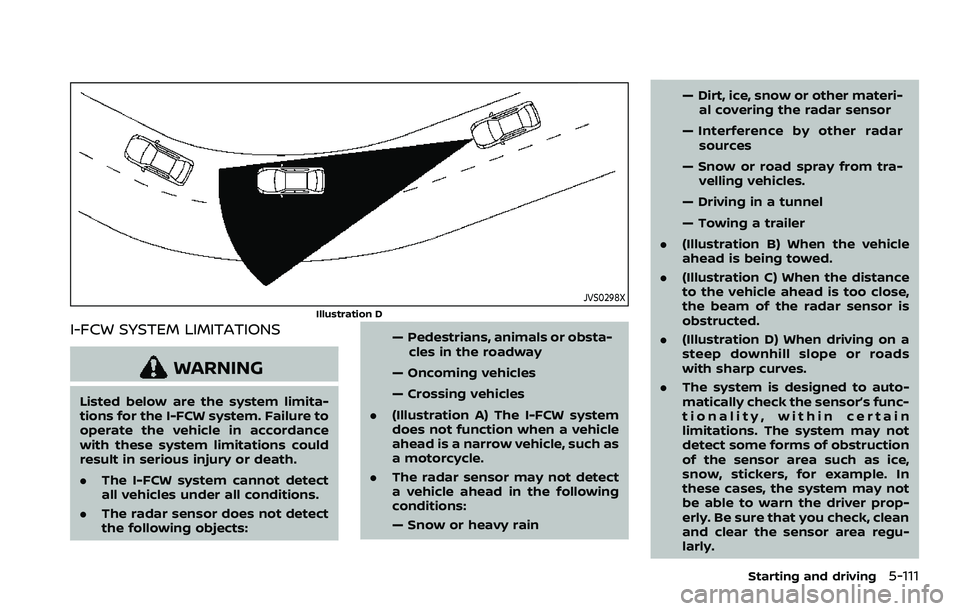
Illustration D
I-FCW SYSTEM LIMITATIONS
WARNING
Listed below are the system limita-
tions for the I-FCW system. Failure to
operate the vehicle in accordance
with these system limitations could
result in serious injury or death.
.The I-FCW system cannot detect
all vehicles under all conditions.
. The radar sensor does not detect
the following objects: — Pedestrians, animals or obsta-
cles in the roadway
— Oncoming vehicles
— Crossing vehicles
. (Illustration A) The I-FCW system
does not function when a vehicle
ahead is a narrow vehicle, such as
a motorcycle.
. The radar sensor may not detect
a vehicle ahead in the following
conditions:
— Snow or heavy rain — Dirt, ice, snow or other materi-
al covering the radar sensor
— Interference by other radar sources
— Snow or road spray from tra- velling vehicles.
— Driving in a tunnel
— Towing a trailer
. (Illustration B) When the vehicle
ahead is being towed.
. (Illustration C) When the distance
to the vehicle ahead is too close,
the beam of the radar sensor is
obstructed.
. (Illustration D) When driving on a
steep downhill slope or roads
with sharp curves.
. The system is designed to auto-
matically check the sensor’s func-
tionality, within certain
limitations. The system may not
detect some forms of obstruction
of the sensor area such as ice,
snow, stickers, for example. In
these cases, the system may not
be able to warn the driver prop-
erly. Be sure that you check, clean
and clear the sensor area regu-
larly.
Starting and driving5-111
Page 387 of 603
— The vehicle is driving on asteep hill.
— There is an accumulation of snow or ice behind the vehi-
cle.
— An ultrasonic wave source, such as another vehicle’s so-
nar, is near the vehicle.
. Once the automatic brake control
operates, it does not operate
again if the vehicle approaches
the same obstacle.
. The automatic brake control can
only operate for a short period of
time. Therefore, the driver must
depress the brake pedal.
. In the following situations, the
RAB system may not operate
properly or may not function
sufficiently:
— The vehicle is driven in bad
weather (rain, fog, snow, etc.).
— The vehicle is driven on a steep hill.
— The vehicle’s posture is chan- ged (e.g., when driving over a
bump).
— The vehicle is driven on a slippery road. — The vehicle is turned sharply
by turning the steering wheel
fully.
— Snow chains are used.
— Wheels or tires other than NISSAN recommended are
used.
— The brakes are cold at low ambient temperatures or im-
mediately after driving has
started.
— The braking force becomes poor due to wet brakes after
driving through a puddle or
washing the vehicle.
. Turn the RAB system off in the
following conditions to prevent
the occurrence of an unexpected
accident resulting from sudden
system operation:
— The vehicle is towed.
— The vehicle is carried on a
flatbed truck.
— The vehicle is on the chassis dynamometer.
— The vehicle drives on an un- even road surface. — Suspension parts other than
those designated as genuine
parts are used. (If the vehicle
height or the vehicle body
inclination is changed, the
system may not detect an
obstacle correctly.)
. When towing a trailer or other
vehicle, turn the RAB system off
to prevent the occurrence of an
unexpected accident resulting
from sudden system operation.
(See “RAB system operation” (P.5-
118).)
. Excessive noise (e.g., audio sys-
tem volume, an open vehicle win-
dow) will interfere with the chime
sound, and it may not be heard.
Starting and driving5-121
Page 389 of 603
CAUTION
During the first 1,200 miles (2,000
km), follow these recommendations
to obtain maximum engine perfor-
mance and ensure the future relia-
bility and economy of your new
vehicle.
Failure to follow these recommenda-
tions may result in shortened engine
life and reduced engine perfor-
mance.
. Avoid driving for long periods at con-
stant speed, either fast or slow. Do not
run the engine over 4,000 rpm.
. Do not accelerate at full throttle in any
gear.
. Avoid quick starts.
. Avoid hard braking as much as possi-
ble.
. Do not tow a trailer for the first 500
miles (805 km). Follow these easy-to-use Fuel Efficient
Driving Tips to help you achieve the most
fuel economy from your vehicle.
1. Use smooth accelerator and brake
pedal application.
.Avoid rapid starts and stops..Use smooth, gentle accelerator andbrake application whenever possi-
ble.
.Maintain constant speed whilecommuting and coast whenever
possible.
2. Maintain constant speed.
.Look ahead to try and anticipate and minimize stops.
.Synchronizing your speed with traf-fic lights allows you to reduce your
number of stops.
.Maintaining a steady speed canminimize red light stops and im-
prove fuel efficiency.
3. Use air conditioning (A/C) at higher vehicle speeds.
.Below 40 MPH (64 km/h), it is moreefficient to open windows to cool
the vehicle due to reduced engine
load.
.Above 40 MPH (64 km/h), it is more
efficient to use A/C to cool the
vehicle due to increased aerody-
namic drag.
.Recirculating the cool air in thecabin when the A/C is on reduces
cooling load.
4. Drive at economical speeds and dis- tances.
.Observing the speed limit and notexceeding 60 MPH (97 km/h)
(where legally allowed) can improve
fuel efficiency due to reduced aero-
dynamic drag.
.Maintaining a safe following dis-tance behind other vehicles re-
duces unnecessary braking.
.Safely monitoring traffic to antici- pate changes in speed permits
reduced braking and smooth accel-
eration changes.
.Select a gear range suitable to roadconditions.
5. Use cruise control.
.Using cruise control during highway driving helps maintain a steady
speed.
.Cruise control is particularly effec-tive in providing fuel savings when
driving on flat terrains.
6. Plan for the shortest route.
.Utilize a map or navigation system to determine the best route to save
time.
Starting and driving5-123
BREAK-IN SCHEDULE FUEL EFFICIENT DRIVING TIPS
Page 400 of 603
5-134Starting and driving
Turn the wheels toward the side of
the road so the vehicle will move away
from the center of the road if it moves.
4. Push the ignition switch to the OFF position.
SIC4474
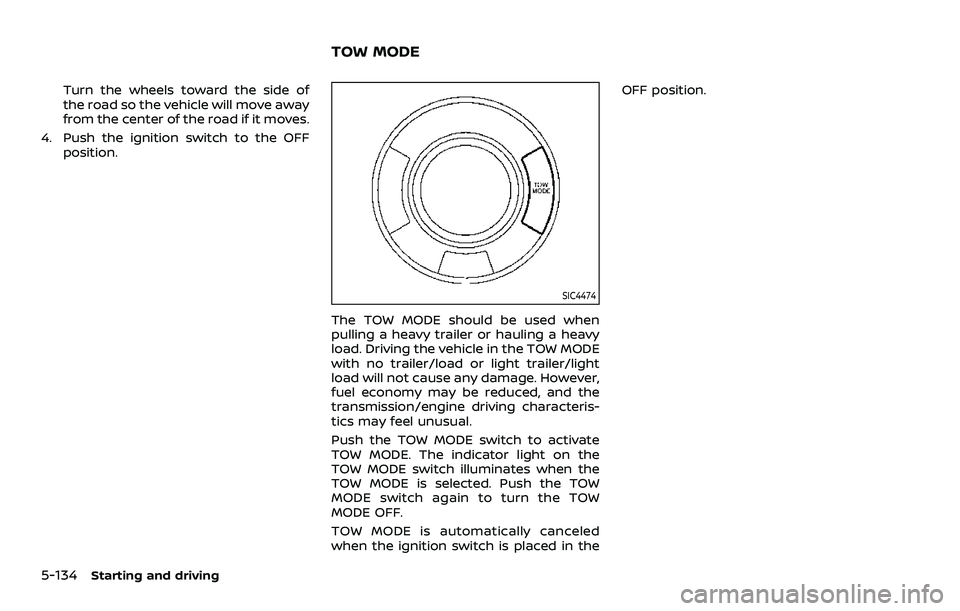
The TOW MODE should be used when
pulling a heavy trailer or hauling a heavy
load. Driving the vehicle in the TOW MODE
with no trailer/load or light trailer/light
load will not cause any damage. However,
fuel economy may be reduced, and the
transmission/engine driving characteris-
tics may feel unusual.
Push the TOW MODE switch to activate
TOW MODE. The indicator light on the
TOW MODE switch illuminates when the
TOW MODE is selected. Push the TOW
MODE switch again to turn the TOW
MODE OFF.
TOW MODE is automatically canceled
when the ignition switch is placed in the OFF position.
TOW MODE
Page 493 of 603
To help ensure smooth, safe and eco-
nomical driving, NISSAN provides two
maintenance schedules that may be
used, depending upon the conditions in
which you usually drive. These schedules
contain both distance and time intervals,
up to 120,000 miles (192,000 km)/96
months. For most people, the odometer
reading will indicate when service is
needed. However, if you drive very little,
your vehicle should be serviced at the
regular time intervals shown in the sche-
dule.
After 120,000 miles (192,000 km)/96
months, continue maintenance at the
same mileage/time intervals.
ADDITIONAL MAINTENANCE ITEMS
FOR SEVERE OPERATING CONDI-
TIONS
Additional maintenance items for se-
vere operating conditions;should be
performed on vehicles that are driven
under especially demanding conditions.
Additional maintenance items should be
performed if you primarily operate your
vehicle under the following conditions:
. Repeated short trips of less than 5
miles (8 km).
. Repeated short trips of less than 10
miles (16 km) with outside tempera-
tures remaining below freezing. .
Operating in hot weather in stop-and-
go “rush hour” traffic.
. Extensive idling and/or low speed
driving for long distances, such as
police, taxi or door-to-door delivery
use.
. Driving in dusty conditions.
. Driving on rough, muddy or salt
spread roads.
. Towing a trailer, or using a camper or
car-top carrier.
If your vehicle is mainly operated under
the severe conditions, follow the severe
maintenance intervals shown in the
maintenance schedule.
NOTE:
For vehicles operated in Canada, both
standard and severe maintenance
items should be performed at every
interval.
Maintenance and schedules9-7
MAINTENANCE SCHEDULES
Page 509 of 603
10 Technical and consumer information
Capacities and
recommended fluids/lubricants .................................... 10-2Fuel information .................................................................. 10-4
Engine oil and oil filter recommendation ........ 10-6
Air conditioning system refrigerant and
oil recommendations ....................................................... 10-7
Specifications ........................................................................\
........ 10-8 Engine ........................................................................\
.................. 10-8
Wheels and tires .................................................................. 10-9
Dimensions ........................................................................\
.. 10-10
When traveling or registering in
another country ..................................................................... 10-11
Vehicle identification .......................................................... 10-11 Vehicle Identification Number
(VIN) plate ........................................................................\
...... 10-11
Vehicle identification number
(chassis number) ............................................................. 10-11
Engine serial number ................................................... 10-12
F.M.V.S.S./C.M.V.S.S. certification label ............. 10-12
Emission control information label .................. 10-12
Tire and loading information label ................... 10-13
Air conditioner specification label ..................... 10-13
Installing front license plate ......................................... 10-15 Vehicle loading information ......................................... 10-15
Terms ........................................................................\
............. 10-15
Vehicle load capacity ................................................ 10-17
Securing the load ......................................................... 10-18
Loading tips ...................................................................... 10-18
Measurement of weights ....................................... 10-19
Towing a trailer ...................................................................... 10-19 Maximum load limits ................................................. 10-19
Maximum Gross Vehicle Weight (GVW)/
maximum Gross Axle Weight (GAW) .............. 10-21
Towing load/specification ..................................... 10-23
Towing safety ................................................................ 10-24
Flat towing ........................................................................\
. 10-35
Uniform tire quality grading ........................................ 10-36 Treadwear ........................................................................\
.. 10-36
Traction AA, A, B and C ........................................... 10-36
Temperature A, B and C ......................................... 10-36
Emission control system warranty ......................... 10-37
Reporting safety defects ................................................ 10-37
Readiness for Inspection/Maintenance
(I/M) test ........................................................................\
............... 10-38
Event Data Recorders (EDR) ......................................... 10-39
Owner’s Manual/Service Manual
order information ................................................................. 10-40
Page 523 of 603
To install the front license plate bracket
to your vehicle, it is recommended you
contact a NISSAN dealer.
WARNING
.It is extremely dangerous to
ride in a cargo area inside
the vehicle. In a collision,
people riding in these areas
are more likely to be ser-
iously injured or killed.
.Do not allow people to ride
in any area of vehicle that is
not equipped with seats and
seat belts.
.Be sure everyone in your
vehicle is in a seat and using
a seat belt properly.
TERMS
It is important to familiarize your-
self with the following terms before
loading your vehicle:
. Curb Weight (actual weight of
your vehicle) - vehicle weight
including: standard and optional
equipment, fluids, emergency
tools, and spare tire assembly.
This weight does notinclude passengers and cargo.
. GVW (Gross Vehicle Weight) -
curb weight plus the combined
weight of passengers and cargo.
. GVWR (Gross Vehicle Weight Rat-
ing) - maximum total combined
weight of the unloaded vehicle,
passengers, luggage, hitch, trai-
ler tongue load and any other
optional equipment. This infor-
mation is located on the F.M.V.S.
S./C.M.V.S.S. label.
. GAWR (Gross Axle Weight Rating)
- maximum weight (load) limit
specified for the front or rear
axle. This information is located
on the F.M.V.S.S./C.M.V.S.S. label.
. GCWR (Gross Combined Weight
Rating) - The maximum total
weight rating of the vehicle,
passengers, cargo, and trailer.
. Vehicle Capacity Weight, Load
limit, Total load capacity - max-
imum total weight limit specified
of the load (passengers and
cargo) for the vehicle. This is
the maximum combined weight
Technical and consumer information10-15
INSTALLING FRONT LICENSE PLATE VEHICLE LOADING INFORMATION
Page 524 of 603
10-16Technical and consumer information
of occupants and cargo that can
be loaded into the vehicle. If the
vehicle is used to tow a trailer,
the trailer tongue weight must
be included as part of the cargo
load. This information is located
on the Tire and Loading Infor-
mation label.
. Cargo capacity - permissible
weight of cargo, the weight of
total occupants weight sub-
tracted from the load limit.
STI0445
Page 525 of 603
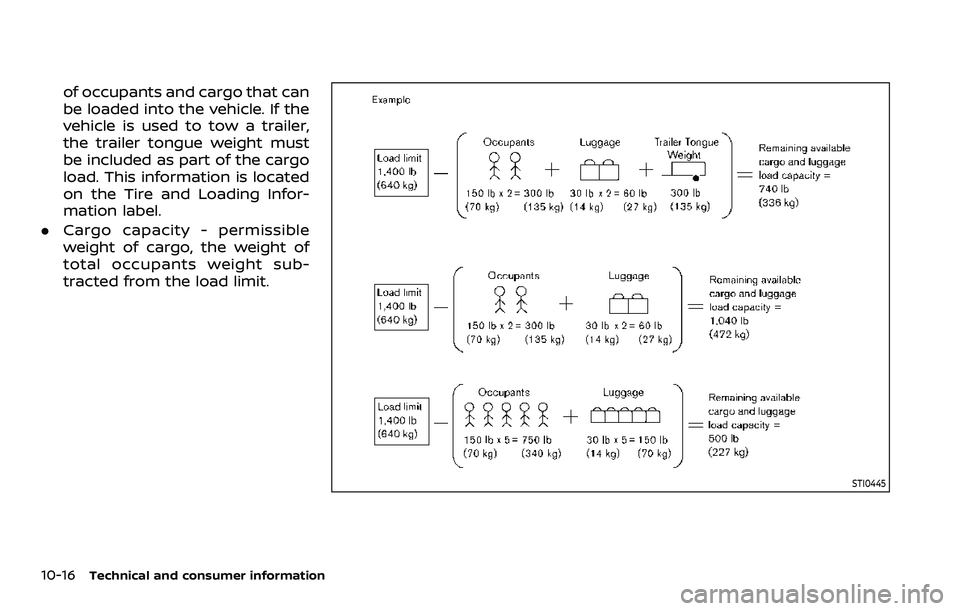
VEHICLE LOAD CAPACITY
Do not exceed the load limit of your
vehicle shown as “The combined
weight of occupants and cargo” on
the Tire and Loading Information
label. Do not exceed the number of
occupants shown as “Seating Ca-
pacity” on the Tire and Loading
Information label.
To get “the combined weight of
occupants and cargo”, add the
weight of all occupants, then add
the total luggage weight. Examples
are shown in the illustration.
Steps for determining correct load
limit
1. Locate the statement “The com-bined weight of occupants and
cargo should never exceed XXX
kg or XXX lbs” on your vehicle’s
placard.
2. Determine the combined weight of the driver and passengers
that will be riding in your vehicle.
3. Subtract the combined weight of the driver and passengers from XXX kg or XXX lbs.
4. The resulting figure equals the available amount of cargo and
luggage load capacity. For ex-
ample, if the XXX amount equals
1400 lbs. and there will be five
150 lb. passengers in your vehi-
cle, the amount of available
cargo and luggage load capacity
is 650 lbs. (1400 − 750 (5 x 150) =
650 lbs) or (640 − 340 (5 x 70) =
300 kg.)
5. Determine the combined weight of luggage and cargo being
loaded on the vehicle. That
weight may not safely exceed
the available cargo and luggage
load capacity calculated in Step
4.
6. If your vehicle will be towing a trailer, load from your trailer will
be transferred to your vehicle.
Consult this manual to deter-
mine how this reduces the avail-
able cargo and luggage load
capacity of your vehicle.
Before driving a loaded vehicle, confirm that you do not exceed
the Gross Vehicle Weight Rating
(GVWR) or the Gross Axle Weight
Rating (GAWR) for your vehicle. (See
“Measurement of weights” (P.10-19).)
Also check tires for proper inflation
pressures. See the Tire and Loading
Information label.
Technical and consumer information10-17
Page 527 of 603
accident and personal in-
jury. Failures caused by
overloading are not covered
by the vehicle’s warranty.
MEASUREMENT OF WEIGHTS
Secure loose items to prevent
weight shifts that could affect the
balance of your vehicle. When the
vehicle is loaded, drive to a scale
and weigh the front and the rear
wheels separately to determine
axle loads. Individual axle loads
should not exceed either of the
gross axle weight ratings (GAWR).
The total of the axle loads should
not exceed the gross vehicle
weight rating (GVWR). These ratings
are given on the vehicle certifica-
tion label. If weight ratings are
exceeded, move or remove items
to bring all weights below the
ratings.WARNING
Overloading or improper loading of a
trailer and its cargo can adversely
affect vehicle handling, braking and
performance and may lead to acci-
dents.
CAUTION
. Do not tow a trailer or haul a
heavy load for the first 500 miles
(800 km). Your engine, axle or
other parts could be damaged.
. For the first 500 miles (800 km)
that you tow a trailer, do not drive
over 50 MPH (80 km/h) and do
not make starts at full throttle.
This helps the engine and other
parts of your vehicle wear in at
the heavier loads.
Your new vehicle was designed to be
used primarily to carry passengers and
cargo. Remember that towing a trailer
places additional loads on your vehicle’s
engine, drivetrain, steering, braking and
other systems.
A NISSAN Towing Guide (U.S. only) is available on the website at
www.nissanusa.com. This guide includes
information on trailer towing capability
and the special equipment required for
proper towing.
MAXIMUM LOAD LIMITS
Maximum trailer loads
Never allow the total trailer load to
exceed the value specified in the “Towing
load/specification” (P.10-23). The total
trailer load equals trailer weight plus its
cargo weight.
.
When towing a trailer load of 3,500
lbs (1,587 kg) or more, trailers with a
brake system MUST be used.
The maximum Gross Combined Weight
Rating (GCWR) should not exceed the
value specified in the following “Towing
Load/Specification” chart.
Technical and consumer information10-19
TOWING A TRAILER