stop NISSAN ARMADA 2022 Owner´s Manual
[x] Cancel search | Manufacturer: NISSAN, Model Year: 2022, Model line: ARMADA, Model: NISSAN ARMADA 2022Pages: 604, PDF Size: 2.97 MB
Page 47 of 604
WARNING
.After adjustment, release the ad-
justment button and try to move
the shoulder belt anchor up and
down to make sure it is securely
fixed in position.
. The shoulder belt anchor height
should be adjusted to the posi-
tion best for you. Failure to do so
may reduce the effectiveness of
the entire restraint system and
increase the chance or severity of
injury in an accident.
SEAT BELT EXTENDERS
If, because of body size or driving position,
it is not possible to properly fit the lap-
shoulder belt and fasten it, an extender
that is compatible with the installed seat
belts is available that can be purchased.
The extender adds approximately 8 in
(200 mm) of length and may be used for
either the driver or front passenger seat-
ing position. It is recommended you visit a
NISSAN dealer for assistance with pur-
chasing an extender if an extender is
required.
WARNING
.It is recommended that only
NISSAN seat belt extenders, made
by the same company which
made the original equipment seat
belts, be used with the NISSAN
seat belts.
. Adults and children who can use
the standard seat belt should not
use an extender. Such unneces-
sary use could result in serious
personal injury in the event of an
accident.
. Never use seat belt extenders to
install child restraints. If the child
restraint is not secured properly,
the child could be seriously in-
jured or killed in a collision or a
sudden stop.
SEAT BELT MAINTENANCE
.To clean the seat belt webbing, apply
a mild soap solution or any solution
recommended for cleaning upholstery
or carpets. Then, wipe with a cloth and
allow the seat belts to dry in the
shade. Do not allow the seat belts to
retract until they are completely dry. .
If dirt builds up in the shoulder belt
guide of the seat belt anchors, the
seat belts may retract slowly. Wipe the
shoulder belt guide with a clean, dry
cloth.
. Periodically check to see that the
seat belt and the metal components
such as buckles, tongues, retractors,
flexible wires and anchors work prop-
erly. If loose parts, deterioration, cuts
or other damage on the webbing is
found, the entire seat belt assembly
should be replaced.
Safety — seats, seat belts and supplemental restraint system1-29
Page 50 of 604
1-32Safety — seats, seat belts and supplemental restraint system
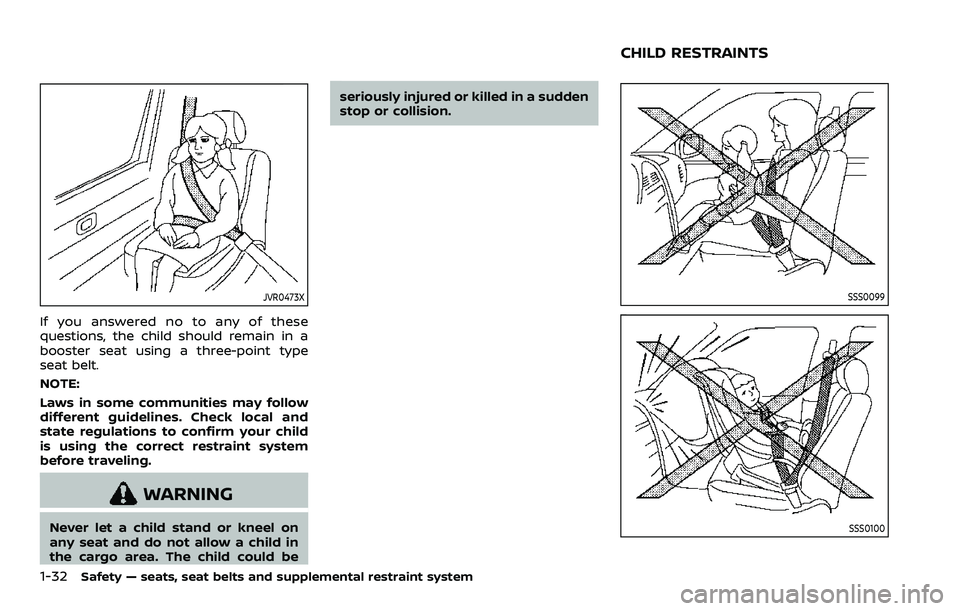
JVR0473X
If you answered no to any of these
questions, the child should remain in a
booster seat using a three-point type
seat belt.
NOTE:
Laws in some communities may follow
different guidelines. Check local and
state regulations to confirm your child
is using the correct restraint system
before traveling.
WARNING
Never let a child stand or kneel on
any seat and do not allow a child in
the cargo area. The child could beseriously injured or killed in a sudden
stop or collision.
SSS0099
SSS0100
CHILD RESTRAINTS
Page 51 of 604
PRECAUTIONS ON CHILD RE-
STRAINTS
WARNING
.Failure to follow the warnings
and instructions for proper use
and installation of child restraints
could result in serious injury or
death of a child or other passen-
gers in a sudden stop or collision:
— The child restraint must be
used and installed properly.
Always follow all of the child
restraint manufacturer’s in-
structions for installation and
use.
— Infants and children should never be held on anyone’s
lap. Even the strongest adult
cannot resist the forces of a
collision.
— Do not put a seat belt around both a child and another pas-
senger.
— NISSAN recommends that all child restraints be installed in
the rear seat. Studies show
that children are safer when
properly restrained in the rear seat than in the front seat. If
you must install a forward-
facing child restraint in the
front seat, see “Forward-fa-
cing child restraint installation
using the seat belts” (P.1-46).
— Even with the NISSAN Ad- vanced Air Bag System, never
install a rear-facing child re-
straint in the front seat. An
inflating air bag could ser-
iously injure or kill a child. A
rear-facing child restraint
must only be used in the rear
seat.
— Be sure to purchase a child restraint that will fit the child
and vehicle. Some child re-
straints may not fit properly
in your vehicle.
— Child restraint anchor points are designed to withstand
loads from child restraints
that are properly fitted.
— Never use the anchor points for adult seat belts or har-
nesses.
— A child restraint with a top tether strap should not be
used in the front passenger seat.
— Keep seatbacks as upright as possible after fitting the child
restraint.
— Infants and children should always be placed in an appro-
priate child restraint while in
the vehicle.
. When the child restraint is not in
use, keep it secured with the
LATCH system or a seat belt. In a
sudden stop or collision, loose
objects can injure occupants or
damage the vehicle.
CAUTION
A child restraint in a closed vehicle
can become very hot. Check the
seating surface and buckles before
placing a child in the child restraint.
This vehicle is equipped with a universal
child restraint anchor system, referred to
as the LATCH (Lower Anchors and
Tethers for CHildren) system. Some child
restraints include rigid or webbing-
mounted attachments that can be con-
nected to these anchors.
Safety — seats, seat belts and supplemental restraint system1-33
Page 53 of 604
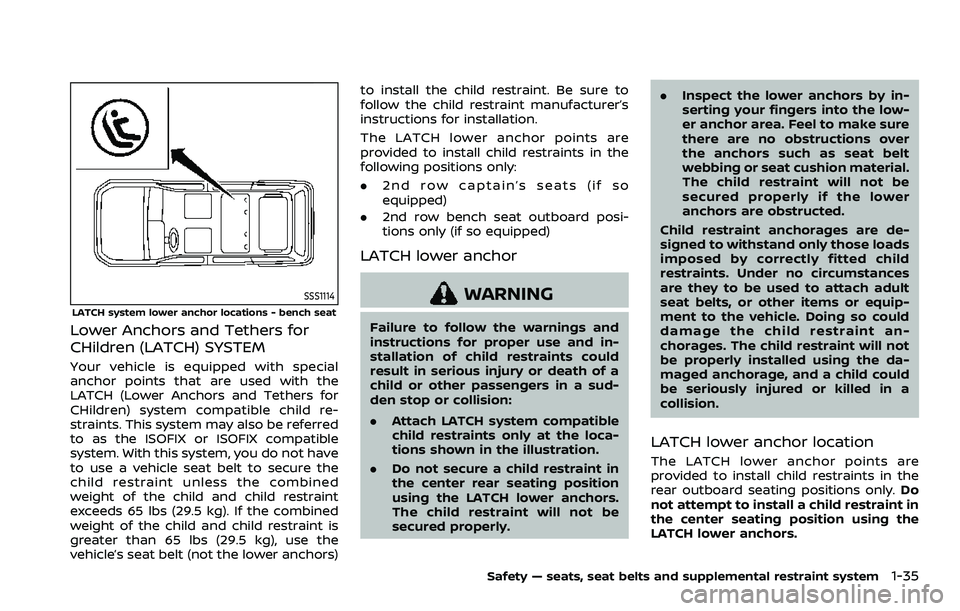
SSS1114
LATCH system lower anchor locations - bench seat
Lower Anchors and Tethers for
CHildren (LATCH) SYSTEM
Your vehicle is equipped with special
anchor points that are used with the
LATCH (Lower Anchors and Tethers for
CHildren) system compatible child re-
straints. This system may also be referred
to as the ISOFIX or ISOFIX compatible
system. With this system, you do not have
to use a vehicle seat belt to secure the
child restraint unless the combined
weight of the child and child restraint
exceeds 65 lbs (29.5 kg). If the combined
weight of the child and child restraint is
greater than 65 lbs (29.5 kg), use the
vehicle’s seat belt (not the lower anchors)to install the child restraint. Be sure to
follow the child restraint manufacturer’s
instructions for installation.
The LATCH lower anchor points are
provided to install child restraints in the
following positions only:
.
2nd row captain’s seats (if so
equipped)
. 2nd row bench seat outboard posi-
tions only (if so equipped)
LATCH lower anchor
WARNING
Failure to follow the warnings and
instructions for proper use and in-
stallation of child restraints could
result in serious injury or death of a
child or other passengers in a sud-
den stop or collision:
.Attach LATCH system compatible
child restraints only at the loca-
tions shown in the illustration.
. Do not secure a child restraint in
the center rear seating position
using the LATCH lower anchors.
The child restraint will not be
secured properly. .
Inspect the lower anchors by in-
serting your fingers into the low-
er anchor area. Feel to make sure
there are no obstructions over
the anchors such as seat belt
webbing or seat cushion material.
The child restraint will not be
secured properly if the lower
anchors are obstructed.
Child restraint anchorages are de-
signed to withstand only those loads
imposed by correctly fitted child
restraints. Under no circumstances
are they to be used to attach adult
seat belts, or other items or equip-
ment to the vehicle. Doing so could
damage the child restraint an-
chorages. The child restraint will not
be properly installed using the da-
maged anchorage, and a child could
be seriously injured or killed in a
collision.
LATCH lower anchor location
The LATCH lower anchor points are
provided to install child restraints in the
rear outboard seating positions only. Do
not attempt to install a child restraint in
the center seating position using the
LATCH lower anchors.
Safety — seats, seat belts and supplemental restraint system1-35
Page 58 of 604
1-40Safety — seats, seat belts and supplemental restraint system
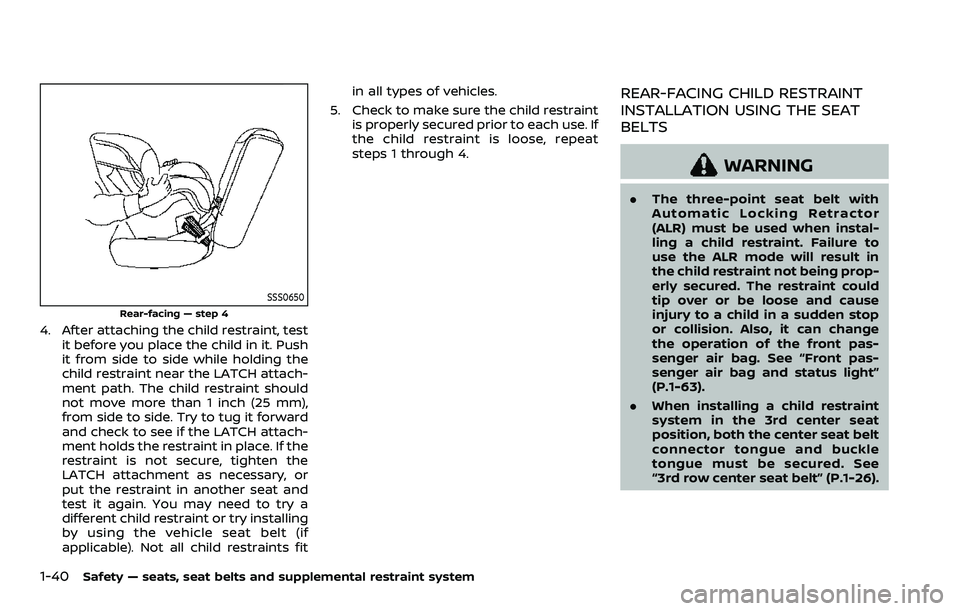
SSS0650
Rear-facing — step 4
4. After attaching the child restraint, testit before you place the child in it. Push
it from side to side while holding the
child restraint near the LATCH attach-
ment path. The child restraint should
not move more than 1 inch (25 mm),
from side to side. Try to tug it forward
and check to see if the LATCH attach-
ment holds the restraint in place. If the
restraint is not secure, tighten the
LATCH attachment as necessary, or
put the restraint in another seat and
test it again. You may need to try a
different child restraint or try installing
by using the vehicle seat belt (if
applicable). Not all child restraints fit in all types of vehicles.
5. Check to make sure the child restraint is properly secured prior to each use. If
the child restraint is loose, repeat
steps 1 through 4.
REAR-FACING CHILD RESTRAINT
INSTALLATION USING THE SEAT
BELTS
WARNING
.The three-point seat belt with
Automatic Locking Retractor
(ALR) must be used when instal-
ling a child restraint. Failure to
use the ALR mode will result in
the child restraint not being prop-
erly secured. The restraint could
tip over or be loose and cause
injury to a child in a sudden stop
or collision. Also, it can change
the operation of the front pas-
senger air bag. See “Front pas-
senger air bag and status light”
(P.1-63).
. When installing a child restraint
system in the 3rd center seat
position, both the center seat belt
connector tongue and buckle
tongue must be secured. See
“3rd row center seat belt” (P.1-26).
Page 64 of 604
1-46Safety — seats, seat belts and supplemental restraint system
JVR0619X
2nd row captain’s seat
JVR0620X2nd row bench seat
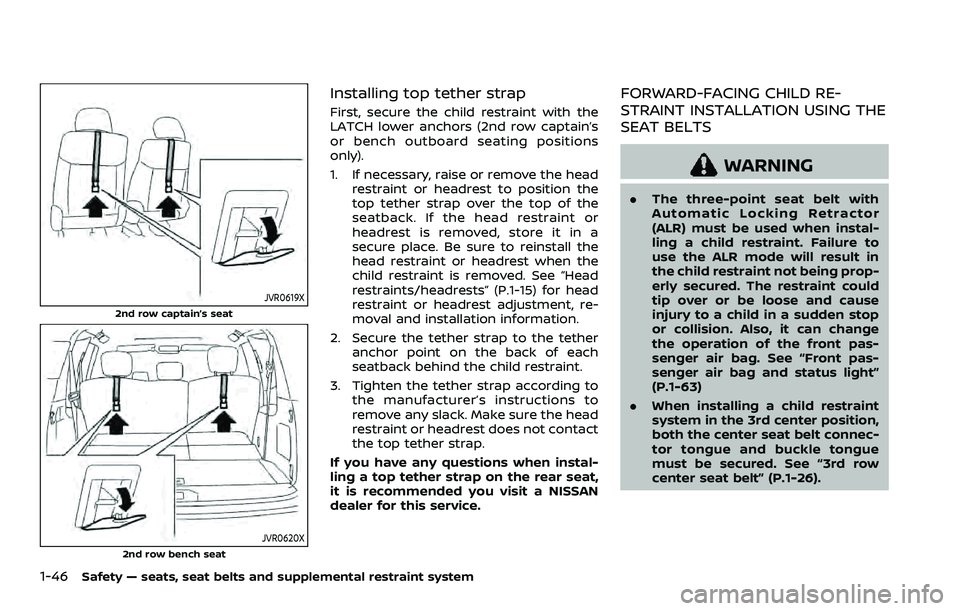
Installing top tether strap
First, secure the child restraint with the
LATCH lower anchors (2nd row captain’s
or bench outboard seating positions
only).
1. If necessary, raise or remove the headrestraint or headrest to position the
top tether strap over the top of the
seatback. If the head restraint or
headrest is removed, store it in a
secure place. Be sure to reinstall the
head restraint or headrest when the
child restraint is removed. See “Head
restraints/headrests” (P.1-15) for head
restraint or headrest adjustment, re-
moval and installation information.
2. Secure the tether strap to the tether anchor point on the back of each
seatback behind the child restraint.
3. Tighten the tether strap according to the manufacturer’s instructions to
remove any slack. Make sure the head
restraint or headrest does not contact
the top tether strap.
If you have any questions when instal-
ling a top tether strap on the rear seat,
it is recommended you visit a NISSAN
dealer for this service.
FORWARD-FACING CHILD RE-
STRAINT INSTALLATION USING THE
SEAT BELTS
WARNING
. The three-point seat belt with
Automatic Locking Retractor
(ALR) must be used when instal-
ling a child restraint. Failure to
use the ALR mode will result in
the child restraint not being prop-
erly secured. The restraint could
tip over or be loose and cause
injury to a child in a sudden stop
or collision. Also, it can change
the operation of the front pas-
senger air bag. See “Front pas-
senger air bag and status light”
(P.1-63)
. When installing a child restraint
system in the 3rd center position,
both the center seat belt connec-
tor tongue and buckle tongue
must be secured. See “3rd row
center seat belt” (P.1-26).
Page 69 of 604
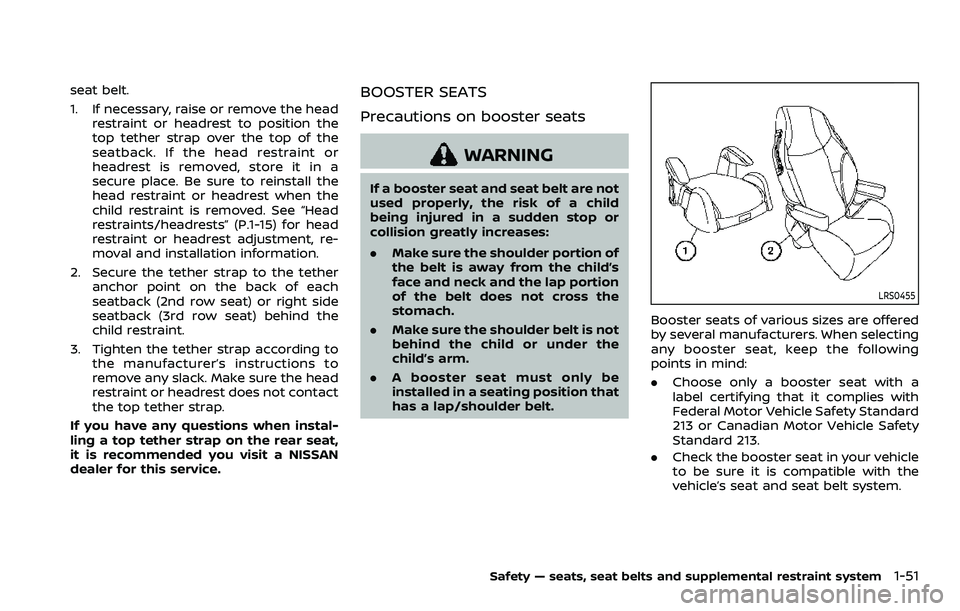
seat belt.
1. If necessary, raise or remove the headrestraint or headrest to position the
top tether strap over the top of the
seatback. If the head restraint or
headrest is removed, store it in a
secure place. Be sure to reinstall the
head restraint or headrest when the
child restraint is removed. See “Head
restraints/headrests” (P.1-15) for head
restraint or headrest adjustment, re-
moval and installation information.
2. Secure the tether strap to the tether anchor point on the back of each
seatback (2nd row seat) or right side
seatback (3rd row seat) behind the
child restraint.
3. Tighten the tether strap according to the manufacturer’s instructions to
remove any slack. Make sure the head
restraint or headrest does not contact
the top tether strap.
If you have any questions when instal-
ling a top tether strap on the rear seat,
it is recommended you visit a NISSAN
dealer for this service.BOOSTER SEATS
Precautions on booster seats
WARNING
If a booster seat and seat belt are not
used properly, the risk of a child
being injured in a sudden stop or
collision greatly increases:
. Make sure the shoulder portion of
the belt is away from the child’s
face and neck and the lap portion
of the belt does not cross the
stomach.
. Make sure the shoulder belt is not
behind the child or under the
child’s arm.
. A booster seat must only be
installed in a seating position that
has a lap/shoulder belt.
LRS0455
Booster seats of various sizes are offered
by several manufacturers. When selecting
any booster seat, keep the following
points in mind:
.Choose only a booster seat with a
label certifying that it complies with
Federal Motor Vehicle Safety Standard
213 or Canadian Motor Vehicle Safety
Standard 213.
. Check the booster seat in your vehicle
to be sure it is compatible with the
vehicle’s seat and seat belt system.
Safety — seats, seat belts and supplemental restraint system1-51
Page 83 of 604

children be properly restrained in a rear
seat. NISSAN also recommends that ap-
propriate child restraints and booster
seats be properly installed in a rear seat.
If this is not possible, the occupant
classification sensors are designed to
operate as described above to turn the
front passenger air bag and front pas-
senger knee air bag OFF for specified
child restraints. Failing to properly secure
child restrains and to use the ALR mode
may allow the restraint to tip or move in
an accident or sudden stop. This can also
result in the passenger air bag and front
passenger knee air bag inflating in a
crash instead of being OFF. (See “Child
restraints” (P.1-32) for proper use and
installation.)
If the front passenger seat is not occu-
pied, the passenger air bag and front
passenger knee air bag are designed not
to inflate in a crash. However, heavy
objects placed on the seat could result
in air bag inflation, because of the object
being detected by the occupant classifi-
cation sensors. Other conditions could
also result in air bag inflation, such as if a
child is standing on the seat, or if two
children are on the seat, contrary to the
instructions in this manual. Always be
sure that you and all vehicle occupants
are seated and restrained properly.Using the front passenger air bag status
light, you can monitor when the front
passenger air bag and front passenger
knee air bag are automatically turned
OFF with the seat occupied. The light will
not illuminate when the front passenger
seat is unoccupied.
If an adult occupant is in the seat but the
front passenger air bag status light is
illuminated (indicating that the front pas-
senger air bag and front passenger knee
air bag are OFF), it could be that the
person is a small adult, or is not sitting on
the seat properly.
If a child restraint must be used in the
front seat, the front passenger air bag
status light may or may not be illumi-
nated, depending on the size of the child
and the type of child restraint being used.
If the front passenger air bag status light
is not illuminated (indicating that the air
bag might inflate in a crash), it could be
that the child restraint or seat belt is not
being used properly. Make sure that the
child restraint is installed properly, the
seat belt is used properly and the occu-
pant is positioned properly. If the front
passenger air bag status light is still not
illuminated, reposition the occupant or
child restraint in a rear seat.
If the front passenger air bag status light
will not illuminate even though you be-lieve that the child restraint, the seat belts
and the occupant are properly positioned,
the system may be sensing an unoccu-
pied seat (in which case the air bag is
OFF). Your NISSAN dealer can check that
the system is OFF by using a special tool.
However, until you have confirmed with
your dealer that your air bag is working
properly, reposition the occupant or child
restraint in a rear seat.
The NISSAN Advanced Air Bag System
and front passenger air bag status light
will take a few seconds to register a
change in the front passenger seat sta-
tus. However, if the seat becomes unoc-
cupied, the front passenger air bag status
light will remain off.
If a malfunction occurs in the front
passenger air bag system, the supple-
mental air bag warning light
, located
in the meter and gauges area will blink.
Have the system checked. It is recom-
mended you visit a NISSAN dealer for this
service.
Normal operation:
In order for the occupant classification
sensor system to classify the front pas-
senger based on weight, please follow the
precautions and steps outlined below:
Safety — seats, seat belts and supplemental restraint system1-65
Page 84 of 604
1-66Safety — seats, seat belts and supplemental restraint system
Precautions:
.Make sure that there are no objects
weighing over 9.1 lbs (4 kg) hanging on
the seat or placed in the seatback
pocket.
. Make sure that a child restraint or
other object is not pressing against
the rear of the seatback.
. Make sure that a rear passenger is not
pushing or pulling on the back of the
front passenger seat.
. Make sure that the front passenger
seat or seatback is not forced back
against an object on the seat or floor
behind it.
. Make sure that there is no object
placed under the front passenger
seat.
Steps:
1. Adjust the seat as outlined. (See “Seats” (P.1-3).) Sit upright, leaning
against the seatback, and centered
on the seat cushion with your feet
comfortably extended to the floor.
2. Make sure there are no objects on your lap.
3. Fasten the seat belt as outlined. (See “Seat belts” (P.1-20).)
4. Remain in this position for 30 seconds allowing the system to classify the front passenger before the vehicle is
put into motion.
5. Ensure proper classification by check- ing the front passenger air bag status
light.
NOTE:
This vehicle’s occupant classification
sensor system locks the classification
during driving so it is important that
you confirm that the front passenger is
properly classified prior to driving. Also,
the occupant classification sensor sys-
tem may recalculate the weight of the
occupant when the vehicle comes to a
stop (i.e. stop light, stop sign, etc.), so
the front passenger seat occupant
should continue to remain seated as
outlined above.
Troubleshooting:If you think the front passenger air bag
status light is incorrect:
1. If the light is ON with no front passenger and no objects on the front passenger
seat:
This may be due to the following condi-
tions that may be interfering with the
weight sensors:
.An object weighing over 9.1 lbs (4 kg)
hanging on the seat or placed in the
seatback pocket. .
A child restraint or other object press-
ing against the rear of the seatback.
. A rear passenger pushing or pulling
on the back of the front passenger
seat.
. Forcing the front seat or seatback
against an object on the seat or floor
behind it.
. An object placed under the front
passenger seat.
. An object placed between the seat
cushion and center console or be-
tween the seat cushion and the door.
If the vehicle is moving, please come to a
stop when it is safe to do so. Check and
correct any of the above conditions.
Restart the vehicle and wait 1 minute.
NOTE:
A system check will be performed dur-
ing which the front passenger air bag
status light will remain lit for about 7
seconds initially.
If the light is still ON after this, it is
recommended that the vehicle be
checked by a NISSAN dealer as soon as
possible.
2. If the light is ON with an adult occupying the front passenger seat:
.Occupant is a small adult — the front
passenger air bag status light is func-
tioning as intended. The front passen-
Page 85 of 604

ger air bag and front passenger knee
air bag are suppressed.
However, if the occupant is not a small
adult, then this may be due to the
following conditions that may be interfer-
ing with the weight sensors:
. Occupant is not sitting upright, lean-
ing against the seatback, and cen-
tered on the seat cushion with his/her
feet comfortably extended to the
floor.
. A child restraint or other object press-
ing against the rear of the seatback.
. A rear passenger pushing or pulling
on the back of the front passenger
seat.
. Forcing the front seat or seatback
against an object on the seat or floor
behind it.
. An object placed under the front
passenger seat.
. An object placed between the seat
cushion and center console or be-
tween the seat cushion and the door.
If the vehicle is moving, please come to a
stop when it is safe to do so. Check and
correct any of the above conditions.
Restart the vehicle and wait 1 minute. NOTE:
A system check will be performed dur-
ing which the front passenger air bag
status light will remain lit for about 7
seconds initially.
If the light is still ON after this, the person
should be advised not to ride in the front
passenger seat and it is recommended
that the vehicle be checked by a NISSAN
dealer as soon as possible.
3. If the light is OFF with a small adult, child
or child restraint occupying the front
passenger seat.
This may be due to the following condi-
tions that may be interfering with the
weight sensors:
.Small adult or child is not sitting
upright, leaning against the seatback,
and centered on the seat cushion with
his/her feet comfortably extended to
the floor.
. The child restraint is not properly
installed, as outlined. (See “Child re-
straints” (P.1-32).)
. An object weighing over 9.1 lbs (4 kg)
hanging on the seat or placed in the
seatback pocket.
. A child restraint or other object press-
ing against the rear of the seatback.
. A rear passenger pushing or pulling
on the back of the front passenger
seat. .
Forcing the front seat or seatback
against an object on the seat or floor
behind it.
. An object placed under the front
passenger seat.
. An object placed between the seat
cushion and center console.
If the vehicle is moving, please come to a
stop when it is safe to do so. Check and
correct any of the above conditions.
Restart the vehicle and wait 1 minute.
NOTE:
A system check will be performed dur-
ing which the front passenger air bag
status light will remain lit for about 7
seconds initially.
If the light is still OFF after this, the small
adult, child or child restraint should be
repositioned in the rear seat and it is
recommended that the vehicle be
checked by a NISSAN dealer as soon as
possible.
Other supplemental front-impact
air bag precautions
WARNING
. Do not place any objects on the
steering wheel pad or on the
instrument panel. Also, do not
Safety — seats, seat belts and supplemental restraint system1-67