cooling NISSAN FRONTIER 1996 D22 / 1.G User Guide
[x] Cancel search | Manufacturer: NISSAN, Model Year: 1996, Model line: FRONTIER, Model: NISSAN FRONTIER 1996 D22 / 1.GPages: 198, PDF Size: 1.3 MB
Page 132 of 198
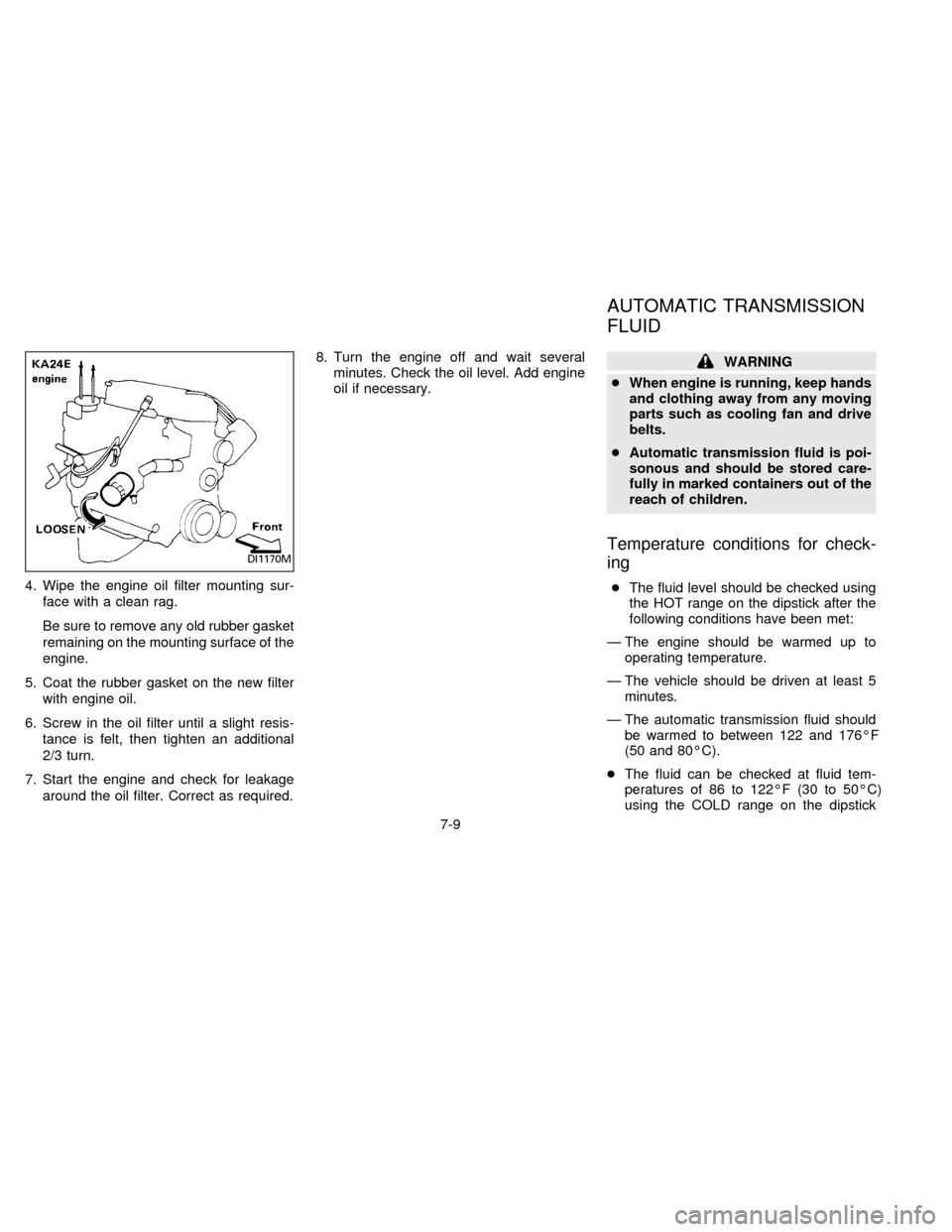
4. Wipe the engine oil filter mounting sur-
face with a clean rag.
Be sure to remove any old rubber gasket
remaining on the mounting surface of the
engine.
5. Coat the rubber gasket on the new filter
with engine oil.
6. Screw in the oil filter until a slight resis-
tance is felt, then tighten an additional
2/3 turn.
7. Start the engine and check for leakage
around the oil filter. Correct as required.8. Turn the engine off and wait several
minutes. Check the oil level. Add engine
oil if necessary.
WARNING
cWhen engine is running, keep hands
and clothing away from any moving
parts such as cooling fan and drive
belts.
cAutomatic transmission fluid is poi-
sonous and should be stored care-
fully in marked containers out of the
reach of children.
Temperature conditions for check-
ing
cThe fluid level should be checked using
the HOT range on the dipstick after the
following conditions have been met:
Ð The engine should be warmed up to
operating temperature.
Ð The vehicle should be driven at least 5
minutes.
Ð The automatic transmission fluid should
be warmed to between 122 and 176ÉF
(50 and 80ÉC).
cThe fluid can be checked at fluid tem-
peratures of 86 to 122ÉF (30 to 50ÉC)
using the COLD range on the dipstick
DI1170M
AUTOMATIC TRANSMISSION
FLUID
7-9
ZX
Page 163 of 198

EXPLANATION OF MAINTE-
NANCE ITEMS
Additional information on the following
items with ``*'' is found in the ``Do-it-
yourself operations'' section.
Emission control system mainte-
nance
Drive belts*Check drive belts for wear,
fraying or cracking and also for proper ten-
sion. Replace the drive belts if found dam-
aged or in accordance with the mainte-
nance schedule.
Air cleaner filterUnder normal driving con-
ditions, the air cleaner filter should be re-
placed in accordance with the maintenance
schedule. However, driving the vehicle in
dusty areas may cause more rapid clogging
of the element. Consequently, the element
may have to be replaced more frequently.
Positive crankcase ventilation (PCV) fil-
terUnder normal driving conditions, the
filter should be replaced in accordance with
the maintenance schedule. If the vehicle is
operated under extremely adverse weather
conditions or in areas where ambient tem-
peratures are either extremely low or ex-tremely high, the filter may become clogged
more rapidly. In such an event, replace the
filter immediately.
Vapor linesCheck vapor lines and connec-
tions for failure or looseness. If leaks are
found, replace the lines.
Fuel lines (hoses, piping, connections,
etc.)Check the fuel hoses, piping and con-
nections for leaks, looseness or deteriora-
tion. Replace any parts if they are damaged.
Fuel filterIf the vehicle is operated under
extremely adverse weather conditions or in
areas where ambient temperatures are ei-
ther extremely low or extremely high, the
filter might become clogged. In such an
event, replace the filter immediately.
Engine coolant*Flush and refill the cooling
system.
Engine oil & oil filter*Under normal driving
conditions, the engine oil and oil filter should
be replaced in accordance with the mainte-
nance schedule. However, under severe
driving conditions, they may have to be
replaced more frequently.
Spark plugs*Replace with new plugs hav-
ing the correct heat range.
Chassis and body maintenance
Brake lines & cablesCheck the brake lines
and hoses (including brake booster vacuum
hoses, connections & check valve) and
parking brake cables for proper attachment,
leaks, cracks, chafing, abrasion, deteriora-
tion, etc.
Brake pads, discs, drums & linings
Check these and the other neighboring
brake components for wear, deterioration
and leaks. Under severe driving conditions,
they may have to be inspected more fre-
quently.
Manual and automatic transmission,
transfer & differential gear oilVisually
inspect for signs of leakage and replace oil
for limited-slip differential. Under severe
driving conditions, the oil should be re-
placed at the specified interval.
Steering gear (box) & linkage, axle &
suspension parts & drive shaft boots
Check for damage, looseness and leakage
of oil or grease. Under severe driving con-
ditions, more frequent inspection should be
performed.
Steering linkage ball joints & front sus-
pension ball jointsCheck the ball joints for
8-10
ZX
Page 167 of 198

The following are approximate capacities. The actual refill capacities may be a little different. When refilling, follow the procedure
described in the ``Do-it-yourself operations'' section to determine the proper refill capacity.
Capacity (Approximate)
Recommended Specifications
US
measureImp
measureLiter
Fuel 15-7/8 gal 13-1/4 gal 60Unleaded gasoline with an octane rating
of at least 87 AKI (RON 91)*1
Engine oil (Refill)
4x2 With oil filter 4-1/8 qt 3-3/8 qt 3.9
API SG or SH and Energy Conserving II *2
API Certification Mark *2 Without oil filter 3-3/4 qt 3-1/8 qt 3.5
4x4 With oil filter 4-3/8 qt 3-5/8 qt 4.1
Without oil filter 4 qt 3-3/8 qt 3.8
Cooling system (with heater and reservoir tank)
4x2 8-5/8 qt 7-1/8 qt 8.1
Anti-freeze coolant
(Ethylene glycol base)
4x4 9-1/2 qt 7-7/8 qt 9.0
*1: For further details, see ``Fuel recommendation''.
*2: For further details, see ``Recommended SAE engine oil viscosity''.
CAPACITIES AND
RECOMMENDED
FUEL/LUBRICANTS
9-2
ZX
Page 193 of 198
Driving
Auto-lock free-running hubs ................. 4-15
Cold weather driving cautions .............. 4-27
Driving with automatic transmission ....... 4-6
Driving with manual transmission ........... 4-9
Driving your 4-wheel drive safely ......... 4-22
Manual-lock free-running hubs ............. 4-19
Precautions when driving ..................... 4-25
Precautions when starting and driving ... 4-2
E
Economy, fuel ............................................ 4-13
Emission control information label............. 9-14
Emission control system warranty ............. 9-22
Engine
Before starting the engine ...................... 4-5
Capacities and recommended
fuel/lubricants.......................................... 9-2
Changing engine coolant........................ 7-5
Changing engine oil................................ 7-7
Changing engine oil filter........................ 7-8
Checking engine coolant level ............... 7-4
Checking engine oil level ....................... 7-6
Engine compartment check locations .... 7-3
Engine coolant temperature gauge ........ 1-4
Engine cooling system ........................... 7-4
Engine oil ................................................ 7-6
Engine oil and oil filter
recommendation ..................................... 9-6
Engine oil viscosity ................................. 9-7
Engine serial number ........................... 9-13Engine specifications .............................. 9-9
Starting the engine ............................... 4-10
Exhaust gas (Carbon monoxide) ................. 4-2
F
Flashers (See hazard warning flasher switch)
Flat tire ......................................................... 5-2
Floor mat positioning aid ............................. 6-4
Fluid (Checking)
Automatic transmission fluid ................... 7-9
Brake and clutch fluid ........................... 7-11
Engine coolant ........................................ 7-4
Engine oil ................................................ 7-6
Power steering fluid .............................. 7-11
Window washer fluid ............................ 7-12
F.M.V.S.S. certification label ..................... 9-13
Front seats
Bench.................................................... 2-10
Separate ................................................. 2-8
Fuel
Capacities and recommended
fuel/lubricants.......................................... 9-2
Fuel economy ....................................... 4-13
Fuel filler cap .......................................... 2-5
Fuel gauge.............................................. 1-4
Fuel octane rating................................... 9-5
Fuel recommendation ............................. 9-4
Fuses ......................................................... 7-20G
Gas station information............................ 10-11
Gauge
Engine coolant temperature gauge ........ 1-4
Fuel gauge.............................................. 1-4
Odometer ................................................ 1-3
Speedometer .......................................... 1-3
Tachometer............................................. 1-3
Trip odometer ......................................... 1-3
Gear selection (See shifting)
General maintenance .................................. 8-2
Glove box lock ............................................. 2-4
H
Hazard warning flasher switch .................. 1-12
Head restraints ............................................ 2-9
Headlight and turn signal switch ............... 1-10
Headlights .................................................. 7-20
Heater
Heater and air conditioner controls ........ 3-3
Heater operation ..................................... 3-4
Hood release ............................................... 2-4
Hubs
Auto-lock free-running hubs ................. 4-15
Manual-lock free-running hubs ............. 4-19
I
Ignition switch .............................................. 4-4
10-2
ZX