ignition NISSAN FRONTIER 1996 D22 / 1.G User Guide
[x] Cancel search | Manufacturer: NISSAN, Model Year: 1996, Model line: FRONTIER, Model: NISSAN FRONTIER 1996 D22 / 1.GPages: 198, PDF Size: 1.3 MB
Page 37 of 198
This Supplemental Restraint System sec-
tion contains important information concern-
ing the driver supplemental air bag. The
Supplemental Restraint System Air Bag can
help reduce impact force to the driver in
certain frontal collisions. The supplemental
air bag is designed tosupplementthe
crash protection provided by the seat belt
and isnot a substitutefor it. The seat belt
should always be correctly worn and the
driver seated a suitable distance from the
steering wheel. (See ``Seat belts'' later in
this section for instructions and precautions
on seat belt usage.)
The supplemental air bag operates only
when the ignition switch is in the ON or
START position.
WARNING
The supplemental air bag ordinarily will
not inflate in the event of a side impact,
rear impact, roll over, or lower severity
frontal collision; so always wear your
seat belts to help reduce the risk or
severity of injury in various kinds of
accidents.
WARNING
The seat belts and the supplemental air
bag are most effective when you are
sitting back and upright in the seat.
Supplemental air bags inflate with
great force. If you are unrestrained,
leaning forward, sitting sideways or out
of position in any way, you are at
greater risk of injury or death in a crash
and may also receive serious or fatal
injuries from the supplemental air bag
if you are up against it when it inflates.
Always sit back against the seatback
and use the seatbelts.
SUPPLEMENTAL RESTRAINT
SYSTEM (SUPPLEMENTAL AIR
BAG SYSTEM)
2-12
ZX
Page 38 of 198
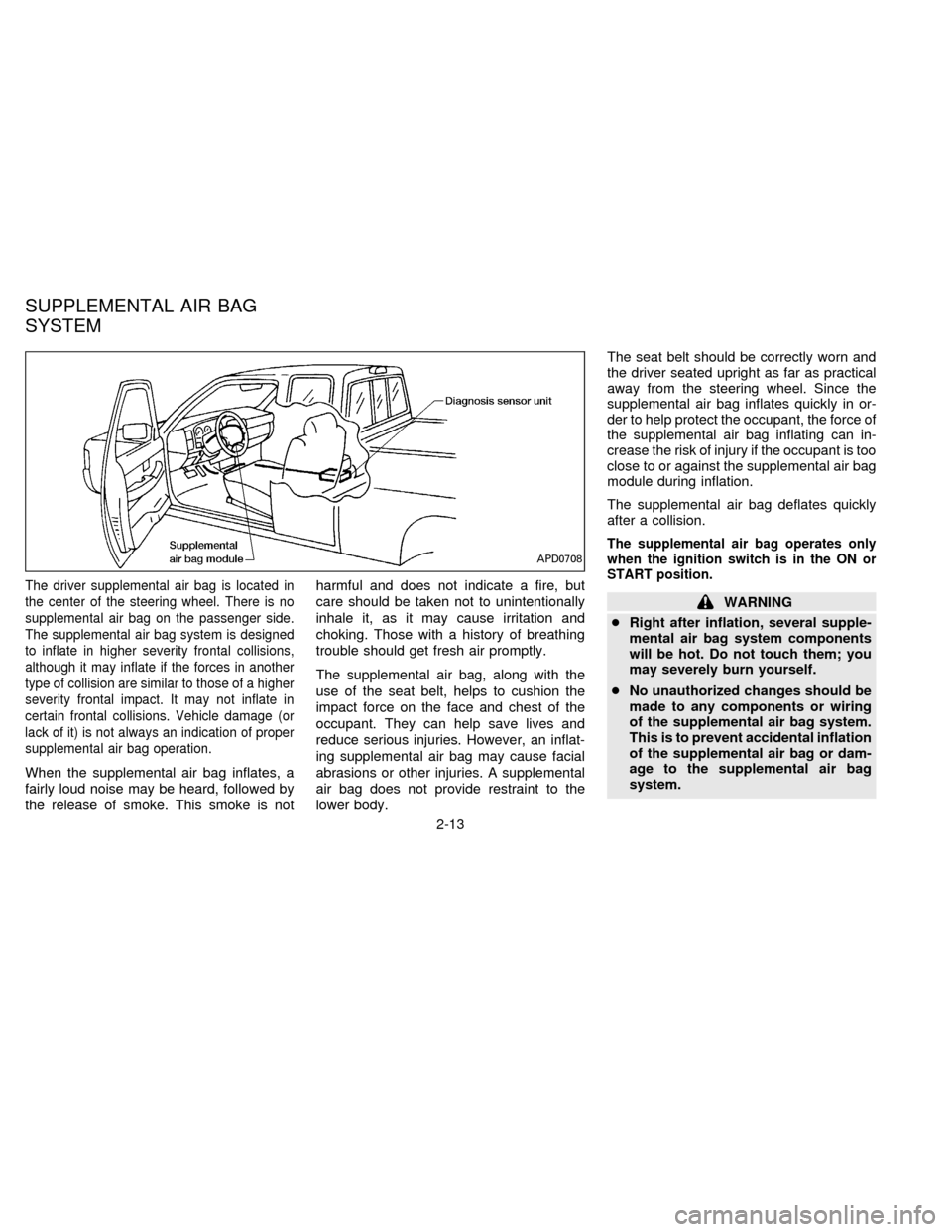
The driver supplemental air bag is located in
the center of the steering wheel. There is no
supplemental air bag on the passenger side.
The supplemental air bag system is designed
to inflate in higher severity frontal collisions,
although it may inflate if the forces in another
type of collision are similar to those of a higher
severity frontal impact. It may not inflate in
certain frontal collisions. Vehicle damage (or
lack of it) is not always an indication of proper
supplemental air bag operation.
When the supplemental air bag inflates, a
fairly loud noise may be heard, followed by
the release of smoke. This smoke is notharmful and does not indicate a fire, but
care should be taken not to unintentionally
inhale it, as it may cause irritation and
choking. Those with a history of breathing
trouble should get fresh air promptly.
The supplemental air bag, along with the
use of the seat belt, helps to cushion the
impact force on the face and chest of the
occupant. They can help save lives and
reduce serious injuries. However, an inflat-
ing supplemental air bag may cause facial
abrasions or other injuries. A supplemental
air bag does not provide restraint to the
lower body.The seat belt should be correctly worn and
the driver seated upright as far as practical
away from the steering wheel. Since the
supplemental air bag inflates quickly in or-
der to help protect the occupant, the force of
the supplemental air bag inflating can in-
crease the risk of injury if the occupant is too
close to or against the supplemental air bag
module during inflation.
The supplemental air bag deflates quickly
after a collision.
The supplemental air bag operates only
when the ignition switch is in the ON or
START position.
WARNING
cRight after inflation, several supple-
mental air bag system components
will be hot. Do not touch them; you
may severely burn yourself.
cNo unauthorized changes should be
made to any components or wiring
of the supplemental air bag system.
This is to prevent accidental inflation
of the supplemental air bag or dam-
age to the supplemental air bag
system.
APD0708
SUPPLEMENTAL AIR BAG
SYSTEM
2-13
ZX
Page 40 of 198

Warning labels about the supplemental air
bag system are placed in the vehicle as
shown in the illustration.The supplemental air bag light, displaying
AIR BAG in the instrument panel, monitors
the circuits of the supplemental air bag. The
circuits monitored by the supplemental air
bag light are the diagnosis sensor unit, the
supplemental air bag module and all related
wiring.
When the ignition key is in the ON or START
position, the supplemental air bag warning
light illuminates for about 7 seconds and
then turns off. This means the system is
operational.
If any of the following conditions occur, the
supplemental air bag needs servicing and
APD0705APD0706
WARNING LABELS SUPPLEMENTAL AIR BAG
WARNING LIGHT
2-15
ZX
Page 41 of 198
should be taken to your nearest authorized
NISSAN dealer:
1. The supplemental air bag light does not
come on and remain on for 7 seconds
and then go off as described above.
2. The supplemental air bag light flashes
intermittently or remains on.
3. The supplemental air bag light does not
come on at all.
Under these conditions, the Supplemental
Restraint System Air Bag does not operate
properly. It must be checked and repaired.
Repair and replacement procedure
The supplemental air bag system is de-
signed to inflate on a one-time-only basis.
As a reminder, unless it is damaged, the
supplemental air bag light remains illumi-
nated after inflation has occurred. Repair
and replacement of the supplemental air
bag system should be done only by an
authorized NISSAN dealer.
To ensure long-term functioning, the
system must be inspected 10 years after
the date of manufacture noted on the
certification label located on the driver
side front pillar.
When maintenance work is required on the
vehicle, the supplemental air bag system
and related parts should be pointed out to
the person conducting the maintenance.
The ignition key must always be in the LOCK
position when working under the hood or
inside the vehicle.
WARNING
cOnce the supplemental air bag in-
flates, the supplemental air bag
module will not function again and
must be replaced. The supplemental
air bag module cannot be repaired.
cThe supplemental air bag system
should be inspected by an autho-
rized NISSAN dealer if there is any
damage to the front end portion of
the vehicle or if the supplemental air
bag has inflated.
cWhen selling your vehicle, we re-
quest that you inform the buyer
about the supplemental air bag sys-
tem and guide the buyer to the ap-
propriate sections in this Owner's
Manual.cIf you need to dispose of the supple-
mental air bag or scrap the vehicle,
contact an authorized NISSAN
dealer. Correct supplemental air bag
disposal procedures are set forth in
the appropriate NISSAN Service
Manual. Incorrect disposal proce-
dures could cause personal injury.
2-16
ZX
Page 42 of 198
PRECAUTIONS ON SEAT BELT
USAGE
Your chances of being injured in an acci-
dent and/or the severity of injury may be
greatly reduced if you are wearing your seat
belt and it is properly adjusted. NISSAN
strongly encourages you and all of your
passengers to buckle up every time you
drive, even if your seating position includes
an supplemental air bag.
Some states, provinces or territories
may specify that seat belts be worn at all
times when a vehicle is being driven.
WARNING
cEvery person who drives or rides in
this vehicle should use a seat belt at
all times. Children should be in ap-
propriate child restraints.
c
The belt should be properly adjusted
to a snug fit. Failure to do so reduces
the effectiveness of the entire restraint
system and increases the chance or
severity of injury in an accident.
cDo not wear the belt inside out or
twisted. Be sure the seat belt tongue is
securely fastened to the proper buckle.
cDo not allow more than one person
to use the same belt.
cAll seat belt assemblies including
retractors and attaching hardware
should be inspected after any colli-
sion at your NISSAN dealer. NISSAN
recommends that all seat belt as-
semblies in use during a collision be
replaced unless the collision was
minor and the belts show no damage
and continue to operate properly.
Seat belt assemblies not in use dur-
ing a collision should also be in-
spected and replaced if either dam-
age or improper operation is noted.
cNever carry more people in the ve-
hicle than there are seat belts.
cNever allow anyone to ride in the
cargo area or in a slide-in camper or
other type cargo area cover while the
vehicle is in motion. These areas do
not contain seat belts. It is not de-
signed for passengers. They could
be injured in sudden braking or
collision.cIf the seat belt warning lamp glows
continuously while the ignition is
turned ON with all doors closed and
all seat belts fastened, it may indi-
cate a malfunction in the system.
Have the system checked by your
NISSAN dealer.
cBe sure to observe the following
cautions when using seat belts. Fail-
ure to do so could increase the
chance and/or severity of injury in an
accident.
cAlways route the shoulder belt over
your outer shoulder and across your
chest. Never run the belt under your
arm or across your neck. The belt
should be away from your face and
neck, but not falling off your
shoulder.
c
Position the lap belt as low as pos-
sible AROUND THE HIPS, NOT THE
WAIST.
cSerious injury or death can occur if
the seat belt is not worn properly.
SEAT BELTS
2-17
ZX
Page 63 of 198

To turn the radio on, turn the ignition key to
ACC or ON. If you listen to the radio with the
engine not running, turn the key to the ACC
position.
Radio reception is affected by station signal
strength, distance from radio transmitter,
buildings, bridges, mountains and other ex-
ternal influences. Intermittent changes in
reception quality normally are caused by
these external influences.
AHA0606
RADIO
3-10
ZX
Page 66 of 198

Adjusting tone quality and sound
balance
To adjust BASS, TREB (treble), FADER,
and BAL (balance) the control knobs must
be released from their stowed positions.
Pushing the knobs once moves them to the
released position.
In the released position, the knobs control
tone quality. Turn the control knobs to ad-
just BASS and TREB to the most pleasing
level.
From the released position, the knobs must
be pulled out in order to control FADER andBAL. FADER adjusts the sound level be-
tween the front and rear speakers, and BAL
adjusts the sound level between the right
and left speakers.
Once sound quality is set to the desired
levels, return the control knobs to the
stowed position by pushing them in com-
pletely and releasing.
CASSETTE TAPE OPERATION
Turn the ignition key to ACC or ON, then
lightly insert the cassette tape into the tape
door.
The cassette tape automatically pulls into
the player. The word TAPE and an arrow
indicating tape side illuminates in the dis-
play window.
Do not force the cassette tape into the
tape door.
Pressing strongly could cause player
damage.
AHA0522AIC0709
3-13
ZX
Page 72 of 198

CASSETTE TAPE OPERATION
Turn the ignition key to ACC or ON, then
lightly insert the cassette tape into the tape
door.
The cassette tape automatically pulls into
the player. The word TAPE and an arrow
indicating tape side illuminates in the dis-
play window.
The radio turns off and the cassette tape
begins to play.
Do not force the cassette tape into the
tape door.Pressing strongly could cause player
damage.
The cassette tape automatically changes
direction to play the other side when the first
side is complete. At this time, the arrow in
the display window changes direction.
PLAY/STOP button
Push the PLAY/STOP button to resume
tape play when:
cthe tape has stopped playing.
cthe tape is in the fast forward mode.
cthe tape is in the rewind mode.
Pressing the PLAY/STOP button during
tape play stops the tape and turns the audio
system off.
Fast forwarding or rewinding the
tape
Push either the FF (fast forward) or REW
(rewind) button for the desired direction.
Automatic Program Search (APS)
fast forwarding or APS rewinding
the tape
Push either the APS FF or APS REW button
while the cassette tape is playing. The tape
runs quickly, stops, then plays the next
selection.
This system searches for the blank intervals
between selections. If there is a blank inter-
val within one program or there is no interval
between programs, the system may not
stop in the desired or expected location.
Changing the direction of tape play
Push the PROG (program) select button.
Dolby NR (noise reduction)
Push theDOLBY NR button for
DOLBY NR encoded tapes to reduce high
frequency tape noise. The indicator light
comes on.
Dolby NR is manufactured under license
from Dolby Laboratories Licensing Corpora-
tion. Dolby NR and the double-D symbol are
trademarks of Dolby Laboratories Licensing
Corporation.
AIC0713
3-19
ZX
Page 76 of 198

4 Starting and driving
Precautions when starting and driving ............... 4-2
On-pavement and off-road driving precautions . 4-3
Drinking alcohol/drugs and driving ..................... 4-4
Ignition switch ..................................................... 4-4
Before starting the engine .................................. 4-5
Driving with automatic transmission ................... 4-6
Driving with manual transmission ...................... 4-9
Starting the engine ........................................... 4-10
Parking brake operation ................................... 4-11
Cruise control ................................................... 4-11
Break-in schedule ............................................. 4-13
Increasing fuel economy ................................. 4-13
Transfer case shifting procedures for
4-wheel drive vehicles ...................................... 4-14
Auto-lock free-running hubs ............... 4-15
Manual-lock free-running hubs .......... 4-19
Driving your 4-wheel drive safely ....... 4-22
Tires of 4-wheel drive ........................ 4-23
Parking/parking on hills .................................... 4-24
Precautions when driving ................................. 4-25
Rear anti-lock brake system ............................ 4-26
Cold weather driving cautions .......................... 4-27
ZX
Page 78 of 198

reduce the three-way catalyst's ability
to help reduce exhaust pollutants.
cKeep your engine tuned up. Malfunc-
tions in the ignition, fuel injection, or
electrical systems can cause overrich
fuel flow into the converter, causing it
to overheat. Do not keep driving if the
engine misfires, or if noticeable loss
of performance or other unusual op-
erating conditions are detected. Have
the vehicle inspected promptly by an
authorized NISSAN dealer.
cAvoid driving with an extremely low
fuel level. Running out of fuel could
cause the engine to misfire, damaging
the three-way catalyst.
cDo not race the engine while warming
it up.
cDo not push or tow your vehicle to
start the engine.
ON-PAVEMENT AND OFF-ROAD
DRIVING PRECAUTIONS
Utility vehicles have higher ground clear-
ance than passenger cars in order to make
them capable of performing in a wide variety
of off-road applications. Specific designcharacteristics give them a higher center of
gravity than ordinary cars. Higher ground
clearance provides a better view of the
road, allowing you to anticipate problems.
Utility vehicles are not designed for corner-
ing at the same speeds as conventional
2-wheel drive vehicles any more than low-
slung sports cars are designed to perform
satisfactorily under off-road conditions. If at
all possible, avoid sharp turns or abrupt
maneuvers. As with other vehicles of this
type, failure to operate this vehicle correctly
may result in loss of control or vehicle
rollover.
Avoiding Collision and Rollover
Failure to operate this vehicle in a safe and
prudent manner may result in loss of control
or an accident. Be alert and drive defen-
sively at all times. Obey all traffic regula-
tions. Avoid excessive speed, high speed
cornering, or sudden steering maneuvers,
because these driving practices could
cause you to lose control of your vehicle.As
with any vehicle, a loss of control could
result in a collision with other vehicles or
objects, or cause the vehicle to roll over,
particularly if the loss of control causes
the vehicle to slide sideways.Be attentiveat all times, and avoid driving when tired.
Never drive when under the influence of
alcohol or drugs (including prescription or
over-the-counter drugs which may cause
drowsiness). Always wear your seat belt as
outlined in the ``Seat Belts'' section of this
manual, and instruct your passengers to do
the same.
4-3
ZX