ECO mode NISSAN FRONTIER 1996 D22 / 1.G Owner's Manual
[x] Cancel search | Manufacturer: NISSAN, Model Year: 1996, Model line: FRONTIER, Model: NISSAN FRONTIER 1996 D22 / 1.GPages: 198, PDF Size: 1.3 MB
Page 185 of 198

Trailer towing tips
In order to gain skill and an understanding
of the vehicle's behavior, you should prac-
tice turning, stopping and backing up in an
area which is free from traffic. Steering,
stability and braking performance will be
somewhat different than under normal driv-
ing conditions.
cAlways secure items in the trailer to
prevent load shift while driving.
c
Avoid abrupt starts, acceleration or stops.
cAvoid sharp turns or lane changes.
cAlways drive your vehicle at a moderate
speed.
cAlways block the wheels on both vehicle
and trailer when parking. Parking on a
slope is not recommended; however, if
you must do so, and if your vehicle is
equipped with automatic transmission,
first block the wheels and apply the park-
ing brake, and then move the transmis-
sion shift lever into the P position. If you
move the shift lever to the P position
before blocking the wheels and applying
the parking brake, transmission damage
could occur.cWhen going down a hill, shift into a lower
gear and use the engine braking effect.
When ascending a long grade, downshift
the transmission to a lower gear and
reduce speed to reduce chances of en-
gine overloading and/or overheating.
However, for long steep grades, do not
stay in 1st or 2nd gear when driving
above 35 MPH (56 km/h).
cIf the engine coolant rises to an ex-
tremely high temperature when the air
conditioning system is on, turn off the air
conditioner. Coolant heat can be addi-
tionally vented by opening the windows,
switching the fan control to high and
setting the temperature control to the
HOT position.
cTrailer towing requires more fuel than
normal circumstances.
cAvoid towing a trailer for your vehicle's
first 500 miles (800 km).
cHave your vehicle serviced more often
than at intervals specified in the recom-
mended Maintenance Schedule.
cWhen making a turn, your trailer wheels
will be closer to the inside of the turn than
your vehicle wheels. To compensate forthis, make a larger than normal turning
radius during the turn.
cCrosswinds and rough roads adversely
affect vehicle/trailer handling, possibly
causing vehicle sway. When being
passed by larger vehicles, be prepared
for possible changes in crosswinds that
could affect vehicle handling. If swaying
does occur, firmly grip the steering
wheel, steer straight ahead, and immedi-
ately (but gradually) reduce vehicle
speed. This combination helps to stabi-
lize the vehicle. Never increase speed.
cBe careful when passing other vehicles.
Passing while towing a trailer requires
considerably more distance than normal
passing. Remember the length of the
trailer must also pass the other vehicle
before you can safely change lanes.
cTo maintain engine braking efficiency
and electrical charging performance, do
not use fifth gear (manual transmission)
or overdrive (automatic transmission).
cAvoid holding the brake pedal down too
long or too frequently. This could cause
the brakes to overheat, resulting in re-
duced braking efficiency.
9-20
ZX
Page 188 of 198
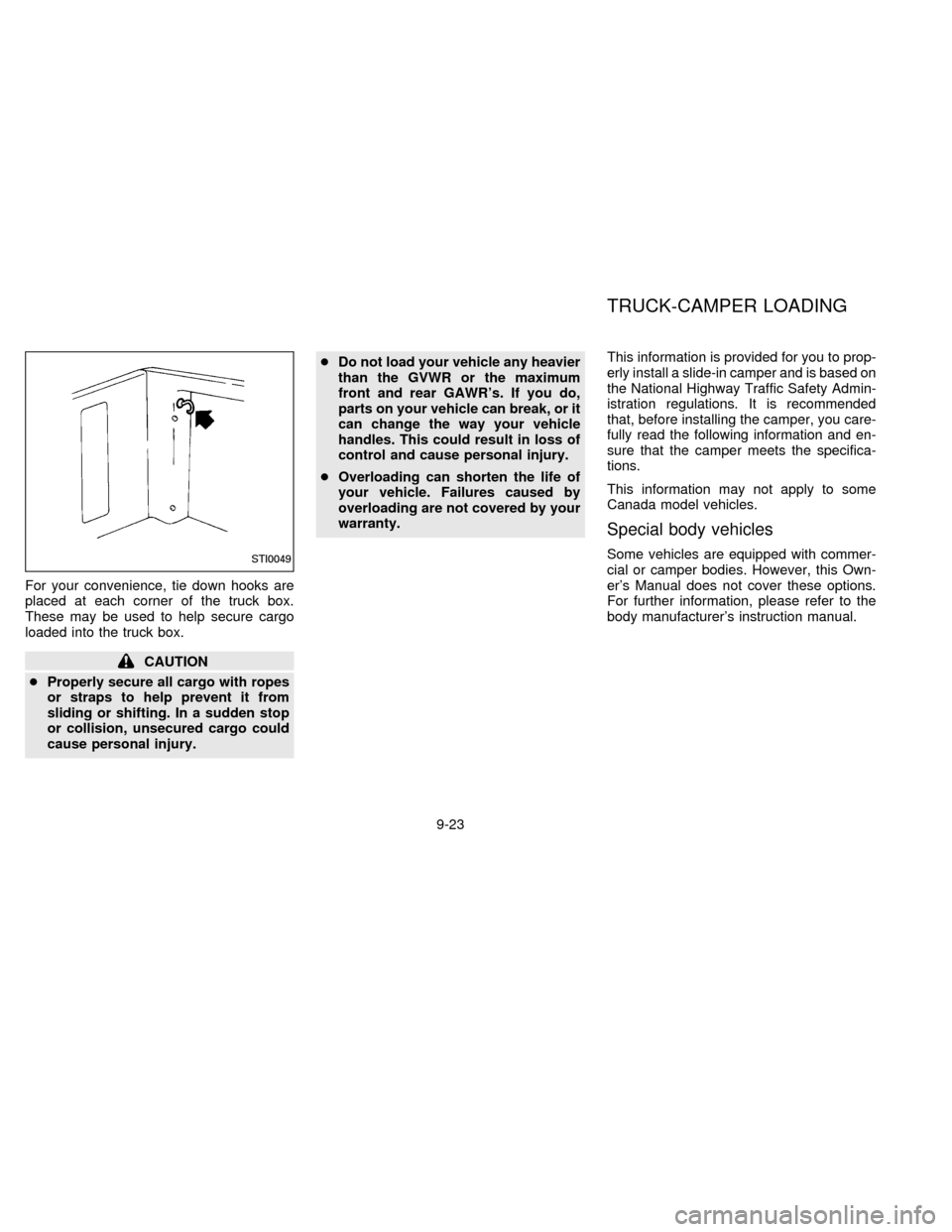
For your convenience, tie down hooks are
placed at each corner of the truck box.
These may be used to help secure cargo
loaded into the truck box.
CAUTION
cProperly secure all cargo with ropes
or straps to help prevent it from
sliding or shifting. In a sudden stop
or collision, unsecured cargo could
cause personal injury.cDo not load your vehicle any heavier
than the GVWR or the maximum
front and rear GAWR's. If you do,
parts on your vehicle can break, or it
can change the way your vehicle
handles. This could result in loss of
control and cause personal injury.
cOverloading can shorten the life of
your vehicle. Failures caused by
overloading are not covered by your
warranty.This information is provided for you to prop-
erly install a slide-in camper and is based on
the National Highway Traffic Safety Admin-
istration regulations. It is recommended
that, before installing the camper, you care-
fully read the following information and en-
sure that the camper meets the specifica-
tions.
This information may not apply to some
Canada model vehicles.
Special body vehicles
Some vehicles are equipped with commer-
cial or camper bodies. However, this Own-
er's Manual does not cover these options.
For further information, please refer to the
body manufacturer's instruction manual.STI0049
TRUCK-CAMPER LOADING
9-23
ZX
Page 189 of 198
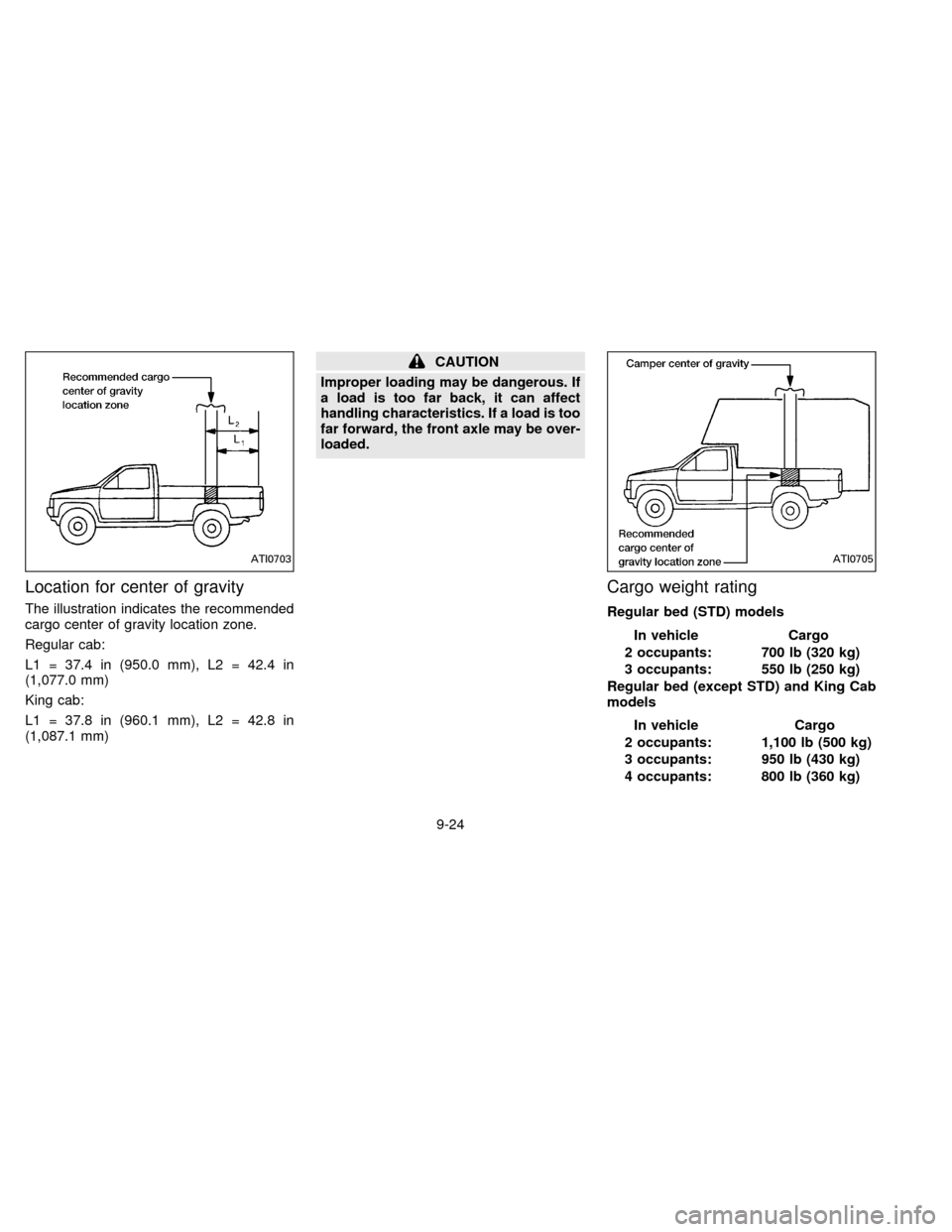
Location for center of gravity
The illustration indicates the recommended
cargo center of gravity location zone.
Regular cab:
L1 = 37.4 in (950.0 mm), L2 = 42.4 in
(1,077.0 mm)
King cab:
L1 = 37.8 in (960.1 mm), L2 = 42.8 in
(1,087.1 mm)
CAUTION
Improper loading may be dangerous. If
a load is too far back, it can affect
handling characteristics. If a load is too
far forward, the front axle may be over-
loaded.
Cargo weight rating
Regular bed (STD) models
In vehicle Cargo
2 occupants: 700 lb (320 kg)
3 occupants: 550 lb (250 kg)
Regular bed (except STD) and King Cab
models
In vehicle Cargo
2 occupants: 1,100 lb (500 kg)
3 occupants: 950 lb (430 kg)
4 occupants: 800 lb (360 kg)
ATI0703ATI0705
9-24
ZX
Page 196 of 198

Wheels and tires................................... 7-24
Towing
Tow truck towing .................................. 5-10
Towing load/specification chart ............ 9-18
Trailer towing ........................................ 9-16
2-wheel drive models ........................... 5-11
4-wheel drive models ........................... 5-12
Transfer case ............................................. 4-14
Transmission
Automatic transmission fluid ................... 7-9
Driving with automatic transmission ....... 4-6
Driving with manual transmission ........... 4-9
Travel (See registering your vehicle in
another country)
Trip odometer .............................................. 1-3
Truck-camper loading ................................ 9-23
Turn signal switch (See headlight and turn
signal switch)
V
Vanity mirror .............................................. 2-27
Vehicle dimensions and weights ............... 9-11
Vehicle identification
Vehicle identification number
(Chassis number) ................................. 9-12
Vehicle identification number plate ...... 9-12
Vehicle loading information ....................... 9-15
Vehicle recovery ........................................ 5-12
Ventilators .................................................... 3-2W
Warning
Supplemental air bag warning light ...... 2-15
Hazard warning flasher switch ............. 1-12
Warning/indicator lights and chimes ...... 1-6
Warning labels (for SRS)........................... 2-15
Weights (See dimensions and weights)
Wheel/tire size ........................................... 9-10
Wheels and tires ........................................ 7-24
Window washer fluid.................................. 7-12
Windows
Opera window....................................... 1-17
Power window ...................................... 1-15
Rear sliding window ............................. 1-16
Wiper
Windshield wiper and washer switch ... 1-11
Wiper blades......................................... 7-16
10-5
ZX