oil NISSAN FRONTIER 1996 D22 / 1.G Owner's Manual
[x] Cancel search | Manufacturer: NISSAN, Model Year: 1996, Model line: FRONTIER, Model: NISSAN FRONTIER 1996 D22 / 1.GPages: 198, PDF Size: 1.3 MB
Page 168 of 198
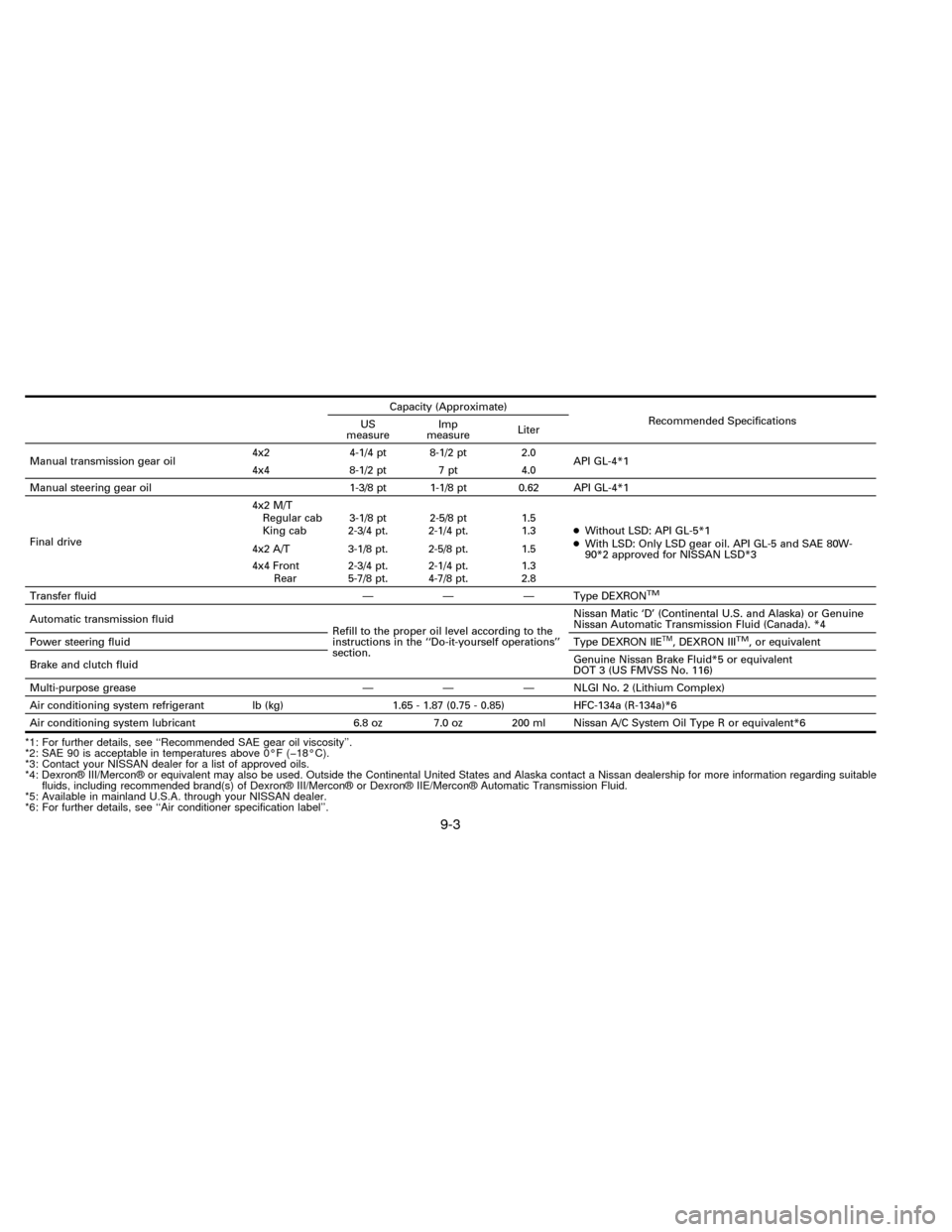
Capacity (Approximate)
Recommended Specifications
US
measureImp
measureLiter
Manual transmission gear oil4x2 4-1/4 pt 8-1/2 pt 2.0
API GL-4*1
4x4 8-1/2 pt 7 pt 4.0
Manual steering gear oil 1-3/8 pt 1-1/8 pt 0.62 API GL-4*1
Final drive4x2 M/T
Regular cab 3-1/8 pt 2-5/8 pt 1.5
King cab 2-3/4 pt. 2-1/4 pt. 1.3cWithout LSD: API GL-5*1
4x2 A/T 3-1/8 pt. 2-5/8 pt. 1.5cWith LSD: Only LSD gear oil. API GL-5 and SAE 80W-
90*2 approved for NISSAN LSD*3
4x4 Front 2-3/4 pt. 2-1/4 pt. 1.3
Rear 5-7/8 pt. 4-7/8 pt. 2.8
Transfer fluid Ð Ð Ð Type DEXRON
TM
Automatic transmission fluid
Refill to the proper oil level according to the
instructions in the ``Do-it-yourself operations''
section.Nissan Matic `D' (Continental U.S. and Alaska) or Genuine
Nissan Automatic Transmission Fluid (Canada). *4
Power steering fluidType DEXRON IIE
TM, DEXRON IIITM, or equivalent
Brake and clutch fluidGenuine Nissan Brake Fluid*5 or equivalent
DOT 3 (US FMVSS No. 116)
Multi-purpose grease Ð Ð Ð NLGI No. 2 (Lithium Complex)
Air conditioning system refrigerant lb (kg) 1.65 - 1.87 (0.75 - 0.85) HFC-134a (R-134a)*6
Air conditioning system lubricant 6.8 oz 7.0 oz 200 ml Nissan A/C System Oil Type R or equivalent*6
*1: For further details, see ``Recommended SAE gear oil viscosity''.
*2: SAE 90 is acceptable in temperatures above 0ÉF (þ18ÉC).
*3: Contact your NISSAN dealer for a list of approved oils.
*4: Dexronž III/Merconž or equivalent may also be used. Outside the Continental United States and Alaska contact a Nissan dealership for more information regarding suitable
fluids, including recommended brand(s) of Dexronž III/Merconž or Dexronž IIE/Merconž Automatic Transmission Fluid.
*5: Available in mainland U.S.A. through your NISSAN dealer.
*6: For further details, see ``Air conditioner specification label''.
9-3
ZX
Page 171 of 198

ENGINE OIL AND OIL FILTER
RECOMMENDATION
Selecting the correct oil
It is essential to chose the correct quality
and viscosity oil to ensure satisfactory en-
gine life and performance. Nissan recom-
mends the use of a low friction oil (energy
conserving oil) in order to improve fuel
economy and conserve energy. Oils which
do not have the specified quality label
should not be used as they could cause
engine damage.Only those engine oils with the American
Petroleum Institute (API) CERTIFICATION
MARK on the front of the container should
be used. This type of oil supersedes the
existing API SG or SH and Energy Conserv-
ing II categories.
If you cannot find engine oil with the CERTI-
FICATION MARK, an API SG or SH and
Energy Conserving II oil with API Service
Symbol may be used. An oil with a single
designation SG or SH, or in combination with
other categories (for example, SG/CC or
SG/CD) may also be used if one with the API
CERTIFICATION MARK cannot be found.
Mineral based or synthetic type oils may be
used in your NISSAN vehicle. These oils
must however, meet the API quality and
SAE viscosity ratings specified for your ve-
hicle. Do not mix mineral based and syn-
thetic type oils in the engine at the same
time.
Oil additives
NISSAN does not recommend the use of oil
additives. The use of an oil additive is not
necessary when the proper oil type is used
and maintenance intervals are followed.
Oil which may contain foreign matter or has
been previously used should not be used.
Oil viscosity
The engine oil viscosity or thickness
changes with temperature. Because of this,
it is important that the engine oil viscosity be
selected based on the temperatures at
which the vehicle will be operated before
the next oil change. The chart ``Recom-
mended SAE viscosity number'' shows the
recommended oil viscosities for the ex-
pected ambient temperatures. Choosing an
oil viscosity other than that recommended
could cause serious engine damage.
ATI0507
9-6
ZX
Page 172 of 198

Selecting the correct oil filter
Your new vehicle is equipped with a high-
quality genuine NISSAN oil filter. When
replacing, use the genuine oil filter or its
equivalent for the reason described in
``Change intervals''.
Change intervals
The oil and oil filter change intervals for your
engine are based on the use of the specified
quality oils and filters. Oil and filter other
than the specified quality, or oil and filter
change intervals longer than recommended
could reduce engine life. Damage to en-
gines caused by improper maintenance or
use of incorrect oil and filter quality and/or
viscosity is not covered by the new NISSAN
vehicle warranties.
Your engine was filled with a high quality
engine oil when it was built. You do not have
to change the oil before the first recom-
mended change interval. Oil and filter
change intervals depend upon how you use
your vehicle. Operation under the following
conditions may require more frequent oil
and filter changes:
Ð repeated short distance driving at cold
outside temperatures,Ð driving in dusty conditions,
Ð extensive idling,
Ð towing a trailer.
RECOMMENDED SAE
VISCOSITY NUMBER
cSAE 5W-30 viscosity oil is preferred
for all temperatures. SAE 10W-30 vis-
cosity oil may be used if the ambient
temperature is above 0ÉF (-18ÉC).
ATI0509
9-7
ZX
Page 186 of 198
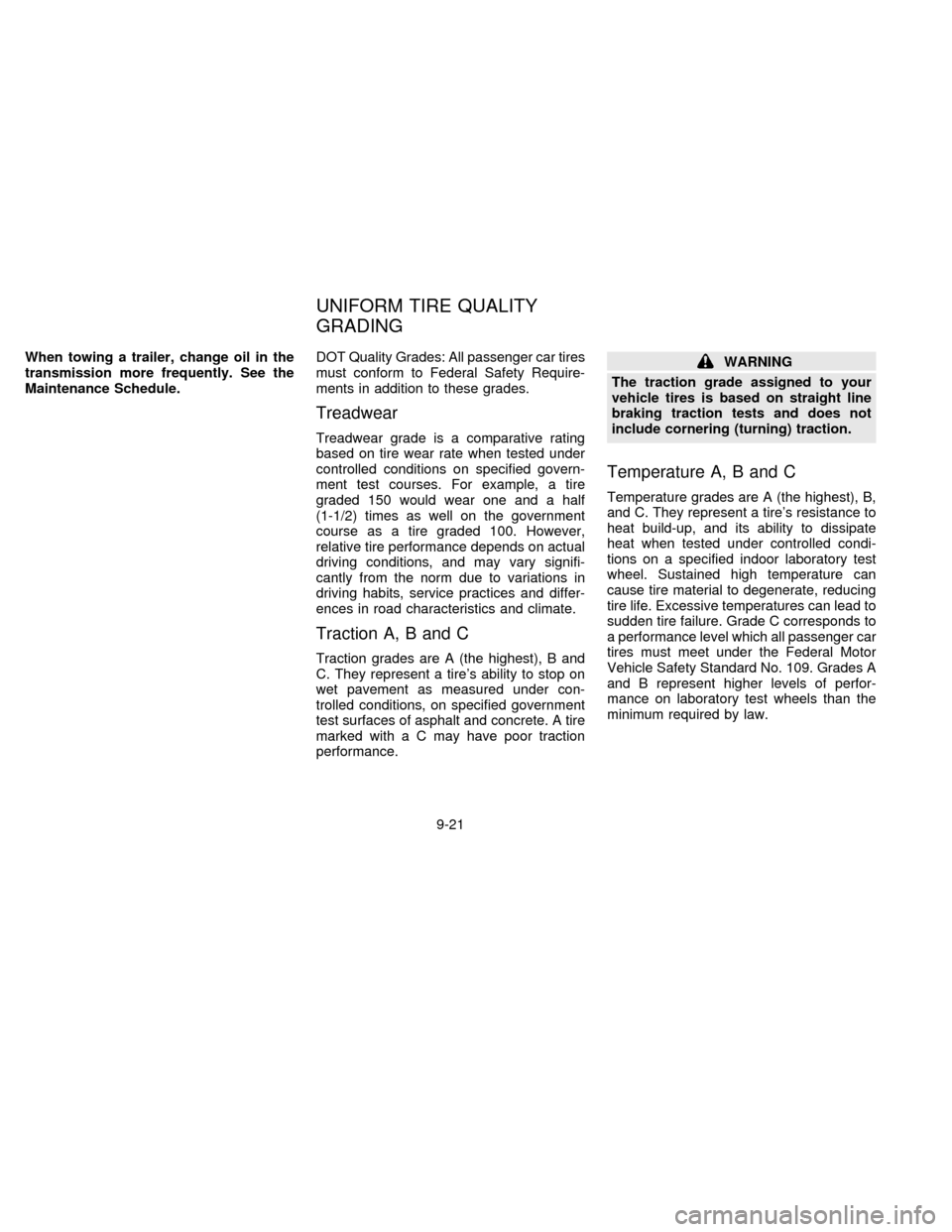
When towing a trailer, change oil in the
transmission more frequently. See the
Maintenance Schedule.DOT Quality Grades: All passenger car tires
must conform to Federal Safety Require-
ments in addition to these grades.
Treadwear
Treadwear grade is a comparative rating
based on tire wear rate when tested under
controlled conditions on specified govern-
ment test courses. For example, a tire
graded 150 would wear one and a half
(1-1/2) times as well on the government
course as a tire graded 100. However,
relative tire performance depends on actual
driving conditions, and may vary signifi-
cantly from the norm due to variations in
driving habits, service practices and differ-
ences in road characteristics and climate.
Traction A, B and C
Traction grades are A (the highest), B and
C. They represent a tire's ability to stop on
wet pavement as measured under con-
trolled conditions, on specified government
test surfaces of asphalt and concrete. A tire
marked with a C may have poor traction
performance.
WARNING
The traction grade assigned to your
vehicle tires is based on straight line
braking traction tests and does not
include cornering (turning) traction.
Temperature A, B and C
Temperature grades are A (the highest), B,
and C. They represent a tire's resistance to
heat build-up, and its ability to dissipate
heat when tested under controlled condi-
tions on a specified indoor laboratory test
wheel. Sustained high temperature can
cause tire material to degenerate, reducing
tire life. Excessive temperatures can lead to
sudden tire failure. Grade C corresponds to
a performance level which all passenger car
tires must meet under the Federal Motor
Vehicle Safety Standard No. 109. Grades A
and B represent higher levels of perfor-
mance on laboratory test wheels than the
minimum required by law.
UNIFORM TIRE QUALITY
GRADING
9-21
ZX
Page 193 of 198

Driving
Auto-lock free-running hubs ................. 4-15
Cold weather driving cautions .............. 4-27
Driving with automatic transmission ....... 4-6
Driving with manual transmission ........... 4-9
Driving your 4-wheel drive safely ......... 4-22
Manual-lock free-running hubs ............. 4-19
Precautions when driving ..................... 4-25
Precautions when starting and driving ... 4-2
E
Economy, fuel ............................................ 4-13
Emission control information label............. 9-14
Emission control system warranty ............. 9-22
Engine
Before starting the engine ...................... 4-5
Capacities and recommended
fuel/lubricants.......................................... 9-2
Changing engine coolant........................ 7-5
Changing engine oil................................ 7-7
Changing engine oil filter........................ 7-8
Checking engine coolant level ............... 7-4
Checking engine oil level ....................... 7-6
Engine compartment check locations .... 7-3
Engine coolant temperature gauge ........ 1-4
Engine cooling system ........................... 7-4
Engine oil ................................................ 7-6
Engine oil and oil filter
recommendation ..................................... 9-6
Engine oil viscosity ................................. 9-7
Engine serial number ........................... 9-13Engine specifications .............................. 9-9
Starting the engine ............................... 4-10
Exhaust gas (Carbon monoxide) ................. 4-2
F
Flashers (See hazard warning flasher switch)
Flat tire ......................................................... 5-2
Floor mat positioning aid ............................. 6-4
Fluid (Checking)
Automatic transmission fluid ................... 7-9
Brake and clutch fluid ........................... 7-11
Engine coolant ........................................ 7-4
Engine oil ................................................ 7-6
Power steering fluid .............................. 7-11
Window washer fluid ............................ 7-12
F.M.V.S.S. certification label ..................... 9-13
Front seats
Bench.................................................... 2-10
Separate ................................................. 2-8
Fuel
Capacities and recommended
fuel/lubricants.......................................... 9-2
Fuel economy ....................................... 4-13
Fuel filler cap .......................................... 2-5
Fuel gauge.............................................. 1-4
Fuel octane rating................................... 9-5
Fuel recommendation ............................. 9-4
Fuses ......................................................... 7-20G
Gas station information............................ 10-11
Gauge
Engine coolant temperature gauge ........ 1-4
Fuel gauge.............................................. 1-4
Odometer ................................................ 1-3
Speedometer .......................................... 1-3
Tachometer............................................. 1-3
Trip odometer ......................................... 1-3
Gear selection (See shifting)
General maintenance .................................. 8-2
Glove box lock ............................................. 2-4
H
Hazard warning flasher switch .................. 1-12
Head restraints ............................................ 2-9
Headlight and turn signal switch ............... 1-10
Headlights .................................................. 7-20
Heater
Heater and air conditioner controls ........ 3-3
Heater operation ..................................... 3-4
Hood release ............................................... 2-4
Hubs
Auto-lock free-running hubs ................. 4-15
Manual-lock free-running hubs ............. 4-19
I
Ignition switch .............................................. 4-4
10-2
ZX
Page 194 of 198

Increasing fuel economy............................ 4-13
Indicator lights and chimes
(See warning/indicator lights and chimes)
Inside mirror ............................................... 2-27
Instrument brightness control .................... 1-12
Interior light and cargo light ....................... 1-14
J
Jack
Pantograph type ..................................... 5-5
Screw type .............................................. 5-6
Jump seat .................................................. 2-11
Jump starting ............................................... 5-8
K
Key ............................................................... 2-2
L
Labels
Air conditioner specification label ......... 9-14
Emission control information label........ 9-14
Engine serial number ........................... 9-13
F.M.V.S.S. certification label ................ 9-13
Vehicle identification number plate ...... 9-12
Warning labels (for SRS) ..................... 2-15
Light
Supplemental air bag warning light ...... 2-15
Bulb check/instrument panel .................. 1-6Bulb replacement.................................. 7-22
Headlight and turn signal switch .......... 1-10
Headlights ............................................. 7-20
Interior light and cargo light .................. 1-14
Light bulbs ............................................ 7-20
Map light ............................................... 1-14
Warning/indicator lights and chimes ...... 1-6
Lock
Door locks............................................... 2-2
Free-running lock (see hubs)
Glove box lock ........................................ 2-4
Power door lock...................................... 2-3
Luggage (see vehicle loading information). 9-15
M
Maintenance
General maintenance ............................. 8-2
Inside the vehicle.................................... 8-3
Maintenance precautions ....................... 7-2
Outside the vehicle ................................. 8-2
Periodic maintenance schedules ............ 8-5
Seat belt maintenance.......................... 2-21
Under the hood and vehicle ................... 8-4
Manual antenna ......................................... 3-20
Manual-lock free-running hubs .................. 4-19
Manual window .......................................... 1-15
Map light .................................................... 1-14
Mirror
Inside mirror.......................................... 2-27
Outside mirror remote control ............. 2-26
Outside mirrors ..................................... 2-26Vanity mirror ......................................... 2-27
O
Octane rating (see fuel)
Odometer ..................................................... 1-3
Oil
Capacities and recommended
fuel/lubricants.......................................... 9-2
Changing engine oil................................ 7-7
Changing engine oil filter........................ 7-8
Checking engine oil level ....................... 7-6
Engine oil ................................................ 7-6
Engine oil and oil filter
recommendation ..................................... 9-6
Opera window ............................................ 1-17
Outside mirror remote control .................. 2-26
Outside mirrors .......................................... 2-26
Overdrive switch .......................................... 4-8
Overheat
If your vehicle overheats ........................ 5-9
Owner's manual order form ....................... 9-26
P
Pantograph type jack ................................... 5-5
Parking
Parking brake check ............................. 7-17
Parking brake operation ....................... 4-11
Parking/parking on hills ........................ 4-24
Periodic maintenance schedules ................. 8-5
10-3
ZX
Page 197 of 198

Recommended fuel:
Unleaded gasoline, at least 87 AKI number
(RON 91)
For further details such as gasohol or diesel
fuel grade, see ``Fuel recommendation'' in
the ``Technical and consumer information''
section.
Recommended engine oil:
Energy Conserving Oils of API SG or SH,
SAE 5W-30 is preferable for all tempera-
tures. See ``Engine oil and oil filter recom-
mendation'' in the ``Technical and consumer
information'' section.
Tire cold pressure:
See the tire placard affixed to the glove box.
Recommended new vehicle
break-in procedure:
During the first 1,000 miles (1,600 km) of
vehicle use, follow the recommendations
outlined in the ``BREAK-IN SCHEDULE''
found in the ``Starting and Driving'' section
of this Owner's Manual. Follow these rec-
ommendations for the future reliability and
economy of your new vehicle. Failure tofollow these recommendations may result in
vehicle damage or shortened engine life.(page)
cIn case of emergency ...................... 5-1
(Flat tire, engine will not start, overheat-
ing, towing)
cHow to start the engine ................... 4-1
cHow to read the meters and
gauges ............................................. 1-1
cMaintenance schedule ..................... 8-1
cDo-it-yourself operations.................. 7-1
cTechnical and consumer
information ....................................... 9-1
GAS STATION INFORMATION QUICK REFERENCE
10-7
ZX