tow NISSAN FRONTIER 1999 D22 / 1.G User Guide
[x] Cancel search | Manufacturer: NISSAN, Model Year: 1999, Model line: FRONTIER, Model: NISSAN FRONTIER 1999 D22 / 1.GPages: 247, PDF Size: 1.89 MB
Page 141 of 247
6 In case of emergency
Flat tire ...................................................................6-2
Pantograph type jack .............................................6-5
Jump starting ..........................................................6-8
Push starting...........................................................6-9
If your vehicle overheats ......................................6-10Tow truck towing .................................................. 6-11
Two-wheel drive models ......................................6-12
Four-wheel drive models ......................................6-12
Vehicle recovery (freeing a stuck vehicle) ...........6-13
ZX
Page 143 of 247
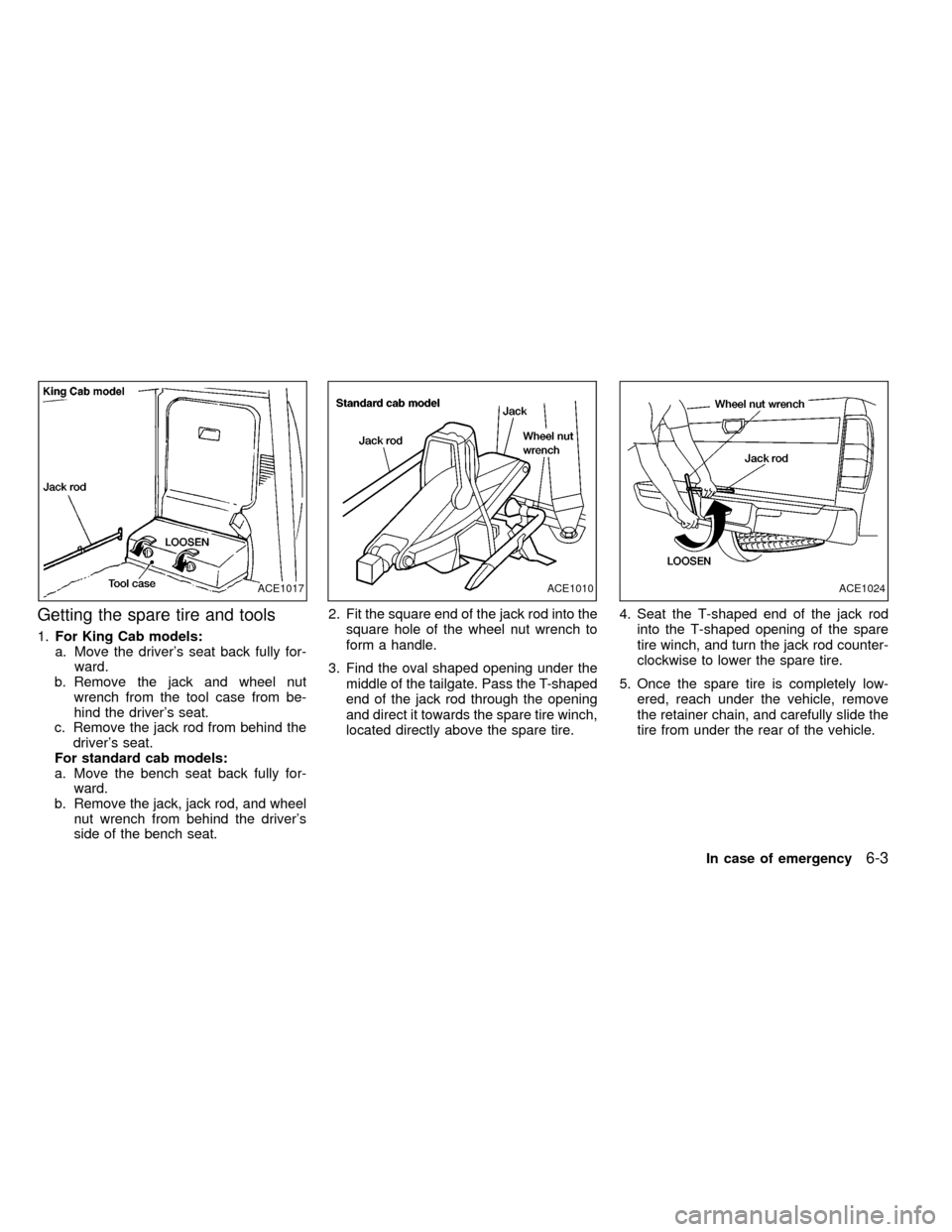
Getting the spare tire and tools
1.For King Cab models:
a. Move the driver's seat back fully for-
ward.
b. Remove the jack and wheel nut
wrench from the tool case from be-
hind the driver's seat.
c. Remove the jack rod from behind the
driver's seat.
For standard cab models:
a. Move the bench seat back fully for-
ward.
b. Remove the jack, jack rod, and wheel
nut wrench from behind the driver's
side of the bench seat.2. Fit the square end of the jack rod into the
square hole of the wheel nut wrench to
form a handle.
3. Find the oval shaped opening under the
middle of the tailgate. Pass the T-shaped
end of the jack rod through the opening
and direct it towards the spare tire winch,
located directly above the spare tire.4. Seat the T-shaped end of the jack rod
into the T-shaped opening of the spare
tire winch, and turn the jack rod counter-
clockwise to lower the spare tire.
5. Once the spare tire is completely low-
ered, reach under the vehicle, remove
the retainer chain, and carefully slide the
tire from under the rear of the vehicle.
ACE1017ACE1010ACE1024
In case of emergency6-3
ZX
Page 149 of 247
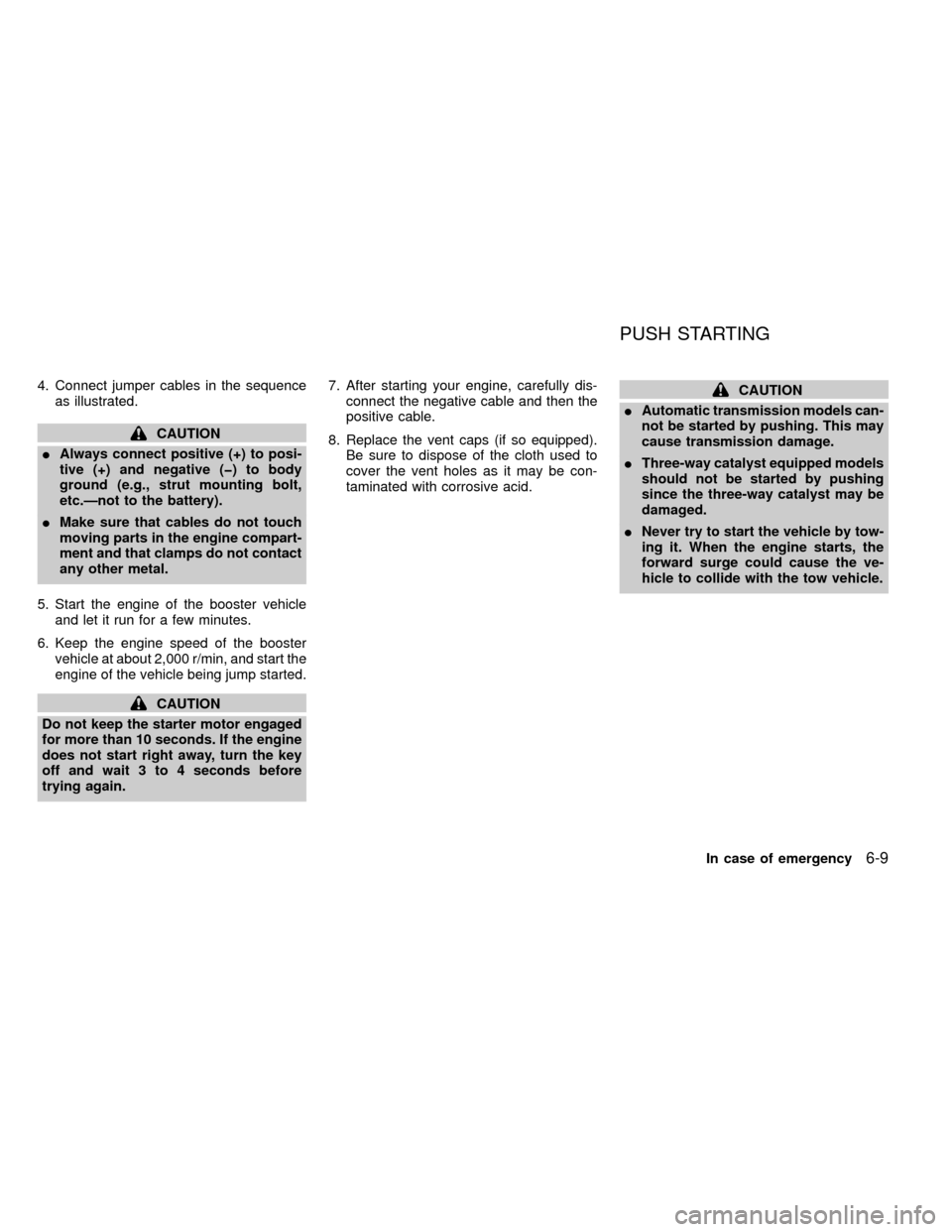
4. Connect jumper cables in the sequence
as illustrated.
CAUTION
IAlways connect positive (+) to posi-
tive (+) and negative (þ) to body
ground (e.g., strut mounting bolt,
etc.Ðnot to the battery).
IMake sure that cables do not touch
moving parts in the engine compart-
ment and that clamps do not contact
any other metal.
5. Start the engine of the booster vehicle
and let it run for a few minutes.
6. Keep the engine speed of the booster
vehicle at about 2,000 r/min, and start the
engine of the vehicle being jump started.
CAUTION
Do not keep the starter motor engaged
for more than 10 seconds. If the engine
does not start right away, turn the key
off and wait 3 to 4 seconds before
trying again.7. After starting your engine, carefully dis-
connect the negative cable and then the
positive cable.
8. Replace the vent caps (if so equipped).
Be sure to dispose of the cloth used to
cover the vent holes as it may be con-
taminated with corrosive acid.
CAUTION
IAutomatic transmission models can-
not be started by pushing. This may
cause transmission damage.
IThree-way catalyst equipped models
should not be started by pushing
since the three-way catalyst may be
damaged.
INever try to start the vehicle by tow-
ing it. When the engine starts, the
forward surge could cause the ve-
hicle to collide with the tow vehicle.
PUSH STARTING
In case of emergency6-9
ZX
Page 151 of 247
When towing your vehicle, U.S. States, Ca-
nadian provinces and local regulations for
towing must be followed. Incorrect towing
equipment could damage your vehicle. Tow-
ing instructions are available from an autho-
rized NISSAN dealer. Local service operators
are generally familiar with the applicable laws
and procedures for towing. To assure proper
towing and to prevent accidental damage to
your vehicle, NISSAN recommends having a
service operator tow your vehicle. It is advis-
able to have the service operator carefully
read the following precautions:
WARNING
INever ride in a vehicle that is being
towed.
INever get under your vehicle after it
has been lifted by a tow truck.
CAUTION
IWhen towing, make sure that the
transmission, axles, steering system
and powertrain are in working con-
dition. If any unit is damaged, a dolly
must be used.IWhen towing with the front wheels
on the ground:
Turn the ignition key to the OFF
position and secure the steering
wheel in a straight-ahead position
with a rope or similar device. Never
place the ignition key in the LOCK
position. This will result in damage
to the steering lock mechanism.
IWhen towing with the rear wheels on
the ground:
Release the parking brake and move
the gearshift lever to the N (Neutral)
position.
On automatic transmission models,
to move the shift lever to N (Neutral),
turn the ignition key to the ACC po-
sition. After moving the shift lever to
N (neutral), be sure to turn the igni-
tion key to the OFF position.
IFor four-wheel drive models:
Set the free-running hubs to the free
position. See ``
Auto-lock free-
running hubsº or ``Manual-lock
free-running hubsº as appropriate in
the ``Starting and driving'' section.Move the transfer case shift lever
into the 2H position and the trans-
mission shift lever into the N (Neu-
tral) position.
IAttach safety chains for all towing.
TOW TRUCK TOWING
In case of emergency6-11
ZX
Page 152 of 247
TWO-WHEEL DRIVE MODELS
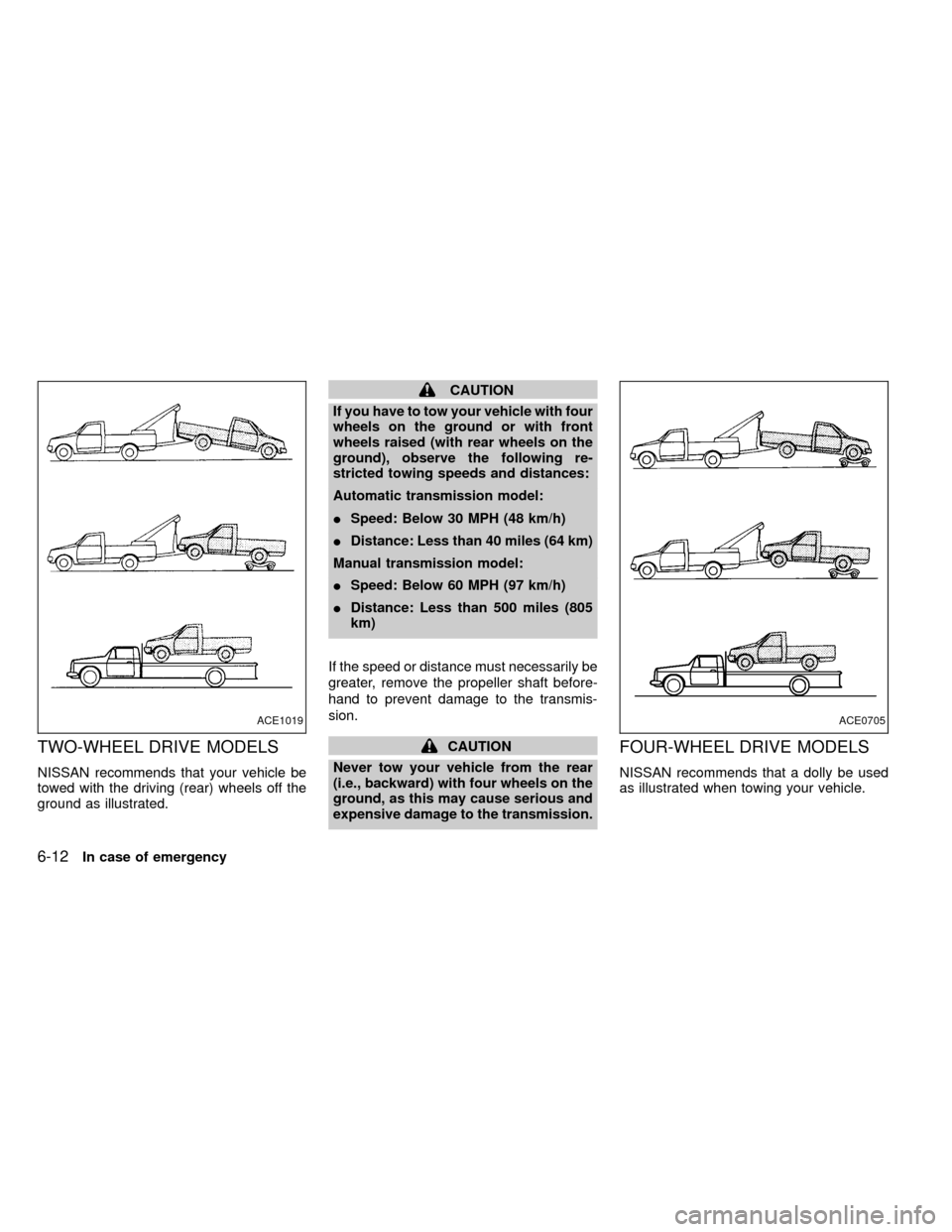
NISSAN recommends that your vehicle be
towed with the driving (rear) wheels off the
ground as illustrated.
CAUTION
If you have to tow your vehicle with four
wheels on the ground or with front
wheels raised (with rear wheels on the
ground), observe the following re-
stricted towing speeds and distances:
Automatic transmission model:
ISpeed: Below 30 MPH (48 km/h)
IDistance: Less than 40 miles (64 km)
Manual transmission model:
ISpeed: Below 60 MPH (97 km/h)
IDistance: Less than 500 miles (805
km)
If the speed or distance must necessarily be
greater, remove the propeller shaft before-
hand to prevent damage to the transmis-
sion.
CAUTION
Never tow your vehicle from the rear
(i.e., backward) with four wheels on the
ground, as this may cause serious and
expensive damage to the transmission.FOUR-WHEEL DRIVE MODELS
NISSAN recommends that a dolly be used
as illustrated when towing your vehicle.
ACE1019ACE0705
6-12In case of emergency
ZX
Page 153 of 247
CAUTION
If you have to tow your vehicle with four
wheels on the ground or with front or
rear wheels raised, observe the follow-
ing restricted towing speeds and dis-
tances:
ISpeed: Below 60 MPH (97 km/h)
IDistance: Less than 500 miles (805
km)
If the speed or distance must necessarily be
greater, remove the front and rear propeller
shafts beforehand to prevent damage to the
transmission.
CAUTION
INever tow your vehicle from the rear
(i.e., backward) with four wheels on
the ground as this may cause seri-
ous and expensive damage to the
transmission.
IBe sure to place the transfer case
shift lever into the 2H position and
the transmission shift lever into the
N (Neutral) position.
VEHICLE RECOVERY (freeing a
stuck vehicle)
ITow chains or cables must be attached
only to the main structural members of
the vehicle.
IPulling devices should be routed so they
do not touch any part of the suspension,
steering, brake or cooling systems.
IAlways pull the cable straight out from
the front or rear of the vehicle. Never pull
the vehicle at an angle.
IPulling devices such as ropes or canvas
straps are not recommended for use in
vehicle towing or recovery.
IStand clear of a stuck vehicle.
WARNING
Do not spin your tires at high speed.
This could cause them to explode and
result in serious injury. Parts of your
vehicle could also overheat and be
damaged.
In case of emergency
6-13
ZX
Page 196 of 247
IClean the inner side of the wheels when
the wheel is changed or the underside of
the vehicle is washed.
IDo not use abrasive cleaners when
washing the wheels.
IInspect wheel rims regularly for dents or
corrosion. This may cause loss of pres-
sure or damage the tire bead.
INISSAN recommends waxing the road
wheels to protect against road salt in
areas where it is used during winter.
Spare tire
Your vehicle may be equipped with a TEM-
PORARY USE ONLY spare tire.
To avoid property damage or personal injury
when using the TEMPORARY USE ONLY
spare tire, observe the following cautions:
WARNING
IThe spare tire should be used for
emergency use only. It should be
replaced by the standard tire at the
first opportunity to avoid possible
tire or differential damage.IDrive carefully while the TEMPO-
RARY USE ONLY spare tire is in-
stalled. Avoid sharp turns and
abrupt braking while driving.
IPeriodically check spare tire infla-
tion pressure. Always keep the pres-
sure of the T135/70R16 spare tire at
60 psi (420 kPa, 4.2 bar). For the full
size spare tire pressure, check the
tire placecard located on the inside
of the glovebox lid.
IDo not drive the vehicle at speeds
faster than 50 MPH (80 km/h).
I
When driving on roads covered with
snow or ice, the TEMPORARY USE
ONLY spare tire should be used on
the front wheels and the original tire
used on the rear wheels (drive
wheels). Use tire chains only on the
two rear original tires.
ITire tread of the TEMPORARY USE
ONLY spare tire will wear at a faster
rate than the standard tire. Replace
the TEMPORARY USE ONLY spare
tire as soon as the tread wear indi-
cators appear.IDo not use the TEMPORARY USE
ONLY spare tire on other vehicles.
IDo not use more than one TEMPO-
RARY USE ONLY spare tire at the
same time.
IDo not tow a trailer when the TEM-
PORARY USE ONLY T135/70R16
spare is installed.
CAUTION
I
The transfer control lever must
be in the 2H position to prevent the
transfer case and differential gears
from being damaged.
IDo not use tire chains on a TEMPO-
RARY USE ONLY spare tire. Tire
chains will not fit properly on a TEM-
PORARY USE ONLY spare tire and
may cause damage to the vehicle.
I
Because the TEMPORARY USE ONLY
spare tire is smaller than the original
tire, ground clearance is reduced. To
avoid damage to the vehicle, do not
drive over obstacles. Also, do not
drive the vehicle through an automatic
car wash since it might get caught.
8-36Do-it-yourself
ZX
Page 203 of 247
To ensure smooth, trouble-free, safe and
economical driving, NISSAN provides two
periodic maintenance schedules that may
be used, depending upon the conditions in
which you usually drive. These schedules
contain both distance and time intervals, up
to 60,000 miles (96,000 km)/48 months. For
most people, the odometer reading will in-
dicate when service is needed. However, if
you drive very little, your vehicle should be
serviced at the regular time intervals shown
in the schedule.
After 60,000 miles (96,000 km)/48
months, continue periodic maintenance
at the same mileage/time intervals.
SCHEDULE ONE
Follow Periodic Maintenance Schedule one
if your driving habits frequently include one
or more of the following driving conditions:
I
Repeated short trips of less than 5
miles (8 km).
I
Repeated short trips of less than 10
miles (16 km) with outside tempera-
tures below freezing.
I
Operating the vehicle in hot weatherduring stop-and-go ``rush hour'' traf-
fic.
I
Extensive idling and/or low speed
driving for long distances, such as
police, taxi or door-to-door delivery
use.
I
Driving in dusty conditions.
I
Driving on rough, muddy, or salt
spread roads.
I
Towing a trailer, using a camper or a
car-top carrier.
SCHEDULE TWO
Follow Periodic Maintenance Schedule two
if none of the driving conditions shown in
Schedule one apply to your driving habits.
Maintenance for off-road driving
(
only)
Whenever you drive off-road through sand,
mud or water as deep as the wheel hub,
more frequent maintenance may be re-
quired of the following items:
¶Brake pads and rotors
¶Brake linings and drums
¶Brake lines and hoses
¶Wheel bearing grease and free-running
hub grease
¶Differential, transmission and transfer oil
¶Steering linkage
¶Propeller shafts and front drive shafts
¶Air cleaner filter
These items should be checked frequently
to assure safe and proper operation of your
vehicle.
PERIODIC MAINTENANCE
SCHEDULES
Maintenance9-5
ZX
Page 205 of 247

Schedule One
Abbreviations: R = Replace I = Inspect. Correct or replace if necessary. [ ]: At the mileage intervals only
MAINTENANCE OPERATIONMAINTENANCE INTERVAL
Perform at number of miles, kilometers
or months, whichever comes first.Miles ý 1,000 3.75 7.5 11.25 15 18.75 22.5 26.25 30 33.75 37.5 41.25 45 48.75 52.5 56.25 60
(km ý 1,000) (6) (12) (18) (24) (30) (36) (42) (48) (54) (60) (66) (72) (78) (84) (90) (96)
Months 3 6 9 12 15 18 21 24 27 30 33 36 39 42 45 48
Chassis and body maintenance
Brake lines & cablesIIII
Brake pads, rotors, drums & liningsIIIIIIII
Automatic transmission, transfer & differen-
tial gear oil (exc. LSD)See NOTE (1)IIII
Limited-slip differential (LSD) gear oil See NOTE (1) I R I I
Manual transmission oil See NOTE (1) I I I [R]
Steering gear (box) & linkage, axle & suspension partsIIIIIIII
Drive shaft boots & propeller shaft (
) IIIIIIII
Front wheel bearing grease (4x2)II
Front wheel bearing grease & free-running
hub grease (
)See NOTE (2)IRIR
Exhaust systemIIIIIIII
Air bag system See NOTE (3)
NOTE: (1) If towing a trailer, using a camper or a car-top carrier, or driving on rough or muddy roads, change (not just inspect) oil at every 30,000
miles (48,000 km) or 24 months except for LSD. Change LSD gear oil every 15,000 miles (24,000 km) or 12 months.
(2) If operating frequently in water, replace grease every 3,750 miles (6,000 km) or 3 months.
(3) Inspect the supplemental air bag system 10 years after the date of manufacture noted on the FMVSS certification label.
Maintenance9-7
ZX
Page 211 of 247

10 Technical and consumer information
Capacities and recommended fuel/lubricants ......10-2
Fuel recommendation...........................................10-4
Engine oil and oil filter recommendation ..............10-6
Recommended sae viscosity number ..................10-7
Air conditioner system refrigerant and
lubricant recommendations ..................................10-8
Engine ..................................................................10-9
Wheel/tire size ....................................................10-10
Dimensions and weights .................................... 10-11
Registering your vehicle in another country.......10-12
Vehicle identification ..........................................10-12
Vehicle identification number (VIN) plate...........10-12
Vehicle identification number (chassis
number) ..............................................................10-12
Engine serial number .........................................10-13
FMVSS certification label ...................................10-13Emission control information label .....................10-14
Tire placard ........................................................10-14
Air conditioner specification label.......................10-14
Installing license plate ........................................10-15
Vehicle loading information ................................10-15
Securing the load ...............................................10-16
Truck-camper loading.........................................10-17
Trailer towing ......................................................10-21
Towing load/specification chart ..........................10-23
Uniform tire quality grading ................................10-26
Emission control system warranty......................10-27
Reporting safety defects (USA) .........................10-27
Readiness for inspection/maintenance (I/M)
test (US only) .....................................................10-28
ZX