tow NISSAN FRONTIER 2003 D22 / 1.G Owner's Manual
[x] Cancel search | Manufacturer: NISSAN, Model Year: 2003, Model line: FRONTIER, Model: NISSAN FRONTIER 2003 D22 / 1.GPages: 272, PDF Size: 3.67 MB
Page 230 of 272
cWhen driving on roads covered with
snow or ice, the TEMPORARY USE
ONLY spare tire should be used on the
front wheels and the original tire used
on the rear wheels (drive wheels) . Use
tire chains only on the two rear original
tires.
cTire tread of the TEMPORARY USE
ONLY spare tire will wear at a faster rate
than the standard tire. Replace the
spare tire as soon as the tread wear
indicators appear.
cDo not use the spare tire on other
vehicles.
cDo not use more than one spare tire at
the same time.
cDo not tow a trailer when the TEMPO-
RARY USE ONLY spare tire is installed.
CAUTION
cWith the spare tire installed the
transfer control lever must be in the 2H
position to prevent the transfer case
and differential gears from being
damaged.cDo not use tire chains on a TEMPO-
RARY USE ONLY spare tire. Tire chains
will not fit properly and may cause dam-
age to the vehicle.
cBecause the TEMPORARY USE ONLY
spare tire is smaller than the original
tire, ground clearance is reduced. To
avoid damage to the vehicle, do not
drive over obstacles. Also, do not drive
the vehicle through an automatic car
wash since it may get caught.
8-42Maintenance and do-it-yourself
ZREVIEW COPY:Ð2003 Truck/Frontier(d22)
Owners Manual(owners)ÐUSA English(nna)
01/15/03Ðarosenma
X
Page 231 of 272

9 Technical and consumer information
Capacities and recommended fuel/lubricants.........9-2
Fuel recommendation...........................9-3
Engine oil and oil filter recommendation...........9-5
Recommended SAE viscosity number............9-6
Air conditioner system refrigerant and
lubricant recommendations......................9-6
Specifications.....................................9-7
Engine........................................9-7
Wheels and tires...............................9-8
Dimensions and weights........................9-9
When traveling or registering your vehicle in
another country..................................9-10
Vehicle identification..............................9-10
Vehicle identification number (VIN) plate.........9-10
Vehicle identification number (chassis
number)......................................9-10
Engine serial number...........................9-11
F.M.V.S.S. certification label....................9-11
Emission control information label...............9-12
Tire placard...................................9-12
Air conditioner specification label................9-12
Installing front license plate........................9-13
Vehicle loading information........................9-13Terms........................................9-13
Determining vehicle load capacity...............9-14
Securing the load..............................9-14
Loading tips..................................9-14
Truck-camper loading information..................9-15
Crew Cab Models.............................9-15
King Cab models..............................9-15
Special Body vehicles..........................9-15
Location for center of gravity....................9-15
Payload weight capacity........................9-16
Measurement of weights.......................9-18
Towing a trailer...................................9-18
Maximum load limits...........................9-18
Towing load/specification chart.................9-20
Towing safety.................................9-21
Uniform tire quality grading........................9-23
Emission control system warranty..................9-24
Reporting safety defects (US only).................9-24
Readiness for inspection/maintenance (I/M) test.....9-24
Dynamometer testing for Inspection/
Maintenance (I/M) test (US only)................9-25
Owner’s manual/service manual order information....9-26
In the event of a collision.......................9-27
ZREVIEW COPY:Ð2003 Truck/Frontier(d22)
Owners Manual(owners)ÐUSA English(nna)
01/15/03Ðarosenma
X
Page 233 of 272
FUEL RECOMMENDATION
For 2.4L/3.3L engine
Use unleaded regular gasoline with an octane
rating of at least 87 AKI (Anti-Knock Index) num-
ber (Research octane number 91) .
For 3.3L supercharger
Use unleaded premium gasoline with an octane
rating of at least 91 AKI number (Research oc-
tane number 96) .
If unleaded premium gasoline is not available,
unleaded regular gasoline with an octane rating
of at least 87 AKI (Research octane number 91)
can be used, but only under the following precau-
tions:
chave the fuel tank filled only partially with un-
leaded regular gasoline, and fill up with un-
leaded premium as soon as possible.
cavoid full throttle driving and abrupt accelera-
tion
However, for maximum vehicle perfor-
mance, the use of unleaded premium gaso-
line is recommended.
CAUTION
Using a fuel other than that specified
could adversely affect the emission con-
trol system, and may also affect the war-
ranty coverage.
Under no circumstances should a leaded
gasoline be used, because this will dam-
age the three-way catalyst.
Reformulated gasoline
Some fuel suppliers are now producing reformu-
lated gasolines. These gasolines are specially
designed to reduce vehicle emissions. NISSAN
supports efforts towards cleaner air and sug-
gests that you use reformulated gasoline when
available.
Gasoline containing oxygenates
Some fuel suppliers sell gasoline containing oxy-
genates such as ethanol, MTBE and methanol
with or without advertising their presence.
NISSAN does not recommend the use of fuels of
which the oxygenate content and the fuel com-
patibility for your NISSAN cannot be readily de-
termined. If in doubt, ask your service station
manager.
If you use oxygenate-blend gasoline, please take
the following precautions as the usage of suchfuels may cause vehicle performance problems
and/or fuel system damage.
cThe fuel should be unleaded and have an
octane rating no lower than that recom-
mended for unleaded gasoline.
cIf an oxygenate-blend other than metha-
nol blend is used, it should contain no
more than 10% oxygenate. (MTBE may,
however, be added up to 15%.)
cIf a methanol blend is used, it should
contain no more than 5% methanol (me-
thyl alcohol, wood alcohol) . It should
also contain a suitable amount of appro-
priate cosolvents and corrosion inhibi-
tors. If not properly formulated with ap-
propriate cosolvents and corrosion
inhibitors, such methanol blends may
cause fuel system damage and/or ve-
hicle performance problems. At this
time, sufficient data is not available to
ensure that all methanol blends are suit-
able for use in NISSAN vehicles.
If any driveability problems such as engine stall-
ing and difficult hot-starting are experienced after
using oxygenate-blend fuels, immediately
change to a non-oxygenate fuel or a fuel with a
low blend of MTBE.
Technical and consumer information9-3
ZREVIEW COPY:Ð2003 Truck/Frontier(d22)
Owners Manual(owners)ÐUSA English(nna)
01/15/03Ðarosenma
X
Page 236 of 272
Change intervals
The oil and oil filter change intervals for your
engine are based on the use of the specified
quality oils and filters. Using engine oil and filters
that are not of the specified quality, or exceeding
recommended oil and filter change intervals
could reduce engine life. Damage to the engine
caused by improper maintenance or use of incor-
rect oil and filter quality and/or viscosity is not
covered by the NISSAN new vehicle warranty.
Your engine was filled with a high-quality engine
oil when it was built. You do not have to change
the oil before the first recommended change
interval. Oil and filter change intervals depend
upon how you use your vehicle.
Operation under the following conditions may
require more frequent oil and filter changes:
crepeated short distance driving at cold outside
temperatures
cdriving in dusty conditions
cextensive idling
ctowing a trailer
RECOMMENDED SAE VISCOSITY
NUMBER
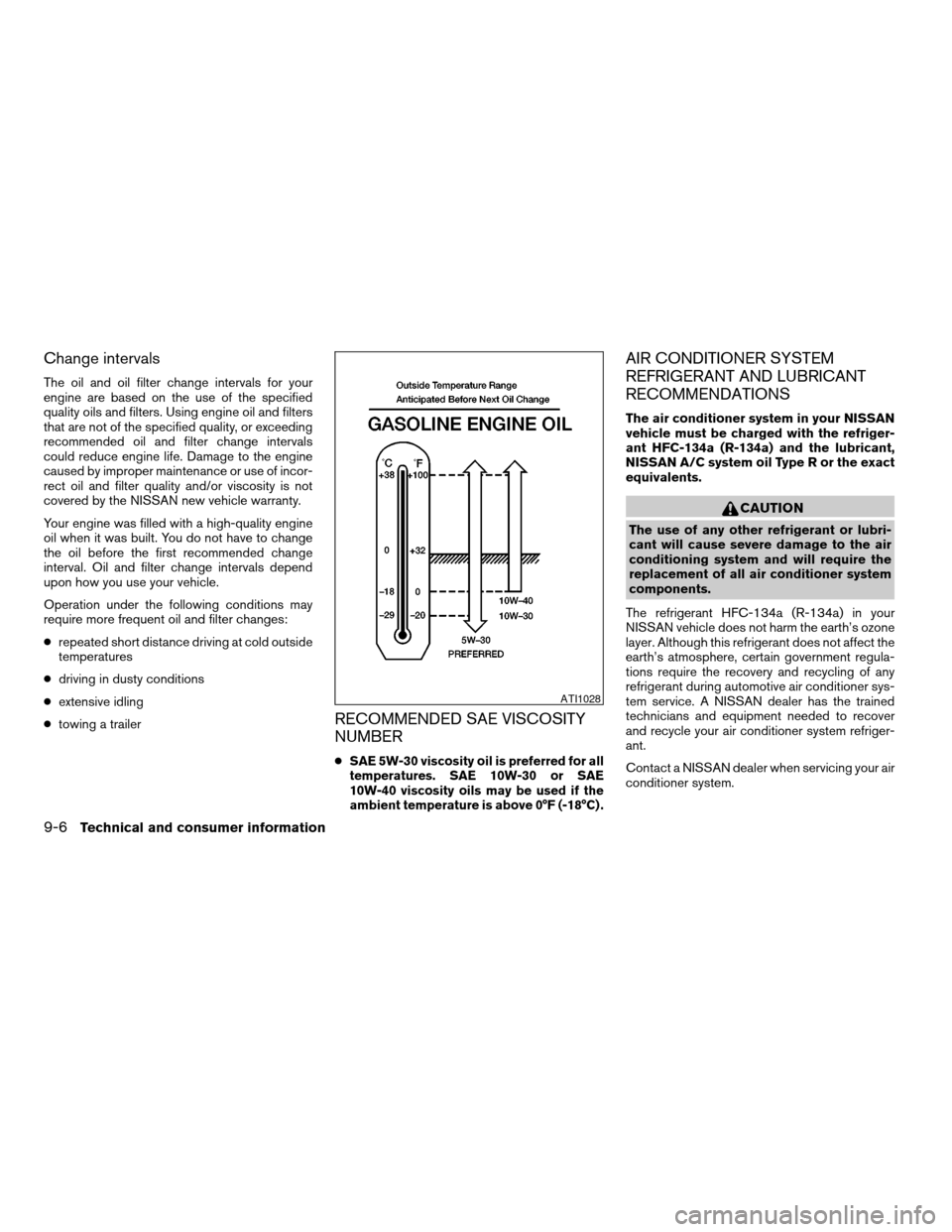
cSAE 5W-30 viscosity oil is preferred for all
temperatures. SAE 10W-30 or SAE
10W-40 viscosity oils may be used if the
ambient temperature is above 0°F (-18°C) .
AIR CONDITIONER SYSTEM
REFRIGERANT AND LUBRICANT
RECOMMENDATIONS
The air conditioner system in your NISSAN
vehicle must be charged with the refriger-
ant HFC-134a (R-134a) and the lubricant,
NISSAN A/C system oil Type R or the exact
equivalents.
CAUTION
The use of any other refrigerant or lubri-
cant will cause severe damage to the air
conditioning system and will require the
replacement of all air conditioner system
components.
The refrigerant HFC-134a (R-134a) in your
NISSAN vehicle does not harm the earth’s ozone
layer. Although this refrigerant does not affect the
earth’s atmosphere, certain government regula-
tions require the recovery and recycling of any
refrigerant during automotive air conditioner sys-
tem service. A NISSAN dealer has the trained
technicians and equipment needed to recover
and recycle your air conditioner system refriger-
ant.
Contact a NISSAN dealer when servicing your air
conditioner system.
ATI1028
9-6Technical and consumer information
ZREVIEW COPY:Ð2003 Truck/Frontier(d22)
Owners Manual(owners)ÐUSA English(nna)
01/15/03Ðarosenma
X
Page 244 of 272
cGAWR (Gross Axle Weight Rating) - maxi-
mum weight (load) limit specified for the front
or rear axle.
DETERMINING VEHICLE LOAD
CAPACITY
The load capacity of this vehicle is determined by
weight, not by available cargo space. For ex-
ample, a roof rack, bike carrier, or similar equip-
ment does not increase load carrying capacity of
your vehicle.
To determine vehicle load capacity:
Vehicle weight can be determined by using a
commercial-grade scale, found at places such as
a truck stop, gravel quarry, grain elevator, or a
scrap metal recycling facility.
1. Determine the curb weight of your vehicle.
2. Compare the curb weight amount to the
GVWR specified for your vehicle to deter-
mine how much more weight your vehicle
can carry.
3. After loading (cargo and passengers) , re-
weigh your vehicle to determine if either
GVWR or GAWR for your vehicle is ex-
ceeded. If GVWR is exceeded, remove
cargo as necessary. If either the front or rear
GAWR is exceeded, shift the load or remove
cargo as necessary.
SECURING THE LOAD
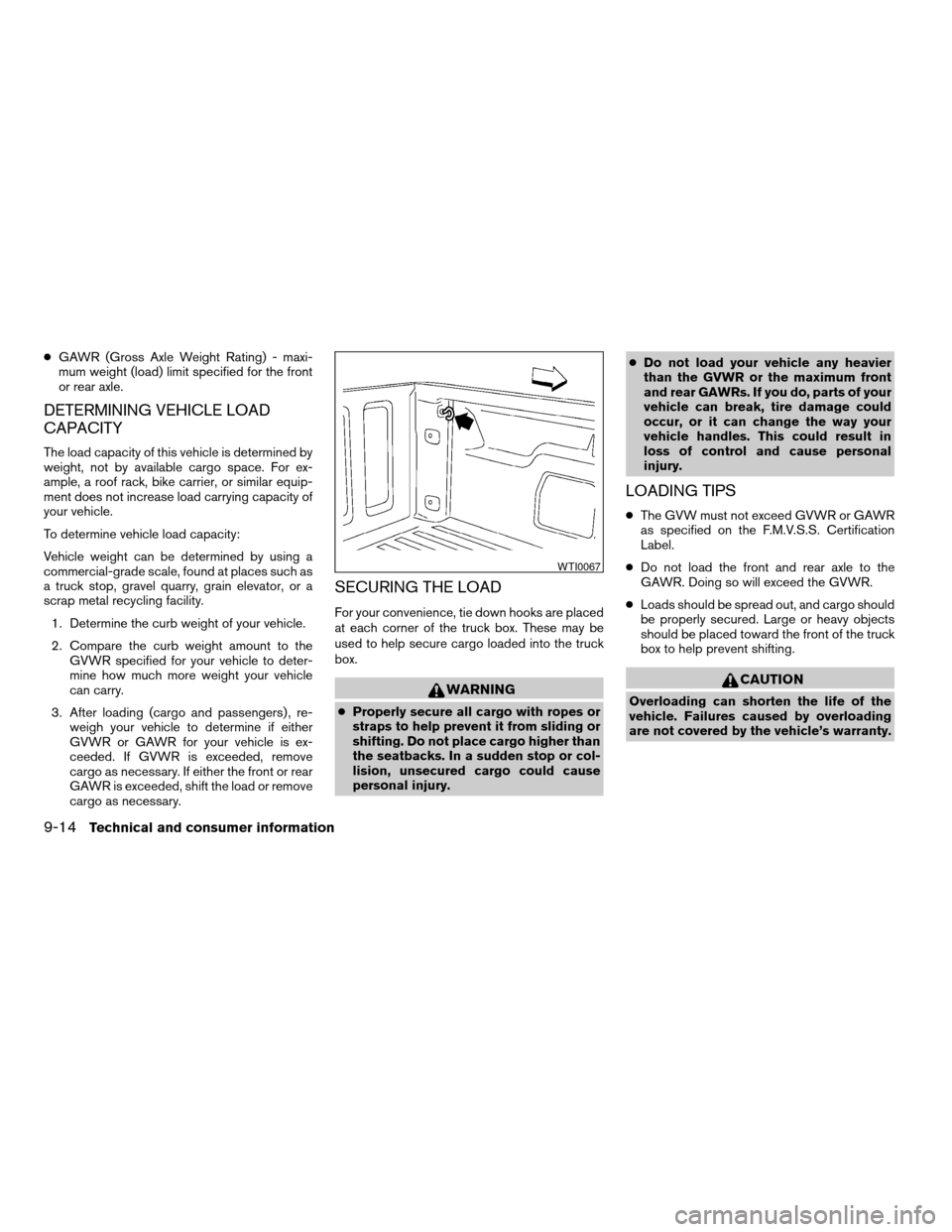
For your convenience, tie down hooks are placed
at each corner of the truck box. These may be
used to help secure cargo loaded into the truck
box.
WARNING
cProperly secure all cargo with ropes or
straps to help prevent it from sliding or
shifting. Do not place cargo higher than
the seatbacks. In a sudden stop or col-
lision, unsecured cargo could cause
personal injury.cDo not load your vehicle any heavier
than the GVWR or the maximum front
and rear GAWRs. If you do, parts of your
vehicle can break, tire damage could
occur, or it can change the way your
vehicle handles. This could result in
loss of control and cause personal
injury.
LOADING TIPS
cThe GVW must not exceed GVWR or GAWR
as specified on the F.M.V.S.S. Certification
Label.
cDo not load the front and rear axle to the
GAWR. Doing so will exceed the GVWR.
cLoads should be spread out, and cargo should
be properly secured. Large or heavy objects
should be placed toward the front of the truck
box to help prevent shifting.
CAUTION
Overloading can shorten the life of the
vehicle. Failures caused by overloading
are not covered by the vehicle’s warranty.
WTI0067
9-14Technical and consumer information
ZREVIEW COPY:Ð2003 Truck/Frontier(d22)
Owners Manual(owners)ÐUSA English(nna)
01/15/03Ðarosenma
X
Page 248 of 272
MEASUREMENT OF WEIGHTS
Secure loose items to prevent weight shifts that
could affect the balance of your vehicle. When
the vehicle is loaded, drive to a scale and weigh
the front and the rear wheels separately to deter-
mine axle loads. Individual axle loads should not
exceed either of the gross axle weight ratings
(GAWR) . The total of the axle loads should not
exceed the gross vehicle weight rating (GVWR) .
These ratings are given on the vehicle certifica-
tion label. If weight ratings are exceeded, move or
remove items to bring all weights below the rat-
ings.Your new vehicle was designed to be used pri-
marily to carry passengers and cargo. Remember
that towing a trailer places additional loads on
your vehicle’s engine, drive train, steering, brak-
ing and other systems.
ANissan Trailer Towing Guide (U.S. only)is
available from a NISSAN dealer. This guide in-
cludes information on trailer towing ability and the
special equipment required for proper towing.
MAXIMUM LOAD LIMITS
Maximum trailer loads
Never allow the total trailer load to exceed the
value specified in the following Towing
Load/Specification Chart found later in this sec-
tion.The total trailer load equals trailer weight plus
its cargo weight.
cWhen towing a trailer load of 1,000 lbs. (454
kg) or more, trailers with a brake system MUST
be used.
The maximum GCWR (Gross Combined Weight
Rating) should not exceed the value specified in
the following Towing Load/ Specification Chart.
The GCWR equals the combined weight of the
towing vehicle (including passengers and cargo)
plus the total trailer load. Towing loads greaterthan these or using improper towing equipment
could adversely affect vehicle handling, braking
and performance.
The ability of your vehicle to tow a trailer is not
only related to the maximum trailer loads, but also
the places you plan to tow. Tow weights appro-
priate for level highway driving may have to be
reduced on very steep grades or in low traction
situations (for example, on slippery boat ramps) .
WARNING
Vehicle damage and/or personal injury re-
sulting from improper towing procedures
are not covered by NISSAN warranties. A
NISSAN Trailer Towing Guide (U.S. only)
containing information on trailer towing
ability and the special equipment required
may be obtained from a NISSAN dealer.
TOWING A TRAILER
9-18Technical and consumer information
ZREVIEW COPY:Ð2003 Truck/Frontier(d22)
Owners Manual(owners)ÐUSA English(nna)
01/15/03Ðarosenma
X
Page 249 of 272

Tongue load
Keep the tongue load between9-11percent of
the total trailer load within the maximum tongue
load limits shown in the following Towing
Load/Specification Chart. If the tongue load be-
comes excessive, rearrange cargo to allow for
proper tongue load.
Maximum gross vehicle
weight/maximum gross axle weight
The gross vehicle weight of the towing vehicle
must not exceed the gross vehicle weight rating
(GVWR) shown on the F. M. V. S. S. certification
label. The gross vehicle weight equals the com-
bined weight of the unloaded vehicle, passen-
gers, luggage, hitch, trailer tongue load and any
other optional equipment. In addition, front or rear
gross axle weight must not exceed the gross axle
weight rating (GAWR) shown on the F. M. V. S. S.
certification label.
CA0009CA0036
Technical and consumer information9-19
ZREVIEW COPY:Ð2003 Truck/Frontier(d22)
Owners Manual(owners)ÐUSA English(nna)
01/15/03Ðarosenma
X
Page 250 of 272
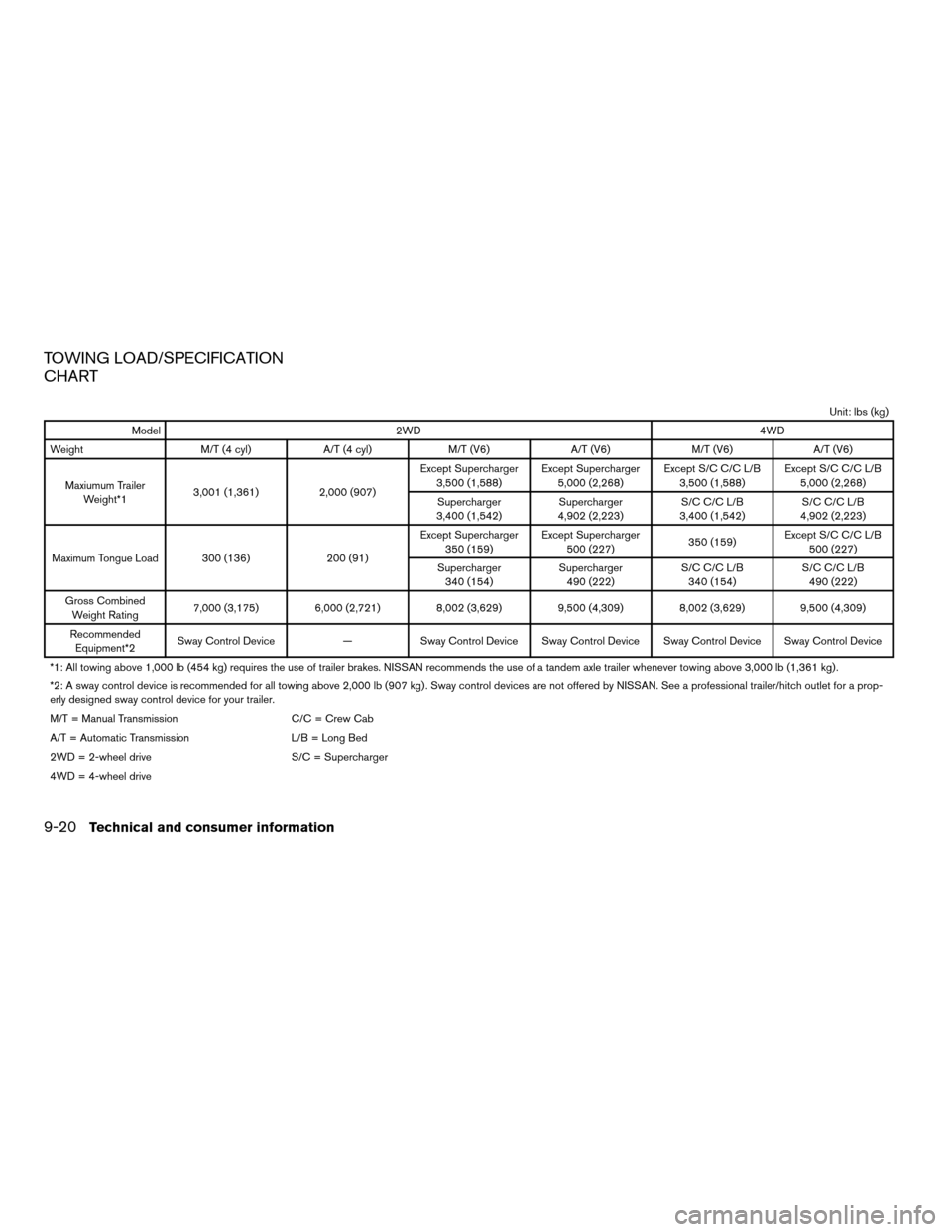
TOWING LOAD/SPECIFICATION
CHART
Unit: lbs (kg)
Model 2WD 4WD
Weight M/T (4 cyl) A/T (4 cyl) M/T (V6) A/T (V6) M/T (V6) A/T (V6)
Maxiumum Trailer
Weight*13,001 (1,361) 2,000 (907)Except Supercharger
3,500 (1,588)Except Supercharger
5,000 (2,268)Except S/C C/C L/B
3,500 (1,588)Except S/C C/C L/B
5,000 (2,268)
Supercharger
3,400 (1,542)Supercharger
4,902 (2,223)S/C C/C L/B
3,400 (1,542)S/C C/C L/B
4,902 (2,223)
Maximum Tongue Load 300 (136) 200 (91)Except Supercharger
350 (159)Except Supercharger
500 (227)350 (159)Except S/C C/C L/B
500 (227)
Supercharger
340 (154)Supercharger
490 (222)S/C C/C L/B
340 (154)S/C C/C L/B
490 (222)
Gross Combined
Weight Rating7,000 (3,175) 6,000 (2,721) 8,002 (3,629) 9,500 (4,309) 8,002 (3,629) 9,500 (4,309)
Recommended
Equipment*2Sway Control Device — Sway Control Device Sway Control Device Sway Control Device Sway Control Device
*1: All towing above 1,000 lb (454 kg) requires the use of trailer brakes. NISSAN recommends the use of a tandem axle trailer whenever towing above 3,000lb (1,361 kg) .
*2: A sway control device is recommended for all towing above 2,000 lb (907 kg) . Sway control devices are not offered by NISSAN. See a professional trailer/hitch outlet for a prop-
erly designed sway control device for your trailer.
M/T = Manual Transmission C/C = Crew Cab
A/T = Automatic Transmission L/B = Long Bed
2WD = 2-wheel drive S/C = Supercharger
4WD = 4-wheel drive
9-20Technical and consumer information
ZREVIEW COPY:Ð2003 Truck/Frontier(d22)
Owners Manual(owners)ÐUSA English(nna)
01/15/03Ðarosenma
X
Page 251 of 272
TOWING SAFETY
Trailer hitch
Check the towing capacity of your bumper hitch
or receiver-type frame mounted hitch. Choose a
proper hitch for your vehicle and trailer. A genuine
Nissan trailer hitch is available from your NISSAN
dealer. Make sure the trailer hitch is securely
attached to the vehicle to help avoid personal
injury or property damage due to sway caused by
crosswinds, rough road surfaces or passing
trucks.
CAUTION
cSpecial hitches which include frame re-
inforcements are required for towing
above 2,000 lb (907 kg) . Suitable genu-
ine NISSAN hitches for pickup trucks
and sport utility vehicles are available
at a NISSAN dealer.
cThe hitch should not be attached to or
affect the operation of the impact-
absorbing bumper.
cDo not use axle-mounted hitches.
cDo not modify the vehicle exhaust sys-
tem, brake system, etc. to install a
trailer hitch.cTo reduce the possibility of additional
damage if your vehicle is struck from
the rear, where practical, remove the
hitch and/or receiver when not in use.
cAfter the hitch is removed, seal the bolt
holes to prevent exhaust fumes, water
or dust from entering the passenger
compartment.
cRegularly check that all trailer hitch
mounting bolts are securely mounted.
Tire pressures
cWhen towing a trailer, inflate the vehicle tires
to the recommended cold tire pressure indi-
cated on the tire placard.
cTrailer tire condition, size, load rating and
proper inflation pressure should be in accor-
dance with the trailer and tire manufacturer’s
specifications.
Safety chains
Always use suitable safety chains between your
vehicle and the trailer. Safety chains should be
crossed and should be attached to the hitch, not
to the vehicle bumper or axle. Be sure to leave
enough slack in the chains to permit turning
corners.
Trailer lights
Trailer lights should comply with federal and/or
local regulations. For assistance in hooking up
trailer lights, contact a NISSAN dealer.
Trailer brakes
If your trailer is equipped with a braking system,
make sure it conforms to federal and/or local
regulations and that it is properly installed.
WARNING
Never connect a trailer brake system di-
rectly to the vehicle brake system.
Pre-towing tips
cBe certain your vehicle maintains a level posi-
tion when a loaded and/or unloaded trailer is
hitched. Do not drive the vehicle if it has an
abnormal nose-up or nose-down condition;
check for improper tongue load, overload,
worn suspension or other possible causes of
either condition.
cAlways secure items in the trailer to prevent
load shift while driving.
cBe certain your rear view mirrors conform to all
federal, state or local regulations. If not, install
any mirrors required for towing before driving
the vehicle.
Technical and consumer information9-21
ZREVIEW COPY:Ð2003 Truck/Frontier(d22)
Owners Manual(owners)ÐUSA English(nna)
01/15/03Ðarosenma
X
Page 252 of 272

Trailer towing tips
In order to gain skill and an understanding of the
vehicle’s behavior, you should practice turning,
stopping and backing up in an area which is free
from traffic. Steering stability and braking perfor-
mance will be somewhat different than under
normal driving conditions.
cAlways secure items in the trailer to prevent
load shift while driving.
cAvoid abrupt starts, acceleration or stops.
cAvoid sharp turns or lane changes.
cAlways drive your vehicle at a moderate speed.
cAlways block the wheels on both vehicle and
trailer when parking. Parking on a slope is not
recommended; however, if you must do so,
and if your vehicle is equipped with an auto-
matic transmission, first block the wheels and
apply the parking brake, and then move the
transmission shift selector lever into the P
(Park) position. If you move the shift selector
lever to the P (Park) position before blocking
the wheels and applying the parking brake,
transmission damage could occur.
cWhen going down a hill, shift into a lower gear
and use the engine braking effect. When go-
ing up a long grade, downshift the transmis-
sion to a lower gear and reduce speed toreduce chances of engine overloading and/or
overheating. However, for long steep grades,
do not stay in 1st or 2nd gear when driving
above 35 MPH (56 km/h) .
cIf the engine coolant rises to an extremely high
temperature when the air conditioner system
is on, turn off the air conditioner. Coolant heat
can be additionally vented by opening the win-
dows, switching the fan control to high and
setting the temperature control to the HOT
position.
cTrailer towing requires more fuel than normal
circumstances.
cAvoid towing a trailer for your vehicle’s first
500 miles (805 km) .
cHave your vehicle serviced more often than at
intervals specified in the recommended Main-
tenance Schedule in the “NISSAN Service
and Maintenance Guide”.
cWhen making a turn, your trailer wheels will be
closer to the inside of the turn than your vehicle
wheels. To compensate for this, make a larger
than normal turning radius during the turn.
cCrosswinds and rough roads will adversely
affect vehicle/trailer handling, possibly caus-
ing vehicle sway. When being passed by
larger vehicles, be prepared for possible
changes in crosswinds that could affect ve-hicle handling. If swaying does occur, firmly
grip the steering wheel, steer straight ahead,
and immediately (but gradually) reduce vehicle
speed. This combination will help stabilize the
vehicle. Never increase speed.
cBe careful when passing other vehicles. Pass-
ing while towing a trailer requires considerably
more distance than normal passing. Remem-
ber, the length of the trailer must also pass the
other vehicle before you can safely change
lanes.
cTo maintain engine braking efficiency and
electrical charging performance, do not use
5th gear (manual transmission) or overdrive
(automatic transmission) .
cAvoid holding the brake pedal down too long
or too frequently. This could cause the brakes
to overheat, resulting in reduced braking effi-
ciency.
When towing a trailer, transmission
oil/fluid should be changed more fre-
quently. For additional information, see the
“Maintenance and do-it-yourself” section
earlier in this manual.
9-22Technical and consumer information
ZREVIEW COPY:Ð2003 Truck/Frontier(d22)
Owners Manual(owners)ÐUSA English(nna)
01/15/03Ðarosenma
X