wheel NISSAN FRONTIER 2004 D22 / 1.G Repair Manual
[x] Cancel search | Manufacturer: NISSAN, Model Year: 2004, Model line: FRONTIER, Model: NISSAN FRONTIER 2004 D22 / 1.GPages: 296, PDF Size: 4.48 MB
Page 251 of 296
Tire chains must be installed only on the
rear wheels and not on the front wheels.
Never install tire chains on a TEMPORARY USE
ONLY spare tire.
Do not use tire chains on dry roads. Driving with
chains in such conditions can cause damage to
the various mechanisms of the vehicle due to
some overstress.
Use only the 2WD range when driving on clear
paved roads.
CHANGING WHEELS AND TIRES
Tire rotation
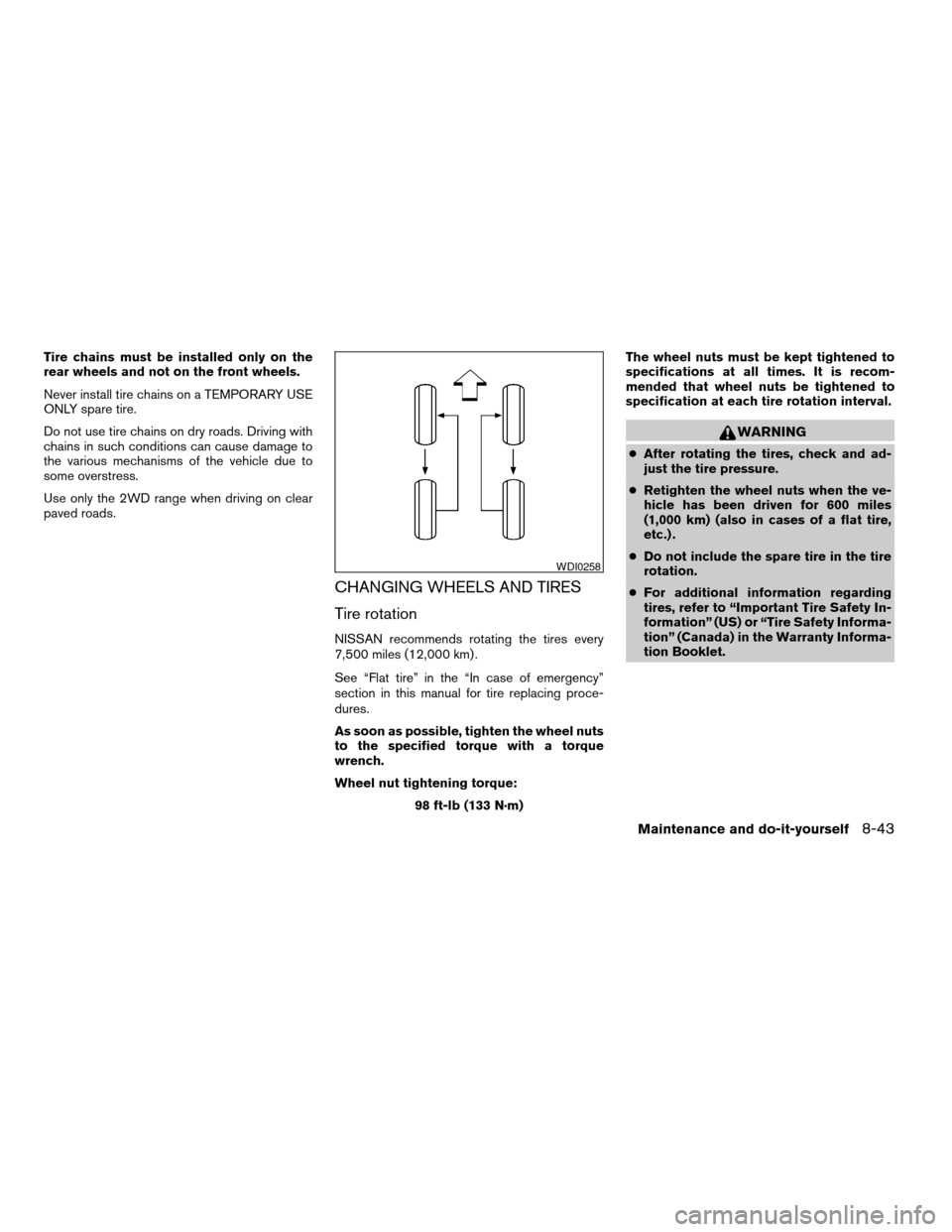
NISSAN recommends rotating the tires every
7,500 miles (12,000 km) .
See “Flat tire” in the “In case of emergency”
section in this manual for tire replacing proce-
dures.
As soon as possible, tighten the wheel nuts
to the specified torque with a torque
wrench.
Wheel nut tightening torque:
98 ft-lb (133 N·m)The wheel nuts must be kept tightened to
specifications at all times. It is recom-
mended that wheel nuts be tightened to
specification at each tire rotation interval.
WARNING
cAfter rotating the tires, check and ad-
just the tire pressure.
cRetighten the wheel nuts when the ve-
hicle has been driven for 600 miles
(1,000 km) (also in cases of a flat tire,
etc.) .
cDo not include the spare tire in the tire
rotation.
cFor additional information regarding
tires, refer to “Important Tire Safety In-
formation” (US) or “Tire Safety Informa-
tion” (Canada) in the Warranty Informa-
tion Booklet.
WDI0258
Maintenance and do-it-yourself8-43
ZREVIEW COPY:Ð2004 Truck/Frontier(d22)
Owners Manual(owners)ÐUSA English(nna)
11/21/03Ðdebbie
X
Page 252 of 296
1. Wear indicator
2. Location mark
Tire wear and damage
WARNING
cTires should be periodically inspected
for wear, cracking, bulging or objects
caught in the tread. If excessive wear,
cracks, bulging or deep cuts are found,
the tire(s) should be replaced.cThe original tires have built-in tread
wear indicators. When the wear indica-
tors are visible, the tire(s) should be
replaced.
cImproper service of the spare tire may
result in serious personal injury. If it is
necessary to repair the spare tire, con-
tact a NISSAN dealer.
cFor additional information regarding
tires, refer to “Important Tire Safety In-
formation” (US) or “Tire Safety Informa-
tion” (Canada) in the Warranty Informa-
tion Booklet.
Replacing wheels and tires
When replacing a tire, use the same size, tread
design, speed rating and load carrying capacity
as originally equipped. Recommended types and
sizes are shown in “Wheels and tires” in the
“Technical and consumer information” section of
this manual.
WARNING
cThe use of tires other than those recom-
mended or the mixed use of tires of
different brands, construction (bias,
bias-belted or radial) , or tread patterns
can adversely affect the ride, braking,
handling, ground clearance, body-to-
tire clearance, tire chain clearance,
speedometer calibration, headlight aim
and bumper height. Some of these ef-
fects may lead to accidents and could
result in serious personal injury.
cIf the wheels are changed for any rea-
son, always replace with wheels which
have the same off-set dimension.
Wheels of a different off-set could
cause premature tire wear, degrade ve-
hicle handling characteristics and/or
interference with the brake
discs/drums. Such interference can
lead to decreased braking efficiency
and/or early brake pad/shoe wear. Re-
fer to “Wheels and tires” in the “Techni-
cal and consumer information” section
of this manual for wheel off-set
dimensions.
WDI0259
8-44Maintenance and do-it-yourself
ZREVIEW COPY:Ð2004 Truck/Frontier(d22)
Owners Manual(owners)ÐUSA English(nna)
11/21/03Ðdebbie
X
Page 253 of 296
cWhen a spare tire is mounted or a wheel
is replaced, the low tire pressure warn-
ing system will not function. Contact
your NISSAN dealer as soon as pos-
sible for tire replacement and/or sys-
tem resetting (for models with the low
tire pressure warning system) .
cDo not install a deformed wheel or tire
even if it has been repaired. Such
wheels or tires could have structural
damage and could fail without warning.
cThe use of retread tires is not
recommended.
cFor additional information regarding
tires, refer to “Important Tire Safety In-
formation” (US) or “Tire Safety Informa-
tion” (Canada) in the Warranty Informa-
tion Booklet.Four-wheel drive models
CAUTION
Always use tires of the same type, size,
brand, construction (bias, bias-belted or
radial) , and tread pattern on all four
wheels. Failure to do so may result in a
circumference difference between tires
on the front and rear axles which will
cause excessive tire wear and may dam-
age the transmission, transfer case and
differential gears.
If excessive tire wear is found, it is recommended
that all four tires be replaced with tires of the
same size, brand, construction and tread pattern.
The tire pressure and wheel alignment should
also be checked and corrected as necessary.
Contact a NISSAN dealer.
Wheel balance
Unbalanced wheels may affect vehicle handling
and tire life. Even with regular use, wheels can get
out of balance. Therefore, they should be bal-
anced as required.
Wheel balance service should be per-
formed with the wheels off the vehicle.
Spin balancing the wheels on the vehicle
could lead to mechanical damage.cFor additional information regarding
tires, refer to “Important Tire Safety
Information” (US) or “Tire Safety Infor-
mation” (Canada) in the Warranty In-
formation Booklet .
Care of wheels
cWash the wheels when washing the vehicle
to maintain their appearance.
cClean the inner side of the wheels when the
wheel is changed or the underside of the
vehicle is washed.
cDo not use abrasive cleaners when washing
the wheels.
cInspect wheel rims regularly for dents or
corrosion. Such damage may cause loss of
pressure or poor seal at the tire bead.
cNISSAN recommends waxing the road
wheels to protect against road salt in areas
where it is used during winter.
Spare tire (TEMPORARY USE ONLY
spare tire)
Your vehicle may be equipped with a TEMPO-
RARY SPARE USE ONLY spare tire.
Maintenance and do-it-yourself8-45
ZREVIEW COPY:Ð2004 Truck/Frontier(d22)
Owners Manual(owners)ÐUSA English(nna)
11/21/03Ðdebbie
X
Page 254 of 296
Observe the following precautions if the TEM-
PORARY USE ONLY spare tire must be used,
Otherwise, your vehicle could be damaged or
involved in an accident:
WARNING
cThe spare tire should be used for emer-
gency use only. It should be replaced
with the standard tire at the first oppor-
tunity to avoid possible tire or differen-
tial damage.
cDrive carefully while the TEMPORARY
USE ONLY spare tire is installed. Avoid
sharp turns and abrupt braking while
driving.
cPeriodically check spare tire inflation
pressure. Always keep the pressure of
the TEMPORARY USE ONLY spare tire
at 60 psi (420 kPa, 4.2 bar) .
cWith the TEMPORARY USE ONLY spare
tire installed do not drive the vehicle at
speeds faster than 50 MPH (80 km/h) .cWhen driving on roads covered with
snow or ice, the TEMPORARY USE
ONLY spare tire should be used on the
front wheels and the original tire used
on the rear wheels (drive wheels) . Use
tire chains only on the two rear original
tires.
cTire tread of the TEMPORARY USE
ONLY spare tire will wear at a faster rate
than the standard tire. Replace the
spare tire as soon as the tread wear
indicators appear.
cDo not use the spare tire on other
vehicles.
cDo not use more than one spare tire at
the same time.
cDo not tow a trailer when the TEMPO-
RARY USE ONLY spare tire is installed.
CAUTION
cWith the spare tire installed the
transfer control lever must be in the 2H
position to prevent the transfer case
and differential gears from being
damaged.cDo not use tire chains on a TEMPO-
RARY USE ONLY spare tire. Tire chains
will not fit properly and may cause dam-
age to the vehicle.
cBecause the TEMPORARY USE ONLY
spare tire is smaller than the original
tire, ground clearance is reduced. To
avoid damage to the vehicle, do not
drive over obstacles. Also, do not drive
the vehicle through an automatic car
wash since it may get caught.
8-46Maintenance and do-it-yourself
ZREVIEW COPY:Ð2004 Truck/Frontier(d22)
Owners Manual(owners)ÐUSA English(nna)
11/21/03Ðdebbie
X
Page 255 of 296

9 Technical and consumer information
Capacities and recommended fuel/lubricants.........9-2
Fuel recommendation...........................9-3
Engine oil and oil filter recommendation...........9-5
Recommended SAE viscosity number............9-6
Air conditioner system refrigerant and
lubricant recommendations......................9-6
Specifications.....................................9-7
Engine........................................9-7
Wheels and tires...............................9-8
Dimensions and weights........................9-9
When traveling or registering your vehicle in
another country..................................9-10
Vehicle identification..............................9-10
Vehicle identification number (VIN) plate.........9-10
Vehicle identification number
(chassis number)..............................9-10
Engine serial number...........................9-11
F.M.V.S.S. certification label....................9-11
Emission control information label...............9-12
Tire placard...................................9-12
Air conditioner specification label................9-12
Installing front license plate........................9-13
Vehicle loading information........................9-13Terms........................................9-13
Determining vehicle load capacity...............9-14
Securing the load..............................9-14
Loading tips..................................9-14
Truck-camper loading information..................9-15
Crew Cab Models.............................9-15
King Cab models..............................9-15
Special Body vehicles..........................9-15
Location for center of gravity....................9-15
Vehicle load weight capacity....................9-16
Measurement of weights.......................9-18
Towing a trailer...................................9-18
Maximum load limits...........................9-18
Towing load/specification chart.................9-20
Towing safety.................................9-21
Flat towing....................................9-23
Uniform tire quality grading........................9-23
Emission control system warranty..................9-24
Reporting safety defects (US only).................9-25
Readiness for inspection/maintenance (I/M) test.....9-25
Dynamometer testing for Inspection/
Maintenance (I/M) test (US only)................9-26
Owner’s Manual/Service Manual order information . . . 9-27
In the event of a collision.......................9-28
ZREVIEW COPY:Ð2004 Truck/Frontier(d22)
Owners Manual(owners)ÐUSA English(nna)
11/21/03Ðdebbie
X
Page 262 of 296

WHEELS AND TIRES
Road wheel/offset in (mm) Tire Spare tire size
4X2 King Cab: XE 15X6JJ/1.18 (30) Steel
15X7JJ/0.79 (20) Alloy
15X7JJ/1.18 (30) Steel*
15X7JJ/1.57 (40) Alloy*P225/70R15
P225/70R15
P265/70R15*
P265/70R15*T135/90D16
T135/90D16
P265/70R15*
P265/70R15*
SC 17X7JJ/1.57 (40) Alloy P265/55R17 P265/55R17
Crew Cab: XE 15X7JJ/1.18 (30) Alloy
15X7JJ/1.57 (40) AlloyP265/70R15
P265/70R15P265/70R15
P265/70R15
SC 17X7JJ/1.57 (40) Alloy P265/55R17 P265/55R17
4X4 King Cab: XE 15X7JJ/1.18 (30) Steel
15X7JJ/1.57 (40) AlloyP265/70R15
P265/70R15P265/70R15
P265/70R15
SC 16X7JJ/1.57 (40) Alloy
17X7JJ/1.57 (40) AlloyP265/70R16
P265/65R17P265/70R16
P265/55R17
Crew Cab: XE 15X7JJ/1.18 (30) Alloy
15X7JJ/1.57 (40) AlloyP265/70R15
P265/70R15P265/70R15
P265/70R15
SC 16X7JJ/1.57 (40) Alloy
17X7JJ/1.57 (40) AlloyP265/70R16
P265/65R17P265/70R16
P265/55R17
*Not available with KA24DE engine.
9-8Technical and consumer information
ZREVIEW COPY:Ð2004 Truck/Frontier(d22)
Owners Manual(owners)ÐUSA English(nna)
11/21/03Ðdebbie
X
Page 263 of 296

DIMENSIONS AND WEIGHTS
Unit: mm (in)
Drive Type 2WD 4WD
Body King Cab Crew Cab Crew Cab King Cab Crew Cab Crew Cab
Wheelbase Long Short Long Long Short Long
Overall length*1 5153 (202.9) 5077 (199.9) 5532 (217.8) 5153 (202.9) 5077 (199.9) 5532 (217.8)
Overall width 1808 (71.2)*4 1808 (71.2)**4 1808 (71.2)**4 1808 (71.2)*4 1808 (71.2)*4 1808 (71.2)*4
Overall height 1605 (63.2)*2
1694 (66.7)*3
1687 (66.4)*51694 (66.7)*3
1687 (66.4)*51694 (66.7)*3
1687 (66.4)*51694 (66.7)*3
1687 (66.4)*51687 (66.4) 1687 (66.4)
Front tread 1395 (54.9)*2
1525 (60)1525 (60) 1525 (60) 1525 (60) 1525 (60) 1525 (60)
Rear tread 1390 (54.7)*2
1507 (59.3)1507 (59.3) 1507 (59.3) 1507 (59.3) 1507 (59.3) 1507 (59.3)
Wheelbase 2950 (116.1) 2950 (116.1) 3329.9 (131.1) 2950 (116.1) 2950 (116.1) 3329.9 (131.1)
Gross vehicle weight rating See the “F.M.V.S.S. certification label” on the driver side door jamb pillar.
lb (kg)
Gross axle weight rating
Front lb (kg)
Rear lb (kg)
*1: Includes rear step bumper.
*2: XE with KA24DE engine.
*3: XE with VG33E engine and SE models.
*4: With over-fender.
*5: SC with VG33ER engine.
Technical and consumer information9-9
ZREVIEW COPY:Ð2004 Truck/Frontier(d22)
Owners Manual(owners)ÐUSA English(nna)
11/21/03Ðdebbie
X
Page 272 of 296
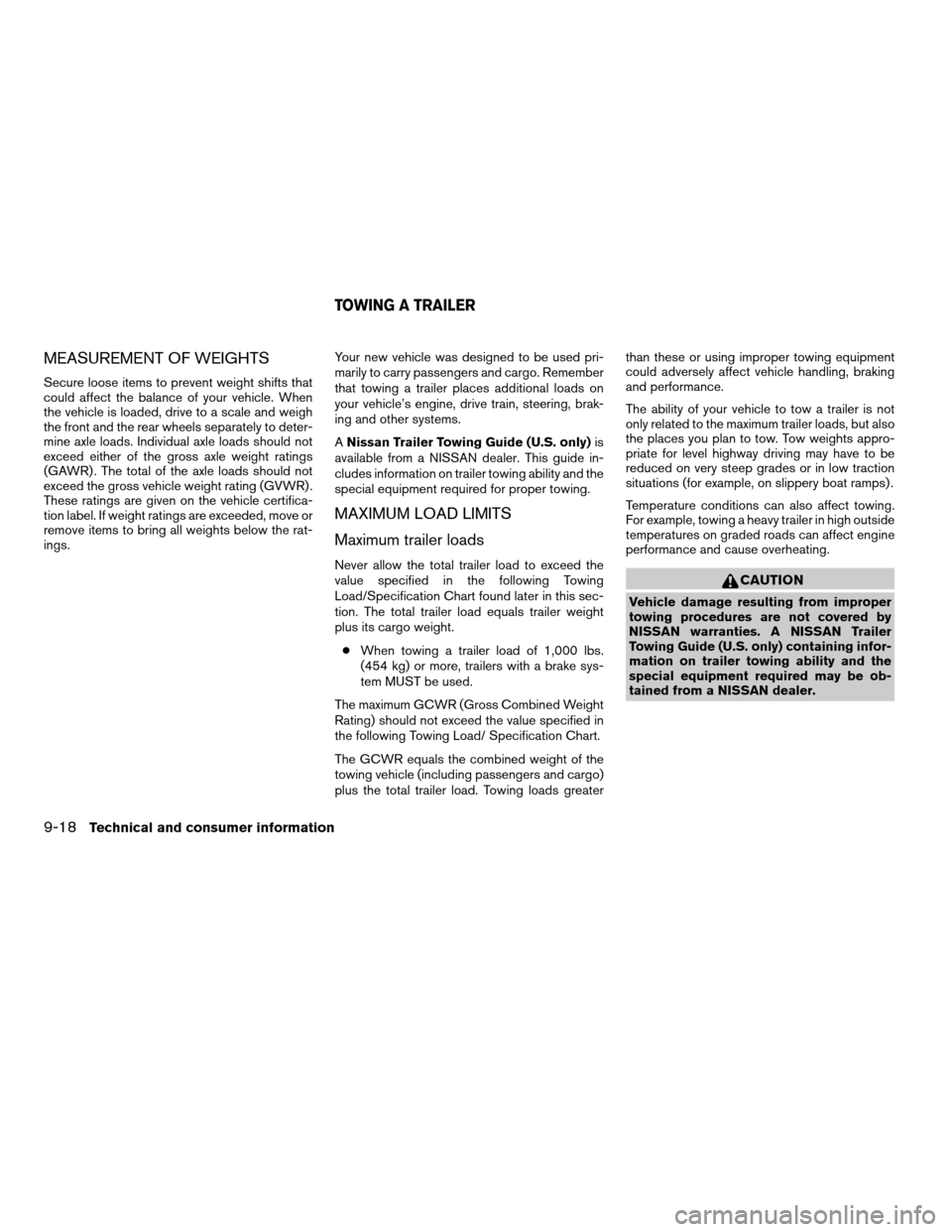
MEASUREMENT OF WEIGHTS
Secure loose items to prevent weight shifts that
could affect the balance of your vehicle. When
the vehicle is loaded, drive to a scale and weigh
the front and the rear wheels separately to deter-
mine axle loads. Individual axle loads should not
exceed either of the gross axle weight ratings
(GAWR) . The total of the axle loads should not
exceed the gross vehicle weight rating (GVWR) .
These ratings are given on the vehicle certifica-
tion label. If weight ratings are exceeded, move or
remove items to bring all weights below the rat-
ings.Your new vehicle was designed to be used pri-
marily to carry passengers and cargo. Remember
that towing a trailer places additional loads on
your vehicle’s engine, drive train, steering, brak-
ing and other systems.
ANissan Trailer Towing Guide (U.S. only)is
available from a NISSAN dealer. This guide in-
cludes information on trailer towing ability and the
special equipment required for proper towing.
MAXIMUM LOAD LIMITS
Maximum trailer loads
Never allow the total trailer load to exceed the
value specified in the following Towing
Load/Specification Chart found later in this sec-
tion. The total trailer load equals trailer weight
plus its cargo weight.
cWhen towing a trailer load of 1,000 lbs.
(454 kg) or more, trailers with a brake sys-
tem MUST be used.
The maximum GCWR (Gross Combined Weight
Rating) should not exceed the value specified in
the following Towing Load/ Specification Chart.
The GCWR equals the combined weight of the
towing vehicle (including passengers and cargo)
plus the total trailer load. Towing loads greaterthan these or using improper towing equipment
could adversely affect vehicle handling, braking
and performance.
The ability of your vehicle to tow a trailer is not
only related to the maximum trailer loads, but also
the places you plan to tow. Tow weights appro-
priate for level highway driving may have to be
reduced on very steep grades or in low traction
situations (for example, on slippery boat ramps) .
Temperature conditions can also affect towing.
For example, towing a heavy trailer in high outside
temperatures on graded roads can affect engine
performance and cause overheating.CAUTION
Vehicle damage resulting from improper
towing procedures are not covered by
NISSAN warranties. A NISSAN Trailer
Towing Guide (U.S. only) containing infor-
mation on trailer towing ability and the
special equipment required may be ob-
tained from a NISSAN dealer.
TOWING A TRAILER
9-18Technical and consumer information
ZREVIEW COPY:Ð2004 Truck/Frontier(d22)
Owners Manual(owners)ÐUSA English(nna)
11/21/03Ðdebbie
X
Page 274 of 296
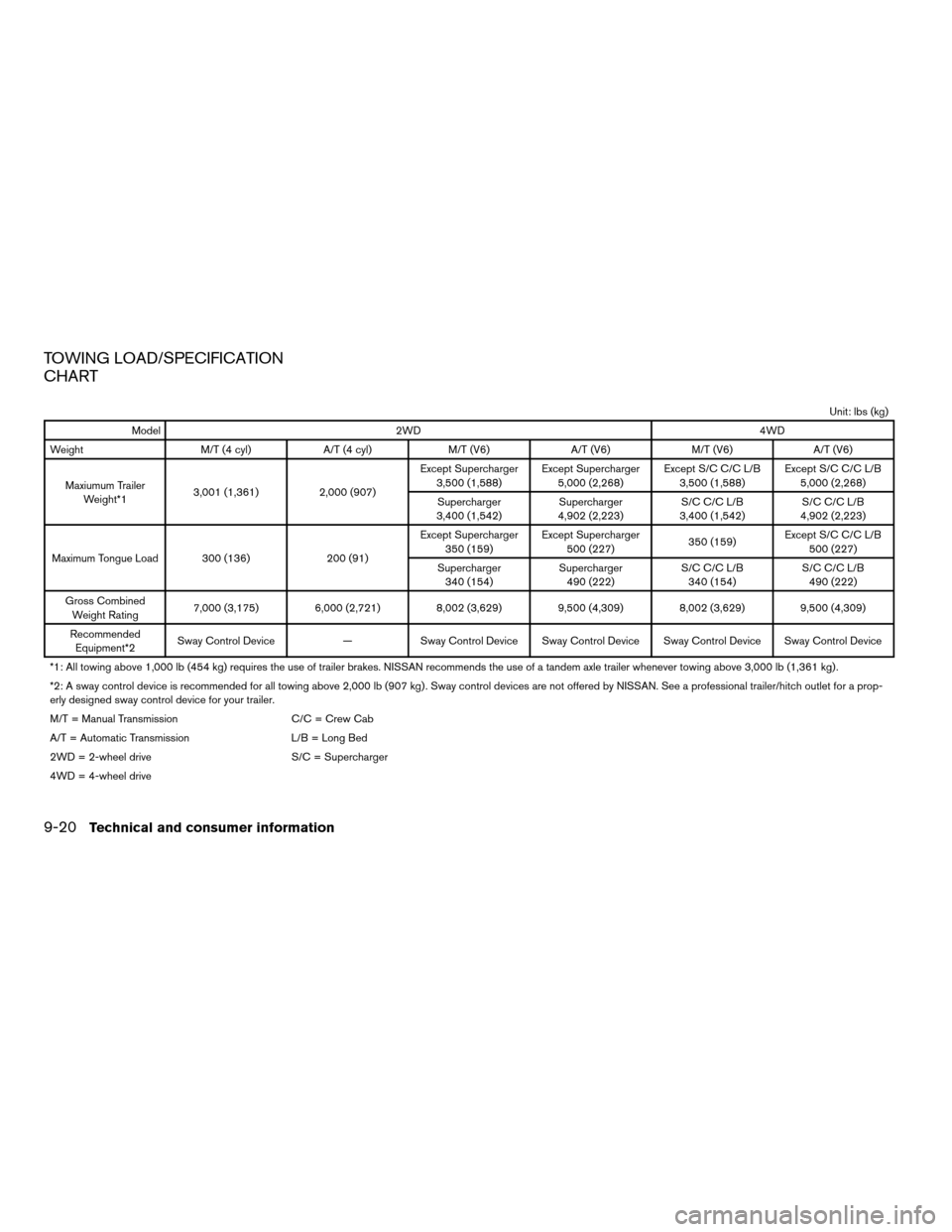
TOWING LOAD/SPECIFICATION
CHART
Unit: lbs (kg)
Model 2WD 4WD
Weight M/T (4 cyl) A/T (4 cyl) M/T (V6) A/T (V6) M/T (V6) A/T (V6)
Maxiumum Trailer
Weight*13,001 (1,361) 2,000 (907)Except Supercharger
3,500 (1,588)Except Supercharger
5,000 (2,268)Except S/C C/C L/B
3,500 (1,588)Except S/C C/C L/B
5,000 (2,268)
Supercharger
3,400 (1,542)Supercharger
4,902 (2,223)S/C C/C L/B
3,400 (1,542)S/C C/C L/B
4,902 (2,223)
Maximum Tongue Load 300 (136) 200 (91)Except Supercharger
350 (159)Except Supercharger
500 (227)350 (159)Except S/C C/C L/B
500 (227)
Supercharger
340 (154)Supercharger
490 (222)S/C C/C L/B
340 (154)S/C C/C L/B
490 (222)
Gross Combined
Weight Rating7,000 (3,175) 6,000 (2,721) 8,002 (3,629) 9,500 (4,309) 8,002 (3,629) 9,500 (4,309)
Recommended
Equipment*2Sway Control Device — Sway Control Device Sway Control Device Sway Control Device Sway Control Device
*1: All towing above 1,000 lb (454 kg) requires the use of trailer brakes. NISSAN recommends the use of a tandem axle trailer whenever towing above 3,000lb (1,361 kg) .
*2: A sway control device is recommended for all towing above 2,000 lb (907 kg) . Sway control devices are not offered by NISSAN. See a professional trailer/hitch outlet for a prop-
erly designed sway control device for your trailer.
M/T = Manual Transmission C/C = Crew Cab
A/T = Automatic Transmission L/B = Long Bed
2WD = 2-wheel drive S/C = Supercharger
4WD = 4-wheel drive
9-20Technical and consumer information
ZREVIEW COPY:Ð2004 Truck/Frontier(d22)
Owners Manual(owners)ÐUSA English(nna)
11/21/03Ðdebbie
X
Page 276 of 296

Trailer towing tips
In order to gain skill and an understanding of the
vehicle’s behavior, you should practice turning,
stopping and backing up in an area which is free
from traffic. Steering stability and braking perfor-
mance will be somewhat different than under
normal driving conditions.
cAlways secure items in the trailer to prevent
load shift while driving.
cAvoid abrupt starts, acceleration or stops.
cAvoid sharp turns or lane changes.
cAlways drive your vehicle at a moderate
speed.
cAlways block the wheels on both vehicle and
trailer when parking. Parking on a slope is
not recommended; however, if you must do
so, and if your vehicle is equipped with an
automatic transmission, first block the
wheels and apply the parking brake, and
then move the transmission shift selector
lever into the P (Park) position. If you move
the shift selector lever to the P (Park) posi-
tion before blocking the wheels and applying
the parking brake, transmission damage
could occur.
cWhen going down a hill, shift into a lower
gear and use the engine braking effect.When going up a long grade, downshift the
transmission to a lower gear and reduce
speed to reduce chances of engine over-
loading and/or overheating. However, for
long steep grades, do not stay in 1st or 2nd
gear when driving above 35 MPH (56 km/h) .
cIf the engine coolant rises to an extremely
high temperature when the air conditioner
system is on, turn off the air conditioner.
Coolant heat can be additionally vented by
opening the windows, switching the fan
control to high and setting the temperature
control to the HOT position.
cTrailer towing requires more fuel than normal
circumstances.
cAvoid towing a trailer for your vehicle’s first
500 miles (805 km) .
cFor the first 500 miles that you do tow, do
not drive over 50 MPH (80 km/h) .
cHave your vehicle serviced more often than
at intervals specified in the recommended
Maintenance Schedule in the “NISSAN Ser-
vice and Maintenance Guide”.
cWhen making a turn, your trailer wheels will
be closer to the inside of the turn than your
vehicle wheels. To compensate for this,
make a larger than normal turning radius
during the turn.cCrosswinds and rough roads will adversely
affect vehicle/trailer handling, possibly caus-
ing vehicle sway. When being passed by
larger vehicles, be prepared for possible
changes in crosswinds that could affect ve-
hicle handling. If swaying does occur, firmly
grip the steering wheel, steer straight ahead,
and immediately (but gradually) reduce ve-
hicle speed. This combination will help sta-
bilize the vehicle. Never increase speed.
cBe careful when passing other vehicles.
Passing while towing a trailer requires con-
siderably more distance than normal pass-
ing. Remember, the length of the trailer must
also pass the other vehicle before you can
safely change lanes.
cTo maintain engine braking efficiency and
electrical charging performance, do not use
5th gear (manual transmission) or overdrive
(automatic transmission) .
cAvoid holding the brake pedal down too long
or too frequently. This could cause the
brakes to overheat, resulting in reduced
braking efficiency.
When towing a trailer, transmission
oil/fluid should be changed more fre-
quently. For additional information, see the
“Maintenance and do-it-yourself” section
earlier in this manual.
9-22Technical and consumer information
ZREVIEW COPY:Ð2004 Truck/Frontier(d22)
Owners Manual(owners)ÐUSA English(nna)
11/21/03Ðdebbie
X