warning light NISSAN FRONTIER 2007 D22 / 1.G Owners Manual
[x] Cancel search | Manufacturer: NISSAN, Model Year: 2007, Model line: FRONTIER, Model: NISSAN FRONTIER 2007 D22 / 1.GPages: 336, PDF Size: 6.84 MB
Page 7 of 336

0 Illustrated table of contents
Airbags, seat belts and child restraints...............0-2
Exterior front......................................0-3
Exterior rear.......................................0-4
Passenger compartment...........................0-5Instrument panel...................................0-6
Engine compartment check locations................0-8
Warning/indicator lights...........................0-10
ZREVIEW COPYÐ2007 Truck/Frontier(d22)
Owners ManualÐUSA_English(nna)
12/13/06Ðcathy
X
Page 12 of 336

1. Ventilators (P. 4-2)
2. Headlight/fog light (if so equipped)/
turn signal switch (P. 2-27)
3. Steering wheel switch for audio control
(if so equipped) (P. 4-26)
4. Driver supplemental air bag/horn
(P. 1-49, P. 2-32)
5. Meters, gauges and warning/indicator
lights (P. 2-5, 2-14)
6. Cruise control main/set switches
(if so equipped) (P. 5-19)
7. Windshield wiper/washer switch
(P. 2-26)
8. Storage (P. 2-37)
9. Audio system controls (if so equipped)
(P. 4-10)
10. Front passenger supplemental air bag
(P. 1-49)
11. Upper and lower glove box (P. 2-41)
12. Power outlet (P. 2-36)
13. Electronic locking rear differential
(E-Lock) system switch (if so
equipped) (P. 2-35)
Heated seat switches (if so equipped)
(P. 2-33)
Hill descent control switch
(if so equipped) (P. 2-34)
WIC0916
INSTRUMENT PANEL
0-6Illustrated table of contents
ZREVIEW COPYÐ2007 Truck/Frontier(d22)
Owners ManualÐUSA_English(nna)
01/09/07Ðdebbie
X
Page 13 of 336

Vehicle dynamic control (VDC) OFF
switch (if so equipped) (P. 2-33)
14. Shift selector lever (P. 5-12)
15. 4WD shift switch (if so equipped)
(P. 5-21)
16. Climate controls (P. 4-2)
17. Passenger air bag status light (P. 1-58)
18. Hazard warning flasher switch (P. 2-31)
19. Ignition switch (P. 5-8)
20. Tilt steering wheel control
(if so equipped) (P. 3-11)
21. Cargo lamp switch (P. 2-32)
22. Clutch interlock (clutch start) switch
(if so equipped) (P. 2-36)
23. Outside mirror controls (if so equipped)
(P. 3-14)
Illustrated table of contents
0-7
ZREVIEW COPYÐ2007 Truck/Frontier(d22)
Owners ManualÐUSA_English(nna)
12/13/06Ðcathy
X
Page 16 of 336
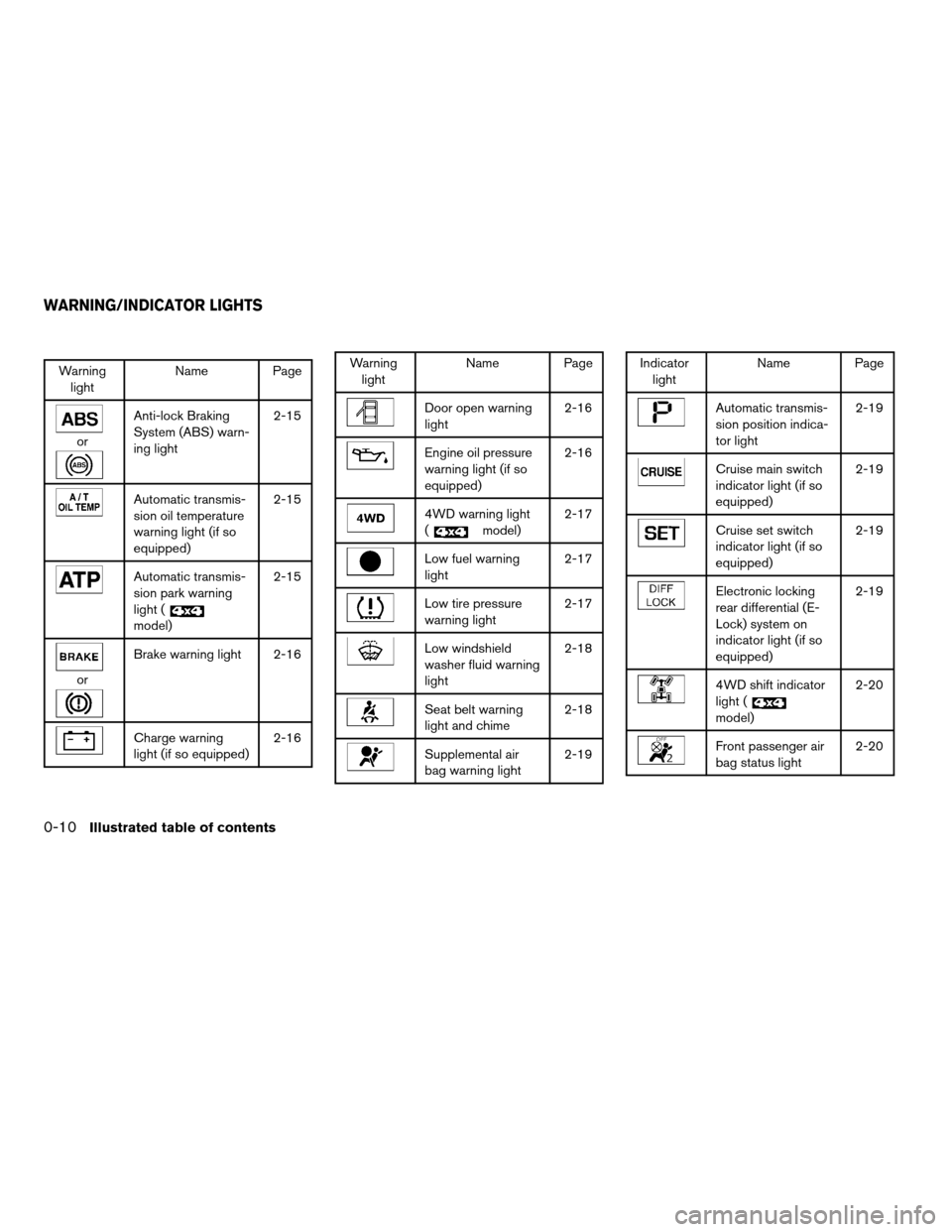
Warning
lightName Page
or
Anti-lock Braking
System (ABS) warn-
ing light2-15
Automatic transmis-
sion oil temperature
warning light (if so
equipped)2-15
Automatic transmis-
sion park warning
light (
model)2-15
or
Brake warning light 2-16
Charge warning
light (if so equipped)2-16
Warning
lightName Page
Door open warning
light2-16
Engine oil pressure
warning light (if so
equipped)2-16
4WD warning light
(
model)2-17
Low fuel warning
light2-17
Low tire pressure
warning light2-17
Low windshield
washer fluid warning
light2-18
Seat belt warning
light and chime2-18
Supplemental air
bag warning light2-19
Indicator
lightName Page
Automatic transmis-
sion position indica-
tor light2-19
Cruise main switch
indicator light (if so
equipped)2-19
Cruise set switch
indicator light (if so
equipped)2-19
Electronic locking
rear differential (E-
Lock) system on
indicator light (if so
equipped)2-19
4WD shift indicator
light (
model)2-20
Front passenger air
bag status light2-20
WARNING/INDICATOR LIGHTS
0-10Illustrated table of contents
ZREVIEW COPYÐ2007 Truck/Frontier(d22)
Owners ManualÐUSA_English(nna)
12/13/06Ðcathy
X
Page 19 of 336

1 Safety—Seats, seat belts and
supplemental restraint system
Seats............................................1-2
Front manual seat adjustment
(if so equipped)................................1-2
Front power seat adjustment
(if so equipped)................................1-4
Jump seat (King cab)...........................1-5
Head restraint adjustment.......................1-6
Active Head Restraint (front seats)...............1-6
Armrest.......................................1-7
Flexible seating.................................1-7
Seat belts.......................................1-11
Precautions on seat belt usage..................1-11
Child safety...................................1-13
Pregnant women..............................1-15
Injured persons................................1-15
Three-point type seat belt with retractor..........1-15
Seat belt extenders............................1-19
Seat belt maintenance.........................1-20
Child restraints...................................1-20
Precautions on child restraints..................1-20LATCH (Lower Anchors and Tethers for
CHildren) system..............................1-22
Top tether strap child restraint..................1-24
Child restraint installation using LATCH..........1-27
Child restraint installation using the seat
belts – front passenger and rear bench seat
(crew cab models only)........................1-31
Child Restraint Installation Using The Seat
Belts – passenger’s side jump seat
(King cab models only).........................1-36
Booster seats....................................1-43
Precautions on booster seats...................1-43
Booster seat installation on front passenger
seat and rear seat (Crew cab models only).......1-46
Booster seat installation on passenger’s side
jump seat only (King cab models only)...........1-48
Supplemental restraint system.....................1-49
Precautions on supplemental restraint
system.......................................1-49
Supplemental air bag warning labels.............1-64
Supplemental air bag warning light..............1-64
ZREVIEW COPYÐ2007 Truck/Frontier(d22)
Owners ManualÐUSA_English(nna)
12/13/06Ðcathy
X
Page 31 of 336
WARNING
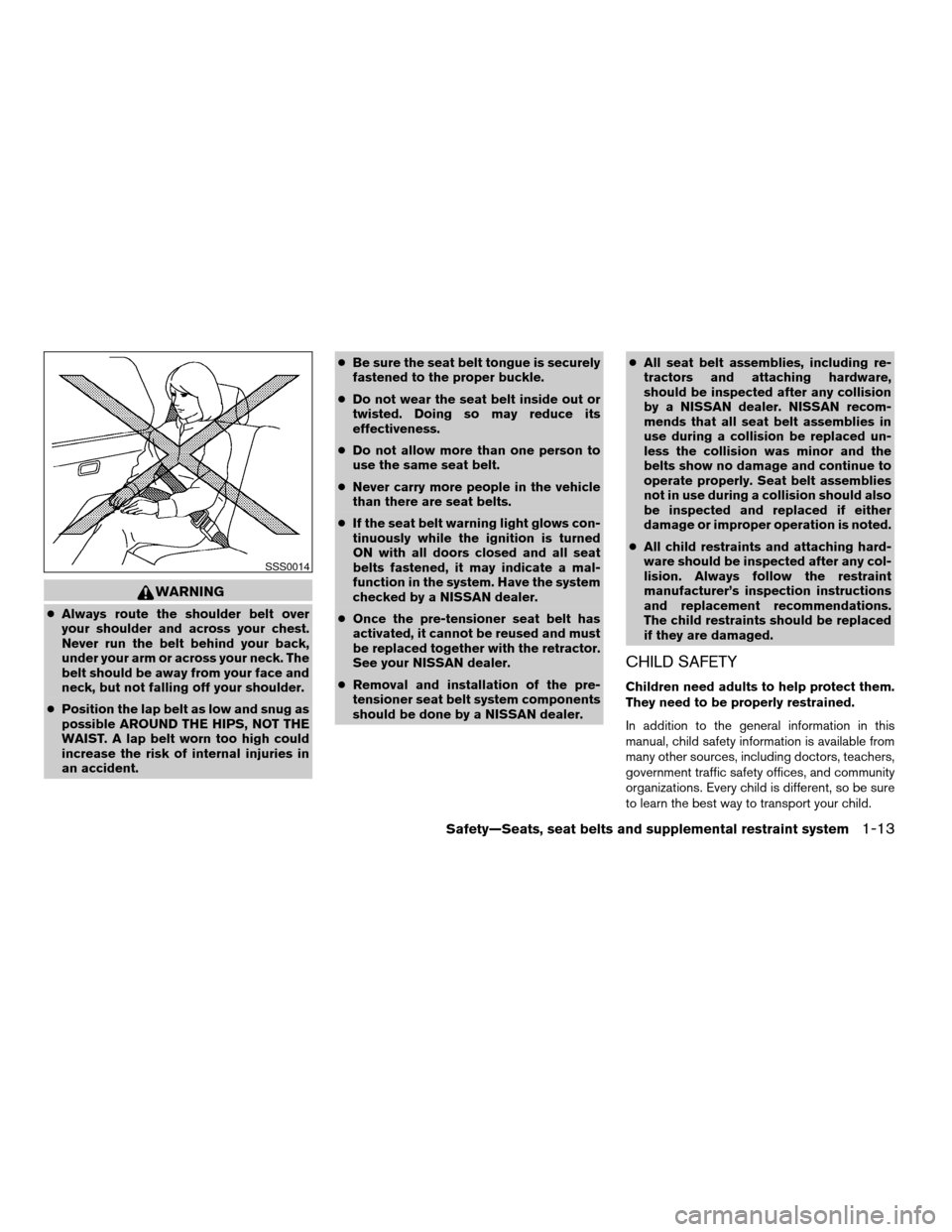
cAlways route the shoulder belt over
your shoulder and across your chest.
Never run the belt behind your back,
under your arm or across your neck. The
belt should be away from your face and
neck, but not falling off your shoulder.
cPosition the lap belt as low and snug as
possible AROUND THE HIPS, NOT THE
WAIST. A lap belt worn too high could
increase the risk of internal injuries in
an accident.cBe sure the seat belt tongue is securely
fastened to the proper buckle.
cDo not wear the seat belt inside out or
twisted. Doing so may reduce its
effectiveness.
cDo not allow more than one person to
use the same seat belt.
cNever carry more people in the vehicle
than there are seat belts.
cIf the seat belt warning light glows con-
tinuously while the ignition is turned
ON with all doors closed and all seat
belts fastened, it may indicate a mal-
function in the system. Have the system
checked by a NISSAN dealer.
cOnce the pre-tensioner seat belt has
activated, it cannot be reused and must
be replaced together with the retractor.
See your NISSAN dealer.
cRemoval and installation of the pre-
tensioner seat belt system components
should be done by a NISSAN dealer.cAll seat belt assemblies, including re-
tractors and attaching hardware,
should be inspected after any collision
by a NISSAN dealer. NISSAN recom-
mends that all seat belt assemblies in
use during a collision be replaced un-
less the collision was minor and the
belts show no damage and continue to
operate properly. Seat belt assemblies
not in use during a collision should also
be inspected and replaced if either
damage or improper operation is noted.
cAll child restraints and attaching hard-
ware should be inspected after any col-
lision. Always follow the restraint
manufacturer’s inspection instructions
and replacement recommendations.
The child restraints should be replaced
if they are damaged.
CHILD SAFETY
Children need adults to help protect them.
They need to be properly restrained.
In addition to the general information in this
manual, child safety information is available from
many other sources, including doctors, teachers,
government traffic safety offices, and community
organizations. Every child is different, so be sure
to learn the best way to transport your child.
SSS0014
Safety—Seats, seat belts and supplemental restraint system1-13
ZREVIEW COPYÐ2007 Truck/Frontier(d22)
Owners ManualÐUSA_English(nna)
12/13/06Ðcathy
X
Page 35 of 336
and fully retracted. Once retracted, the seat belt
is in the emergency locking mode. See “Child
restraints” later in this section for more informa-
tion.
The automatic locking mode should be
used only for child restraint installation.
During normal seat belt use by a passen-
ger, the locking mode should not be acti-
vated. If it is activated it may cause uncom-
fortable seat belt tension. It can also
change the operation of the front passen-
ger air bag. See “Front passenger air bag
and status light” later in this section.
WARNING
When fastening the seat belts, be certain
that the seatbacks are completely se-
cured in the latched position. If they are
not completely secured, passengers may
be injured in an accident or sudden stop.
Fastening the seat belts (Jump seats
King cab models)
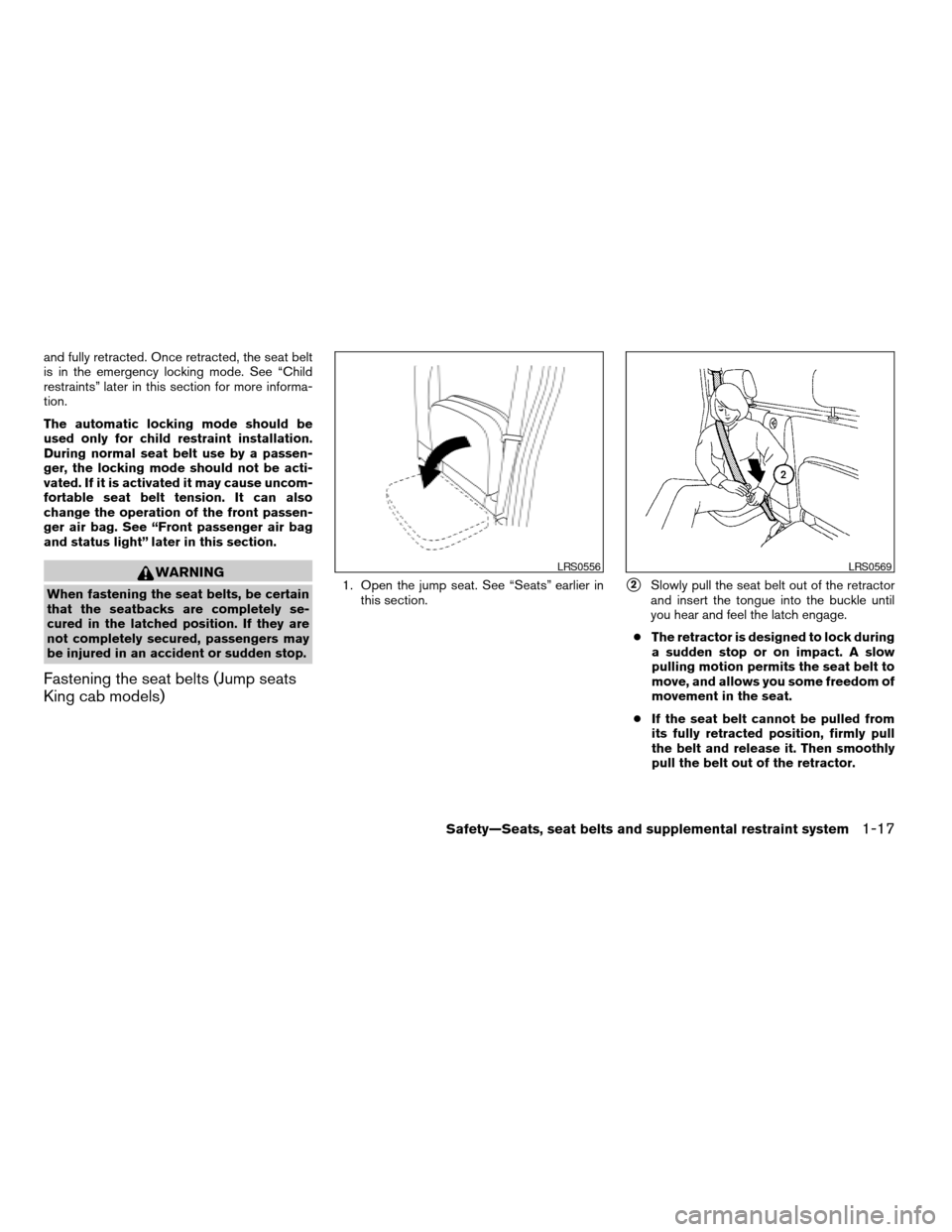
1. Open the jump seat. See “Seats” earlier in
this section.s2Slowly pull the seat belt out of the retractor
and insert the tongue into the buckle until
you hear and feel the latch engage.
cThe retractor is designed to lock during
a sudden stop or on impact. A slow
pulling motion permits the seat belt to
move, and allows you some freedom of
movement in the seat.
cIf the seat belt cannot be pulled from
its fully retracted position, firmly pull
the belt and release it. Then smoothly
pull the belt out of the retractor.
LRS0556LRS0569
Safety—Seats, seat belts and supplemental restraint system1-17
ZREVIEW COPYÐ2007 Truck/Frontier(d22)
Owners ManualÐUSA_English(nna)
12/13/06Ðcathy
X
Page 65 of 336

3. The booster seat should be positioned on
the vehicle seat so that it is stable. If neces-
sary, adjust or remove the head restraint to
obtain the correct booster seat fit. See
“Head restraint adjustment” earlier in this
section. If the head restraint is removed,
store it in a secure place. Be sure to install
the head restraint when the booster seat is
removed. If the seating position does not
have an adjustable head restraint and it is
interfering with the proper booster seat fit,
try another seating position or a different
booster seat.4. Position the lap portion of the seat belt low
and snug on the child’s hips. Be sure to
follow the booster seat manufacturer’s in-
structions for adjusting the belt routing.
5. Pull the shoulder belt portion of the seat belt
toward the retractor to take up extra slack.
Be sure the shoulder belt is positioned
across the top, middle portion of the child’s
shoulder. Be sure to follow the booster seat
manufacturer’s instructions for adjusting the
belt routing.
6. Follow the warnings, cautions and instruc-
tions for properly fastening a seat belt
shown in the “Three-point seat belt with
retractor” earlier in this section.
7. If the booster is installed in the front passen-
ger seat: When the ignition switch is turned
to the ON position, the passenger air bag
status light
may or may not be illumi-
nated, depending on the size of the child and
the type of booster seat being used. See
“Front passenger air bag and status light”
later in this section.
Rear outboard position
LRS0563
Front passenger position
LRS0454
Safety—Seats, seat belts and supplemental restraint system1-47
ZREVIEW COPYÐ2007 Truck/Frontier(d22)
Owners ManualÐUSA_English(nna)
12/13/06Ðcathy
X
Page 68 of 336
vehicle is impacted. In a rollover both curtain air
bags are designed to inflate and remain inflated
for a short time.
These supplemental restraint systems are de-
signed tosupplementthe crash protection pro-
vided by the seat belts and arenot a substitute
for them. Seat belts should always be correctly
worn and the occupant seated a suitable dis-
tance away from the steering wheel, instrument
panel and door finishers. See “Seat belts” earlier
in this section for instructions and precautions on
seat belt usage.
The supplemental air bags operate only
when the ignition switch is in the ON or
START position.
After turning the ignition key to the ON
position, the supplemental air bag warning
light illuminates. The supplemental air bag
warning light will turn off after about 7
seconds if the system is operational.
WARNING
cThe supplemental front air bags ordi-
narily will not inflate in the event of a
side impact, rear impact, rollover, or
lower severity frontal collision. Always
wear your seat belts to help reduce the
risk or severity of injury in various kinds
of accidents.
cThe front passenger air bag will not
inflate if the passenger air bag status
light is lit or if the front passenger seat
is unoccupied. See “Front passenger air
bag and status light” later in this
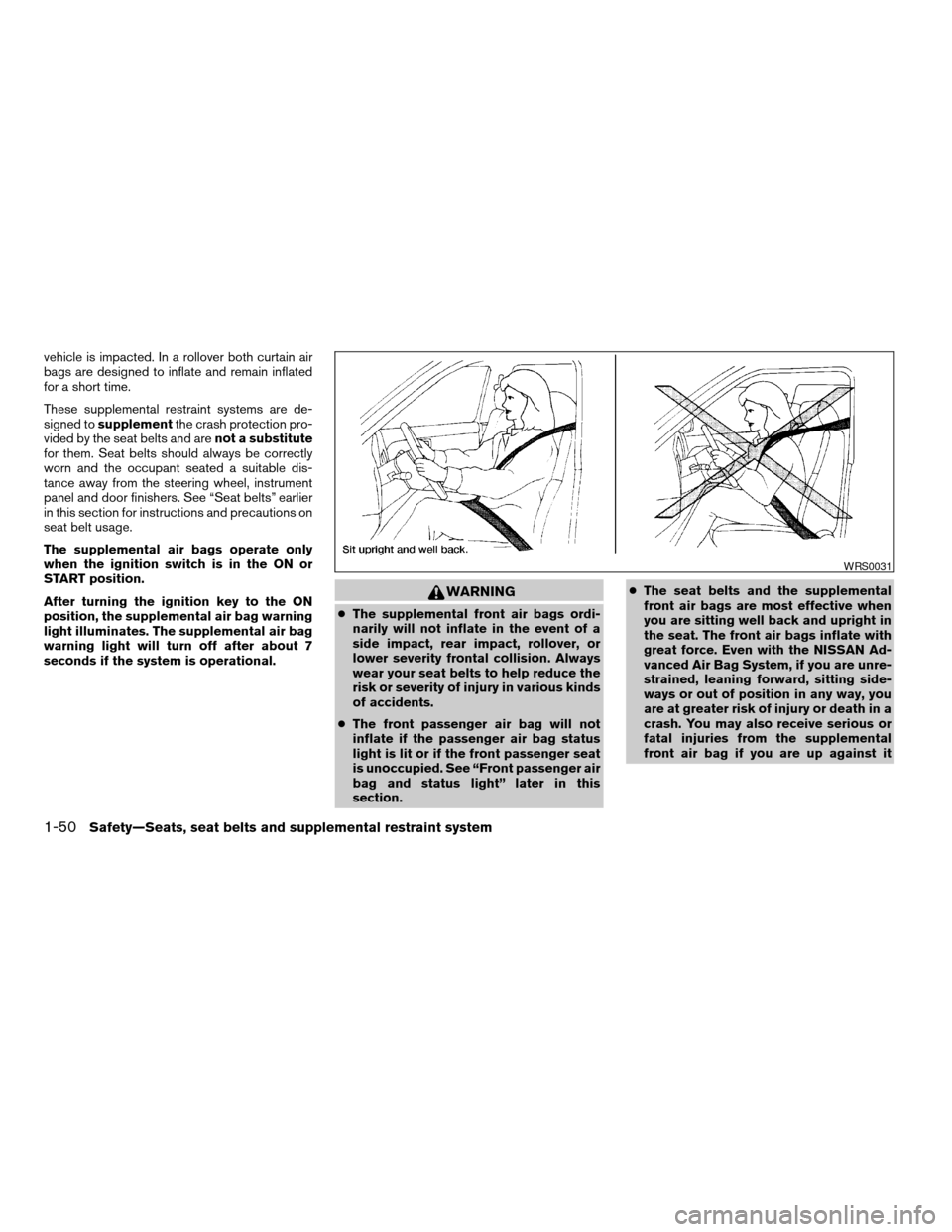
section.cThe seat belts and the supplemental
front air bags are most effective when
you are sitting well back and upright in
the seat. The front air bags inflate with
great force. Even with the NISSAN Ad-
vanced Air Bag System, if you are unre-
strained, leaning forward, sitting side-
ways or out of position in any way, you
are at greater risk of injury or death in a
crash. You may also receive serious or
fatal injuries from the supplemental
front air bag if you are up against it
WRS0031
1-50Safety—Seats, seat belts and supplemental restraint system
ZREVIEW COPYÐ2007 Truck/Frontier(d22)
Owners ManualÐUSA_English(nna)
12/13/06Ðcathy
X
Page 69 of 336
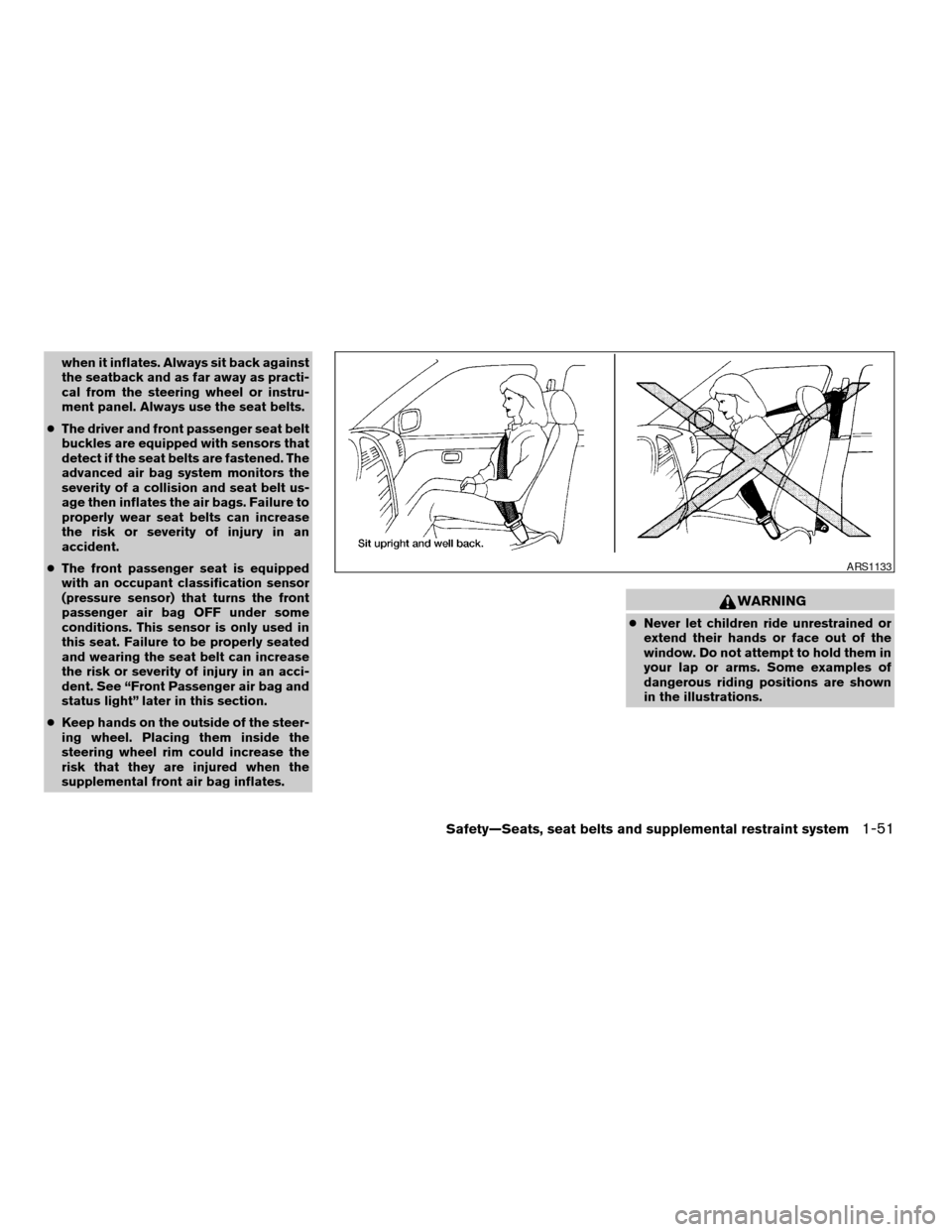
when it inflates. Always sit back against
the seatback and as far away as practi-
cal from the steering wheel or instru-
ment panel. Always use the seat belts.
cThe driver and front passenger seat belt
buckles are equipped with sensors that
detect if the seat belts are fastened. The
advanced air bag system monitors the
severity of a collision and seat belt us-
age then inflates the air bags. Failure to
properly wear seat belts can increase
the risk or severity of injury in an
accident.
cThe front passenger seat is equipped
with an occupant classification sensor
(pressure sensor) that turns the front
passenger air bag OFF under some
conditions. This sensor is only used in
this seat. Failure to be properly seated
and wearing the seat belt can increase
the risk or severity of injury in an acci-
dent. See “Front Passenger air bag and
status light” later in this section.
cKeep hands on the outside of the steer-
ing wheel. Placing them inside the
steering wheel rim could increase the
risk that they are injured when the
supplemental front air bag inflates.
WARNING
cNever let children ride unrestrained or
extend their hands or face out of the
window. Do not attempt to hold them in
your lap or arms. Some examples of
dangerous riding positions are shown
in the illustrations.
ARS1133
Safety—Seats, seat belts and supplemental restraint system1-51
ZREVIEW COPYÐ2007 Truck/Frontier(d22)
Owners ManualÐUSA_English(nna)
12/13/06Ðcathy
X