air conditioning NISSAN FRONTIER 2010 Owner´s Manual
[x] Cancel search | Manufacturer: NISSAN, Model Year: 2010, Model line: FRONTIER, Model: NISSAN FRONTIER 2010Pages: 373, PDF Size: 6.21 MB
Page 327 of 373
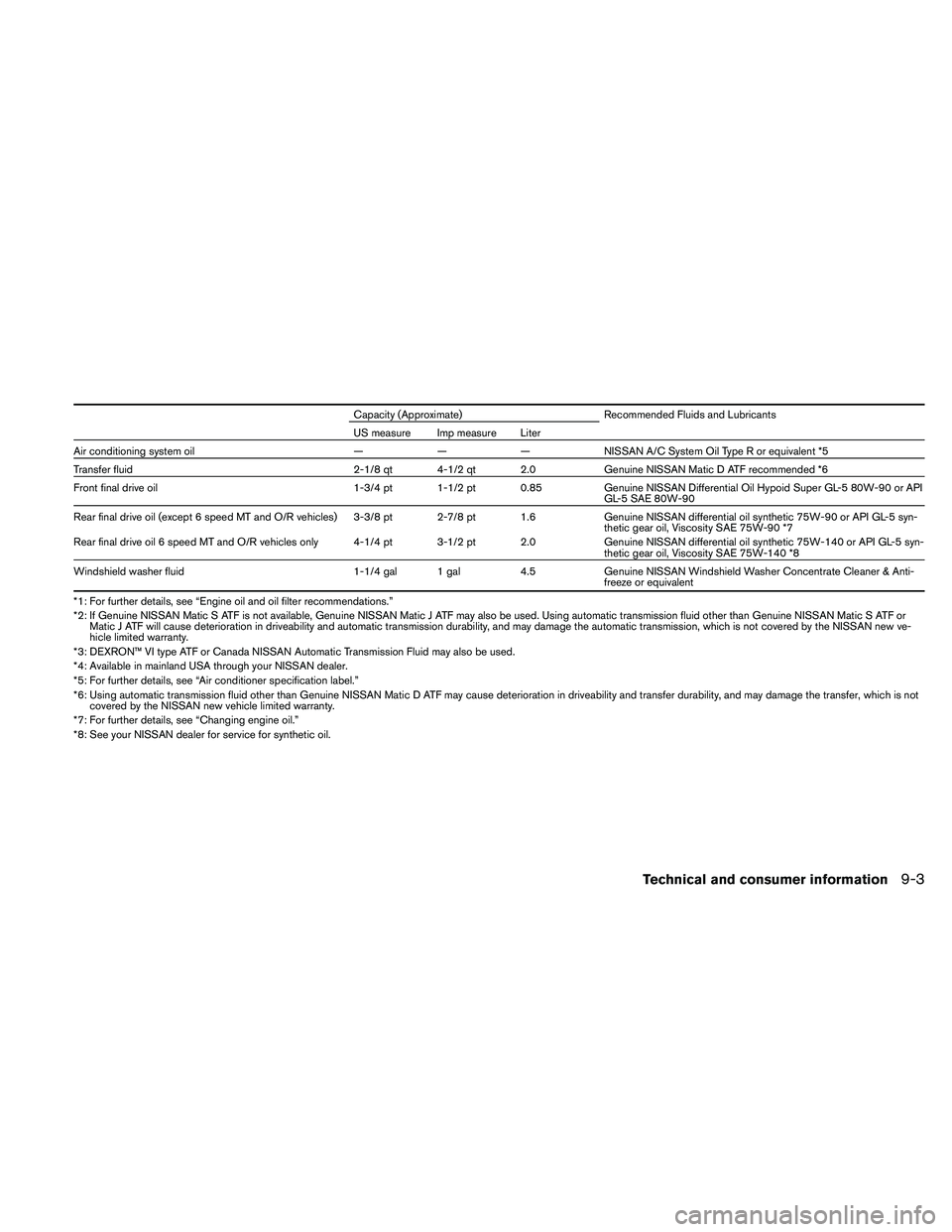
Capacity (Approximate) Recommended Fluids and Lubricants
US measure Imp measure Liter
Air conditioning system oil— — — NISSAN A/C System Oil Type R or equivalent *5
Transfer fluid 2-1/8 qt 4-1/2 qt 2.0 Genuine NISSAN Matic D ATF recommended *6
Front final drive oil 1-3/4 pt 1-1/2 pt 0.85 Genuine NISSAN Differential Oil Hypoid Super GL-5 80W-90 or API
GL-5 SAE 80W-90
Rear final drive oil (except 6 speed MT and O/R vehicles) 3-3/8 pt 2-7/8 pt 1.6 Genuine NISSAN differential oil synthetic 75W-90 or API GL-5 syn-
thetic gear oil, Viscosity SAE 75W-90 *7
Rear final drive oil 6 speed MT and O/R vehicles only 4-1/4 pt 3-1/2 pt 2.0 Genuine NISSAN differential oil synthetic 75W-140 or API GL-5 syn-
thetic gear oil, Viscosity SAE 75W-140 *8
Windshield washer fluid 1-1/4 gal 1 gal 4.5 Genuine NISSAN Windshield Washer Concentrate Cleaner & Anti-
freeze or equivalent
*1: For further details, see “Engine oil and oil filter recommendations.”
*2: If Genuine NISSAN Matic S ATF is not available, Genuine NISSAN Matic J ATF may also be used. Using automatic transmission fluid other than Genuine NISSAN Matic S ATF or
Matic J ATF will cause deterioration in driveability and automatic transmission durability, and may damage the automatic transmission, which is notcovered by the NISSAN new ve-
hicle limited warranty.
*3: DEXRON™ VI type ATF or Canada NISSAN Automatic Transmission Fluid may also be used.
*4: Available in mainland USA through your NISSAN dealer.
*5: For further details, see “Air conditioner specification label.”
*6: Using automatic transmission fluid other than Genuine NISSAN Matic D ATF may cause deterioration in driveability and transfer durability, and may damage the transfer, which is not
covered by the NISSAN new vehicle limited warranty.
*7: For further details, see “Changing engine oil.”
*8: See your NISSAN dealer for service for synthetic oil.
Technical and consumer information9-3
Page 348 of 373
WARNING
Overloading or improper loading can ad-
versely affect vehicle handling, braking
and performance and may lead to
accidents.
VEHICLE LOAD WEIGHT CAPACITY
The vehicle payload weight capacity shown on
the Tire and Loading Information label, see “Tire
and Loading Information label” in this section,
indicates the maximum total weight of passen-
gers, optional equipment (air conditioning, trailer
hitch, etc) and cargo that your vehicle is designed
to carry.
Before driving a loaded vehicle, confirm that you
do not exceed the Gross Vehicle Weight Rating
(GVWR) or the Gross Axle Weight Rating
(GAWR) for your vehicle. See ’’Vehicle Loading
Information’’ earlier in this section for details.
Also check tires for proper inflation pressures.
See the Tire and Loading Information label.
MEASUREMENT OF WEIGHTS
Secure loose items to prevent weight
shifts that could affect the balance of your
vehicle. When the vehicle is loaded, drive
to a scale and weigh the front and the rear
wheels separately to determine axle
loads. Individual axle loads should not ex-
ceed either of the gross axle weight rat-
ings (GAWR) . The total of the axle loads
should not exceed the gross vehicle
weight rating (GVWR) . These ratings are
given on the vehicle certification label. If
weight ratings are exceeded, move or re-
move items to bring all weights below the
ratings.
WARNING
Overloading or improper loading of a
trailer and its cargo can adversely affect
vehicle handling, braking and perfor-
mance and may lead to accidents.
CAUTION
cDo not tow a trailer or haul a heavy load
for the first 500 miles (800 km) . Your
engine, axle or other parts could be
damaged.
cFor the first 500 miles (800 km) that you
tow a trailer, do not drive over 50 mph
(80 km/h) and do not make starts at full
throttle. This helps the engine and other
parts of your vehicle wear in at the
heavier loads.
Your new vehicle was designed to be used pri-
marily to carry passengers and cargo. Remember
that towing a trailer places additional loads on
your vehicle’s engine, drive train, steering, brak-
ing and other systems.
A NISSAN Towing Guide (U.S. only) is available
on the website at www.nissanusa.com. This
guide includes information on trailer towing ca-
pability and the special equipment required for
proper towing.
TOWING A TRAILER
9-24Technical and consumer information