display NISSAN FRONTIER 2012 Owner´s Manual
[x] Cancel search | Manufacturer: NISSAN, Model Year: 2012, Model line: FRONTIER, Model: NISSAN FRONTIER 2012Pages: 384, PDF Size: 2.89 MB
Page 233 of 384
subsequent vehicle start-ups as long as the mal-
function exists. When the malfunction indicator is
illuminated, the system may not be able to detect
or signal low tire pressure as intended. TPMS
malfunctions may occur for a variety of reasons,
including the installation of replacement or alter-
nate tires or wheels on the vehicle that prevent
the TPMS from functioning properly. Always
check the TPMS malfunction telltale after replac-
ing one or more tires or wheels on your vehicle to
ensure that the replacement or alternate tires and
wheels allow the TPMS to continue to function
properly.
Additional information:● The TPMS does not monitor the tire
pressure of the spare tire.
● The TPMS will activate only when the vehicle
is driven at speeds above 16 MPH (25
km/h) . Also, this system may not detect a
sudden drop in tire pressure (for example a
flat tire while driving) . ●
The low tire pressure warning light does not
automatically turn off when the tire pressure
of your tires are adjusted. After the tires are
inflated to the recommended pressure, the
vehicle must be driven at speeds above 16
MPH (25 km/h) to activate the TPMS and
turn off the low tire pressure warning light.
Use a tire pressure gauge to check the tire
pressure.
● The CHECK TIRE PRES (pressure) warning
message is displayed in the odometer when
the low tire pressure warning light is illumi-
nated and low tire pressure is detected. The
CHECK TIRE PRES warning message turns
off when the low tire pressure warning light
turns off. Push the reset button for more than
1 second to manually turn off the CHECK
TIRE PRES warning message. The low tire
pressure warning light remains illuminated
until the tires are inflated to the recom-
mended COLD tire pressure. The CHECK
TIRE PRES warning message is displayed
each time the ignition switch is placed in the
ON position as long as the low tire pressure
warning light remains illuminated. See
“Check tire pressure warning message” in
the “Instruments and controls” section. ●
The CHECK TIRE PRES warning is not dis-
played if the low tire pressure warning light
illuminates to indicate a TPMS malfunction.
● Tire pressure rises and falls depending on
the heat caused by the vehicle’s operation
and the outside temperature. Low outside
temperature can lower the temperature of
the air inside the tire which can cause a
lower tire inflation pressure. This may cause
the low tire pressure warning light to illumi-
nate. If the warning light illuminates in low
ambient temperature, check the tire pres-
sure for all four tires.
● The Tire and Loading Information label (also
referred to as the vehicle placard or tire
inflation pressure label) is located in the
driver’s door opening.
For additional information, see “Low tire pressure
warning light” in the “Instruments and controls”
section and “Tire Pressure Monitoring System
(TPMS)” in the “In case of emergency” section.
5-4Starting and driving
Page 257 of 384
4WD shift indicator light
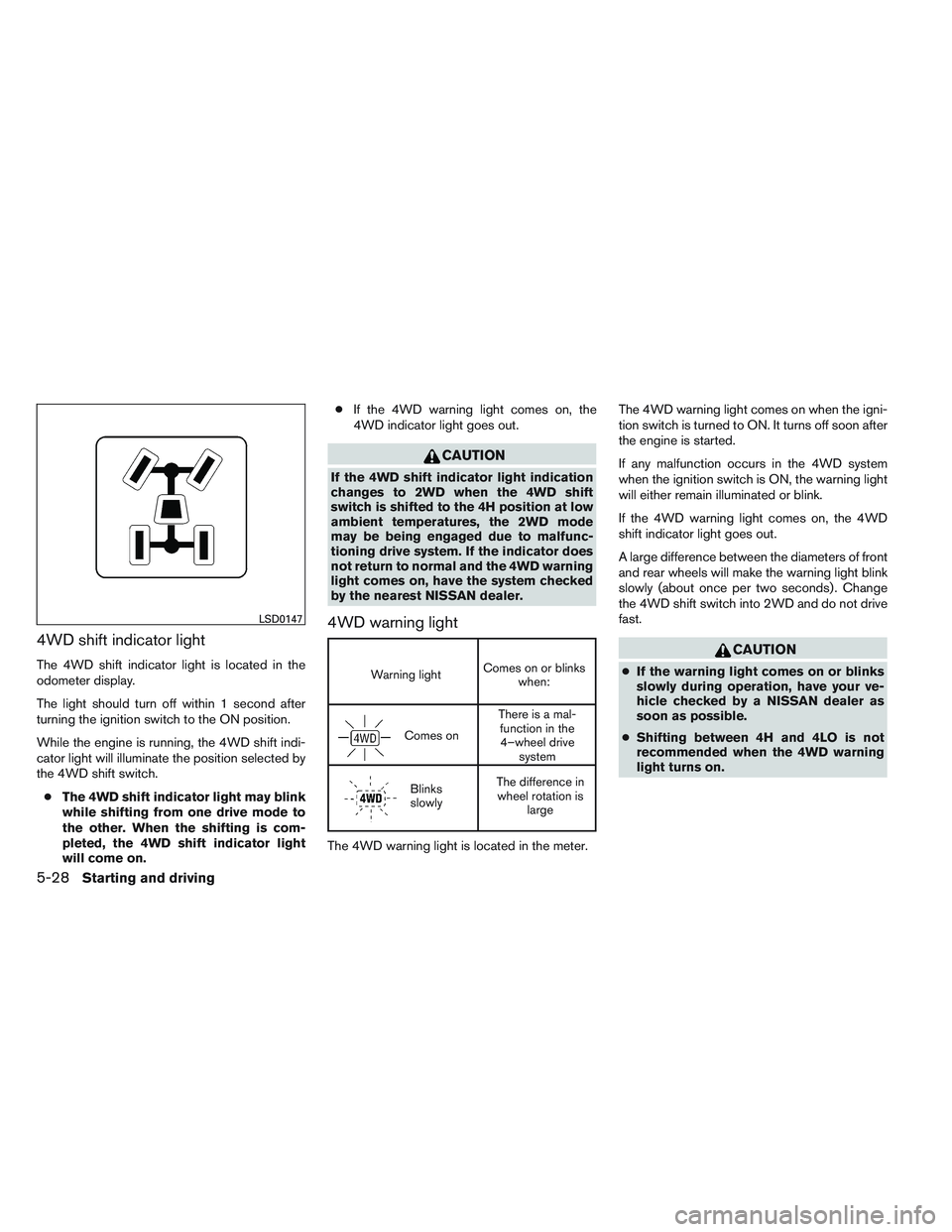
The 4WD shift indicator light is located in the
odometer display.
The light should turn off within 1 second after
turning the ignition switch to the ON position.
While the engine is running, the 4WD shift indi-
cator light will illuminate the position selected by
the 4WD shift switch.● The 4WD shift indicator light may blink
while shifting from one drive mode to
the other. When the shifting is com-
pleted, the 4WD shift indicator light
will come on. ●
If the 4WD warning light comes on, the
4WD indicator light goes out.
CAUTION
If the 4WD shift indicator light indication
changes to 2WD when the 4WD shift
switch is shifted to the 4H position at low
ambient temperatures, the 2WD mode
may be being engaged due to malfunc-
tioning drive system. If the indicator does
not return to normal and the 4WD warning
light comes on, have the system checked
by the nearest NISSAN dealer.
4WD warning light
Warning light Comes on or blinks
when:
Comes on There is a mal-
function in the4–wheel drive system
Blinks
slowly The difference in
wheel rotation is large
The 4WD warning light is located in the meter. The 4WD warning light comes on when the igni-
tion switch is turned to ON. It turns off soon after
the engine is started.
If any malfunction occurs in the 4WD system
when the ignition switch is ON, the warning light
will either remain illuminated or blink.
If the 4WD warning light comes on, the 4WD
shift indicator light goes out.
A large difference between the diameters of front
and rear wheels will make the warning light blink
slowly (about once per two seconds) . Change
the 4WD shift switch into 2WD and do not drive
fast.
CAUTION
●
If the warning light comes on or blinks
slowly during operation, have your ve-
hicle checked by a NISSAN dealer as
soon as possible.
● Shifting between 4H and 4LO is not
recommended when the 4WD warning
light turns on.
LSD0147
5-28Starting and driving
Page 377 of 384
Clutchinterlock(clutchstart)switch......2-37
C.M.V.S.S. certification label..........9-11
Cold weather driving ..............5-38
Compact disc (CD) player ...........4-27
Compass display ................2-10
Console box ...................2-41
Controls Audiocontrols(steeringwheel).......4-35
Heater and air conditioner controls . .4-2, 4-10
Coolant Capacities and recommended
fuel/lubricants .................9-2
Changing engine coolant ...........8-9
Checking engine coolant level ........8-9
Engine coolant temperature gauge .....2-6
Corrosionprotection ...............7-5
Cruise control ..................5-20
Cupholders...................2-44
Curtain side-impact and rollover air bag ....1-76
D
Daytime running light system (Canada only) . .2-30
Defroster switch Rear window defroster switch .......2-27
Dimensionsandweights.............9-9
Dimmer switch for instrument panel ......2-31
Door locks .....................3-3
Door open warning light .............2-17
Drive belt .....................8-18
Driving Cold weather driving ............5-38
Driving with automatic transmission ....5-13
Driving with manual transmission ......5-17
Precautions when starting and driving ....5-2 E
Economy - fuel ..................5-22
Electronic locking rear differential (E-Lock)
system ......................5-29
Electronic locking rear differential (E-Lock)
system switch ..................2-36
Emission control information label .......9-12
Emission control system warranty .......9-37
Engine Before starting the engine ..........5-12
Block heater .................5-39
Capacities and recommended
fuel/lubricants .................9-2
Changing engine coolant ...........8-9
Changing engine oil .............8-11
Changing engine oil filter ..........8-12
Checking engine coolant level ........8-9
Checking engine oil level ..........8-10
Engine compartment check locations ....8-6
Engine coolant temperature gauge .....2-6
Engine cooling system ............8-8
Engineoil...................8-10
Engine oil and oil filter recommendation . . .9-6
Engine oil pressure warning light ......2-17
Engine oil viscosity ..............9-6
Engine serial number ............9-11
Engine specifications .............9-8
Starting the engine .............5-12
Engine oil pressure gauge ............2-8
Eventdatarecorders ..............9-38
Exhaust gas (Carbon monoxide) .........5-2
Extended storage switch ............8-27 F
First aid kit .....................6-2
Flashers
(See hazard
warning flasher switch) ......2-32
Flat tire .......................6-3
Floor mat positioning aid .............7-5
Fluid Brake fluid ..................8-14
Capacities and recommended
fuel/lubricants .................9-2
Clutch fluid ..................8-15
Engine coolant .................8-8
Engine oil ...................8-10
Power steering fluid .............8-14
Windshield-washer fluid ...........8-15
F.M.V.S.S. certification label ...........9-11
Foglightswitch .................2-32
Front air bag system
(See supplemental restraint system) ......1-71
Front seats .....................1-3
Fuel Capacities and recommended
fuel/lubricants .................9-2
Fuel economy ................5-22
Fuel-filler door and cap ...........3-11
Fuelgauge...................2-7
Fuel octane rating ...............9-5
Fuel recommendation .............9-4
Loose fuel cap warning ........2-5,3-11
Fuses.......................8-24
Fusiblelinks ...................8-25
10-2