wheel NISSAN FRONTIER 2013 D40 / 2.G Owners Manual
[x] Cancel search | Manufacturer: NISSAN, Model Year: 2013, Model line: FRONTIER, Model: NISSAN FRONTIER 2013 D40 / 2.GPages: 444, PDF Size: 4.13 MB
Page 430 of 444
●Downshift the transmission to a lower gear
for engine braking when driving down steep
or long hills. This will help slow the vehicle
without applying the brakes.
● Avoid holding the brake pedal down too long
or too frequently. This could cause the
brakes to overheat, resulting in reduced
braking efficiency.
● Increase your following distance to allow for
greater stopping distances while towing a
trailer. Anticipate stops and brake gradually.
● NISSAN recommends that the cruise con-
trol not be used while towing a trailer.
● Some states or provinces have specific
regulations and speed limits for vehicles that
are towing trailers. Obey the local speed
limits.
● Check your hitch, trailer wiring harness con-
nections, and trailer wheel lug nuts after
50 miles (80 km) of travel and at every break.
● When launching a boat, don’t allow the wa-
ter level to go over the exhaust tail pipe or
rear bumper.
● Make sure you disconnect the trailer lights
before backing the trailer into the water or
the trailer lights may burn out. When towing a trailer, final drive gear oil
should be replaced and transmission
oil/fluid should be changed more fre-
quently. For additional information, see the
“Maintenance and do-it-yourself” section
earlier in this manual.
FLAT TOWING
Towing your vehicle with all four wheels on the
ground is sometimes called flat towing. This method
is sometimes used when towing a vehicle behind a
recreational vehicle, such as a motor home.
CAUTION
●
Failure to follow these guidelines can
result in severe transmission damage.
● Whenever flat towing your vehicle, al-
ways tow forward, never backward.
● DO NOT tow any automatic transmis-
sion vehicle with all four wheels on the
ground (flat towing) . Doing so WILL
DAMAGE internal transmission parts
due to lack of transmission lubrication.
● For emergency towing procedures refer
to “Towing recommended by NISSAN”
in the “In case of emergency” section of
this manual.
Manual Transmission (if so equipped)
● Always tow with the manual transmission in
Neutral.
● On 4-wheel drive vehicles, place the transfer
case in the 2H range. Failure to do so will
cause the powertrain to bind up.
● After towing 500 miles (805 km) , start and
idle the engine with the transmission in Neu-
tral for two minutes. Failure to idle the engine
after every 500 miles (805 km) of towing
may cause damage to internal transmission
parts.
Automatic Transmission (if so
equipped)
To tow a vehicle equipped with an automatic
transmission, an appropriate vehicle dolly MUST
be placed under the towed vehicle’s drive
wheels. Always follow the dolly manufacturer’s
recommendations when using their product.
Technical and consumer information9-35
Page 431 of 444
DOT (Department of Transportation) Quality
Grades: All passenger car tires must conform to
federal safety requirements in addition to these
grades.
Quality grades can be found where applicable on
the tire sidewall between tread shoulder and
maximum section width. For example:
Treadwear 200 Traction AA Temperature A
Treadwear
The treadwear grade is a comparative rating
based on the wear rate of the tire when tested
under controlled conditions on a specified gov-
ernment test course. For example, a tire graded
150 would wear one and one-half (1 1/2) times
as well on the government course as a tire graded
100. The relative performance of tires depends
upon the actual conditions of their use, however,
and may depart significantly from the norm due to
variations in driving habits, service practices and
differences in road characteristics and climate.
Traction AA, A, B and C
The traction grades, from highest to lowest, are
AA, A, B, and C. Those grades represent the
tire’s ability to stop on wet pavement as mea-
sured under controlled conditions on specified
government test surfaces of asphalt and con-
crete. A tire marked C may have poor traction
performance.WARNING
The traction grade assigned to this tire is
based on straight-ahead braking traction
tests, and does not include acceleration,
cornering, hydroplaning, or peak traction
characteristics.
Temperature A, B and C
The temperature grades are A (the highest) , B,
and C, representing the tire’s resistance to the
generation of heat, and its ability to dissipate heat
when tested under controlled conditions on a
specified indoor laboratory test wheel. Sustained
high temperature can cause the material of the
tire to degenerate and reduce tire life, and exces-
sive temperature can lead to sudden tire failure.
The grade C corresponds to a level of perfor-
mance which all passenger car tires must meet
under the Federal Motor Safety Standard No.
109. Grades B and A represent higher levels of
performance on the laboratory test wheel than
the minimum required by law.
WARNING
The temperature grade for this tire is es-
tablished for a tire that is properly inflated
and not overloaded. Excessive speed,
under-inflation, or excessive loading, ei-
ther separately or in combination, can
cause heat build-up and possible tire
failure.
UNIFORM TIRE QUALITY GRADING
9-36Technical and consumer information
Page 433 of 444

Additional information concerning motor
vehicle safety may be obtained from Trans-
port Canada’s Road Safety Information
Centre at 1-800-333-0371 or online at
www.tc.gc.ca/roadsafety (English speak-
ers) or www.tc.gc.ca/securiteroutiere
(French speakers) .
To notify NISSAN of any safety concerns
please contact our Consumer Information
Centre toll free at 1-800-387-0122.
WARNING
A vehicle equipped with Four-Wheel Drive
(4WD) should never be tested using a two
wheel dynamometer (such as the dyna-
mometers used by some states for emis-
sions testing) , or similar equipment. Make
sure you inform the test facility personnel
that your vehicle is equipped with 4WD
before it is placed on a dynamometer.
Using the wrong test equipment may re-
sult in transmission damage or unex-
pected vehicle movement which could re-
sult in serious vehicle damage or personal
injury.
Due to legal requirements in some states and
Canadian Provinces, your vehicle may be re-
quired to be in what is called the “ready condi-
tion” for an Inspection/Maintenance (I/M) test of
the emission control system.
The vehicle is set to the “ready condition” when it
is driven through certain driving patterns. Usually,
the ready condition can be obtained by ordinary
usage of the vehicle. If a powertrain system component is repaired or
the battery is disconnected, the vehicle may be
reset to a “not ready” condition. Before taking the
I/M test, check the vehicle’s
inspection/maintenance test readiness condi-
tion. Place the ignition switch in the ON position
without starting the engine. If the Malfunction
Indicator Light (MIL) comes on steady for 20 sec-
onds and then blinks for 10 seconds , the I/M test
condition is “not ready”. If the MIL does not blink
after 20 seconds, the I/M test condition is
“ready”. Contact a NISSAN dealer to set the
“ready condition” or to prepare the vehicle for
testing.
READINESS FOR INSPECTION/
MAINTENANCE (I/M) TEST
9-38Technical and consumer information
Page 436 of 444
10 Index
4WDwarninglight...............2-17A
Active brake limited slip (ABLS) system . . .5-36
Air bag (See supplemental restraint
system) .....................1-63
Air bag system Front (See supplemental front impact
air bag system) ...............1-70
Airbagwarninglabels.............1-77
Airbagwarninglight...........1-78,2-20
Air cleaner housing filter ............8-20
Air conditioner Air conditioner operation ......4-20,4-28
Air conditioner service ...........4-35
Air conditioner specification label .....9-12
Air conditioner system refrigerant and
oil recommendations .............9-7
Heater and air conditioner controls ....4-17,
4-25, 4-33
Servicing air conditioner ..........4-35
Airflowcharts..............4-22,4-29
Alarm system
(See vehicle security system) .........2-24
Anchor point locations .............1-29
Antenna.....................4-76
Anti-lock brake warning light ..........2-15
Anti-lock Braking System (ABS) ........5-35
Audible reminders ...............2-24
Audio system ..................4-35
Bluetooth®audio..........4-70,4-71 Compact disc (CD) player . .4-46, 4-51, 4-58
FM/AM radio with compact disc
(CD) player
.................4-45
FM/AM/SAT radio with compact disc
(CD) player ..............4-49,4-54
Audio System iPod®Player.............4-64,4-66
Audio system Radio ....................4-35
Steering wheel audio control switch . . .4-75
USB interface ............4-61,4-62
Autolight switch .................2-29
Automatic Automatic power window switch .....2-49
Automatic transmission position indicator
light .....................2-20
Driving with automatic transmission ....5-13
Automatic anti-glare inside mirror .......3-15
Automatic door locks ..............3-5
AUXjack.................4-52,4-60
B
Battery ......................8-16
Chargewarninglight............2-16
Before starting the engine ...........5-12
Belt (See drive belt) ..............8-18
Block heater Engine ....................5-42
Bluetooth®audio............4-70,4-71
Bluetooth® hands-free phone
system ..................4-77,4-91 Boosterseats..................1-58
Brake
Anti-lock Braking System (ABS) ......5-35
Brakefluid..................8-14
Brakelight(Seestoplight).........8-31
Brake system ................5-34
Brake warning light .............2-16
Brake wear indicators ........2-24,8-23
Parking brake operation ..........5-20
Self-adjusting brakes ............8-23
Brakes ......................8-23
Break-inschedule ...............5-22
Brightness/contrast button ...........4-11
Brightness control Instrument panel ..............2-31
Bulb check/instrument panel ..........2-15
Bulbreplacement................8-31
C
Capacities and recommended
fuel/lubricants ...................9-2
Cargolightswitch ...............2-32
Cargo (See vehicle loading information) . . .9-13
CarphoneorCBradio.............4-77
CDcareandcleaning .............4-74
CD player (See audio system) . .4-46, 4-51, 4-58
Check tire press .................2-5
Child restraints .......1-23,1-24,1-25,1-27
Precautions
on child
restraints ........1-25,1-36,1-48,1-58
Top tether strap anchor point locations . .1-29
Page 437 of 444
Child restraint with top tether strap.......1-29
Child safety rear door lock ............3-6
Chimes, audible reminders ...........2-24
Cleaningexteriorandinterior...........7-2
Clock.......................4-45
Clutch Clutchfluid..................8-15
Clutchinterlock(clutchstart)switch......2-36
C.M.V.S.S. certification label ..........9-11
Cold weather driving ..............5-41
Compact disc (CD) player ....4-46,4-51,4-58
Compass display ................2-10
Console box ...................2-41
Controlpanelbuttons...............4-4 Brightness/contrast button .........4-11
Enterbutton..................4-4
Setting button .................4-7
Controls Audiocontrols(steeringwheel).......4-75
Heater and air conditioner
controls .............4-17,4-25,4-33
Coolant Capacities and recommended
fuel/lubricants .................9-2
Changing engine coolant ...........8-9
Checking engine coolant level ........8-9
Engine coolant temperature gauge .....2-6
Corrosionprotection ...............7-5
Cruise control ..................5-21
Cupholders...................2-44
Curtain side-impact and rollover air bag ....1-75
D
Daytime running light system (Canada only) . .2-30 Defroster switch
Rear window defroster switch .......2-27
Dimensionsandweights.............9-9
Dimmer switch for instrument panel ......2-31
Display controls (see control panel buttons) . .4-4
Door locks .....................3-3
Door open warning light .............2-17
Drive belt .....................8-18
Driving Cold weather driving ............5-41
Driving with automatic transmission ....5-13
Driving with manual transmission ......5-18
Precautions when starting and driving ....5-2
E
Economy - fuel ..................5-24
Electronic locking rear differential
(E-Lock) system .................5-31
Electronic locking rear differential
(E-Lock) system switch .............2-35
Emission control information label .......9-11
Emission control system warranty .......9-37
Engine Before starting the engine ..........5-12
Block heater .................5-42
Capacities and recommended
fuel/lubricants .................9-2
Changing engine coolant ...........8-9
Changing engine oil .............8-11
Changing engine oil filter ..........8-12
Checking engine coolant level ........8-9
Checking engine oil level ..........8-10
Engine compartment check locations ....8-6
Engine coolant temperature gauge .....2-6Engine cooling system
............8-8
Engine oil ...................8-10
Engine oil and oil filter recommendation . . .9-6
Engine oil pressure warning light ......2-17
Engine oil viscosity ..............9-6
Engine
serial number ............9-11
Engine specifications .............9-8
Starting the engine .............5-12
Engine oil pressure gauge ............2-8
Enterbutton....................4-4
Eventdatarecorders ..............9-39
Exhaust gas (Carbon monoxide) .........5-2
Extended storage switch ............8-27
F
First aid kit .....................6-2
Flashers (See hazard warning flasher switch) . .6-3
Flat tire .......................6-3
Floor mat positioning aid .............7-5
Fluid Brake fluid ..................8-14
Capacities and recommended
fuel/lubricants .................9-2
Clutch fluid ..................8-15
Engine coolant .................8-8
Engine oil ...................8-10
Power steering fluid .............8-14
Windshield-washer fluid ...........8-15
F.M.V.S.S. certification label ...........9-11
Foglightswitch .................2-32
Front air bag system
(See supplemental restraint system) ......1-70
Front seats .....................1-2
10-2
Page 440 of 444

Push starting...................6-12
R
Radio Car phone or CB radio ...........4-77
FM/AM radio with compact disc
(CD) player ..................4-45
FM/AM/SAT radio with compact disc
(CD) player ..............4-49,4-54
Steering wheel audio control switch ....4-75
Readiness for inspection maintenance
(I/M) test .....................9-38
Rear power windows ..............2-49
Rear sliding window ...............2-50
Rear sonar system ................5-40
Rear sonar system off switch ..........2-37
RearViewMonitor................4-11
Rear window defroster switch .........2-27
Recorders Eventdata..................9-39
Refrigerant recommendation ...........9-7
Registering your vehicle in another country . .9-10
Remote keyless entry system ...........3-6
Reporting safety defects (US only) .......9-37
Roof rack .....................2-46
S
Safety Child safety rear door lock ..........3-6
Child seat belts .....1-25,1-36,1-48,1-58
Reporting safety defects (US only) .....9-37Seat
Jumpseat ...................1-6
Seat adjustment Frontmanualseatadjustment ........1-2
Front power seat adjustment .........1-4
Seatback pockets ................2-44
Seat belt Childsafety..................1-23
Infants and small children ..........1-24
Injured Person ................1-18
Largerchildren................1-24
Precautions on seat belt usage .......1-15
Pregnant women ...............1-18
Pre-tensioner seat belt system .......1-76
Seatbeltextenders .............1-22
Seatbeltmaintenance............1-23
Seatbelts...................1-15
Shoulder belt height adjustment ......1-22
Three-point type with retractor .......1-18
Seat belt warning light ..............2-19
Seats Adjustment ...................1-2
Frontseats...................1-2
Heatedseats.................2-33
Manual front seat adjustment .........1-2
Security indicator light ..............2-22
Security system (NISSAN vehicle immobilizer
system) , engine start ........2-25,3-2,5-12
Self-adjusting brakes ..............8-23
Service manual order form ...........9-39
Servicing air conditioner .............4-35
Setting button ...................4-7
Shifting Automatic transmission ...........5-14
Manual transmission .............5-18
Shiftlockrelease.................5-16 Shoulder belt height adjustment
........1-22
Side air bag system (See supplemental side air
bag, curtain and rollover air bag systems) . . .1-75
Sonar Rear system .................5-40
Spark plug replacement .............8-19
Speedometer ...................2-4
SRSwarninglabel................1-77
Starting Before starting the engine ..........5-12
Jump starting .................
6-10
Precautions when starting and driving ....5-2
Push starting .................6-12
Starting the engine .............5-12
Steering Power steering fluid .............8-14
Power steering system ...........5-34
Tilting steering wheel ............3-13
Steering wheel audio control switch ......4-75
Stoplight.....................8-31
Storage......................2-38
Storage tray ................2-38,2-40
Sunglasses case .................2-42
Sunroof (see Moonroof) .............2-50
Sun visors ....................3-14
Supplemental air bag warning labels ......1-77
Supplemental air bag warning light . . .1-78, 2-20
Supplemental front impact air bag system . . .1-70
Supplemental restraint system Information and warning labels .......1-77
Precautions on supplemental restraint
system ....................1-63
Supplemental restraint system
(Supplemental air bag system) .........1-63
Switch Autolight switch ...............2-29
10-5
Page 441 of 444
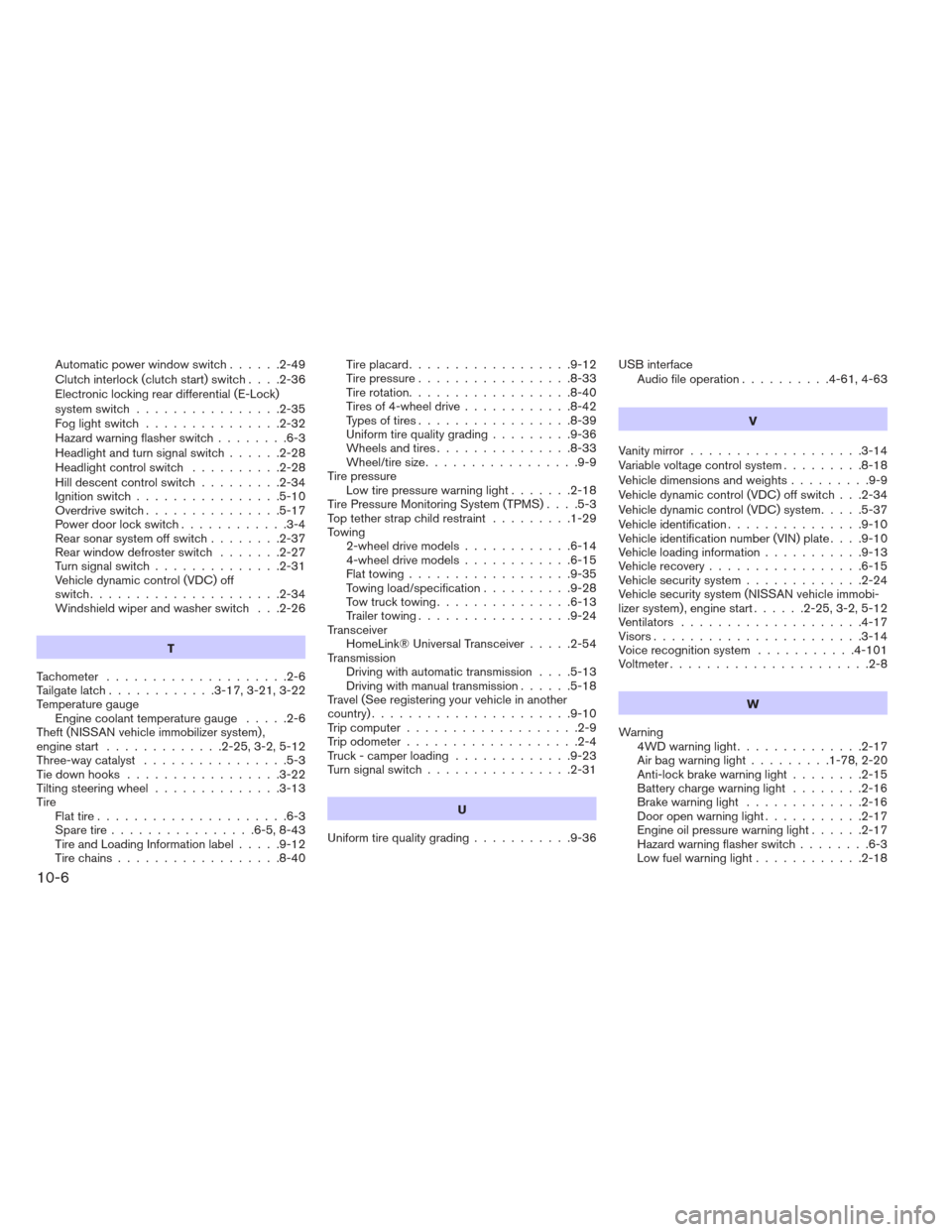
Automatic power window switch......2-49
Clutch interlock (clutch start) switch ....2-36
Electronic locking rear differential (E-Lock)
systemswitch................2-35
Foglightswitch ...............2-32
Hazard warning flasher switch ........6-3
Headlight and turn signal switch ......2-28
Headlightcontrolswitch ..........2-28
Hill descent control switch .........2-34
Ignition switch ................5-10
Overdrive switch ...............5-17
Power door lock switch ............3-4
Rear sonar system off switch ........2-37
Rear window defroster switch .......2-27
Turnsignalswitch..............2-31
Vehicle dynamic control (VDC) off
switch.....................2-34
Windshield wiper and washer switch . . .2-26
T
Tachometer ....................2-6
Tailgate latch ............3-17,3-21,3-22
Temperature gauge Engine coolant temperature gauge .....2-6
Theft (NISSAN vehicle immobilizer system) ,
engine start .............2-25,3-2,5-12
Three-way catalyst ................5-3
Tie down hooks .................3-22
Tilting steering wheel ..............3-13
Tire Flat tire .....................6-3
Spare tire ................6-5,8-43
Tire and Loading Information label .....9-12
Tire chains ..................8-40 Tireplacard..................9-12
Tire pressure
.................8-33
Tire rotation..................8-40
Tires of 4-wheel drive ............8-42
Types of tires .................8-39
Uniform tire quality grading .........9-36
Wheels and tires ...............8-33
Wheel/tire size .................9-9
Tire pressure Low tire pressure warning light .......2-18
Tire Pressure Monitoring System (TPMS) ....5-3
Top tether strap child restraint .........1-29
Towing 2-wheel drive models ............6-14
4-wheel drive models ............6-15
Flattowing..................9-35
Towing load/specification ..........9-28
Towtrucktowing...............6-13
Trailer towing .................9-24
Transceiver HomeLink® Universal Transceiver .....2-54
Transmission Driving with automatic transmission ....5-13
Driving with manual transmission ......5-18
Travel (See registering your vehicle in another
country) ......................9-10
Trip computer ...................2-9
Trip odometer ...................2-4
Truck - camper loading .............9-23
Turn signal switch ................2-31
U
Uniform tire quality grading ...........9-36USB interface
Audio file operation ..........4-61,4-63
V
V
anity mirror ...................3-14
Variable voltage control system .........8-18
Vehicledimensionsandweights.........9-9
Vehicle dynamic control (VDC) off switch . . .2-34
Vehicle dynamic control (VDC) system .....5-37
Vehicle identification ...............9-10
Vehicle identification number (VIN) plate ....9-10
Vehicleloadinginformation...........9-13
Vehicle recovery .................6-15
Vehicle security system .............2-24
Vehicle security system (NISSAN vehicle immobi-
lizer system) , engine start ......2-25,3-2,5-12
Ventilators ....................4-17
Visors.......................3-14
Voice recognition system ...........4-101
Voltmeter......................2-8
W
Warning 4WDwarninglight..............2-17
Airbagwarninglight.........1-78, 2-20
Anti-lock brake warning light ........2-15
Battery charge warning light ........2-16
Brake warning light .............2-16
Door open warning light ...........2-17
Engine oil pressure warning light ......2-17
Hazard warning flasher switch ........6-3
Low fuel warning light ............2-18
10-6
Page 442 of 444

Low tire pressure warning light.......2-18
Low windshield-washer fluid warning
light......................2-19
Passenger air bag and status light .....1-72
Seat belt warning light ............2-19
Vehicle security system ...........2-24
Warning/indicator lights and audible
reminders ...................2-14
Warning labels (for SRS) ..........1-77
Warninglights..................2-14
Washer switch Windshield wiper and washer switch . . .2-26
Weights(Seedimensionsandweights).....9-9
Wheels and tires .................8-33
Wheel/tire size ...................9-9
When traveling or registering your vehicle
in another country ................9-10
Windows Locking passengers’ windows .......2-49
Manual windows ...............2-49
Power windows ...............2-47
Rear power windows ............2-49
Rear sliding window .............2-50
Windshield-washer fluid .............8-15
Windshield wiper and washer switch .....2-26
Wiper Windshield wiper and washer switch . . .2-26
Wiper blades .................8-22
10-7
Page 443 of 444

RECOMMENDED FUEL:
Use unleaded regular gasoline with an octane
rating of at least 87 AKI (Anti-Knock Index) num-
ber (Research octane number 91) .
CAUTION
●Using a fuel other than that specified
could adversely affect the emission
control system, and may also affect the
warranty coverage.
● Under no circumstances should a
leaded gasoline be used, because this
will damage the three-way catalyst.
●
Do not use E-15 or E-85 fuel in your ve-
hicle. Your vehicle is not designed to run
on E-15 or E-85 fuel. Using E-15 or E-85
fuel in a vehicle not specifically designed
for E-15 or E-85 fuel can adversely affect
the emission control devices and sys-
tems of the vehicle. Damage caused by
such fuel is not covered by the NISSAN
new vehicle limited warranty.
● U.S. government regulations require
ethanol dispensing pumps to be identi-
fied by a small, square, orange and
black label with the common abbrevia-
tion or the appropriate percentage for
that region. For additional information, see “Capacities and
recommended fuel/lubricants” in the “Technical
and consumer information” section.
RECOMMENDED ENGINE OIL:
●
Engine oil with API Certification Mark
● Viscosity SAE 5W-30
See “Engine oil and oil filter recommendations” in
the “Technical and consumer information” sec-
tion of this manual.
COLD TIRE PRESSURE:
See Tire and Loading Information label.
The label is typically located on the driver side
center pillar or on the driver’s door. For additional
information, see “Wheels and tires” in the “Main-
tenance and do-it-yourself” section of this
manual.
RECOMMENDED NEW VEHICLE
BREAK-IN PROCEDURE:
During the first 1,200 mi (2,000 km) of vehicle
use, follow the recommendations outlined in the
“Break-in schedule” information found in the
“Starting and driving” section of this manual. Fol-
low these recommendations for the future reli-
ability and economy of your new vehicle. Failure
to follow these recommendations may result in
vehicle damage or shortened engine life.
GAS STATION INFORMATION