service NISSAN FRONTIER 2016 D23 / 3.G Manual PDF
[x] Cancel search | Manufacturer: NISSAN, Model Year: 2016, Model line: FRONTIER, Model: NISSAN FRONTIER 2016 D23 / 3.GPages: 469, PDF Size: 4.46 MB
Page 415 of 469
Wheel nut tightening torque:98 ft-lb (133 N·m)
The wheel nuts must be kept tight-
ened to specifications at all times. It
is recommended that wheel nuts be
tightened to specification at each
tire rotation interval.
WARNING
● After rotating the tires, check and
adjust the tire pressure.
● Retighten the wheel nuts when
the vehicle has been driven for
600 miles (1,000 km) (also in
cases of a flat tire, etc.) .
● Do not include the spare tire in
the tire rotation.
● For additional information re-
garding tires, refer to “Important
Tire Safety Information” (US) or
“Tire Safety Information”
(Canada) in the Warranty Infor-
mation Booklet.
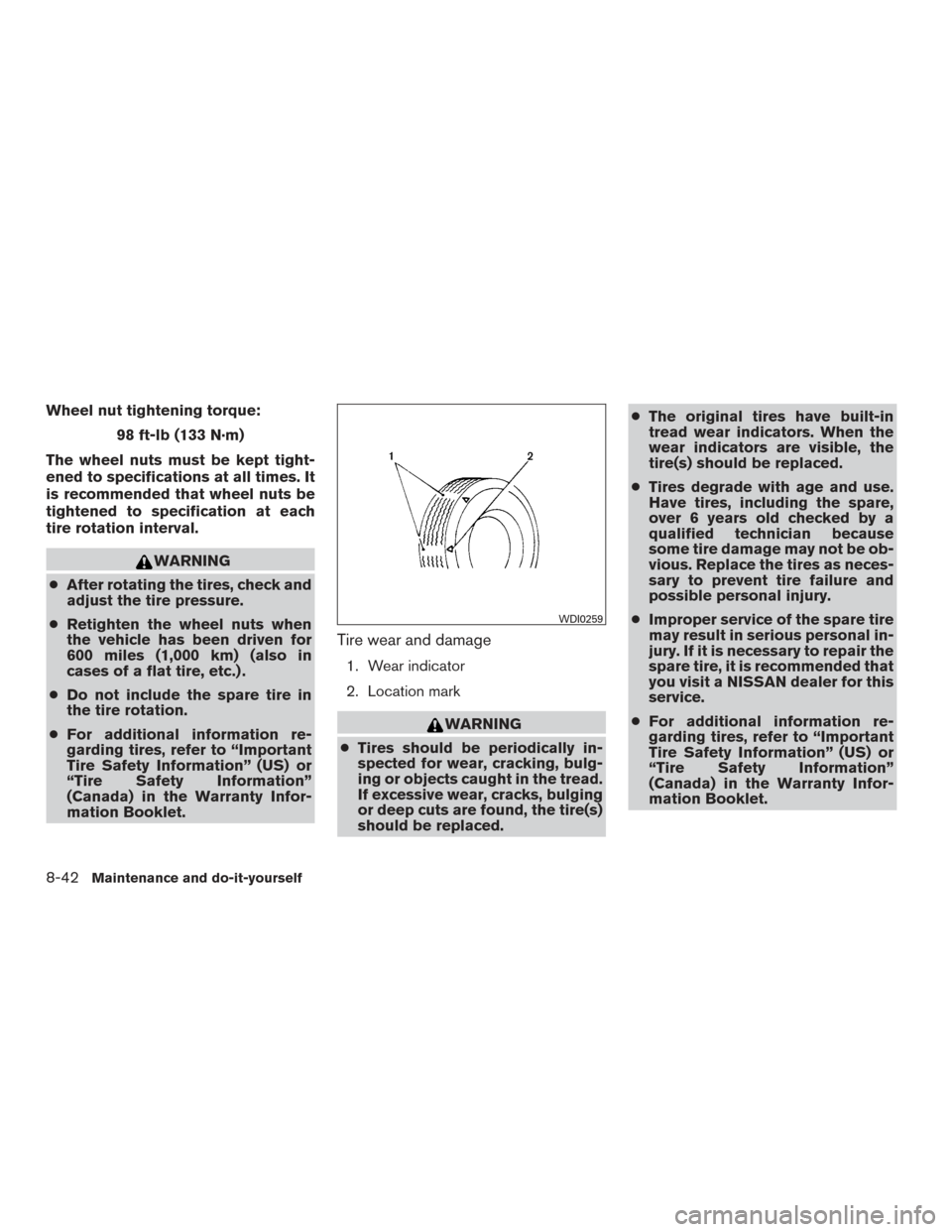
Tire wear and damage
1. Wear indicator
2. Location mark
WARNING
● Tires should be periodically in-
spected for wear, cracking, bulg-
ing or objects caught in the tread.
If excessive wear, cracks, bulging
or deep cuts are found, the tire(s)
should be replaced. ●
The original tires have built-in
tread wear indicators. When the
wear indicators are visible, the
tire(s) should be replaced.
● Tires degrade with age and use.
Have tires, including the spare,
over 6 years old checked by a
qualified technician because
some tire damage may not be ob-
vious. Replace the tires as neces-
sary to prevent tire failure and
possible personal injury.
● Improper service of the spare tire
may result in serious personal in-
jury. If it is necessary to repair the
spare tire, it is recommended that
you visit a NISSAN dealer for this
service.
● For additional information re-
garding tires, refer to “Important
Tire Safety Information” (US) or
“Tire Safety Information”
(Canada) in the Warranty Infor-
mation Booklet.
WDI0259
8-42Maintenance and do-it-yourself
Page 416 of 469
Replacing wheels and tires
When replacing a tire, use the same size, tread
design, speed rating and load carrying capacity
as originally equipped. For additional information,
refer to “Wheels and tires” in the “Technical and
consumer information” section of this manual.
WARNING
●The use of tires other than those recom-
mended or the mixed use of tires of
different brands, construction (bias,
bias-belted or radial) , or tread patterns
can adversely affect the ride, braking,
handling, Vehicle Dynamic Control
(VDC) system, ground clearance, body-
to-tire clearance, tire chain clearance,
speedometer calibration, headlight aim
and bumper height. Some of these ef-
fects may lead to accidents and could
result in serious personal injury.
● If your vehicle was originally equipped
with 4 tires that were the same size and
you are only replacing 2 of the 4 tires,
install the new tires on the rear axle.
Placing new tires on the front axle may
cause loss of vehicle control in some
driving conditions and cause an acci-
dent and personal injury. ●
If the wheels are changed for any rea-
son, always replace with wheels which
have the same off-set dimension.
Wheels of a different off-set could
cause premature tire wear, degrade ve-
hicle handling characteristics, affect the
VDC system and/or interference with
the brake discs. Such interference can
lead to decreased braking efficiency
and/or early brake pad wear. For addi-
tional information on wheel off-set di-
mensions, refer to “Wheels and tires” in
the “Technical and consumer informa-
tion” section of this manual.
● Since the spare tire is not equipped with
the TPMS, when a spare tire is mounted
or a wheel is replaced, tire pressure will
not be indicated, the TPMS will not
function and the low tire pressure warn-
ing light will flash for approximately
1 minute. The light will remain on after
1 minute. Have your tires replaced
and/or TPMS system reset as soon as
possible. It is recommended that you
visit a NISSAN dealer for this service.
● Replacing tires with those not originally
specified by NISSAN could affect the
proper operation of the TPMS. ●
The TPMS sensor may be damaged if it
is not handled correctly. Be careful
when handling the TPMS sensor.
● When replacing the TPMS sensor, the
ID registration may be required. It is
recommended that you visit a NISSAN
dealer for ID registration.
● Do not use a valve stem cap that is not
specified by NISSAN. The valve stem
cap may become stuck.
● Be sure that the valve stem caps are
correctly fitted. Otherwise the valve may
be clogged up with dirt and cause a
malfunction or loss of pressure.
● Do not install a damaged or deformed
wheel or tire even if it has been re-
paired. Such wheels or tires could have
structural damage and could fail with-
out warning.
● The use of retread tires is not
recommended.
● For additional information regarding
tires, refer to “Important Tire Safety In-
formation” (US) or “Tire Safety Informa-
tion” (Canada) in the Warranty Informa-
tion Booklet.
Maintenance and do-it-yourself8-43
Page 417 of 469
Four-wheel drive models
CAUTION
Always use tires of the same type, size,
brand, construction (bias, bias-belted or
radial) , and tread pattern on all four
wheels. Failure to do so may result in a
circumference difference between tires on
the front and rear axles which will cause
excessive tire wear and may damage the
transmission, transfer case and differen-
tial gears.
If excessive tire wear is found, it is recommended
that all four tires be replaced with tires of the
same size, brand, construction and tread pattern.
The tire pressure and wheel alignment should
also be checked and corrected as necessary. It is
recommended that you visit a NISSAN dealer for
this service.
Wheel balance
Unbalanced wheels may affect vehicle handling
and tire life. Even with regular use, wheels can get
out of balance. Therefore, they should be bal-
anced as required. Wheel balance service should be per-
formed with the wheels off the vehicle.
Spin balancing the wheels on the vehicle
could lead to mechanical damage.
● For additional information regarding
tires, refer to “Important Tire Safety
Information” (US) or “Tire Safety Infor-
mation” (Canada) in the Warranty In-
formation Booklet.
Care of wheels
●Wash the wheels when washing the vehicle
to maintain their appearance.
● Clean the inner side of the wheels when the
wheel is changed or the underside of the
vehicle is washed.
● Do not use abrasive cleaners when washing
the wheels.
● Inspect wheel rims regularly for dents or
corrosion. Such damage may cause loss of
pressure or poor seal at the tire bead.
● NISSAN recommends waxing the road
wheels to protect against road salt in areas
where it is used during winter.
8-44Maintenance and do-it-yourself
Page 418 of 469
9 Technical and consumer information
Recommended fluids/lubricants and capacities.......9-2
Fuel recommendation ...........................9-5
Engine oil and oil filter recommendations ..........9-7
Air conditioner system (if so equipped)
refrigerant and oil recommendations ..............9-8
Specifications .....................................9-9
Engine ........................................9-9
Wheels and tires .............................. 9-10
Dimensions and weights .......................9-11
When traveling or registering in another country ......9-12
Vehicle identification .............................. 9-12
Vehicle identification number (VIN) plate .........9-12
Engine serial number ........................... 9-13
F.M.V.S.S./C.M.V.S.S. certification label ..........9-13
Emission control information label ...............9-13
Tire and loading information label ................9-14
Air conditioner specification label
(if so equipped) ............................... 9-14
Installing front license plate ........................9-14
Installing front license plate with grommets .......9-14
Installing front license plate without
grommets .................................... 9-15
Vehicle loading information ........................9-15
Terms ........................................ 9-15
Vehicle load capacity .......................... 9-16Securing the load
.............................. 9-18
Utili-track™ channel system (if so equipped) ......9-19
Loading tips .................................. 9-24
Truck-camper loading information ..................9-24
Crew cab models .............................. 9-24
King Cab models .............................. 9-24
Special Body vehicles .......................... 9-24
Location for center of gravity ....................9-25
Vehicle load weight capacity ....................9-25
Measurement of weights .......................9-26
Towing a trailer ................................... 9-26
Maximum load limits ........................... 9-26
Towing load/specification .......................9-30
Towing safety ................................. 9-31
Flat towing
for 4–Wheel drive vehicle
(if so equipped) ............................... 9-37
Flat towing for rear wheel drive vehicle
(if so equipped) ............................... 9-37
Uniform tire quality grading ........................9-38
Emission control system warranty ..................9-39
Reporting safety defects .......................... 9-39
Readiness for inspection/maintenance (I/M) test .....9-40
Event Data Recorders (EDR) .......................9-41
Owner’s Manual/Service Manual order information . . . 9-41
Page 420 of 469
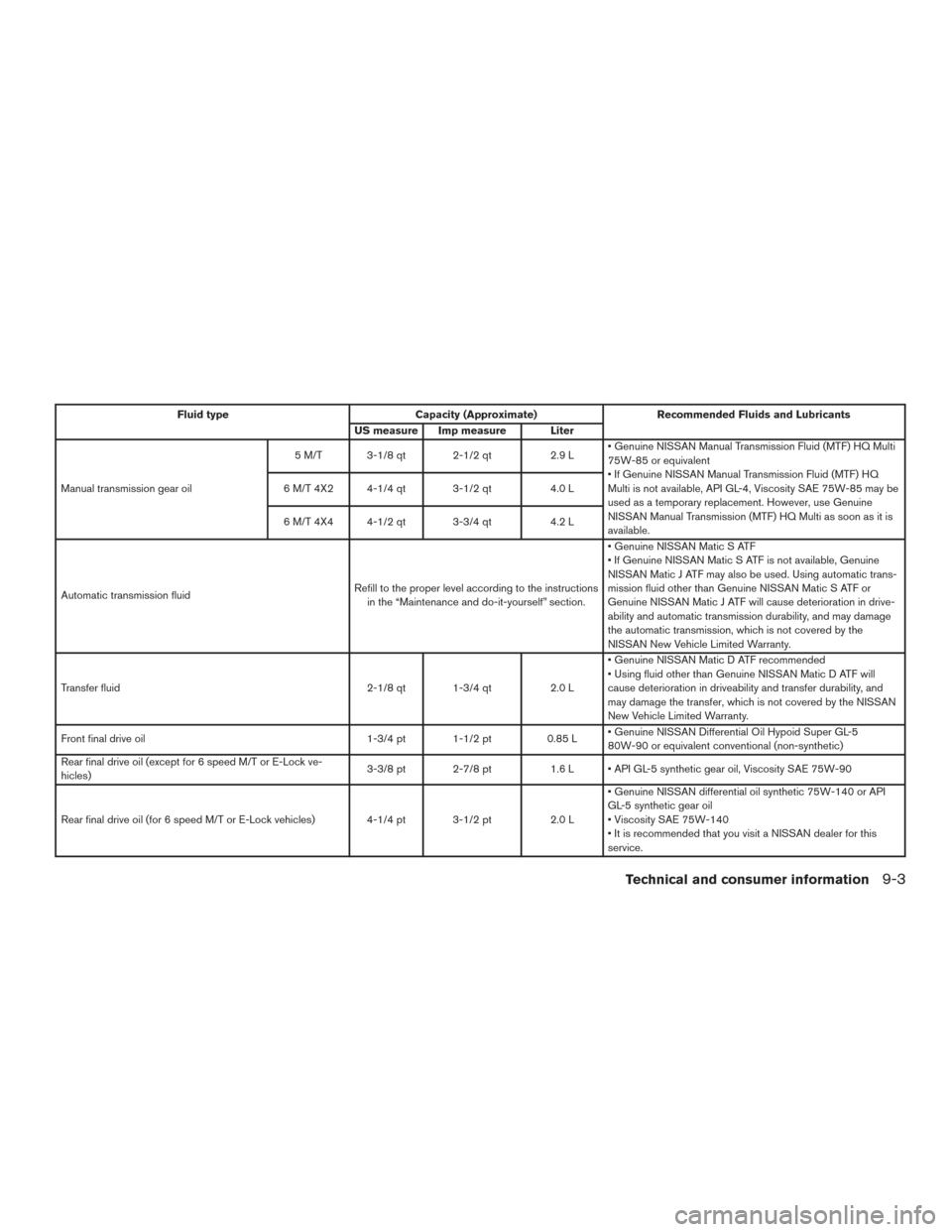
Fluid typeCapacity (Approximate) Recommended Fluids and Lubricants
US measure Imp measure Liter
Manual transmission gear oil 5 M/T 3-1/8 qt 2-1/2 qt
2.9 L• Genuine NISSAN Manual Transmission Fluid (MTF) HQ Multi
75W-85 or equivalent
• If Genuine NISSAN Manual Transmission Fluid (MTF) HQ
Multi is not available, API GL-4, Viscosity SAE 75W-85 may be
used as a temporary replacement. However, use Genuine
NISSAN Manual Transmission (MTF) HQ Multi as soon as it is
available.
6 M/T 4X2 4-1/4 qt 3-1/2 qt
4.0 L
6 M/T 4X4 4-1/2 qt 3-3/4 qt 4.2 L
Automatic transmission fluid Refill to the proper level according to the instructions
in the “Maintenance and do-it-yourself” section. • Genuine NISSAN Matic S ATF
• If Genuine NISSAN Matic S ATF is not available, Genuine
NISSAN Matic J ATF may also be used. Using automatic trans-
mission fluid other than Genuine NISSAN Matic S ATF or
Genuine NISSAN Matic J ATF will cause deterioration in drive-
ability and automatic transmission durability, and may damage
the automatic transmission, which is not covered by the
NISSAN New Vehicle Limited Warranty.
Transfer fluid 2-1/8 qt 1-3/4 qt2.0 L• Genuine NISSAN Matic D ATF recommended
• Using fluid other than Genuine NISSAN Matic D ATF will
cause deterioration in driveability and transfer durability, and
may damage the transfer, which is not covered by the NISSAN
New Vehicle Limited Warranty.
Front final drive oil 1-3/4 pt 1-1/2 pt0.85 L• Genuine NISSAN Differential Oil Hypoid Super GL-5
80W-90 or equivalent conventional (non-synthetic)
Rear final drive oil (except for 6 speed M/T or E-Lock ve-
hicles) 3-3/8 pt 2-7/8 pt
1.6 L • API GL-5 synthetic gear oil, Viscosity SAE 75W-90
Rear final drive oil (for 6 speed M/T or E-Lock vehicles) 4-1/4 pt 3-1/2 pt 2.0 L• Genuine NISSAN differential oil synthetic 75W-140 or API
GL-5 synthetic gear oil
• Viscosity SAE 75W-140
• It is recommended that you visit a NISSAN dealer for this
service.
Technical and consumer information9-3
Page 421 of 469
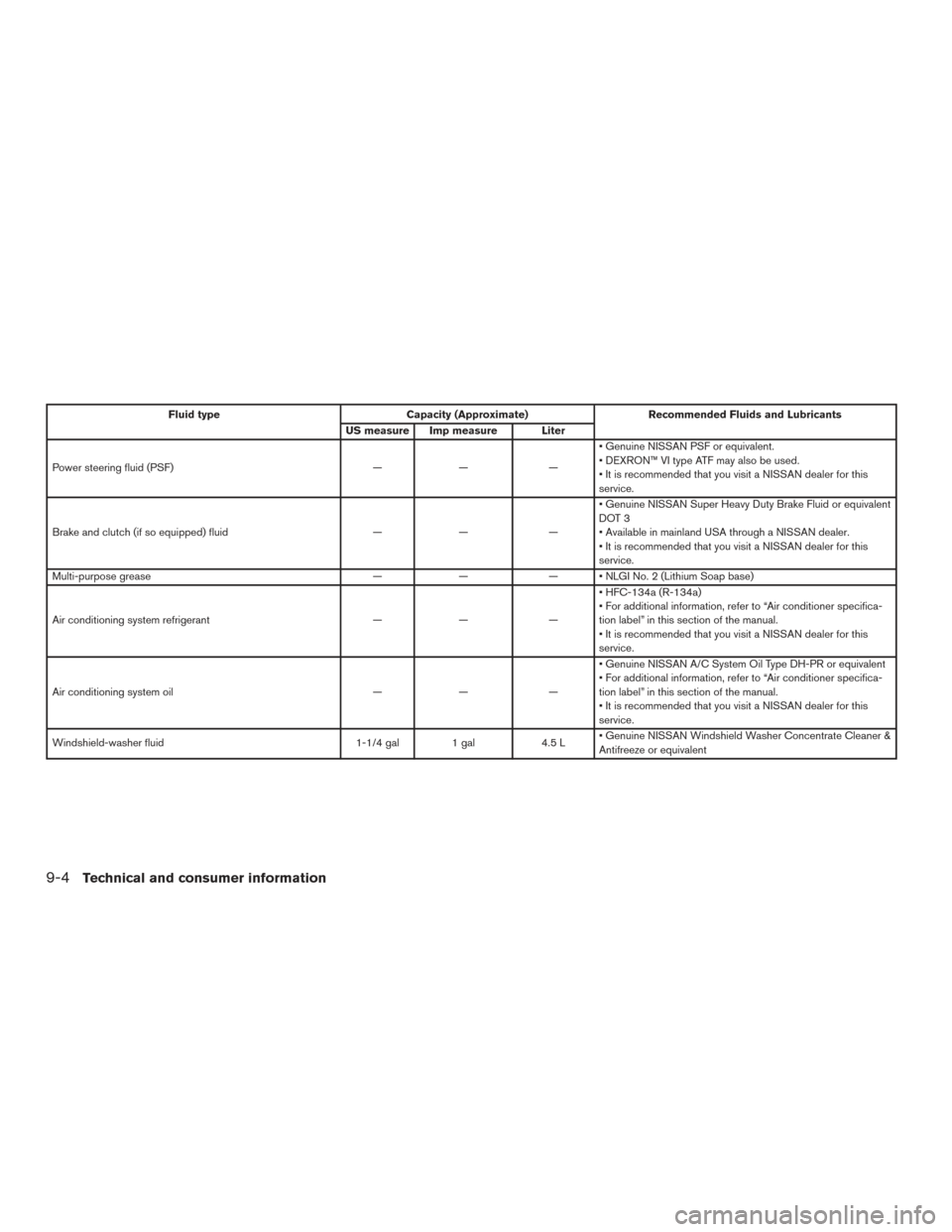
Fluid typeCapacity (Approximate) Recommended Fluids and Lubricants
US measure Imp measure Liter
Power steering fluid (PSF) —— —• Genuine NISSAN PSF or equivalent.
• DEXRON™ VI type ATF may also be used.
• It is recommended that you visit a NISSAN dealer for this
service.
Brake and clutch (if so equipped) fluid —— —• Genuine NISSAN Super Heavy Duty Brake Fluid or equivalent
DOT 3
• Available in mainland USA through a NISSAN dealer.
• It is recommended that you visit a NISSAN dealer for this
service.
Multi-purpose grease —— — • NLGI No. 2 (Lithium Soap base)
Air conditioning system refrigerant —— —• HFC-134a (R-134a)
• For additional information, refer to “Air conditioner specifica-
tion label” in this section of the manual.
• It is recommended that you visit a NISSAN dealer for this
service.
Air conditioning system oil —— —• Genuine NISSAN A/C System Oil Type DH-PR or equivalent
• For additional information, refer to “Air conditioner specifica-
tion label” in this section of the manual.
• It is recommended that you visit a NISSAN dealer for this
service.
Windshield-washer fluid 1-1/4 gal 1 gal4.5 L• Genuine NISSAN Windshield Washer Concentrate Cleaner &
Antifreeze or equivalent
9-4Technical and consumer information
Page 422 of 469
FUEL RECOMMENDATION
Use unleaded regular gasoline with an octane
rating of at least 87 AKI (Anti-Knock Index) num-
ber (Research octane number 91) .
CAUTION
●Using a fuel other than that specified
could adversely affect the emission
control system, and may also affect the
warranty coverage.
● Under no circumstances should a
leaded gasoline be used, because this
will damage the three-way catalyst.
● Do not use E-15 or E-85 fuel in your
vehicle. Your vehicle is not designed to
run on E-15 or E-85 fuel. Using E-15 or
E-85 fuel in a vehicle not specifically
designed for E-15 or E-85 fuel can ad-
versely affect the emission control de-
vices and systems of the vehicle. Dam-
age caused by such fuel is not covered
by the NISSAN New Vehicle Limited
Warranty. ●
Do not use fuel that contains the octane
booster methylcyclopentadienyl man-
ganese tricarbonyl (MMT) . Using fuel
containing MMT may adversely affect
vehicle performance and vehicle emis-
sions. Not all fuel dispensers are la-
beled to indicate MMT content, so you
may have to consult your gasoline re-
tailer for more details. Note that Fed-
eral and California laws prohibit the use
of MMT in reformulated gasoline.
● U.S. government regulations require
ethanol dispensing pumps to be identi-
fied by a small, square, orange and
black label with the common abbrevia-
tion or the appropriate percentage for
that region.
Gasoline specifications
NISSAN recommends using gasoline that meets
the World-Wide Fuel Charter (WWFC) specifi-
cations where it is available. Many of the automo-
bile manufacturers developed this specification
to improve emission control system and vehicle
performance. Ask your service station manager if
the gasoline meets the WWFC specifications.
Reformulated gasoline
Some fuel suppliers are now producing reformu-
lated gasolines. These gasolines are specially designed to reduce vehicle emissions. NISSAN
supports efforts towards cleaner air and sug-
gests that you use reformulated gasoline when
available.
Gasoline containing oxygenates
Some fuel suppliers sell gasoline containing oxy-
genates such as ethanol, Methyl Tert-butyl Ether
(MTBE) and methanol with or without advertising
their presence. NISSAN does not recommend
the use of fuels of which the oxygenate content
and the fuel compatibility for your NISSAN can-
not be readily determined. If in doubt, ask your
service station manager.
If you use oxygenate-blend gasoline, please take
the following precautions as the usage of such
fuels may cause vehicle performance problems
and/or fuel system damage.
● The fuel should be unleaded and have
an octane rating no lower than that
recommended for unleaded gasoline.
● If an oxygenate-blend other than
methanol blend is used, it should con-
tain no more than 10% oxygenate.
(MTBE may, however, be added up to
15%.)
Technical and consumer information9-5
Page 425 of 469
Oil viscosity
The engine oil viscosity or thickness changes
with temperature. Because of this, it is important
to select the engine oil viscosity based on the
temperatures at which the vehicle will be oper-
ated before the next oil change. Choosing an oil
viscosity other than that recommended could
cause serious engine damage.
Selecting the correct oil filter
Your new NISSAN vehicle is equipped with a
high-quality Genuine NISSAN oil filter. When
replacing, use a Genuine NISSAN oil filter or its
equivalent for the reason described in “Change
intervals.”
Change intervals
The oil and oil filter change intervals for your
engine are based on the use of the specified
quality oils and filters. Using engine oil and filters
that are not of the specified quality, or exceeding
recommended oil and filter change intervals
could reduce engine life. Damage to the engine
caused by improper maintenance or use of incor-
rect oil and filter quality and/or viscosity is not
covered by the NISSAN New Vehicle Limited
Warranty.Your engine was filled with a high-quality engine
oil when it was built. You do not have to change
the oil before the first recommended change
interval. Oil and filter change intervals depend
upon how you use your vehicle.
Operation under the following conditions may
require more frequent oil and filter changes:
● repeated short distance driving at cold out-
side temperatures
● driving in dusty conditions
● extensive idling
● towing a trailer
● stop and go commuting
For additional information, refer to “NISSAN Ser-
vice and Maintenance Guide” for the mainte-
nance schedule.
AIR CONDITIONER SYSTEM (if so
equipped) REFRIGERANT AND OIL
RECOMMENDATIONS
The air conditioner system in your NISSAN
vehicle must be charged with the refriger-
ant HFC-134a (R-134a) and NISSAN A/C
system oil Type DH-PR or the exact equiva-
lents.
CAUTION
The use of any other refrigerant or oil will
cause severe damage to the air condition-
ing system and will require the replace-
ment of all air conditioner system
components.
The refrigerant HFC-134a (R-134a) in your
NISSAN vehicle does not harm the earth’s ozone
layer. Although this refrigerant does not affect the
earth’s atmosphere, certain government regula-
tions require the recovery and recycling of any
refrigerant during automotive air conditioner sys-
tem service. A NISSAN dealer has the trained
technicians and equipment needed to recover
and recycle your air conditioner system refriger-
ant.
It is recommended that you visit a NISSAN dealer
when servicing your air conditioner system.
9-8Technical and consumer information
Page 453 of 469
To drive away:1. Start the vehicle.
2. Apply and hold the brake pedal.
3. Shift the transmission into gear.
4. Release the parking brake.
5. Drive slowly until the vehicle and trailer are clear from the blocks.
6. Apply and hold the brake pedal.
7. Have someone retrieve and store the blocks. ● While going downhill, the weight of the
trailer pushing on the tow vehicle may de-
crease overall stability. Therefore, to main-
tain adequate control, reduce your speed
and shift to a lower gear. Avoid long or
repeated use of the brakes when descend-
ing a hill, as this reduces their effectiveness
and could cause overheating. Shifting to a
lower gear instead provides “engine brak-
ing” and reduces the need to brake as fre-
quently.
● If the engine coolant temperature rises to a
high temperature, refer to “If your vehicle
overheats” in the “In case of emergency”
section of this owner’s manual.
● Trailer towing requires more fuel than normal
circumstances. ●
Avoid towing a trailer for your vehicle’s first
500 miles (805 km) .
● For the first 500 miles (805 km) that you do
tow, do not drive over 50 mph (80 km/h).
● Have your vehicle serviced more often than
at intervals specified in the recommended
Maintenance Schedule in the “NISSAN Ser-
vice and Maintenance Guide”.
● When making a turn, your trailer wheels will
be closer to the inside of the turn than your
vehicle wheels. To compensate for this,
make a larger than normal turning radius
during the turn.
● Crosswinds and rough roads will adversely
affect vehicle/trailer handling, possibly caus-
ing vehicle sway. When being passed by
larger vehicles, be prepared for possible
changes in crosswinds that could affect ve-
hicle handling.
Do the following if the trailer begins to sway: 1. Take your foot off the accelerator pedal to allow the vehicle to coast and steer as
straight ahead as the road conditions allow.
This combination will help stabilize the ve-
hicle
– Do not correct trailer sway by steering or applying the brakes. 2. When the trailer sway stops, gently apply the
brakes and pull to the side of the road in a
safe area.
3. Try to rearrange the trailer load so it is bal- anced as described in this section.
● Be careful when passing other vehicles.
Passing while towing a trailer requires con-
siderably more distance than normal pass-
ing. Remember, the length of the trailer must
also pass the other vehicle before you can
safely change lanes.
● Downshift the transmission to a lower gear
for engine braking when driving down steep
or long hills. This will help slow the vehicle
without applying the brakes.
● Avoid holding the brake pedal down too long
or too frequently. This could cause the
brakes to overheat, resulting in reduced
braking efficiency.
● Increase your following distance to allow for
greater stopping distances while towing a
trailer. Anticipate stops and brake gradually.
● NISSAN recommends that the cruise con-
trol not be used while towing a trailer.
9-36Technical and consumer information
Page 455 of 469
●After towing 500 miles (805 km) , start and
idle the engine with the transmission in Neu-
tral for two minutes. Failure to idle the engine
after every 500 miles (805 km) of towing
may cause damage to internal transmission
parts.
Automatic Transmission (if so
equipped)
To tow a vehicle equipped with an automatic
transmission, an appropriate vehicle dolly MUST
be placed under the towed vehicle’s drive
wheels. Always follow the dolly manufacturer’s
recommendations when using their product. DOT (Department of Transportation) Quality
Grades: All passenger car tires must conform to
federal safety requirements in addition to these
grades.
Quality grades can be found where applicable on
the tire sidewall between tread shoulder and
maximum section width. For example:
Treadwear 200 Traction AA Temperature A
Treadwear
The treadwear grade is a comparative rating
based on the wear rate of the tire when tested
under controlled conditions on a specified gov-
ernment test course. For example, a tire graded
150 would wear one and one-half (1 1/2) times
as well on the government course as a tire graded
100. The relative performance of tires depends
upon the actual conditions of their use, however,
and may depart significantly from the norm due to
variations in driving habits, service practices and
differences in road characteristics and climate.
Traction AA, A, B and C
The traction grades, from highest to lowest, are
AA, A, B, and C. Those grades represent the
tire’s ability to stop on wet pavement as mea-
sured under controlled conditions on specified
government test surfaces of asphalt and con-
crete. A tire marked C may have poor traction
performance.
WARNING
The traction grade assigned to this tire is
based on straight-ahead braking traction
tests, and does not include acceleration,
cornering, hydroplaning, or peak traction
characteristics.
Temperature A, B and C
The temperature grades are A (the highest) , B, and
C, representing the tire’s resistance to the genera-
tion of heat, and its ability to dissipate heat when
tested under controlled conditions on a specified
indoor laboratory test wheel. Sustained high tem-
perature can cause the material of the tire to de-
generate and reduce tire life, and excessive tem-
perature can lead to sudden tire failure. The grade
C corresponds to a level of performance which all
passenger car tires must meet under the Federal
Motor Safety Standard No. 109. Grades B and A
represent higher levels of performance on the labo-
ratory test wheel than the minimum required by law.
WARNING
The temperature grade for this tire is estab-
lished for a tire that is properly inflated and
not overloaded. Excessive speed, under-
inflation, or excessive loading, either sepa-
rately or in combination, can cause heat
build-up and possible tire failure.
UNIFORM TIRE QUALITY GRADING
9-38Technical and consumer information