load capacity NISSAN FRONTIER 2018 Owner´s Manual
[x] Cancel search | Manufacturer: NISSAN, Model Year: 2018, Model line: FRONTIER, Model: NISSAN FRONTIER 2018Pages: 502, PDF Size: 4.85 MB
Page 472 of 502
Towing capacities are calculated assum-
ing a base vehicle with driver and any op-
tions required to achieve the rating. Addi-
tional passengers, cargo and/or optional
equipment, such as the trailer hitch, will
add weight to the vehicle and reduce your
vehicle’s maximum towing capacity and
trailer tongue load.
The vehicle and trailer need to be weighed
to confirm the vehicle is within the GVWR,
Front GAWR, Rear GAWR, Gross Combined
Weight Rating (GCWR) and Towing capacity.
All vehicle and trailer weights can be mea-
sured using platform type scales com-
monly found at truck stops, highway weigh
stations, building supply centers or salvage
yards.
To determine the available payload capac-
ity for tongue load, use the following proce-
dure.1. Locate the GVWR on the F.M.V.S.S./C.M.V.S.S. certification label. 2. Weigh your vehicle on the scale with all
of the passengers and cargo that are
normally in the vehicle when towing a
trailer.
3. Subtract the actual vehicle weight from the GVWR. The remaining amount is
the available maximum tongue load.
To determine the available towing capacity,
use the following procedure. 1. Find the GCWR for your vehicle on the "Towing Load/Specification" chart
found in this section.
2. Subtract the actual vehicle weight from the GCWR. The remaining amount
is the available maximum towing ca-
pacity.
To determine the Gross Trailer Weight,
weigh your trailer on a scale with all equip-
ment and cargo, that are normally in the
trailer when it is towed. Make sure the
Gross Trailer Weight is not more than the
Gross Trailer Weight Rating shown on the
trailer and is not more than the calculated
available maximum towing capacity. Also weigh the front and rear axles on the
scale to make sure the Front Gross Axle
Weight and Rear Gross Axle Weight are not
more than Front Gross Axle Weight and
Rear Gross Axle Weight on the
F.M.V.S.S./C.M.V.S.S. certification label. The
cargo in the trailer and vehicle may need to
be moved or removed to meet the speci-
fied ratings.
Example:
∙ Gross Vehicle Weight (GVW) as weighed on a scale- including passengers, cargo
and hitch - 5,185 lbs. (2352 kg).
∙ Gross Vehicle Weight Rating (GVWR) from F.M.V.S.S./C.M.V.S.S. certification la-
bel - 5,815 lbs. (2638 kg).
∙ Gross Combined Weight Rating (GCWR) from “Towing Load/Specification" chart
- 11,133 lbs. (5050 kg).
∙ Maximum Trailer towing capacity from “Towing Load/Specification" chart -
6,100 lbs. (2767 kg).
Technical and consumer information10-33
Page 473 of 502
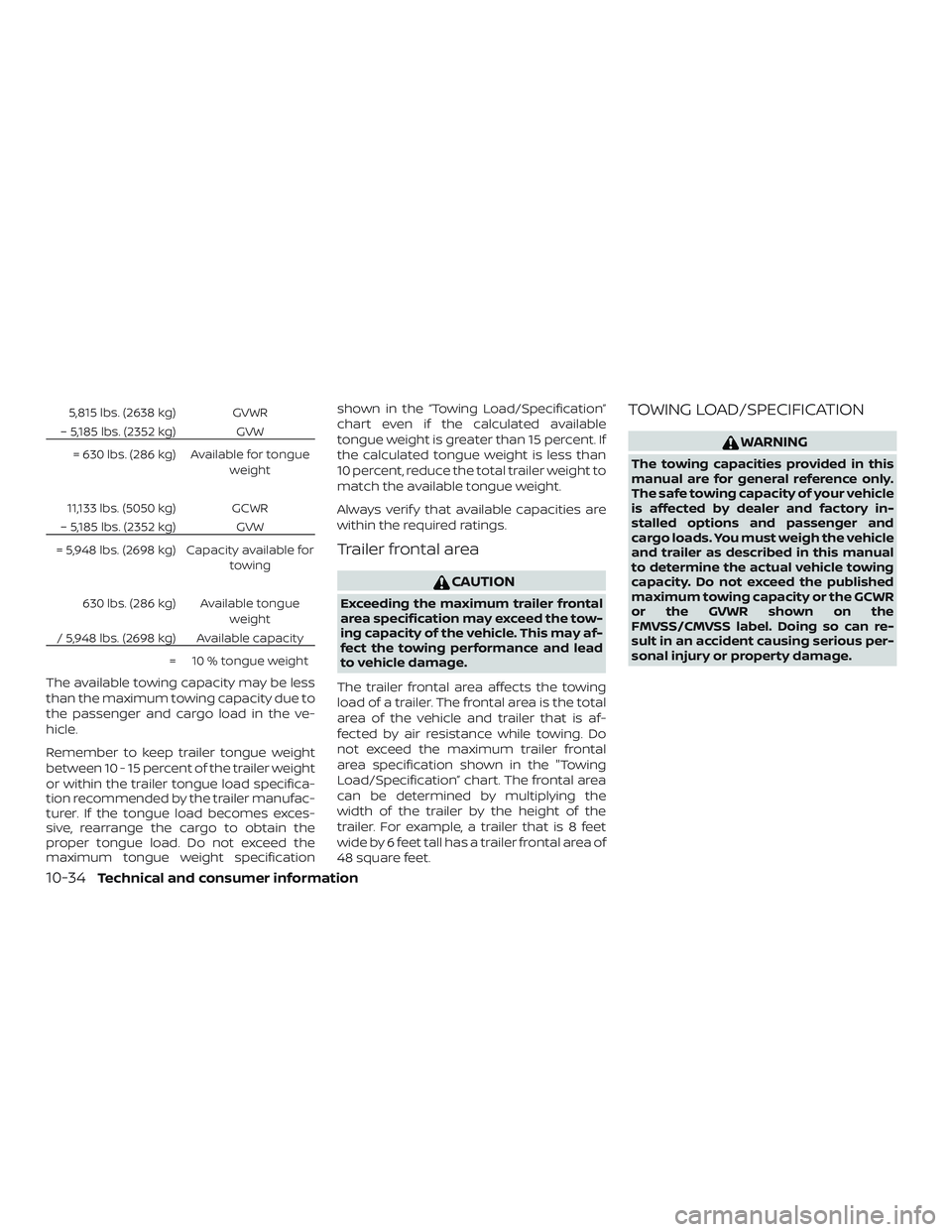
5,815 lbs. (2638 kg) GVWR
– 5,185 lbs. (2352 kg) GVW
= 630 lbs. (286 kg) Available for tongue weight
11,133 lbs. (5050 kg) GCWR
– 5,185 lbs. (2352 kg) GVW
= 5,948 lbs. (2698 kg) Capacity available for towing
630 lbs. (286 kg) Available tongue weight
/ 5,948 lbs. (2698 kg) Available capacity
= 10 % tongue weight
The available towing capacity may be less
than the maximum towing capacity due to
the passenger and cargo load in the ve-
hicle.
Remember to keep trailer tongue weight
between 10 - 15 percent of the trailer weight
or within the trailer tongue load specifica-
tion recommended by the trailer manufac-
turer. If the tongue load becomes exces-
sive, rearrange the cargo to obtain the
proper tongue load. Do not exceed the
maximum tongue weight specification shown in the “Towing Load/Specification”
chart even if the calculated available
tongue weight is greater than 15 percent. If
the calculated tongue weight is less than
10 percent, reduce the total trailer weight to
match the available tongue weight.
Always verif y that available capacities are
within the required ratings.
Trailer frontal area
CAUTION
Exceeding the maximum trailer frontal
area specification may exceed the tow-
ing capacity of the vehicle. This may af-
fect the towing performance and lead
to vehicle damage.
The trailer frontal area affects the towing
load of a trailer. The frontal area is the total
area of the vehicle and trailer that is af-
fected by air resistance while towing. Do
not exceed the maximum trailer frontal
area specification shown in the "Towing
Load/Specification” chart. The frontal area
can be determined by multiplying the
width of the trailer by the height of the
trailer. For example, a trailer that is 8 feet
wide by 6 feet tall has a trailer frontal area of
48 square feet.
TOWING LOAD/SPECIFICATION
WARNING
The towing capacities provided in this
manual are for general reference only.
The safe towing capacity of your vehicle
is affected by dealer and factory in-
stalled options and passenger and
cargo loads. You must weigh the vehicle
and trailer as described in this manual
to determine the actual vehicle towing
capacity. Do not exceed the published
maximum towing capacity or the GCWR
or the GVWR shown on the
FMVSS/CMVSS label. Doing so can re-
sult in an accident causing serious per-
sonal injury or property damage.
10-34Technical and consumer information
Page 474 of 502
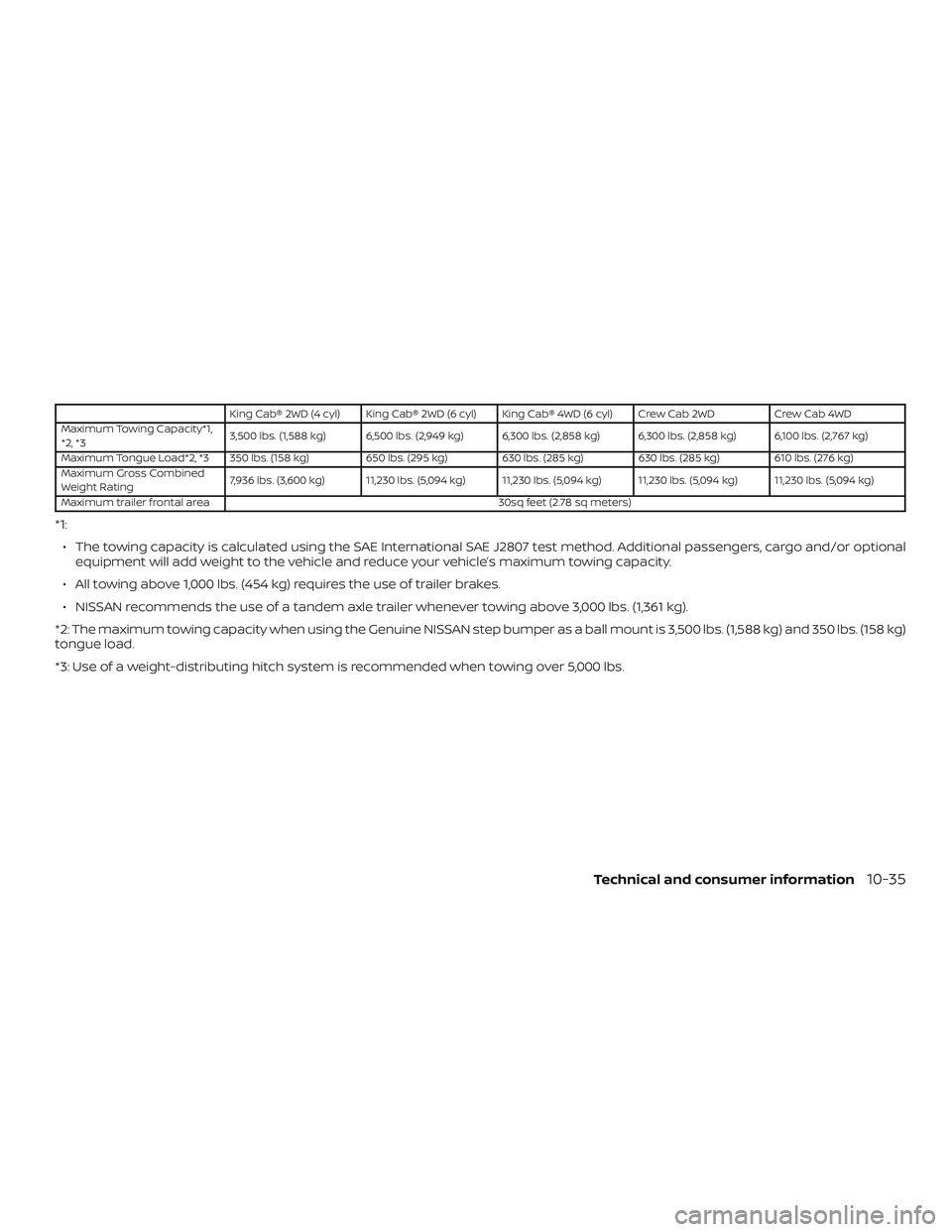
King Cab® 2WD (4 cyl) King Cab® 2WD (6 cyl) King Cab® 4WD (6 cyl) Crew Cab 2WDCrew Cab 4WD
Maximum Towing Capacity*1,
*2, *3 3,500 lbs. (1,588 kg) 6,500 lbs. (2,949 kg) 6,300 lbs. (2,858 kg) 6,300 lbs. (2,858 kg) 6,100 lbs. (2,767 kg)
Maximum Tongue Load*2, *3 350 lbs. (158 kg) 650 lbs. (295 kg)630 lbs. (285 kg) 630 lbs. (285 kg)610 lbs. (276 kg)
Maximum Gross Combined
Weight Rating 7,936 lbs. (3,600 kg) 11,230 lbs. (5,094 kg) 11,230 lbs. (5,094 kg) 11,230 lbs. (5,094 kg) 11,230 lbs. (5,094 kg)
Maximum trailer frontal area 30sq feet (2.78 sq meters)
*1:
∙ The towing capacity is calculated using the SAE International SAE J2807 test method. Additional passengers, cargo and/or optional equipment will add weight to the vehicle and reduce your vehicle’s maximum towing capacity.
∙ All towing above 1,000 lbs. (454 kg) requires the use of trailer brakes.
∙ NISSAN recommends the use of a tandem axle trailer whenever towing above 3,000 lbs. (1,361 kg).
*2: The maximum towing capacity when using the Genuine NISSAN step bumper as a ball mount is 3,500 lbs. (1,588 kg) and 350 lbs. (158 kg)
tongue load.
*3: Use of a weight-distributing hitch system is recommended when towing over 5,000 lbs.
Technical and consumer information10-35