service schedule NISSAN FRONTIER 2018 Owner´s Manual
[x] Cancel search | Manufacturer: NISSAN, Model Year: 2018, Model line: FRONTIER, Model: NISSAN FRONTIER 2018Pages: 502, PDF Size: 4.85 MB
Page 430 of 502
To help ensure smooth, safe and economi-
cal driving, NISSAN provides two mainte-
nance schedules that may be used, de-
pending upon the conditions in which you
usually drive. These schedules contain
both distance and time intervals, up to
120,000 miles (192,000 km)/144 months. For
most people, the odometer reading will in-
dicate when service is needed. However, if
you drive very little, your vehicle should be
serviced at the regular time intervals
shown in the schedule.
Af ter 120,000 miles
(192,000 km)/144 months, continue
maintenance at the same mileage/time
intervals.
ADDITIONAL MAINTENANCE ITEMS
FOR SEVERE OPERATING
CONDITIONS
Additional maintenance items for severe
operating conditionsshould be per-
formed on vehicles that are driven under
especially demanding conditions. Addi-
tional maintenance items should be per-
formed if you primarily operate your vehicle
under the following conditions:
∙ Repeated short trips of less than 5 miles (8 km). ∙ Repeated short trips of less than
10 miles (16 km) with outside tempera-
tures remaining below freezing.
∙ Operating in hot weather in stop- and-go “rush hour” traffic.
∙ Extensive idling and/or low speed driv- ing for long distances, such as police,
taxi or door-to-door delivery use.
∙ Driving in dusty conditions.
∙ Driving on rough, muddy or salt spread roads.
∙ Towing a trailer, using a camper or using a car-top carrier.
NOTE:
For vehicles operated in Canada, both
standard and severe maintenance items
should be performed at every interval. The following tables show the standard
maintenance schedule. Depending upon
weather and atmospheric conditions,
varying road surfaces, individual driving
habits and vehicle usage, additional or
more frequent maintenance may be re-
quired.
Af ter 120,000 miles
(192,000 km)/144 months, continue
maintenance at the same mileage/time
interval.
MAINTENANCE SCHEDULES STANDARD MAINTENANCE
Maintenance and schedules9-7
Page 449 of 502
For the best starting and vehicle driveabil-
ity results, do not continually switch be-
tween E-85 and unleaded regular gasoline.
If you must switch fuels, NISSAN recom-
mends the following:∙ do not switch when the fuel gauge indi- cates less than 1/4 full
∙ add more than 5 gallons of fuel
∙ operate the vehicle immediately af ter refueling for a period of at least 5 min-
utes
NOTE:
When the ambient temperature is above
90°F (32°C), you may experience hard
starting and rough idle following start
up even if the above recommendations
are followed.
Starting
The characteristics of E-85 fuel make it un-
suitable for use when ambient tempera-
tures fall below 0°F (-18°C). In the range of
0°F (-18°C) to 32°F (0°C), you may experience
an increase in the time it takes for you en-
gine to start, and a deterioration in drivabil-
ity (sags and/or hesitations) until the en-
gine is fully warmed up. Fuel consumption
Because E-85 fuel contains less energy per
gallon than gasoline, you will experience an
increase in fuel consumption. You can ex-
pect your fuel mileage to decrease by
about 30% compared to gasoline opera-
tion.
Replacement parts
Many components in your Flexible Fuel Ve-
hicle (FFV) are designed to be compatible
with ethanol. Always be sure that your ve-
hicle is serviced with correct ethanol com-
patible parts.
CAUTION
Replacing fuel system components
with non-ethanol compatible compo-
nents can damage your vehicle and
may also affect the warranty coverage.
Maintenance
If you operate your vehicle using E-85 fuel,
follow the correct maintenance log shown
in the “Maintenance and schedules” sec-
tion of this manual.
CAUTION
Do not use ethanol mixture greater
than 85% in your vehicle. It will cause
difficulty in cold starting and may affect
driveability.
10-10Technical and consumer information
Page 451 of 502
Change intervals
The oil and oil filter change intervals for
your engine are based on the use of the
specified quality oils and filters. Using en-
gine oil and filters that are not of the speci-
fied quality, or exceeding recommended oil
and filter change intervals could reduce
engine life. Damage to the engine caused
by improper maintenance or use of incor-
rect oil and filter quality and/or viscosity is
not covered by the NISSAN New Vehicle
Limited Warranty.
Your engine was filled with a high-quality
engine oil when it was built. You do not have
to change the oil before the first recom-
mended change interval. Oil and filter
change intervals depend upon how you
use your vehicle.
Operation under the following conditions
may require more frequent oil and filter
changes:∙ repeated short distance driving at cold outside temperatures
∙ driving in dusty conditions
∙ extensive idling
∙ towing a trailer
∙ stop and go commuting For additional information, refer to the
“Maintenance and schedules” section of
this manual.
AIR CONDITIONER SYSTEM
REFRIGERANT AND OIL
RECOMMENDATIONS
The air conditioner system in your
NISSAN vehicle must be charged with the
refrigerant HFC-134a (R-134a) and
NISSAN A/C system oil Type R (KLH00-
PAGRO) or the exact equivalents.
CAUTION
The use of any other refrigerant or oil
will cause severe damage to the air con-
ditioning system and will require the re-
placement of all air conditioner system
components.
The refrigerant HFC-134a (R-134a) in your
NISSAN vehicle does not harm the earth’s
ozone layer. Although this refrigerant does
not affect the earth’s atmosphere, certain
government regulations require the recov-
ery and recycling of any refrigerant during
automotive air conditioner system service.
A NISSAN dealer has the trained techni-
cians and equipment needed to recover
and recycle your air conditioner system re-
frigerant.
It is recommended that you visit a NISSAN
dealer when servicing your air conditioner
system.
10-12Technical and consumer information
Page 480 of 502
∙ Always drive your vehicle at a moderatespeed.
∙ When backing up, hold the bottom of the steering wheel with one hand. Move
your hand in the direction in which you
want the trailer to go. Make small cor-
rections and back up slowly. If possible,
have someone guide you when you are
backing up.
Always block the wheels on both vehicle
and trailer when parking. Parking on a
slope is not recommended; however, if you
must do so:
CAUTION
If you move the shif t lever to the P (Park)
position before blocking the wheels
and applying the parking brake, trans-
mission damage could occur.
1. Apply and hold the brake pedal.
2. Have someone place blocks on the downhill side of the vehicle and trailer
wheels.
3. Af ter the wheel blocks are in place, slowly release the brake pedal until the
blocks absorb the vehicle load.
4. Apply the parking brake. 5. Shif t the transmission into P (Park).
6. Make sure the
indicator light (if so
equipped) indicates the transfer case is
in 4H, 4L, or 2H and that the ATP light is
off. If the
indicator light is flashing,
or the ATP light is ON, make sure the
transmission is in P (Park) (A/T) and
turn the 4WD switch to 2WD or 4H. For
additional information, refer to “Auto-
matic transmission park warning light”
in the “Instruments and controls” sec-
tion and “Using 4-wheel drive (4WD)” in
the “Starting and driving” section of this
manual.
7. Turn off the engine.
To drive away:
1. Start the vehicle.
2. Apply and hold the brake pedal.
3. Shif t the transmission into gear.
4. Release the parking brake.
5. Drive slowly until the vehicle and trailer are clear from the blocks.
6. Apply and hold the brake pedal.
7. Have someone retrieve and store the blocks. ∙ While going downhill, the weight of the
trailer pushing on the tow vehicle may
decrease overall stability. Therefore, to
maintain adequate control, reduce your
speed and shif t to a lower gear. Avoid
long or repeated use of the brakes
when descending a hill, as this reduces
their effectiveness and could cause
overheating. Shif ting to a lower gear in-
stead provides “engine braking” and re-
duces the need to brake as frequently.
∙ If the engine coolant temperature rises to a high temperature, refer to “If your
vehicle overheats” in the “In case of
emergency” section of this manual.
∙ Trailer towing requires more fuel than normal circumstances.
∙ Avoid towing a trailer for your vehicle’s first 500 miles (805 km).
∙ For the first 500 miles (805 km) that you do tow, do not drive over 50 mph
(80 km/h).
∙ Have your vehicle serviced more of ten than at intervals specified. For addi-
tional information, refer to “Mainte-
nance Schedules” in the “Maintenance
and schedules” section of this manual.
Technical and consumer information10-41
Page 488 of 502
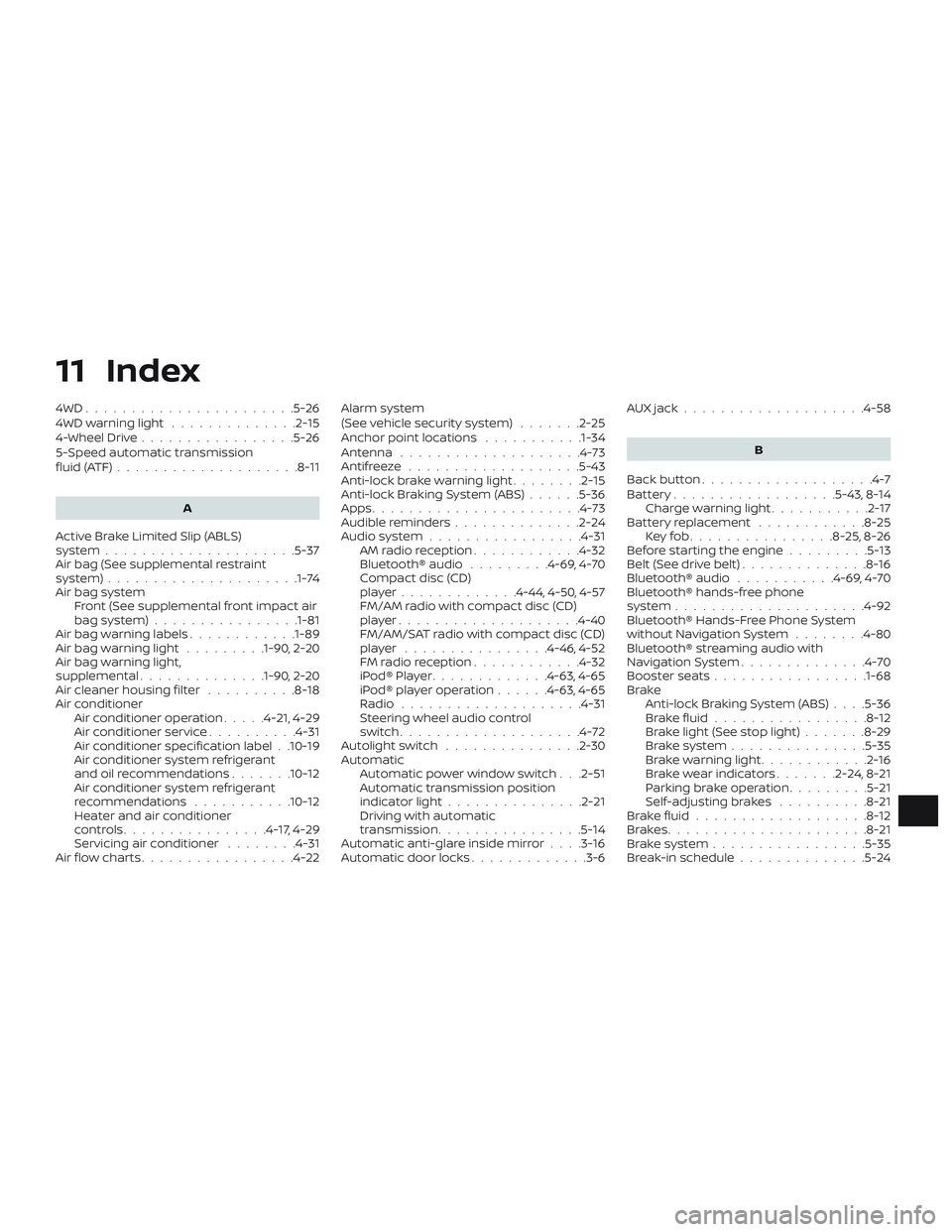
11 Index
4WD.......................5-26
4WDwarninglight ..............2-15
4-Wheel Drive.................5-26
5-Speed automatic transmission
fluid(ATF)....................8-11
A
Active Brake Limited Slip (ABLS)
system .....................5-37
Air bag (See supplemental restraint
system) .................... .1-74
Air bag system Front (See supplemental front impact air
bagsystem)............... .1-81
Air bag warning labels ............1-89
Airbagwarninglight .........1-90, 2-20
Air bag warning light,
supplemental ..............1-90, 2-20
Air cleaner housing filter ..........8-18
Air conditioner Air conditioner operation .....4-21,4-29
Air conditioner service ..........4-31
Air conditioner specification label . .10-19
Air conditioner system refrigerant
and oil recommendations .......10-12
Air conditioner system refrigerant
recommendations ...........10-12
Heater and air conditioner
controls................4-17,4-29
Servicing air conditioner ........4-31
Air flow charts .................4-22 Alarm system
(See vehicle security system)
.......2-25
Anchor point locations ...........1-34
Antenna ....................4-73
Antifreeze ...................5-43
Anti-lock brake warning light ........2-15
Anti-lock Braking System (ABS) ......5-36
Apps .......................4-73
Audible reminders ..............2-24
Audiosystem.................4-31 AMradioreception............4-32
Bluetooth® audio .........4-69,4-70
Compact disc (CD)
player.............4-44,4-50,4-57
FM/AM radio with compact disc (CD)
player....................4-40
FM/AM/SAT radio with compact disc (CD)
player ................4-46,4-52
FMradioreception............4-32
iPod®Player.............4-63,4-65
iPod® player operation ......4-63,4-65
Radio ....................4-31
Steering wheel audio control
switch....................4-72
Autolightswitch ...............2-30
Automatic Automatic power window switch . . .2-51
Automatic transmission position
indicatorlight...............2-21
Driving with automatic
transmission ................5-14
Automatic anti-glare inside mirror ....3-16
Automatic door locks .............3-6 AUXjack....................4-58
B
Back button ...................4-7
Battery..................5-43,8-14 Charge warning light ...........2-17
Battery replacement ............8-25
Keyfob................8-25,8-26
Before starting the engine .........5-13
Belt(Seedrivebelt)..............8-16
Bluetooth® audio ...........4-69,4-70
Bluetooth® hands-free phone
system .....................4-92
Bluetooth® Hands-Free Phone System
without Navigation System ........4-80
Bluetooth® streaming audio with
NavigationSystem..............4-70
Booster seats .................1-68
Brake Anti-lock Braking System (ABS) ....5-36
Brakefluid.................8-12
Brakelight(Seestoplight).......8-29
Brakesystem...............5-35
Brakewarninglight............2-16
Brakewearindicators.......2-24, 8-21
Parking brake operation .........5-21
Self-adjustingbrakes ..........8-21
B
rakefluid...................8-12
Brakes......................8-21
Brakesystem.................5-35
Break-in schedule ..............5-24