4WD NISSAN FRONTIER 2019 Owner´s Manual
[x] Cancel search | Manufacturer: NISSAN, Model Year: 2019, Model line: FRONTIER, Model: NISSAN FRONTIER 2019Pages: 516, PDF Size: 5.04 MB
Page 316 of 516
5 Starting and driving
Precautions when starting and driving..........5-2
Exhaust gas (carbon monoxide) ..............5-2
Three-way catalyst ...........................5-3
Tire Pressure Monitoring System
(TPMS)........................................5-3
On-pavement and off-road driving
precautions ..................................5-6
Avoiding collision and rollover ................5-7
Off-roadrecovery ............................5-7
Rapid air pressure loss .......................5-7
Drinking alcohol/drugs and driving ...........5-8
Driving safety precautions ....................5-9
Ignition switch ................................... 5-11
Automatic transmission
(if so equipped) ............................... 5-11
Manual transmission (M/T)
(if so equipped) .............................. 5-12
Key positions ................................ 5-12
NISSAN Vehicle Immobilizer System
(if so equipped) .............................. 5-12
Before starting the engine ......................5-13
Starting the engine ............................. 5-13
Driving the vehicle .............................. 5-14Automatic transmission (A/T)
(if so equipped)
.............................. 5-14
Manual transmission (if so equipped) ........5-19
Parking brake .................................. 5-21
Cruise control .................................. 5-22
Precautions on cruise control ................5-22
Cruise control operations ....................5-23
Break-in schedule .............................. 5-24
Fuel efficient driving tips ........................5-24
Increasing fuel economy .......................5-25
Using 4–Wheel Drive (4WD)
(if so equipped) ................................. 5-26
Transfer case shif ting procedures ...........5-26
Electronic locking rear differential (E-Lock)
system (if so equipped) ......................... 5-33
Parking/parking on hills ........................5-34
Power steering ................................. 5-35
Brake system ................................... 5-35
Brake precautions ........................... 5-35
Anti-lock Braking System (ABS) ..............5-36
Active Brake Limited Slip (ABLS) system .........5-37
Vehicle Dynamic Control (VDC) system .........5-38
Brake force distribution ......................5-40
Page 325 of 516
DRIVING SAFETY PRECAUTIONS
Your NISSAN is designed for both normal
and off-road use. However, avoid driving in
deep water or mud as your NISSAN is
mainly designed for leisure use, unlike a
conventional off-road vehicle.
Remember that 2-Wheel Drive models are
less capable than 4–Wheel Drive (4WD)
models for rough road driving and extrica-
tion when stuck in deep snow or mud, or
the like.
Please observe the following precautions:
WARNING
∙ Drive carefully when off the road andavoid dangerous areas. Every person
who drives or rides in this vehicle
should be seated with their seat belt
fastened. This will keep you and your
passengers in position when driving
over rough terrain.
∙ Do not drive across steep slopes. In- stead drive either straight up or
straight down the slopes. Off-road ve-
hicles can tip over sideways much
more easily than they can forward or
backward. ∙ Many hills are too steep for any ve-
hicle. If you drive up them, you may
stall. If you drive down them, you may
not be able to control your speed. If
you drive across them, you may roll
over.
∙ Do not shif t gears while driving on downhill grades as this could cause
loss of control of the vehicle.
∙ Stay alert when driving to the top of a hill. At the top there could be a drop-
off or other hazard that could cause
an accident.
∙ If your engine stalls or you cannot make it to the top of a steep hill, never
attempt to turn around. Your vehicle
could tip or roll over. Always back
straight down in R (Reverse) gear.
Never back down in N (Neutral) or with
the clutch depressed (manual trans-
mission vehicles), using only the
brake, as this could cause loss of
control. ∙ Heavy braking going down a hill could
cause your brakes to overheat and
fade, resulting in loss of control and
an accident. Apply brakes lightly and
use a low gear to control your speed.
Use the hill descent control feature (if
so equipped).
∙ Unsecured cargo can be thrown around when driving over rough ter-
rain. Properly secure all cargo so it will
not be thrown forward and cause in-
jury to you or your passengers.
∙ To avoid raising the center of gravity excessively, do not exceed the rated
capacity of the roof rack (if so
equipped) and evenly distribute the
load. Secure heavy loads in the cargo
area as far forward and as low as pos-
sible. Do not equip the vehicle with
tires larger than specified in this
manual. This could cause your vehicle
to roll over.
∙ Do not grip the inside or spokes of the steering wheel when driving off-road.
The steering wheel could move sud-
denly and injure your hands. Instead
drive with your fingers and thumbs on
the outside of the rim.
Starting and driving5-9
Page 326 of 516
∙ Before operating the vehicle, ensurethat the driver and all passengers
have their seat belts fastened.
∙ Always drive with the floor mats in place as the floor may become hot.
∙ Lower your speed when encountering strong crosswinds. With a higher cen-
ter of gravity, your NISSAN is more af-
fected by strong side winds. Slower
speeds ensure better vehicle control.
∙ Do not drive beyond the performance capability of the tires, even with 4WD
engaged (if so equipped).
∙ For 4WD equipped vehicles, do not at- tempt to raise two wheels off the
ground and shif t the transmission to
any drive or reverse position with the
engine running. Doing so may result
in drivetrain damage or unexpected
vehicle movement which could result
in serious vehicle damage or personal
injury. ∙ Do not attempt to test a 4WD
equipped vehicle on a 2-wheel dyna-
mometer (such as the dynamometers
used by some states for emissions
testing), or similar equipment even if
the other two wheels are raised off the
ground. Make sure you inform test fa-
cility personnel that your vehicle is
equipped with 4WD before it is placed
on a dynamometer. Using the wrong
test equipment may result in drive-
train damage or unexpected vehicle
movement which could result in seri-
ous vehicle damage or personal
injury.
∙ Accelerating quickly, sharp steering maneuvers or sudden braking may
cause loss of control.
∙ If at all possible, avoid sharp turning maneuvers, particularly at high
speeds. Your NISSAN 4WD vehicle has
a higher center of gravity than a pas-
senger car. The vehicle is not de-
signed for cornering at the same
speeds as passenger cars. Failure to
operate this vehicle correctly could
result in loss of control and/or a roll-
over accident. ∙ Always use tires of the same type,
size, brand, construction (bias, bias-
belted, or radial), and tread pattern on
all four wheels. Install tire chains on
the rear wheels when driving on slip-
pery roads and drive carefully.
∙ Be sure to check the brakes immedi- ately af ter driving in mud or water. For
additional information, refer to “Wet
brakes” in this section.
∙ Avoid parking your vehicle on steep hills. If you get out of the vehicle and it
rolls forward, backward or sideways,
you could be injured.
∙ Whenever you drive off-road through sand, mud or water as deep as the
wheel hub, more frequent mainte-
nance may be required. For additional
information, refer to “Maintenance
under severe operating conditions” in
the “Maintenance and schedules” sec-
tion of this manual.
5-10Starting and driving
Page 342 of 516
WARNING
∙ For 4WD equipped vehicles, do not at-tempt to raise two wheels off the
ground and shif t the transmission to
any drive or reverse position with the
engine running. Doing so may result
in drivetrain damage or unexpected
vehicle movement which could result
in serious vehicle damage or personal
injury.
∙ Do not attempt to test a 4WD equipped vehicle on a 2-wheel dyna-
mometer (such as the dynamometers
used by some states for emissions
testing), or similar equipment even if
the other two wheels are raised off the
ground. Make sure you inform test fa-
cility personnel that your vehicle is
equipped with 4WD before it is placed
on a dynamometer. Using the wrong
test equipment may result in drive-
train damage or unexpected vehicle
movement which could result in seri-
ous vehicle damage or personal
injury.
CAUTION
∙ Do not drive the vehicle in the 4H or4LO position on dry hard surface
roads. Driving on dry, hard surfaces in
4H or 4LO may cause unnecessary
noise, tire wear and increased fuel
consumption.
If the 4WD warning light turns on
when you are driving on dry hard sur-
face roads:
– In the 4H position, shif t the 4WD shif t switch to 2–Wheel Drive
(2WD).
– In the 4LO position for automatic transmission vehicles, stop the ve-
hicle and shif t the shif t lever to the
N (Neutral) position with the brake
pedal depressed and shif t the 4WD
shif t switch to 2WD.
– In the 4LO position for manual transmission vehicles, stop the ve-
hicle and shif t the shif t lever to the
N (Neutral) position with the clutch
pedal depressed and shif t the 4WD
shif t switch to 2WD. ∙ If the warning light is still on af ter the
above operation, have your vehicle
checked as soon as possible. It is rec-
ommended that you visit a NISSAN
dealer for this service.
TRANSFER CASE SHIFTING
PROCEDURES
The part-time 4WD system provides three
positions (2WD, 4H and 4LO), so you can
select the desired drive mode according to
the driving conditions.
USING 4–WHEEL DRIVE (4WD)
(if so equipped)
5-26Starting and driving
Page 343 of 516
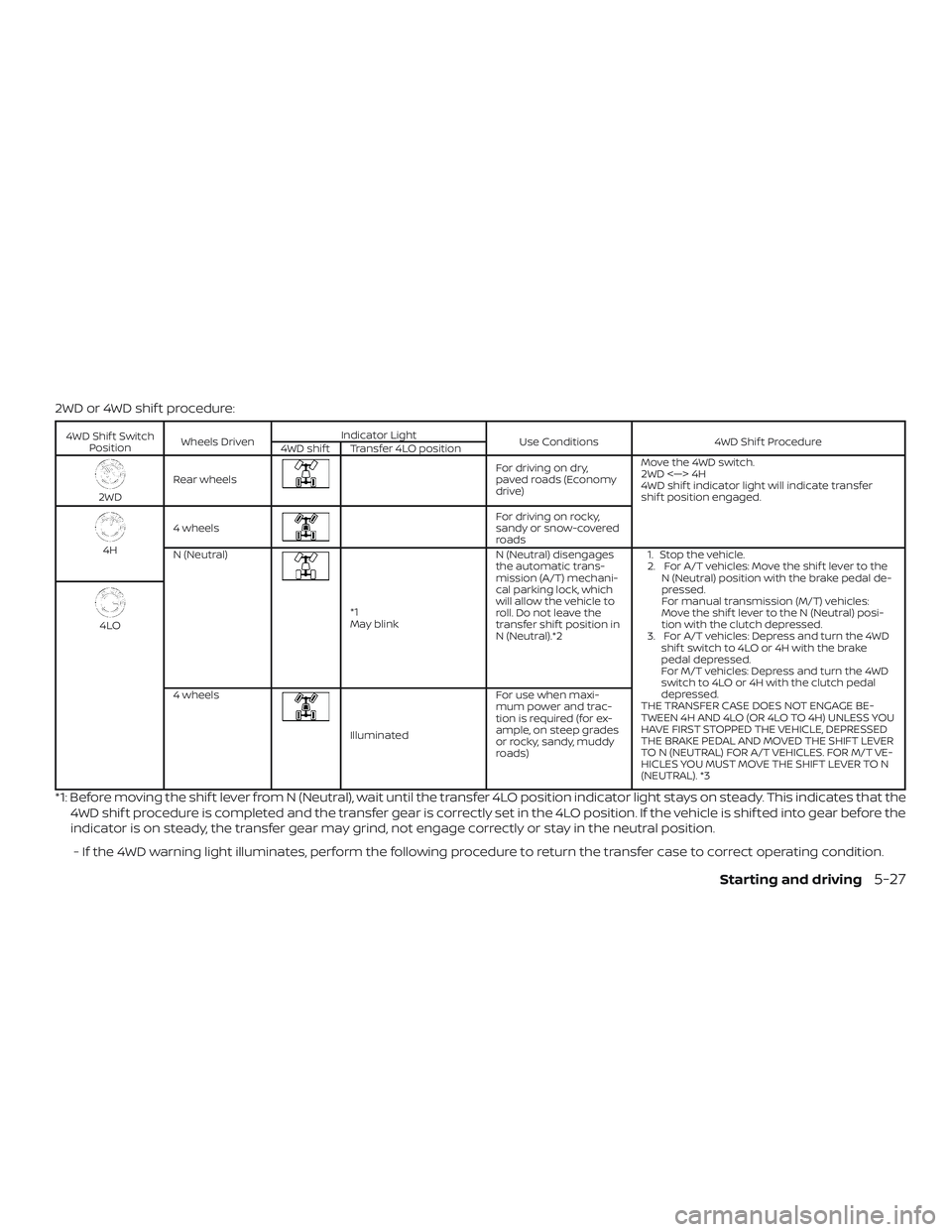
2WD or 4WD shif t procedure:
4WD Shif t SwitchPosition Wheels Driven Indicator Light
Use Conditions 4WD Shif t Procedure
4WD shif t Transfer 4LO position
2WD Rear wheels
For driving on dry,
paved roads (Economy
drive) Move the 4WD switch.
2WD <—> 4H
4WD shif t indicator light will indicate transfer
shif t position engaged.
4H
4 wheels
For driving on rocky,
sandy or snow-covered
roads
N (Neutral)
*1
May blink N (Neutral) disengages
the automatic trans-
mission (A/T) mechani-
cal parking lock, which
will allow the vehicle to
roll. Do not leave the
transfer shif t position in
N (Neutral).*2 1. Stop the vehicle.
2. For A/T vehicles: Move the shif t lever to the
N (Neutral) position with the brake pedal de-
pressed.
For manual transmission (M/T) vehicles:
Move the shif t lever to the N (Neutral) posi-
tion with the clutch depressed.
3. For A/T vehicles: Depress and turn the 4WD shif t switch to 4LO or 4H with the brake
pedal depressed.
For M/T vehicles: Depress and turn the 4WD
switch to 4LO or 4H with the clutch pedal
depressed.
THE TRANSFER CASE DOES NOT ENGAGE BE-
TWEEN 4H AND 4LO (OR 4LO TO 4H) UNLESS YOU
HAVE FIRST STOPPED THE VEHICLE, DEPRESSED
THE BRAKE PEDAL AND MOVED THE SHIFT LEVER
TO N (NEUTRAL) FOR A/T VEHICLES. FOR M/T VE-
HICLES YOU MUST MOVE THE SHIFT LEVER TO N
(NEUTRAL). *34LO
4 wheels
Illuminated For use when maxi-
mum power and trac-
tion is required (for ex-
ample, on steep grades
or rocky, sandy, muddy
roads)
*1: Before moving the shif t lever from N (Neutral), wait until the transfer 4LO position indicator light stays on steady. This indicates that the
4WD shif t procedure is completed and the transfer gear is correctly set in the 4LO position. If the vehicle is shif ted into gear before the
indicator is on steady, the transfer gear may grind, not engage correctly or stay in the neutral position.
- If the 4WD warning light illuminates, perform the following procedure to return the transfer case to correct operating condition.
Starting and driving5-27
Page 344 of 516
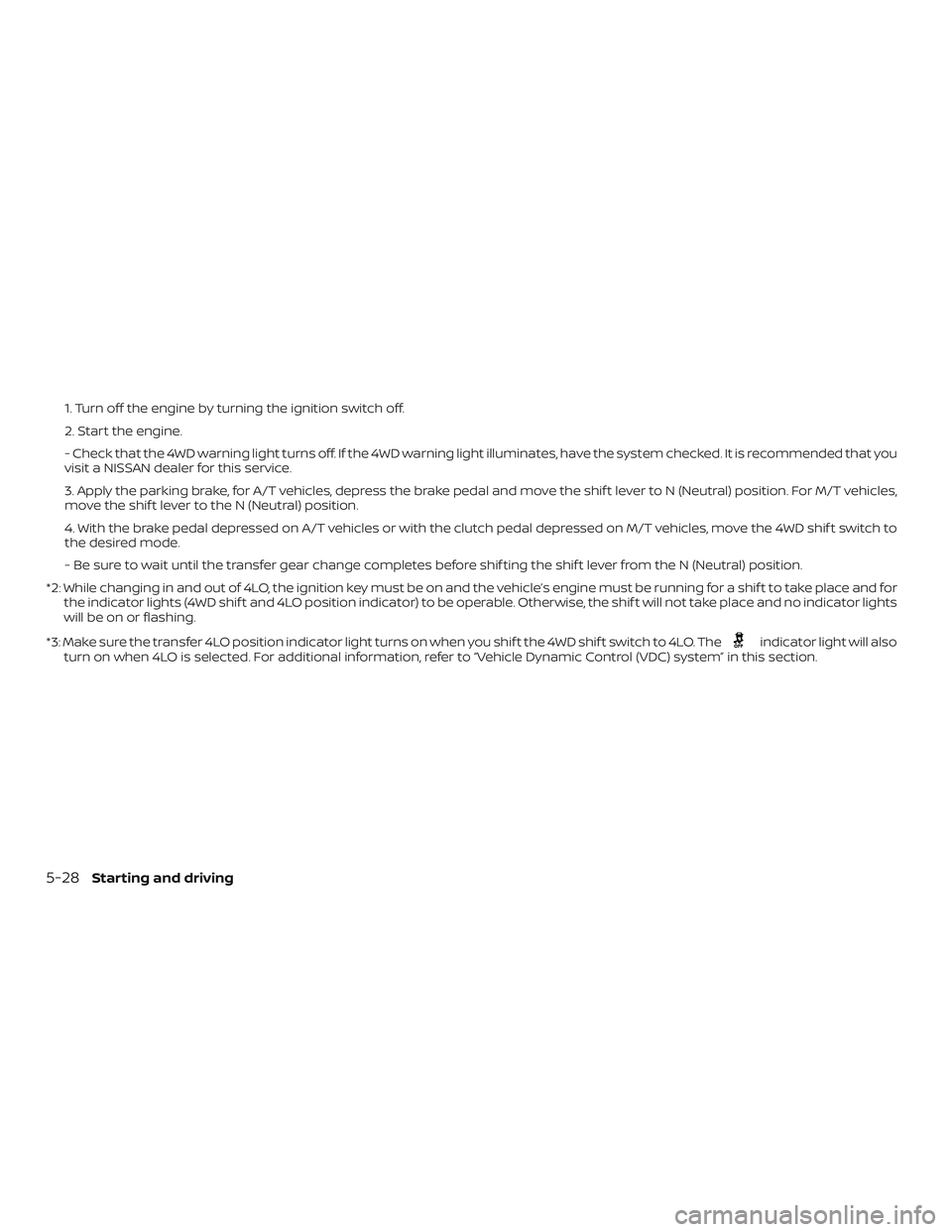
1. Turn off the engine by turning the ignition switch off.
2. Start the engine.
- Check that the 4WD warning light turns off. If the 4WD warning light illuminates, have the system checked. It is recommended that you
visit a NISSAN dealer for this service.
3. Apply the parking brake, for A/T vehicles, depress the brake pedal and move the shif t lever to N (Neutral) position. For M/T vehicles,
move the shif t lever to the N (Neutral) position.
4. With the brake pedal depressed on A/T vehicles or with the clutch pedal depressed on M/T vehicles, move the 4WD shif t switch to
the desired mode.
- Be sure to wait until the transfer gear change completes before shif ting the shif t lever from the N (Neutral) position.
*2: While changing in and out of 4LO, the ignition key must be on and the vehicle’s engine must be running for a shif t to take place and for the indicator lights (4WD shif t and 4LO position indicator) to be operable. Otherwise, the shif t will not take place and no indicator lights
will be on or flashing.
*3: Make sure the transfer 4LO position indicator light turns on when you shif t the 4WD shif t switch to 4LO. The
indicator light will also
turn on when 4LO is selected. For additional information, refer to “Vehicle Dynamic Control (VDC) system” in this section.
5-28Starting and driving
Page 345 of 516
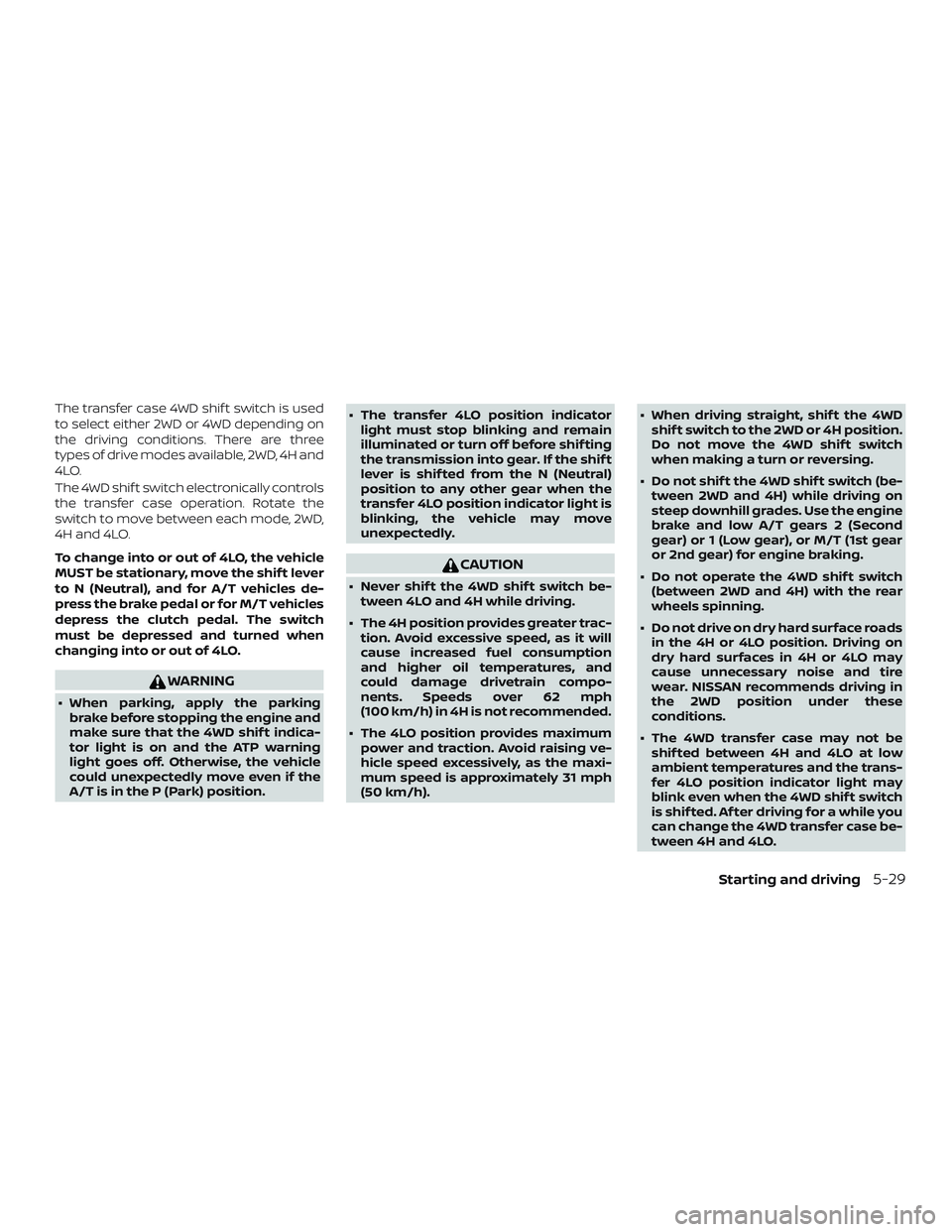
The transfer case 4WD shif t switch is used
to select either 2WD or 4WD depending on
the driving conditions. There are three
types of drive modes available, 2WD, 4H and
4LO.
The 4WD shif t switch electronically controls
the transfer case operation. Rotate the
switch to move between each mode, 2WD,
4H and 4LO.
To change into or out of 4LO, the vehicle
MUST be stationary, move the shif t lever
to N (Neutral), and for A/T vehicles de-
press the brake pedal or for M/T vehicles
depress the clutch pedal. The switch
must be depressed and turned when
changing into or out of 4LO.
WARNING
∙ When parking, apply the parkingbrake before stopping the engine and
make sure that the 4WD shif t indica-
tor light is on and the ATP warning
light goes off. Otherwise, the vehicle
could unexpectedly move even if the
A/T is in the P (Park) position. ∙ The transfer 4LO position indicator
light must stop blinking and remain
illuminated or turn off before shif ting
the transmission into gear. If the shif t
lever is shif ted from the N (Neutral)
position to any other gear when the
transfer 4LO position indicator light is
blinking, the vehicle may move
unexpectedly.
CAUTION
∙ Never shif t the 4WD shif t switch be-tween 4LO and 4H while driving.
∙ The 4H position provides greater trac- tion. Avoid excessive speed, as it will
cause increased fuel consumption
and higher oil temperatures, and
could damage drivetrain compo-
nents. Speeds over 62 mph
(100 km/h) in 4H is not recommended.
∙ The 4LO position provides maximum power and traction. Avoid raising ve-
hicle speed excessively, as the maxi-
mum speed is approximately 31 mph
(50 km/h). ∙ When driving straight, shif t the 4WD
shif t switch to the 2WD or 4H position.
Do not move the 4WD shif t switch
when making a turn or reversing.
∙ Do not shif t the 4WD shif t switch (be- tween 2WD and 4H) while driving on
steep downhill grades. Use the engine
brake and low A/T gears 2 (Second
gear) or 1 (Low gear), or M/T (1st gear
or 2nd gear) for engine braking.
∙ Do not operate the 4WD shif t switch (between 2WD and 4H) with the rear
wheels spinning.
∙ Do not drive on dry hard surface roads in the 4H or 4LO position. Driving on
dry hard surfaces in 4H or 4LO may
cause unnecessary noise and tire
wear. NISSAN recommends driving in
the 2WD position under these
conditions.
∙ The 4WD transfer case may not be shif ted between 4H and 4LO at low
ambient temperatures and the trans-
fer 4LO position indicator light may
blink even when the 4WD shif t switch
is shif ted. Af ter driving for a while you
can change the 4WD transfer case be-
tween 4H and 4LO.
Starting and driving5-29
Page 346 of 516
When driving on rough roads:∙ Set the 4WD shif t switch to 4H or 4LO.
∙ Drive carefully according to the road surface conditions.
When the vehicle is stuck: ∙ Set the 4WD shif t switch to 4H or 4LO.
∙ Use the Electronic Locking Rear Differ- ential (E-Lock) system (if so equipped).
Turn the switch ON while the vehicle is
stationary and apply the throttle to try
to free the vehicle.
∙ If it is difficult to free the vehicle, rock the vehicle back and forth between R (Re-
verse) and D (Drive) gears.
∙ If the vehicle is stuck deep in mud, place stones or wooden blocks under the
tires. Then try the recovery procedures
above. Tire chains may be effective.
CAUTION
∙ Do not spin the tires excessively. Tireswill sink deep into the mud, making it
difficult to free the vehicle.
∙ Avoid shif ting gears with the engine running at high speeds as this may
cause malfunction.
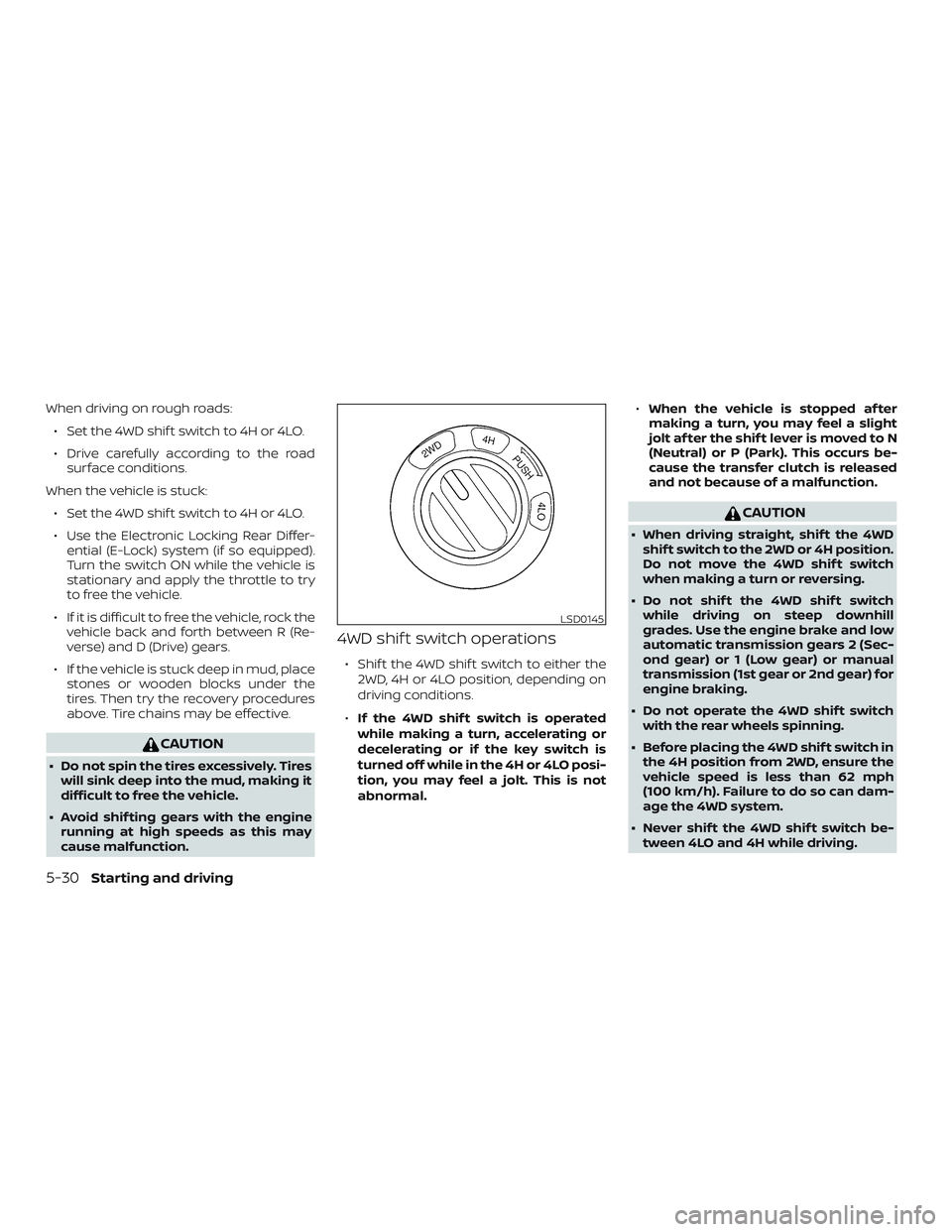
4WD shif t switch operations
∙ Shif t the 4WD shif t switch to either the
2WD, 4H or 4LO position, depending on
driving conditions.
∙ If the 4WD shif t switch is operated
while making a turn, accelerating or
decelerating or if the key switch is
turned off while in the 4H or 4LO posi-
tion, you may feel a jolt. This is not
abnormal. ∙
When the vehicle is stopped af ter
making a turn, you may feel a slight
jolt af ter the shif t lever is moved to N
(Neutral) or P (Park). This occurs be-
cause the transfer clutch is released
and not because of a malfunction.
CAUTION
∙ When driving straight, shif t the 4WD
shif t switch to the 2WD or 4H position.
Do not move the 4WD shif t switch
when making a turn or reversing.
∙ Do not shif t the 4WD shif t switch while driving on steep downhill
grades. Use the engine brake and low
automatic transmission gears 2 (Sec-
ond gear) or 1 (Low gear) or manual
transmission (1st gear or 2nd gear) for
engine braking.
∙ Do not operate the 4WD shif t switch with the rear wheels spinning.
∙ Before placing the 4WD shif t switch in the 4H position from 2WD, ensure the
vehicle speed is less than 62 mph
(100 km/h). Failure to do so can dam-
age the 4WD system.
∙ Never shif t the 4WD shif t switch be- tween 4LO and 4H while driving.
LSD0145
5-30Starting and driving
Page 347 of 516
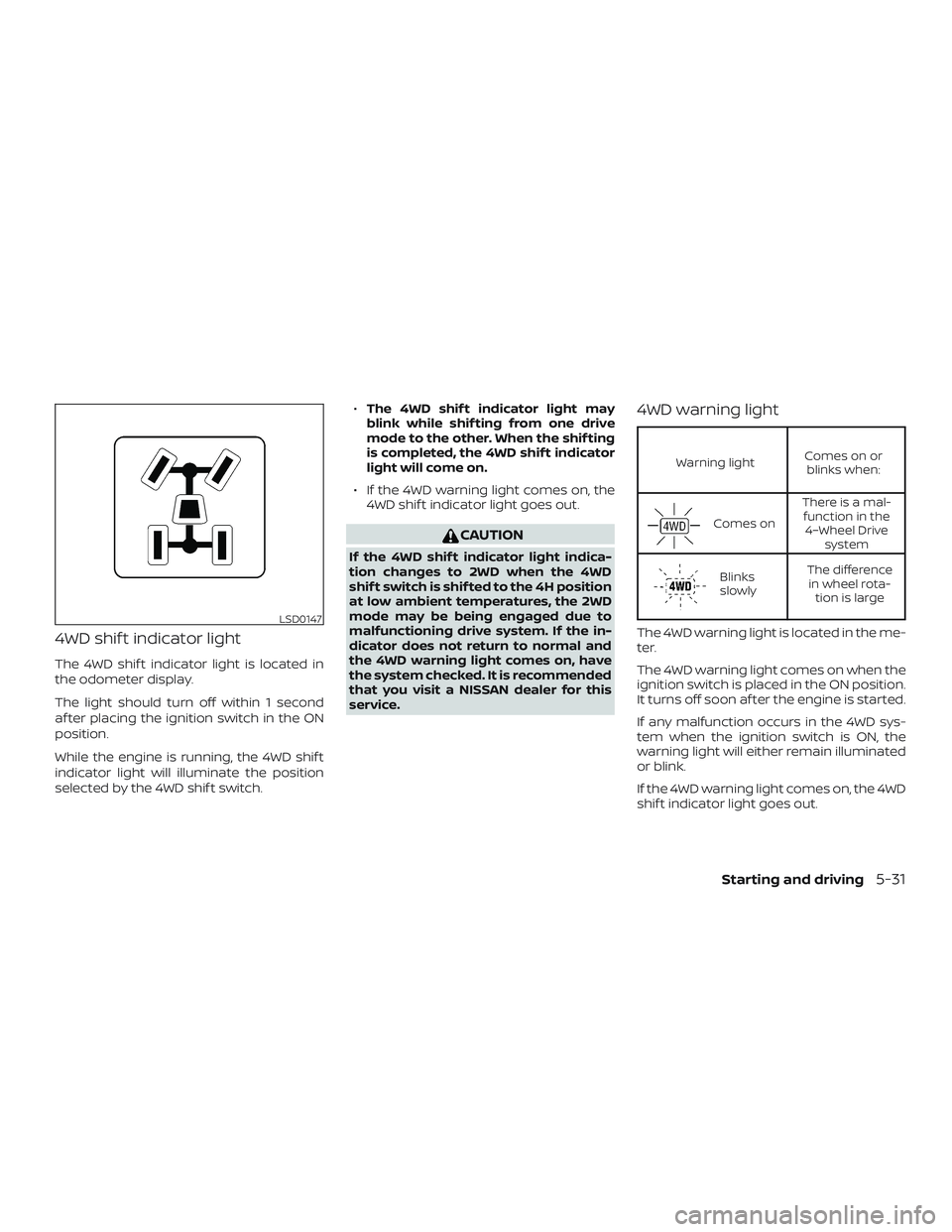
4WD shif t indicator light
The 4WD shif t indicator light is located in
the odometer display.
The light should turn off within 1 second
af ter placing the ignition switch in the ON
position.
While the engine is running, the 4WD shif t
indicator light will illuminate the position
selected by the 4WD shif t switch.∙
The 4WD shif t indicator light may
blink while shif ting from one drive
mode to the other. When the shif ting
is completed, the 4WD shif t indicator
light will come on.
∙ If the 4WD warning light comes on, the 4WD shif t indicator light goes out.
CAUTION
If the 4WD shif t indicator light indica-
tion changes to 2WD when the 4WD
shif t switch is shif ted to the 4H position
at low ambient temperatures, the 2WD
mode may be being engaged due to
malfunctioning drive system. If the in-
dicator does not return to normal and
the 4WD warning light comes on, have
the system checked. It is recommended
that you visit a NISSAN dealer for this
service.
4WD warning light
Warning light Comes on or
blinks when:
Comes on There is a mal-
function in the 4–Wheel Drive system
Blinks
slowly The difference
in wheel rota- tion is large
The 4WD warning light is located in the me-
ter.
The 4WD warning light comes on when the
ignition switch is placed in the ON position.
It turns off soon af ter the engine is started.
If any malfunction occurs in the 4WD sys-
tem when the ignition switch is ON, the
warning light will either remain illuminated
or blink.
If the 4WD warning light comes on, the 4WD
shif t indicator light goes out.LSD0147
Starting and driving5-31
Page 348 of 516
A large difference between the diameters
of front and rear wheels will make the
warning light blink slowly (about once per
2 seconds). Change the 4WD shif t switch
into 2WD and do not drive fast.
CAUTION
∙ If the warning light comes on or blinksslowly during operation, have your
vehicle checked as soon as possible. It
is recommended that you visit a
NISSAN dealer for this service.
∙ Shif ting between 4H and 4LO is not recommended when the 4WD warn-
ing light turns on.
∙ When the warning light comes on, the 2WD mode may be engaged even if
the 4WD shif t switch is in 4H. Be espe-
cially careful when driving. If corre-
sponding parts are malfunctioning,
the 4WD mode will not be engaged
even if the 4WD shif t switch is shif ted. ∙ Do not drive the vehicle in the 4H or
4LO position on dry hard surface
roads. Driving on dry, hard surfaces in
4H or 4LO may cause unnecessary
noise, tire wear and increased fuel
consumption.
If the 4WD warning light turns on
when you are driving on dry hard sur-
face roads:
– In the 4H position, shif t the 4WD shif t switch to 2WD.
– In the 4LO position for automatic transmission vehicles, stop the ve-
hicle and shif t the shif t lever to the
N (Neutral) position with the brake
pedal depressed and shif t the 4WD
shif t switch to 2WD.
– In the 4LO position for manual transmission vehicles, stop the ve-
hicle and shif t the shif t lever to the
N (Neutral) position with the clutch
pedal depressed and shif t the 4WD
shif t switch to 2WD.
∙ If the warning light is still on af ter the above operation, have your vehicle
checked as soon as possible. It is rec-
ommended that you visit a NISSAN
dealer for this service. ∙ The transfer case may be damaged if
you continue driving with the warning
light blinking.
5-32Starting and driving