fuel cap NISSAN FRONTIER 2019 Owner´s Manual
[x] Cancel search | Manufacturer: NISSAN, Model Year: 2019, Model line: FRONTIER, Model: NISSAN FRONTIER 2019Pages: 516, PDF Size: 5.04 MB
Page 441 of 516
fuel fumes are evident, check for the cause
and have it corrected immediately.
Power steering fluid level* and lines:
Check the level when the fluid is cold, with
the engine off. Check the lines for proper
attachment, leaks, cracks, etc.
Radiator and hoses:Check the front of the
radiator and clean off any dirt, insects,
leaves, etc., that may have accumulated.
Make sure the hoses have no cracks, defor-
mation, rot or loose connections.
Underbody: The underbody is frequently
exposed to corrosive substances such as
those used on icy roads or to control dust. It
is very important to remove these sub-
stances, otherwise rust may form on the
floor pan, frame, fuel lines and around the
exhaust system. At the end of winter, the
underbody should be thoroughly flushed
with plain water, being careful to clean
those areas where mud and dirt may accu-
mulate. For additional information, refer to
the “Appearance and care” section of this
manual.
Windshield-washer fluid*: Check that
there is adequate fluid in the reservoir. The following descriptions are provided to
give you a better understanding of the
scheduled maintenance items that should
be regularly checked or replaced. The
maintenance schedule indicates at which
mileage/time intervals each item requires
service.
In addition to scheduled maintenance,
your vehicle requires that some items be
checked during normal day-to-day opera-
tion. For additional information, refer to
“General maintenance” in this section.
Items marked with
“*”are recommended
by NISSAN for reliable vehicle operation.
You are not required to perform mainte-
nance on these items in order to maintain
the warranties which come with your
NISSAN. Other maintenance items and in-
tervals are required.
When applicable, additional information
can be found in the “Do-it-yourself ” section
of this manual. NOTE:
NISSAN does not advocate the use of
non-OEM approved af termarket flush-
ing systems and strongly advises
against performing these services on a
NISSAN product. Many of the af termar-
ket flushing systems use non-OEM ap-
proved chemicals or solvents, the use of
which has not been validated by NISSAN.
For recommended fuel, lubricants, fluids,
grease, and refrigerant, refer to “Recom-
mended fluids/lubricants and capaci-
ties” in the “Technical and consumer in-
formation” section of this manual.
EMISSION CONTROL SYSTEM
MAINTENANCE:
Drive belts*:
Check engine drive belts for
wear, fraying or cracking and for proper
tension. Replace any damaged drive belts.
Engine air filter: Replace at specified inter-
vals. When driving for prolonged periods in
dusty conditions, check/replace the filter
more frequently.
Engine coolant*: Replace coolant at the
specified interval. When adding or replac-
ing coolant, be sure to use only Genuine
NISSAN Long Life Antifreeze/Coolant (blue)
EXPLANATION OF SCHEDULED
MAINTENANCE ITEMS
Maintenance and schedules9-5
Page 442 of 516
or equivalent with the proper mixture. (For
additional information on the proper mix-
ture for your area, refer to “Engine cooling
system” in the “Do-it-yourself ” section of
this manual.)
NOTE: Mixing any other type of coolant
or the use of non-distilled water may re-
duce the recommended service interval
of the coolant.
Engine oil and oil filter:Replace engine oil
and oil filter at the specified intervals. For
recommended oil grade and viscosity refer
to “Recommended fluids/lubricants and
capacities” in the “Technical and consumer
information” section of this manual.
Evaporative emissions control vapor
lines*: Check vapor lines for leaks or loose-
ness. Tighten connections or replace parts
as necessary.
Fuel lines*: Check the fuel hoses, piping
and connections for leaks, looseness, or
deterioration. Tighten connections or re-
place parts as necessary.
Spark plugs: Replace at specified intervals.
Install new plugs of the same type as origi-
nally equipped.CHASSIS AND BODY
MAINTENANCE:
Brake lines and cables: Visually inspect for
proper installation. Check for chafing,
cracks, deterioration, and signs of leaking.
Replace any deteriorated or damaged
parts immediately.
Brake pads and rotors: Check for wear,
deterioration and fluid leaks. Replace any
deteriorated or damaged parts immedi-
ately.
Exhaust system: Visually inspect the ex-
haust pipes, muffler and hangers for leaks,
cracks, deterioration, and damage. Tighten
connections or replace parts as necessary.
In-cabin microfilter: Replace at specified
intervals. When driving for prolonged peri-
ods in dusty conditions, replace the filter
more frequently.
Steering gear and linkage, axle and sus-
pension parts, drive shaf t boots: Check
for damage, looseness, and leakage of oil
or grease. Under severe driving conditions,
inspect more frequently. Tire rotation:
Tires should be rotated every
5,000 miles (8,000 km) according to the in-
structions under “Explanation of general
maintenance items” in this section. When
rotating tires, check for damage and un-
even wear. Replace if necessary.
Transmission fluid/oil, differential oil: Vi-
sually inspect for signs of leakage at speci-
fied intervals.
9-6Maintenance and schedules
Page 452 of 516
10 Technical and consumer information
Recommended fluids/lubricants and
capacities...................................... 10-2
Fuel recommendation
(for QR25DE models) ......................... 10-4
Fuel recommendation
(for VQ40DE models) ........................ 10-7
Flexible Fuel Vehicle (FFV) fuel
recommendation (if so equipped) ...........10-9
Engine oil and oil filter
recommendations .......................... 10-11
Air conditioner system refrigerant and
oil recommendations ......................10-12
Specifications ................................. 10-13
Engine ..................................... 10-13
Wheels and tires ............................ 10-14
Dimensions and weights ...................10-14
When traveling or registering in another
country ........................................ 10-15
Vehicle identification .......................... 10-15
Vehicle Identification Number (VIN)
plate ....................................... 10-15
Engine serial number ....................... 10-15
F.M.V.S.S./C.M.V.S.S. certification label ........10-16
Emission control information label .........10-17 Tire and Loading Information label
.........10-17
Air conditioner specification label ...........10-18
Installing front license plate ....................10-18
Installing front license plate with
grommets .................................. 10-18
Vehicle loading information ...................10-19
Terms ...................................... 10-19
Vehicle load capacity ....................... 10-20
Securing the load ........................... 10-21
Utili-track® channel system
(if so equipped) ............................. 10-22
Loading tips ................................ 10-27
Truck-camper loading information ............10-28
Crew cab models ........................... 10-28
King Cab® models .......................... 10-28
Special Body vehicles ....................... 10-28
Location for center of gravity ...............10-28
V ehicle
load weight capacity ...............10-29
Measurement of weights ...................10-29
Towing a trailer ................................ 10-29
Maximum load limits ....................... 10-30
Towing load/specification ..................10-33
Towing safety .............................. 10-35
Page 454 of 516
The following are approximate capacities. The actual refill capacities may be a little different. When refilling, follow the procedure
described in the “Do-it-yourself ” section to determine the proper refill capacity.
Fluid typeCapacity (approximate) Recommended Fluids/Lubricants
Metric
Measure US
Measure Imperial
Measure
Fuel 80 L 21-1/8 gal 17-5/8 gal• For additional information, refer to “Fuel recommenda-
tion (for QR25DE models)”, “Fuel recommendation (for
VQ40DE models)” or “Flexible Fuel Vehicle (FFV) fuel rec-
ommendation” in this section.
Engine oil*1
Drain and refill
*1: For additional
information, refer to
“Engine” in the “Do-it-
yourself ” section of
this manual. QR25DE
With oil filter
change 4.6 L 4-7/8 qt 4 qt • Genuine “Nissan Motor Oil 5W-30” (or equivalent) is
recommended.
• If the above motor oil (or engine oil) is not available, a
synthetic SAE 5W-30 GF-5 SN motor oil (or engine oil) may
be used. Damage caused by the use of motor oil (or en-
gine oil) other than as recommended is not covered un-
der NISSAN’s/INFINITI’s New Vehicle Limited Warranty. For
additional information, refer to “Engine oil and oil filter
recommendation” in this section.
Without oil
filter change 4.3 L 4-1/2 qt 3-3/4 qt
VQ40DE With oil filter
change 5.1 L 5-3/8 qt 4-1/2 qt • Genuine “Nissan Motor Oil 5W-30” (or equivalent) is
recommended.
• If the above motor oil (or engine oil) is not available, a
synthetic SAE 5W-30 GF-5 SN motor oil (or engine oil) may
be used. Damage caused by the use of motor oil (or en-
gine oil) other than as recommended is not covered un-
der NISSAN’s/INFINITI’s New Vehicle Limited Warranty. For
additional information, refer to “Engine oil and oil filter
recommendation” in this section.
Without oil
filter change 4.8 L 5-1/8 qt 4-1/4 qt
Engine coolant
(with reservoir) QR25DE
9.4 L 2-1/2 gal 2-1/8 gal
• Pre-diluted Genuine NISSAN Long Life Antifreeze/
Coolant (blue) or equivalent
VQ40DE 10.2 L 2-3/4 gal 2-1/4 gal
RECOMMENDED FLUIDS/
LUBRICANTS AND CAPACITIES
10-2Technical and consumer information
Page 456 of 516
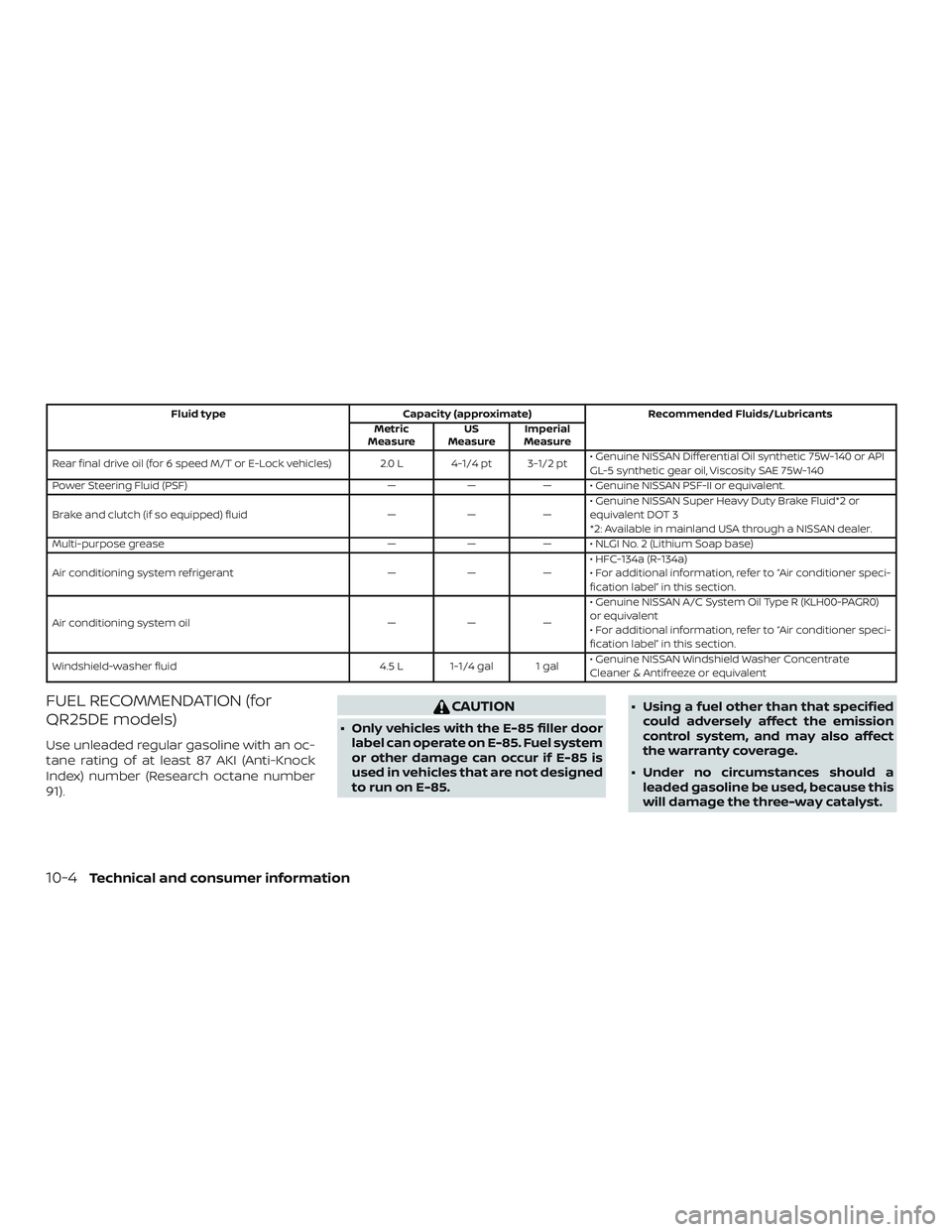
Fluid typeCapacity (approximate) Recommended Fluids/Lubricants
Metric
Measure US
Measure Imperial
Measure
Rear final drive oil (for 6 speed M/T or E-Lock vehicles) 2.0 L 4-1/4 pt 3-1/2 pt • Genuine NISSAN Differential Oil synthetic 75W-140 or API
GL-5 synthetic gear oil, Viscosity SAE 75W-140
Power Steering Fluid (PSF) ——— • Genuine NISSAN PSF-II or equivalent.
Brake and clutch (if so equipped) fluid ———• Genuine NISSAN Super Heavy Duty Brake Fluid*2 or
equivalent DOT 3
*2: Available in mainland USA through a NISSAN dealer.
Multi-purpose grease ——— • NLGI No. 2 (Lithium Soap base)
Air conditioning system refrigerant ———• HFC-134a (R-134a)
• For additional information, refer to “Air conditioner speci-
fication label” in this section.
Air conditioning system oil ———• Genuine NISSAN A/C System Oil Type R (KLH00-PAGR0)
or equivalent
• For additional information, refer to “Air conditioner speci-
fication label” in this section.
Windshield-washer fluid 4.5 L 1-1/4 gal 1 gal• Genuine NISSAN Windshield Washer Concentrate
Cleaner & Antifreeze or equivalent
FUEL RECOMMENDATION (for
QR25DE models)
Use unleaded regular gasoline with an oc-
tane rating of at least 87 AKI (Anti-Knock
Index) number (Research octane number
91).
CAUTION
∙ Only vehicles with the E-85 filler door
label can operate on E-85. Fuel system
or other damage can occur if E-85 is
used in vehicles that are not designed
to run on E-85. ∙ Using a fuel other than that specified
could adversely affect the emission
control system, and may also affect
the warranty coverage.
∙ Under no circumstances should a leaded gasoline be used, because this
will damage the three-way catalyst.
10-4Technical and consumer information
Page 462 of 516
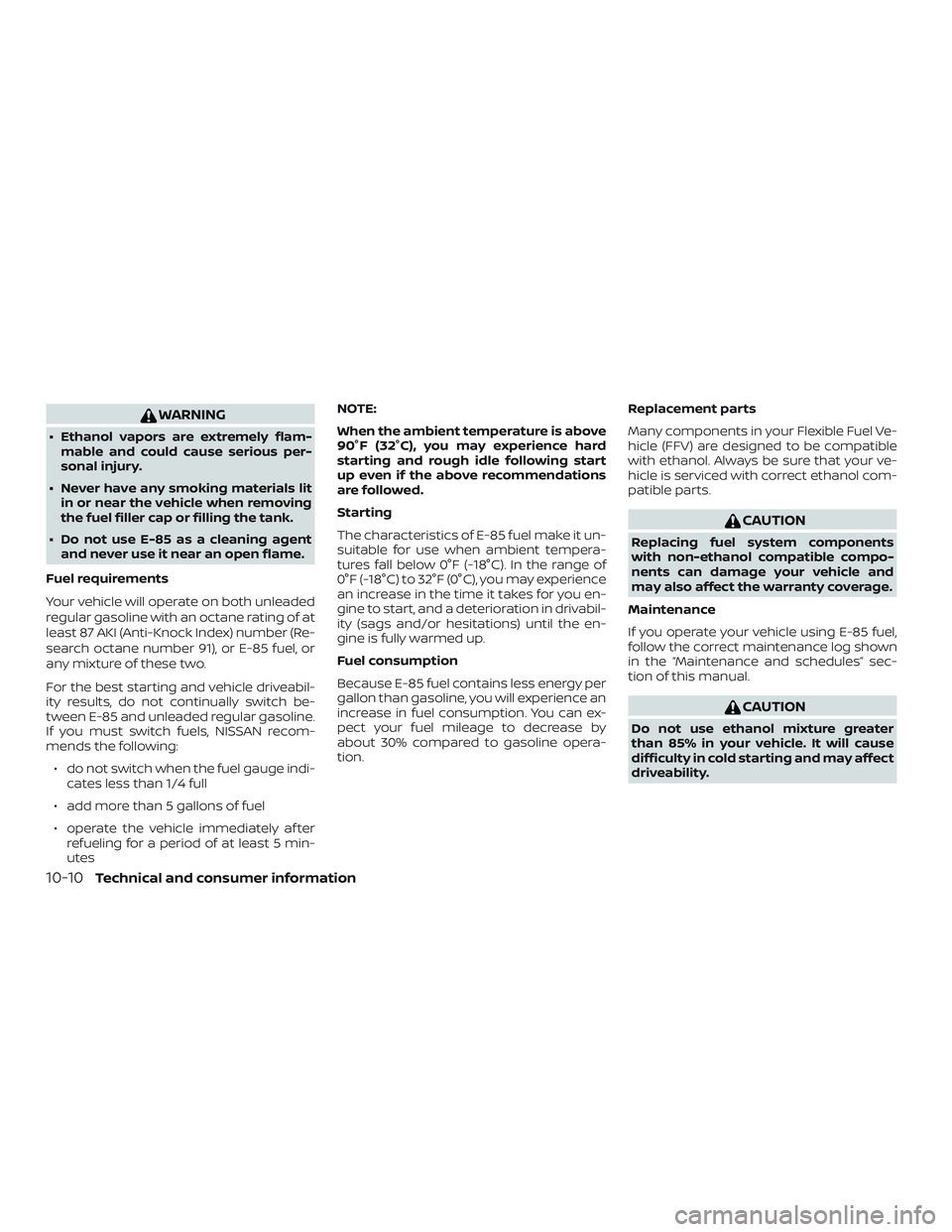
WARNING
∙ Ethanol vapors are extremely flam-mable and could cause serious per-
sonal injury.
∙ Never have any smoking materials lit in or near the vehicle when removing
the fuel filler cap or filling the tank.
∙ Do not use E-85 as a cleaning agent and never use it near an open flame.
Fuel requirements
Your vehicle will operate on both unleaded
regular gasoline with an octane rating of at
least 87 AKI (Anti-Knock Index) number (Re-
search octane number 91), or E-85 fuel, or
any mixture of these two.
For the best starting and vehicle driveabil-
ity results, do not continually switch be-
tween E-85 and unleaded regular gasoline.
If you must switch fuels, NISSAN recom-
mends the following: ∙ do not switch when the fuel gauge indi- cates less than 1/4 full
∙ add more than 5 gallons of fuel
∙ operate the vehicle immediately af ter refueling for a period of at least 5 min-
utes NOTE:
When the ambient temperature is above
90°F (32°C), you may experience hard
starting and rough idle following start
up even if the above recommendations
are followed.
Starting
The characteristics of E-85 fuel make it un-
suitable for use when ambient tempera-
tures fall below 0°F (-18°C). In the range of
0°F (-18°C) to 32°F (0°C), you may experience
an increase in the time it takes for you en-
gine to start, and a deterioration in drivabil-
ity (sags and/or hesitations) until the en-
gine is fully warmed up.
Fuel consumption
Because E-85 fuel contains less energy per
gallon than gasoline, you will experience an
increase in fuel consumption. You can ex-
pect your fuel mileage to decrease by
about 30% compared to gasoline opera-
tion.
Replacement parts
Many components in your Flexible Fuel Ve-
hicle (FFV) are designed to be compatible
with ethanol. Always be sure that your ve-
hicle is serviced with correct ethanol com-
patible parts.
CAUTION
Replacing fuel system components
with non-ethanol compatible compo-
nents can damage your vehicle and
may also affect the warranty coverage.
Maintenance
If you operate your vehicle using E-85 fuel,
follow the correct maintenance log shown
in the “Maintenance and schedules” sec-
tion of this manual.
CAUTION
Do not use ethanol mixture greater
than 85% in your vehicle. It will cause
difficulty in cold starting and may affect
driveability.
10-10Technical and consumer information
Page 463 of 516
ENGINE OIL AND OIL FILTER
RECOMMENDATIONS
Selecting the correct oil
It is essential to choose the correct grade,
quality and viscosity engine oil to ensure
satisfactory engine life and performance.
For additional information, refer to “Recom-
mended fluids/lubricants and capacities”
in this section. NISSAN recommends the
use of an energy conserving oil in order to
improve fuel economy.
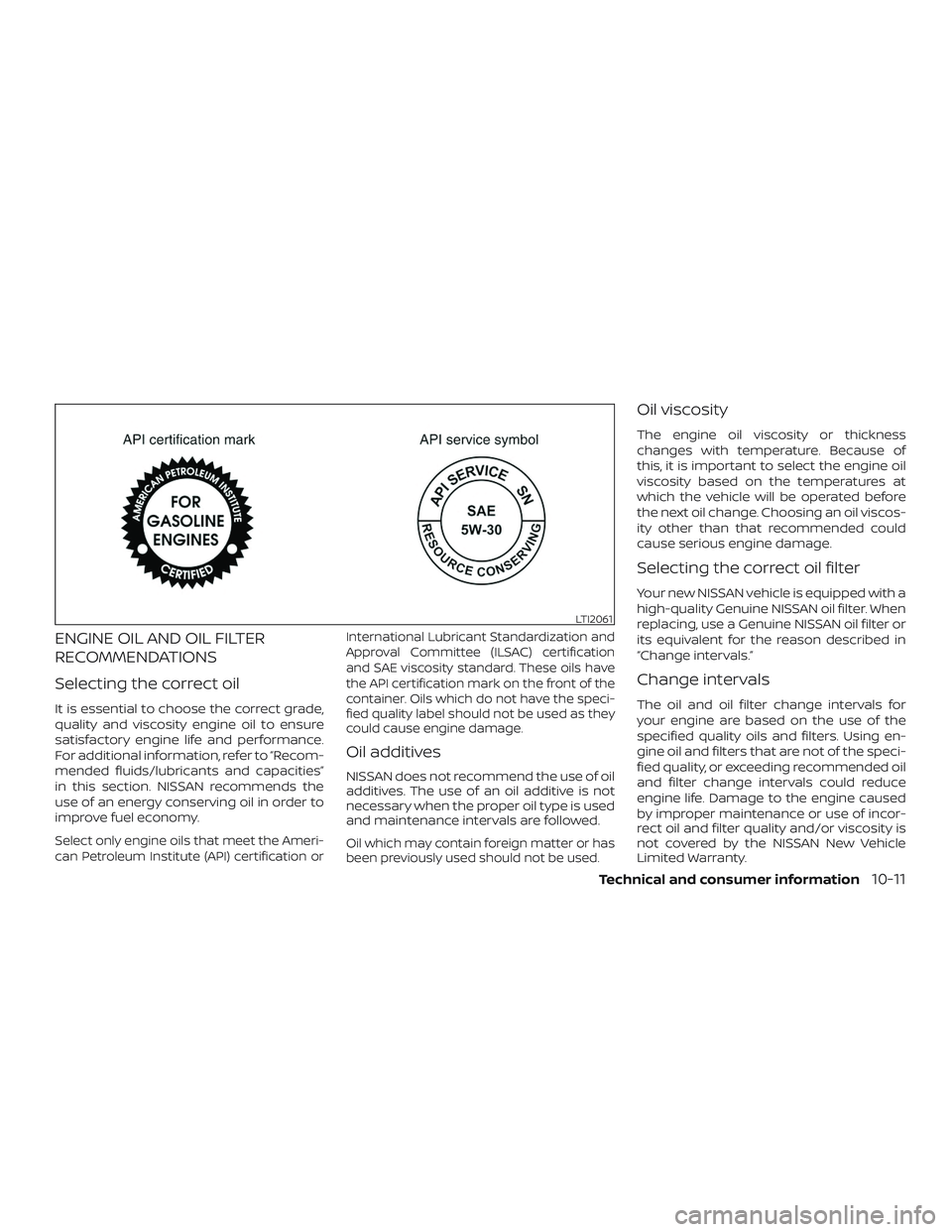
Select only engine oils that meet the Ameri-
can Petroleum Institute (API) certification orInternational Lubricant Standardization and
Approval Committee (ILSAC) certification
and SAE viscosity standard. These oils have
the API certification mark on the front of the
container. Oils which do not have the speci-
fied quality label should not be used as they
could cause engine damage.
Oil additives
NISSAN does not recommend the use of oil
additives. The use of an oil additive is not
necessary when the proper oil type is used
and maintenance intervals are followed.
Oil which may contain foreign matter or has
been previously used should not be used.
Oil viscosity
The engine oil viscosity or thickness
changes with temperature. Because of
this, it is important to select the engine oil
viscosity based on the temperatures at
which the vehicle will be operated before
the next oil change. Choosing an oil viscos-
ity other than that recommended could
cause serious engine damage.
Selecting the correct oil filter
Your new NISSAN vehicle is equipped with a
high-quality Genuine NISSAN oil filter. When
replacing, use a Genuine NISSAN oil filter or
its equivalent for the reason described in
“Change intervals.”
Change intervals
The oil and oil filter change intervals for
your engine are based on the use of the
specified quality oils and filters. Using en-
gine oil and filters that are not of the speci-
fied quality, or exceeding recommended oil
and filter change intervals could reduce
engine life. Damage to the engine caused
by improper maintenance or use of incor-
rect oil and filter quality and/or viscosity is
not covered by the NISSAN New Vehicle
Limited Warranty.
LTI2061
Technical and consumer information10-11
Page 502 of 516
Brakes......................8-22
Brake system..................5-35
Break-in schedule ...............5-24
Brightness/contrast button ......4-9,4-15
Brightness control Instrument panel .............2-32
Bulb check/instrument panel ........2-15
Bulb replacement ...............8-30
C
Capacities and recommended fuel/
lubricants....................10-2
Cargolampswitch..............2-33
Cargo
(See vehicle loading information) .....10-19
Car phone or CB radio ............4-83
CDcareandcleaning.............4-74
CD player (See audio system) ........4-56
Childrestraints........1-25, 1-26, 1-28, 1-30 LATCH (Lower Anchors and Tethers for
CHildren)System..............1-30
Precautions on child
restraints.........1-28, 1-40, 1-56, 1-68
Top tether strap anchor point
locations...................1-33
Child restraint with top tether strap . . . .1-33
Child safety rear door lock ..........3-6
Chimes, audible reminders .........2-24
Cleaningexteriorandinterior......7-2,7-4
Clock set/adjustment ..........4-7,4-13
Clock setting (models with Navigation
System) .....................4-13
Clutch Clutchfluid.................8-14 Clutch interlock (clutch start) switch . . .2-38
C.M.V.S.S. certification label
.........10-16
Cold weather driving .............5-43
Compact disc (CD) player ..........4-56
Compass .....................2-11
Compass and outside temperature
display......................2-10
Compass display ................2-11
Connect phone ................4-76
Console box ..................2-45
Control panel buttons ..........4-4,4-10
Back button .................4-13
Brightness/contrast button ....4-9,4-15
Enterbutton..............4-4,4-10
Settingbutton.............4-7,4-13
Withnavigationsystem.......4-10,4-11
Controls Audio controls (steering wheel) .....4-74
Heater and air conditioner
controls................4-23,4-35
Coolant Capacities and recommended
fuel/lubricants...............10-2
Changing engine coolant .........8-6
Checking engine coolant level ......8-6
Engine coolant temperature gauge . .2-6
Corrosionprotection..............7-8
Cruisecontrol .................5-22
Cupholders ..................2-46
Curtain side-impact and rollover air
bag........................1-87
D
Daytime Running Lights (DRL) system . . .2-31 Defroster switch
Rear window and outside mirror
defrosterswitch..............2-28
Rearwindowdefrosterswitch.....2-28
Dimensions and weights ..........10-14
Dimmer switch for instrument panel . . .2-32
Display controls
(see control panel buttons) .......4-4,4-10
Door locks ....................3-3
Door open warning light ...........2-17
Drivebelt.....................8-17
Driving Coldweatherdriving...........5-43
Driving with automatic
transmission ................5-14
Driving with manual transmission . . .5-19
Precautions when starting and
driving .....................5-2
Driving the vehicle ...............5-14
E
Economy - fuel .................5-25
Electronic locking rear differential (E-Lock)
system......................5-33
Electronic locking rear differential (E-Lock)
systemswitch.................2-37
Emission control information label ....10-17
Emission control system warranty . . . .10-44
Engine Before starting the engine ........5-13
Capacities and recommended
fuel/lubricants...............10-2
Changing engine
coolant.........8-6
Changing engine oil ............8-8
11-2
Page 503 of 516
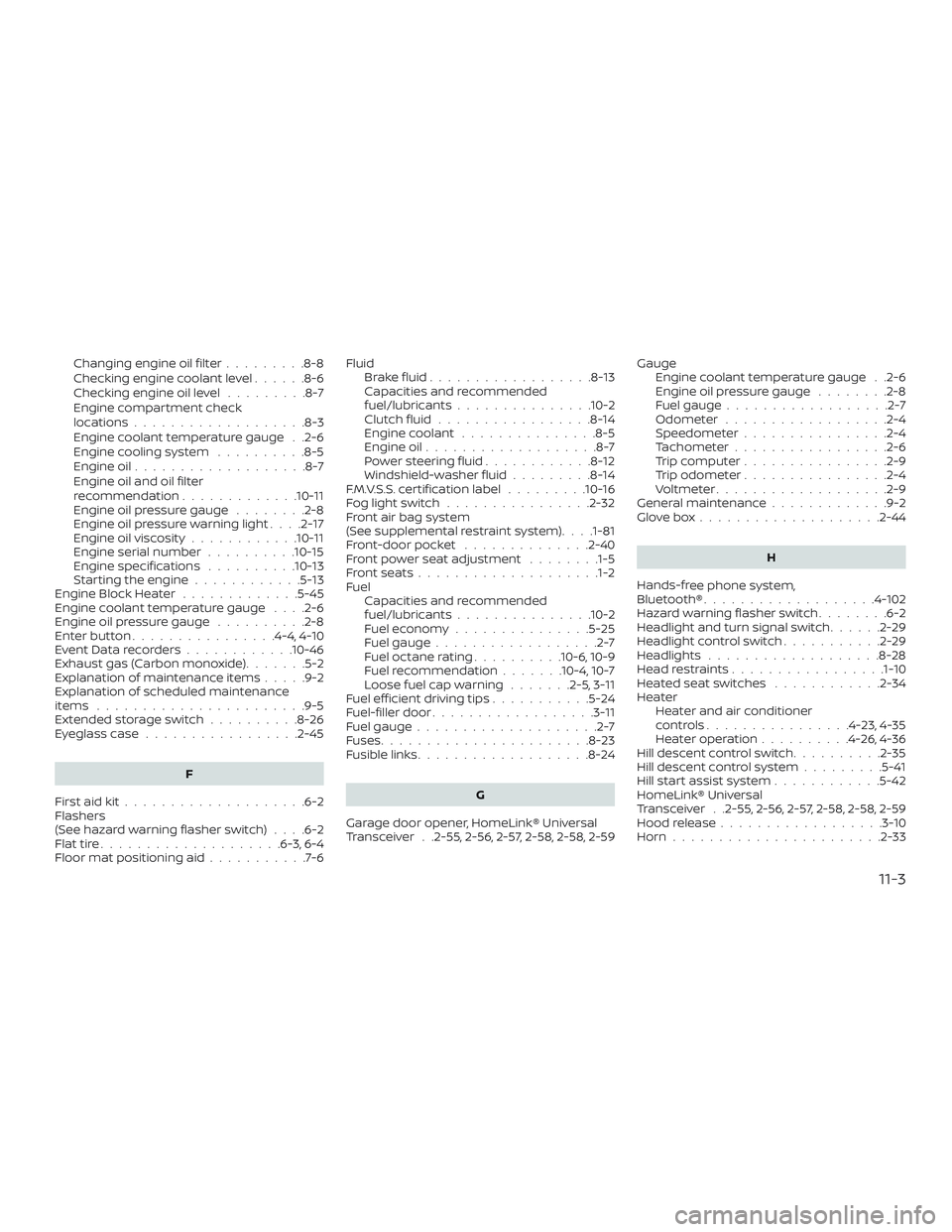
Changing engine oil filter.........8-8
Checking engine coolant level ......8-6
Checking engine oil level .........8-7
Engine compartment check
locations...................8-3
Engine coolant temperature gauge . .2-6
Engine cooling system ..........8-5
Engine oil ...................8-7
Engine oil and oil filter
recommendation .............10-11
Engine oil pressure gauge ........2-8
Engine oil pressure warning light ....2-17
Engine oil viscosity ............10-11
Engine serial number ..........10-15
Engine specifications ..........10-13
Starting the engine ............5-13
Engine Block Heater .............5-45
Engine coolant temperature gauge ....2-6
Engine oil pressure gauge ..........2-8
Enterbutton................4-4,4-10
EventDatarecorders............10-46
Exhaust gas (Carbon monoxide) .......5-2
Explanation of maintenance items .....9-2
Explanation of scheduled maintenance
items .......................9-5
Extended storage switch ..........8-26
Eyeglasscase.................2-45
F
Firstaidkit....................6-2
Flashers
(See hazard warning flasher switch) ....6-2
Flattire....................6-3,6-4
Floormatpositioningaid...........7-6 Fluid
Brakefluid..................8-13
Capacities and recommended
fuel/lubricants...............10-2
Clutchfluid.................8-14
Engine coolant ...............8-5
Engine oil ...................8-7
Powersteeringfluid............8-12
Windshield-washer fluid .........8-14
F.M.V.S.S. certification label .........10-16
Foglightswitch................2-32
Front air bag system
(See supplemental restraint system) . . . .1-81
Front-door pocket ..............2-40
Front power seat adjustment ........1-5
Frontseats....................1-2
Fuel Capacities and recommended
fuel/lubricants...............10-2
Fuel economy ...............5-25
Fuel gauge ..................2-7
Fueloctanerating..........10-6,10-9
Fuel recommendation .......10-4,10-7
Loose fuel cap warning .......2-5,3-11
Fuel efficient driving tips ...........5-24
Fuel-filler door ..................3-11
Fuel gauge ....................2-7
Fuses .......................8-23
Fusiblelinks...................8-24
G
Garage door opener, HomeLink® Universal
Transceiver . .2-55, 2-56, 2-57, 2-58, 2-58, 2-59 Gauge
Engine coolant temperature gauge . .2-6
Engine oil pressure gauge ........2-8
Fuel gauge ..................2-7
Odometer ..................2-4
Speedometer ................2-4
Tachometer .................2-6
Trip computer ................2-9
Trip odometer ................2-4
Voltmeter...................2-9
General maintenance .............9-2
Glovebox....................2-44
H
Hands-fr ee
phone system,
Bluetooth®...................4-102
Hazardwarningflasherswitch........6-2
Headlight and turn signal switch ......2-29
Headlightcontrolswitch...........2-29
Headlights...................8-28
Headrestraints.................1-10
Heated seat switches ............2-34
Heater Heater and air conditioner
controls................4-23,4-35
Heater operation ..........4-26,4-36
Hill descent control switch ..........2-35
Hill descent control system .........5-41
Hill start assist system ............5-42
HomeLink® Universal
Transceiver . .2-55, 2-56, 2-57, 2-58, 2-58, 2-59
Hood release ..................3-10
Horn.......................2-33
11-3
Page 504 of 516
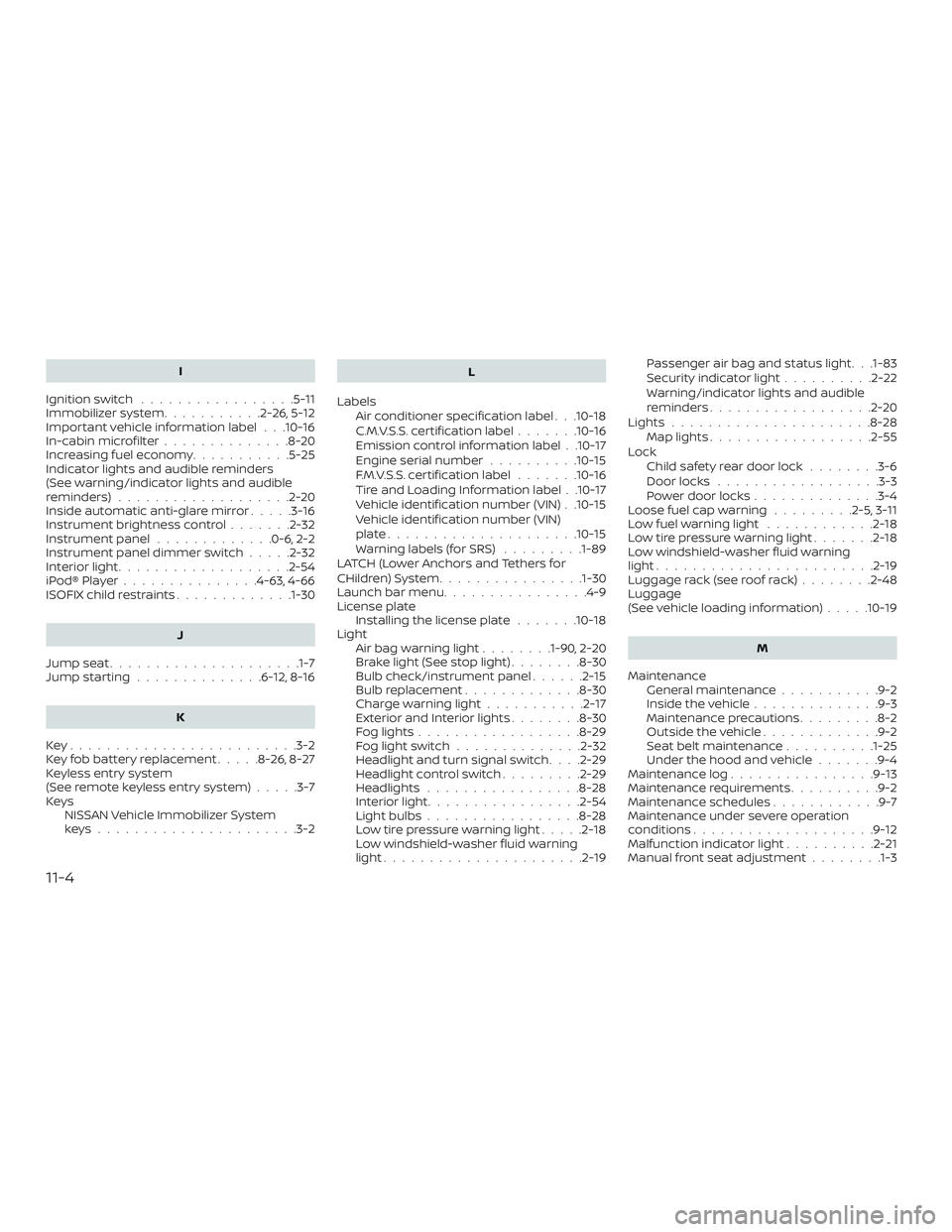
I
Ignition switch .................5-11
Immobilizer system ...........2-26,5-12
Important vehicle information label . . .10-16
In-cabinmicrofilter..............8-20
Increasing fuel economy ...........5-25
Indicator lights and audible reminders
(See warning/indicator lights and audible
reminders) ...................2-20
Inside automatic anti-glare mirror .....3-16
Instrument brightness control .......2-32
Instrument panel .............0-6,2-2
Instrument panel dimmer switch .....2-32
Interiorlight...................2-54
iPod®Player...............4-63,4-66
ISOFIX child restraints .............1-30
J
Jumpseat.....................1-7
Jumpstarting..............6-12,8-16
K
Key.........................3-2
Key fob battery replacement .....8-26,8-27
Keyless entry system
(See remote keyless entry system) .....3-7
Keys NISSAN Vehicle Immobilizer System
keys......................3-2 L
Labels Air conditioner specification label . . .10-18
C.M.V.S.S. certification label .......10-16
Emission control information label . .10-17
Engine serial number ..........10-15
F.M.V.S.S. certification label .......10-16
Tire and Loading Information label . .10-17
Vehicle identification number (VIN) . .10-15
Vehicle identification number (VIN)
plate.....................10-15
Warning labels (for SRS) .........1-89
LATCH (Lower Anchors and Tethers for
CHildren)System................1-30
Launch bar menu ................4-9
License plate Installing the license plate .......10-18
Light Airbagwarninglight........1-90, 2-20
Brakelight(Seestoplight)........8-30
Bulb check/instrument panel ......2-15
Bulb replacement .............8-30
Charge warning light ...........2-17
ExteriorandInteriorlights........8-30
Foglights..................8-29
Foglightswitch..............2-32
Headlight and turn signal switch ....2-29
Headlightcontrolswitch.........2-29
Headlights.................8-28
Interiorlight.................2-54
Lightbulbs.................8-28
Low tire pressure warning light .....2-18
Low windshield-washer fluid warning
light......................2-19 Passenger air bag and status light. . .1-83
Security indicator light
..........2-22
Warning/indicator lights and audible
reminders ..................2-20
Lights......................8-28 Maplights..................2-55
Lock Child safety rear door lock ........3-6
Door locks ..................3-3
Power door locks ..............3-4
Loose fuel cap warning .........2-5,3-11
Lowfuelwarninglight ........... .2-18
Low tire pressure warning light .......2-18
Low windshield-washer fluid warning
light........................2-19
Luggage rack (see roof rack) ........2-48
Luggage
(See vehicle loading information) .....10-19
M
Maintenance General maintenance ...........9-2
Insidethevehicle..............9-3
Maintenance precautions .........8-2
Outsidethevehicle.............9-2
Seat belt maintenance ..........1-25
Under the
hood and vehicle .......9-4
Maintenance log ................9-13
Maintenance requirements ..........9-2
Maintenance schedules ............9-7
Maintenance under severe operation
conditions....................9-12
Malfunctionindicatorlight..........2-21
Manual front seat adjustment ........1-3
11-4