fuel pressure NISSAN FRONTIER 2019 Owner´s Manual
[x] Cancel search | Manufacturer: NISSAN, Model Year: 2019, Model line: FRONTIER, Model: NISSAN FRONTIER 2019Pages: 516, PDF Size: 5.04 MB
Page 341 of 516
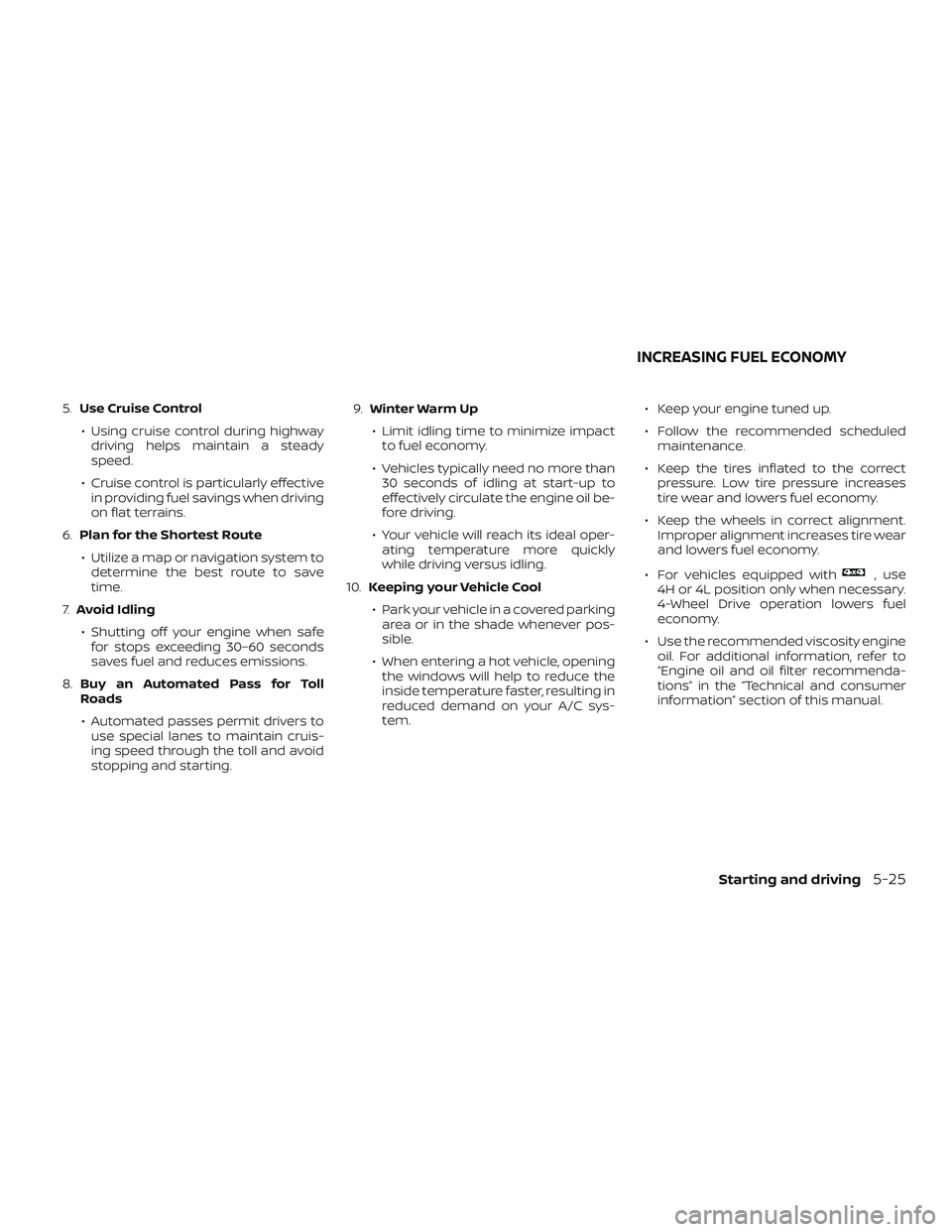
5.Use Cruise Control
∙ Using cruise control during highway driving helps maintain a steady
speed.
∙ Cruise control is particularly effective in providing fuel savings when driving
on flat terrains.
6. Plan for the Shortest Route
∙ Utilize a map or navigation system to determine the best route to save
time.
7. Avoid Idling
∙ Shutting off your engine when safe for stops exceeding 30–60 seconds
saves fuel and reduces emissions.
8. Buy an Automated Pass for Toll
Roads
∙ Automated passes permit drivers to use special lanes to maintain cruis-
ing speed through the toll and avoid
stopping and starting. 9.
Winter Warm Up
∙ Limit idling time to minimize impact to fuel economy.
∙ Vehicles typically need no more than 30 seconds of idling at start-up to
effectively circulate the engine oil be-
fore driving.
∙ Your vehicle will reach its ideal oper- ating temperature more quickly
while driving versus idling.
10. Keeping your Vehicle Cool
∙ Park your vehicle in a covered parking area or in the shade whenever pos-
sible.
∙ When entering a hot vehicle, opening the windows will help to reduce the
inside temperature faster, resulting in
reduced demand on your A/C sys-
tem. ∙ Keep your engine tuned up.
∙ Follow the recommended scheduled
maintenance.
∙ Keep the tires inflated to the correct pressure. Low tire pressure increases
tire wear and lowers fuel economy.
∙ Keep the wheels in correct alignment. Improper alignment increases tire wear
and lowers fuel economy.
∙ For vehicles equipped with
, use
4H or 4L position only when necessary.
4-Wheel Drive operation lowers fuel
economy.
∙ Use the recommended viscosity engine oil. For additional information, refer to
“Engine oil and oil filter recommenda-
tions” in the “Technical and consumer
information” section of this manual.
INCREASING FUEL ECONOMY
Starting and driving5-25
Page 392 of 516
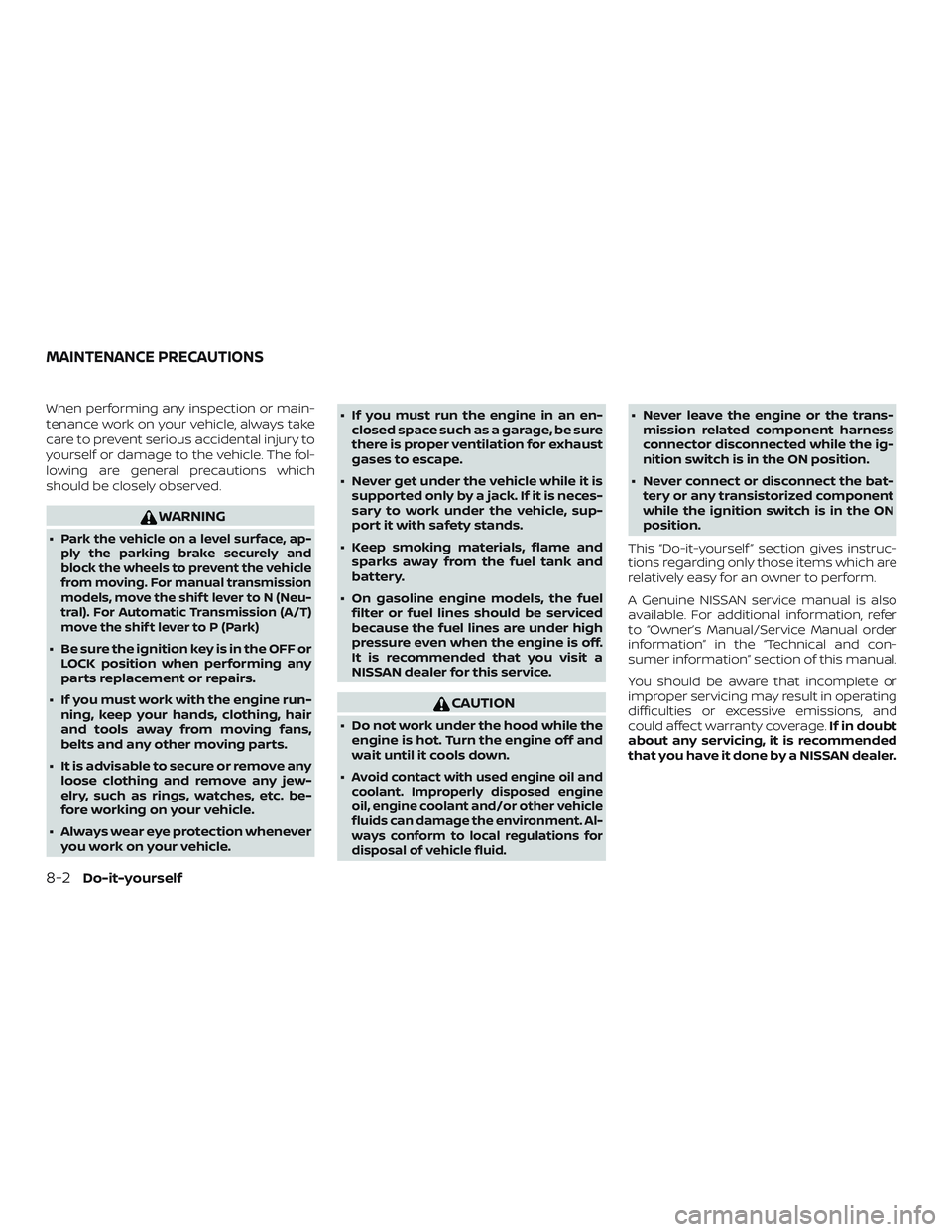
When performing any inspection or main-
tenance work on your vehicle, always take
care to prevent serious accidental injury to
yourself or damage to the vehicle. The fol-
lowing are general precautions which
should be closely observed.
WARNING
∙Park the vehicle on a level surface, ap-
ply the parking brake securely and
block the wheels to prevent the vehicle
from moving. For manual transmission
models, move the shif t lever to N (Neu-
tral). For Automatic Transmission (A/T)
move the shif t lever to P (Park)
∙ Be sure the ignition key is in the OFF orLOCK position when performing any
parts replacement or repairs.
∙ If you must work with the engine run- ning, keep your hands, clothing, hair
and tools away from moving fans,
belts and any other moving parts.
∙ It is advisable to secure or remove any loose clothing and remove any jew-
elry, such as rings, watches, etc. be-
fore working on your vehicle.
∙ Always wear eye protection whenever you work on your vehicle. ∙ If you must run the engine in an en-
closed space such as a garage, be sure
there is proper ventilation for exhaust
gases to escape.
∙ Never get under the vehicle while it is supported only by a jack. If it is neces-
sary to work under the vehicle, sup-
port it with safety stands.
∙ Keep smoking materials, flame and sparks away from the fuel tank and
battery.
∙ On gasoline engine models, the fuel filter or fuel lines should be serviced
because the fuel lines are under high
pressure even when the engine is off.
It is recommended that you visit a
NISSAN dealer for this service.
CAUTION
∙ Do not work under the hood while theengine is hot. Turn the engine off and
wait until it cools down.
∙
Avoid contact with used engine oil and
coolant. Improperly disposed engine
oil, engine coolant and/or other vehicle
fluids can damage the environment. Al-
ways conform to local regulations for
disposal of vehicle fluid.
∙ Never leave the engine or the trans- mission related component harness
connector disconnected while the ig-
nition switch is in the ON position.
∙ Never connect or disconnect the bat- tery or any transistorized component
while the ignition switch is in the ON
position.
This “Do-it-yourself ” section gives instruc-
tions regarding only those items which are
relatively easy for an owner to perform.
A Genuine NISSAN service manual is also
available. For additional information, refer
to “Owner’s Manual/Service Manual order
information” in the “Technical and con-
sumer information” section of this manual.
You should be aware that incomplete or
improper servicing may result in operating
difficulties or excessive emissions, and
could affect warranty coverage. If in doubt
about any servicing, it is recommended
that you have it done by a NISSAN dealer.
MAINTENANCE PRECAUTIONS
8-2Do-it-yourself
Page 503 of 516
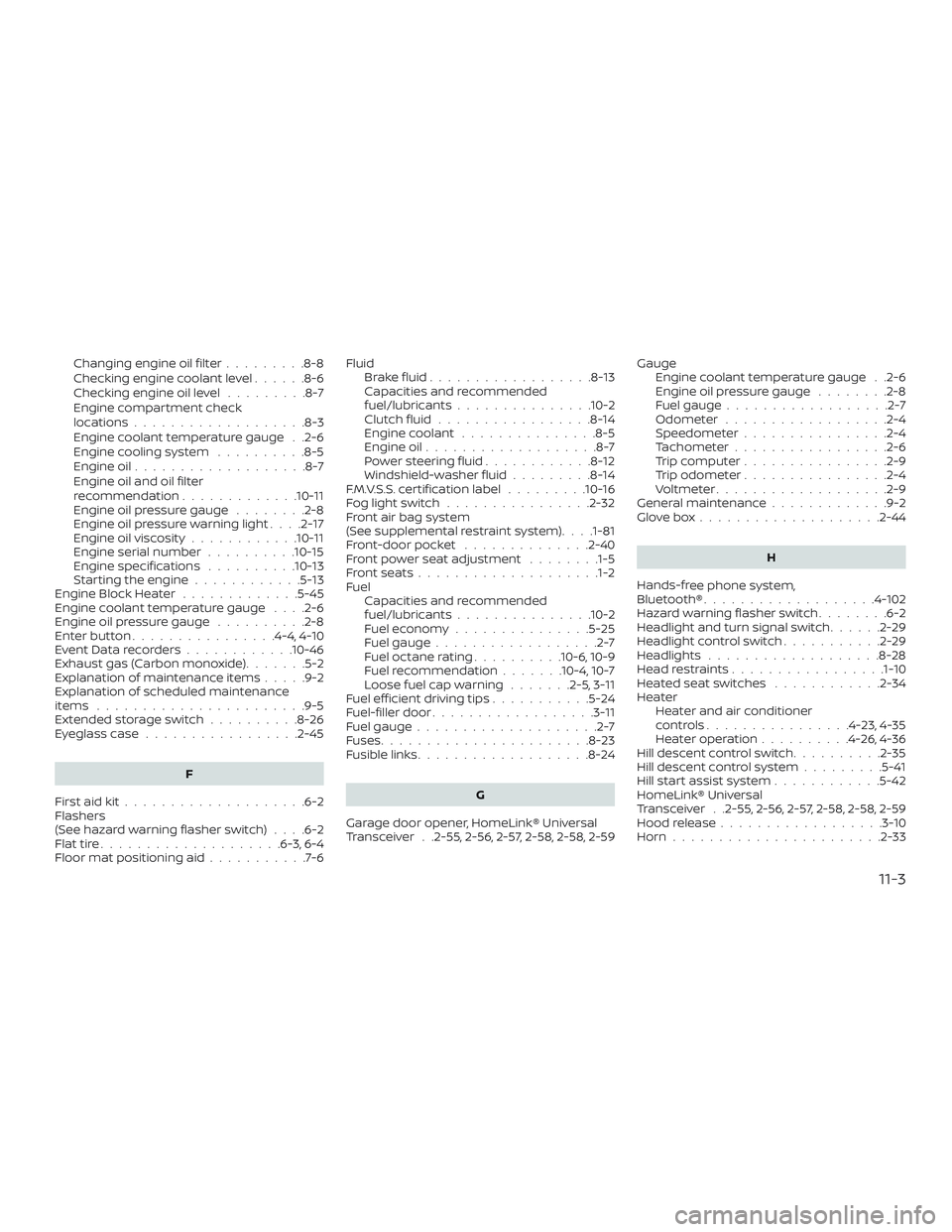
Changing engine oil filter.........8-8
Checking engine coolant level ......8-6
Checking engine oil level .........8-7
Engine compartment check
locations...................8-3
Engine coolant temperature gauge . .2-6
Engine cooling system ..........8-5
Engine oil ...................8-7
Engine oil and oil filter
recommendation .............10-11
Engine oil pressure gauge ........2-8
Engine oil pressure warning light ....2-17
Engine oil viscosity ............10-11
Engine serial number ..........10-15
Engine specifications ..........10-13
Starting the engine ............5-13
Engine Block Heater .............5-45
Engine coolant temperature gauge ....2-6
Engine oil pressure gauge ..........2-8
Enterbutton................4-4,4-10
EventDatarecorders............10-46
Exhaust gas (Carbon monoxide) .......5-2
Explanation of maintenance items .....9-2
Explanation of scheduled maintenance
items .......................9-5
Extended storage switch ..........8-26
Eyeglasscase.................2-45
F
Firstaidkit....................6-2
Flashers
(See hazard warning flasher switch) ....6-2
Flattire....................6-3,6-4
Floormatpositioningaid...........7-6 Fluid
Brakefluid..................8-13
Capacities and recommended
fuel/lubricants...............10-2
Clutchfluid.................8-14
Engine coolant ...............8-5
Engine oil ...................8-7
Powersteeringfluid............8-12
Windshield-washer fluid .........8-14
F.M.V.S.S. certification label .........10-16
Foglightswitch................2-32
Front air bag system
(See supplemental restraint system) . . . .1-81
Front-door pocket ..............2-40
Front power seat adjustment ........1-5
Frontseats....................1-2
Fuel Capacities and recommended
fuel/lubricants...............10-2
Fuel economy ...............5-25
Fuel gauge ..................2-7
Fueloctanerating..........10-6,10-9
Fuel recommendation .......10-4,10-7
Loose fuel cap warning .......2-5,3-11
Fuel efficient driving tips ...........5-24
Fuel-filler door ..................3-11
Fuel gauge ....................2-7
Fuses .......................8-23
Fusiblelinks...................8-24
G
Garage door opener, HomeLink® Universal
Transceiver . .2-55, 2-56, 2-57, 2-58, 2-58, 2-59 Gauge
Engine coolant temperature gauge . .2-6
Engine oil pressure gauge ........2-8
Fuel gauge ..................2-7
Odometer ..................2-4
Speedometer ................2-4
Tachometer .................2-6
Trip computer ................2-9
Trip odometer ................2-4
Voltmeter...................2-9
General maintenance .............9-2
Glovebox....................2-44
H
Hands-fr ee
phone system,
Bluetooth®...................4-102
Hazardwarningflasherswitch........6-2
Headlight and turn signal switch ......2-29
Headlightcontrolswitch...........2-29
Headlights...................8-28
Headrestraints.................1-10
Heated seat switches ............2-34
Heater Heater and air conditioner
controls................4-23,4-35
Heater operation ..........4-26,4-36
Hill descent control switch ..........2-35
Hill descent control system .........5-41
Hill start assist system ............5-42
HomeLink® Universal
Transceiver . .2-55, 2-56, 2-57, 2-58, 2-58, 2-59
Hood release ..................3-10
Horn.......................2-33
11-3
Page 504 of 516
I
Ignition switch .................5-11
Immobilizer system ...........2-26,5-12
Important vehicle information label . . .10-16
In-cabinmicrofilter..............8-20
Increasing fuel economy ...........5-25
Indicator lights and audible reminders
(See warning/indicator lights and audible
reminders) ...................2-20
Inside automatic anti-glare mirror .....3-16
Instrument brightness control .......2-32
Instrument panel .............0-6,2-2
Instrument panel dimmer switch .....2-32
Interiorlight...................2-54
iPod®Player...............4-63,4-66
ISOFIX child restraints .............1-30
J
Jumpseat.....................1-7
Jumpstarting..............6-12,8-16
K
Key.........................3-2
Key fob battery replacement .....8-26,8-27
Keyless entry system
(See remote keyless entry system) .....3-7
Keys NISSAN Vehicle Immobilizer System
keys......................3-2 L
Labels Air conditioner specification label . . .10-18
C.M.V.S.S. certification label .......10-16
Emission control information label . .10-17
Engine serial number ..........10-15
F.M.V.S.S. certification label .......10-16
Tire and Loading Information label . .10-17
Vehicle identification number (VIN) . .10-15
Vehicle identification number (VIN)
plate.....................10-15
Warning labels (for SRS) .........1-89
LATCH (Lower Anchors and Tethers for
CHildren)System................1-30
Launch bar menu ................4-9
License plate Installing the license plate .......10-18
Light Airbagwarninglight........1-90, 2-20
Brakelight(Seestoplight)........8-30
Bulb check/instrument panel ......2-15
Bulb replacement .............8-30
Charge warning light ...........2-17
ExteriorandInteriorlights........8-30
Foglights..................8-29
Foglightswitch..............2-32
Headlight and turn signal switch ....2-29
Headlightcontrolswitch.........2-29
Headlights.................8-28
Interiorlight.................2-54
Lightbulbs.................8-28
Low tire pressure warning light .....2-18
Low windshield-washer fluid warning
light......................2-19 Passenger air bag and status light. . .1-83
Security indicator light
..........2-22
Warning/indicator lights and audible
reminders ..................2-20
Lights......................8-28 Maplights..................2-55
Lock Child safety rear door lock ........3-6
Door locks ..................3-3
Power door locks ..............3-4
Loose fuel cap warning .........2-5,3-11
Lowfuelwarninglight ........... .2-18
Low tire pressure warning light .......2-18
Low windshield-washer fluid warning
light........................2-19
Luggage rack (see roof rack) ........2-48
Luggage
(See vehicle loading information) .....10-19
M
Maintenance General maintenance ...........9-2
Insidethevehicle..............9-3
Maintenance precautions .........8-2
Outsidethevehicle.............9-2
Seat belt maintenance ..........1-25
Under the
hood and vehicle .......9-4
Maintenance log ................9-13
Maintenance requirements ..........9-2
Maintenance schedules ............9-7
Maintenance under severe operation
conditions....................9-12
Malfunctionindicatorlight..........2-21
Manual front seat adjustment ........1-3
11-4
Page 508 of 516
W
Warning 4WDwarninglight.............2-15
Airbagwarninglight........1-90, 2-20
Anti-lock brake warning light ......2-15
Battery charge warning light ......2-17
Brakewarninglight............2-16
Door open warning light .........2-17
Engine oil pressure warning light ....2-17
Hazard warning flasher switch ......6-2
Loose fuel cap warning .......2-5,3-11
Lowfuelwarninglight ..........2-18
Low tire pressure warning light .....2-18
Low windshield-washer fluid warning
light......................2-19
Passenger air bag and status light. . .1-83
Seatbeltwarninglight.......1-18, 2-19
Supplemental air bag warning
light ..................1-90, 2-20
TPMS......................2-4
Vehicle security system .........2-24
Warning/indicator lights and audible
reminders ..................2-20
Warning labels (for SRS) .........1-89
Warning/indicator lights and audible
reminders ....................2-20
Audible reminders .............2-20
Indicatorlights...............2-20
Warninglights...............2-20
Warninglights.................2-20
Warning lights, indicator lights and audible
reminders ....................2-14
Weights
(See dimensions and weights) .......10-14Wheels and tires
............8-33,10-14
Wheel/tire size .................10-14
When traveling or registering in another
country .....................10-15
Windows ....................2-49 Locking passengers' windows .....2-51
Manual windows .............2-49
Powerwindows..............2-49
Rearpowerwindows...........2-51
Rearslidingwindow............2-52
Windshield-washer fluid ...........8-14
Windshield wiper blades ...........8-21
Wiper Wiper blades ................8-21
Wiper and washer switch ..........2-27
11-8
Page 514 of 516
∙ Do not use E-15 or E-85 fuel in yourvehicle. Your vehicle is not designed to
run on E-15 or E-85 fuel. Using E-15 or
E-85 fuel in a vehicle not specifically
designed for E-15 or E-85 fuel can ad-
versely affect the emission control
devices and systems of the vehicle.
Damage caused by such fuel is not
covered by the NISSAN New Vehicle
Limited Warranty.
∙ Do not use fuel that contains the oc- tane booster methylcyclopentadienyl
manganese tricarbonyl (MMT). Using
fuel containing MMT may adversely
affect vehicle performance and ve-
hicle emissions. Not all fuel dispens-
ers are labeled to indicate MMT con-
tent, so you may have to consult your
gasoline retailer for more details.
Note that Federal and California laws
prohibit the use of MMT in reformu-
lated gasoline.
∙ U.S. government regulations require ethanol dispensing pumps to be iden-
tified by a small, square, orange and
black label with the common abbre-
viation or the appropriate percentage
for that region. For additional information, refer to “Recom-
mended fluids/lubricants and capacities”
in the “Technical and consumer informa-
tion” section of this manual.
FLEXIBLE FUEL VEHICLE (FFV)
FUEL RECOMMENDATION (if so
equipped):
If your vehicle is equipped as a Flexible Fuel
Vehicle (FFV) your vehicle is designed to
use (E-85) Fuel Ethanol, “Regular” unleaded
regular gasoline or any percentage of the
two fuels combined.
CAUTION
∙ Using a fuel other than that specified
could adversely affect the emission
control system, and may also affect
the warranty coverage.
∙ Under no circumstances should a leaded gasoline be used, because this
will damage the three-way catalyst.
For additional information, refer to “Recom-
mended fluids/lubricants and capacities”
in the “Technical and consumer informa-
tion” section of this manual.
ENGINE OIL RECOMMENDATION:
Refer to “Recommended fluids/lubricants
and capacities” in the “Technical and con-
sumer information” section of this manual.
COLD TIRE PRESSURE:
For additional information, refer to “Tire and
Loading Information label” in the “Technical
and consumer information” section of this
manual.
The label is typically located on the driver
side center pillar or on the driver’s door. For
additional information, refer to “Wheels and
tires” in the “Do-it-yourself ” section of this
manual.
RECOMMENDED NEW VEHICLE
BREAK-IN PROCEDURE:
During the first 1,200 miles (2,000 km) of
vehicle use, follow the break-in procedure
recommendations for the future reliability
and economy of your new vehicle. For ad-
ditional information, refer to “Break-in
schedule” in the “Starting and driving” sec-
tion of this manual. Failure to follow these
recommendations may result in vehicle
damage or shortened engine life.