spare wheel NISSAN FRONTIER 2019 Owner´s Manual
[x] Cancel search | Manufacturer: NISSAN, Model Year: 2019, Model line: FRONTIER, Model: NISSAN FRONTIER 2019Pages: 516, PDF Size: 5.04 MB
Page 374 of 516
∙ The spare tire is designed for emer-gency use. For additional information,
refer to “Wheels and tires” in the “Do-
it-yourself ” section of this manual. To start your engine with a booster battery,
the instructions and precautions below
must be followed.
WARNING
∙ If done incorrectly, jump starting can
lead to a battery explosion, resulting
in severe injury or death. It could also
damage your vehicle.
∙ Explosive hydrogen gas is always present in the vicinity of the battery.
Keep all sparks and flames away from
the battery.
∙ Do not allow battery fluid to come into contact with eyes, skin, clothing or
painted surfaces. Battery fluid is a
corrosive sulfuric acid solution which
can cause severe burns. If the fluid
should come into contact with any-
thing, immediately flush the con-
tacted area with water.
∙ Keep battery out of the reach of children.
∙ The booster battery must be rated at 12 volts. Use of an improperly rated
battery can damage your vehicle. ∙ Whenever working on or near a bat-
tery, always wear suitable eye protec-
tors (for example, goggles or indus-
trial safety spectacles) and remove
rings, metal bands, or any other jew-
elry. Do not lean over the battery
when jump starting.
∙ Do not attempt to jump start a frozen battery. It could explode and cause
serious injury.
∙ The automatic engine cooling fan (if so equipped) may come on at any
time without warning, even if the igni-
tion switch is in the OFF position and
the engine is not running. To avoid in-
jury, keep hands and other objects
away from it.
JUMP STARTING
6-12In case of emergency
Page 423 of 516
If you have a flat tire, refer to “Flat tire” in
the “In case of emergency ” section of
this manual.
TIRE PRESSURE
Tire Pressure Monitoring System
(TPMS)
This vehicle is equipped with TPMS. It
monitors tire pressure of all tires ex-
cept the spare. When the low tire
pressure warning light is lit and the
CHECK TIRE PRES (pressure) warning
message is displayed in the odom-
eter, one or more of your tires is sig-
nificantly under-inflated.
TPMS will activate only when the ve-
hicle is driven at speeds above
16 mph (25 km/h). Also, this system
may not detect a sudden drop in tire
pressure (for example, a flat tire while
driving).
For additional information, refer to
“Low tire pressure warning light” in
the “Instruments and controls” sec-
tion, “Tire Pressure Monitoring Sys-
tem (TPMS)” in the “Starting and driv-ing” section, and “Flat tire” in the “In
case of emergency” section of this
manual.
Tire inflation pressure
Check the tire pressures (including
the spare) of ten and always prior to
long distance trips. The recom-
mended tire pressure specifications
are shown on the F.M.V.S.S./C.M.V.S.S.
certification label or the Tire and
Loading Information label under the
“Cold Tire Pressure” heading. The Tire
and Loading Information label is af-
fixed to the driver side center pillar.
Tire pressures should be checked
regularly because:
∙ Most tires naturally lose air over time.
∙ Tires can lose air suddenly when driven over potholes or other ob-
jects or if the vehicle strikes a
curb while parking. The tire pressures should be
checked when the tires are cold. The
tires are considered COLD af ter the
vehicle has been parked for 3 or
more hours, or driven less than 1 mile
(1.6 km) at moderate speeds.
Incorrect tire pressure, including
under inflation, may adversely af-
fect tire life and vehicle handling.
WARNING
∙ Improperly inflated tires can fail suddenly and cause an
accident.
WHEELS AND TIRES
Do-it-yourself8-33
Page 431 of 516
CHANGING WHEELS AND TIRES
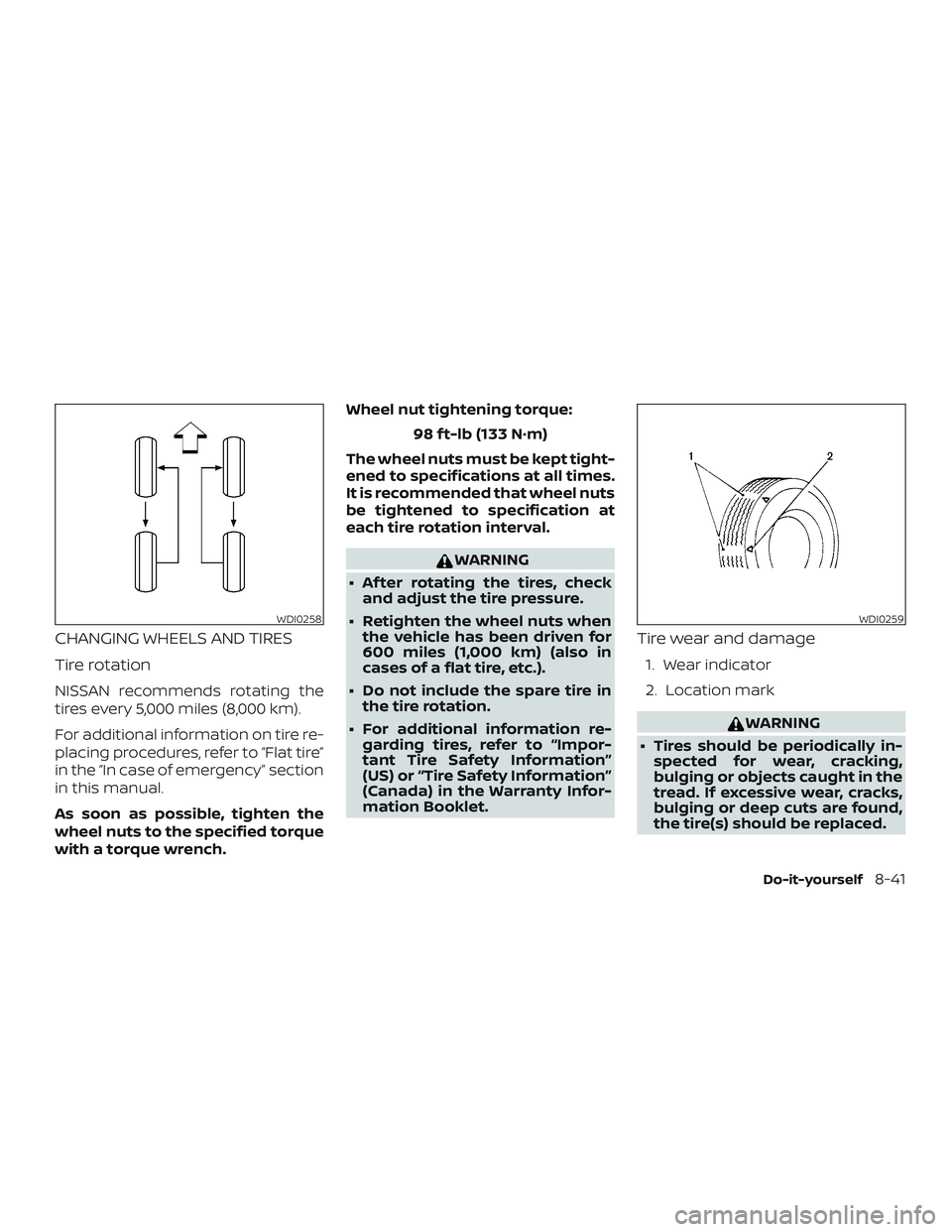
Tire rotation
NISSAN recommends rotating the
tires every 5,000 miles (8,000 km).
For additional information on tire re-
placing procedures, refer to “Flat tire”
in the “In case of emergency” section
in this manual.
As soon as possible, tighten the
wheel nuts to the specified torque
with a torque wrench.Wheel nut tightening torque:
98 f t-lb (133 N·m)
The wheel nuts must be kept tight-
ened to specifications at all times.
It is recommended that wheel nuts
be tightened to specification at
each tire rotation interval.
WARNING
∙ Af ter rotating the tires, check and adjust the tire pressure.
∙ Retighten the wheel nuts when the vehicle has been driven for
600 miles (1,000 km) (also in
cases of a flat tire, etc.).
∙ Do not include the spare tire in the tire rotation.
∙ For additional information re- garding tires, refer to “Impor-
tant Tire Safety Information”
(US) or “Tire Safety Information”
(Canada) in the Warranty Infor-
mation Booklet.
Tire wear and damage
1. Wear indicator
2. Location mark
WARNING
∙ Tires should be periodically in- spected for wear, cracking,
bulging or objects caught in the
tread. If excessive wear, cracks,
bulging or deep cuts are found,
the tire(s) should be replaced.
WDI0258WDI0259
Do-it-yourself8-41
Page 432 of 516
∙ The original tires have built-intread wear indicators. When the
wear indicators are visible, the
tire(s) should be replaced.
∙ Tires degrade with age and use. Have tires, including the spare,
over 6 years old checked by a
qualified technician because
some tire damage may not be
obvious. Replace the tires as
necessary to prevent tire failure
and possible personal injury.
∙ Improper service of the spare tire may result in serious per-
sonal injury. If it is necessary to
repair the spare tire, it is recom-
mended that you visit a NISSAN
dealer for this service.
∙ For additional information re- garding tires, refer to “Impor-
tant Tire Safety Information”
(US) or “Tire Safety Information”
(Canada) in the Warranty Infor-
mation Booklet.
Replacing wheels and tires
When replacing a tire, use the same size,
tread design, speed rating and load carry- ing capacity as originally equipped. For ad-
ditional information, refer to “Wheels and
tires” in the “Technical and consumer infor-
mation” section of this manual.
WARNING
∙ The use of tires other than those rec-
ommended or the mixed use of tires
of different brands, construction
(bias, bias-belted or radial), or tread
patterns can adversely affect the ride,
braking, handling, Vehicle Dynamic
Control (VDC) system, 4WD, ground
clearance, body-to-tire clearance, tire
chain clearance, speedometer cali-
bration, headlight aim and bumper
height. Some of these effects may
lead to accidents and could result in
serious personal injury.
∙ If your vehicle was originally equipped with four tires that were the
same size and you are only replacing
two of the four tires, install the new
tires on the rear axle. Placing new tires
on the front axle may cause loss of
vehicle control in some driving condi-
tions and cause an accident and per-
sonal injury. ∙ If the wheels are changed for any rea-
son, always replace with wheels
which have the same off-set dimen-
sion. Wheels of a different off-set
could cause premature tire wear, de-
grade vehicle handling characteris-
tics, affect the VDC system and/or in-
terference with the brake discs. Such
interference can lead to decreased
braking efficiency and/or early brake
pad wear. For additional information
on wheel off-set dimensions, refer to
“Wheels and tires” in the “Technical
and consumer information” section of
this manual.
∙ When replacing a wheel without the TPMS such as the spare tire, TPMS will
not function and the low tire pressure
warning light will flash for approxi-
mately 1 minute. The light will remain
on af ter 1 minute. Have your tires re-
placed and/or TPMS system reset as
soon as possible. It is recommended
that you visit a NISSAN dealer for this
service.
∙ Replacing tires with those not origi- nally specified by NISSAN could affect
the proper operation of the TPMS.
8-42Do-it-yourself
Page 434 of 516
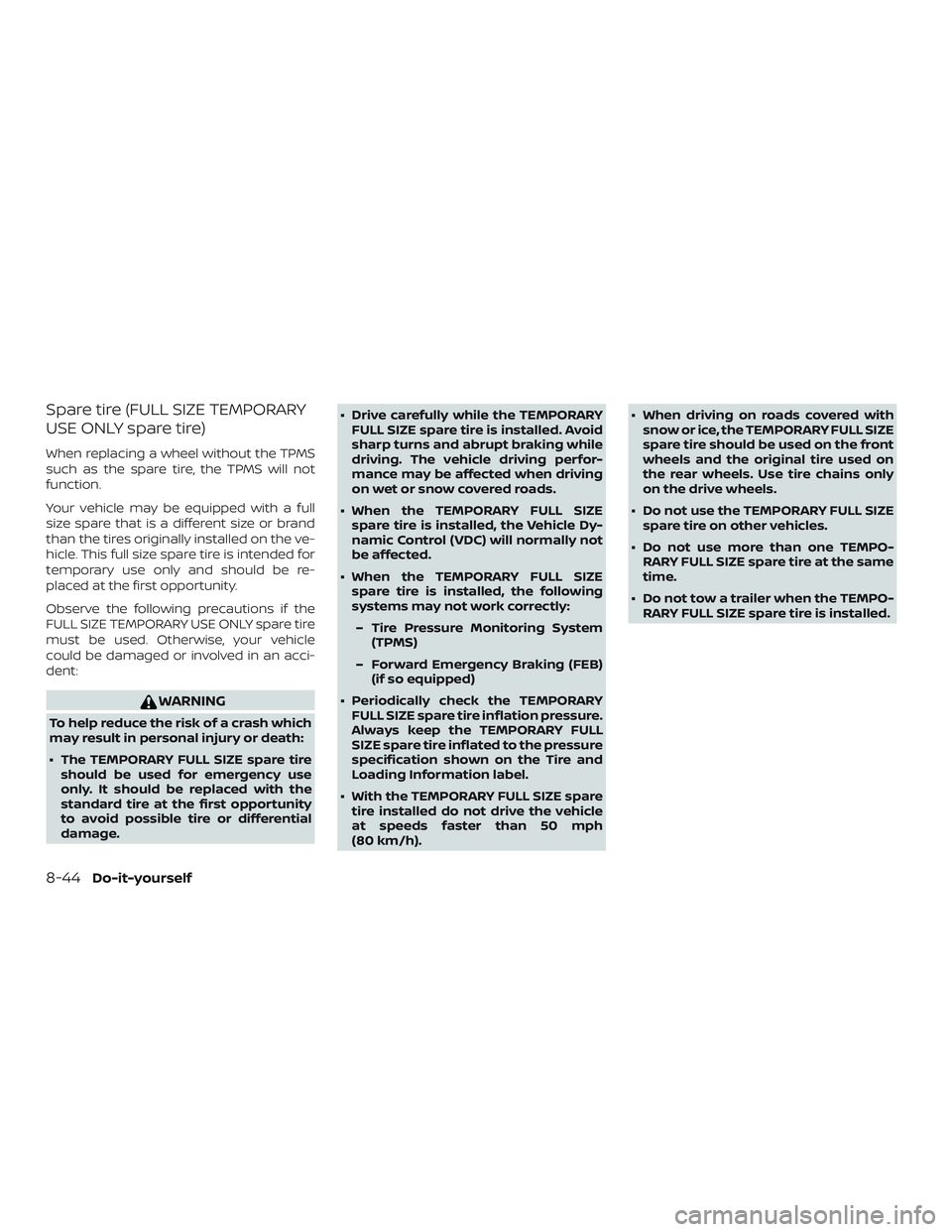
Spare tire (FULL SIZE TEMPORARY
USE ONLY spare tire)
When replacing a wheel without the TPMS
such as the spare tire, the TPMS will not
function.
Your vehicle may be equipped with a full
size spare that is a different size or brand
than the tires originally installed on the ve-
hicle. This full size spare tire is intended for
temporary use only and should be re-
placed at the first opportunity.
Observe the following precautions if the
FULL SIZE TEMPORARY USE ONLY spare tire
must be used. Otherwise, your vehicle
could be damaged or involved in an acci-
dent:
WARNING
To help reduce the risk of a crash which
may result in personal injury or death:
∙ The TEMPORARY FULL SIZE spare tireshould be used for emergency use
only. It should be replaced with the
standard tire at the first opportunity
to avoid possible tire or differential
damage. ∙ Drive carefully while the TEMPORARY
FULL SIZE spare tire is installed. Avoid
sharp turns and abrupt braking while
driving. The vehicle driving perfor-
mance may be affected when driving
on wet or snow covered roads.
∙ When the TEMPORARY FULL SIZE spare tire is installed, the Vehicle Dy-
namic Control (VDC) will normally not
be affected.
∙ When the TEMPORARY FULL SIZE spare tire is installed, the following
systems may not work correctly:
– Tire Pressure Monitoring System (TPMS)
– Forward Emergency Braking (FEB) (if so equipped)
∙ Periodically check the TEMPORARY FULL SIZE spare tire inflation pressure.
Always keep the TEMPORARY FULL
SIZE spare tire inflated to the pressure
specification shown on the Tire and
Loading Information label.
∙ With the TEMPORARY FULL SIZE spare tire installed do not drive the vehicle
at speeds faster than 50 mph
(80 km/h). ∙ When driving on roads covered with
snow or ice, the TEMPORARY FULL SIZE
spare tire should be used on the front
wheels and the original tire used on
the rear wheels. Use tire chains only
on the drive wheels.
∙ Do not use the TEMPORARY FULL SIZE spare tire on other vehicles.
∙ Do not use more than one TEMPO- RARY FULL SIZE spare tire at the same
time.
∙ Do not tow a trailer when the TEMPO- RARY FULL SIZE spare tire is installed.
8-44Do-it-yourself
Page 439 of 516
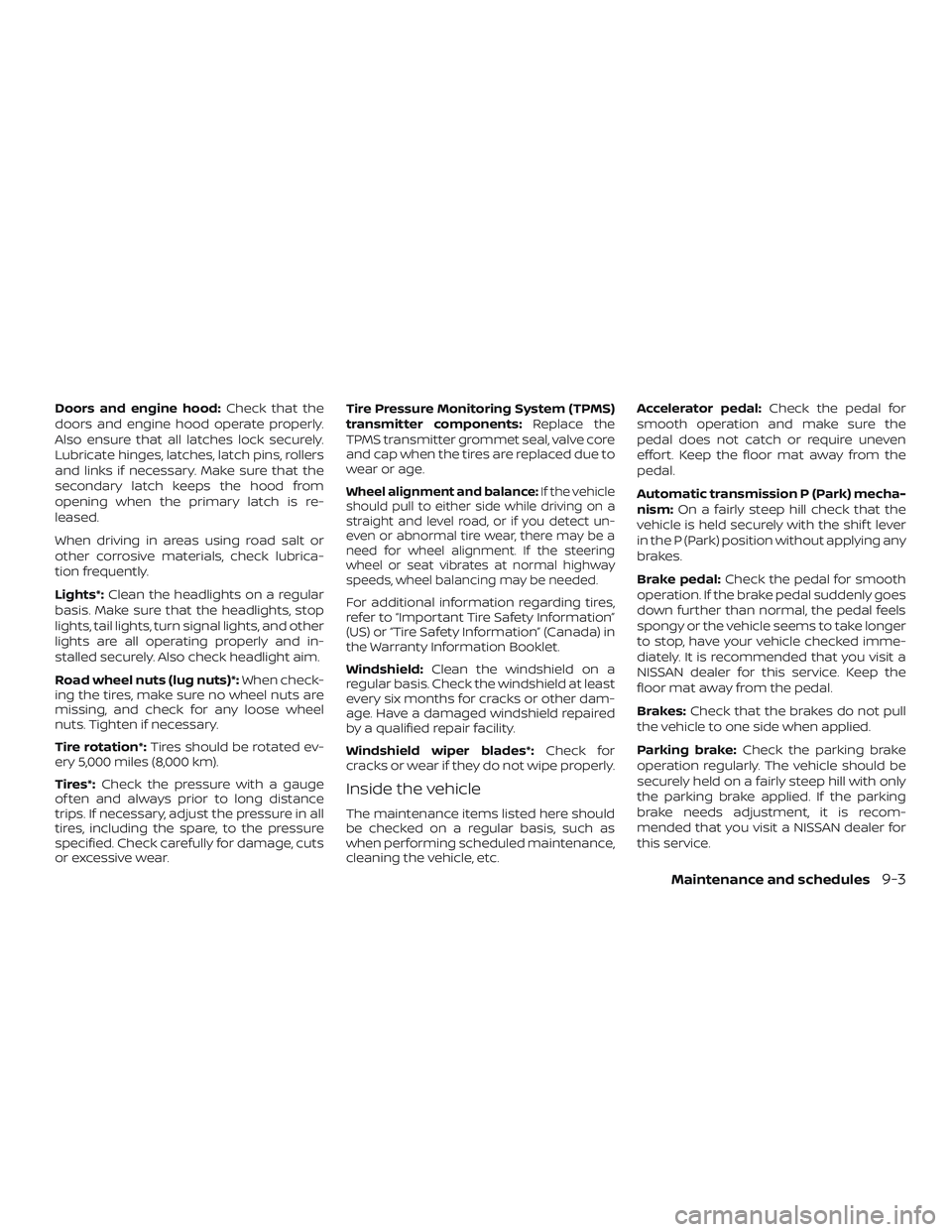
Doors and engine hood:Check that the
doors and engine hood operate properly.
Also ensure that all latches lock securely.
Lubricate hinges, latches, latch pins, rollers
and links if necessary. Make sure that the
secondary latch keeps the hood from
opening when the primary latch is re-
leased.
When driving in areas using road salt or
other corrosive materials, check lubrica-
tion frequently.
Lights*: Clean the headlights on a regular
basis. Make sure that the headlights, stop
lights, tail lights, turn signal lights, and other
lights are all operating properly and in-
stalled securely. Also check headlight aim.
Road wheel nuts (lug nuts)*: When check-
ing the tires, make sure no wheel nuts are
missing, and check for any loose wheel
nuts. Tighten if necessary.
Tire rotation*: Tires should be rotated ev-
ery 5,000 miles (8,000 km).
Tires*: Check the pressure with a gauge
of ten and always prior to long distance
trips. If necessary, adjust the pressure in all
tires, including the spare, to the pressure
specified. Check carefully for damage, cuts
or excessive wear. Tire Pressure Monitoring System (TPMS)
transmitter components:
Replace the
TPMS transmitter grommet seal, valve core
and cap when the tires are replaced due to
wear or age.
Wheel alignment and balance: If the vehicle
should pull to either side while driving on a
straight and level road, or if you detect un-
even or abnormal tire wear, there may be a
need for wheel alignment. If the steering
wheel or seat vibrates at normal highway
speeds, wheel balancing may be needed.
For additional information regarding tires,
refer to “Important Tire Safety Information”
(US) or “Tire Safety Information” (Canada) in
the Warranty Information Booklet.
Windshield: Clean the windshield on a
regular basis. Check the windshield at least
every six months for cracks or other dam-
age. Have a damaged windshield repaired
by a qualified repair facility.
Windshield wiper blades*: Check for
cracks or wear if they do not wipe properly.
Inside the vehicle
The maintenance items listed here should
be checked on a regular basis, such as
when performing scheduled maintenance,
cleaning the vehicle, etc. Accelerator pedal:
Check the pedal for
smooth operation and make sure the
pedal does not catch or require uneven
effort. Keep the floor mat away from the
pedal.
Automatic transmission P (Park) mecha-
nism: On a fairly steep hill check that the
vehicle is held securely with the shif t lever
in the P (Park) position without applying any
brakes.
Brake pedal: Check the pedal for smooth
operation. If the brake pedal suddenly goes
down further than normal, the pedal feels
spongy or the vehicle seems to take longer
to stop, have your vehicle checked imme-
diately. It is recommended that you visit a
NISSAN dealer for this service. Keep the
floor mat away from the pedal.
Brakes: Check that the brakes do not pull
the vehicle to one side when applied.
Parking brake: Check the parking brake
operation regularly. The vehicle should be
securely held on a fairly steep hill with only
the parking brake applied. If the parking
brake needs adjustment, it is recom-
mended that you visit a NISSAN dealer for
this service.
Maintenance and schedules9-3
Page 466 of 516
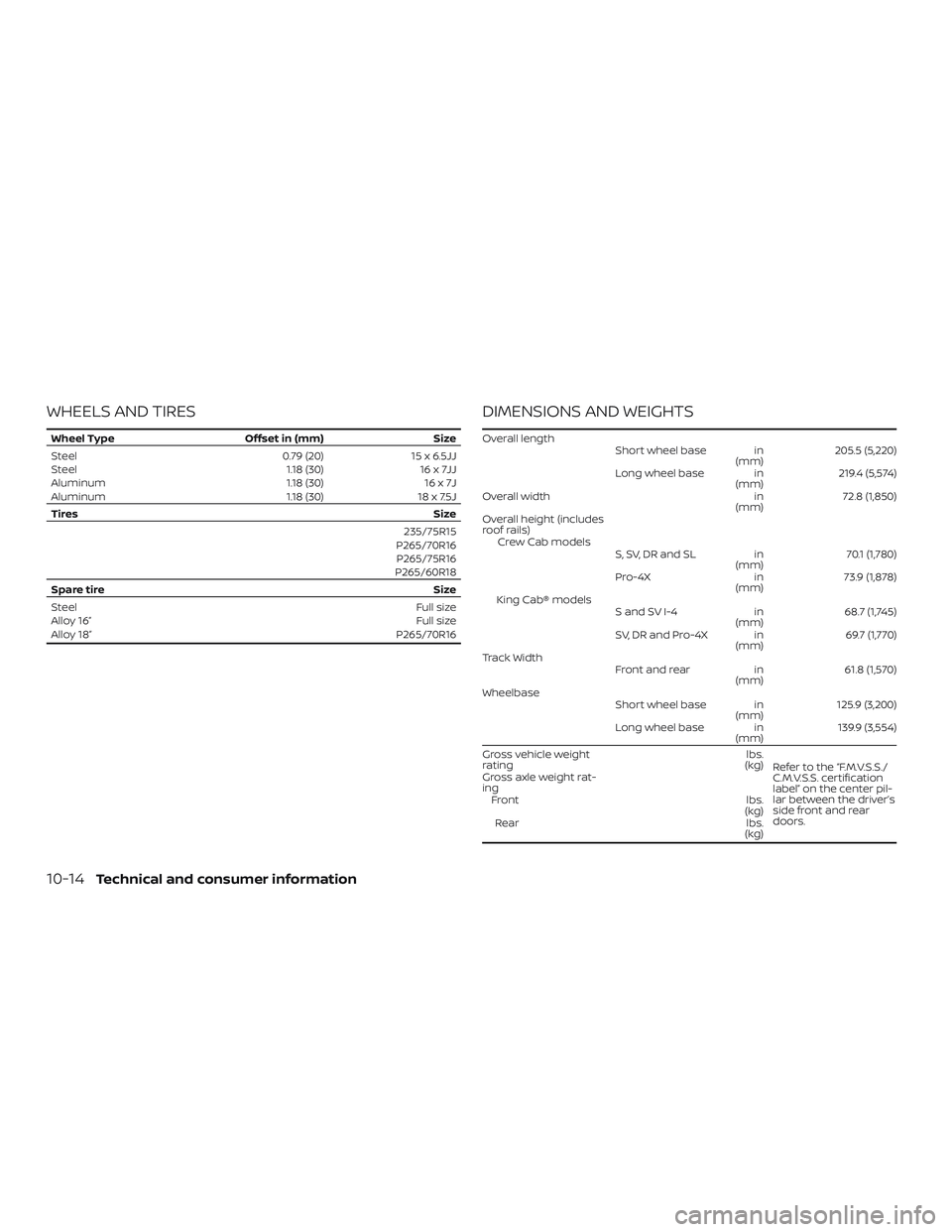
WHEELS AND TIRES
Wheel TypeOffset in (mm)Size
Steel 0.79 (20)15 x 6.5JJ
Steel 1.18 (30)16 x 7JJ
Aluminum 1.18 (30)16 x 7J
Aluminum 1.18 (30)18 x 7.5J
Tires Size
235/75R15
P265/70R16 P265/75R16
P265/60R18
Spare tire Size
Steel Full size
Alloy 16” Full size
Alloy 18” P265/70R16
DIMENSIONS AND WEIGHTS
Overall length
Short wheel base in(mm)205.5 (5,220)
Long wheel base in (mm)219.4 (5,574)
Overall width in
(mm) 72.8 (1,850)
Overall height (includes
roof rails) Crew Cab models S, SV, DR and SL in
(mm) 70.1 (1,780)
Pro-4X in
(mm) 73.9 (1,878)
King Cab® models S and SV I-4 in
(mm) 68.7 (1,745)
SV, DR and Pro-4X in (mm)69.7 (1,770)
Track Width Front and rear in
(mm) 61.8 (1,570)
Wheelbase Short wheel base in(mm)125.9 (3,200)
Long wheel base in (mm)139.9 (3,554)
Gross vehicle weight
rating lbs.
(kg) Refer to the “F.M.V.S.S./
C.M.V.S.S. certification
label” on the center pil-
lar between the driver’s
side front and rear
doors.
Gross axle weight rat-
ing
Front lbs.
(kg)
Rear lbs.
(kg)
10-14Technical and consumer information
Page 481 of 516
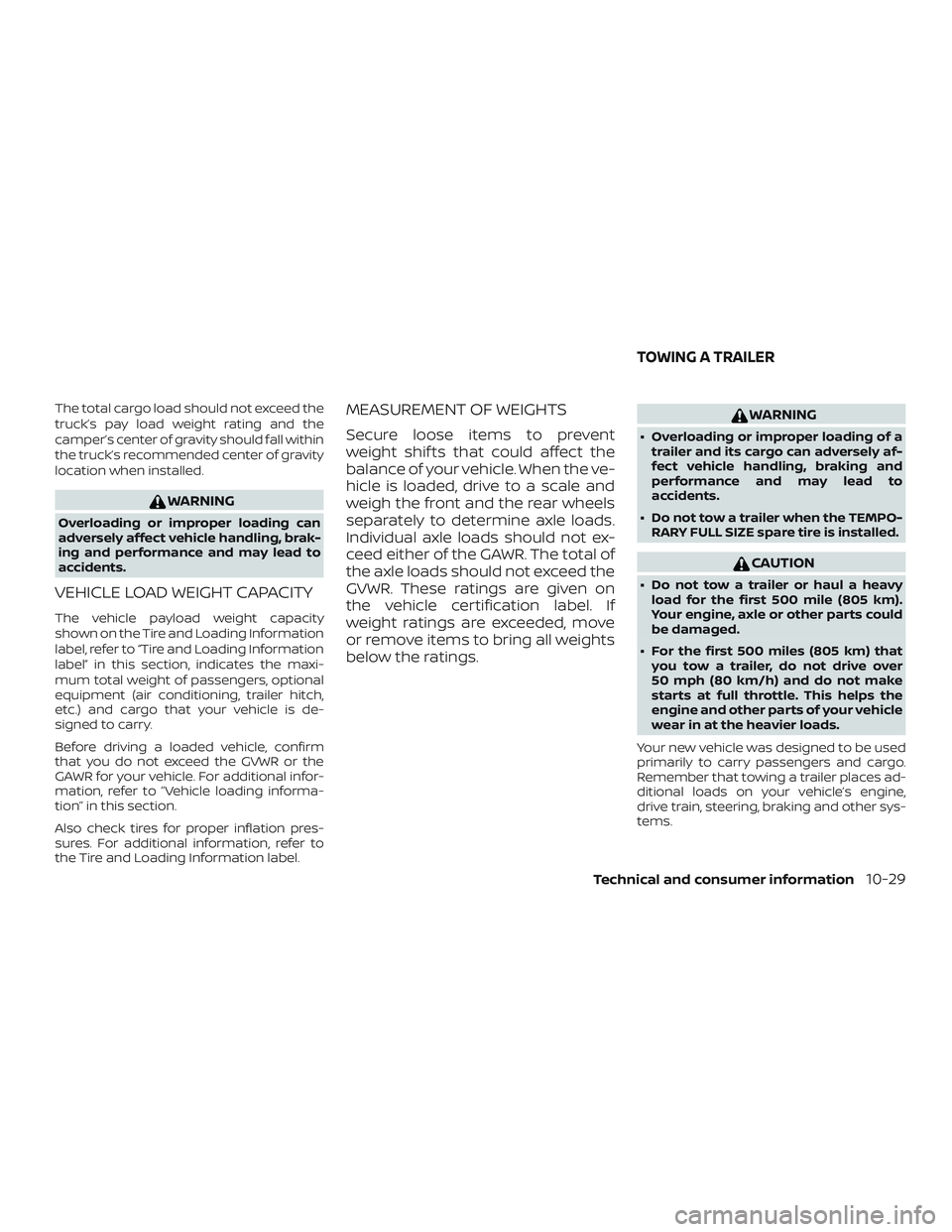
The total cargo load should not exceed the
truck’s pay load weight rating and the
camper’s center of gravity should fall within
the truck’s recommended center of gravity
location when installed.
WARNING
Overloading or improper loading can
adversely affect vehicle handling, brak-
ing and performance and may lead to
accidents.
VEHICLE LOAD WEIGHT CAPACITY
The vehicle payload weight capacity
shown on the Tire and Loading Information
label, refer to “Tire and Loading Information
label” in this section, indicates the maxi-
mum total weight of passengers, optional
equipment (air conditioning, trailer hitch,
etc.) and cargo that your vehicle is de-
signed to carry.
Before driving a loaded vehicle, confirm
that you do not exceed the GVWR or the
GAWR for your vehicle. For additional infor-
mation, refer to ’’Vehicle loading informa-
tion’’ in this section.
Also check tires for proper inflation pres-
sures. For additional information, refer to
the Tire and Loading Information label.
MEASUREMENT OF WEIGHTS
Secure loose items to prevent
weight shif ts that could affect the
balance of your vehicle. When the ve-
hicle is loaded, drive to a scale and
weigh the front and the rear wheels
separately to determine axle loads.
Individual axle loads should not ex-
ceed either of the GAWR. The total of
the axle loads should not exceed the
GVWR. These ratings are given on
the vehicle certification label. If
weight ratings are exceeded, move
or remove items to bring all weights
below the ratings.
WARNING
∙ Overloading or improper loading of atrailer and its cargo can adversely af-
fect vehicle handling, braking and
performance and may lead to
accidents.
∙ Do not tow a trailer when the TEMPO- RARY FULL SIZE spare tire is installed.
CAUTION
∙ Do not tow a trailer or haul a heavyload for the first 500 mile (805 km).
Your engine, axle or other parts could
be damaged.
∙ For the first 500 miles (805 km) that you tow a trailer, do not drive over
50 mph (80 km/h) and do not make
starts at full throttle. This helps the
engine and other parts of your vehicle
wear in at the heavier loads.
Your new vehicle was designed to be used
primarily to carry passengers and cargo.
Remember that towing a trailer places ad-
ditional loads on your vehicle’s engine,
drive train, steering, braking and other sys-
tems.
TOWING A TRAILER
Technical and consumer information10-29
Page 507 of 516
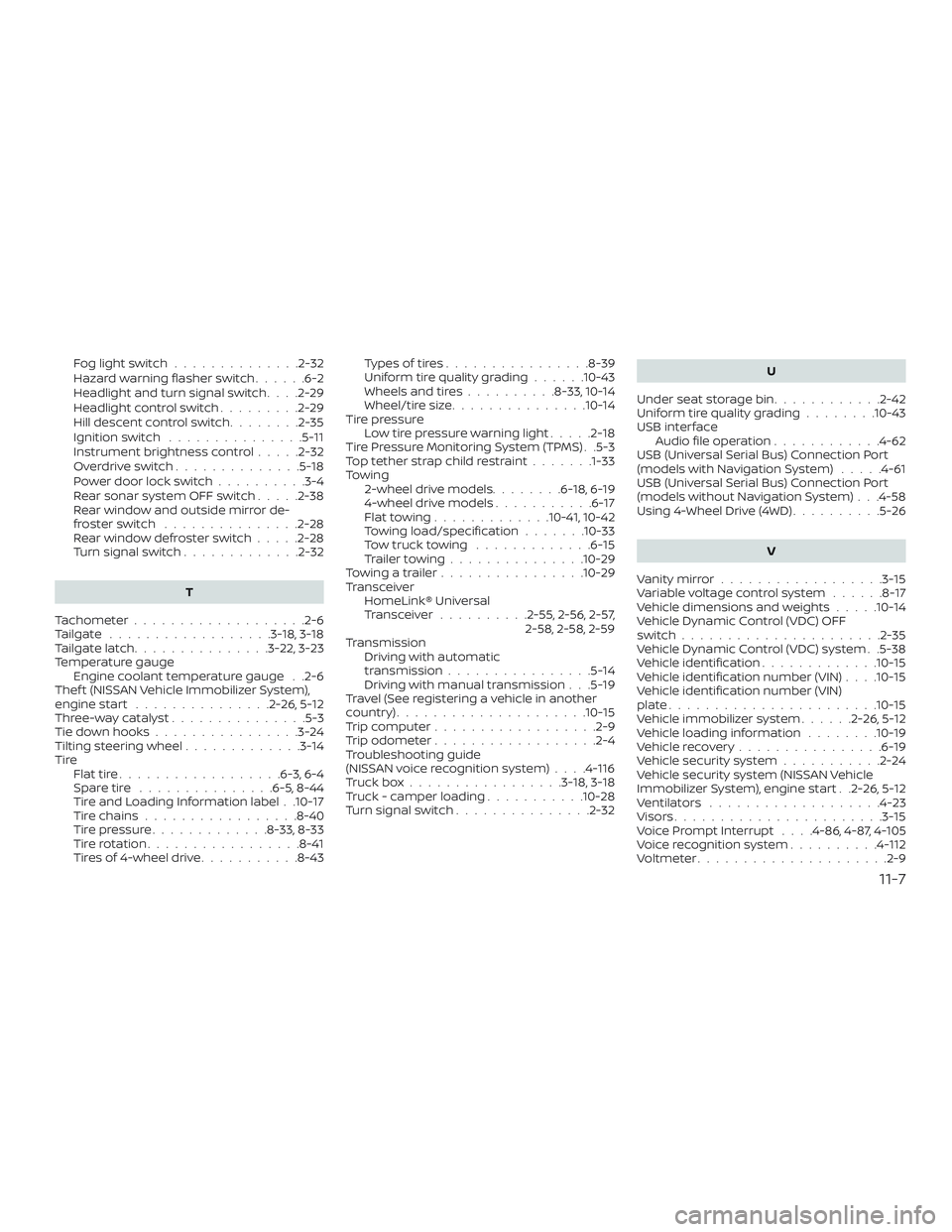
Foglightswitch..............2-32
Hazard warning flasher switch......6-2
Headlight and turn signal switch ....2-29
Headlightcontrolswitch.........2-29
Hill descent control switch ........2-35
Ignition switch ...............5-11
Instrument brightness control .....2-32
Overdriveswitch..............5-18
Power door lock switch ..........3-4
Rear sonar system OFF switch .....2-38
Rear window and outside mirror de-
frosterswitch ...............2-28
Rearwindowdefrosterswitch.....2-28
Turn signal switch .............2-32
T
Tachometer ...................2-6
Tailgate ..................3-18, 3-18
Tailgatelatch...............3-22,3-23
Temperature gauge Engine coolant temperature gauge . .2-6
Thef t (NISSAN Vehicle Immobilizer System),
engine start ...............2-26,5-12
Three-waycatalyst...............5-3
Tie down hooks ................3-24
Tilting steering wheel .............3-14
Tire Flattire..................6-3,6-4
Spare tire ...............6-5,8-44
Tire and Loading Information label . .10-17
Tire chains .................8-40
Tire pressure .............8-33,8-33
Tirerotation.................8-41
Tires of 4-wheel drive ...........8-43 Types of tires
................8-39
Uniform tire quality grading ......10-43
Wheels and tires ..........8-33,10-14
Wheel/tire size ...............10-14
Tire pressure Lowtirepressurewarninglight.....2-18
Tire Pressure Monitoring System (TPMS) . .5-3
Toptetherstrapchildrestraint.......1-33
Towing 2-wheel drive models ........6-18,6-19
4-wheel drive models ...........6-17
Flattowing.............10-41,10-42
Towing load/specification .......10-33
Towtrucktowing .............6-15
Trailertowing...............10-29
Towingatrailer................10-29
Transceiver HomeLink® Universal
Transceiver ..........2-55,2-56,2-57,
2-58, 2-58, 2-59
Transmission Driving with automatic
transmission ................5-14
Driving with manual transmission . . .5-19
Travel (See registering a vehicle in another
country) .....................10-15
Trip computer ..................2-9
Trip odometer ..................2-4
Troubleshooting guide
(NISSAN voice recognition system) ....4-116
Truckbox.................3-18,3-18
Truck - camper loading ...........10-28
Turn signal switch ...............2-32 U
Under seat storage bin ............2-42
Uniform tire quality grading ........10-43
USB interface Audio file operation ............4-62
USB (Universal Serial Bus) Connection Port
(models with Navigation System) .....4-61
USB (Universal Serial Bus) Connection Port
(models without Navigation System) . . .4-58
Using 4-Wheel Drive (4WD) ..........5-26
V
Vanitymirror..................3-15
Variablevoltagecontrolsystem......8-17
Vehicle dimensions and weights .....10-14
Vehicle Dynamic Control (VDC) OFF
switch......................2-35
Vehicle Dynamic Control (VDC) system . .5-38
Vehicle identification .............10-15
Vehicle identification number (VIN) . . . .10-15
Vehicle identification number (VIN)
p l
ate.......................10-15
Vehicle immobilizer system ......2-26,5-12
Vehicle loading information ........10-19
Vehiclerecovery................6-19
Vehicle security system ...........2-24
Vehicle security system (NISSAN Vehicle
Immobilizer System), engine start . .2-26, 5-12
Ventilators ...................4-23
Visors...................... .3-15
Voice Prompt Interrupt ....4-86,4-87,4-105
Voice recognition system ..........4-112
Voltmeter.................... .2-9
11-7