tires NISSAN FRONTIER 2019 Owner´s Manual
[x] Cancel search | Manufacturer: NISSAN, Model Year: 2019, Model line: FRONTIER, Model: NISSAN FRONTIER 2019Pages: 516, PDF Size: 5.04 MB
Page 439 of 516
Doors and engine hood:Check that the
doors and engine hood operate properly.
Also ensure that all latches lock securely.
Lubricate hinges, latches, latch pins, rollers
and links if necessary. Make sure that the
secondary latch keeps the hood from
opening when the primary latch is re-
leased.
When driving in areas using road salt or
other corrosive materials, check lubrica-
tion frequently.
Lights*: Clean the headlights on a regular
basis. Make sure that the headlights, stop
lights, tail lights, turn signal lights, and other
lights are all operating properly and in-
stalled securely. Also check headlight aim.
Road wheel nuts (lug nuts)*: When check-
ing the tires, make sure no wheel nuts are
missing, and check for any loose wheel
nuts. Tighten if necessary.
Tire rotation*: Tires should be rotated ev-
ery 5,000 miles (8,000 km).
Tires*: Check the pressure with a gauge
of ten and always prior to long distance
trips. If necessary, adjust the pressure in all
tires, including the spare, to the pressure
specified. Check carefully for damage, cuts
or excessive wear. Tire Pressure Monitoring System (TPMS)
transmitter components:
Replace the
TPMS transmitter grommet seal, valve core
and cap when the tires are replaced due to
wear or age.
Wheel alignment and balance: If the vehicle
should pull to either side while driving on a
straight and level road, or if you detect un-
even or abnormal tire wear, there may be a
need for wheel alignment. If the steering
wheel or seat vibrates at normal highway
speeds, wheel balancing may be needed.
For additional information regarding tires,
refer to “Important Tire Safety Information”
(US) or “Tire Safety Information” (Canada) in
the Warranty Information Booklet.
Windshield: Clean the windshield on a
regular basis. Check the windshield at least
every six months for cracks or other dam-
age. Have a damaged windshield repaired
by a qualified repair facility.
Windshield wiper blades*: Check for
cracks or wear if they do not wipe properly.
Inside the vehicle
The maintenance items listed here should
be checked on a regular basis, such as
when performing scheduled maintenance,
cleaning the vehicle, etc. Accelerator pedal:
Check the pedal for
smooth operation and make sure the
pedal does not catch or require uneven
effort. Keep the floor mat away from the
pedal.
Automatic transmission P (Park) mecha-
nism: On a fairly steep hill check that the
vehicle is held securely with the shif t lever
in the P (Park) position without applying any
brakes.
Brake pedal: Check the pedal for smooth
operation. If the brake pedal suddenly goes
down further than normal, the pedal feels
spongy or the vehicle seems to take longer
to stop, have your vehicle checked imme-
diately. It is recommended that you visit a
NISSAN dealer for this service. Keep the
floor mat away from the pedal.
Brakes: Check that the brakes do not pull
the vehicle to one side when applied.
Parking brake: Check the parking brake
operation regularly. The vehicle should be
securely held on a fairly steep hill with only
the parking brake applied. If the parking
brake needs adjustment, it is recom-
mended that you visit a NISSAN dealer for
this service.
Maintenance and schedules9-3
Page 442 of 516
or equivalent with the proper mixture. (For
additional information on the proper mix-
ture for your area, refer to “Engine cooling
system” in the “Do-it-yourself ” section of
this manual.)
NOTE: Mixing any other type of coolant
or the use of non-distilled water may re-
duce the recommended service interval
of the coolant.
Engine oil and oil filter:Replace engine oil
and oil filter at the specified intervals. For
recommended oil grade and viscosity refer
to “Recommended fluids/lubricants and
capacities” in the “Technical and consumer
information” section of this manual.
Evaporative emissions control vapor
lines*: Check vapor lines for leaks or loose-
ness. Tighten connections or replace parts
as necessary.
Fuel lines*: Check the fuel hoses, piping
and connections for leaks, looseness, or
deterioration. Tighten connections or re-
place parts as necessary.
Spark plugs: Replace at specified intervals.
Install new plugs of the same type as origi-
nally equipped.CHASSIS AND BODY
MAINTENANCE:
Brake lines and cables: Visually inspect for
proper installation. Check for chafing,
cracks, deterioration, and signs of leaking.
Replace any deteriorated or damaged
parts immediately.
Brake pads and rotors: Check for wear,
deterioration and fluid leaks. Replace any
deteriorated or damaged parts immedi-
ately.
Exhaust system: Visually inspect the ex-
haust pipes, muffler and hangers for leaks,
cracks, deterioration, and damage. Tighten
connections or replace parts as necessary.
In-cabin microfilter: Replace at specified
intervals. When driving for prolonged peri-
ods in dusty conditions, replace the filter
more frequently.
Steering gear and linkage, axle and sus-
pension parts, drive shaf t boots: Check
for damage, looseness, and leakage of oil
or grease. Under severe driving conditions,
inspect more frequently. Tire rotation:
Tires should be rotated every
5,000 miles (8,000 km) according to the in-
structions under “Explanation of general
maintenance items” in this section. When
rotating tires, check for damage and un-
even wear. Replace if necessary.
Transmission fluid/oil, differential oil: Vi-
sually inspect for signs of leakage at speci-
fied intervals.
9-6Maintenance and schedules
Page 452 of 516
10 Technical and consumer information
Recommended fluids/lubricants and
capacities...................................... 10-2
Fuel recommendation
(for QR25DE models) ......................... 10-4
Fuel recommendation
(for VQ40DE models) ........................ 10-7
Flexible Fuel Vehicle (FFV) fuel
recommendation (if so equipped) ...........10-9
Engine oil and oil filter
recommendations .......................... 10-11
Air conditioner system refrigerant and
oil recommendations ......................10-12
Specifications ................................. 10-13
Engine ..................................... 10-13
Wheels and tires ............................ 10-14
Dimensions and weights ...................10-14
When traveling or registering in another
country ........................................ 10-15
Vehicle identification .......................... 10-15
Vehicle Identification Number (VIN)
plate ....................................... 10-15
Engine serial number ....................... 10-15
F.M.V.S.S./C.M.V.S.S. certification label ........10-16
Emission control information label .........10-17 Tire and Loading Information label
.........10-17
Air conditioner specification label ...........10-18
Installing front license plate ....................10-18
Installing front license plate with
grommets .................................. 10-18
Vehicle loading information ...................10-19
Terms ...................................... 10-19
Vehicle load capacity ....................... 10-20
Securing the load ........................... 10-21
Utili-track® channel system
(if so equipped) ............................. 10-22
Loading tips ................................ 10-27
Truck-camper loading information ............10-28
Crew cab models ........................... 10-28
King Cab® models .......................... 10-28
Special Body vehicles ....................... 10-28
Location for center of gravity ...............10-28
V ehicle
load weight capacity ...............10-29
Measurement of weights ...................10-29
Towing a trailer ................................ 10-29
Maximum load limits ....................... 10-30
Towing load/specification ..................10-33
Towing safety .............................. 10-35
Page 466 of 516
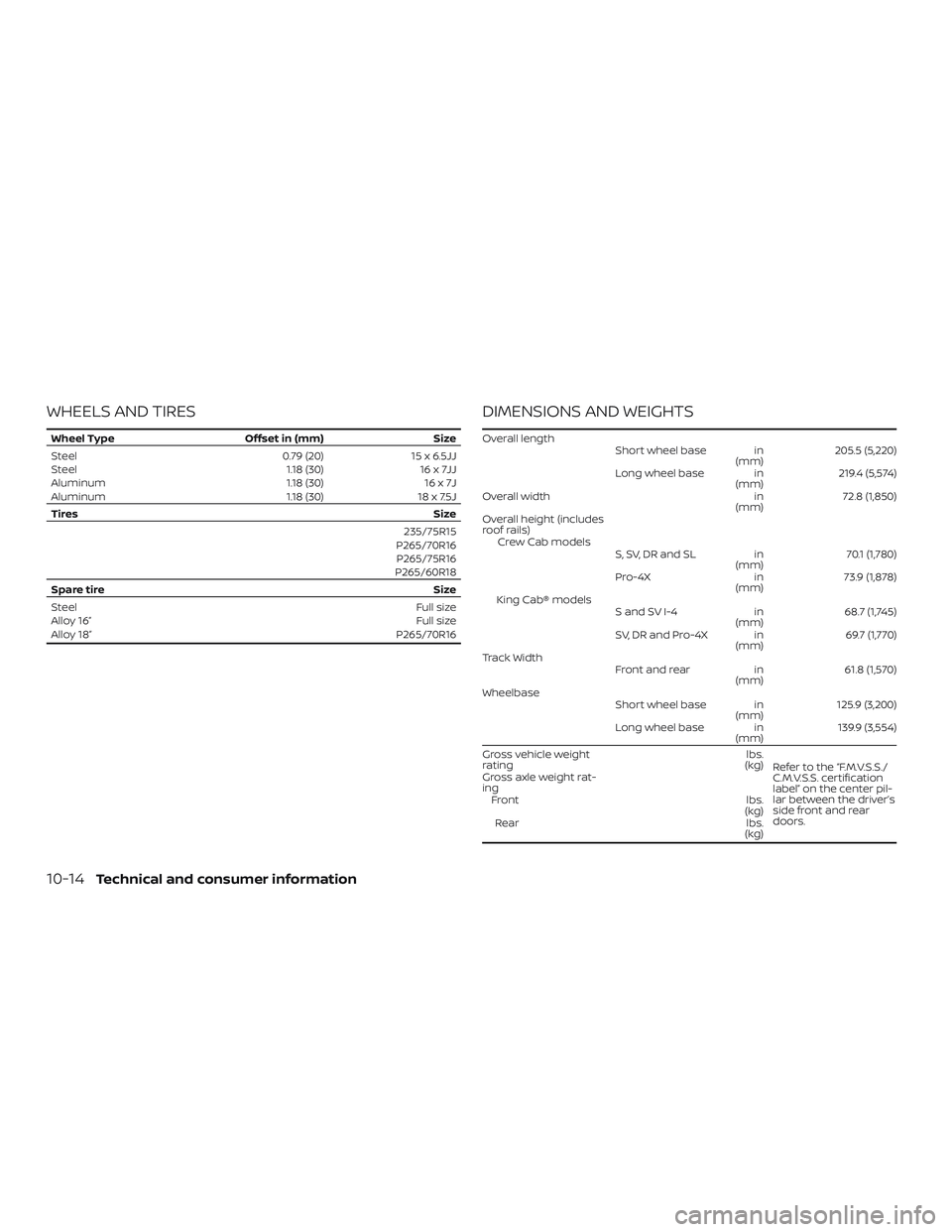
WHEELS AND TIRES
Wheel TypeOffset in (mm)Size
Steel 0.79 (20)15 x 6.5JJ
Steel 1.18 (30)16 x 7JJ
Aluminum 1.18 (30)16 x 7J
Aluminum 1.18 (30)18 x 7.5J
Tires Size
235/75R15
P265/70R16 P265/75R16
P265/60R18
Spare tire Size
Steel Full size
Alloy 16” Full size
Alloy 18” P265/70R16
DIMENSIONS AND WEIGHTS
Overall length
Short wheel base in(mm)205.5 (5,220)
Long wheel base in (mm)219.4 (5,574)
Overall width in
(mm) 72.8 (1,850)
Overall height (includes
roof rails) Crew Cab models S, SV, DR and SL in
(mm) 70.1 (1,780)
Pro-4X in
(mm) 73.9 (1,878)
King Cab® models S and SV I-4 in
(mm) 68.7 (1,745)
SV, DR and Pro-4X in (mm)69.7 (1,770)
Track Width Front and rear in
(mm) 61.8 (1,570)
Wheelbase Short wheel base in(mm)125.9 (3,200)
Long wheel base in (mm)139.9 (3,554)
Gross vehicle weight
rating lbs.
(kg) Refer to the “F.M.V.S.S./
C.M.V.S.S. certification
label” on the center pil-
lar between the driver’s
side front and rear
doors.
Gross axle weight rat-
ing
Front lbs.
(kg)
Rear lbs.
(kg)
10-14Technical and consumer information
Page 473 of 516
Steps for determining correct
load limit
1. Locate the statement “The com-bined weight of occupants and
cargo should never exceed XXX
lbs. or XXX kg” on your vehicle’s
placard.
2. Determine the combined weight of the driver and passengers
that will be riding in your vehicle.
3. Subtract the combined weight of the driver and passengers
from XXX lbs. or XXX kg.
4. The resulting figure equals the available amount of cargo and
luggage load capacity. For ex-
ample, if the XXX amount equals
1,400 lbs. and there will be five
150 lbs. passengers in your ve-
hicle, the amount of available
cargo and luggage load capac-
ity is 650 lbs. (1,400-750 (5 X 150) =
650 lbs.) or (640-340 (5 X 70) =
300 kg.) 5. Determine the combined weight
of luggage and cargo being
loaded on the vehicle. That
weight may not safely exceed
the available cargo and luggage
load capacity calculated in
step 4.
6. If your vehicle will be towing a trailer, load from your trailer will
be transferred to your vehicle.
Consult this manual to deter-
mine how this reduces the avail-
able cargo and luggage load ca-
pacity of your vehicle.
Before driving a loaded vehicle, con-
firm that you do not exceed the
GVWR or the GAWR for your vehicle.
For additional information, refer to
“Measurement of weights” in this
section.
Also check tires for proper inflation
pressures. For additional informa-
tion, refer to the “Tire and Loading
Information label” in the “Do-it-
yourself ” section of this manual.
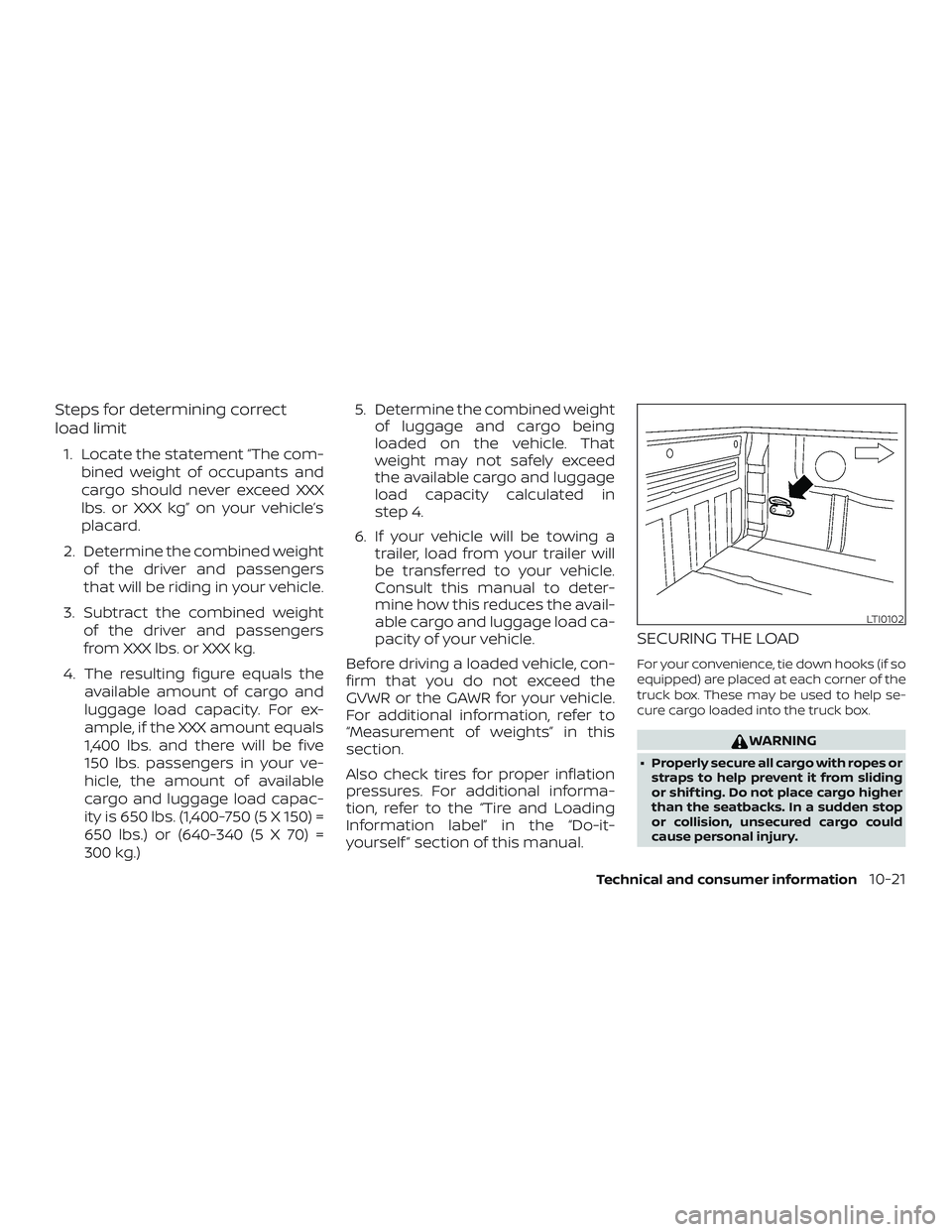
SECURING THE LOAD
For your convenience, tie down hooks (if so
equipped) are placed at each corner of the
truck box. These may be used to help se-
cure cargo loaded into the truck box.
WARNING
∙ Properly secure all cargo with ropes or straps to help prevent it from sliding
or shif ting. Do not place cargo higher
than the seatbacks. In a sudden stop
or collision, unsecured cargo could
cause personal injury.
LTI0102
Technical and consumer information10-21
Page 481 of 516
The total cargo load should not exceed the
truck’s pay load weight rating and the
camper’s center of gravity should fall within
the truck’s recommended center of gravity
location when installed.
WARNING
Overloading or improper loading can
adversely affect vehicle handling, brak-
ing and performance and may lead to
accidents.
VEHICLE LOAD WEIGHT CAPACITY
The vehicle payload weight capacity
shown on the Tire and Loading Information
label, refer to “Tire and Loading Information
label” in this section, indicates the maxi-
mum total weight of passengers, optional
equipment (air conditioning, trailer hitch,
etc.) and cargo that your vehicle is de-
signed to carry.
Before driving a loaded vehicle, confirm
that you do not exceed the GVWR or the
GAWR for your vehicle. For additional infor-
mation, refer to ’’Vehicle loading informa-
tion’’ in this section.
Also check tires for proper inflation pres-
sures. For additional information, refer to
the Tire and Loading Information label.
MEASUREMENT OF WEIGHTS
Secure loose items to prevent
weight shif ts that could affect the
balance of your vehicle. When the ve-
hicle is loaded, drive to a scale and
weigh the front and the rear wheels
separately to determine axle loads.
Individual axle loads should not ex-
ceed either of the GAWR. The total of
the axle loads should not exceed the
GVWR. These ratings are given on
the vehicle certification label. If
weight ratings are exceeded, move
or remove items to bring all weights
below the ratings.
WARNING
∙ Overloading or improper loading of atrailer and its cargo can adversely af-
fect vehicle handling, braking and
performance and may lead to
accidents.
∙ Do not tow a trailer when the TEMPO- RARY FULL SIZE spare tire is installed.
CAUTION
∙ Do not tow a trailer or haul a heavyload for the first 500 mile (805 km).
Your engine, axle or other parts could
be damaged.
∙ For the first 500 miles (805 km) that you tow a trailer, do not drive over
50 mph (80 km/h) and do not make
starts at full throttle. This helps the
engine and other parts of your vehicle
wear in at the heavier loads.
Your new vehicle was designed to be used
primarily to carry passengers and cargo.
Remember that towing a trailer places ad-
ditional loads on your vehicle’s engine,
drive train, steering, braking and other sys-
tems.
TOWING A TRAILER
Technical and consumer information10-29
Page 490 of 516
Tire pressures
∙ When towing a trailer, inflate thevehicle tires to the recom-
mended cold tire pressure indi-
cated on the Tire and Loading In-
formation label.
∙ Trailer tire condition, size, load rat- ing and proper inflation pressure
should be in accordance with the
trailer and tire manufacturer’s
specifications.
Safety chains
Always use suitable safety chains between
your vehicle and the trailer. The safety
chains should be crossed and should be
attached to the hitch, not to the vehicle
bumper or axle. The safety chains can be
attached to the bumper if the hitch ball is
mounted to the bumper. Be sure to leave
enough slack in the chains to permit turn-
ing corners.
Trailer lights
CAUTION
When splicing into the vehicle electrical
system, a commercially available
power-type module/converter must be
used to provide power for all trailer
lighting. This unit uses the vehicle bat-
tery as a direct power source for all
trailer lights while using the vehicle tail
light, stop light and turn signal circuits
as a signal source. The
module/converter must draw no more
than 15 milliamps from the stop and tail
lamp circuits. Using a
module/converter that exceeds these
power requirements may damage the
vehicle’s electrical system. See a repu-
table trailer dealer to obtain the proper
equipment and to have it installed.
Trailer lights should comply with federal
and/or local regulations. For assistance in
hooking up trailer lights, it is recommended
that you visit a NISSAN dealer or reputable
trailer dealer. Vehicles equipped with the
optional trailer tow package are equipped
with a 7-pin trailer harness connector. A flat
4–pin harness is available from your dealer
for vehicles without a tow package. If your
trailer is equipped with a flat 4-pin connec- tor, an adapter will be needed to connect
the trailer lights to the vehicle. Adapters are
available at auto parts stores and hitch re-
tailers.Trailer brakes
If your trailer is equipped with a braking
system, make sure it conforms to federal
and/or local regulations and that it is prop-
erly installed.
Vehicles equipped with a 7–pin trailer har-
ness connector are pre-wired for a trailer
brake controller. It is recommended that
you visit a NISSAN dealer for a trailer brake
adapter harness.
WARNING
Never connect a trailer brake system di-
rectly to the vehicle brake system.
When towing a trailer load of 3,500 lbs.
(1587 kg) or more, trailers with a brake
system MUST be used. However, most
states require a separate braking system
on trailers with a loaded weight above a
specific amount. Make sure the trailer
meets the local regulations and the regu-
lations where you plan to tow.
Several types of braking systems are avail-
able.
10-38Technical and consumer information
Page 495 of 516
DOT (Department of Transportation) Qual-
ity Grades: All passenger car tires must
conform to federal safety requirements in
addition to these grades.
Quality grades can be found where appli-
cable on the tire sidewall between tread
shoulder and maximum section width. For
example:
Treadwear 200 Traction AA Temperature
A
Treadwear
The treadwear grade is a comparative rat-
ing based on the wear rate of the tire when
tested under controlled conditions on a
specified government test course. For ex-
ample, a tire graded 150 would wear one
and one-half (1 1/2) times as well on the
government course as a tire graded 100.
The relative performance of tires depends
upon the actual conditions of their use,
however, and may depart significantly from
the norm due to variations in driving habits,
service practices and differences in road
characteristics and climate.
Traction AA, A, B and C
The traction grades, from highest to low-
est, are AA, A, B, and C. Those grades repre-
sent the tire’s ability to stop on wet pave-ment as measured under controlled
conditions on specified government test
surfaces of asphalt and concrete. A tire
marked C may have poor traction perfor-
mance.
WARNING
The traction grade assigned to this tire
is based on straight-ahead braking
traction tests, and does not include ac-
celeration, cornering, hydroplaning, or
peak traction characteristics.
Temperature A, B and C
The temperature grades are A (the high-
est), B, and C, representing the tire’s resis-
tance to the generation of heat, and its
ability to dissipate heat when tested under
controlled conditions on a specified indoor
laboratory test wheel. Sustained high tem-
perature can cause the material of the tire
to degenerate and reduce tire life, and ex-
cessive temperature can lead to sudden
tire failure. The grade C corresponds to a
level of performance which all passenger
car tires must meet under the Federal Mo-
tor Vehicle Safety Standard No. 109. Grades
B and A represent higher levels of perfor-
mance on the laboratory test wheel than
the minimum required by law.
WARNING
The temperature grade for this tire is
established for a tire that is properly in-
flated and not overloaded. Excessive
speed, under-inflation, or excessive
loading, either separately or in combi-
nation, can cause heat build-up and
possible tire failure.
UNIFORM TIRE QUALITY GRADING
Technical and consumer information10-43
Page 507 of 516
Foglightswitch..............2-32
Hazard warning flasher switch......6-2
Headlight and turn signal switch ....2-29
Headlightcontrolswitch.........2-29
Hill descent control switch ........2-35
Ignition switch ...............5-11
Instrument brightness control .....2-32
Overdriveswitch..............5-18
Power door lock switch ..........3-4
Rear sonar system OFF switch .....2-38
Rear window and outside mirror de-
frosterswitch ...............2-28
Rearwindowdefrosterswitch.....2-28
Turn signal switch .............2-32
T
Tachometer ...................2-6
Tailgate ..................3-18, 3-18
Tailgatelatch...............3-22,3-23
Temperature gauge Engine coolant temperature gauge . .2-6
Thef t (NISSAN Vehicle Immobilizer System),
engine start ...............2-26,5-12
Three-waycatalyst...............5-3
Tie down hooks ................3-24
Tilting steering wheel .............3-14
Tire Flattire..................6-3,6-4
Spare tire ...............6-5,8-44
Tire and Loading Information label . .10-17
Tire chains .................8-40
Tire pressure .............8-33,8-33
Tirerotation.................8-41
Tires of 4-wheel drive ...........8-43 Types of tires
................8-39
Uniform tire quality grading ......10-43
Wheels and tires ..........8-33,10-14
Wheel/tire size ...............10-14
Tire pressure Lowtirepressurewarninglight.....2-18
Tire Pressure Monitoring System (TPMS) . .5-3
Toptetherstrapchildrestraint.......1-33
Towing 2-wheel drive models ........6-18,6-19
4-wheel drive models ...........6-17
Flattowing.............10-41,10-42
Towing load/specification .......10-33
Towtrucktowing .............6-15
Trailertowing...............10-29
Towingatrailer................10-29
Transceiver HomeLink® Universal
Transceiver ..........2-55,2-56,2-57,
2-58, 2-58, 2-59
Transmission Driving with automatic
transmission ................5-14
Driving with manual transmission . . .5-19
Travel (See registering a vehicle in another
country) .....................10-15
Trip computer ..................2-9
Trip odometer ..................2-4
Troubleshooting guide
(NISSAN voice recognition system) ....4-116
Truckbox.................3-18,3-18
Truck - camper loading ...........10-28
Turn signal switch ...............2-32 U
Under seat storage bin ............2-42
Uniform tire quality grading ........10-43
USB interface Audio file operation ............4-62
USB (Universal Serial Bus) Connection Port
(models with Navigation System) .....4-61
USB (Universal Serial Bus) Connection Port
(models without Navigation System) . . .4-58
Using 4-Wheel Drive (4WD) ..........5-26
V
Vanitymirror..................3-15
Variablevoltagecontrolsystem......8-17
Vehicle dimensions and weights .....10-14
Vehicle Dynamic Control (VDC) OFF
switch......................2-35
Vehicle Dynamic Control (VDC) system . .5-38
Vehicle identification .............10-15
Vehicle identification number (VIN) . . . .10-15
Vehicle identification number (VIN)
p l
ate.......................10-15
Vehicle immobilizer system ......2-26,5-12
Vehicle loading information ........10-19
Vehiclerecovery................6-19
Vehicle security system ...........2-24
Vehicle security system (NISSAN Vehicle
Immobilizer System), engine start . .2-26, 5-12
Ventilators ...................4-23
Visors...................... .3-15
Voice Prompt Interrupt ....4-86,4-87,4-105
Voice recognition system ..........4-112
Voltmeter.................... .2-9
11-7
Page 508 of 516
W
Warning 4WDwarninglight.............2-15
Airbagwarninglight........1-90, 2-20
Anti-lock brake warning light ......2-15
Battery charge warning light ......2-17
Brakewarninglight............2-16
Door open warning light .........2-17
Engine oil pressure warning light ....2-17
Hazard warning flasher switch ......6-2
Loose fuel cap warning .......2-5,3-11
Lowfuelwarninglight ..........2-18
Low tire pressure warning light .....2-18
Low windshield-washer fluid warning
light......................2-19
Passenger air bag and status light. . .1-83
Seatbeltwarninglight.......1-18, 2-19
Supplemental air bag warning
light ..................1-90, 2-20
TPMS......................2-4
Vehicle security system .........2-24
Warning/indicator lights and audible
reminders ..................2-20
Warning labels (for SRS) .........1-89
Warning/indicator lights and audible
reminders ....................2-20
Audible reminders .............2-20
Indicatorlights...............2-20
Warninglights...............2-20
Warninglights.................2-20
Warning lights, indicator lights and audible
reminders ....................2-14
Weights
(See dimensions and weights) .......10-14Wheels and tires
............8-33,10-14
Wheel/tire size .................10-14
When traveling or registering in another
country .....................10-15
Windows ....................2-49 Locking passengers' windows .....2-51
Manual windows .............2-49
Powerwindows..............2-49
Rearpowerwindows...........2-51
Rearslidingwindow............2-52
Windshield-washer fluid ...........8-14
Windshield wiper blades ...........8-21
Wiper Wiper blades ................8-21
Wiper and washer switch ..........2-27
11-8