belt NISSAN FRONTIER 2020 Owner´s Manual
[x] Cancel search | Manufacturer: NISSAN, Model Year: 2020, Model line: FRONTIER, Model: NISSAN FRONTIER 2020Pages: 492, PDF Size: 3.05 MB
Page 3 of 492
This manual was prepared to help you un-
derstand the operation and maintenance
of your vehicle so that you may enjoy many
miles (kilometers) of driving pleasure.
Please read through this manual before
operating your vehicle.
A separate Warranty Information Book-
let explains details about the warranties
covering your vehicle. The “Maintenance
and schedules” section of this manual
explains details about maintaining and
servicing your vehicle. Additionally, a
separate Customer Care/Lemon Law
Booklet (U.S. only) will explain how to re-
solve any concerns you may have with
your vehicle, and clarif y your rights un-
der your state's lemon law.
When you require any service or have any
questions, a NISSAN dealer will be glad to
assist you with the extensive resources
available to them.
In addition to factory-installed options,
your vehicle may also be equipped with
additional accessories installed prior to de-
livery. It is recommended that you visit a
NISSAN dealer for details concerning the
particular accessories with which your ve-
hicle is equipped. It is important that you
familiarize yourself with all disclosures,
warnings, cautions and instructions con-cerning proper use of such accessories
prior to operating the vehicle and/or ac-
cessory. It is recommended that you visit a
NISSAN dealer for details concerning the
particular accessories with which your ve-
hicle is equipped.
Before driving your vehicle, please read this
Owner's Manual carefully. This will ensure
familiarity with controls and maintenance
requirements assisting you in the safe op-
eration of your vehicle.
WARNING
IMPORTANT SAFETY INFORMATION RE-
MINDERS!
Follow these important driving rules to
help ensure a safe and comfortable trip
for you and your passengers!
• NEVER drive under the influence of
alcohol or drugs.
•
ALWAYS observe posted speed limits
and never drive too fast for conditions.
• ALWAYS give your full attention to
driving and avoid using vehicle fea-
tures or taking other actions that
could distract you.
• ALWAYS use your seat belts and ap-
propriate child restraint systems.
Pre-teen children should be seated in
the rear seat.
• ALWAYS provide information about
the proper use of vehicle safety fea-
tures to all occupants of the vehicle.
• ALWAYS review this Owner’s Manual
for important safety information.
FOREWORD READ FIRST—THEN DRIVE SAFELY
Page 9 of 492
Table of
contentsIllustrated table of contents
Safety-Seats, seat belts and supplemental restraint system
Instruments and controls
Pre-driving checks and adjustments
Monitor, climate, audio, phone and voice recognition systems
Starting and driving
In case of emergency
Appearance and care
Do-it-yourself
Maintenance and schedules
Technical and consumer information
Index
0
1
2
3
4
5
6
7
8
9
10
11
Page 11 of 492
0 Illustrated table of contents
Air bags, seat belts and child restraints..........0-2
Exterior front ....................................0-3
Exterior rear .....................................0-4
Passenger compartment .......................0-5 Instrument panel
................................0-6
Engine compartment check locations ...........0-8
Warning and indicator lights .....................0-9
Page 12 of 492
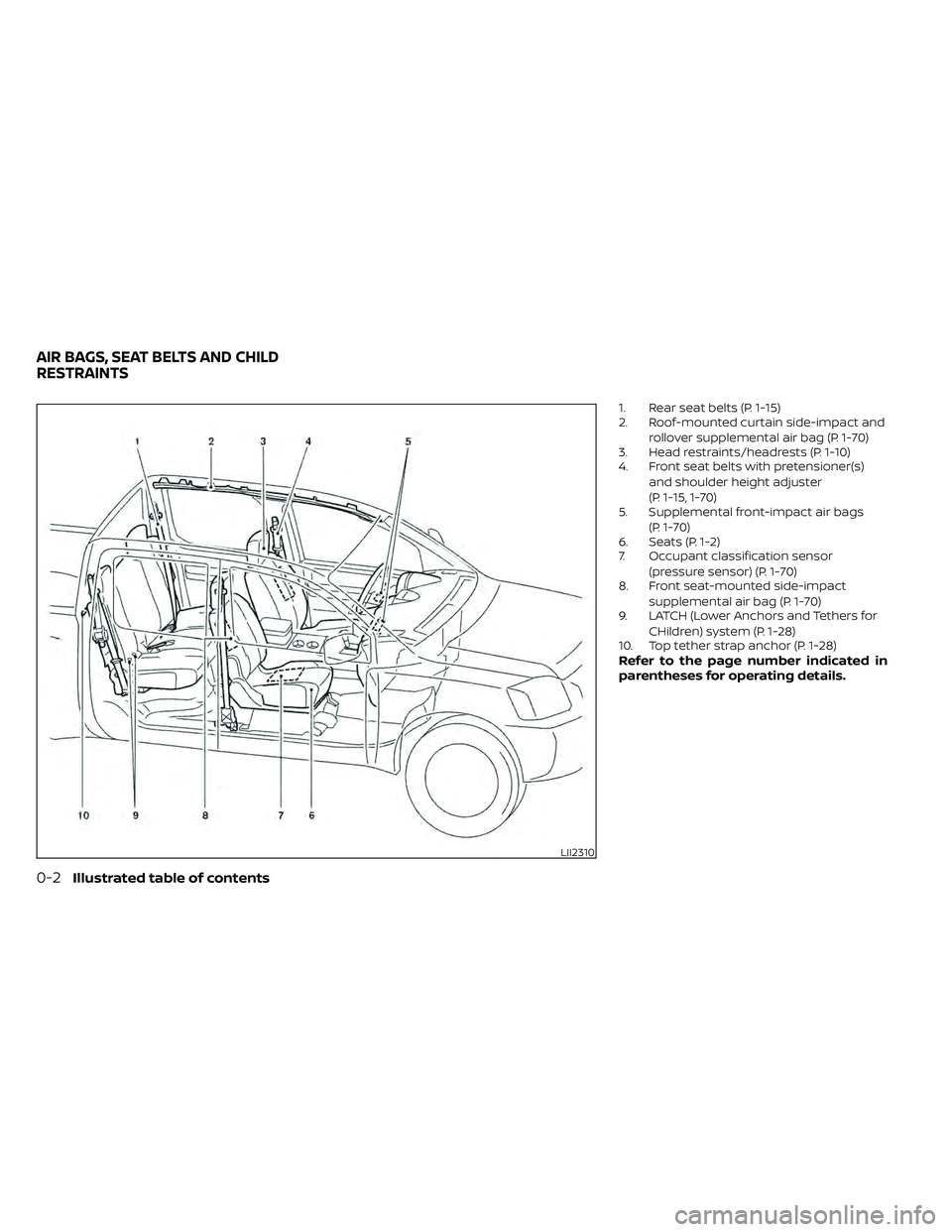
1. Rear seat belts (P. 1-15)
2. Roof-mounted curtain side-impact androllover supplemental air bag (P. 1-70)
3. Head restraints/headrests (P. 1-10)
4. Front seat belts with pretensioner(s)
and shoulder height adjuster
(P. 1-15, 1-70)
5. Supplemental front-impact air bags
(P. 1-70)
6. Seats (P. 1-2)
7. Occupant classification sensor
(pressure sensor) (P. 1-70)
8. Front seat-mounted side-impact
supplemental air bag (P. 1-70)
9. LATCH (Lower Anchors and Tethers for
CHildren) system (P. 1-28)
10. Top tether strap anchor (P. 1-28)
Refer to the page number indicated in
parentheses for operating details.
LII2310
AIR BAGS, SEAT BELTS AND CHILD
RESTRAINTS
0-2Illustrated table of contents
Page 18 of 492
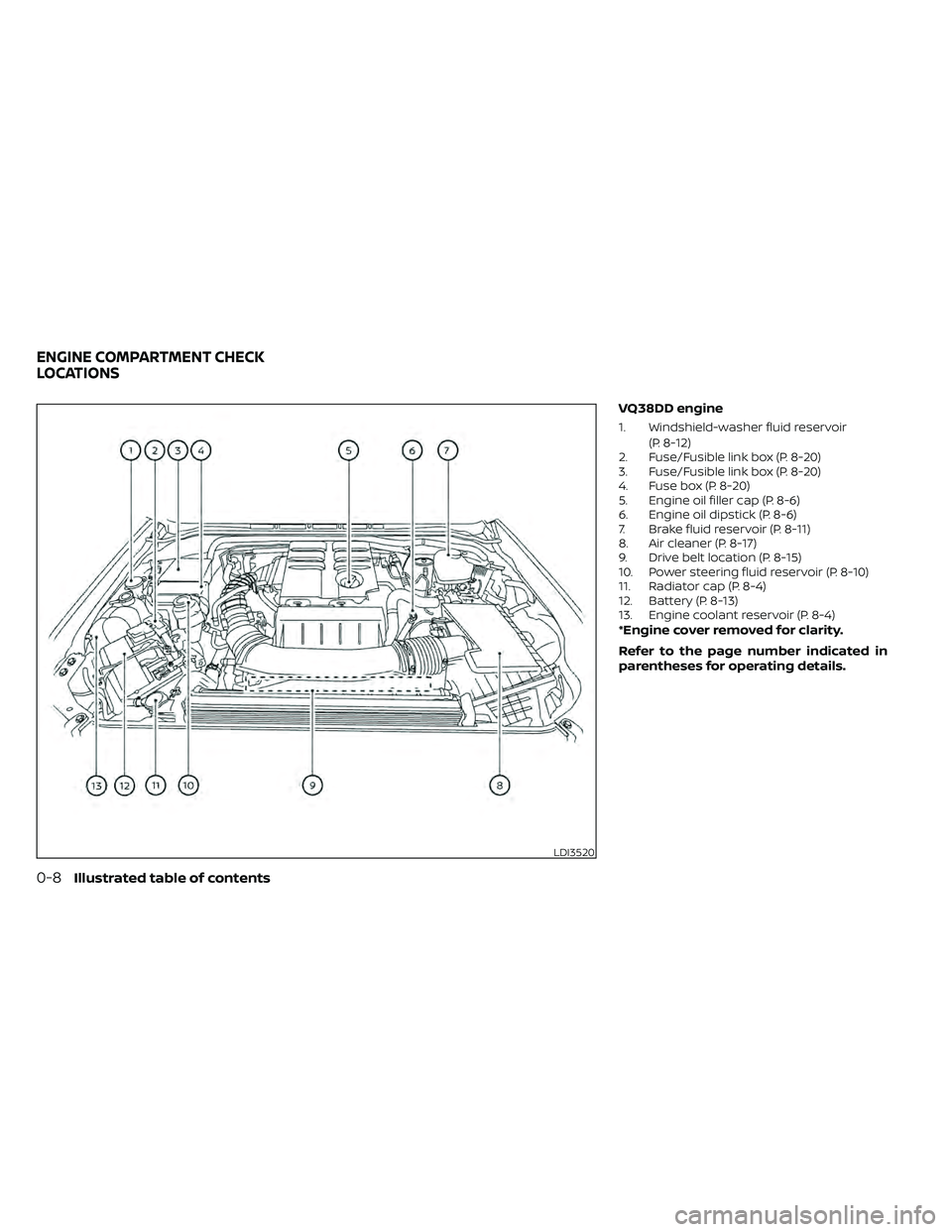
VQ38DD engine
1. Windshield-washer fluid reservoir(P. 8-12)
2. Fuse/Fusible link box (P. 8-20)
3. Fuse/Fusible link box (P. 8-20)
4. Fuse box (P. 8-20)
5. Engine oil filler cap (P. 8-6)
6. Engine oil dipstick (P. 8-6)
7. Brake fluid reservoir (P. 8-11)
8. Air cleaner (P. 8-17)
9. Drive belt location (P. 8-15)
10. Power steering fluid reservoir (P. 8-10)
11. Radiator cap (P. 8-4)
12. Battery (P. 8-13)
13. Engine coolant reservoir (P. 8-4)
*Engine cover removed for clarity.
Refer to the page number indicated in
parentheses for operating details.
LDI3520
ENGINE COMPARTMENT CHECK
LOCATIONS
0-8Illustrated table of contents
Page 19 of 492
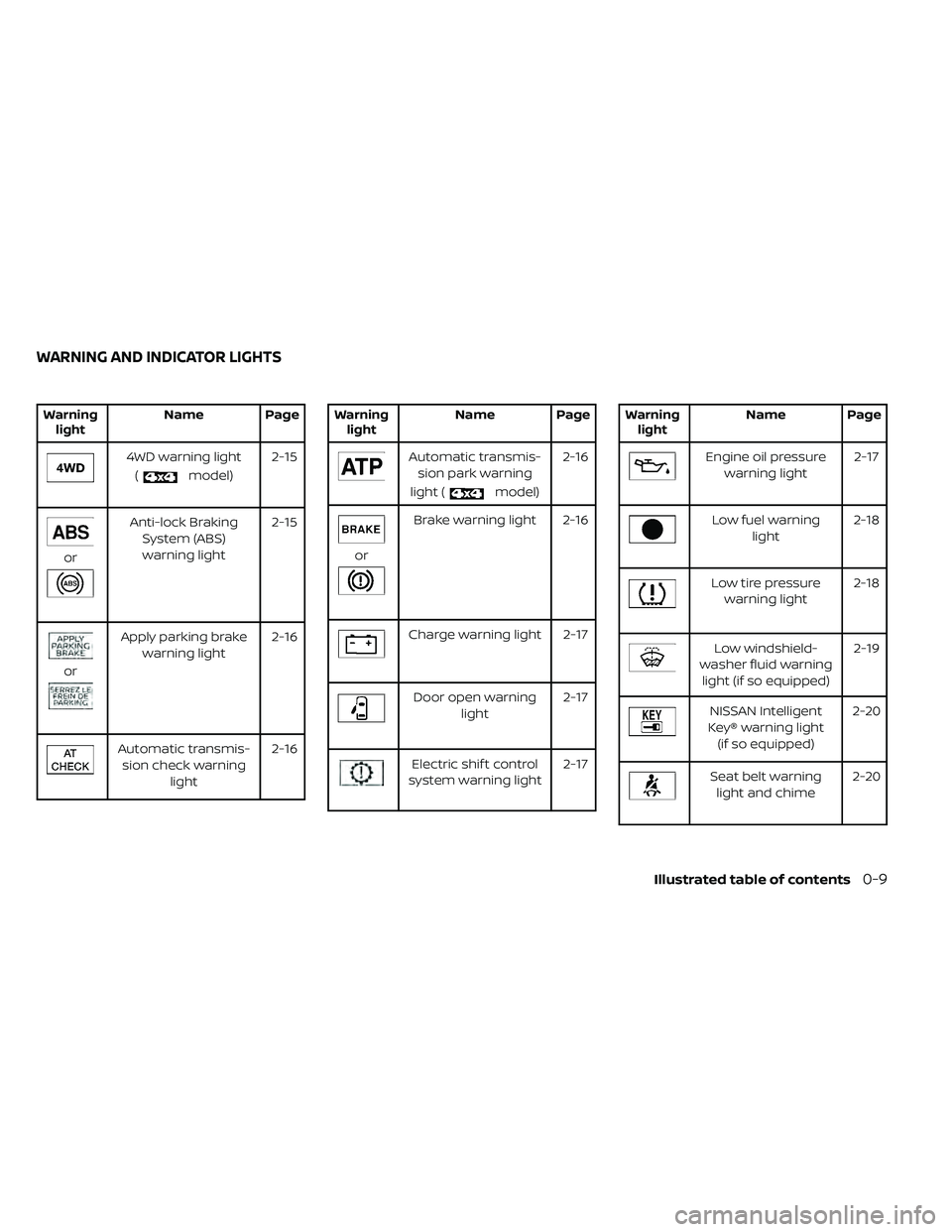
WarninglightName Page
4WD warning light
(
model) 2-15
or
Anti-lock Braking
System (ABS)warning light 2-15
or
Apply parking brake
warning light 2-16
Automatic transmis-
sion check warning light 2-16
Warning
lightName Page
Automatic transmis-
sion park warning
light (
model) 2-16
or
Brake warning light 2-16
Charge warning light 2-17
Door open warning
light 2-17
Electric shif t control
system warning light 2-17
Warning
lightName Page
Engine oil pressure
warning light 2-17
Low fuel warning
light 2-18
Low tire pressure
warning light 2-18
Low windshield-
washer fluid warning light (if so equipped) 2-19
NISSAN Intelligent
Key® warning light (if so equipped) 2-20
Seat belt warning
light and chime 2-20
WARNING AND INDICATOR LIGHTS
Illustrated table of contents0-9
Page 22 of 492
1 Safety-Seats, seat belts and
supplemental restraint system
Seats............................................ 1-2Front manual seat adjustment
(if so equipped) ................................1-3
Front power seat adjustment
(if so equipped) ............................... 1-5
Rear bench seat (if so equipped) ............. 1-6
Jump seat (if so equipped) ....................1-7
Armrest (if so equipped) .......................1-7
Flexible seating ................................1-7
Head restraints/headrests ......................1-10
Adjustable head restraint/headrest
components ................................. 1-11
Non-adjustable head restraint/headrest
components................................. 1-12
Remove...................................... 1-12
Install ........................................ 1-13
Adjust ........................................ 1-13
Front-seat active head restraints .............1-14
Seatbelts ....................................... 1-15
Precautions on seat belt usage ...............1-15
Seat belt warning light and chime ............1-18
Pregnant women ............................ 1-18
Injured persons .............................. 1-18Three-point type seat belt with
retractor .....................................
1-19
Seat belt extenders ......................... 1-24
Seat belt maintenance ......................1-24
Child safety .................................... 1-25
Infants ...................................... 1-26
Small children ............................... 1-26
Larger children .............................. 1-26
Child restraints ................................. 1-28
Precautions on child restraints ..............1-28
LATCH (Lower Anchors and Tethers for
CHildren) system ............................ 1-30
Rear-facing child restraint installation
using LATCH (Crew Cab models) .............1-34
Rear-facing child restraint installation
using LATCH — jump seat
(King Cab® models) .......................... 1-36
Rear-facing child restraint installation
using the seat belts (Crew Cab models) .....1-39
Rear-facing child restraint installation
using the seat belts — jump seat
(King Cab® models) .......................... 1-42
Page 23 of 492

Forward-facing child restraint
installation using LATCH
(Crew Cab models).......................... 1-47
Forward-facing child restraint
installation using LATCH — jump seat
(King Cab® models) .......................... 1-50
Forward-facing child restraint
installation using the seat belts —
front passenger and rear bench seat
(Crew Cab models) .......................... 1-54Forward-facing child restraint
installation using the seat belts —
front passenger and jump seats
(King Cab® models)
.......................... 1-59
Booster seats ............................... 1-65
Supplemental Restraint System (SRS) ..........1-70
Precautions on SRS ......................... 1-70
Supplemental air bag warning labels ........1-85
Supplemental air bag warning light .........1-85
Page 24 of 492
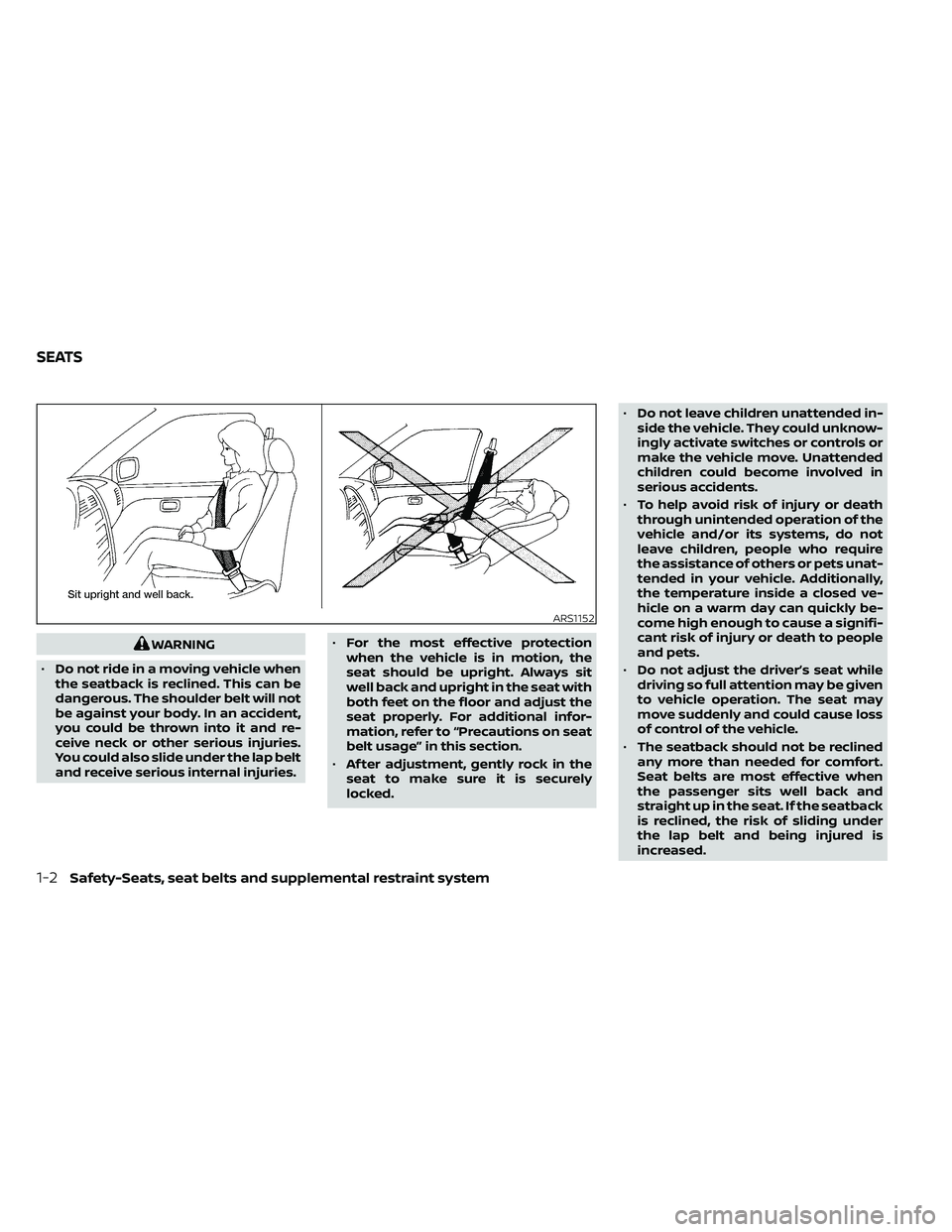
WARNING
• Do not ride in a moving vehicle when
the seatback is reclined. This can be
dangerous. The shoulder belt will not
be against your body. In an accident,
you could be thrown into it and re-
ceive neck or other serious injuries.
You could also slide under the lap belt
and receive serious internal injuries. •
For the most effective protection
when the vehicle is in motion, the
seat should be upright. Always sit
well back and upright in the seat with
both feet on the floor and adjust the
seat properly. For additional infor-
mation, refer to “Precautions on seat
belt usage” in this section.
• Af ter adjustment, gently rock in the
seat to make sure it is securely
locked. •
Do not leave children unattended in-
side the vehicle. They could unknow-
ingly activate switches or controls or
make the vehicle move. Unattended
children could become involved in
serious accidents.
• To help avoid risk of injury or death
through unintended operation of the
vehicle and/or its systems, do not
leave children, people who require
the assistance of others or pets unat-
tended in your vehicle. Additionally,
the temperature inside a closed ve-
hicle on a warm day can quickly be-
come high enough to cause a signifi-
cant risk of injury or death to people
and pets.
• Do not adjust the driver’s seat while
driving so full attention may be given
to vehicle operation. The seat may
move suddenly and could cause loss
of control of the vehicle.
• The seatback should not be reclined
any more than needed for comfort.
Seat belts are most effective when
the passenger sits well back and
straight up in the seat. If the seatback
is reclined, the risk of sliding under
the lap belt and being injured is
increased.
ARS1152
SEATS
1-2Safety-Seats, seat belts and supplemental restraint system
Page 25 of 492

CAUTION
When adjusting the seat positions, be
sure not to contact any moving parts to
avoid possible injuries and/or damage.
FRONT MANUAL SEAT
ADJUSTMENT (if so equipped)
Your vehicle seats can be adjusted manu-
ally. For additional information about ad-
justing the seats, refer to the steps outlined
in this section.
Forward and backward
Pull the lever up and hold it while you slide
the seat forward or backward to the de-
sired position. Release the lever to lock the
seat in position.
Reclining
To recline the seatback, pull the lever up
and lean back. To bring the seatback for-
ward, pull the lever up and lean your body
forward. Release the lever to lock the seat-
back in position.
The reclining feature allows adjustment of
the seatback for occupants of different
sizes for added comfort and to help obtain
proper seat belt fit. For additional informa-
tion, refer to “Precautions on seat belt us-
age” in this section. Also, the seatback can
be reclined to allow occupants to rest
when the vehicle is stopped and the shif t
WRS0175WRS0176
Safety-Seats, seat belts and supplemental restraint system1-3