towing NISSAN FRONTIER 2022 Owner´s Manual
[x] Cancel search | Manufacturer: NISSAN, Model Year: 2022, Model line: FRONTIER, Model: NISSAN FRONTIER 2022Pages: 556, PDF Size: 6.11 MB
Page 405 of 556
6 In case of emergency
Hazard warning flasher switch..................6-2
Emergency engine shut off ......................6-2
Flat tire ..........................................6-3
Tire Pressure Monitoring System
(TPMS) .......................................6-3
Changing a flat tire ...........................6-3
Jump starting ................................... 6-11Push starting
................................... 6-13
If your vehicle overheats ........................6-13
Towing your vehicle ............................ 6-14
Towing recommended by NISSAN ...........6-15
Vehicle recovery
(freeing a stuck vehicle) .....................6-16
Page 418 of 556
3. Get out of the vehicle. Look and listen forsteam or coolant escaping from the ra-
diator before opening the hood. If steam
or coolant is escaping, turn off the en-
gine. Do not open the hood further until
no steam or coolant can be seen.
4. Open the engine hood.
WARNING
If steam or water is coming from the
engine, stand clear to prevent getting
burned.
5. Visually check drive belts for damage or looseness. Also check if the cooling fan
is running. The radiator hoses and radia-
tor should not leak water. If coolant is
leaking, the water pump belt is missing
or loose, or the cooling fan does not run,
stop the engine.
WARNING
Be careful not to allow your hands, hair,
jewelry or clothing to come into con-
tact with, or get caught in, engine belts
or the engine cooling fan. The engine
cooling fan can start at any time. 6. Af ter the engine cools down, check the
coolant level in the engine coolant res-
ervoir tank with the engine running. Add
coolant to the engine coolant reservoir
tank if necessary. Have your vehicle re-
paired. It is recommended that you visit
a NISSAN dealer for this service. When towing your vehicle, all jurisdictional
and local regulations for towing must be
followed. Incorrect towing equipment
could damage your vehicle. Towing in-
structions are available from a NISSAN
dealer. Local service operators are gener-
ally familiar with the applicable laws and
procedures for towing. To assure proper
towing and to prevent accidental damage
to your vehicle, NISSAN recommends hav-
ing a service operator tow your vehicle. It is
advisable to have the service operator
carefully read the following precautions:
WARNING
• Never ride in a vehicle that is being
towed.
• Never get under your vehicle af ter it
has been lif ted by a tow truck.
CAUTION
• When towing, make sure that the
transmission, axles, steering system
and powertrain are in working condi-
tion. Use dollies or flatbed if any of
the listed systems are not working.
• Always attach safety chains before
towing.
TOWING YOUR VEHICLE
6-14In case of emergency
Page 419 of 556
For additional information, see “Flat towing
— 4WD with automatic transmission ”
(P. 10-39) or “Flat towing — 2WD with auto-
matic transmission” (P. 10-39).
TOWING RECOMMENDED BY
NISSAN
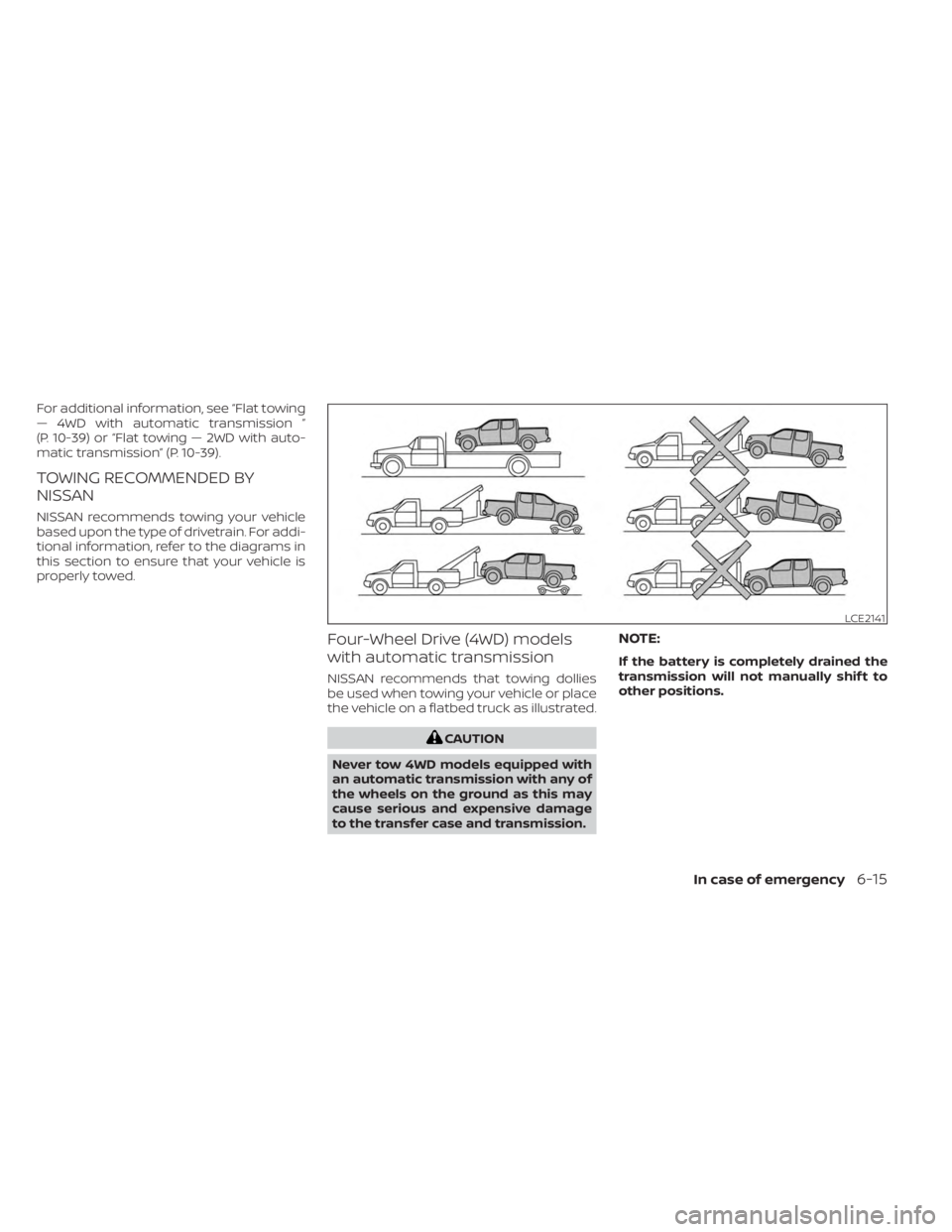
NISSAN recommends towing your vehicle
based upon the type of drivetrain. For addi-
tional information, refer to the diagrams in
this section to ensure that your vehicle is
properly towed.
Four-Wheel Drive (4WD) models
with automatic transmission
NISSAN recommends that towing dollies
be used when towing your vehicle or place
the vehicle on a flatbed truck as illustrated.
CAUTION
Never tow 4WD models equipped with
an automatic transmission with any of
the wheels on the ground as this may
cause serious and expensive damage
to the transfer case and transmission.
NOTE:
If the battery is completely drained the
transmission will not manually shif t to
other positions.
LCE2141
In case of emergency6-15
Page 420 of 556
Two-Wheel Drive models with
automatic transmission
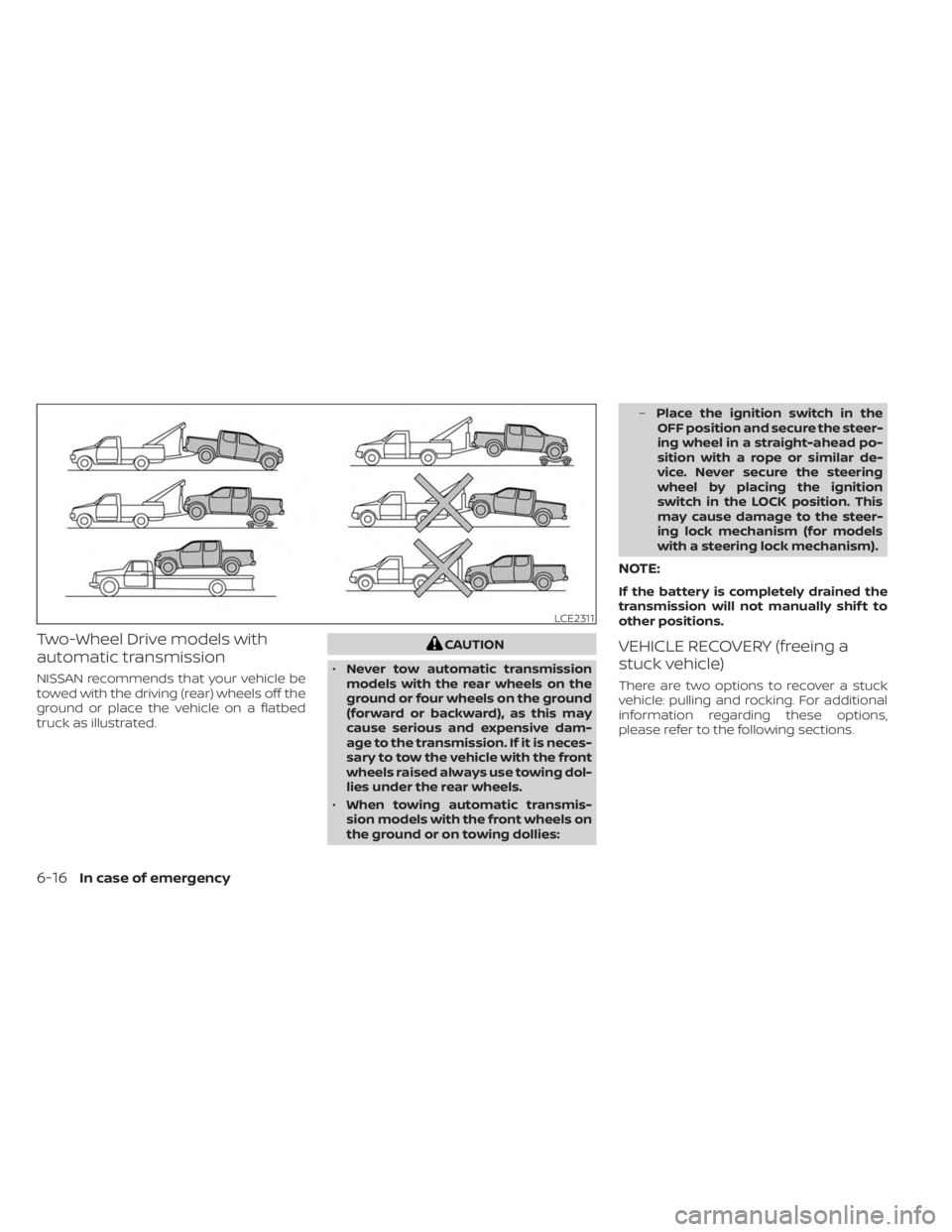
NISSAN recommends that your vehicle be
towed with the driving (rear) wheels off the
ground or place the vehicle on a flatbed
truck as illustrated.
CAUTION
• Never tow automatic transmission
models with the rear wheels on the
ground or four wheels on the ground
(forward or backward), as this may
cause serious and expensive dam-
age to the transmission. If it is neces-
sary to tow the vehicle with the front
wheels raised always use towing dol-
lies under the rear wheels.
• When towing automatic transmis-
sion models with the front wheels on
the ground or on towing dollies: –
Place the ignition switch in the
OFF position and secure the steer-
ing wheel in a straight-ahead po-
sition with a rope or similar de-
vice. Never secure the steering
wheel by placing the ignition
switch in the LOCK position. This
may cause damage to the steer-
ing lock mechanism (for models
with a steering lock mechanism).
NOTE:
If the battery is completely drained the
transmission will not manually shif t to
other positions.
VEHICLE RECOVERY (freeing a
stuck vehicle)
There are two options to recover a stuck
vehicle: pulling and rocking. For additional
information regarding these options,
please refer to the following sections.
LCE2311
6-16In case of emergency
Page 421 of 556
Pulling a stuck vehicle
WARNING
To avoid vehicle damage, serious per-
sonal injury or death when recovering a
stuck vehicle:
• Contact a professional towing ser-
vice to recover the vehicle if you have
any questions regarding the recov-
ery procedure.
• Attach recovery devices only to main
structural members of the vehicle or
the recovery hooks (if so equipped).
• Do not use the vehicle tie-downs to
tow or free a stuck vehicle.
• Only use devices specifically de-
signed for vehicle recovery and fol-
low the manufacturer's instructions.
• Always pull the recovery device
straight out from the front of the ve-
hicle. Never pull at an angle.
• Route recovery devices so they do
not touch any part of the vehicle ex-
cept the attachment point.
If your vehicle is stuck in sand, snow, mud,
etc., use a tow strap or other device de-
signed specifically for vehicle recovery. Al-
ways follow the manufacturer's instruc-
tions for the recovery device.
Rocking a stuck vehicle
WARNING
• Stand clear of a stuck vehicle.
• Do not spin your tires at high speed.
This could cause them to explode
and result in serious injury. Parts of
your vehicle could also overheat and
be damaged.
If your vehicle is stuck in sand, snow, mud,
etc., use the following procedure:
1. Turn off the Vehicle Dynamic Control (VDC) system.
2. Make sure the area in front and behind the vehicle is clear of obstructions.
3. Turn the steering wheel right and lef t to clear an area around the front tires.
4. Slowly rock the vehicle forward and backward.
• Shif t back and forth between R (Re- verse) and D (Drive).
• Apply the accelerator as little as pos- sible to maintain the rocking motion.
• Release the accelerator pedal before shif ting between R (Reverse) and D
(Drive). • Do not spin the tires above 34 mph (55
km/h).
5. If the vehicle cannot be freed af ter a few tries, contact a professional towing ser-
vice to remove the vehicle.
In case of emergency6-17
Page 481 of 556
Tire rotation:Rotate tires at the specified
interval shown in the maintenance sched-
ule. When rotating tires, check for damage
and uneven wear. Replace if necessary.
Transmission fluid/oil, differential oil
and transfer case oil: Visually inspect for
signs of leakage at specified intervals.
Off-road maintenance: Check the follow-
ing items frequently whenever you drive
off-road through deep sand, mud or water:
• Brake pads and rotors
• Brake linings and drums
• Brake lines and hoses
• Differential, transmission and transfer case oil
• Steering linkage
• Propeller shaf t(s) and front drive shaf ts
• Engine air filter
• Clutch housing drain (AWD only) To help ensure smooth, safe and economi-
cal driving, NISSAN provides two mainte-
nance schedules that may be used, de-
pending upon the conditions in which you
usually drive. These schedules contain
both distance and time intervals, up to
120,000 miles (192,000 km)/96 months. For
most people, the odometer reading will in-
dicate when service is needed. However, if
you drive very little, your vehicle should be
serviced at the regular time intervals
shown in the schedule.
Af ter 120,000 miles (192,000 km)/96
months, continue maintenance at the
same mileage/time intervals.
ADDITIONAL MAINTENANCE ITEMS
FOR SEVERE OPERATING
CONDITIONS
Additional maintenance items for severe
operating conditions
should be per-
formed on vehicles that are driven under
especially demanding conditions. Addi-
tional maintenance items should be per-
formed if you primarily operate your vehicle
under the following conditions:
• Repeated short trips of less than 5 miles (8 km). • Repeated short trips of less than 10 miles
(16 km) with outside temperatures re-
maining below freezing.
• Operating in hot weather in stop-and-go “rush hour” traffic.
• Extensive idling and/or low speed driving for long distances, such as police, taxi or
door-to-door delivery use.
• Driving in dusty conditions.
• Driving on rough, muddy or salt spread roads.
• Towing a trailer, using a camper or using a car-top carrier.
If your vehicle is mostly operated under the
severe conditions, follow the severe use
maintenance intervals shown in the main-
tenance schedule.
MAINTENANCE SCHEDULES
Maintenance and schedules9-7
Page 483 of 556
10,000 miles/(16,000 km)/
12 months
Perform at number of miles, kilometers or
months, whichever comes first.
Standard maintenance:
Not applicable. Proceed to next interval
Severe use maintenance:
Inspections:
• Brake pads and rotors
• Steering gear and linkage
• Axle and suspension parts
• Drive shaf t boots (4WD models)
• Propeller shaf t (4WD models)
• Exhaust system
Essential:
• Replace engine oil & filter
• Replace brake fluid
15,000 miles/(24,000 km)/
12 months
Perform at number of miles, kilometers or
months, whichever comes first.
Standard maintenance:
Inspections:
• Automatic transmission fluid (2) (3)
• Brake lines and cables
• Brake pads and rotors
• Drive shaf t boots (4WD models)
• Propeller shaf t (4WD models)
• Differential gear oil
• Transfer fluid
Essential:
• Replace engine oil & filter
• Replace in-cabin microfilter
• Lubricate propeller shaf t (4WD models)
• Tire rotation
Severe use maintenance:
Not applicable. Proceed to next interval.
(2) Request a NISSAN dealer to inspect the
fluid deterioration data using a CONSULT. If
the deterioration data is more than 77000,
replace the AT fluid.(3) If using under severe conditions such as
towing a trailer, using a car-top carrier, or
driving on rough or muddy roads, change
(not just inspect) oil at every 30,000 miles
(48,000 km) or 24 months. NISSAN recom-
mends using Genuine NISSAN Matic P au-
tomatic transmission fluid. Using auto-
matic transmission fluid that is not
equivalent to Genuine NISSAN Matic P may
damage the transmission or impact trans-
mission durability. Damage caused by the
use of fluid other than as recommended is
not covered under the NISSAN New Vehicle
Limited Warranty.
Maintenance and schedules9-9
Page 485 of 556
25,000 miles/(40,000 km)/
30 months
Perform at number of miles, kilometers or
months, whichever comes first.
Standard maintenance:
Not applicable. Proceed to next interval
Severe use maintenance:
Inspections:
• Brake pads and rotors
• Steering gear and linkage
• Axle and suspension parts
• Drive shaf t boots (4WD models)
• Propeller shaf t (4WD models)
• Exhaust system
Essential:
• Replace engine oil & filter
30,000 miles/(48,000 km)/
24 months
Perform at number of miles, kilometers or
months, whichever comes first.
Standard maintenance:
Inspections:
• Automatic transmission fluid (2) (3)
• Brake lines and cables
• Brake pads and rotors
• EVAP vapor lines & fuel lines*
• Exhaust system
• Drive shaf t boots (4WD models)
• Propeller shaf t (4WD models)
• Steering gear and linkage
• Axle and suspension parts
• Differential gear oil
• Transfer fluid
Essential:
• Replace engine air filter (1)
• Replace brake fluid
• Replace engine oil & filter
• Replace in-cabin microfilter
• Lubricate propeller shaf t (4WD models)
• Tire rotationSevere use maintenance:
Not applicable. Proceed to next interval
* Maintenance items and intervals with “*”
are recommended by NISSAN for reliable
vehicle operation. The owner need not per-
form such maintenance in order to main-
tain the emission warranty or manufac-
turer recall liability. Other maintenance
items and intervals are required.
(1) If operating mainly in dusty conditions,
more frequent maintenance may be required.
(2) Request a NISSAN dealer to inspect the
fluid deterioration data using a CONSULT. If
the deterioration data is more than 77000,
replace the AT fluid.
(3) If using under severe conditions such as
towing a trailer, using a car-top carrier, or
driving on rough or muddy roads, change
(not just inspect) oil at every 30,000 miles
(48,000 km) or 24 months. NISSAN recom-
mends using Genuine NISSAN Matic P au-
tomatic transmission fluid. Using auto-
matic transmission fluid that is not
equivalent to Genuine NISSAN Matic P may
damage the transmission or impact trans-
mission durability. Damage caused by the
use of fluid other than as recommended is
not covered under the NISSAN New Vehicle
Limited Warranty.
Maintenance and schedules9-11
Page 487 of 556
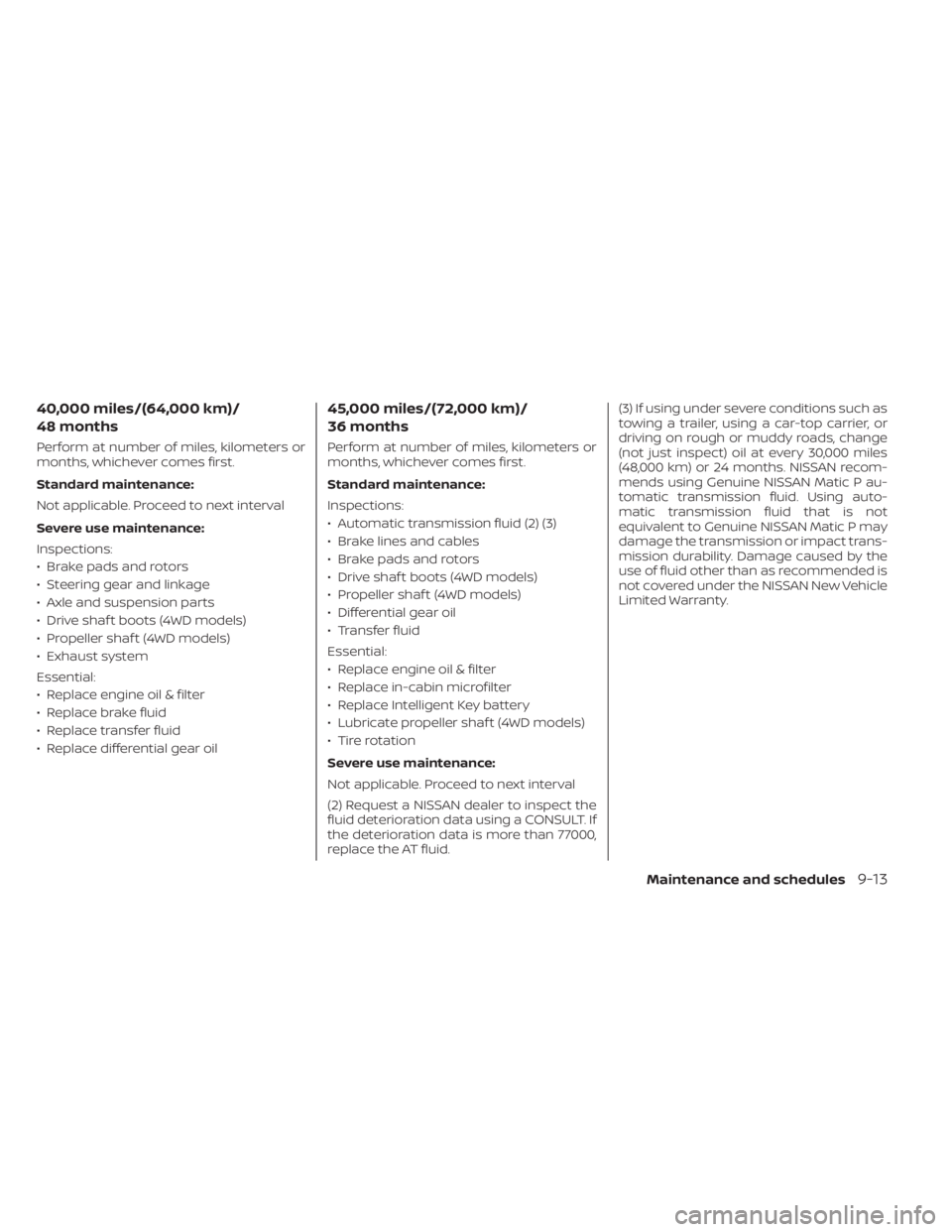
40,000 miles/(64,000 km)/
48 months
Perform at number of miles, kilometers or
months, whichever comes first.
Standard maintenance:
Not applicable. Proceed to next interval
Severe use maintenance:
Inspections:
• Brake pads and rotors
• Steering gear and linkage
• Axle and suspension parts
• Drive shaf t boots (4WD models)
• Propeller shaf t (4WD models)
• Exhaust system
Essential:
• Replace engine oil & filter
• Replace brake fluid
• Replace transfer fluid
• Replace differential gear oil
45,000 miles/(72,000 km)/
36 months
Perform at number of miles, kilometers or
months, whichever comes first.
Standard maintenance:
Inspections:
• Automatic transmission fluid (2) (3)
• Brake lines and cables
• Brake pads and rotors
• Drive shaf t boots (4WD models)
• Propeller shaf t (4WD models)
• Differential gear oil
• Transfer fluid
Essential:
• Replace engine oil & filter
• Replace in-cabin microfilter
• Replace Intelligent Key battery
• Lubricate propeller shaf t (4WD models)
• Tire rotation
Severe use maintenance:
Not applicable. Proceed to next interval
(2) Request a NISSAN dealer to inspect the
fluid deterioration data using a CONSULT. If
the deterioration data is more than 77000,
replace the AT fluid.(3) If using under severe conditions such as
towing a trailer, using a car-top carrier, or
driving on rough or muddy roads, change
(not just inspect) oil at every 30,000 miles
(48,000 km) or 24 months. NISSAN recom-
mends using Genuine NISSAN Matic P au-
tomatic transmission fluid. Using auto-
matic transmission fluid that is not
equivalent to Genuine NISSAN Matic P may
damage the transmission or impact trans-
mission durability. Damage caused by the
use of fluid other than as recommended is
not covered under the NISSAN New Vehicle
Limited Warranty.
Maintenance and schedules9-13
Page 489 of 556
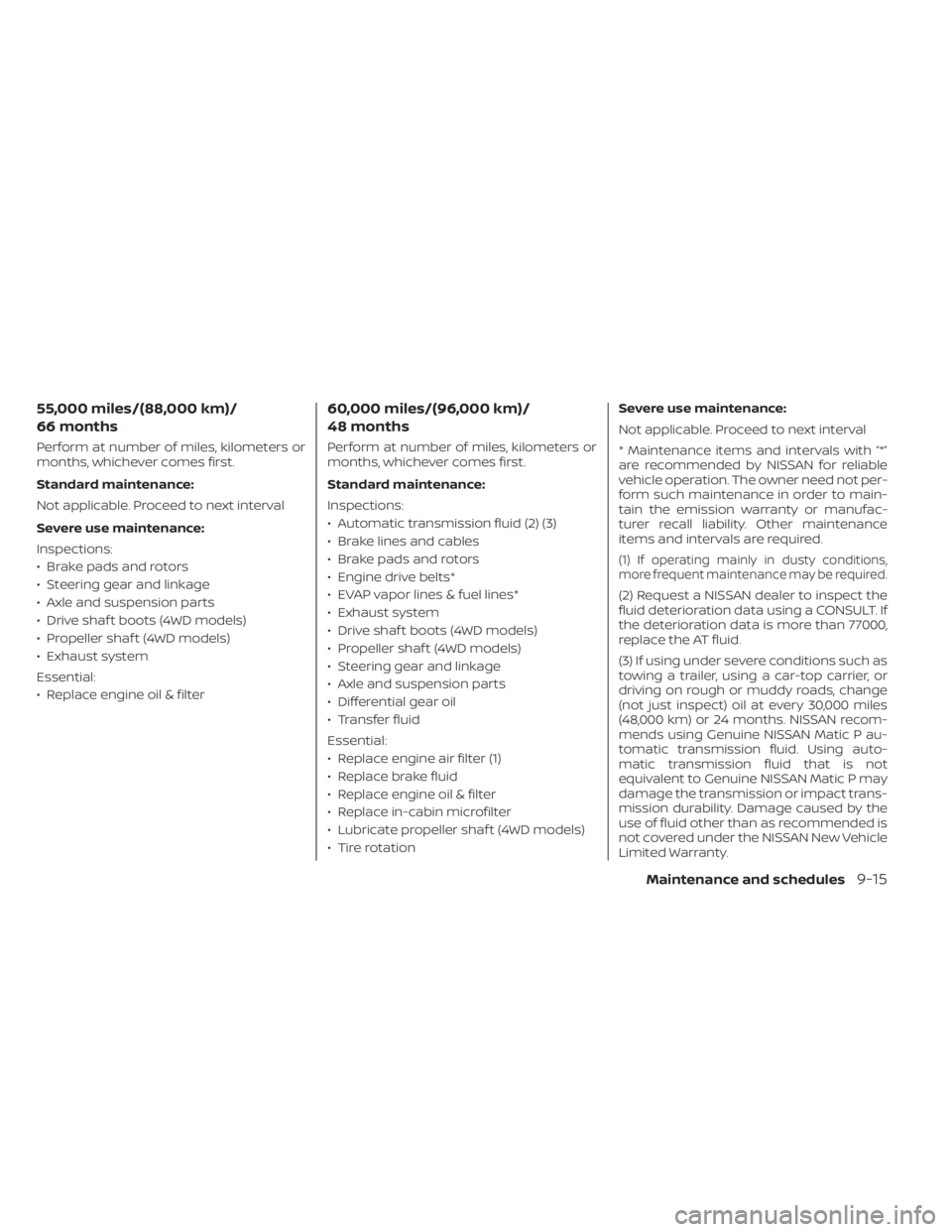
55,000 miles/(88,000 km)/
66 months
Perform at number of miles, kilometers or
months, whichever comes first.
Standard maintenance:
Not applicable. Proceed to next interval
Severe use maintenance:
Inspections:
• Brake pads and rotors
• Steering gear and linkage
• Axle and suspension parts
• Drive shaf t boots (4WD models)
• Propeller shaf t (4WD models)
• Exhaust system
Essential:
• Replace engine oil & filter
60,000 miles/(96,000 km)/
48 months
Perform at number of miles, kilometers or
months, whichever comes first.
Standard maintenance:
Inspections:
• Automatic transmission fluid (2) (3)
• Brake lines and cables
• Brake pads and rotors
• Engine drive belts*
• EVAP vapor lines & fuel lines*
• Exhaust system
• Drive shaf t boots (4WD models)
• Propeller shaf t (4WD models)
• Steering gear and linkage
• Axle and suspension parts
• Differential gear oil
• Transfer fluid
Essential:
• Replace engine air filter (1)
• Replace brake fluid
• Replace engine oil & filter
• Replace in-cabin microfilter
• Lubricate propeller shaf t (4WD models)
• Tire rotationSevere use maintenance:
Not applicable. Proceed to next interval
* Maintenance items and intervals with “*”
are recommended by NISSAN for reliable
vehicle operation. The owner need not per-
form such maintenance in order to main-
tain the emission warranty or manufac-
turer recall liability. Other maintenance
items and intervals are required.
(1) If operating mainly in dusty conditions,
more frequent maintenance may be required.
(2) Request a NISSAN dealer to inspect the
fluid deterioration data using a CONSULT. If
the deterioration data is more than 77000,
replace the AT fluid.
(3) If using under severe conditions such as
towing a trailer, using a car-top carrier, or
driving on rough or muddy roads, change
(not just inspect) oil at every 30,000 miles
(48,000 km) or 24 months. NISSAN recom-
mends using Genuine NISSAN Matic P au-
tomatic transmission fluid. Using auto-
matic transmission fluid that is not
equivalent to Genuine NISSAN Matic P may
damage the transmission or impact trans-
mission durability. Damage caused by the
use of fluid other than as recommended is
not covered under the NISSAN New Vehicle
Limited Warranty.
Maintenance and schedules9-15