SERVICE AT NISSAN FRONTIER 2023 Owners Manual
[x] Cancel search | Manufacturer: NISSAN, Model Year: 2023, Model line: FRONTIER, Model: NISSAN FRONTIER 2023Pages: 572, PDF Size: 6.58 MB
Page 518 of 572
FUEL RECOMMENDATION
Use unleaded regular gasoline with an oc-
tane rating of at least 87 AKI (Anti-Knock
Index) number (Research octane number
91).
CAUTION
• Only vehicles with the E-85 filler door
label can operate on E-85. Fuel sys-
tem or other damage can occur if
E-85 is used in vehicles that are not
designed to run on E-85.
• Using a fuel other than that specified
could adversely affect the emission
control system, and may also affect
the warranty coverage.
•
Under no circumstances should a
leaded gasoline be used, because this
will damage the three-way catalyst.
• Do not use a fuel containing more
than 15% ethanol in your vehicle. Your
vehicle is not designed to run on a
fuel containing more than 15% etha-
nol. Using a fuel containing more
than 15% ethanol in a vehicle not spe-
cifically designed for a fuel contain-
ing more than 15% ethanol can ad-
versely affect the emission control
devices and systems of the vehicle.
Damage caused by such fuel is not
covered by the NISSAN New Vehicle
Limited Warranty.
• Do not use fuel that contains the oc-
tane booster methylcyclopentadi-
enyl manganese tricarbonyl (MMT).
Using fuel containing MMT may ad-
versely affect vehicle performance
and vehicle emissions. Not all fuel
dispensers are labeled to indicate
MMT content, so you may have to
consult your gasoline retailer for
more details. Note that Federal and
California laws prohibit the use of
MMT in reformulated gasoline. •
U.S. government regulations require
ethanol dispensing pumps to be
identified by a small, square, orange
and black label with the common ab-
breviation or the appropriate per-
centage for that region.
Gasoline specifications
NISSAN recommends using gasoline that
meets the World-Wide Fuel Charter (WWFC)
specifications where it is available. Many of
the automobile manufacturers developed
this specification to improve emission con-
trol system and vehicle performance. Ask
your service station manager if the gaso-
line meets the WWFC specifications.
Reformulated gasoline
Some fuel suppliers are now producing re-
formulated gasolines. These gasolines are
specially designed to reduce vehicle emis-
sions. NISSAN supports efforts towards
cleaner air and suggests that you use re-
formulated gasoline when available.
10-4Technical and consumer information
Page 519 of 572
Gasoline containing oxygenates
Some fuel suppliers sell gasoline contain-
ing oxygenates such as ethanol, Methyl
Tert-butyl Ether (MTBE) and methanol with
or without advertising their presence.
NISSAN does not recommend the use of
fuels of which the oxygenate content and
the fuel compatibility for your NISSAN can-
not be readily determined. If in doubt, ask
your service station manager.
If you use oxygenate-blend gasoline,
please take the following precautions as
the usage of such fuels may cause vehicle
performance problems and/or fuel system
damage.
•The fuel should be unleaded and have
an octane rating no lower than that
recommended for unleaded gasoline.
• If an oxygenate-blend other than
methanol blend is used, it should con-
tain no more than 15% oxygenate. •
If a methanol blend is used, it should
contain no more than 5% methanol
(methyl alcohol, wood alcohol). It
should also contain a suitable amount
of appropriate cosolvents and corro-
sion inhibitors. If not properly formu-
lated with appropriate cosolvents and
corrosion inhibitors, such methanol
blends may cause fuel system damage
and/or vehicle performance problems.
At this time, sufficient data is not avail-
able to ensure that all methanol blends
are suitable for use in NISSAN vehicles.
If any driveability problems such as engine
stalling and difficult hot-starting are expe-
rienced af ter using oxygenate-blend fuels,
immediately change to a non-oxygenate
fuel or a fuel with a low blend of MTBE.
Take care not to spill gasoline during re-
fueling. Gasoline containing oxygenates
can cause paint damage.
E–15 fuel
E-15 fuel is a mixture of approximately 15%
fuel ethanol and 85% unleaded gasoline.
E-15 can only be used in vehicles designed
to run on E-15 fuel. U.S. government regula-
tions require fuel ethanol dispensing
pumps to be identified with small, square,
orange and black label with the common
abbreviation or the appropriate percent-
age for that region.
E–85 fuel
E-85 fuel is a mixture of approximately 85%
fuel ethanol and 15% unleaded gasoline.
E-85 can only be used in a Flexible Fuel
Vehicle (FFV). Do not use E-85 in your ve-
hicle. U.S. government regulations require
fuel ethanol dispensing pumps to be iden-
tified by a small, square, orange and black
label with the common abbreviation or the
appropriate percentage for that region.
Technical and consumer information10-5
Page 522 of 572
Change intervals
The oil and oil filter change intervals for
your engine are based on the use of the
specified quality oils and filters. Using en-
gine oil and filters that are not of the speci-
fied quality, or exceeding recommended oil
and filter change intervals could reduce
engine life or cause severe damage to the
engine. Damage to the engine caused by
improper maintenance or use of incorrect
oil and filter quality and/or viscosity is not
covered by the NISSAN New Vehicle Limited
Warranty.
Your engine was filled with a high-quality
engine oil when it was built. You do not have
to change the oil before the first recom-
mended change interval. Oil and filter
change intervals depend upon how you
use your vehicle.
NISSAN recommends the use of Genuine
NISSAN parts or equivalent. The use of
parts that do not meet or exceed NISSAN
specifications, can cause damage to your
vehicle, and have an effect on your war-
ranty coverage. It is recommended that
you visit a NISSAN dealer parts department
who can provide information on the proper
parts for your vehicle.Operation under the following conditions
may require more frequent oil and filter
changes:
• repeated short distance driving at cold
outside temperatures
• driving in dusty conditions
• extensive idling
• towing a trailer
• stop and go commuting
For additional information, see the “Mainte-
nance and schedules” section of this
manual.
AIR CONDITIONER SYSTEM
REFRIGERANT AND OIL
RECOMMENDATIONS
The air conditioner system in your
NISSAN vehicle must be charged with the
refrigerant HFO-1234yf (R-1234yf ) and
NISSAN A/C system oil Type ND-OIL12
(PAG) or the exact equivalents.
CAUTION
The use of any other refrigerant or oil
will cause severe damage to the air
conditioning system and will require
the replacement of all air conditioner
system components. The refrigerant HFO-1234yf (R-1234yf ) in
your NISSAN vehicle does not harm the
earth's ozone layer. Although this refriger-
ant does not affect the earth's atmo-
sphere, certain government regulations re-
quire the recovery and recycling of any
refrigerant during automotive air condi-
tioner system service. Air conditioner sys-
tem should only be serviced by trained and
certified technicians to ensure proper and
safe operation (SAE J2845). A NISSAN dealer
has the trained technicians and equip-
ment needed to recover and recycle your
air conditioner system refrigerant. Only
new and SAEJ2842 certified evaporator(s)
shall be used as replacement parts.
A damaged or leaking air conditioning
evaporator shall never be repaired or re-
placed with one removed from a used or
salvaged vehicle. To replace a damaged or
leaking evaporator, use only new and SAE
J2842 certified evaporator(s). It is recom-
mended that you visit a NISSAN dealer when
servicing your air conditioner system.
10-8Technical and consumer information
Page 529 of 572
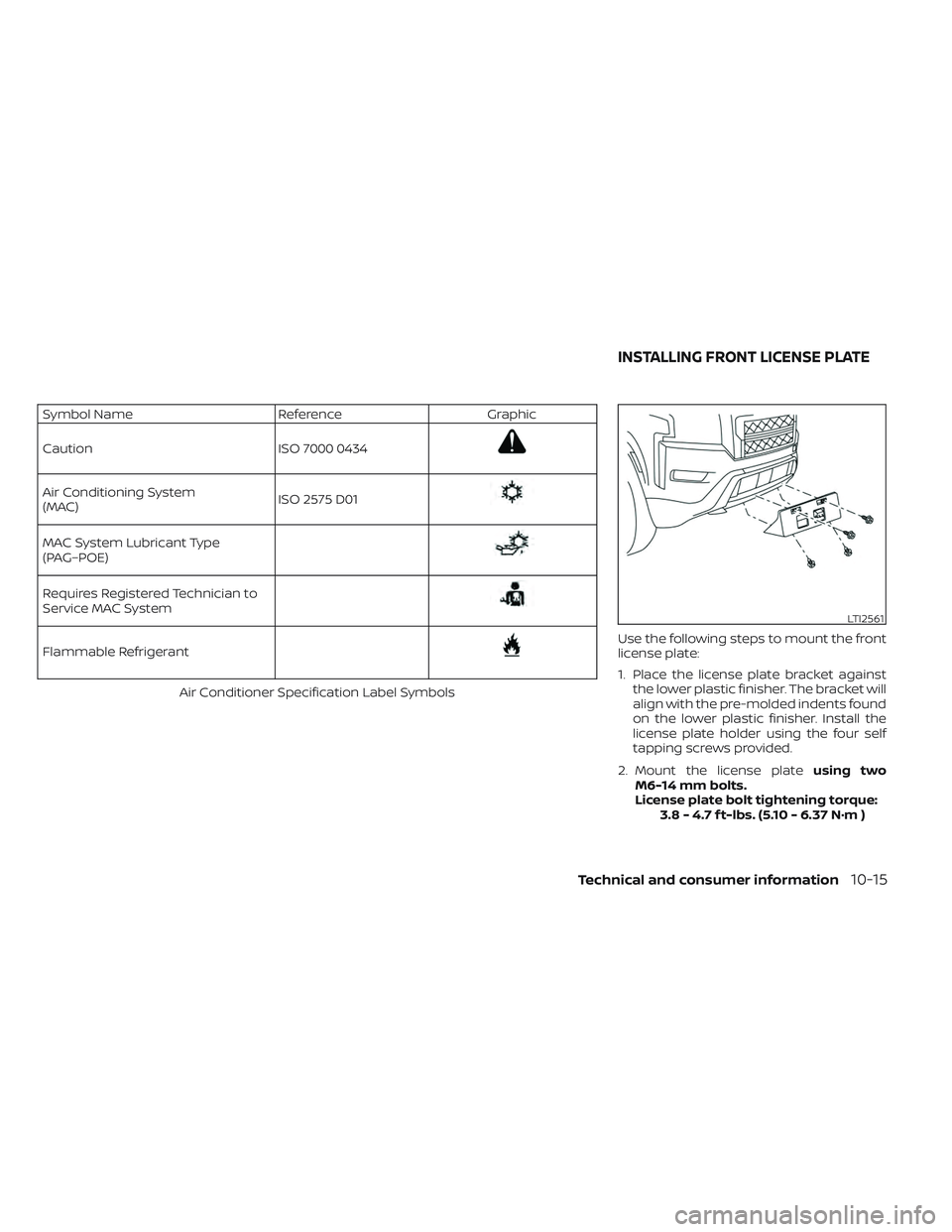
Symbol NameReferenceGraphic
Caution ISO 7000 0434
Air Conditioning System
(MAC)ISO 2575 D01
MAC System Lubricant Type
(PAG–POE)
Requires Registered Technician to
Service MAC System
Flammable Refrigerant
Air Conditioner Specification Label Symbols Use the following steps to mount the front
license plate:
1. Place the license plate bracket against
the lower plastic finisher. The bracket will
align with the pre-molded indents found
on the lower plastic finisher. Install the
license plate holder using the four self
tapping screws provided.
2. Mount the license plate using two
M6-14 mm bolts.
License plate bolt tightening torque: 3.8 - 4.7 f t-lbs. (5.10 - 6.37 N·m )
LTI2561
INSTALLING FRONT LICENSE PLATE
Technical and consumer information10-15
Page 552 of 572
• Avoid abrupt starts, acceleration or stops.
• Avoid sharp turns or lane changes.
• Always drive your vehicle at a moderatespeed.
• When backing up, hold the bottom of the steering wheel with one hand. Move your
hand in the direction in which you want
the trailer to go. Make small corrections
and back up slowly. If possible, have
someone guide you when you are back-
ing up.
Always block the wheels on both vehicle
and trailer when parking. Parking on a
slope is not recommended; however, if you
must do so:
CAUTION
If you move the shif t lever to the P
(Park) position before blocking the
wheels and applying the parking brake,
transmission damage could occur.
1. Apply and hold the brake pedal.
2. Have someone place blocks on the downhill side of the vehicle and trailer
wheels.
3. Af ter the wheel blocks are in place, slowly release the brake pedal until the
blocks absorb the vehicle load. 4. Apply the parking brake.
5. Shif t the transmission into P (Park).
6. Make sure the 4WD shif t indicator light (if
so equipped) indicates the transfer case
is in 4H, 4LO, or 2WD and that the ATP
light is off. If the 4WD shif t indicator light
is flashing, or the ATP light is ON, make
sure the transmission is in P (Park) and
turn the 4WD switch to 2WD or 4H. For
additional information, see “Automatic
transmission park warning light” (P. 2-13)
and “Using 4-wheel drive (4WD)” (P. 5-109).
7. Turn off the engine.
To drive away:
1. Start the vehicle.
2. Apply and hold the brake pedal.
3. Shif t the transmission into gear.
4. Release the parking brake.
5. Drive slowly until the vehicle and trailer are clear from the blocks.
6. Apply and hold the brake pedal.
7. Have someone retrieve and store the blocks. • While going downhill, the weight of the
trailer pushing on the tow vehicle may
decrease overall stability. Therefore, to
maintain adequate control, reduce your
speed and shif t to a lower gear. Avoid
long or repeated use of the brakes when
descending a hill, as this reduces their
effectiveness and could cause overheat-
ing. Shif ting to a lower gear instead pro-
vides “engine braking” and reduces the
need to brake as frequently.
• If the engine coolant temperature rises to a high temperature, see “If your vehicle
overheats” (P. 6-13).
• Trailer towing requires more fuel than normal circumstances.
• Avoid towing a trailer for your vehicle's first 500 miles (805 km).
• For the first 500 miles (805 km) that you do tow, do not drive over 50 mph (80
km/h).
• Have your vehicle serviced more of ten than at intervals specified. For additional
information, see the “Maintenance and
schedules” section of this manual.
• When making a turn, your trailer wheels will be closer to the inside of the turn than
your vehicle wheels. To compensate for
this, make a larger than normal turning
radius during the turn.
10-38Technical and consumer information
Page 555 of 572
DOT (Department of Transportation) Qual-
ity Grades: All passenger car tires must
conform to federal safety requirements in
addition to these grades.
Quality grades can be found where appli-
cable on the tire sidewall between tread
shoulder and maximum section width. For
example:
Treadwear 200 Traction AA Temperature A
Treadwear
The treadwear grade is a comparative rat-
ing based on the wear rate of the tire when
tested under controlled conditions on a
specified government test course. For ex-
ample, a tire graded 150 would wear one
and one-half (1 1/2) times as well on the
government course as a tire graded 100.
The relative performance of tires depends
upon the actual conditions of their use,
however, and may depart significantly from
the norm due to variations in driving habits,
service practices and differences in road
characteristics and climate.
Traction AA, A, B and C
The traction grades, from highest to low-
est, are AA, A, B, and C. Those grades repre-
sent the tire's ability to stop on wet pave-
ment as measured under controlledconditions on specified government test
surfaces of asphalt and concrete. A tire
marked C may have poor traction
performance.
WARNING
The traction grade assigned to this tire
is based on straight-ahead braking
traction tests, and does not include ac-
celeration, cornering, hydroplaning, or
peak traction characteristics.
Temperature A, B and C
The temperature grades are A (the high-
est), B, and C, representing the tire’s resis-
tance to the generation of heat, and its
ability to dissipate heat when tested under
controlled conditions on a specified indoor
laboratory test wheel. Sustained high tem-
perature can cause the material of the tire
to degenerate and reduce tire life, and ex-
cessive temperature can lead to sudden
tire failure. The grade C corresponds to a
level of performance which all passenger
car tires must meet under the Federal Mo-
tor Safety Standard No. 109. Grades B and A
represent higher levels of performance on
the laboratory test wheel than the mini-
mum required by law.
WARNING
The temperature grade for this tire is
established for a tire that is properly
inflated and not overloaded. Excessive
speed, under-inflation, or excessive
loading, either separately or in combi-
nation, can cause heat build-up and
possible tire failure.
UNIFORM TIRE QUALITY GRADING
Technical and consumer information10-41
Page 558 of 572
This vehicle is equipped with an Event Data
Recorder (EDR). The main purpose of an
EDR is to record, in certain crash or near
crash-like situations, such as an air bag
deployment or hitting a road obstacle, data
that will assist in understanding how a ve-
hicle's systems performed. The EDR is de-
signed to record data related to vehicle dy-
namics and safety systems for a short
period of time, typically 30 seconds or less.
The EDR in this vehicle is designed to re-
cord such data as:
• How various systems in your vehicle wereoperating;
• Whether or not the driver and passenger safety belts were buckled/fastened;
• How far (if at all) the driver was depress- ing the accelerator and/or brake pedal;
and,
• How fast the vehicle was traveling.
• Sounds are not recorded. These data can help provide a better un-
derstanding of the circumstances in which
crashes and injuries occur. NOTE: EDR data
are recorded by your vehicle only if a non-
trivial crash situation occurs; no data are
recorded by the EDR under normal driving
conditions and no personal data (e.g.,
name, gender, age, and crash location) are
recorded. However, other parties, such as
law enforcement, could combine the EDR
data with the type of personally identif ying
data routinely acquired during a crash
investigation.
To read data recorded by an EDR, special
equipment is required, and access to the
vehicle or the EDR is needed. In addition to
the vehicle manufacturer and NISSAN
dealer, other parties, such as law enforce-
ment, that have the special equipment, can
read the information if they have access to
the vehicle or the EDR.
EDR data will only be accessed with the
consent of the vehicle owner or lessee or
as otherwise required or permitted by law.Genuine NISSAN Service Manuals for this
model year and prior can be purchased.
A Genuine NISSAN Service Manual is the
best source of service and repair informa-
tion for your vehicle. This manual is the
same one used by the factory-trained
technicians working at NISSAN dealer-
ships. Genuine NISSAN Owner’s Manuals
can also be purchased.
For USA
For current pricing and availability of
Genuine
NISSAN Service Manuals, contact:
www.nissan-techinfo.com
For current pricing and availability of
GenuineNISSAN Owner's Manuals, contact:
1-800-247-5321
For Canada
To purchase a copy of a Genuine NISSAN
Service Manual or Owner’s Manual, for this
model year and prior, please contact your
nearest NISSAN dealer. For the phone num-
ber and location of a NISSAN dealer in your
area, call the NISSAN Information Center at
1-800-387-0122 and a bilingual NISSAN rep-
resentative will assist you.
EVENT DATA RECORDERS (EDR) OWNER'S MANUAL/SERVICE
MANUAL ORDER INFORMATION
10-44Technical and consumer information
Page 559 of 572
11 Index
4
4-Wheel Drive................5-1094WD......................5-109
A
Active Brake Limited Slip (ABLS)
system....................5-120Air bag (See supplemental restraint
system).....................1-70Air bag systemFront (See supplemental front impact air
bag system)
................1-77Air bag warning labels............1-90Air bag warning light.........1-90, 2-15Air bag warning light,
supplemental..............1-90, 2-15Air cleaner housing filter..........8-20Air conditionerAir conditioner operation. . . .4-33, 4-39Air conditioner service..........4-43Air conditioner specification label. .10-14Air conditioner system refrigerant and oil
recommendations............10-8Air conditioner system refrigerant
recommendations............10-8Heater and air conditioner (automatic)
(if so equipped)..............4-38
Heater and air conditioner controls.4-39Servicing air conditioner........4-43Air flow charts................4-34Alarm system (See vehicle security
system)................... .2-39Anchor point locations............1-31Antenna....................4-44Anti-lock brake warning light.......2-13Anti-lock Braking System (ABS)......5-118Antifreeze...................5-134Autolight switch...............2-44Automatic
Automatic power window switch. . .2-76Driving with automatic transmission.5-19Automatic anti-glare inside mirror. . . .3-25Automatic door locks.............3-7Automatic Emergency Braking (AEB) with
Pedestrian Detection............5-81Automatic transmission fluid temperature
gauge..................... .2-8
B
Battery.................5-134, 8-16Charge warning light...........2-14Battery replacement............8-26Key fob...................8-26NISSAN Intelligent Key®.........8-26Before starting the engine.........5-17Belt (See drive belt)..............8-19
Blind Spot Warning (BSW)..........5-32Booster seats.................1-64Brake
Anti-lock Braking System (ABS). . . .5-118Brake fluid.................8-14Brake light (See stop light).......8-29Brake system...............5-118Brake warning light............2-13Brake wear indicators.......2-21,8-22Parking brake operation.........5-24Self-adjusting brakes..........8-22Brake fluid...................8-14Brake system................5-118Brakes.....................8-22Break-in schedule..............5-107Brightness controlInstrument panel.............2-49Bulb check/instrument panel.......2-13Bulb replacement..............8-29
C
C.M.V.S.S. certification label........10-13Capacities and recommended
fuel/lubricants................10-2Car phone or CB radio...........4-44Cargo (See vehicle loading
information)................ .10-16Cargo lamp switch.............2-50Cargo light................. .2-80
Page 563 of 572
O
Octane rating (See fuel octane rating). .10-6Odometer....................2-5Oil
Capacities and recommended
fuel/lubricants
...............10-2Changing engine oil............8-8Changing engine oil filter.........8-8Checking engine oil level.........8-8Engine oil.................. .8-8Engine oil and oil filter
recommendation.............10-7Engine oil viscosity.............10-7Outside mirror defroster switch......2-43Outside mirrors................3-25Overhead sunglasses holder........2-72Overheat
If your vehicle overheats.........6-13Owner's manual order form........10-44Owner's manual/service manual order
information................. .10-44
P
Parking
Parking brake operation.........5-24Parking/parking on hills.........5-116Parking brake.................5-24PowerPower door locks..............3-6Power outlet.............2-60, 2-61Power steering fluid............8-14
Power steering system.........5-117Power windows...............2-74Rear power windows...........2-75Power inverter switch............2-56Power outlet...............2-60, 2-61Power steering................5-117Power steering fluid..............8-14PrecautionsMaintenance precautions.........8-2On-pavement and off-road driving
precautions................. .5-9Precautions on booster
seats...........1-38, 1-41, 1-54, 1-64Precautions on child
restraints.........1-38, 1-41, 1-54, 1-64Precautions on seat belt usage.....1-14Precautions on supplemental restraint
system....................1-70Precautions when starting and
driving..................5-4, 5-11Push starting..................6-13
R
Radio
Car phone or CB radio..........4-44Readiness for inspection maintenance
(I/M) test................... .10-43Rear Automatic Braking (RAB). . . .2-20, 5-76Rear Cross Traffic Alert (RCTA).......5-42Rear Door Alert.........2-34, 2-35, 2-59Rear power windows.............2-75Rear seat.................... .1-6
Rear sliding window.............2-76Rear Sonar System (RSS)..........5-124Rear sonar system OFF switch.......2-56Rearview mirror................3-25RearView Monitor................4-3Recommended Fluids............10-2Recorders
Event Data................ .10-44Refrigerant recommendation.......10-8Registering a vehicle in another
country.................... .10-12Remote Engine Start.............3-18Reporting safety defects (US only). . . .10-42
S
Safety
Child safety rear door lock.........3-7Child seat belts. .1-26, 1-38, 1-41, 1-54, 1-64Reporting safety defects (US only). .10-42SeatJump seat.................. .1-6Seat adjustment
Front manual seat adjustment......1-3Front power seat adjustment.......1-4Seat beltChild safety.................1-23Infants and small children........1-24Injured person................1-17Larger children...............1-25Precautions on seat belt usage.....1-14Pregnant women..............1-17Seat belt extenders............1-22
11-5
Page 564 of 572
Seat belt maintenance..........1-23Seat belts................1-14,7-6Shoulder belt height adjustment. . . .1-22Three-point type with retractor.....1-18Seat belt extenders..............1-22Seat belt warning light.........1-17,2-15Seatback pockets...............2-68SeatsAdjustment..................1-2Front seats..................1-2Manual front seat adjustment......1-3Rear seat.................. .1-6Security indicator light............2-15Security system (NISSAN Vehicle Immobilizer
System), engine start.........2-41, 5-16Security systems
Vehicle security system.........2-39Self-adjusting brakes.............8-22Service manual order form........10-44Servicing air conditioner...........4-43Shif tingAutomatic transmission.........5-20Shoulder belt height adjustment......1-22Side air bag system (See supplemental side
air bag, curtain and rollover air bag
systems)
................... .1-86Sonar
Rear system................5-124Spark plug replacement...........8-19Spark plugs...................8-19Specifications................ .10-9Speedometer................. .2-5Speedometer and odometer........2-4SRS warning label...............1-90
Stability control................5-121Standard maintenance............9-8Starting
Before starting the engine........5-17Jump starting............6-11,8-18Precautions when starting and
driving................. .5-4, 5-11Push starting................6-13Starting the engine (gasoline engine
only).......................5-17Steering
Power steering fluid............8-14Power steering system.........5-117Tilting steering wheel...........3-23Steering wheel.................3-23Stop light....................8-29Storage.................... .2-67Storage tray...................2-71Sun visors....................3-24Sunglasses case................2-72Sunglasses holder..............2-72Sunroof...................2-77,7-5Supplemental air bag warning labels. . .1-90Supplemental air bag warning
light....................1-90, 2-15Supplemental front impact air bag
system......................1-77Supplemental restraint system
Information and warning labels.....1-90Precautions on supplemental restraint
system....................1-70Supplemental restraint system (Supplemen-
tal air bag system)...............1-70Switch Autolight switch
..............2-44Automatic power window switch. . .2-76Electronic locking rear differential (E-Lock)
system switch...............2-55Fog light switch..............2-49Hazard warning flasher switch......6-2Headlight and turn signal switch. . . .2-43Headlight control switch.........2-43Hill descent control switch........2-54Instrument brightness control.....2-49Power door lock switch..........3-6Power inverter switch...........2-56Rear sonar system OFF switch.....2-56Tow mode switch.............2-57Turn signal switch.............2-49
T
Tachometer..................
.2-6Tailgate.....................3-27Temperature gauge
Engine coolant temperature gauge. . .2-6Thef t (NISSAN Vehicle Immobilizer System),
engine start...............2-41, 5-16Three-way catalyst...............5-5Tie down hooks................3-31Tilting steering wheel.............3-23TireFlat tire................... .6-3Spare tire..........6-4, 6-5, 6-6, 8-44Tire and Loading Information label. .10-14Tire chains.................8-40Tire pressure................8-32
11-6