power steering NISSAN FRONTIER 2023 User Guide
[x] Cancel search | Manufacturer: NISSAN, Model Year: 2023, Model line: FRONTIER, Model: NISSAN FRONTIER 2023Pages: 572, PDF Size: 6.58 MB
Page 410 of 572
•When the driver’s door is open.
• When the steering wheel is operated.
• When the Idling Stop System indicator
blinks at a low speed.
(When the Idling Stop System indica-
tor blinks at a high speed (twice ap-
proximately every 1 second), be sure to
check if the engine hood is open. When
the engine hood is opened the engine
will be in the normal stopped state. In
this case, restart the engine with the
ignition switch).
(When the Idling Stop System indicator
blinks at a low speed (once approxi-
mately every 2 seconds), have the sys-
tem checked, and if necessary repaired,
by a NISSAN dealer promptly).
• When the fan speed control is in any
position other than “OFF,” (0) while the
air flow control is in the front defroster
position.
• When the front defroster switch is on.
• When the rear window defroster switch
is on.
• When the temperature inside the ve-
hicle is lower than approximately 68°F
(20°C). •
When the temperature inside the ve-
hicle is higher than approximately 86°F
(30°C). (When the air conditioner is off,
the Idling Stop System will operate.)
• When the fan speed of the air condi-
tioner is set to the maximum speed.
• When the Idling Stop OFF switch is
turned on.
• When the power consumption is large.
• When the altitude is high.
• When the accelerator pedal is
depressed.
• When the shif t lever is any range other
than D (Drive).
• When the brake pedal is not firmly
depressed.
• When stopping the vehicle on steep
sloping roads.
NOTE:
The engine will not restart even if the
brake pedal is released while the Idling
Stop System is activated under the fol-
lowing conditions:
• When the engine hood is opened.
NOTE:
It may take some time until the Idling
Stop System activates under the follow-
ing conditions:
•When the battery is discharged.
• When the outside temperature is low or
high.
•
When the battery is replaced or the bat-
tery terminal is disconnected for ex-
tended periods and then reconnected.
NOTE:
When the Idling Stop System indicator
illuminates, the engine starts running
automatically under at least one of the
following conditions:
• The driver’s seat belt is unfastened, or
the driver’s door is open.
• The battery voltage becomes low (due
to electrical load from other vehicle
systems like headlights, heaters, etc.,
or auxiliary devices connected to the
12 volt socket inside the vehicle).
• The vehicle speed is above about 1 mph
(2 km/h).
• When the rear window defroster is
operated.
5-130Starting and driving
Page 411 of 572
•When the temperature inside the ve-
hicle is lower than approximately 68°F
(20°C).
• When the temperature inside the ve-
hicle is higher than approximately 86°C
(30°F). (When the air conditioner is off,
the Idling Stop System will operate.)
• When the front defroster is turned on.
• When more than 3 minutes have
elapsed since the Idling Stop System
was active.
• When the accelerator pedal is
depressed.
• When the steering wheel is operated.
(The steering wheel operation may be-
come heavy, but this is not a
malfunction.)
• When the battery capacity is low.
• When the power consumption is high.
• When the shif t lever is any range other
than D (Drive).
• When the Idling Stop OFF switch is
pushed.NOTE:
The following condition will prevent the
Idling Stop System from automatically
restarting the engine. Starting the en-
gine with the ignition switch operation is
then necessary:
• The hood is open.
Use this system while waiting at a stop
light, etc. When the vehicle is stopped for
long periods of time, turn off the engine.
When the engine is stopped by the Idling
Stop System, heating, cooling and dehu-
midif ying functions will be deactivated. To
avoid the air conditioning functions from
being deactivated, turn off the Idling Stop
System by pushing the Idling Stop OFF
switch.
RETROGRADE MOVEMENT
CONTROL FUNCTION
This system is designed to reduce the ret-
rograde movement that occurs while the
driver’s foot changes from depressing the
brake pedal to the accelerator pedal when
moving the vehicle while the Idling Stop
System is active on a hilly road.
IDLING STOP SYSTEM DISPLAY
The status of the Idling Stop System can be
checked in the vehicle information display.
Starting and driving5-131
Page 430 of 572
3. Get out of the vehicle. Look and listen forsteam or coolant escaping from the ra-
diator before opening the hood. If steam
or coolant is escaping, turn off the en-
gine. Do not open the hood further until
no steam or coolant can be seen.
4. Open the engine hood.
WARNING
If steam or water is coming from the
engine, stand clear to prevent getting
burned.
5. Visually check drive belts for damage or looseness. Also check if the cooling fan
is running. The radiator hoses and radia-
tor should not leak water. If coolant is
leaking, the water pump belt is missing
or loose, or the cooling fan does not run,
stop the engine.
WARNING
Be careful not to allow your hands, hair,
jewelry or clothing to come into con-
tact with, or get caught in, engine belts
or the engine cooling fan. The engine
cooling fan can start at any time. 6. Af ter the engine cools down, check the
coolant level in the engine coolant res-
ervoir tank with the engine running. Add
coolant to the engine coolant reservoir
tank if necessary. Have your vehicle re-
paired. It is recommended that you visit
a NISSAN dealer for this service. When towing your vehicle, all jurisdictional
and local regulations for towing must be
followed. Incorrect towing equipment
could damage your vehicle. Towing in-
structions are available from a NISSAN
dealer. Local service operators are gener-
ally familiar with the applicable laws and
procedures for towing. To assure proper
towing and to prevent accidental damage
to your vehicle, NISSAN recommends hav-
ing a service operator tow your vehicle. It is
advisable to have the service operator
carefully read the following precautions:
WARNING
• Never ride in a vehicle that is being
towed.
• Never get under your vehicle af ter it
has been lif ted by a tow truck.
CAUTION
• When towing, make sure that the
transmission, axles, steering system
and powertrain are in working condi-
tion. Use dollies or flatbed if any of
the listed systems are not working.
• Always attach safety chains before
towing.
TOWING YOUR VEHICLE
6-14In case of emergency
Page 443 of 572
8 Do-it-yourself
Maintenance precautions.......................8-2
Engine compartment check locations ...........8-4
Engine cooling system ..........................8-6
Checking engine coolant level ................8-7
Changing engine coolant ....................8-7
Engine oil .......................................8-8
Checking engine oil level .....................8-8
Changing engine oil and oil filter ..............8-8
Automatic Transmission Fluid (ATF) .............8-13
Power Steering Fluid (PSF) ......................8-14
Brake fluid ...................................... 8-14
Brake fluid ................................... 8-15
Windshield-washer fluid ........................8-15
Windshield-washer fluid reservoir ...........8-15
Battery......................................... 8-16
Jump starting ............................... 8-18
Variable voltage control system ................8-18
Drive belt ....................................... 8-19
Spark plugs .................................... 8-19
Replacing spark plugs ....................... 8-19Air cleaner
..................................... 8-20
In-cabin microfilter .......................... 8-20
Windshield wiper blades ........................8-21
Cleaning .................................... 8-21
Replacing ................................... 8-21
Brakes ......................................... 8-22
Fuses .......................................... 8-23
Engine compartment .......................8-24
Passenger compartment ...................8-25
Battery replacement ........................... 8-26
NISSAN Intelligent Key® ......................8-26
Lights .......................................... 8-28
Headlights .................................. 8-28
Fog lights (if so equipped) ...................8-28
Exterior and interior lights ...................8-29
Wheels and tires ............................... 8-32
Tire pressure ................................ 8-32
Tire labeling ................................. 8-36
T
ypes of tires ................................ 8-39
Tire chains .................................. 8-40
Changing wheels and tires ..................8-41
Page 446 of 572
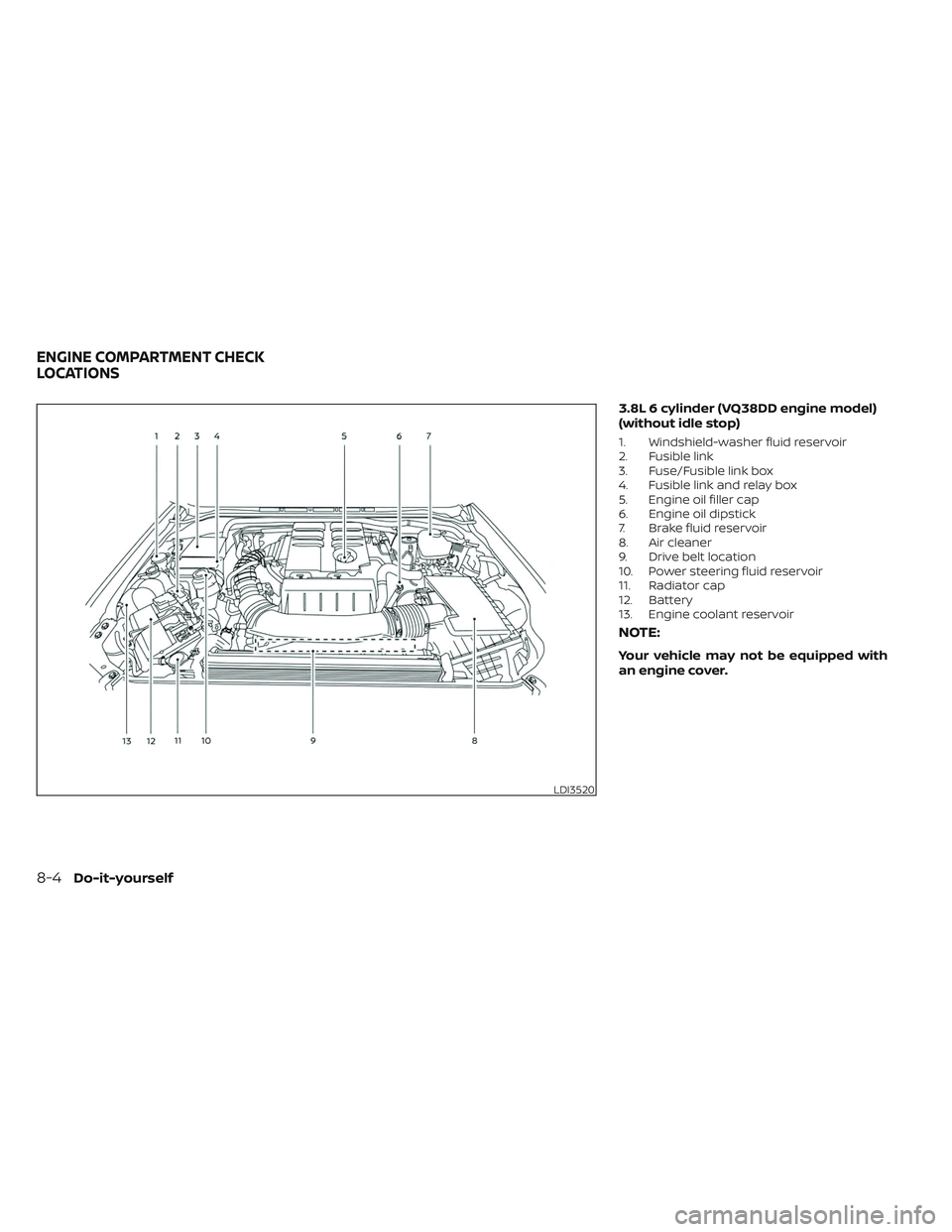
3.8L 6 cylinder (VQ38DD engine model)
(without idle stop)
1. Windshield-washer fluid reservoir
2. Fusible link
3. Fuse/Fusible link box
4. Fusible link and relay box
5. Engine oil filler cap
6. Engine oil dipstick
7. Brake fluid reservoir
8. Air cleaner
9. Drive belt location
10. Power steering fluid reservoir
11. Radiator cap
12. Battery
13. Engine coolant reservoir
NOTE:
Your vehicle may not be equipped with
an engine cover.
LDI3520
ENGINE COMPARTMENT CHECK
LOCATIONS
8-4Do-it-yourself
Page 447 of 572
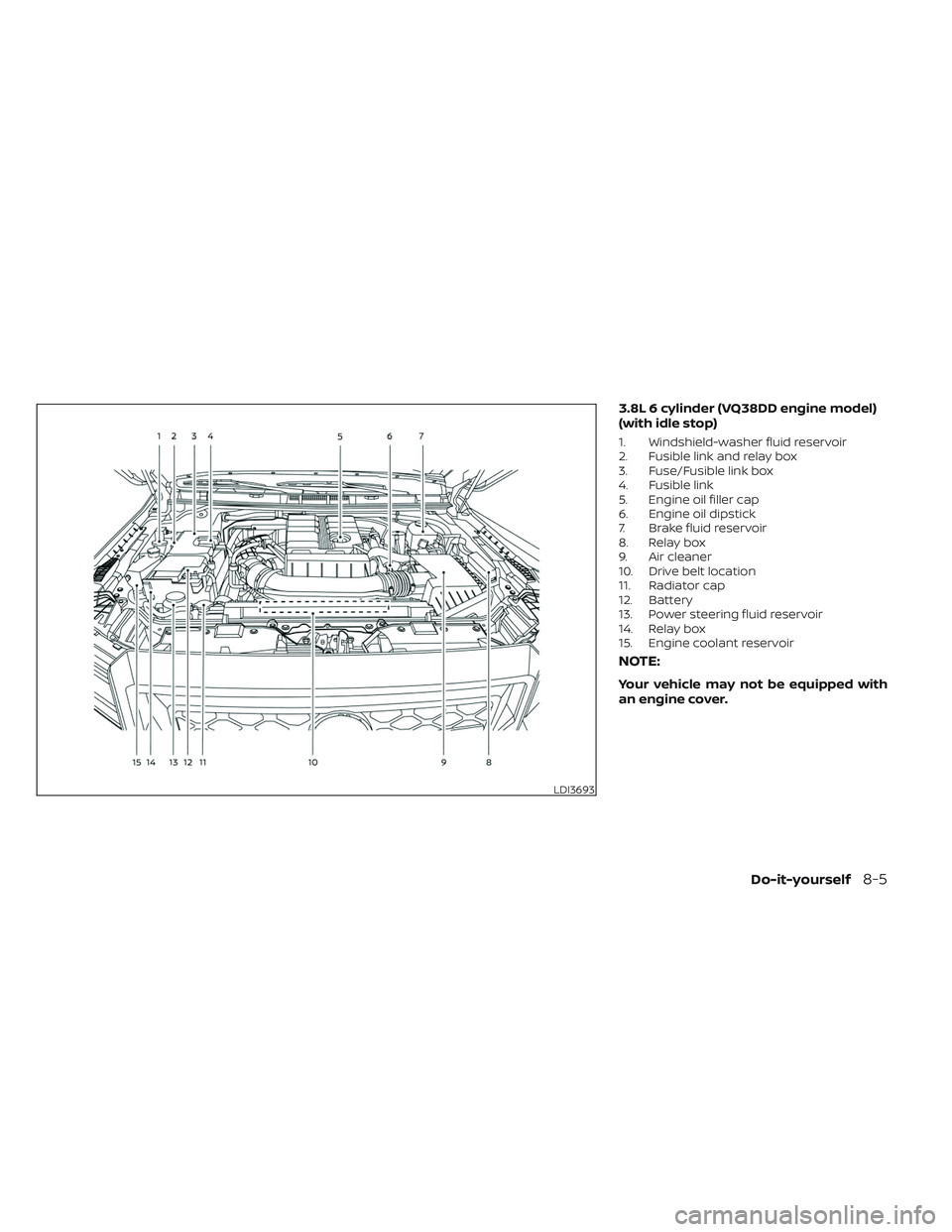
3.8L 6 cylinder (VQ38DD engine model)
(with idle stop)
1. Windshield-washer fluid reservoir
2. Fusible link and relay box
3. Fuse/Fusible link box
4. Fusible link
5. Engine oil filler cap
6. Engine oil dipstick
7. Brake fluid reservoir
8. Relay box
9. Air cleaner
10. Drive belt location
11. Radiator cap
12. Battery
13. Power steering fluid reservoir
14. Relay box
15. Engine coolant reservoir
NOTE:
Your vehicle may not be equipped with
an engine cover.
LDI3693
Do-it-yourself8-5
Page 456 of 572
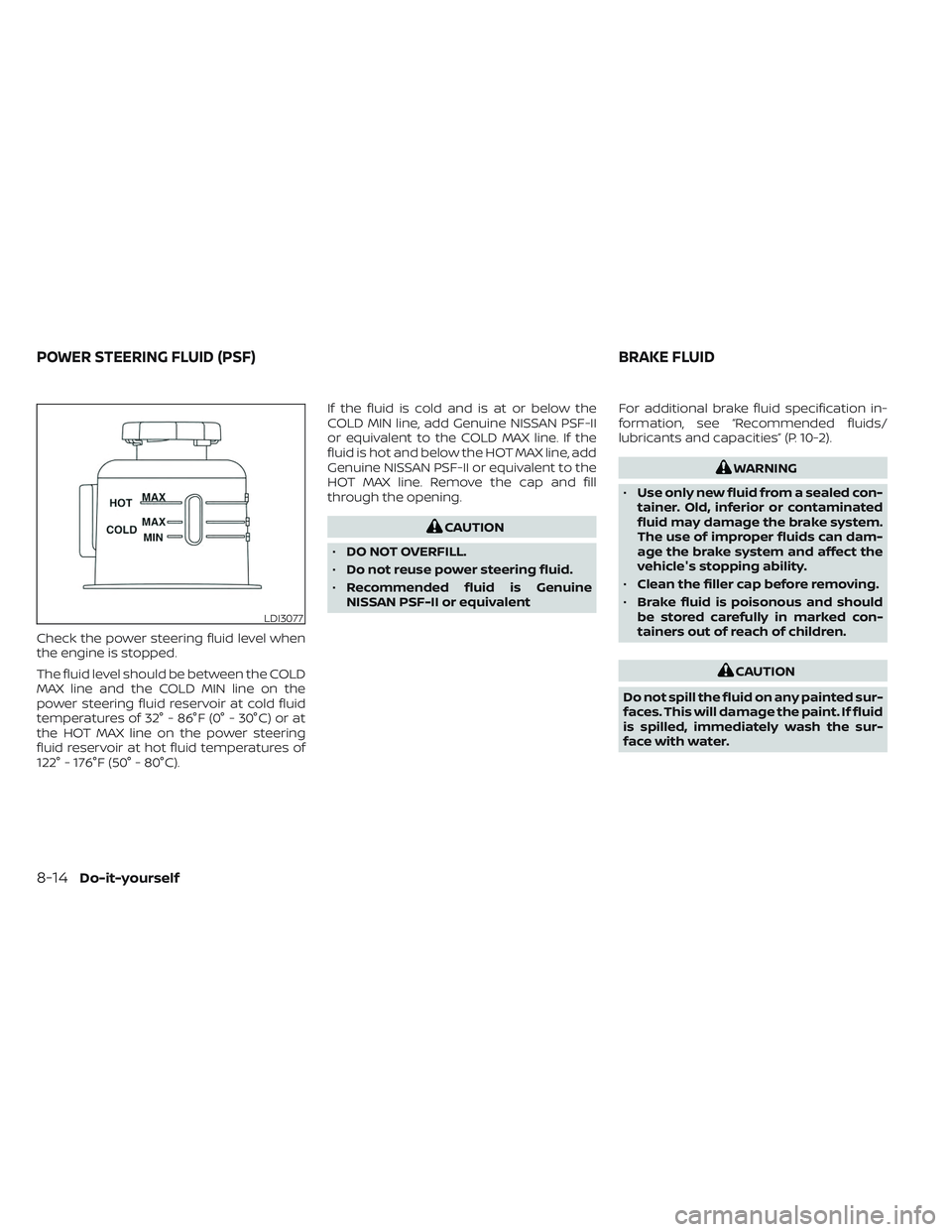
Check the power steering fluid level when
the engine is stopped.
The fluid level should be between the COLD
MAX line and the COLD MIN line on the
power steering fluid reservoir at cold fluid
temperatures of 32° - 86°F (0° - 30°C) or at
the HOT MAX line on the power steering
fluid reservoir at hot fluid temperatures of
122° - 176°F (50° - 80°C).If the fluid is cold and is at or below the
COLD MIN line, add Genuine NISSAN PSF-II
or equivalent to the COLD MAX line. If the
fluid is hot and below the HOT MAX line, add
Genuine NISSAN PSF-II or equivalent to the
HOT MAX line. Remove the cap and fill
through the opening.
CAUTION
• DO NOT OVERFILL.
• Do not reuse power steering fluid.
• Recommended fluid is Genuine
NISSAN PSF-II or equivalent For additional brake fluid specification in-
formation, see “Recommended fluids/
lubricants and capacities” (P. 10-2).
WARNING
• Use only new fluid from a sealed con-
tainer. Old, inferior or contaminated
fluid may damage the brake system.
The use of improper fluids can dam-
age the brake system and affect the
vehicle's stopping ability.
• Clean the filler cap before removing.
• Brake fluid is poisonous and should
be stored carefully in marked con-
tainers out of reach of children.
CAUTION
Do not spill the fluid on any painted sur-
faces. This will damage the paint. If fluid
is spilled, immediately wash the sur-
face with water.
LDI3077
POWER STEERING FLUID (PSF) BRAKE FLUID
8-14Do-it-yourself
Page 461 of 572
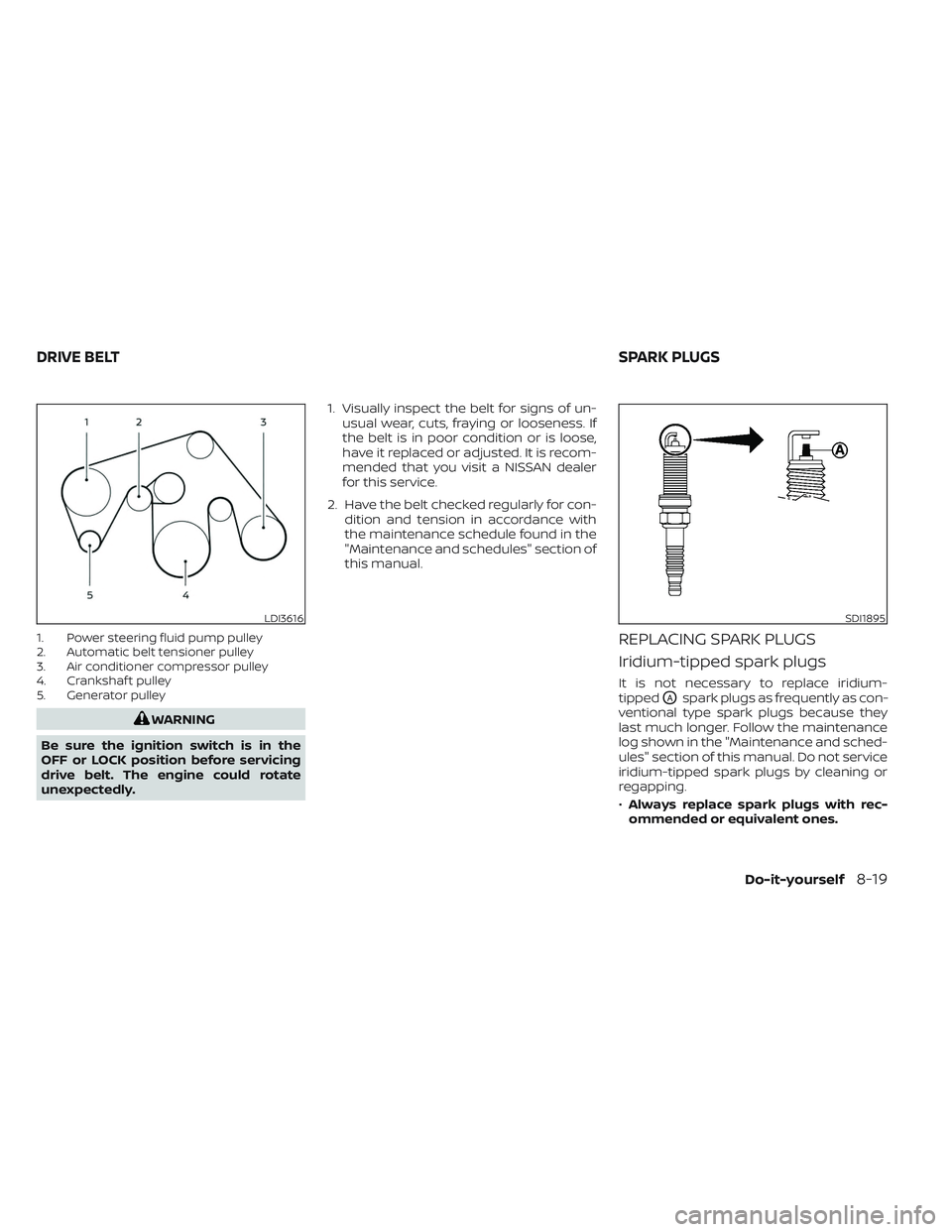
1. Power steering fluid pump pulley
2. Automatic belt tensioner pulley
3. Air conditioner compressor pulley
4. Crankshaf t pulley
5. Generator pulley
WARNING
Be sure the ignition switch is in the
OFF or LOCK position before servicing
drive belt. The engine could rotate
unexpectedly. 1. Visually inspect the belt for signs of un-
usual wear, cuts, fraying or looseness. If
the belt is in poor condition or is loose,
have it replaced or adjusted. It is recom-
mended that you visit a NISSAN dealer
for this service.
2. Have the belt checked regularly for con- dition and tension in accordance with
the maintenance schedule found in the
"Maintenance and schedules" section of
this manual.
REPLACING SPARK PLUGS
Iridium-tipped spark plugs
It is not necessary to replace iridium-
tipped
OAspark plugs as frequently as con-
ventional type spark plugs because they
last much longer. Follow the maintenance
log shown in the "Maintenance and sched-
ules" section of this manual. Do not service
iridium-tipped spark plugs by cleaning or
regapping.
• Always replace spark plugs with rec-
ommended or equivalent ones.
LDI3616SDI1895
DRIVE BELT SPARK PLUGS
Do-it-yourself8-19
Page 492 of 572
Brake pedal:Check the pedal for smooth
operation. If the brake pedal suddenly goes
down further than normal, the pedal feels
spongy or the vehicle seems to take longer
to stop, have your vehicle checked imme-
diately. It is recommended that you visit a
NISSAN dealer for this service. Keep the
floor mat away from the pedal.
Brakes: Check that the brakes do not pull
the vehicle to one side when applied.
Parking brake: Check the parking brake
operation regularly. The vehicle should be
securely held on a fairly steep hill with only
the parking brake applied. If the parking
brake needs adjustment, it is recom-
mended that you visit a NISSAN dealer for
this service.
Seats: Check seat position controls such
as seat adjusters, seatback recliner, etc., to
ensure they operate smoothly and all
latches lock securely in every position.
Check that the head restraints/headrests
move up and down smoothly and the locks
(if so equipped) hold securely in all latched
positions.
Seat belts: Check that all parts of the seat
belt system (for example, buckles, anchors,
adjusters and retractors) operate properly
and smoothly, and are installed securely. Check the belt webbing for cuts, fraying,
wear or damage.
Steering wheel:
Check for changes in the
steering system, such as excessive free
play, hard steering or strange noises.
Warning lights and chimes: Make sure all
warning lights and chimes are operating
properly.
Windshield defroster: Check that the air
comes out of the defroster outlets properly
and in sufficient quantity when operating
the heater or air conditioner.
Windshield wiper and washer*: Check
that the wipers and washer operate prop-
erly and that the wipers do not streak.
Under the hood and vehicle
The maintenance items listed here should
be checked periodically (for example, each
time you check the engine oil or refuel).
Battery (for maintenance free batter-
ies)*: This vehicle is equipped with a sealed
maintenance free battery. It is recom-
mended that you visit a NISSAN dealer for
service.
NOTE:
Care should be taken to avoid situations
that can lead to potential battery dis-
charge and potential no-start conditions
such as:
1. Installation or extended use of elec- tronic accessories that consume bat-
tery power when the engine is not
running (Phone chargers, GPS, DVD
players, etc.).
2. Vehicle is not driven regularly and/or only driven short distances.
In these cases, the battery may need to
be charged to maintain battery health.
Brake fluid level*: Make sure that the fluid
level is between the MAX and MIN lines on
the reservoir.
Engine coolant level*: Check the coolant
level when the engine is cold.
Engine drive belts*: Check engine drive
belts for wear, fraying or cracking and for
proper tension. Replace any damaged
drive belts.
9-4Maintenance and schedules
Page 493 of 572
Engine oil level*:Check the level af ter
parking the vehicle on a level spot and
turning off the engine. Wait more than 15
minutes for the oil to drain back into the oil
pan.
Exhaust system: Make sure there are no
loose supports, cracks or holes. If the
sound of the exhaust seems unusual or
there is a smell of exhaust fumes, immedi-
ately have the exhaust system inspected. It
is recommended that you visit a NISSAN
dealer for this service. For additional infor-
mation, see “Exhaust gas (carbon monox-
ide)” (P. 5-4).
Fluid leaks: Check under the vehicle for
fuel, oil, water or other fluid leaks af ter the
vehicle has been parked for a while. Water
dripping from the air conditioner af ter use
is normal. If you should notice any leaks or if
fuel fumes are evident, check for the cause
and have it corrected immediately.
Power steering fluid level* and lines:
Check the level when the fluid is cold, with
the engine off. Check the lines for proper
attachment, leaks, cracks, etc. Radiator and hoses:
Check the front of the
radiator and clean off any dirt, insects,
leaves, etc., that may have accumulated.
Make sure the hoses have no cracks, defor-
mation, rot or loose connections.
Underbody: The underbody is frequently
exposed to corrosive substances such as
those used on icy roads or to control dust. It
is very important to remove these sub-
stances, otherwise rust may form on the
floor pan, frame, fuel lines and around the
exhaust system. At the end of winter, the
underbody should be thoroughly flushed
with plain water, being careful to clean
those areas where mud and dirt may accu-
mulate. For additional information, see
“Cleaning exterior” (P. 7-2 ).
Windshield-washer fluid*: Check that
there is adequate fluid in the reservoir. The following descriptions are provided to
give you a better understanding of the
scheduled maintenance items that should
be regularly checked or replaced. The
maintenance schedule indicates at which
mileage/time intervals each item requires
service.
In addition to scheduled maintenance,
your vehicle requires that some items be
checked during normal day-to-day opera-
tion. For additional information, see “Gen-
eral maintenance” (P. 9-2).
Items marked with
“*”are recommended
by NISSAN for reliable vehicle operation.
You are not required to perform mainte-
nance on these items in order to maintain
the warranties which come with your
NISSAN. Other maintenance items and in-
tervals are required.
When applicable, additional information
can be found in the “Do-it-yourself ” section
of this manual.
EXPLANATION OF SCHEDULED
MAINTENANCE ITEMS
Maintenance and schedules9-5