tire type NISSAN FRONTIER 2023 User Guide
[x] Cancel search | Manufacturer: NISSAN, Model Year: 2023, Model line: FRONTIER, Model: NISSAN FRONTIER 2023Pages: 572, PDF Size: 6.58 MB
Page 479 of 572
6. Two- or three-digit number (95):This number is the tire's load in-
dex. It is a measurement of how
much weight each tire can
support.
7. H: Tire speed rating. You should not drive the vehicle faster than
the tire speed rating.
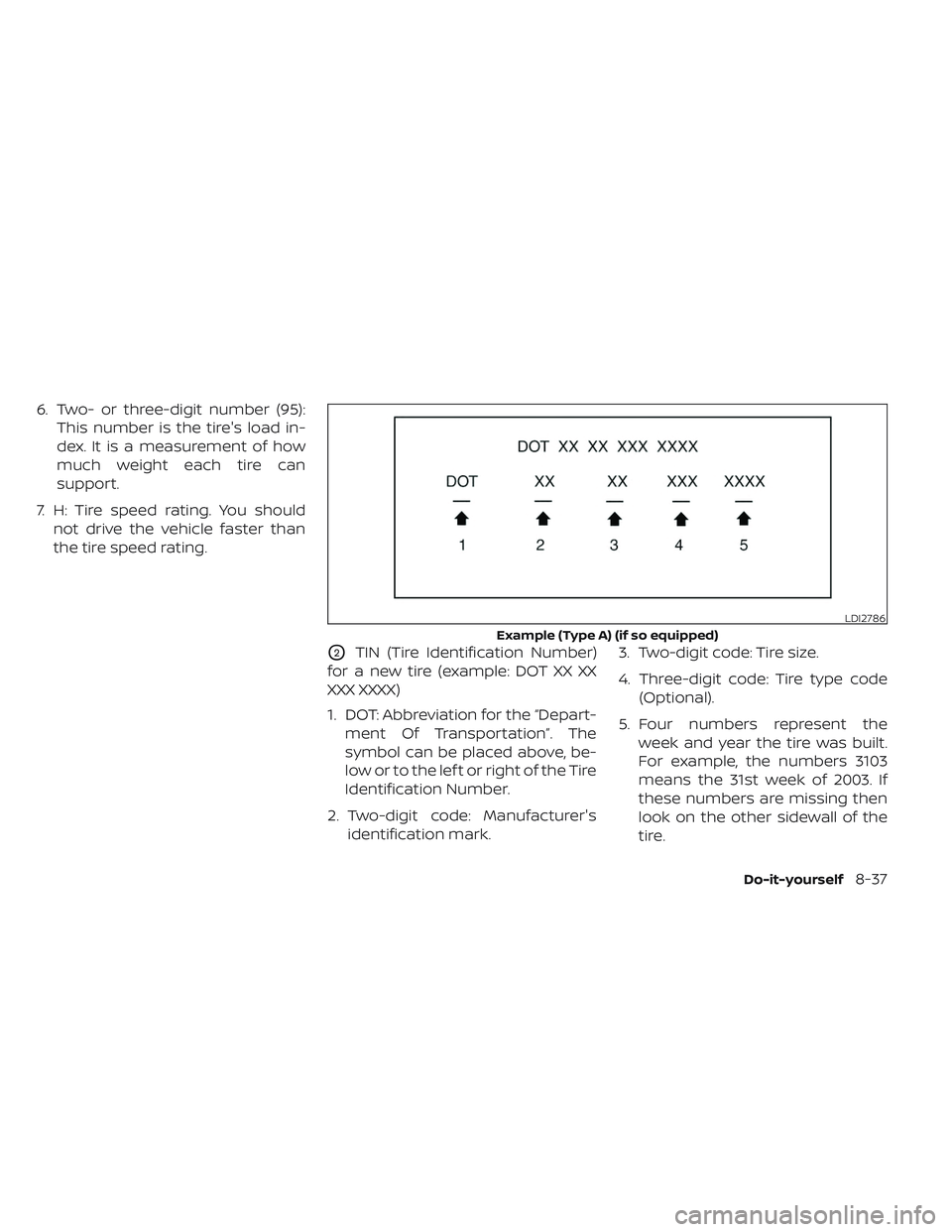
O2TIN (Tire Identification Number)
for a new tire (example: DOT XX XX
XXX XXXX)
1. DOT: Abbreviation for the “Depart- ment Of Transportation”. The
symbol can be placed above, be-
low or to the lef t or right of the Tire
Identification Number.
2. Two-digit code: Manufacturer's identification mark. 3. Two-digit code: Tire size.
4. Three-digit code: Tire type code
(Optional).
5. Four numbers represent the week and year the tire was built.
For example, the numbers 3103
means the 31st week of 2003. If
these numbers are missing then
look on the other sidewall of the
tire.
LDI2786
Example (Type A) (if so equipped)
Do-it-yourself8-37
Page 480 of 572
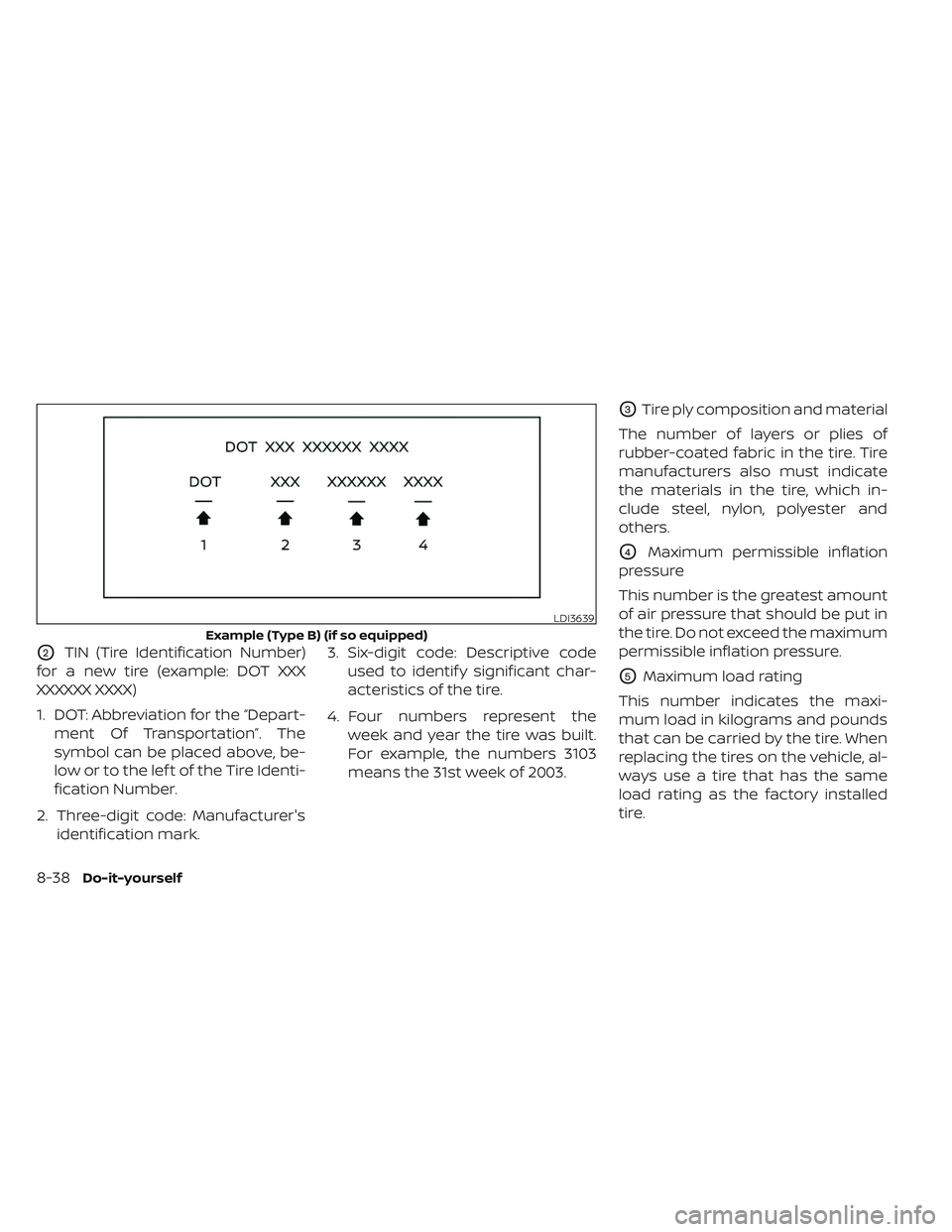
O2TIN (Tire Identification Number)
for a new tire (example: DOT XXX
XXXXXX XXXX)
1. DOT: Abbreviation for the “Depart- ment Of Transportation”. The
symbol can be placed above, be-
low or to the lef t of the Tire Identi-
fication Number.
2. Three-digit code: Manufacturer's identification mark. 3. Six-digit code: Descriptive code
used to identif y significant char-
acteristics of the tire.
4. Four numbers represent the week and year the tire was built.
For example, the numbers 3103
means the 31st week of 2003.
O3Tire ply composition and material
The number of layers or plies of
rubber-coated fabric in the tire. Tire
manufacturers also must indicate
the materials in the tire, which in-
clude steel, nylon, polyester and
others.
O4Maximum permissible inflation
pressure
This number is the greatest amount
of air pressure that should be put in
the tire. Do not exceed the maximum
permissible inflation pressure.
O5Maximum load rating
This number indicates the maxi-
mum load in kilograms and pounds
that can be carried by the tire. When
replacing the tires on the vehicle, al-
ways use a tire that has the same
load rating as the factory installed
tire.
LDI3639
Example (Type B) (if so equipped)
8-38Do-it-yourself
Page 481 of 572
O6Term of “tubeless” or “tube type”
Indicates whether the tire requires
an inner tube (“tube type”) or not
(“tubeless”).
O7The word “radial”
The word “radial” is shown if the tire
has radial structure.
O8Manufacturer or brand name
Manufacturer or brand name is
shown.
Other Tire-related Terminology
In addition to the many terms that
are defined throughout this section,
Intended Outboard Sidewall is (1) the
sidewall that contains a whitewall,
bears white lettering or bears
manufacturer, brand, and/or model
name molding that is higher or
deeper than the same molding on
the other sidewall of the tire, or (2)
the outward facing sidewall of an asymmetrical tire that has a particu-
lar side that must always face out-
ward when mounted on a vehicle.
TYPES OF TIRES
WARNING
• When changing or replacing tires, be
sure all four tires are of the same type
(i.e., Summer, All Season or Snow)
and construction. A NISSAN dealer
may be able to help you with infor-
mation about tire type, size, speed
rating and availability.
• Replacement tires may have a lower
speed rating than the factory
equipped tires, and may not match
the potential maximum vehicle
speed. Never exceed the maximum
speed rating of the tire.
• Replacing tires with those not origi-
nally specified by NISSAN could af-
fect the proper operation of the low
tire pressure warning system. •
Always use tires of the same type,
size, brand, construction and tread
pattern on all four wheels. Failure to
do so may result in a circumference
difference between tires on the front
and rear axles which can cause the
Vehicle Dynamic Control (VDC) sys-
tem to malfunction resulting in per-
sonal injury or death, excessive tire
wear and may damage the transmis-
sion and differential gears.
• For additional information regarding
tires, refer to “Important Tire Safety
Information” (US) or “Tire Safety In-
formation” (Canada) in the Warranty
Information Booklet.
All season tires
NISSAN specifies All Season tires on some
models to provide good performance all
year, including snowy and icy road condi-
tions. All Season tires are identified by ALL
SEASON and/or M&S on the tire sidewall.
Snow tires have better snow traction than
All Season tires and may be more appropri-
ate in some areas.
Do-it-yourself8-39
Page 482 of 572
Summer tires
NISSAN specifies summer tires on some
models to provide superior performance
on dry roads. Summer tire performance is
substantially reduced in snow and ice.
Summer tires do not have the tire traction
rating “M&S” on the tire sidewall.
If you plan to operate your vehicle in snowy
or icy conditions, NISSAN recommends the
use of SNOW tires or ALL SEASON tires on all
four wheels.
Snow tires
If snow tires are needed, it is necessary to
select tires equivalent in size and load rat-
ing to the original equipment tires. If you do
not, it can adversely affect the safety and
handling of your vehicle.
Generally, snow tires have lower speed rat-
ings than factory equipped tires and may
not match the potential maximum vehicle
speed. Never exceed the maximum speed
rating of the tire.
If you install snow tires, they must be the
same size, brand, construction and tread
pattern on all four wheels.For additional traction on icy roads, stud-
ded tires may be used. However, some U.S.
states and Canadian provinces prohibit
their use. Check local, state and provincial
laws before installing studded tires. Skid
and traction capabilities of studded snow
tires on wet or dry surfaces may be poorer
than that of non-studded snow tires.
TIRE CHAINS
Use of tire chains may be prohibited ac-
cording to location. Check the local laws
before installing tire chains. When installing
tire chains, make sure they are the proper
size for the tires on your vehicle and are
installed according to the chain manufac-
turer's suggestions.
Use only SAE class “S”
chains. Class “S” chains are used on ve-
hicles with restricted tire to vehicle clear-
ance. Vehicles that can use Class “S” chains
are designed to meet the minimum clear-
ances between the tire and the closest ve-
hicle suspension or body component re-
quired to accommodate the use of a
winter traction device (tire chains or
cables). The minimum clearances are de-
termined using the factory equipped tire
size. Other types may damage your vehicle.
Use chain tensioners when recommended
by the tire chain manufacturer to ensure a
tight fit. Loose end links of the tire chain must be secured or removed to prevent
the possibility of whipping action damage
to the fenders or underbody. If possible,
avoid fully loading your vehicle when using
tire chains. In addition, drive at a reduced
speed. Otherwise, your vehicle may be
damaged and/or vehicle handling and
performance may be adversely affected.
Tire chains must be installed only on the
rear wheels and not on the front wheels.
Do not use tire chains on dry roads. Driving
with chains in such conditions can cause
damage to the various mechanisms of the
vehicle due to some overstress.
Use only the 2WD range when driving on
clear paved roads.
8-40Do-it-yourself
Page 485 of 572
•If the wheels are changed for any
reason, always replace with wheels
which have the same off-set dimen-
sion. Wheels of a different off-set
could cause premature tire wear, de-
grade vehicle handling characteris-
tics, affect the VDC system and/or in-
terference with the brake discs. Such
interference can lead to decreased
braking efficiency and/or early brake
pad wear. For additional information
on wheel off-set dimensions, see
“Wheels and tires” (P. 10-10).
• When using a wheel without the
TPMS such as the spare tire, the TPMS
will not function and the low tire
pressure warning light will flash for
approximately 1 minute. The light will
remain on af ter 1 minute. Have your
tires replaced and/or TPMS system
reset as soon as possible. It is recom-
mended that you visit a NISSAN
dealer for this service.
• Replacing tires with those not origi-
nally specified by NISSAN could af-
fect the proper operation of the
TPMS. •
The TPMS sensor may be damaged if
it is not handled correctly. Be careful
when handling the TPMS sensor.
• When replacing the TPMS sensor, the
ID registration may be required. It is
recommended that you visit a
NISSAN dealer for ID registration.
• Do not use a valve stem cap that is
not specified by NISSAN. The valve
stem cap may become stuck.
• Be sure that the valve stem caps are
correctly fitted. Otherwise the valve
may be clogged up with dirt and
cause a malfunction or loss of
pressure.
• Do not install a damaged or de-
formed wheel or tire even if it has
been repaired. Such wheels or tires
could have structural damage and
could fail without warning.
• The use of retread tires is not
recommended.
• For additional information regarding
tires, refer to “Important Tire Safety
Information” (US) or “Tire Safety In-
formation” (Canada) in the Warranty
Information Booklet.Four-wheel drive models
CAUTION
Always use tires of the same type, size,
brand, construction (bias, bias-belted
or radial), and tread pattern on all four
wheels. Failure to do so may result in a
circumference difference between tires
on the front and rear axles which will
cause excessive tire wear and may
damage the transmission, transfer
case and differential gears.
If excessive tire wear is found, it is recom-
mended that all four tires be replaced with
tires of the same size, brand, construction
and tread pattern. The tire pressure and
wheel alignment should also be checked
and corrected as necessary. It is recom-
mended that you visit a NISSAN dealer for
this service.
Wheel balance
Unbalanced wheels may affect vehicle
handling and tire life. Even with regular use,
wheels can get out of balance. Therefore,
they should be balanced as required.
Do-it-yourself8-43
Page 528 of 572
TIRE AND LOADING INFORMATION
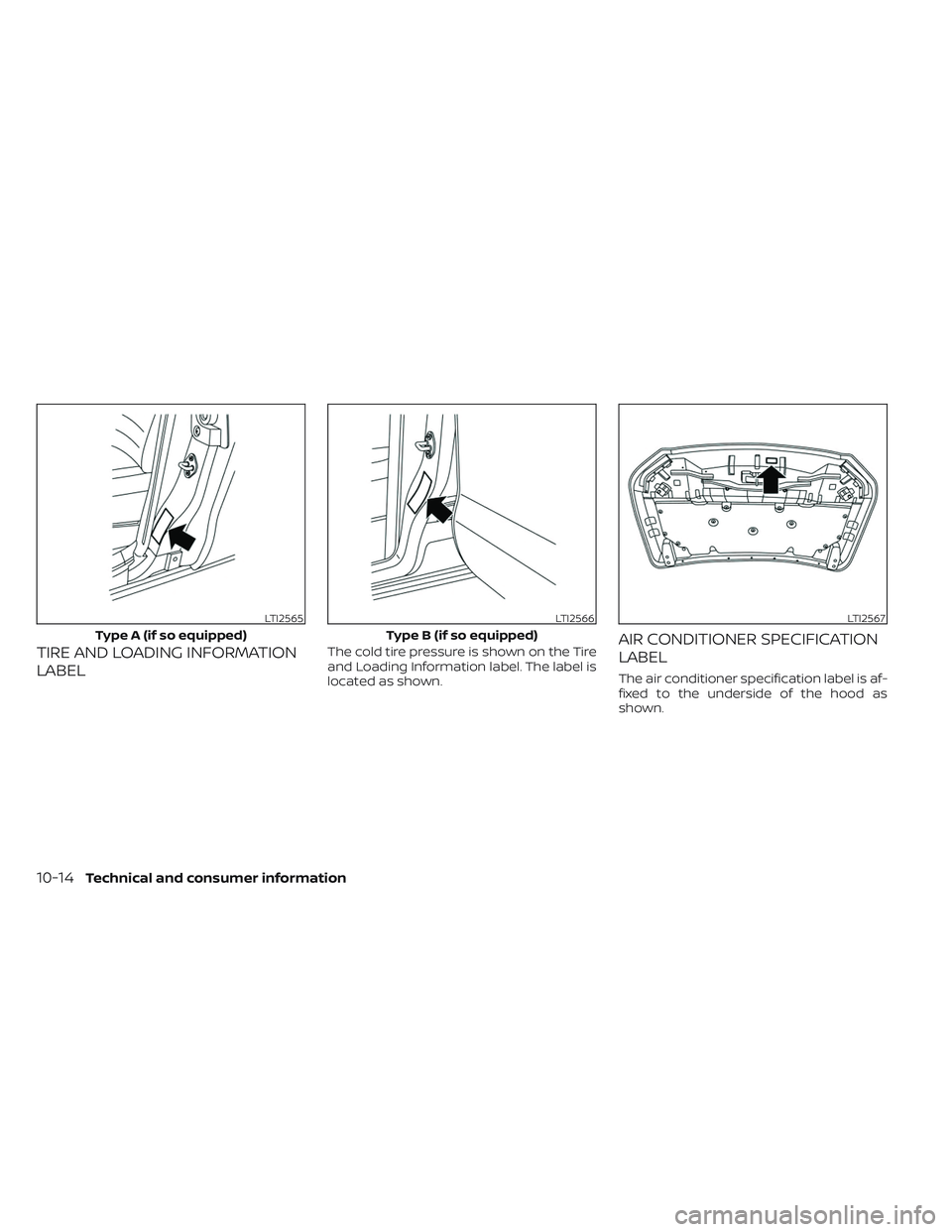
LABELThe cold tire pressure is shown on the Tire
and Loading Information label. The label is
located as shown.AIR CONDITIONER SPECIFICATION
LABEL
The air conditioner specification label is af-
fixed to the underside of the hood as
shown.
LTI2565
Type A (if so equipped)
LTI2566
Type B (if so equipped)
LTI2567
10-14Technical and consumer information
Page 550 of 572
WARNING
• Do not use axle-mounted hitches.
• Do not modif y the vehicle exhaust
system, brake system, etc. to install a
trailer hitch.
• To reduce the possibility of addi-
tional damage if your vehicle is
struck from the rear, where practical,
remove the ball mount from the re-
ceiver when not in use.
•
Regularly check that all trailer hitch
mounting bolts are securely mounted.
Tire pressures
• When towing a trailer, inflate the
vehicle tires to the recommended
cold tire pressure indicated on the
Tire and Loading Information label.
• Trailer tire condition, size, load rat- ing and proper inflation pressure
should be in accordance with
the trailer and tire manufacturer's
specifications.
Safety chains
Always use suitable safety chains between
your vehicle and the trailer. The safety
chains should be crossed and should be
attached to the hitch, not to the vehicle
bumper or axle. The safety chains can be
attached to the bumper if the hitch ball is
mounted to the bumper. Be sure to leave
enough slack in the chains to permit turn-
ing corners.
Trailer lights
CAUTION
When splicing into the vehicle electrical
system, a commercially available power-
type module/converter must be used to
provide power for all trailer lighting. This
unit uses the vehicle battery as a direct
power source for all trailer lights while
using the vehicle tail light, stop light and
turn signal circuits as a signal source.
The module/converter must draw no
more than 15 milliamps from the stop
and tail lamp circuits. Using a module/
converter that exceeds these power re-
quirements may damage the vehicle's
electrical system. See a reputable trailer
dealer to obtain the proper equipment
and to have it installed.
Trailer lights should comply with federal
and/or local regulations. For assistance in
hooking up trailer lights, it is recommended
that you visit a NISSAN dealer or reputable
trailer dealer. Vehicles equipped with the
optional trailer tow package are equipped
with a 7-pin trailer harness connector. A flat
4–pin harness is available from your dealer
for vehicles without a tow package. If your
trailer is equipped with a flat 4-pin connec-
tor, an adapter will be needed to connect
the trailer lights to the vehicle. Adapters are
available at auto parts stores and hitch
retailers.
Trailer brakes
If your trailer is equipped with a braking
system, make sure it conforms to federal
and/or local regulations and that it is prop-
erly installed.
Vehicles equipped with a 7–pin trailer har-
ness connector are pre-wired for a trailer
brake controller. It is recommended that
you visit a NISSAN dealer for a trailer brake
adapter harness.
WARNING
Never connect a trailer brake system
directly to the vehicle brake system.
10-36Technical and consumer information
Page 551 of 572
When towing a trailer load of 3,500 lbs.
(1587 kg) or more, trailers with a brake
system MUST be used.However, most
states require a separate braking system
on trailers with a loaded weight above a
specific amount. Make sure the trailer
meets the local regulations and the regu-
lations where you plan to tow.
Several types of braking systems are
available.
Surge Brakes -The surge brake actuator is
mounted on the trailer tongue with a hy-
draulic line running to each trailer wheel.
Surge brakes are activated by the trailer
pushing against the hitch ball when the
tow vehicle is braking. Hydraulic surge
brakes are common on rental trailers and
some boat trailers. In this type of system,
there is no hydraulic or electric connection
for brake operation between the tow ve-
hicle and the trailer.
Electric Trailer Brakes -Electric braking
systems are activated by an electronic sig-
nal sent from a trailer brake controller (spe-
cial brake-sensing module). If electric trailer
brakes are used, see “Electric trailer brake
controller" (P. 10-37)..
Have a professional supplier of towing
equipment make sure the trailer brakes are properly installed and demonstrate proper
brake function testing.
Electric trailer brake controller
Trailers equipped with electric brakes may
require the installation of an af termarket
trailer brake controller.
A Genuine NISSAN jumper harness is avail-
able that is specifically designed to be used
when installing an af termarket brake
controller.
Install the af termarket electric trailer brake
controller according to the manufacturer's
instructions.
Pre-towing tips
• Be certain your vehicle maintains a level
position when a loaded and/or unloaded
trailer is hitched. Do not drive the vehicle if
it has an abnormal nose-up or nose-
down condition; check for improper
tongue load, overload, worn suspension
or other possible causes of either
condition.
• Always secure items in the trailer to pre- vent load shif t while driving.
• Keep the cargo load as low as possible in the trailer to keep the trailer center of
gravity low. • Load the trailer so approximately 60% of
the trailer load is in the front half and 40%
is in the back half. Also make sure the load
is balanced side to side.
• Check your hitch, trailer tire pressure, ve- hicle tire pressure, trailer light operation,
and trailer wheel lug nuts every time you
attach a trailer to the vehicle.
• Be certain your rearview mirrors conform to all federal, state or local regulations. If
not, install any mirrors required for towing
before driving the vehicle.
• Determine the overall height of the ve- hicle and trailer so the required clearance
is known.Trailer towing tips
In order to gain skill and an understanding
of the vehicle's behavior, you should prac-
tice turning, stopping and backing up in an
area which is free from traffic. Steering sta-
bility and braking performance will be
somewhat different than under normal
driving conditions.
• Always secure items in the trailer to pre-vent load shif t while driving.
• Lock the trailer hitch coupler with a pin or lock to prevent the coupler from inadver-
tently becoming unlatched.
Technical and consumer information10-37
Page 564 of 572
Seat belt maintenance..........1-23Seat belts................1-14,7-6Shoulder belt height adjustment. . . .1-22Three-point type with retractor.....1-18Seat belt extenders..............1-22Seat belt warning light.........1-17,2-15Seatback pockets...............2-68SeatsAdjustment..................1-2Front seats..................1-2Manual front seat adjustment......1-3Rear seat.................. .1-6Security indicator light............2-15Security system (NISSAN Vehicle Immobilizer
System), engine start.........2-41, 5-16Security systems
Vehicle security system.........2-39Self-adjusting brakes.............8-22Service manual order form........10-44Servicing air conditioner...........4-43Shif tingAutomatic transmission.........5-20Shoulder belt height adjustment......1-22Side air bag system (See supplemental side
air bag, curtain and rollover air bag
systems)
................... .1-86Sonar
Rear system................5-124Spark plug replacement...........8-19Spark plugs...................8-19Specifications................ .10-9Speedometer................. .2-5Speedometer and odometer........2-4SRS warning label...............1-90
Stability control................5-121Standard maintenance............9-8Starting
Before starting the engine........5-17Jump starting............6-11,8-18Precautions when starting and
driving................. .5-4, 5-11Push starting................6-13Starting the engine (gasoline engine
only).......................5-17Steering
Power steering fluid............8-14Power steering system.........5-117Tilting steering wheel...........3-23Steering wheel.................3-23Stop light....................8-29Storage.................... .2-67Storage tray...................2-71Sun visors....................3-24Sunglasses case................2-72Sunglasses holder..............2-72Sunroof...................2-77,7-5Supplemental air bag warning labels. . .1-90Supplemental air bag warning
light....................1-90, 2-15Supplemental front impact air bag
system......................1-77Supplemental restraint system
Information and warning labels.....1-90Precautions on supplemental restraint
system....................1-70Supplemental restraint system (Supplemen-
tal air bag system)...............1-70Switch Autolight switch
..............2-44Automatic power window switch. . .2-76Electronic locking rear differential (E-Lock)
system switch...............2-55Fog light switch..............2-49Hazard warning flasher switch......6-2Headlight and turn signal switch. . . .2-43Headlight control switch.........2-43Hill descent control switch........2-54Instrument brightness control.....2-49Power door lock switch..........3-6Power inverter switch...........2-56Rear sonar system OFF switch.....2-56Tow mode switch.............2-57Turn signal switch.............2-49
T
Tachometer..................
.2-6Tailgate.....................3-27Temperature gauge
Engine coolant temperature gauge. . .2-6Thef t (NISSAN Vehicle Immobilizer System),
engine start...............2-41, 5-16Three-way catalyst...............5-5Tie down hooks................3-31Tilting steering wheel.............3-23TireFlat tire................... .6-3Spare tire..........6-4, 6-5, 6-6, 8-44Tire and Loading Information label. .10-14Tire chains.................8-40Tire pressure................8-32
11-6
Page 565 of 572
Tire rotation.................8-41Tires of 4-wheel drive...........8-43Types of tires................8-39Uniform tire quality grading.......10-41Wheel/tire size...............10-10Wheels and tires..........8-32, 10-10Tire pressure
Low tire pressure warning light.....2-17Tire Pressure Monitoring System (TPMS).5-5Top tether strap child restraint.......1-31Tow mode switch...............2-57Towing2-wheel drive models...........6-16Flat towing................ .10-40Tow truck towing..............6-14Towing load/specification.......10-30Trailer towing...............10-27Towing a trailer................10-27Traffic Sign Recognition (TSR)........5-24Transceiver
HomeLink® Universal
Transceiver
......2-80, 2-81, 2-83, 2-84TransmissionDriving with automatic transmission.5-19Travel (See registering a vehicle in another
country)................... .10-12Trip odometer..................2-5Truck - camper loading...........10-25Truck box....................3-27Turn signal switch...............2-49
U
Under seat storage bin...........2-69Uniform tire quality grading........10-41USB Charging Ports..............2-63Using four wheel drive (4WD).......5-109
V
Vanity mirror..................3-24Variable voltage control system......8-18Vehicle dimensions and weights.....10-11Vehicle Dynamic Control (VDC) OFF
switch..................... .2-53Vehicle Dynamic Control (VDC) system.5-121Vehicle identification.............10-12Vehicle identification number (VIN). . . .10-12Vehicle identification number (VIN)
plate...................... .10-12Vehicle immobilizer system.....2-41, 5-16Vehicle information display.........2-22Vehicle loading information........10-16Vehicle recovery................6-16Vehicle security system...........2-39Vehicle security system (NISSAN Vehicle Im-
mobilizer System), engine start. . .2-41, 5-16Ventilators...................4-28Visors......................3-24Voltmeter....................2-8
W
Warning
Air bag warning light........1-90, 2-15Anti-lock brake warning light......2-13Battery charge warning light......2-14Brake warning light............2-13Engine oil pressure warning light. . . .2-15Hazard warning flasher switch......6-2Loose fuel cap warning..........2-33Low fuel warning light. . . .2-15, 2-19, 2-34Low tire pressure warning light.....2-17Low windshield-washer fluid warning
light..................... .2-34Passenger air bag and status light. . .1-80Seat belt warning light.......1-17,2-15Supplemental air bag warning
light...................1-90, 2-15Vehicle security system.........2-39Warning labels (for SRS)..........1-90Warning/indicator lights and audible
reminders..................2-13Warning lights.................2-13Warning lights, indicator lights and audible
reminders....................2-11Warning systems switch..........2-52Warning/indicator lights and audible
reminders....................2-13Audible reminders.............2-13Indicator lights...............2-13Warning lights................2-13Weights (See dimensions and weights).10-11Wheel/tire size................10-10Wheels and tires............8-32, 10-10
11-7