tire size NISSAN FRONTIER 2023 Owner's Manual
[x] Cancel search | Manufacturer: NISSAN, Model Year: 2023, Model line: FRONTIER, Model: NISSAN FRONTIER 2023Pages: 572, PDF Size: 6.58 MB
Page 484 of 572
WARNING
• Tires should be periodically in-
spected for wear, cracking,
bulging or objects caught in
the tread. If excessive wear,
cracks, bulging or deep cuts
are found, the tire(s) should be
replaced.
• The original tires have built-in
tread wear indicators. When
the wear indicators are visible,
the tire(s) should be replaced.
• Tires degrade with age and
use. Have tires, including the
spare, over 6 years old checked
by a qualified technician be-
cause some tire damage may
not be obvious. Replace the
tires as necessary to prevent
tire failure and possible per-
sonal injury. •
Improper service of the spare
tire may result in serious per-
sonal injury. If it is necessary to
repair the spare tire, it is rec-
ommended that you visit a
NISSAN dealer for this service.
• For additional information re-
garding tires, refer to “Impor-
tant Tire Safety Information”
(US) or “Tire Safety Informa-
tion” (Canada) in the Warranty
Information Booklet.
Replacing wheels and tires
When replacing a tire, use the same size,
tread design, speed rating and load carry-
ing capacity as originally equipped. For ad-
ditional information, see “Wheels and tires”
(P. 10-10).
WARNING
• The use of tires other than those rec-
ommended or the mixed use of tires
of different brands, construction
(bias, bias-belted or radial), or tread
patterns can adversely affect the
ride, braking, handling, Vehicle Dy-
namic Control (VDC) system, ground
clearance, body-to-tire clearance,
tire chain clearance, speedometer
calibration, headlight aim and bum-
per height. Some of these effects
may lead to accidents and could re-
sult in serious personal injury.
• If your vehicle was originally
equipped with four tires that were
the same size and you are only re-
placing two of the four tires, install
the new tires on the rear axle. Placing
new tires on the front axle may cause
loss of vehicle control in some driving
conditions and cause an accident
and personal injury.
8-42Do-it-yourself
Page 485 of 572
•If the wheels are changed for any
reason, always replace with wheels
which have the same off-set dimen-
sion. Wheels of a different off-set
could cause premature tire wear, de-
grade vehicle handling characteris-
tics, affect the VDC system and/or in-
terference with the brake discs. Such
interference can lead to decreased
braking efficiency and/or early brake
pad wear. For additional information
on wheel off-set dimensions, see
“Wheels and tires” (P. 10-10).
• When using a wheel without the
TPMS such as the spare tire, the TPMS
will not function and the low tire
pressure warning light will flash for
approximately 1 minute. The light will
remain on af ter 1 minute. Have your
tires replaced and/or TPMS system
reset as soon as possible. It is recom-
mended that you visit a NISSAN
dealer for this service.
• Replacing tires with those not origi-
nally specified by NISSAN could af-
fect the proper operation of the
TPMS. •
The TPMS sensor may be damaged if
it is not handled correctly. Be careful
when handling the TPMS sensor.
• When replacing the TPMS sensor, the
ID registration may be required. It is
recommended that you visit a
NISSAN dealer for ID registration.
• Do not use a valve stem cap that is
not specified by NISSAN. The valve
stem cap may become stuck.
• Be sure that the valve stem caps are
correctly fitted. Otherwise the valve
may be clogged up with dirt and
cause a malfunction or loss of
pressure.
• Do not install a damaged or de-
formed wheel or tire even if it has
been repaired. Such wheels or tires
could have structural damage and
could fail without warning.
• The use of retread tires is not
recommended.
• For additional information regarding
tires, refer to “Important Tire Safety
Information” (US) or “Tire Safety In-
formation” (Canada) in the Warranty
Information Booklet.Four-wheel drive models
CAUTION
Always use tires of the same type, size,
brand, construction (bias, bias-belted
or radial), and tread pattern on all four
wheels. Failure to do so may result in a
circumference difference between tires
on the front and rear axles which will
cause excessive tire wear and may
damage the transmission, transfer
case and differential gears.
If excessive tire wear is found, it is recom-
mended that all four tires be replaced with
tires of the same size, brand, construction
and tread pattern. The tire pressure and
wheel alignment should also be checked
and corrected as necessary. It is recom-
mended that you visit a NISSAN dealer for
this service.
Wheel balance
Unbalanced wheels may affect vehicle
handling and tire life. Even with regular use,
wheels can get out of balance. Therefore,
they should be balanced as required.
Do-it-yourself8-43
Page 486 of 572
Wheel balance service should be per-
formed with the wheels off the vehicle.
Spin balancing the wheels on the vehicle
could lead to mechanical damage.
•For additional information regarding
tires, refer to “Important Tire Safety In-
formation” (US) or “Tire Safety Informa-
tion” (Canada) in the Warranty Informa-
tion Booklet.
Care of wheels
• Wash the wheels when washing the ve- hicle to maintain their appearance.
• Clean the inner side of the wheels when the wheel is changed or the underside of
the vehicle is washed.
• Do not use abrasive cleaners when washing the wheels.
• Inspect wheel rims regularly for dents or corrosion. Such damage may cause loss
of pressure or poor seal at the tire bead.
• NISSAN recommends waxing the road wheels to protect against road salt in ar-
eas where it is used during winter.
Spare tire (FULL SIZE TEMPORARY
USE ONLY spare tire)
When using a wheel without the TPMS such
as the spare tire, the TPMS will not function.
Your vehicle may be equipped with a full
size spare that is a different size or brand
than the tires originally installed on the ve-
hicle. This full size spare tire is intended for
temporary use only and should be re-
placed at the first opportunity.
Observe the following precautions if the
FULL SIZE TEMPORARY USE ONLY spare tire
must be used. Otherwise, your vehicle
could be damaged or involved in an
accident:
WARNING
To help reduce the risk of a crash which
may result in personal injury or death:
• The TEMPORARY FULL SIZE spare tire
should be used for emergency use
only. It should be replaced with the
standard tire at the first opportunity
to avoid possible tire or differential
damage. •
Drive carefully while the TEMPORARY
FULL SIZE spare tire is installed. Avoid
sharp turns and abrupt braking while
driving. The vehicle driving perfor-
mance may be affected when driving
on wet or snow covered roads.
• When the TEMPORARY FULL SIZE
spare tire is installed, the Vehicle Dy-
namic Control (VDC) will normally not
be affected.
• When the TEMPORARY FULL SIZE
spare tire is installed, the following
systems may not work correctly:
– Tire Pressure Monitoring System
(TPMS)
– Automatic Emergency Braking
(AEB) with Pedestrian Protection
• Periodically check the TEMPORARY
FULL SIZE spare tire inflation pres-
sure. Always keep the TEMPORARY
FULL SIZE spare tire inflated to the
pressure specification shown on the
Tire and Loading Information label.
•
With the TEMPORARY FULL SIZE spare
tire installed do not drive the vehicle at
speeds faster than 50 mph (80 km/h).
8-44Do-it-yourself
Page 487 of 572
•When driving on roads covered with
snow or ice, the TEMPORARY FULL
SIZE spare tire should be used on the
front wheels and the original tire
used on the rear wheels. Use tire
chains only on the drive wheels.
• Do not use the TEMPORARY FULL SIZE
spare tire on other vehicles.
• Do not use more than one TEMPO-
RARY FULL SIZE spare tire at the same
time.
• Do not tow a trailer when the TEMPO-
RARY FULL SIZE spare tire is installed.CAUTION
• Do not use tire chains on a TEMPO-
RARY FULL SIZE spare tire. Tire chains
will not fit properly and may cause
damage to the vehicle.
• Use of the TEMPORARY FULL SIZE
spare tire on a vehicle that has tires
larger than were originally equipped
can affect the 4WD System. This may
result in a circumference difference
between tires on front and rear axles
which can cause the 4WD system to
automatically place the vehicle in
2WD and flash the 4WD light. When
the TEMPORARY FULL SIZE spare tire
is replaced with a tire that matches
all other tires on the vehicle, and all
tires are properly inflated the 4WD
system will operate normally.
Do-it-yourself8-45
Page 524 of 572
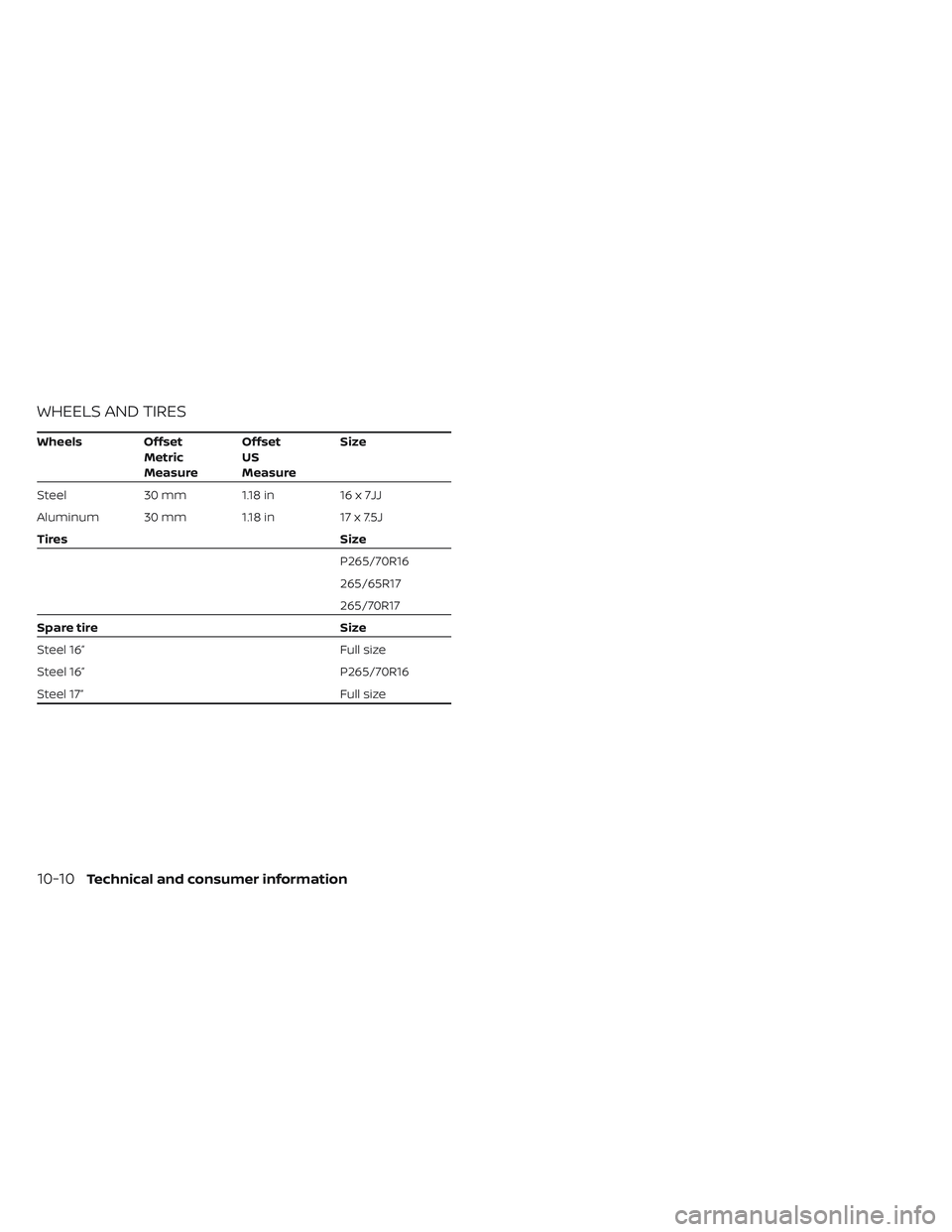
WHEELS AND TIRES
Wheels OffsetMetric
MeasureOffset
US
MeasureSize
Steel 30 mm 1.18 in 16 x 7JJ
Aluminum 30 mm 1.18 in 17 x 7.5J
Tires Size
P265/70R16
265/65R17
265/70R17
Spare tire Size
Steel 16” Full size
Steel 16” P265/70R16
Steel 17” Full size
10-10Technical and consumer information
Page 541 of 572
WARNING
• Overloading or improper loading of
a trailer and its cargo can adversely
affect vehicle handling, braking
and performance and may lead to
accidents.
• Do not tow a trailer when the TEMPO-
RARY FULL SIZE spare tire is installed.
CAUTION
• Do not tow a trailer or haul a heavy
load for the first 500 mile (805 km).
Your engine, axle or other parts could
be damaged.
• For the first 500 miles (805 km) that
you tow a trailer, do not drive over 50
mph (80 km/h) and do not make
starts at full throttle. This helps the
engine and other parts of your ve-
hicle wear in at the heavier loads.
Your new vehicle was designed to be used
primarily to carry passengers and cargo.
Remember that towing a trailer places ad-
ditional loads on your vehicle's engine,
drive train, steering, braking and other
systems.
A NISSAN Towing Guide (U.S. only) is available
on the website at www.nissanusa.com. This
guide includes information on trailer towing
capability and the special equipment re-
quired for proper towing.
MAXIMUM LOAD LIMITS
Maximum trailer loads
Never allow the total trailer load to exceed
the value specified in the “Towing Load/
Specification” chart found in this section.
The total trailer load equals trailer weight
plus its cargo weight.
• When towing a trailer load of 3,500 lbs.
(1,587 kg) or more, trailers with a brake
system MUST be used.
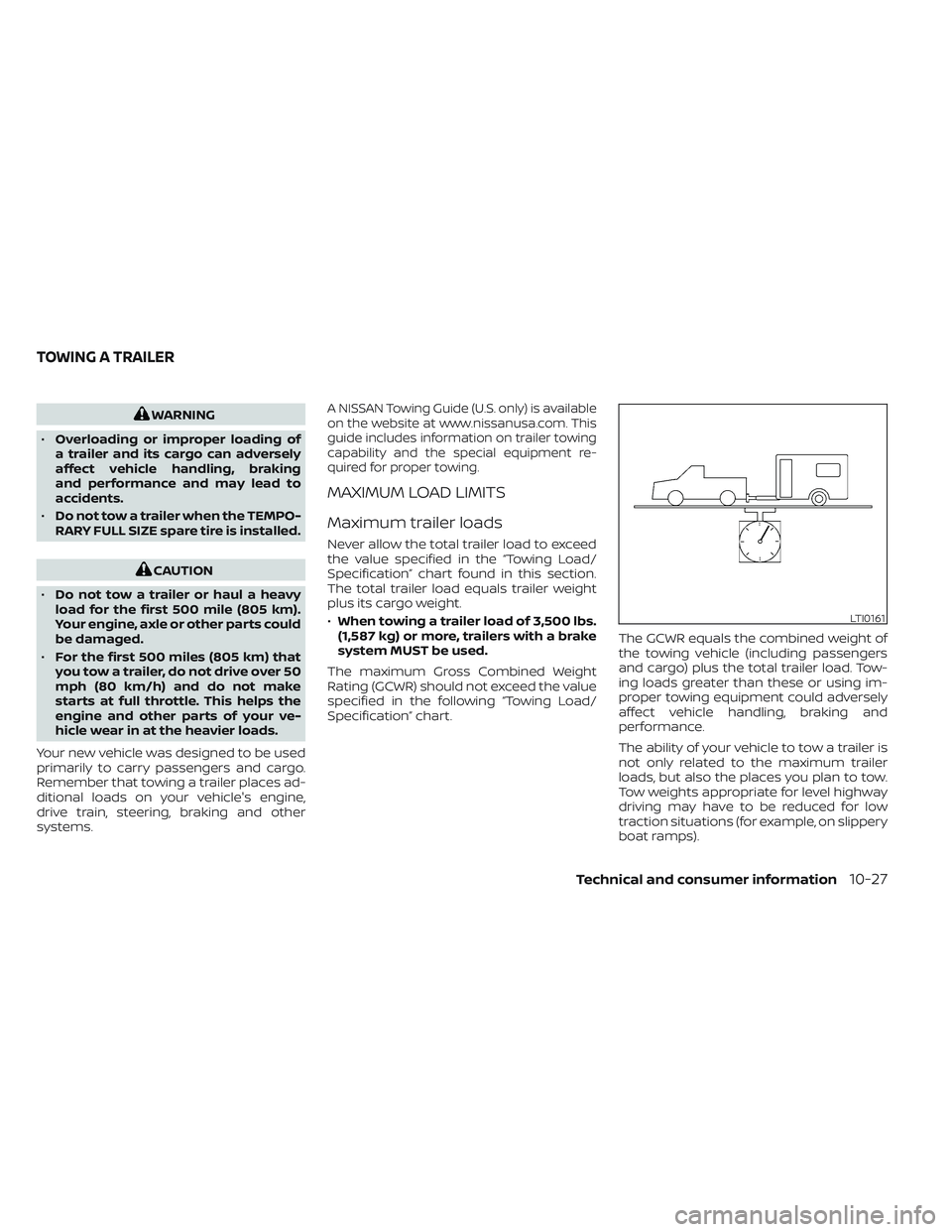
The maximum Gross Combined Weight
Rating (GCWR) should not exceed the value
specified in the following “Towing Load/
Specification” chart. The GCWR equals the combined weight of
the towing vehicle (including passengers
and cargo) plus the total trailer load. Tow-
ing loads greater than these or using im-
proper towing equipment could adversely
affect vehicle handling, braking and
performance.
The ability of your vehicle to tow a trailer is
not only related to the maximum trailer
loads, but also the places you plan to tow.
Tow weights appropriate for level highway
driving may have to be reduced for low
traction situations (for example, on slippery
boat ramps).
LTI0161
TOWING A TRAILER
Technical and consumer information10-27
Page 550 of 572
WARNING
• Do not use axle-mounted hitches.
• Do not modif y the vehicle exhaust
system, brake system, etc. to install a
trailer hitch.
• To reduce the possibility of addi-
tional damage if your vehicle is
struck from the rear, where practical,
remove the ball mount from the re-
ceiver when not in use.
•
Regularly check that all trailer hitch
mounting bolts are securely mounted.
Tire pressures
• When towing a trailer, inflate the
vehicle tires to the recommended
cold tire pressure indicated on the
Tire and Loading Information label.
• Trailer tire condition, size, load rat- ing and proper inflation pressure
should be in accordance with
the trailer and tire manufacturer's
specifications.
Safety chains
Always use suitable safety chains between
your vehicle and the trailer. The safety
chains should be crossed and should be
attached to the hitch, not to the vehicle
bumper or axle. The safety chains can be
attached to the bumper if the hitch ball is
mounted to the bumper. Be sure to leave
enough slack in the chains to permit turn-
ing corners.
Trailer lights
CAUTION
When splicing into the vehicle electrical
system, a commercially available power-
type module/converter must be used to
provide power for all trailer lighting. This
unit uses the vehicle battery as a direct
power source for all trailer lights while
using the vehicle tail light, stop light and
turn signal circuits as a signal source.
The module/converter must draw no
more than 15 milliamps from the stop
and tail lamp circuits. Using a module/
converter that exceeds these power re-
quirements may damage the vehicle's
electrical system. See a reputable trailer
dealer to obtain the proper equipment
and to have it installed.
Trailer lights should comply with federal
and/or local regulations. For assistance in
hooking up trailer lights, it is recommended
that you visit a NISSAN dealer or reputable
trailer dealer. Vehicles equipped with the
optional trailer tow package are equipped
with a 7-pin trailer harness connector. A flat
4–pin harness is available from your dealer
for vehicles without a tow package. If your
trailer is equipped with a flat 4-pin connec-
tor, an adapter will be needed to connect
the trailer lights to the vehicle. Adapters are
available at auto parts stores and hitch
retailers.
Trailer brakes
If your trailer is equipped with a braking
system, make sure it conforms to federal
and/or local regulations and that it is prop-
erly installed.
Vehicles equipped with a 7–pin trailer har-
ness connector are pre-wired for a trailer
brake controller. It is recommended that
you visit a NISSAN dealer for a trailer brake
adapter harness.
WARNING
Never connect a trailer brake system
directly to the vehicle brake system.
10-36Technical and consumer information
Page 565 of 572
Tire rotation.................8-41Tires of 4-wheel drive...........8-43Types of tires................8-39Uniform tire quality grading.......10-41Wheel/tire size...............10-10Wheels and tires..........8-32, 10-10Tire pressure
Low tire pressure warning light.....2-17Tire Pressure Monitoring System (TPMS).5-5Top tether strap child restraint.......1-31Tow mode switch...............2-57Towing2-wheel drive models...........6-16Flat towing................ .10-40Tow truck towing..............6-14Towing load/specification.......10-30Trailer towing...............10-27Towing a trailer................10-27Traffic Sign Recognition (TSR)........5-24Transceiver
HomeLink® Universal
Transceiver
......2-80, 2-81, 2-83, 2-84TransmissionDriving with automatic transmission.5-19Travel (See registering a vehicle in another
country)................... .10-12Trip odometer..................2-5Truck - camper loading...........10-25Truck box....................3-27Turn signal switch...............2-49
U
Under seat storage bin...........2-69Uniform tire quality grading........10-41USB Charging Ports..............2-63Using four wheel drive (4WD).......5-109
V
Vanity mirror..................3-24Variable voltage control system......8-18Vehicle dimensions and weights.....10-11Vehicle Dynamic Control (VDC) OFF
switch..................... .2-53Vehicle Dynamic Control (VDC) system.5-121Vehicle identification.............10-12Vehicle identification number (VIN). . . .10-12Vehicle identification number (VIN)
plate...................... .10-12Vehicle immobilizer system.....2-41, 5-16Vehicle information display.........2-22Vehicle loading information........10-16Vehicle recovery................6-16Vehicle security system...........2-39Vehicle security system (NISSAN Vehicle Im-
mobilizer System), engine start. . .2-41, 5-16Ventilators...................4-28Visors......................3-24Voltmeter....................2-8
W
Warning
Air bag warning light........1-90, 2-15Anti-lock brake warning light......2-13Battery charge warning light......2-14Brake warning light............2-13Engine oil pressure warning light. . . .2-15Hazard warning flasher switch......6-2Loose fuel cap warning..........2-33Low fuel warning light. . . .2-15, 2-19, 2-34Low tire pressure warning light.....2-17Low windshield-washer fluid warning
light..................... .2-34Passenger air bag and status light. . .1-80Seat belt warning light.......1-17,2-15Supplemental air bag warning
light...................1-90, 2-15Vehicle security system.........2-39Warning labels (for SRS)..........1-90Warning/indicator lights and audible
reminders..................2-13Warning lights.................2-13Warning lights, indicator lights and audible
reminders....................2-11Warning systems switch..........2-52Warning/indicator lights and audible
reminders....................2-13Audible reminders.............2-13Indicator lights...............2-13Warning lights................2-13Weights (See dimensions and weights).10-11Wheel/tire size................10-10Wheels and tires............8-32, 10-10
11-7