flexible seats NISSAN FRONTIER 2023 Owners Manual
[x] Cancel search | Manufacturer: NISSAN, Model Year: 2023, Model line: FRONTIER, Model: NISSAN FRONTIER 2023Pages: 572, PDF Size: 6.58 MB
Page 22 of 572
1 Safety-Seats, seat belts and
supplemental restraint system
Seats............................................ 1-2Front manual seat adjustment
(if so equipped) ................................1-3
Front power seat adjustment
(if so equipped) ............................... 1-4
Rear bench seat (if so equipped) ............. 1-6
Jump seat (if so equipped) ................... 1-6
Armrest (if so equipped) ...................... 1-6
Flexible seating ................................1-7
Head restraints/headrests ...................... 1-9
Adjustable head restraint/headrest
components ................................. 1-11
Non-adjustable head restraint/
headrest components .......................1-11
Remove...................................... 1-11
Install ........................................ 1-12
Adjust ........................................ 1-12
Seatbelts ....................................... 1-14
Precautions on seat belt usage ...............1-14
Seat belt warning light and chime ............1-17
Pregnant women ............................ 1-17
Injured persons .............................. 1-17
Three-point type seat belt with
retractor ..................................... 1-18
Seat belt extenders ......................... 1-22Seat belt maintenance
......................1-23
Child safety .................................... 1-23
Infants ...................................... 1-24
Small children ............................... 1-24
Larger children .............................. 1-25
Child restraints ................................. 1-26
Precautions on child restraints ..............1-26
LATCH (Lower Anchors and Tethers for
CHildren) system ............................ 1-28
Rear-facing child restraint installation
using LATCH (Crew Cab models) .............1-32
Rear-facing child restraint installation
using LATCH — jump seat (King Cab®
models) ..................................... 1-34
Rear-facing child restraint installation
using the seat belts (Crew Cab models) .....1-38
Rear-facing child restraint installation
using the seat belts — jump seat
(King Cab® models) ........................... 1-41
Forward-facing child restraint
installation using LATCH
(Crew Cab models) .......................... 1-45
Forward-facing child restraint
installation using LATCH — jump seat
(King Cab® models) .......................... 1-49
Page 28 of 572
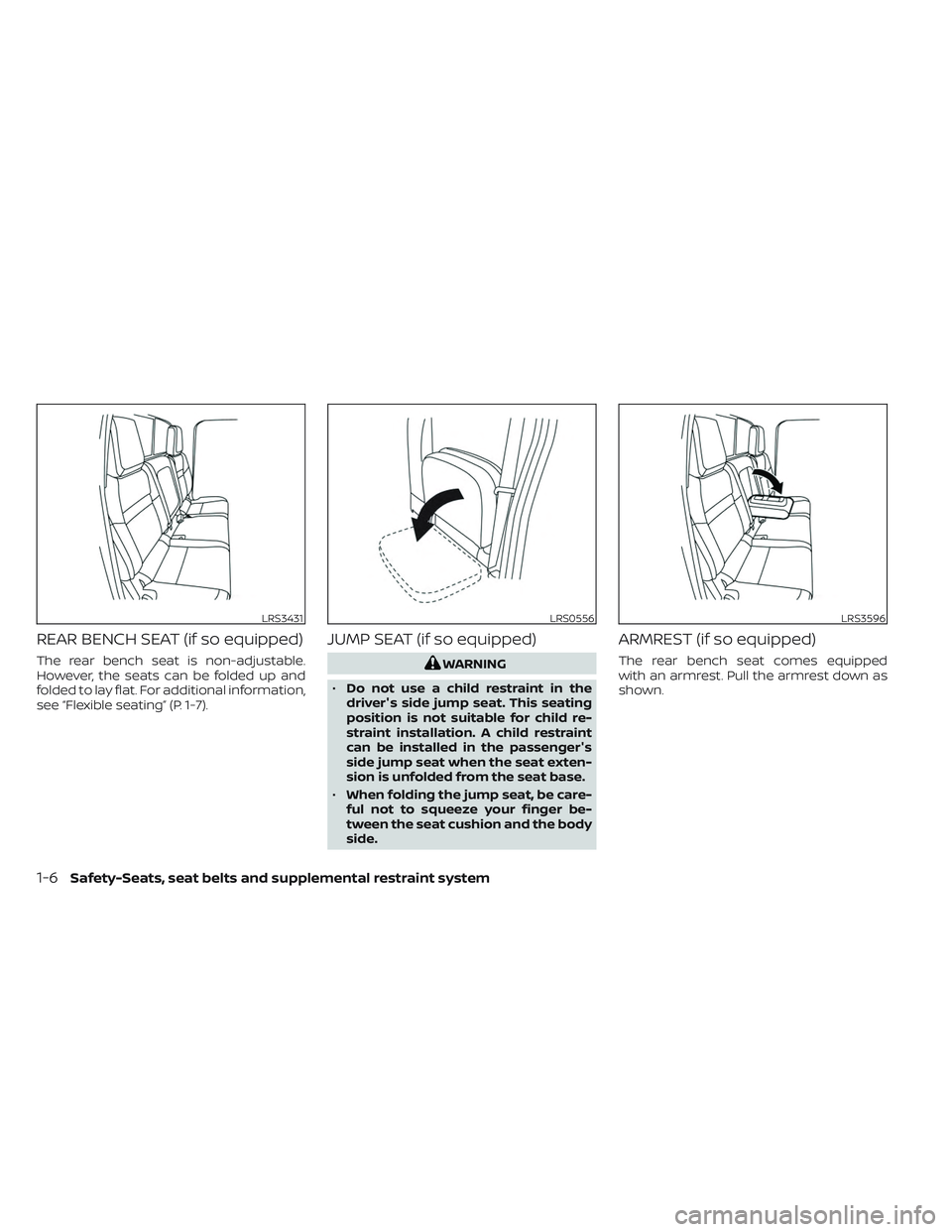
REAR BENCH SEAT (if so equipped)
The rear bench seat is non-adjustable.
However, the seats can be folded up and
folded to lay flat. For additional information,
see “Flexible seating” (P. 1-7).
JUMP SEAT (if so equipped)
WARNING
• Do not use a child restraint in the
driver's side jump seat. This seating
position is not suitable for child re-
straint installation. A child restraint
can be installed in the passenger's
side jump seat when the seat exten-
sion is unfolded from the seat base.
• When folding the jump seat, be care-
ful not to squeeze your finger be-
tween the seat cushion and the body
side.
ARMREST (if so equipped)
The rear bench seat comes equipped
with an armrest. Pull the armrest down as
shown.
LRS3431LRS0556LRS3596
1-6Safety-Seats, seat belts and supplemental restraint system
Page 29 of 572
FLEXIBLE SEATING
WARNING
• Never allow anyone to ride in the
cargo area or on the rear seats when
they are in the fold-down position. In
a collision, people riding in these ar-
eas without proper restraints are
more likely to be seriously injured or
killed.
• Do not allow people to ride in any
area of your vehicle that is not
equipped with seats and seat belts.
Be sure everyone in your vehicle is in
a seat and using a seat belt properly.
• Do not allow more than one person
to use the same seat belt.
• Do not fold down the rear seats when
occupants are in the rear seat area or
any luggage is on the rear seats.
– Make sure that the seat path is
clear before moving the seat.
– Be careful not to allow hands or
feet to get caught or pinched in
the seat. •
Head restraints/headrests should be
adjusted properly as they may pro-
vide significant protection against
injury in an accident. Always replace
and adjust them properly if they have
been removed for any reason.
• If the head restraints/headrests are
removed for any reason, they should
be securely stored to prevent them
from causing injury to passengers or
damage to the vehicle in case of sud-
den braking or an accident.
• When returning the seatbacks to the
upright position, be certain they are
completely secured in the latched
position. If they are not completely
secured, passengers may be injured
in an accident or sudden stop.
• Properly secure all cargo to help pre-
vent it from sliding or shif ting. Do not
place cargo higher than the seat-
backs. In a sudden stop or collision,
unsecured cargo could cause per-
sonal injury.
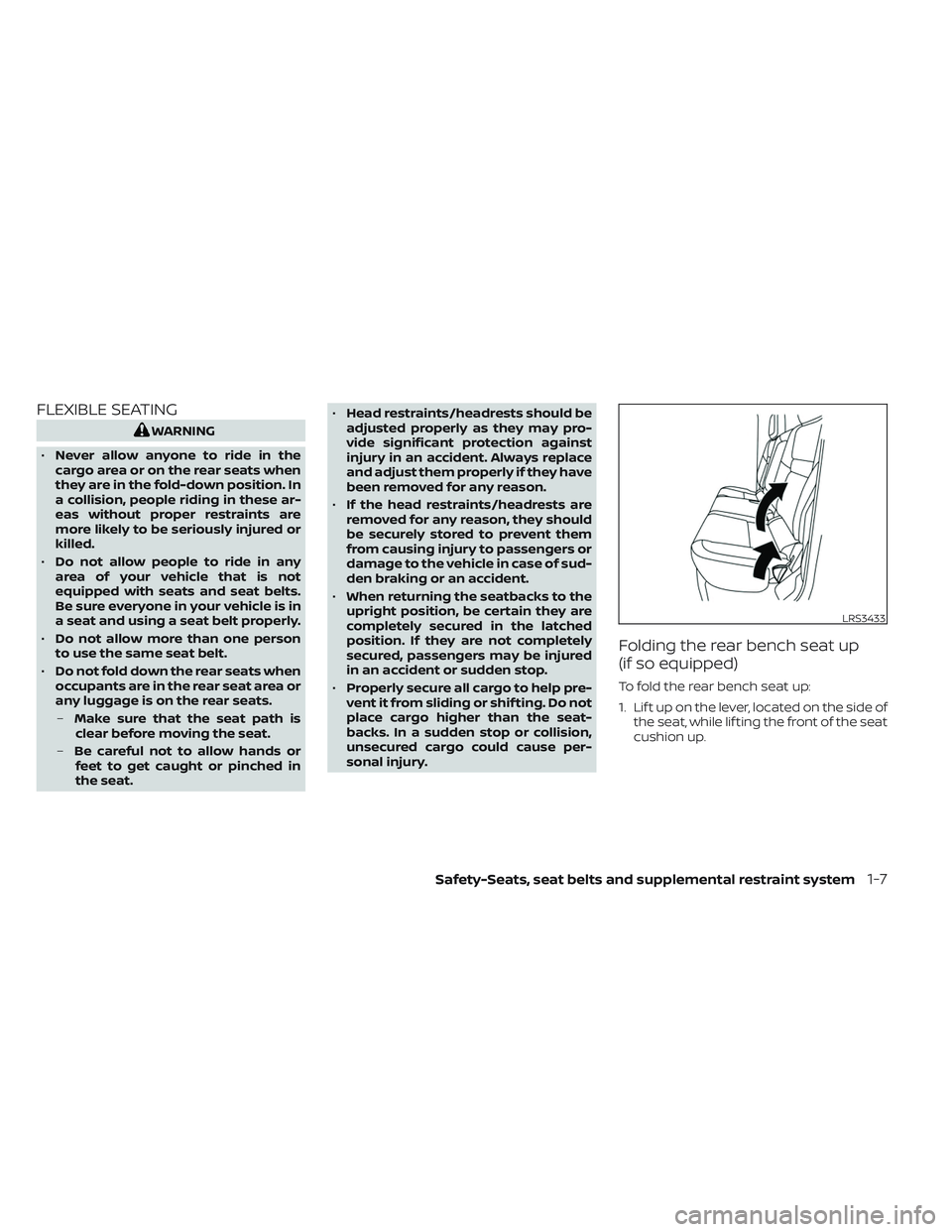
Folding the rear bench seat up
(if so equipped)
To fold the rear bench seat up:
1. Lif t up on the lever, located on the side of the seat, while lif ting the front of the seat
cushion up.
LRS3433
Safety-Seats, seat belts and supplemental restraint system1-7
Page 45 of 572
WARNING
• Only NISSAN seat belt extenders,
made by the same company which
made the original equipment seat
belts, should be used with NISSAN
seat belts.
• Adults and children who can use the
standard seat belt should not use an
extender. Such unnecessary use
could result in serious personal injury
in the event of an accident.
• Never use seat belt extenders to in-
stall child restraints. If the child re-
straint is not secured properly, the
child could be seriously injured or
killed in a collision or a sudden stop.SEAT BELT MAINTENANCE
• To clean the seat belt webbing, apply a
mild soap solution or any solution rec-
ommended for cleaning upholstery or
carpet. Then wipe with a cloth and allow
the seat belts to dry in the shade. Do not
allow the seat belts to retract until they
are completely dry.
• If dirt builds up in the shoulder belt
guide of the seat belt anchors, the seat
belts may retract slowly. Wipe the shoul-
der belt guide with a clean, dry cloth.
• Periodically check to see that the seat
belt and the metal components, such
as buckles, tongues, retractors, flexible
wires and anchors, work properly. If loose
parts, deterioration, cuts or other dam-
age on the webbing is found, the entire
seat belt assembly should be replaced.WARNING
Do not allow children to play with the
seat belts. Most seating positions are
equipped with Automatic Locking Re-
tractor (ALR) mode seat belts. If the seat
belt becomes wrapped around a child’s
neck with the ALR mode activated, the
child can be seriously injured or killed if
the seat belt retracts and becomes
tight. This can occur even if the vehicle
is parked. Unbuckle the seat belt to re-
lease the child. If the seat belt cannot
be unbuckled or is already unbuckled,
release the child by cutting the seat
belt with a suitable tool (such as a knife
or scissors) to release the seat belt.
Children need adults to help protect them.
They need to be properly restrained.
In addition to the general information in
this manual, child safety information is
available from many other sources, includ-
ing doctors, teachers, government traffic
safety offices, and community organiza-
tions. Every child is different, so be sure to
learn the best way to transport your child.
CHILD SAFETY
Safety-Seats, seat belts and supplemental restraint system1-23