maintenance NISSAN GT-R 2014 R35 User Guide
[x] Cancel search | Manufacturer: NISSAN, Model Year: 2014, Model line: GT-R, Model: NISSAN GT-R 2014 R35Pages: 354, PDF Size: 5.08 MB
Page 26 of 354
the wheels. The tire may slip on the wheel if
the vehicle is driven in these conditions
before 48 hours have passed. If the tire slips
on the wheel, the wheel/tire assembly will be
out of balance and will require rebalancing.
Brakes
The information and specifications in this
section apply only when engaging in
performance driving.
.Check for the heat deterioration of the
brakes and parts around the brakes.
. It is recommended that you remove air from
the brake system after any of the following:
— When engaging in high performance
driving for the first time after purchasing
a new vehicle.
— After replacing the brake fluid.
— When engaging in high performance driving for a sustained period of time. It
is recommended that bleeding the brake
be performed when the brake calipers
are hot (about 2128F (1008C)) .
Brake pad:
NISSAN recommends adding an additional
cross spring to the front calipers before enga-
ging in performance driving. The additional
spring reduces brake pad movement resulting from cornering forces and will reduce the stroke
of the brake pedal. Contact a GT-R certified
NISSAN dealer to purchase the spring and
arrange installation. If a cross spring is added, a
clattering or squeaking sound may be heard on
rare occasions.
Brake pad break-in procedure:
NISSAN recommends that a special brake pad
break-in procedure be performed before enga-
ging in performance driving. Contact a GT-R
certified NISSAN dealer for details.
INSPECTION AND ADJUSTMENTS
AFTER DRIVING
The information and specifications in this
section apply only when engaging in
performance driving.
NOTICE
At the completion of performance driv-
ing, all fluid and other adjustments
should be returned to the normal fluid
specifications as shown in the “Main-
tenance and do-it-yourself” section of
this manual.
Fluids
The information and specifications in this
section apply only when engaging in
performance driving.
.
Check the engine, transmission, differential
and under the vehicle for oil and coolant
leaks.
. Check the fluid levels and adjust as neces-
sary using the specified fluid as described
under the conditions listed in this section.
(
“Recommended fluids and mainte-
nance interval” page GTR-20) If you do not
drive under the conditions listed, refer to the
2014 NISSAN Service and Maintenance
Guide.
. When changing fluids, be sure to use the
specified fluids as described in this Owner’s
manual. (
“Capacities and recom-
mended fuel/lubricants” page 9-2)
GT-R OverviewGTR-19
Page 27 of 354
GTR-20GT-R Overview
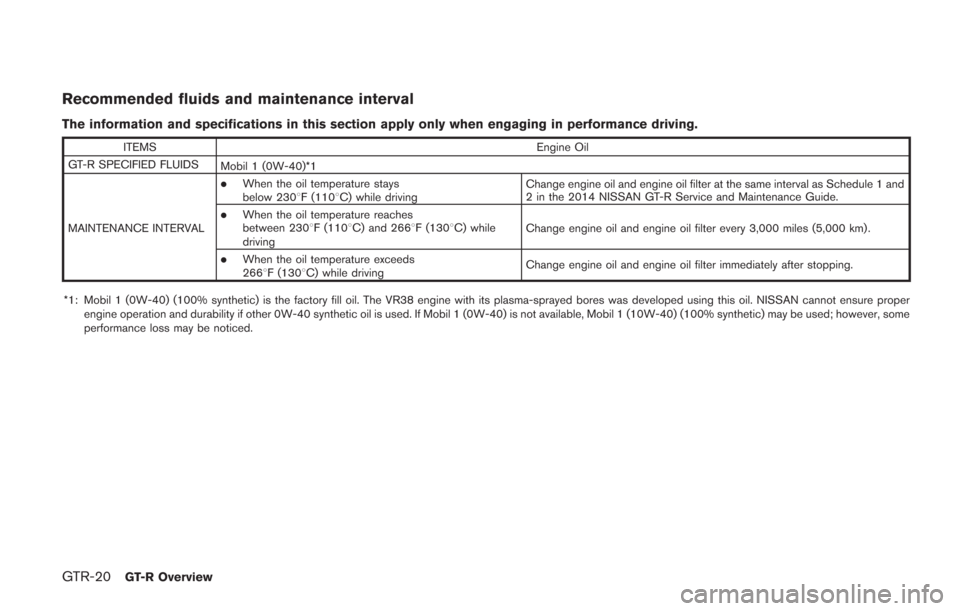
Recommended fluids and maintenance interval
The information and specifications in this section apply only when engaging in performance driving.
ITEMSEngine Oil
GT-R SPECIFIED FLUIDS Mobil 1 (0W-40)*1
MAINTENANCE INTERVAL
.When the oil temperature stays
below 2308F (1108C) while driving Change engine oil and engine oil filter at the same interval as Schedule 1 and
2 in the 2014 NISSAN GT-R Service and Maintenance Guide.
.When the oil temperature reaches
between 2308F (1108C) and 2668F (1308C) while
drivingChange engine oil and engine oil filter every 3,000 miles (5,000 km).
.When the oil temperature exceeds
2668F (1308C) while driving
Change engine oil and engine oil filter immediately after stopping.
*1: Mobil 1 (0W-40) (100% synthetic) is the factory fill oil. The VR38 engine with its plasma-sprayed bores was developed using this oil. NISSAN cannot ensure proper engine operation and durability if other 0W-40 synthetic oil is used. If Mobil 1 (0W-40) is not available, Mobil 1 (10W-40) (100% synthetic) may be used; however, some
performance loss may be noticed.
Page 28 of 354
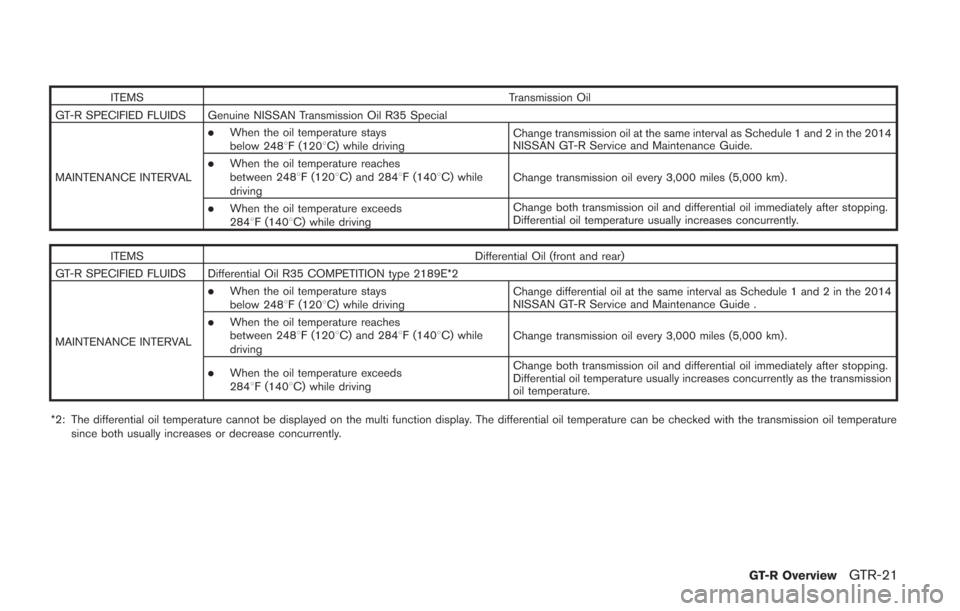
ITEMSTransmission Oil
GT-R SPECIFIED FLUIDS Genuine NISSAN Transmission Oil R35 Special
MAINTENANCE INTERVAL
.When the oil temperature stays
below 2488F (1208C) while driving Change transmission oil at the same interval as Schedule 1 and 2 in the 2014
NISSAN GT-R Service and Maintenance Guide.
.When the oil temperature reaches
between 2488F (1208C) and 2848F (1408C) while
drivingChange transmission oil every 3,000 miles (5,000 km) .
.When the oil temperature exceeds
2848F (1408C) while drivingChange both transmission oil and differential oil immediately after stopping.
Differential oil temperature usually increases concurrently.
ITEMS Differential Oil (front and rear)
GT-R SPECIFIED FLUIDS Differential Oil R35 COMPETITION type 2189E*2
MAINTENANCE INTERVAL
.When the oil temperature stays
below 2488F (1208C) while driving Change differential oil at the same interval as Schedule 1 and 2 in the 2014
NISSAN GT-R Service and Maintenance Guide .
.When the oil temperature reaches
between 2488F (1208C) and 2848F (1408C) while
drivingChange transmission oil every 3,000 miles (5,000 km) .
.When the oil temperature exceeds
2848F (1408C) while drivingChange both transmission oil and differential oil immediately after stopping.
Differential oil temperature usually increases concurrently as the transmission
oil temperature.
*2: The differential oil temperature cannot be displayed on the multi function display. The differential oil temperature can be checked with the transmission oil temperature since both usually increases or decrease concurrently.
GT-R OverviewGTR-21
Page 29 of 354

GTR-22GT-R Overview
ITEMSBrake Fluid
GT-R SPECIFIED FLUIDS Genuine NISSAN Brake Fluid R35 Special II*3
MAINTENANCE INTERVAL Change brake fluid every 3,000 miles (5,000 km).
*3: Genuine NISSAN Brake Fluid R35 Special II is the factory fill brake fluid. The Vehicle Dynamic Control (VDC) unit and other related parts were specially designed for this brake fluid and NISSAN cannot ensure the best performance and proper operation of the vehicle if other brake fluid is used.
Page 50 of 354

1 Safety — Seats, seat belts and supple-mental restraint system
Seats ........................................................................\
................... 1-2
Front seats ........................................................................\
... 1-3
Rear compartment (models without rear seat) ........... 1-5
Head restraints ................................................................... 1-6
Seat belts ........................................................................\
........... 1-7 Precautions on seat belt usage ...................................... 1-7
Pregnant women ................................................................ 1-9
Injured persons ................................................................... 1-9
Three-point type seat belt with retractor ..................... 1-9
Seat belt extenders ......................................................... 1-13
Seat belt maintenance ................................................... 1-13
Child safety ........................................................................\
..... 1-13 Infants ........................................................................\
......... 1-14
Small children ................................................................... 1-14
Larger children ................................................................. 1-15
Child restraints ....................................................................... 1-15
Precautions on child restraints .................................... 1-16
Lower Anchors and Tethers for CHildren System
(LATCH) (models with rear seat) ................................ 1-17
Rear-facing child restraint installation using LATCH
(models with rear seat) .................................................. 1-20 Rear-facing child restraint installation using the
seat belts (models with rear seat) ............................ 1-22
Forward-facing child restraint installation using
LATCH (models with rear seat) ................................. 1-25
Forward-facing child restraint installation using the
seat belts ........................................................................\
. 1-26
Installing top tether strap ............................................ 1-30
Booster seats ................................................................. 1-31
Supplemental restraint system .......................................... 1-34 Precautions on supplemental restraint system ...... 1-34
NISSAN Advanced Air Bag System
(front seats) .................................................................... 1-40
Front seat-mounted side-impact supplemental
air bag and roof-mounted curtain side-impact
supplemental air bag systems ................................... 1-44
Seat belts with pretensioners (front seats) ............ 1-45
Supplemental air bag warning labels ...................... 1-46
Supplemental air bag warning light ......................... 1-47
Repair and replacement procedure ......................... 1-47
Page 62 of 354
SEAT BELT EXTENDERS
If, because of body size or driving position, it is
not possible to properly fit the lap-shoulder belt
and fasten it, an extender that is compatible with
the installed seat belts is available that can be
purchased. The extender adds approximately 8
in (200 mm) of length and may be used for either
the driver or front passenger seating position.
See a GT-R certified NISSAN dealer for
assistance with purchasing an extender if an
extender is required.
WARNING
.Only NISSAN seat belt extenders,
made by the same company which
made the original equipment seat
belts, should be used with the
NISSAN seat belts.
. Adults and children who can use the
standard seat belt should not use an
extender. Such unnecessary use
could result in serious personal
injury in the event of an accident.
. Never use seat belt extenders to
install child restraints. If the child
restraint is not secured properly, the
child could be seriously injured in a collision or a sudden stop.
SEAT BELT MAINTENANCE
.
To clean the seat belt webbing, apply a
mild soap solution or any solution recom-
mended for cleaning upholstery or carpets.
Then, wipe with a cloth and allow the seat
belts to dry in the shade. Do not allow the
seat belts to retract until they are completely
dry.
. If dirt builds up in the shoulder belt
guide of the seat belt anchors, the seat
belts may retract slowly. Wipe the shoulder
belt guide with a clean, dry cloth.
. Periodically check to see that the seat
belt and the metal components such as
buckles, tongues, retractors, flexible wires
and anchors work properly. If loose parts,
deterioration, cuts or other damage on the
webbing is found, the entire seat belt
assembly should be replaced.
WARNING
Do not allow children to play with the
seat belts. Most seating positions are
equipped with Automatic Locking Re-
tractor (ALR) mode seat belts. If the
seat belt becomes wrapped around a
child’s neck with the ALR mode acti-
vated, the child can be seriously injured
or killed if the seat belt retracts and
becomes tight. This can occur even if
the vehicle is parked. Unbuckle the seat
belt to release the child. If the seat belt
can not be unbuckled or is already
unbuckled, release the child by cutting
the seat belt with a suitable tool (such
as a knife or scissors) to release the
seat belt.
Children need adults to help protect them.
They need to be properly restrained.
In addition to the general information in this
manual, child safety information is available from
many other sources, including doctors, teachers,
government traffic safety offices, and community
organizations. Every child is different, so be sure
to learn the best way to transport your child.
There are three basic types of child restraint
Safety — Seats, seat belts and supplemental restraint system1-13
CHILD SAFETY
Page 96 of 354
SUPPLEMENTAL AIR BAG WARN-
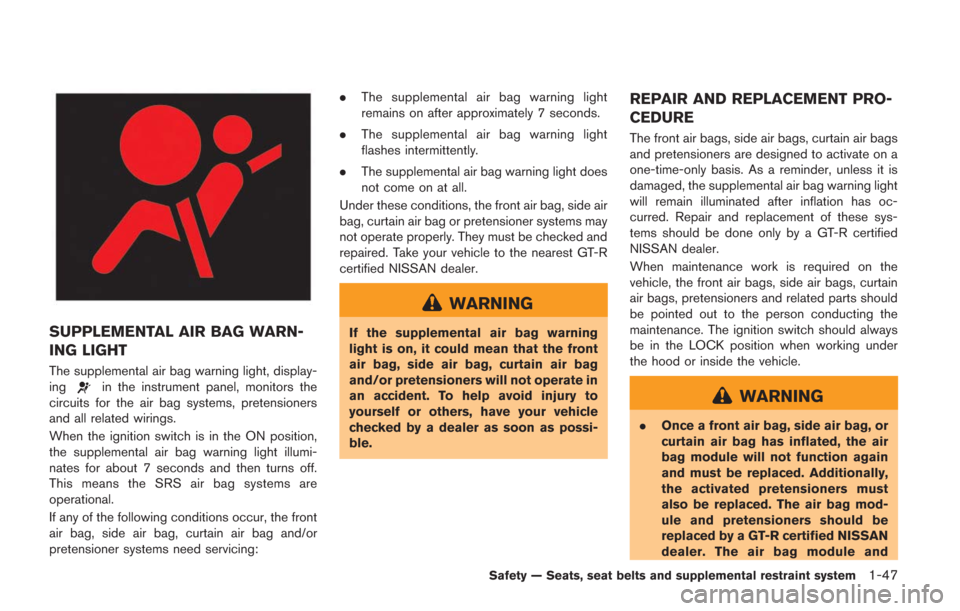
ING LIGHT
The supplemental air bag warning light, display-
ingin the instrument panel, monitors the
circuits for the air bag systems, pretensioners
and all related wirings.
When the ignition switch is in the ON position,
the supplemental air bag warning light illumi-
nates for about 7 seconds and then turns off.
This means the SRS air bag systems are
operational.
If any of the following conditions occur, the front
air bag, side air bag, curtain air bag and/or
pretensioner systems need servicing: .
The supplemental air bag warning light
remains on after approximately 7 seconds.
. The supplemental air bag warning light
flashes intermittently.
. The supplemental air bag warning light does
not come on at all.
Under these conditions, the front air bag, side air
bag, curtain air bag or pretensioner systems may
not operate properly. They must be checked and
repaired. Take your vehicle to the nearest GT-R
certified NISSAN dealer.
WARNING
If the supplemental air bag warning
light is on, it could mean that the front
air bag, side air bag, curtain air bag
and/or pretensioners will not operate in
an accident. To help avoid injury to
yourself or others, have your vehicle
checked by a dealer as soon as possi-
ble.
REPAIR AND REPLACEMENT PRO-
CEDURE
The front air bags, side air bags, curtain air bags
and pretensioners are designed to activate on a
one-time-only basis. As a reminder, unless it is
damaged, the supplemental air bag warning light
will remain illuminated after inflation has oc-
curred. Repair and replacement of these sys-
tems should be done only by a GT-R certified
NISSAN dealer.
When maintenance work is required on the
vehicle, the front air bags, side air bags, curtain
air bags, pretensioners and related parts should
be pointed out to the person conducting the
maintenance. The ignition switch should always
be in the LOCK position when working under
the hood or inside the vehicle.
WARNING
. Once a front air bag, side air bag, or
curtain air bag has inflated, the air
bag module will not function again
and must be replaced. Additionally,
the activated pretensioners must
also be replaced. The air bag mod-
ule and pretensioners should be
replaced by a GT-R certified NISSAN
dealer. The air bag module and
Safety — Seats, seat belts and supplemental restraint system1-47
Page 110 of 354
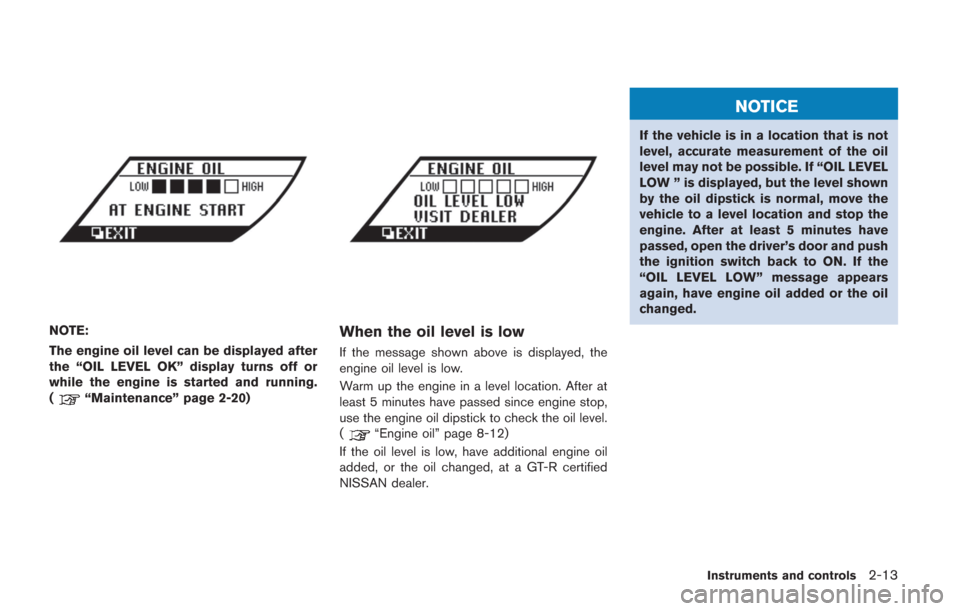
NOTE:
The engine oil level can be displayed after
the “OIL LEVEL OK” display turns off or
while the engine is started and running.
(
“Maintenance” page 2-20)
When the oil level is low
If the message shown above is displayed, the
engine oil level is low.
Warm up the engine in a level location. After at
least 5 minutes have passed since engine stop,
use the engine oil dipstick to check the oil level.
(
“Engine oil” page 8-12)
If the oil level is low, have additional engine oil
added, or the oil changed, at a GT-R certified
NISSAN dealer.
NOTICE
If the vehicle is in a location that is not
level, accurate measurement of the oil
level may not be possible. If “OIL LEVEL
LOW ” is displayed, but the level shown
by the oil dipstick is normal, move the
vehicle to a level location and stop the
engine. After at least 5 minutes have
passed, open the driver’s door and push
the ignition switch back to ON. If the
“OIL LEVEL LOW” message appears
again, have engine oil added or the oil
changed.
Instruments and controls2-13
Page 116 of 354
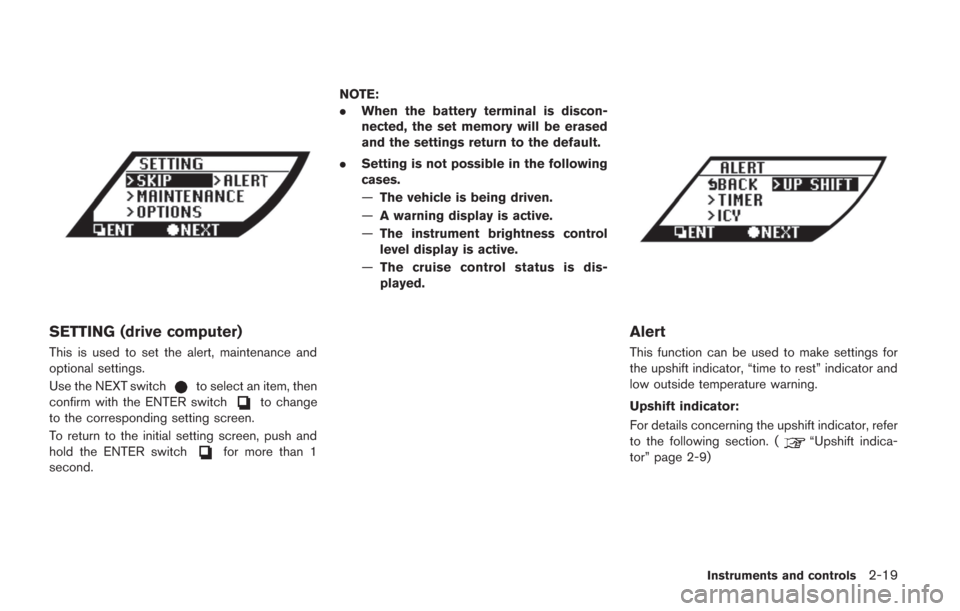
SETTING (drive computer)
This is used to set the alert, maintenance and
optional settings.
Use the NEXT switch
to select an item, then
confirm with the ENTER switchto change
to the corresponding setting screen.
To return to the initial setting screen, push and
hold the ENTER switch
for more than 1
second. NOTE:
.
When the battery terminal is discon-
nected, the set memory will be erased
and the settings return to the default.
. Setting is not possible in the following
cases.
—The vehicle is being driven.
— A warning display is active.
— The instrument brightness control
level display is active.
— The cruise control status is dis-
played.
Alert
This function can be used to make settings for
the upshift indicator, “time to rest” indicator and
low outside temperature warning.
Upshift indicator:
For details concerning the upshift indicator, refer
to the following section. (
“Upshift indica-
tor” page 2-9)
Instruments and controls2-19
Page 117 of 354
2-20Instruments and controls
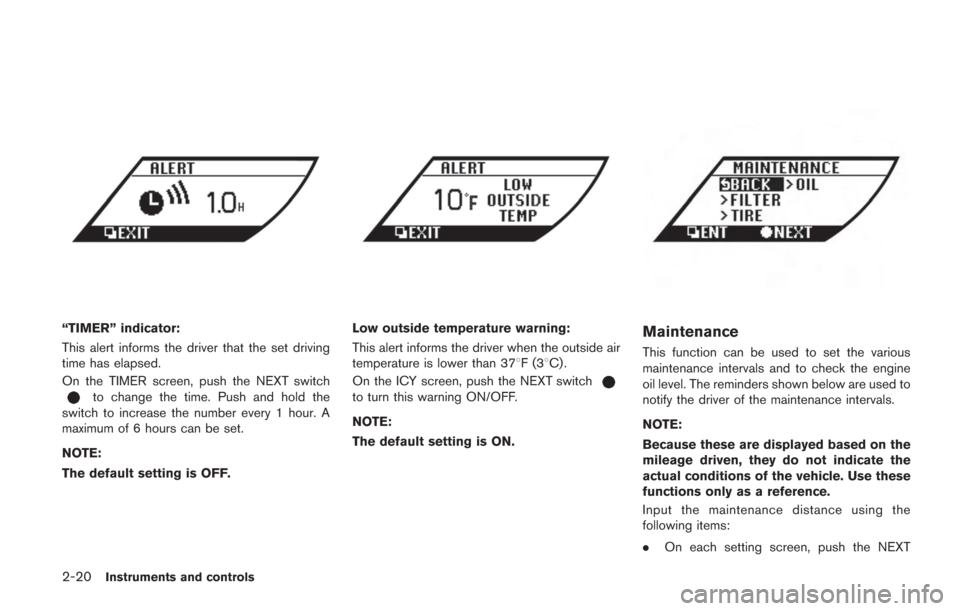
“TIMER” indicator:
This alert informs the driver that the set driving
time has elapsed.
On the TIMER screen, push the NEXT switch
to change the time. Push and hold the
switch to increase the number every 1 hour. A
maximum of 6 hours can be set.
NOTE:
The default setting is OFF.
Low outside temperature warning:
This alert informs the driver when the outside air
temperature is lower than 378F(3 8C) .
On the ICY screen, push the NEXT switch
to turn this warning ON/OFF.
NOTE:
The default setting is ON.
Maintenance
This function can be used to set the various
maintenance intervals and to check the engine
oil level. The reminders shown below are used to
notify the driver of the maintenance intervals.
NOTE:
Because these are displayed based on the
mileage driven, they do not indicate the
actual conditions of the vehicle. Use these
functions only as a reference.
Input the maintenance distance using the
following items:
. On each setting screen, push the NEXT